Monday, September 10, 2007

Odds are stacked against myth debunkers

Here is an interesting article I've read recently. It has depressing implications for Center Of Inquiry and I guess everyone who would like to see the world thinking more rationally.

Persistence of Myths Could Alter Public Policy Approach

Some highlights from the article:

The conventional response to myths and urban legends is to counter bad information with accurate information. But the new psychological studies show that denials and clarifications, for all their intuitive appeal, can paradoxically contribute to the resiliency of popular myths.

[...]

The research also highlights the disturbing reality that once an idea has been implanted in people's minds, it can be difficult to dislodge. Denials inherently require repeating the bad information, which may be one reason they can paradoxically reinforce it.

Indeed, repetition seems to be a key culprit. Things that are repeated often become more accessible in memory, and one of the brain's subconscious rules of thumb is that easily recalled things are true.


But silently ignoring the lies isn't any better, the article says:

So is silence the best way to deal with myths? Unfortunately, the answer to that question also seems to be no.

Another recent study found that when accusations or assertions are met with silence, they are more likely to feel true, said Peter Kim, an organizational psychologist at the University of Southern California. He published his study in the Journal of Applied Psychology.


The article ends with this pessimistic conclusion:

Myth-busters, in other words, have the odds against them.


It really makes you wonder if humanity is doomed to live in perpetual ignorance (and I know a lot of people would answer with a resounding "yes"! ;-() How did people ever stop believing, for example, that whispering incantations or casting an evil glance on someone can cause a person to fall ill? Actually, it may be too optimistic to say people stopped believing it. :-) There are plenty of people who still do, even these days. But at least the majority doesn't... I would hope. Or, OK, at least the majority doesn't think it's a valid reason to accuse someone of casting spells and burn them at a stake. So how did the humankind ever moved beyond these superstitions? Well, this question runs central to a James Morrow novel "The Last Witchfinder". The novel is about one woman's lifelong quest to banish not just the trials and executions of witches, but the very notion of witchery. We discussed this book in the FACT book club, and it lead to some interesting philosophical debates. I will post the report of the discussion in the next few weeks.

Sunday, September 02, 2007

Authors and the fans who love them: maybe a little too much: an ArmadilloCon 2007 panel

This is my last post from this year's ArmadilloCon. The topic is a problem many of us wish we had. :-)

Authors and the fans who love them: maybe a little too much

Description in the program book: Ever wonder why your favorite author looks a little scared when they see you? The panelists will talk about the tale-tell signs of a stalker and tell amusing stories about what has happened to them in the past. (For instance, did they call you at home during a baseball game?)

Since the stories told on this panel were a bit personal in nature, the panelists' names were omitted. The stories weren't so much about real stalking anyway, as about weird encounters between writers and their fans.

Tips on how to properly stalk a writer


Unconventional gestures of admiration


A writer who lied to a priest


Guests Of Honor with unusual demands


The whole article can be found on my web site.

By the way, one of these authors said the most persistent stalkers are writing students. "The first line of a panel on writing in conventions is populated by intense looking young men with laptops, and after the panel they'll follow you around wherever you go." I would fit that profile very well, except for not being a man (or, ahem, young :-)) because I do often sit in a front row with a laptop and type away furiously. But I swear I had not followed anyone around at any convention. :-)

Friday, August 24, 2007

ArmadilloCon: my first experience as a moderator

... on the "That's a FACT" panel.

It wasn't bad. It was just as I expected. It was made easier by the fact that there were only about 6 people in the audience. Which was also as I expected. :-) Two of those people were not even from Austin, but from places like Minneapolis, so I'm not sure what they were hoping to get out of this panel. I could fantasize that they came to hear advice about running a science fiction reading group, so that they could start one in the place where they live, but I think it's more likely that they were just killing time on Sunday afternoon before their flight home. :-)

According to the program, the panelists were supposed to "...go over the books they have read over the past year letting you know which ones got a thumbs up and which ones were stinkers. They will also talk about how you can join the bi-weekly reading group." We followed these instructions to the letter. :-) As a moderator, I made a list of books that received the best reception with the FACT reading group, and wrote it on a whiteboard. We briefly talked about each of those books, as well as the "stinkers".

The FACT reading group holds power over authors' careers :-)


AT, the reading group coordinator (who wasn't supposed to be on the panel, but joined us halfway into the panel -- the game of Pictionary ended prematurely :-)) told an amusing anecdote about a time when a certain author received an especially bad reception with the reading group. She called AT during the meeting so that the readers could ask her questions about her book, in case they needed her to clarify something. However, people were so unimpressed by her novel that they couldn't think of questions to ask. They unanimously decided that this author didn't know anything about the three main elements of her book: private investigators, Catholic church, or the internet. According to AT, a highly negative review of her book on the FACT reading group website kept her from selling her subsequent novels, and she had to start writing under a pseudonym.

The thumbs-up list


And here is the list of the thumbs-up books. (I won't post the list of the stinkers, because I've already critiqued them in separate posts on my blog, and I don't want to dwell on the negative. :-))

John Moore "Bad Prince Charlie" -- a light, humorous urban fantasy everybody liked

Terry Pratchett "Going Postal"

Jasper Fforde "The Big Over Easy"

Charles Stross "Family Trade", "Atrocity Archives"

Naomi Novik "Her Majesty's Dragon"

John Scalzi "Old Man's War"

Cordwainer Smith "We The Underpeople"

Stanislaw Lem "Cyberiad"

Vernor Vinge "Rainbows End"

Tuesday, August 21, 2007

Center For Inquiry presence at ArmadilloCon

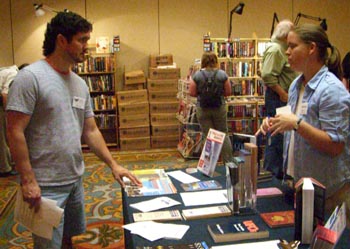
At this ArmadilloCon I spent a substantial amount of time in the dealer room -- on the dealers' side of the table! I was volunteering at the Center For Inquiry table. We would grab the passers-by by their sleeves and proselytize to them our doctrine of freethought and rationalist mindset. No, I'm kidding. We did not try to engage anyone in the conversation against their own will. And the nature of materials on the CFI table -- books and booklets on freethought, skepticism and humanism -- indeed had an ability to make some people uncomfortable. Jenni (the person who coordinated the CFI activities at the ArmadilloCon, and who spent quite a few hours at the table) observed more than one person scurrying away after taking one look at the titles of books on our table.

CFI booth at ArmadilloCon 2007 CFI booth at ArmadilloCon 2007

Still, some other people struck up conversations with us. Long ones, sometimes. I guess that compensated somewhat for their scarcity. One guy argued that religious fundamentalism is losing its strength and is on the way to extinction, at least in the US if not worldwide. We pointed out there were a lot of signs to the contrary, such as (to take the most obvious example) encroachment on abortion rights.Then he started a long discussion on why the recently passed laws to curtail abortion rights in several states aren't really important. Since I stay away from politics in this blog, I'll say no more, but it suffices to say it was an interesting discussion. It could have gone on even longer, but at some point we were joined by a woman who brought a different perspective to the discussion. She teaches at a university, and in the last few years she has had hard time with some students who demand that she bring a religious perspective into the classroom. I don't remember the exact way she phrased it, but I think she was saying some students want her to address the subjects she teaches from a biblical perspective. They are a minority, but a vocal one, and they have gotten increasingly louder over the years.

By joining our discussion, she drew the guy's argumentative zeal towards herself, and soon they drifted off into the crowd where they continued their agitated debate.

Jenni talks with Matt Cardin Jenni talks with Matt Cardin

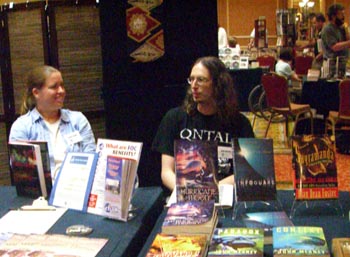
We also had a handful of people sign up for the CFI email list. Another thing we did -- with less than stellar results -- was sell books. All the books were from Pyr, a publishing house that has a close relationship to CFI. They sent us a shipment of science fiction and popular science books at a discount, so we could, in theory, make a profit selling them... but we sold only about 7 books throughout the entire weekend. The dealers' room was teeming with booksellers, and the competition was stiff.

Center For Inquiry volunteers at ArmadilloCon 2007 Center For Inquiry volunteers at ArmadilloCon 2007

I can't say if participation in ArmadilloCon was really beneficial to CFI in terms of attracting new members, but I personally had a nice time sitting at the table and chatting with some people (mostly with fellow volunteers, and sometimes with other congoers who wandered by).

Here are more of my pictures and blog posts from ArmadilloCon 2007.

Sunday, August 19, 2007

Create a World: an ArmadilloCon 2007 panel

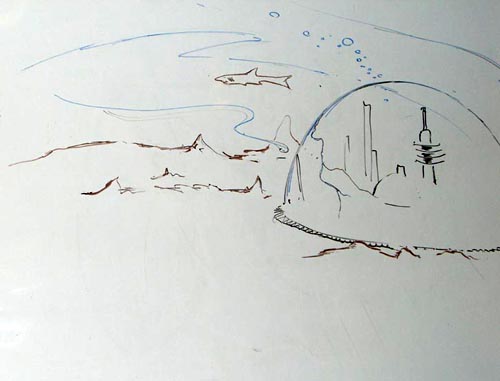
Every ArmadilloCon has a world-building panel, where the panelists and the audience "create" a science-fictional or fantasy world by collective brainstorming. Artist R. Cat Conrad often participates by drawing scenes from this world on a whiteboard.

For starters, the panelists and the audience decide by voting: are they building a science fiction or a fantasy world? The audience is almost equally split between the two, but, but science fiction prevails by a small margin.

The submerged city under a dome of a force field

To keep the scope of the task manageable, we'll focus on one city in this world we are building. The city is half-submerged in water. Or it maybe be fully submerged and exist under a dome of a force field. What kind of inhabitants will it have? What kind of conflicts will arise in this society? They may arise from the different species' fight for dominance, or natural cataclysms. What kind of religion will they have, and what part will it play in the conflict? What myths will this society tell itself? And finally, some silly touches.

The whole article can be found on my web site.

Here are more of my pictures and blog posts from ArmadilloCon 2007.

Tuesday, August 14, 2007

What I Should Have Read This Year: an ArmadilloCon 2007 panel

I've noticed over the years that some of the "What I Should Have Read" panelists have tastes so unlike mine, it's as if we are from different planets. (It's different people each year, by the way.) For example, some people's idea of good science fiction is a Sherlock Holmes-type detective story with time travel, as you'll see further in the text. I'm sure a time-travelling Sherlock Holmes can be done very well, but... I've already read the original Sherlock Holmes, so why would I want to read the same story again? I read science fiction for something new, although it becomes increasingly harder to find. But the moment I truly realized I landed on a wrong planet came when I listed to Rick Klaw praising a comic book "I shall destroy all the civilized planets" by Flether Hanks. (More about it behind the cut). I sat there thinking, well, I'm not against weird, but I would never read SF just for that. Even the weird needs to have logic.

I found it a bit comical that while the panelists praised obscure, bizarre books like the one mentioned above, they had hardly anything to say on this year's Hugo nominees. A person in the audience asked which of this year's Hugo nominees they would recommend most highly, and Willie admitted he drew a blank on who the nominees were. Jessica Reisman corrected the situation somewhat by recommending "Blindsight" by Peter Watts.

Without further ado, here is the list of the recommended books.

Some of this year's must-read books garnered nominations from more than one panelist, and we shall start with them.

Books recommended by 2 people:

Two-handed Engine, a Henry Kuttner story collection. Joe Lansdale says: "Kuttner is one of the best SF writers, although he's a better short story writer than a novelist. The reason Kuttner still survives is because he's a damn good writer. Ideas, charcters, writing -- he's got all that."

"Thirteen" by Richard Morgan

Books recommended by 1 person:
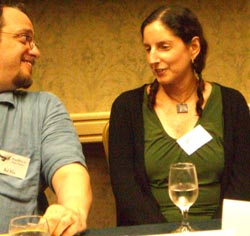
Rick Klaw and Jessica Reisman at ArmadilloCon 2007 Rick Klaw and Jessica Reisman.

Here is the list of Willie's recommended science fiction books (each title is followed by Willie's short comment):

Brasyl by Ian McDonald -- In McDonald's "River Of Gods" it was India taking over the Universe, now he's doing Brazil taking over the universe.

The Prefect by Alastair Reynolds -- a quintessential space opera.

Execution Channel by Ken MacLeod -- an almost mainstream thriller that has pretty amazing stuff in it.

Mainspring by Jay Lake -- trying to imagine a world where Newtonian clockwork idea is in fact true, and where the world is composed of springs.

The Yiddish Policemen's Union by Michael Chabon -- alternate history.

Hurricane Moon by Alexis Glynn Latner

Here is the list of Willie's recommended fantasy books (each title is followed by Willie's short comment):

Un Lun Dun by China Mieville -- the villain is amazing.

Renegade's Magic by Robin Hobb -- a conclusion to her current series.

Heart Shaped Box by Joe Hill -- Stephen King's son who writes under a pseudonym.

Interworld by Neil Gaiman and Michael Reaves

Reaper's Gale by Steven Erikson

Ysabel -- Guy Gavriel Kay

Legacy -- Lois Bujold

Here are books recommended by CJ Mills. (All of these books were more than a year old.)

The Prodigal Troll by Charles Coleman Finlay

The Terrorists of Irustan and The Maquisarde by Louise Marley

Anansi Boys by Neil Gaiman

Books recommended by Joe Lansdale

Pearls from Peoria and The Best of Philip Jose Farmer: story collections by Phil Jose Farmer.

Books recommended by Jessica Reisman:

Territoryby Emma Bull -- alternative history.

Precious Dragon by Liz Williams
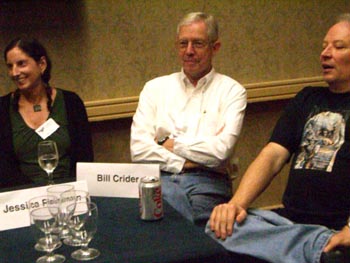
Jessica Reisman, Bill Crider and Joe Lansdale at ArmadilloCon 2007 Jessica Reisman, Bill Crider and Joe Lansdale.

Books recommended by Rick Klaw:

Fast Forward 1, edited by Lou Anders -- a pretty incredible anthology. It's got an incredible Robert Charles Wilson story. There's also a story by Tony Balantyne about a world operating system, infected by a virus.

Acacia by David Durham. It's a violent fantasy with no magic. It's closer to George R. R. Martin, not to Lord of the Rings.

Michael Moorcock's detective stories -- they essentially Sherlock Holmes stories. They go to plaes you would never expect.

I Shall Destroy All the Civilized Planets: the Comics of Fletcher Hanks. Rick Klaw says: "You have these cosmic power shadow charaters who would punish people for doing the wrong things. They would freeze people's heads, they would dissect them. There is a guy there with flaming hands who goes around killing people."

Or -- and I'm not sure I got this right -- there are people who want to kill everyone on Earth except themselves, so they tie themselves to Earth and spin up the Earth so that everyone would fly off of it. The last idea sounded so absurd that I really don't know if I got it right. At that point I just sat there thinking, well... this panel is going to be less helpful to me than I hoped.

Books recommended by Bill Crider:

The Dead Fathers Club by Matt Haig -- a riff on Hamlet. A dark, but hilarious book. And if you've read Hamlet several times, you'll get a lot of in-jokes about Hamlet.

There was also a book that, in my calculation, collected 0 nominations, despite being mentioned by two people. One of the mentions was positive, the other negative, so I guess they canceled out. That was Un Lun Dun by China Mieville.

Here are more of my pictures and blog posts from ArmadilloCon 2007.

Sunday, August 12, 2007

A few quotes from ArmadilloCon 2007

John Moore

John Moore

From the panel "The story unwritten" (A discussion on what stories are left to be told and why they haven't been written yet): "Fortunately, writers today are no longer shackled to the idea that writing is original creative process," said John Moore. If you can think of a spinoff, go with it. "For example, who's to say Dudley Dursley shouldn't have his own fantasy series? In each book he could team up with another 10-year-old wizard," he said.

From "Mythology/Schmythology" panel
Laura Anne Gilman

Laura Anne Gilman

Laura Anne Gilman: "Is a hero someone who knows he has a destiny, or someone who fights against the odds to do something heroic? Somebody like Harry Potter, who knew he had a destiny, who was told by everybody he was special, and people trained him for that and protected him? I don't think that's a hero, that's cannon fodder."

Here are more of my pictures and blog posts from ArmadilloCon 2007.

Saturday, August 11, 2007

Con disaster stories: an ArmadilloCon 2007 panel

Some of the panelists started accumulating material for this panel since the very beginning of their involvement with fandom. One panelist was drafted into working an art show at a convention because she packed a short, low-cut dress. Another was told that her background as a medical professional working in a psychiatric ward made her eminently qualified. That's not to say she did not get creeped out by things she saw at cons. A certain con in the Pacific Northwest has mock slave auctions, where (if I understood correctly) teenage girls are "auctioned off". The panelist did not go into details, except to say "sometimes they're kissing auctions, sometimes they are creepy. Lingerie is usually involved."

The program book said: "Want to hear about the best disasters in the fandom world?" Indeed, some of the fiascos, or merely weird stories, mentioned in this panel, were real pearls.

They swooned over Brad, even though he wasn't Pitt

To stir things up, put a dyslexic in charge of printing the program

Sprinklers are not a sex toy

Pictures from ArmadilloCon 2007 can be found in my photo gallery.

Friday, August 10, 2007

Losing my writers' workshop virginity

Ah, the ArmadilloCon writers' workshop.

This is the first writers' workshop I've ever been to -- actually, the first time I've had my writing critiqued. It's like crack. I'm hooked. I want more, more of this experience!

Not because the critiquers praised my work. Of course they didn't, nor did I expect them to. I'm very aware of the flaws in my writing. But it was so interesting to have other people read -- really read -- my work and analyze it in detail, and tell me what they did and didn't like. This was so much better than reader comments I received on some of my stories that were published in fanzines and on the internet. Those were limited to "it sucked" or "I didn't get it". This was the whole new dimension of critique.

Louise Marley, Sarah Arnold and Chuck Emerson at ArmadilloCon 2007 writers' workshop Author Louise Marley (the teacher of our group), and students Sarah Arnold and Chuck Emerson. More pictures from ArmadilloCon 2007 are in my photo gallery

As I said in one of my earlier posts, due to size restrictions I could only submit half a story. Because of that, I did not expect to get helpful critique, but what I got exceeded my expectations. To summarize the readers' comments: my ideas were interesting and BIIG. But the story wasn't so much a story as an outline. For a novel. Some comments were of a nature "this sentence needs to be a chapter", or "I really want to know how this or that happened". I guess that's not too different from the ole "show, not tell". There were infodumps in some places. Several reviewers commented that the story was completely devoid of setting and the action was totally internal -- and that's very true. All the reviewers asked me to put in more images, some sensory stuff, to help them see the characters. That's an entirely valid comment. My characters are devoid of external descriptions. Not just because descriptions are desperately difficult for me to come up with. I don't see my characters as 3-dimensional people... or even 1-dimensional ones. They are just moving points in space that draw trajectories connecting my ideas.

Steve Wilson, Patrice Sarath and Matthew Bey at ArmadilloCon 2007 writers' workshop Patrice Sarath, the coordinator of the writers' workshop (center), Steve Wilson, and Matthew Bey (instructors). More pictures from ArmadilloCon 2007 are in my photo gallery

The most fascinating thing for me was to see how people saw different things in my story than what I've put in there. A topic I thought was secondary, they perceived as primary. And they had very few comments on the topic I myself perceived as primary -- perhaps because the primary topic does not reveal itself in earnest until the second half of the story, which they didn't have a chance to read.

A curious fact: based on the text alone, only 2 of 6 critiquers figured out English isn't my first language. That's not to say they didn't find flaws in my writing style; they did. The most common criticism was repetitiveness.

In any case, the workshop experience was rich beyond my expectations. I still haven't had a chance to absorb all the comments. What I said here is just scratching the surface. What saddens me is that the aspects of the story that require fixing are probably beyond my skills right now... and may be for a long time.

Here are more of my pictures and blog posts from ArmadilloCon 2007.
Thursday, August 09, 2007

Louise Marley "Glass Harmonica": a book review

Louise Marley will be a Guest of Honor at this year's ArmadilloCon, so I made an effort to read one of her books. I like to have an idea what the Guest of Honor is "about". "Glass Harmonica" was a fun book to read.

The most straightforward plot I've seen in years

It's set in the near future about a decade from now. The protagonist is a young woman named Erin, a world-renowned musician who plays glass harmonica, the title instrument of the book. It's a device that's played by running one's fingers over the rims of spinning glasses. Her twin brother, Charlie, is a composer who suffers from a neurodegenerative illness that made him incapable of walking. He undergoes an experimental treatment that supposedly has a chance to help him walk again.

Then there is a parallel story line set in the late 1700s in England, where the protagonist is a teenage girl Eilish, a street musician who, too, plays a glass harmonica. She's been lifted out of poverty by Benjamin Franklin when Franklin constructed a glass harmonica, and needed a talented musician to play it and help him improve its design. He was impressed by Eilish's talent and employed her in that capacity.

And that's about it. This pretty much describes the plot of the book. It is very straightforward. There are no twists or surprises. Not any major ones, anyway. It's so devoid of mystery or suspense, that you start to wonder, will anything notable, shocking, or simply unexpected, ever happen in the book? Even as things get worse for some characters, they do so in a very gradual, predictable manner.

Science and pseudoscience

I'm actually not sure I would call this book science fiction. Maybe science fantasy. Actually, Louise Marley once said her favorite genre is science fantasy. There are two kinds of science-fictional elements in this novel:

(1) the two girls occasionally see one another as a ghost-like presence;

(2) Charlie's experimental treatment consists of stimulating his brain by certain sounds, to help route neural impulses to his legs around the damaged neuron pathways.

(1) The ghosts are "explained" by "quantum weirdness". As soon the word "quantum" is uttered, the characters throw up their hands and admit they don't know first thing about it, yet they believe they found a good explanation. Because hey, everybody knows quantum physics is "weird", so who's to say it can't explain ghosts? As well as a whole slew of paranormal phenomena, such as remote viewing? Maybe I'm being unjustly sarcastic here, as well as oversimplifying a little, but pseudoscience irks me. Anyone who actually understands quantum physics (not that I do) will tell you that quantum physics can't explain paranormal phenomena... if they really exist. And I don't believe they do. I wouldn't be involved in the Center For Inquiry otherwise.

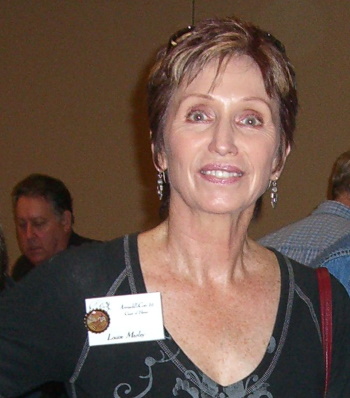
Louise Marley at ArmadilloCon 2007 Author Louise Marley at the ArmadilloCon 2007

I find (2) a lot more credible than (1). Some research into rerouting neural impulses in the brain is already taking place. There's been some fascinating research that suggested it may be possible for blind people to "see" with their tongues (video signals from a camera are routed to a sensor placed on a person's tongue, which translates them into electrical impulses that "tingle" the tongue in certain patterns. The patterns the tongue senses are interpreted by the brain as images). Similarly, people suffering from chronic vertigo can use a tongue sensor to teach the brain to compensate for confusing signals from inner ear (that are causing the vertigo). In light of this, reprogramming your brain with sound doesn't seem too infeasible, but I still have strong doubts. Since it's a relatively low-tech concept, it would seem somebody would have tried it already. Perhaps someone had. But we haven't heard of any discoveries in that area.

A perfect escapist book

However, if you don't ask too many questions, this book can be quite enjoyable. It's a fast, lighthearted read. So fast it practically read itself! Such a contrast to several "high concept" SF books I've read lately that were loaded with plot speed bumps. The story in this book flows smoothly like a melody from a musician's fingertips (not that I ever heard glass harmonica music, so perhaps my metaphor isn't appropriate.

The main characters are all likeable, and it's fun to get glimpses into a rarefied world of classical musicians, their jet-setting lifestyle of concerts, press interviews, and spur-of-the-moment jaunts to London. And romance is handled very well in this book! It's not something I see often in SF. In most books I read (perhaps because they are written by male writers) the romance storyline consists of two scenes: first, the heroine and the hero find each other attractive, second, they fall into bed. That's it. How boring. Where's the suspense, the mystery, the pining, the uncertainty? Not so in "Glass Harmonica". There's plenty of suspense here: will the two would-be lovers get together or not? There's plenty of pining, and shyness, and teasing, and pulling back at the last minute. Very well done! It is, in a word, a perfect escapist book.

Wednesday, August 08, 2007

Me -- a moderator!

I will be on one of ArmadilloCon panels! Not only that, I'll get to play a moderator! :-) Fortunately, the panel is on a subject I have some experience with.

That's a FACT: The FACT Reading group will go over the books they have read over the past year letting you know which ones got a thumbs up and which ones were stinkers. They will also talk about how you can join the bi-weekly reading group.


It's at 2 pm on Sunday.

Since the initially assigned moderator bowed out, I volunteered to moderate and was allowed to! So now I have to think of smart questions to ask panelists (referred to below as W, M and K). I need to come up with some open-ended questions that will let them talk a lot. On the other hand, the potential questions are already listed in the panel descriptions. So I guess it may go like this:

Me (addresses the panelists): "so, which books got a thumbs-up? What do you think, W? M? K? "

Then I'll go:

"And which ones were the stinkers? W? M? K?"

I hope this will be enough to fill the panel time. :-) But maybe I shouldn't worry about that. I was told that two of the panelists are rather talkative and that it may be hard to keep them in check. Actually, I know them both and I haven't really noticed them monopolizing the conversation, at least not in the book group. So we'll see.

Sunday, July 29, 2007

Vernor Vinge's "Rainbows End": FACT group discussion and my opinion

11 members of the FACT reading group attended the discussion of Vernor Vinge's "Rainbows End" on June 19, 2007. One reader emailed their comments. All but 1 member have read Vernor Vinge before. Everybody started the book. All but 2 people finished it, and the rest were planning to finish.

Overall people thought it was a multilayered book, even though (to quote one reader) when you read it it does not feel like a book with layers. The majority of the group felt the story was entertaining. However, everyone seems to have taken something different away from it.

Some people did not think that the technology portrayed in the book brought up any unique concepts, but others were impressed how convincingly Vernor Vinge extrapolated from existing technological trends. One reader said he had just read in the news that Google and Linden Labs are collaborating on "something like that" (he didn't clarify). Several readers noted that the technologies Vinge describes seemed familiar to them from Vinge's earlier novel "Deepness in the Sky". The ubiquitous nodes that store information about the physical world around them, are a milder version of localizer dust; the You-Gotta-Believe-Me technology is a milder version of Focus.

A fun read or food for thought?

Some people thought "Rainbows End" was mostly a spy / mystery thriller, a fun read without a significant science-fictional aspect; on the contrary, a minority said it was an intellectually worthwhile book to read, but the story did not "pull them along". Of those who were hooked by the story, several complained that the plot hit a major snag at the library battle scene. The battle, which draws out over a hundred pages or more, snarls the flow of the story, more so because the particulars of it aren't really important to the plot. To be fair, one reader loved the library battle scene. He felt as if watching a group of inhabitants of the World Of Warcraft universe battle the inhabitants of the Discworld universe for supremacy of their environment.

Vernor Vinge at the ArmadilloCon 2003 Vernor Vinge at the ArmadilloCon 2003, a science fiction convention in Austin, Texas

Yet other group members said the book was both a pleasure to read and provided food for thought.

Those readers noted that the book attempts to describe what it's like to be in the bend of the technological progress curve going off into the Singularity, and debated whether Vernor Vinge was more successful at it than Charles Stross in "Accelerando". Regardless, a few readers acknowledged that the author did an impressive job of showing the coming of the Singularity from the inside, so transparently you don't even understand how it happens. He showed it from several perspectives: there were kids in the book who have really mastered the "wearing" (a catch-all term for using the augmented reality technologies via devices built into the clothing and contact lenses); there were kids who were struggling with it; and then there were the "retreads" -- people who grew up in the pre-wearing era, and who needed to be taught this from scratch; there were even people who rebelled against the augmented reality, like the guy who, instead of wearing his computers, carried a laptop.

An "Alice in Wonderland"-like tour of the future

To make the "brave new world" comprehensible to us, the author had to show it through the eyes of one of our contemporaries, which explains the choice of the viewpoint character as Robert Gu, a retread. The readers observed that if Vinge chose a point of view character who was "native" to the new technologies, we wouldn't understand at all what was happening in the story. To quote a reader, Robert Gu was an equivalent of a shipwrecked English sailor in the medieval Japan.

This leads us to the question of what the Rabbit was. Even though it's not clear from the book (beyond some educated guesses), what kind of entity the Rabbit is, a reader observed that Rabbit's role is essentially that of the White Rabbit from "Alice in Wonderland". He further said "Rainbows End" is essentially an "Alice in Wonderland" kind of story, the Wonderland in this case being the high-tech future Robert Gu is touring. Hence Gu is kind of an Alice. (Not to be confused with a "Rainbows End" character named Alice. One of the more mysterious characters in the novel, she left some readers wanting more. They thought that for the importance of the role she played, the author should have told us more about her.)

The protagonist is a jerk, but he's often right

Speaking of characterization, though this group considers it be one of Vernor Vinge's lesser strengths, most people thought that Vinge did a good job with Robert Gu. They found Gu's character growth convincing. Myself, not so much. I wasn't impressed with Robert Gu's transformation from a world class jerk to a caring person, since it seemed externally, not internally motivated. His Alzheimer's treatment gave him a whole new personality, taking away his ability to see deeply into people and push their buttons, so he wasn't able to hurt people as well as he used to. That's not to say that Robert Gu is not an interesting character. He really is. The scene where he lashes out against Miri sheds lights on the complexities of his personality. Even though his delight in hurting Miri is despicable, his put-down of her has a ring of truth to it. It is true that she doesn't understand what the world was like before the augmented reality, and she doesn't understand what it's like to read books in their original, bare, unenhanced state, using only your imagination to experience the story fully. Miri is used to virtual reality doing that job for her, getting her into a story: a job that used to be done by the human mind alone. People who grew up without knowing how to use their imagination to enrich their experience seem retarded to Robert, and so does Miri. Despite his arrogance, it's hard not to agree he has a point, and that he has a right to feel offended by her simple-minded encouragement to embrace the augmented reality.

The political aspect of the book

One reader said all these things discussed so far were irrelevant to what Vinge wanted to do. The reader thought "Rainbows End" was one of the best political novels written of late, relevant to our current time when the country's administration doesn't live in reality-based world. He liked that Vinge did not take a stance on whether the high-tech world he described was utopia or dystopia. It can be either, since the ubiquitous computing devices that enrich one's perception of reality can also be used for surveillance of the wearers. But the author did not push one view or the other; instead he showed good and bad implications of the whole series of things that are going on now, such as department of homeland security, or interesting unintended consequences of Alzheimer's treatment.

Another reader was intrigued with the political aspect of the book that was left hidden behind the scenes. There are hints in the book that the near future world is going to be far more dangerous and violent than what we have experienced so far. Vinge offhandedly mentions that Alice's family was from Chicago and "none of them survived". Or that the counter-terrorist measures were mostly working, because "they haven't lost a major city in almost 5 years". Apparently, minor cities were lost more often than that.

Several prominent science fiction writers had written novels that were their response to 9/11, and it may be fair to say that "Rainbows End" was Vernor Vinge's reaction to that event -- somewhat belated, but not if you keep in mind that this writer produces 1-2 novels a decade. To quote a reader, "He's been writing as fast as he could."

Saturday, July 21, 2007

It turned out I have dissed Cheesecake Photoblog prematurely. After some dialog in the Cheesecake Photoblog forum, I took one of the developers' suggestion to install a newer version than the one I tried first and failed; the newer version installed and worked just fine. After that, I was able to install the older version just as easily, and it worked straight out of the box, too. So I have to wonder if my initial problems with installation were caused by some temporary glitches in my web hosting environment. Of course, if that was the case, I'll never find out what the problem was. In any case, Cheesecake Photoblog does not yet have all the features that would make me seriously consider trading Gallery2 for it. I was told, though, that it may have those features in its version 2.0, whenever that might be.

Thursday, July 19, 2007

Mary Doria Russell "The Sparrow": a CFI Austin book group discussion

4 people attended the CFI Austin Science And Religion In Fiction book group discussion of Mary Doria Russell's book "The Sparrow". 3 out of 4 gave the book a thumbs-up, 1 thumbs-down.

The book presents a wide range of views from atheism to belief

One thing everybody liked about the book was that Mary Doria Russell presented the views of both believers and nonbelievers. The proportions, however, were disappointingly unequal. The only atheist on the mission, George, didn't get much air time. He was more like a token atheist. He was a very nice person, but he didn't say much throughout the book. Russell did better with other characters, who possessed various degrees of belief and nonbelief. Even the believers had complex views about religion; no one was dogmatic. For example, Emilio joined the Jesuit order for practical reasons, not because he was pious. But then he came to believe when the moment of faith washed over him. One reader said it was interesting to read about it, because he never experienced anything like that. Another reader said she wished more Christians read this book, because the author treated the material thoughtfully. Since Mary Doria Russell in her lifetime went from being Catholic to being atheist, and then to Jewish, we guessed she's obviously has thought about stuff a lot, and it shows in the book.

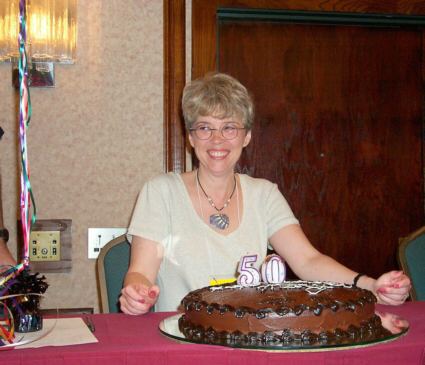
Mary Doria Russell at the ArmadilloCon 2000 Mary Doria Russell at the ArmadilloCon 2000, Austin science fiction convention. She celebrated her 50th birthday at the convention, and the organizers presented her with a cake.

Overall, the readers agreed, "The Sparrow" may be more interesting to believers who may be grappling with questions of faith, than to nonbelievers. For the latter, Emilio's endless questioning of what part God had or didn't have in the events can get tedious after a while. A non-theist would see those questions as based on a false premise.

Other things people liked about the story

  • Witty prose, lots of humor;
  • Remarkably vivid characters, each of them a full-fledged human being, which is rare in science fiction. Often, the characters in science fiction books are hardly more than stick figures who are there to spout author's ideas, or pawns to play out a conflict the author has set up. Not so in the "Sparrow", where each character is a multi-dimensional individual.
  • There were interesting insights in what it means to be a Jesuit;
  • There were lots of interesting tidbits and subthemes in the story, such as predator / prey races or the brain-picking AI "vultures".

I found "The Sparrow" an enjoyable read because it has several very likeable characters, easy to identify and empathize with. But that does not preclude the novel from addressing the dark sides of the human nature. I think the reason why this book spoke to me so strongly is because it asks a question "why do bad things happen to good people", and portrays a group of brilliant people who despite their best intentions make horrible, vast, destructive mistakes. It shows how even the best knowledge can lead to erroneous conclusions; it raises all the hard questions and interesting ethical dilemmas; if anything, it points to randomness and unpredictability of the world, not leaving a place in it for any intelligent supernatural force. At least those were my conclusions. However, our main character at the end of the sequel reaches a different conclusion.

This is not to say that there weren't serious criticisms of the book voiced by the members of the group.

It's not really science fiction

One reader was especially disappointed that the book, despite its science-fictional furnishings, turned out to be not really science fiction. "I'm a sucker for first contact stories," he said, "but it seems like a sham in this book. Instead, the story is all about Emilio's search for discovery. It's a background to ask, is there God, etc.? I was so tired by the end of the book of his inner dialogue about what part God played in the events and in Emilio's personal suffering. Yes, there were rocketships, but the book could have been set in 1700 and the mission could be going to Polynesian islands. So science fiction was just a framework on which to hang the morality flag."

Some plot twists are based on characters acting like idiots

Another flaw of the book is that some critical plot points stretch the reader's credibility a bit too much.

Attention! Spoilers!

Such as: Sophia "borrows" the lander (a rocket that they use to go back and forth between the planet and the ship in the orbit) and uses up most of the fuel, not leaving enough for the mission to get off the planet. A reader called this plot twist ludicrous. "When I drive, I pay attention to how much fuel there is," said a reader. "And when the lander is the only way to get off the planet, when the fuel is your lifeblood, it's just not credible that Sophia would have not checked the fuel levels in advance. It's not like 'ohmigosh, I forgot!'"

It was also hard to believe that the locals were not very impressed to meet the visitors from the stars. "They treat them so blase," said a reader. "We're gonna kill them all, and give one guy as a gift to head honcho. Huh? Maybe, but it seems so unrealistic. It's like, visitors from the stars arrive at the White House lawn, and we just capture them and give them away as presents."

It was also not very believable that the people back on Earth jumped to an easy conclusion that Emilio worked as a prostitute. Did it not occur to them that the most obvious explanation may not be correct when you are dealing with an alien society? Why didn't they interpret Emilio's actions with a more open mind?

End of spoilers

Sunday, July 15, 2007

Companies that don't Get It

While visiting his mom in New Jersey with Erika, Steve bought a Kodak disposable camera to take pictures of the child gallivanting about New Jersey beaches and such. Back in Austin he got the film developed at HEB and pictures put on a CD. I stuck the CD in my computer to get the pictures off. That's all I wanted: to get the pictures off the CD and onto my hard drive. It may come as a shock to Kodak that I did NOT want to sign up for Kodak's online photo gallery, and that I was perfectly capable of viewing and copying pictures using the good ole Windows Explorer -- I did NOT special software for that! Most emphatically, though, I did not want to install the said software.

Yet that's what I was forced to do if I wanted to see the pictures. Clicking on the CD gave me only one option, to install Kodak Easy Share software. It took half an hour to install. As is typical of Windows programs, the installation required to reboot the computer. All so that I could take a peek at 20-odd pictures. Because you know, as an average user, I'm so dumb that if you give me a CD with a folder of pictures in it, I won't know what to do with it. ;-) No, Kodak had to waste half an hour of my time installing software that lets me do nothing I can't already do by double-clicking or drag-and-dropping folders and files! Never mind that my hard drive is creaking at the seams with all the software I have on it, including several image manipulation programs. And wouldn't you know, Easy Share installed itself in the system tray, slowing down my already slow computer even more.

What I found the most presumptuous is that it also asked me to create an account for its online photo sharing site. Why did it assume I don't already use photo-sharing sites of my own choice, such as Flickr? This attitude is so patronizing. And the software did not really give me an option to NOT create an account. The most you can get away with is "Remind me later".

So I gritted my teeth, went through the install, copied the pictures onto my hard drive, and uninstalled the damn thing. Only then I realized I could have bypassed this by booting my computer into Linux, sticking the CD in, and getting the pictures off. Since the Easy Share program wouldn't run on Linux, it would not launch itself when I click on the CD, so I may be able to see directly into the image directory hidden somewhere in the Easy Share directory structure. So I did that, just for the heck of it. And of course, Linux was able to see the picture directory on the CD right away. Should have thought of it earlier. I'm glad to know -- attention, flame bait! -- that Linux is useful for something. :-) Kodak -- less so. I'll try to remember not to buy Kodak disposable cameras again. (Because I'm pretty sure it wasn't HEB's idea to stick the Easy Share software on the CD: it must be part of an agreement it has with Kodak about developing pictures from their disposable cameras.)

Friday, July 13, 2007

Photo software mumblings

Adding Statcounter to Gallery2 turned out to be easy. I don't know what about it confused me at first.

Continuing the gallery / photoblog saga, I got an unexpected response to a post on my other blog where I dissed Cheesecake Photoblog. One of its developers invited me to post my bad experiences on Cheesecake Photoblog forum. So I did. We'll see if it results in a productive dialog. Not that I'm really motivated to get Cheesecake Photoblog running on my web site, but I'm a bit curious how can it work out of the box for other people (as they claimed in the forum) and be such a disaster for me.

Wednesday, July 11, 2007

Can't Sew? Duc' it! Costuming with Duct Tape: an ApolloCon 2007 panel

Panelists: Chuck Coshow (moderator), Mary Miller, Shai Mohammed, Val Villareal

Description in the program book: It's light on one side and dark on the other and holds the universe together. Now you can use it to hold your costume together. Our team of guerilla costumers show tricks and techniques for non-sewn costumes using duct tape.

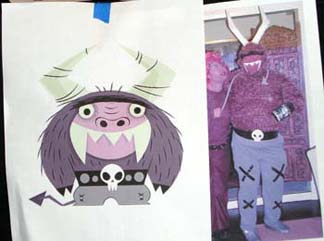
Who would have thought that duct tape is the unsung hero of costuming? The panelists could not praise its versatility high enough. It comes in a variety of surface colors and textures, and you can make all sorts of costume parts out of it. It is also infinitely repairable. To repair a tear, simply tape another piece over it. The panelists demonstrated some basic costume parts you can make with duct tape. For example, in the picture below is a boot, completely covered with shiny red duct tape. (The boot is reclaimable: the tape can be peeled off and the boot restored to its original condition.)

Shai with a boot covered in red tape Picture of a picture of Chuck and Val's costume
Shai with a boot covered in red tape Picture of a picture of Chuck and Val's costume, made with (among other things) tons of duct tape.

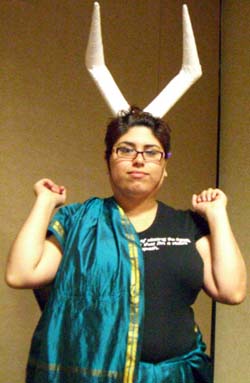
The horns Chuck is wearing in the costume above are shown up close below on Val. Yes, they are made mostly out of duct tape. The tape is wrapped around the frame that was made -- IIRC -- cardboard tubes from used-up paper towel rolls.

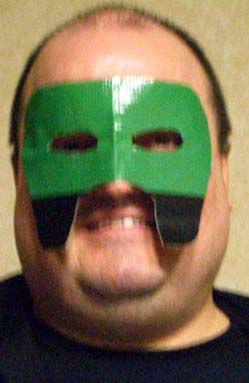
Valerie's horns Chuck's mask
Val with horns Chuck's duct tape mask.
Val with a roll of tape, making Chuck's mask Mary Miller

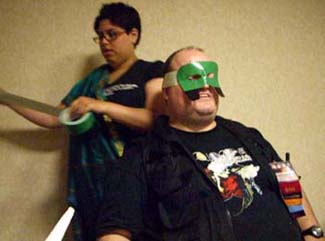
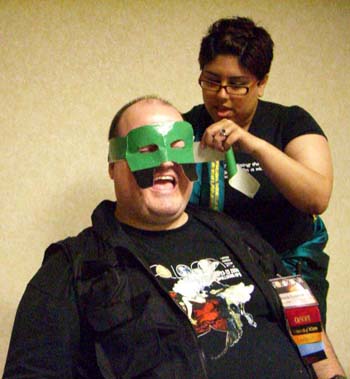
In the course of the panel Chuck and Val made a simple mask. Chuck cut the mask out of a paper towel and covered one of its sides with strips of green and black tape (see above). Then Val made a two-sided headband (left) out of tape and attached it to the sides of Chuck's mask.

Val with a roll of tape, making Chuck's mask

The paper towel backing is a good thing not just because you don't want the tape to stick to your skin, but also because the towel provides an absorbent (albeit minimally) layer. And this brings us to the an oft-emphasized advice. The wearer should keep in mind that duct tape does not breathe. He or she will be sweating like hell under all that tape. It is imperative to wear absorbent garments underneath, unless, quoth Mary Miller, your character is a slug and is supposed to drip-drip-drip across the stage.

I must say, this panel nearly inspired me to get into costuming. Or get back into costuming, actually, after a brief foray I made into it 15 years ago. If only I didn't already suffer from hobby overload...

Here are more of my pictures and blog posts from ApolloCon 2007.

Monday, July 09, 2007

101 Uses for a Paper Clip (McGyver, eat your heart out) : an ApolloCon 2007 panel

Panelists: Kimber Chessmore, Dusty Rainbolt

Description in the program book: Ever wonder what McGyver might do with a paper clip? Our panelists, specially selected for their devious minds, consider McGyver-esque uses for the humble paper clip, and a variety of other small, household objects... as they toss back one bottle of beer after another.

No, actually the program book didn't say anything about beer. But it was a crucial ingredient in the panel. Some of the paperclip uses were not likely to be imagined without some brain chemistry alterations.

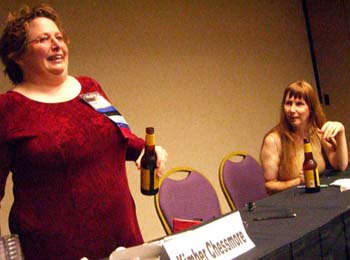
Kimber Chessmore and Dusty Rainbolt Kimber Chessmore and Dusty Rainbolt at ApolloCon 2007

People-poking, jewelry, cleaning; other household uses

Quite obviously, a straightened paperclip can serve as a tool for various kinds of poking, prodding or goading. That was a major set of its uses. For example, you could prod gamers with it to get them out of your way. (I didn't think gamers were a major nuisance at the convention, though.) It can be used for straightforward torture. A guy in the audience said, in Clockwork Orange you can use it to prop people's eyes open.

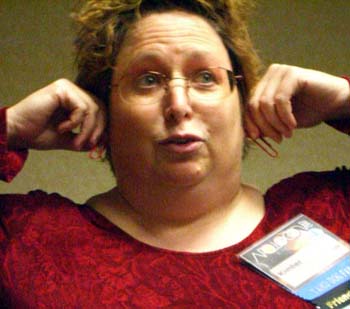
Kimber Chessmore with a straightened paperclip Kimber Chessmore with a straightened paperclip in her left hand (barely visible) for people-prodding

Paper clips can also double as jewelry, for example, earrings for unpierced ears, as Kimber Chessmore demonstrated; or an emergency wedding ring, if you suddenly have to pretend to be married (straighten it and wrap it around your finger).

Kimber Chessmore with paperclips as earrings Kimber Chessmore with paperclips as earrings

Cleaning / hygiene: on a desert island, use a paperclip to clean teeth and various orifices. At home it's handy for digging the hair out of your sink trap (for those with long hair).

Art: if you are making clay pots, a paper clip is a sculpting tool (suggested by a woman in the audience). For cosplay or masquerade, you can fashion an instant antenna out of paperclip if you left the real one at home.

Mundane uses: In all its immeasurable flexibility, a paperclip can be any of these things: a dart tip. A thingy to hang a Christmas ornament from. Or a picture on the wall. For bra repair (if those plastic thingies at the ends of your bra straps break unexpectedly). To puncture an orange peel, so you could peel the orange more easily. A back scratcher. A bookmark. A package opener. Shoe laces. A swizzlestick. A cheap man's cigar punch. A cat toy (not necessarily a safe cat toy, says Dusty).

Farm uses (I've no idea if any of them are valid -- I wasn't raised on a farm): a tool for branding cattle. For horse tack repair. As a bailing wire substitution.

Offbeat uses

Some of the more "out there" uses suggested by people in the audience: on a desert island, paperclips (if you have at least two of them) can be dowsing rods for finding water. Also on a desert island, for lancing a hematoma. Another medical use: as an acupuncture tool. Oh, and speaking of which, Dusty suggested a paperclip could serve as a tattoo needle, though you may need a lot more than two drinks for that, she added.

Kimber said she once posed the paperclip usage question to a group of very polite girls, and the politest of them immediately went: nipple clamps!

Nara (a member of the audience) observed that a paperclip can be handy for stealthy kilt lifting.

Here are more of my pictures and blog posts from ApolloCon 2007.

Sunday, July 08, 2007

I fixed the Gallery! Really fixed it!

I think I have finally fixed the instance of Gallery2 on my web site for real. I am now able to add new images and do pretty much everything with it I did before. I wrote about how I broke Gallery2 here. Since then, I fixed it, but incompletely: it did not allow me to add new pictures. After some more work, I solved that last remaining glitch. What was wrong the first time? The short answer: I had overlooked a table that contains a column that is (I think but am not completely sure) auto-incremented each time a new item is added to Gallery2. That column generates unique IDs for Gallery2 items. Since I did not set its value to the value of the latest item inserted before the upgrade, it was generating ID values that were already "taken" by older items. The full, updated story of how the brokenness came to be and how I fixed it, is here, and yes, I realize that none of the handful of readers of this blog are interested in either the problem or its solution. :-) I'm posting the link here purely "for the sake of completeness", as they say in mathematics. :-)

I also need to find a way to put StatCounter code on my Gallery2 site. It's not obvious where in the Gallery2 bowels its HTML is generated.

However, I am not sure if I want to continue to use Gallery2 at all, or if I want to switch to a different software. My ideal software would have the features of both a photo gallery and a photo blog. (I wrote more about features I look for in photo gallery / blogging software in this blog post.) I tried out two systems that claimed to have such features, Cheesecake Photoblog and Sylverblog, and they both were pathetically unusable. They were so bad I'm not even motivated to write about all the ways they are bad. :-)

Friday, July 06, 2007

Size Matters! Knowing or Choosing the Correct Length to Tell Your Tale: An ApolloCon 2007 panel

Panelists: Katharine Eliska Kimbriel, Alexis Glynn Latner (moderator), Julia Mandala, Chris Roberson, Shanna Swendson

Description in the program book: How do writers know how long a story should be? Is it something they decide or something the story demands? Our panel discusses questions of size, from flash to series. (Don't worry guys, it's perfectly safe.)

It's as if this panel was created with me in mind, so closely it fit my writing predicament (inability to write short stories). But since this was yet another panel on writing and editing, there was bound to be some overlap with the previous two I went to. And so I was able to distill the noteworthy tips or observations into a few sentences.

Shanna Swendson Shanna Swendson

Apparently a lot of people, including accomplished writers, have trouble writing short stories. Shanna Swendson says she certainly does. All her stories turn into novels. (The same thing happens to me.) She wonders if she trained herself that way, to think in novels. The only time she managed to write short stories was when she wrote a series of connected fanfic stories, that all made up a big 100,000 word story.

Alexis Glynn Latner thinks that people who think in short stories are in the minority. She gave this advice: if you have trouble writing short, pick the most narrowly focused idea you can come up with. She also warned that worldbuilding adds to the word count. So it's much easier to make a story short if it's set in a consensus world -- for example, if it's alternative history. Or elves in the mall.

Alexis Glynn Latner Alexis Glynn Latner

A woman in the audience said that every time she writes a story, it comes out as series of dialogs, connected with two-sentence transitions. She asked how to make her stories more balanced between dialog and narrative. Alexis Glynn Latner recommended that she take another author's short story she really liked, highlight the dialog and see what the author does between the bits of dialog.

Here are more of my blog posts from ApolloCon 2007.