Subtitled "Escape From Clichea", Arianne "Tex" Thompson's worldbuilding workshop was the most remarkable event at the ArmadilloCon 2016, and was alone worth the price of admission. She gave a heap of good, practical, doable recommendations on how to improve your worldbuilding, storytelling, and characters. At a typical writing workshop you'll get vague advice like "show, don't tell", and "kill your darlings", but rarely will you hear specific recommendations what to do. But Tex Thompson's workshop was an avalanche of such implementable nuggets of goodness. She showed us how to look at your story material differently and tease the interrestingness out of it.
To be sure, this wasn't the kind of workshop where professional writers and editors critique your manuscript. This was 1.5 hours of Tex Thompson speaking. But I came out of it full of ideas of how to make my stories better.
I wrote them down to the extent I remembered them.
The workshop wasn't strictly just about worldbuilding, but also covered deeper aspects of writing, like how to find your identity as a writer, how to find what makes you unique, and use it to build your online presence.
On how to build your identity as a writer
Write down 3 things you have been paid to do. Then 3 things you could write an article about. If the things on those lists have nothing to do with writing, that's completely fine. Those are things that make you unique. They help you stand out between other writers. If nothing else, they could give you ideas for your blog posts, and a blog is a big part of how a writer attracts and keeps an audience.
Here is another way to mine ideas for blog posts.
Write a list of 3 stories that you want your work to be compared to. Then write down common elements between them. For example, Tex Thompson said that for her, those elements are: (1) ensemble cast / team effort; (2) people with different abilities or powers; (3) big, wild, slightly-ruined world. Such elements are great for mining ideas for your blog or convention panel topics. For example, combining (1) and (2) could lead to Top 10 teams in comics.
Other lists to tease out your identity
Things you would you do with your life if you won a million dollars
What you tend to get into arguments about
Worldbuilding exercises
Association exercise. What do the words "four kingdoms" remind you of, asks Tex Thompson.
Audience says: 4 elements, 4 directions, 4 seasons.
Tex Thompson. Take your first idea and place it carefully in the garbage. Because it is also many people's first idea.
What could be a fresher take on the "four kingdoms" idea? The audience replied:
- Aliens come and the kingdoms have to unite to defeat them;
- Economics arms race;
- Each of the 4 lands has a princess and they are all supposed to be in a beauty pageant, but one of them has a prince and he wants to compete too.
Best practices for writers

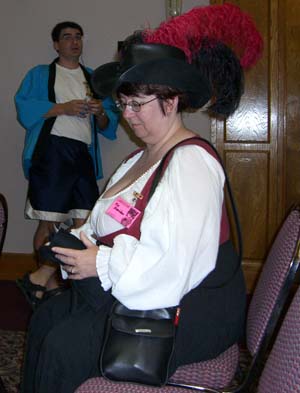
"Arianne 'Tex' Thompson leads the Escape from Clichea worldbuilding workshop at ArmadilloCon 2016. More pictures from ArmadilloCon 2016 (39) are in my photo gallery.
- Use the Triforce!
- Ask yourself: "what is the easiest, laziest thing I could do here?" Then do something else.
- Start with Episode IV, and leave space for more stories as you go.
- Question your assumptions.
- Give us something we expect and something we don't.
- Who benefits from the current state of affairs? Who tends to benefit in most zombie apocalypse stories? Zombies, warlords, gritty surrivors. Even in the worst of times somebody turns a profit. Doomsday preparers, escaping prisoners, drug companies? Gun manufacturer Colt?
- Who loses out? Who is the first to go? The slow and the sick. The people on the front lines where the apocalypse started -- hospital workers who got blood sprayed on them. They are gone.
- Who's trying to maintain the status quo? Usually people who are winning, or people who think they are getting a better deal than they would otherwise. How many of you stayed in a crappy job because its certainty was better than the uncertainty of the alternative?
- Who is trying to change things? Someone who is losing, who has nothing left to lose.
Triforce consists of: Education - something you know about; Passion - something you care about; Inspiration - something you are excited about. At the intersection of those things is a story that only you can write, says "Tex" Thompson.
What happened in Harry Potter world before the HP started? All the Voldemort stuff, the Marauders. Your idea for the front story might make an awesome back story.
Have you read a story about space travel that's set in the 25th century, but all the gender norms are from the 20th century? Or they have all the same notions of nuclear family and property?
Everything that surprises you about another country / culture says something about your own. There is a book series CultureShock! that explains how to live in another country. In US it says, don't drop off at someone's house uninvited. It's OK to ask what people do, but not how old they are. You can call uninvited, but not after 9 pm. Never cut in line, that will not be good to you.
Many enormously successful TV and book series do that. Star Trek: a Western but in space. Game of Thrones: medieval fantasy, but gritty / realistic. Harry Potter: witches / wizards, but in high school. Another example. Chuck Wendig once asked: what would a vampire do in a zombie apocalypse? In "Double Dead", the vampire tries to make sure that the human race does not go extinct, because then he'll be out of food. So he herds human survivors through the apocalypse.
In any scenario, ask:
Explore the timeline
While my memory of the workshop is already vague, I think this was a segue of the "vampires protect people from zombies" exercise. I assume this all means not that we, writers, need to explore all these time periods in our prose, it's just that perhaps the story could be built around not the event itself, but what happened n number of years later.
- 3 months later: chaos, social collapse, ragtag survivors
- 10 years later: status quo; the world is relatively stable. But what are we doing now that we weren't doing 3 months after the event? Maybe we are enslaving zombies. We have started to adapt to this new world.
- 50 years later: the idea that there was something before this seems strange. You still have people who remember the old world, Kennedy's assasination, the days when presidents used to drive down the street in open convertibles. But also the current generation may not know or appreciate reasons for the current state of affairs. This leads to a possibility of a new conflict. They have no respoect for their vampires-elders. They don't understand why people submit to the vampire lords.
- 100 years later: nobody remembers the way it was. Nobody alive today remembers the flu pandemic of 1918. From the 50s to the 90s our big preoccupation was the cold war and the Bomb. Now everybody has a bomb. We don't worry about Russians launching nukes so much. We are worried about people sitting next to us in a movie theatter. The Great War doesn't come up so much as it does in the fantasy novel prologues.
How much info to dump?
When Tex Thompson teaches at the DFW writers workshop, she tells writers: don't pack me a lunch, leave me breadcrumbs. If your mom packs you a lunch, you'll throw away the apple, trade the cookies, etc. You are more like T-Rex: you don't want to be fed, you want to hunt.
Give readers just enough information about your world to build something of their own
Consider how many bigger-than-big franchises -- Harry Potter, Star Wars, Marvel Universe, Lord of the Rings, Game of Thrones, Pokemon -- give you enough information so that you can create your own Jedi, superhero, wizard school, etc. And they make the world vast and intriguing enough that you would WANT to! Ask yourself: what am I giving my readers to do while they wait for my next book? Fan theories about what is Jon Snow's real heritage, Rey's from Star Wars real heritage, etc. Can they make a costume of a character? In how many ways can they participate in this world? In what ways can you make it exciting to participate?
Tex Thompson enjoyed Harry Potter, but like many fantasy novels, the main character was a dude. She wanted to make her own hero. For example, in the world of Sugar Rush racers, who are all named after candy, Tex's friend made his own Sugar Rush racer, Molten Milk Toast. Does your world accommodate other heroes? Do you establish your world well enough for your fans to actively participate in it? And is it interesting enough that they would want to? If your wizard school is in UK, would the readers wonder what it would be like in the Caribbean?
A guy in the audience. Leave the rules a little open, that the people would wonder how much is possible.
Tex. Right. We need some rules at the outset, but we don't need them all right away. And a lot of the secret sauce is what is the right order of revelations so that they would let people build upon one another, etc.

"Use the Triforce, Luke! Triforce consists of Passion, Education, or Inspiration -- in other words, something you care about, something you know about, and something you are excited about. At the intersection of these three lies a story only you can write. More pictures from ArmadilloCon 2016 (39) are in my photo gallery.
Problem: infodumps are boring
Solution: do not let your story answer any questions the reader hasn't had time to ask!
Give out world details and exposition like treats. Instead of infodumping an explanation of how the star drive work, ask yourself, what question is that an answer to? The question probably comes up when the star drive is broken and needs to be fixed. "We need a new flux capacitor, or else the discombobulator won't work."
What excuse do they make for explaining magic in Avatar the Last Airbender? "Why is so-and-so special? Why can he control all 4 elements?"
Anything you are tempted to go on and one for 100 pages about, make it the focal point of your story. Make your story about how to survive on Mars, and hundreds of pages on growing potatoes will become relevant.
Problem: making a fictional world as detailed as the real wone would take forever, and also be super boring. What should you do?
Answer from the audience. Use the same cliches as in the real world?
Tex. Yes. Use the words "magic wand". Readers already know how it works. Or "hyperdrive". Everybody knows what it is.
You don't want to include things that are not relevant, things that have no emotion attached to it. But if I tell you what magic the blue crystal does, what will you automatically wonder about? What other crystals are there, and what magic they do.
Solution: imply that your world contains more detail than is explicitly given in the book.
Conservation of detail: if something is explained in depth, it's because it's somehow important to the story. (The Malazan series by Steven Erikson stomp on this idea. He explains everything about everything.) Respect your readers' brain cells. If I ask the reader to spend a brain cell, there should be a reward for it.
Using the real world responsibly
How to avoid stereotypes
In real life we have stereotypes about entire nations, about some states or even some cities. In fantasy it is easy to fall into the same pattern. Elves have stereotypes about orcs and vice versa. Their races do not get along. But in reality, within any nation, people are quite different from one another. There is enough internal variation between elves and between orcs. In real world, your biggest beef is usually not with the person across the ocean, but with a person across the street. Your fantasy world will be more detailed if you tell us what elves fight among themselves about. Is it what type of wood is best for bow crafting? Is it something as silly as what end of an egg to open from breakfast?
What kinds of people tend to get left out this kind of story? Can you find a way to include them?
Going back to the vampires-in-a-zombie-apocalypse example, what kind of people don't make it through a zombie apocalypse? The elderly and the sick. One of Tex's friend had said: "Why would I want to read stories about apocalypse? If power goes out, my fridge goes out, I won't get my insulin and I'll die. So why would I want to read it?"
One of the plot threads in your book could be about how a guy with diabetes makes it through the apocalypse. Will the vampire take care of him personally? Will he the vampire hunt pigs to make insulin?
Make a story that includes a category of people who are not commonly included, and you might have a whole new big group of fandom for yourself.
Smash the Monoliths!
Question. What is the easiest, laziest, most obvious, least-realistic thing I could do with my fictional people?
Answer. Create a monoculture.
You are probably wondering: but what if I mess up? What if I write a character outside of my own experience and get it wrong? Don't worry, says Tex: you WILL mess up. No matter what you write, someone will hate it. There is a famous quote: "If you're not pissing someone off, you probably aren't doing anything important." Use your fear of hurting people (from other cultures or marginalized groups) to motivate you to do your research. Listen to people, and solicit feedback -- even painful feedback.
The following year I had the fortune to attend another of Tex Thompson's workshops, "Plate Tectonics Theory of Dialogue". It took place in Austin in July 2017, and focused on dialogue. Your characters are constantly in motion: they clash, collide, fold, buckle, shift. Good dialogue expresses all that. Here are some of the slides from the dialogue workshop
.



 Posts
Posts


