Showing posts with label religion. Show all posts

Thursday, November 26, 2015

Heina Dadabhoy speaks at the Atheist Community of Austin

At her pre-atheist-bat-cruise lecture, an ex-Muslim and atheist activist Heina Dadabhoy was rather critical of westerners stereotyping Muslim women. Her tone was gentle and playful, but the message was sharp.

Heina gave many examples of how Westerners like to fetishize Muslim women's presumed powerlessness and oppression. That doesn't really help the women, just like the memes that compare burqa-covered women with garbage bags don't either. It's not just conservatives: progressives do it too. And they should know better.

Western people like to not acknowledge that Muslim women have agency. It comes across in patronizing comments, such as when little old ladies would come up to Heina back when she wore a headscarf, and say "Dear, you know you don't have to wear that here." Heina was tempted to answer, "Here? Where else would I wear it? I haven't lived in any other country than US."

When she first got on the internet as an adolescent, and some men online found out that she was a Muslim, with a headscarf, trapped at home (I don't know if she meant that last part sarcastically or genuinely), they objectified her as an oppressed princess that needs to be saved. And there was an undercurrent of "you better be grateful and keep your bitch mouth shut". Heina pointed out that it happens in the atheist movement to, cough cough (I guess she meant Richard Dawkins, though he is not alone in that). She had people say to her: it's so great you left Islam! Are you still pure? Do you still have your headscarves? Can you wear one for me? The weirdos just keep coming out of the woodwork.

But Muslim women are not without agency, and Heina bristled against being portrayed as a helpless, isolated girl in need of rescue and liberation. Even as a teenager, growing up in a very strict fundamentalist environment, Heina and her friends found ways to have fun. For example, they used religious phrases to rate boys by hotness, e.g. "Look what the God has created!"

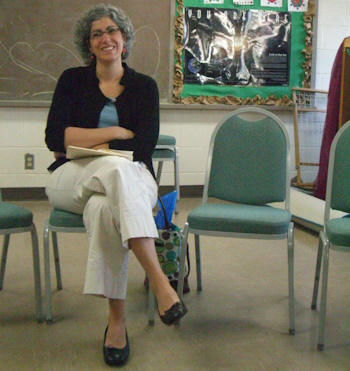
Heina Dadabhoy gives a lecture before the Atheist Community Austin bat cruise in September of 2015
Heina Dadabhoy gives a lecture before the Atheist Community Austin bat cruise in September of 2015. More pictures from the 2015 Atheist Community of Austin bat cruise are in my photo gallery.

Heina pointed out that all societies have patriarchal structures oppressing women. While there is no "law" in the West that women should shave their legs, the societal pressure is there nevertheless; the fact that no one is going to throw you in jail for refusing can make this norm even harder to get rid of. Whether you think that the less clothing a woman is wearing the more immoral the country is, or the freer it is, it's the same thing: you define women's sexuality as only in relation to men.

Later in her speech she gave a bunch of trivia about Islamic rules that govern dating, sex, relationships, and marriage. Not surprisingly, most of them don't take women's wishes into account. Oh, and she assured us that the myth that "virgins" (as in 72 virgins that await a man in heaven) is mistranslated "raisins" is completely wrong. The guy who said that just didn't understand language. Speaking of which, what do women get when they get to heaven? Apparently, in some corner of Islamic mythology it is written that women will be reclining on couches, eating, and they will be served by beautiful clear-eyed servant boys. There is a lot of discussion between Muslim women to what extent those boys are used. "So there is kind of some forward thinking there," says Heina.

(I already forgot if all women were supposed to get these boy servants in heaven, or only particularly virtuous ones, or maybe just the ones who died as martyrs.)

Some people from the audience asked her how, with all the gender segregation, are you supposed to meet a person you're going to marry? She replied that it could be someone you met at a mosque, or it might be someone your parents knew all his or her life. There is also a lot of halal flirting going on in the hallways of Islamic association gatherings: "Can I have your dad's email?" Oh, and Islamic men and women who are unmarried are called boy and girl, even if they are in their 40s.

As a takeaway message, she said we should champion an attitude of female agency. We should not buy into Islam's erasure. We should not agree when Westerners say, oh, Islam women are oppressed and have no agency. The most important thing, the most pragmatic thing is harm reduction. We should not try to deconvert them all, its not going to happen. A person from the audience asked her for ideas on how to support progressive Islam. Heina replied: "For one thing, western people should not be smartass and condescending: 'ha ha, you are a Muslim feminist? How do you do that?' Progressive Muslims are eager to get involved, but nobody even notices that they exist." When Heina points out to someone that she is an ex-Muslim, someone inevitably tells her that all ex-Muslims are dead.

(People from the other side tell her she's been bought and paid for, but she is still waiting for that check.)

Sunday, March 30, 2014

Michael Bishop "Close Encounters With The Deity": book review

Encounters with mystical, supernatural, or otherwise incomprehensible beings and forces are the topic of Michael Bishop's story collection "Close Encounters With The Deity". Some of those beings are gods, some are aliens, and some are not even creatures, but metaphysical notions. The results are... mixed. These stories might cause you feel a little let down by lack of satisfying endings, but they might also stay with you long after you finished them. They make a good case that a solid ending isn't necessary for a story to have lasting power.

These are not plot-driven stories: in many of them, the main thing that happens is the protagonist's inner transformation. An exception is the story about people who are forced to watch movies, which has a lively plot. Sometimes an inner transformation is accompanied by an outer one, like the story Dogs' Lives. The incomprehensible, mystifying being in it is the protagonist itself, or rather who/what he becomes in the course of his life. His life is shown through his memories of various dogs he shared it with; so in other words, it's about dogs' encounters with a (semi-)deity. Perhaps they were a thread connecting him to the humanity as he became transhuman.

But most commonly the characters do nothing but talk (or merely think) about inexplicable things that are happening to them. Yes, they feel profoundly affected, but they don't take any action. In fact, many times they let themselves be lead "off a cliff" by mysterious forces, at which point the story falls off the cliff as well. The protagonist does not understand, let alone accomplish, anything. Such are the stories Alien Graffiti, and A Spy in The Domain Of Arnheim. In the latter, a guy wakes up in a 19th century hotel room without knowing who he is, and starts taking orders from a voice coming from a gramophone. In some other stories, like Voices, the protagonist's adventure culminates in an encounter with a deity, but hardly anything changes for the protagonist. Well, he may become a tiny bit different inside. Maybe he wanted to meet a deity, and he got it. But what of it? No epiphany follows.

Yet even those stories are interesting in a way, because the characters are interesting people, and their adventures, though disappointing the end, can be intriguing while they last. Nevertheless, both I and the other person who attended the book club where we discussed this book (yes, this was a sparsely-attended meeting) thought the most enjoyable stories were those that delivered a payoff at the end. The examples are:

-- the puzzlingly titled Storming The Bijou, Mon Amour: a story about people who are forced to spend their own lives watching movies. If they dare not pay attention, their souls are erased when law enforcers take a picture of them. The protagonist sets out to investigate what or who is behind the movie projector.

-- A Gift From The Graylanders: a story revolving around childhood nightmares and a threat of nuclear annihilation. As a side note, nuclear annihilation or its possibility is a common thread in this whole collection. That's not surprising, considering the era they it was written in.

-- And The Marlin Spoke. The last one contains both a personal transformation AND a plot. The plot does not tell us what exactly happened, but the suspense in it is resolved so nicely, and the protagonist's quest is achieved in such a fulfilling way that I didn't feel let down.

The last story in the book, "The Gospel According to Gamaliel Crucis", deserves a separate mention -- we spent more time discussing it than any other story. It was singled out in the foreword as a kind of tale that might seem risky for an editor to publish, as it might alienate the audience; but that nevertheless needs to be published, because religion shouldn't be beyond criticism or examination. This novella mimics the Bible in its format, down to numbering of the verses; only the savior this time is an insectoid, female alien named Mantikhoras. She acquires four disciples, and they go about spreading her religious teachings much like Jesus and his apostles.

But... like many stories in this book, it leaves you wondering both what was the point of this particular messiah's coming, and of writing a "remake" of the Bible. It wasn't written for the shock value, because it's told in a sympathetic, non-parodying way. Nor does it say, here is how things would be different if a messiah were an insectoid and the event was set in modern times; nor does it make a compelling case that things would always play out the same. Basically, this story does not try to make any point. I'd say that if you are offering your take on a universally known story, you kind of need a point.

On the other hand, most of these stories are best enjoyed if you don't expect them to have a point. (Love's Heresy may be the only one with a clear message, and the only one that takes a clear stance on religious matters.) Mostly they just show humanity's wish for divine revelations as if in a warped mirror; humans assume that supernatural forces have certain agendas, perhaps to teach a moral lesson, to enact what their holy books say they should enact, but inevitably those forces act in ways that are often cruel, pointless, and incomprehensible to us -- perhaps because there is no secret meaning to comprehend.

I would recommend this collection to a reader who does not expect a plot, but enjoys a different, puzzlingly skewed view of religious and supernatural matters. The stories are highly atmospheric, and the characters really come to life. An example of that is Bob Dylan in The Bob Dylan Tambourine Software story. The image of Bob Dylan that comes through in this story is much like an image of Bob Dylan one can glimpse from his song lyrics (I never heard him speak, so I don't know if there is any correlation with the real person). In this imaginary, alternate-universe interview he explains his motivation for quitting music and instead writing software to facilitate people's religious experiences.

So: peculiar mood, bizarrely imagined situations, well-drawn characters, a view of religion that does not judge or take sides, but calmly observes how weird people's religious leanings can be, to what counterintuitive places they may lead -- all of those are reasons to read this book.

Monday, September 19, 2011

Human rights -- one of the societal evils?

I got an interesting discussion going on a couple of my private social media channels about this church sign in Austin, Texas. So I thought it warrants a public blog post, summarizing various people's opinions. Apologies to those who have seen this discussion before. This is the last time I'm posting about it.

Human rights, narcissism, infidelity, materialism, prejudice, hypocricy

When I first saw this sign, my first thought was: are they kidding? Human rights, narcissism, infidelity, materialism, prejudice, hypocricy all grouped together? am I to understand that human rights are a vice on par with with narcissism, infidelity, etc.? What kind of church would be against human rights? Perhaps in their doctrine, humans have no rights except those given by God. So an attempt of humans to establish their own rights is one of the evils of secularism. (I'm really stretching my imagination here.) The church website (www.cccaustin.com) does not make it clearer.

The speculation in my social media streams converged around three possibilities:

(1) it's an unintentionally awkward phrasing, possibly because of a formatting limitation. They couldn't fit "human rights violations" on the sign (without messing up visually), so they put "human rights", because the phrase "human rights" is usually followed by "violations"; thus "violations" can be dropped.

(2) it's a form of trolling... erm, ingenious marketing. Whetting people's appetite by an intentionally cryptic or contradictory statement. Maybe they'll be curious enough to come to the church to find out what it's all about.

(3) this church really counts human rights among the evils of secularism. About half of the people who commented on this photo thought so.

"I couldn't tell if they're for Human Rights or against them, but since they're against the other topics I'm assuming they're against Human Rights too."
"'Human rights' originated after WWII and were defined by a multi-national commission. So Human Rights are an innovation and not given by God in the Bible, therefore they're evil. It doesn't matter that by and large they're corollaries of the "Love your neighbors as yourselves" commandment."

"This page on the church website, You have a part to play, seems to make the point even more strongly. On its web page (which, unlike a sign, does not have formatting limitations), they list all six "issues", including human rights, and says 'In addition, we we will be sponsoring a unique "small group challenge": our small groups will have the opportunity to craft a personal and creative response to these issues, competing for a $250 prize per issue [...]'."

It's probably not (1), because awkward phrasing in a sign could easily be clarified on the website. It may also be (2) and (3) combined. One friend said, "this is a deliberate attempt to confuse people and attract attention, and not a simple failure of parallel rhetorical construction."

Friday, June 17, 2011

How wishlists are like orthodox rituals

First, I'll grumble about Amazon.com wishlists a bit. There should be a way to group items with AND, OR, and NOT operators. For example, I want bag A, or bag B, or bag C, all of which look very similar, but not all three. But in addition to those bags I also might like a wallet, which is assigned an equally high priority in my list. So my wishlist clause would be (Bag A OR Bag B OR Bag C) AND (Wallet D OR Wallet E).

Overthinking much? Maybe that's why I'm the least fun person to get gifts for. Knowing how to want the right kind of presents is an art I have never mastered. By right kind I mean the kind that easily lend themselves to dropping hints. Isn't that how Miss Manners claims it should be done? A lady gushes about the beauty of a particular object, and her significant other, family or friends are make note of that. That's how they get ideas for what to get her for birthdays and holidays.

And of course, the items should be in the right price range for the significant other, family, etc.

But what if the items you truly crave are so specific that a mere hint would not suffice -- the exact make and model is needed? What if, indeed, dropping a mere hint could lead to a gift-giving disaster, where the giver spends a chunk of cash on a product that differs from your object of desire in small, crucial detail? What if it's an iPad when you wanted an Android tablet? Or it has a touchscreen keyboard when you need a physical one?

In a world of increasing customization, where advertising industry pushes products "as unique as you are", it's getting harder to be satisfied by things that were supposed to please everyone in a certain demographic category: perfume, a journal with handcrafted covers, a DVD of a popular movie. I myself have been guilty of wanting rather idiosyncratic products: a wallet that would double as a handbag and a waistpack; an MP3 player that would record radio programs AND play audiobooks. Those things do exist but they are not easy to find. And if they lack one of these functions, I'd rather not have them at all than let them rot in the back of the closet.

So I made up a wishlist. Amazon.com makes it so easy. Not only it sells everything under the Sun, but if another online store has an item Amazon doesn't sell, you can still add it to your Amazon wishlist via a Firefox extension. (I haven't installed it and can't vouch for how it works.) Great -- you made it easy on your nearest-and-dearest. But how is it different from them handing you a wad of cash and telling you to go buy what you want? There is no surprise in it -- and in my old-fashioned notions, surprise is a key element of gift-giving. Perhaps technology that lets you have your wishes fulfilled so precisely could also help you restore the element of surprise. Maybe wishlists could have some kind of "random" feature, that would let the gift-giver pick a random element from category A, B, or C. But isn't this just building a layer of meaningless ritual to soften the ruthless practicality of the transaction? Isn't it akin to Orthodox Jews keeping hallway lights on all night on Sabbath, because they're not allowed to operate light switches? Or programming elevators to stop on every floor, because they're not allowed to push buttons? Or connecting two houses with a string so they could bring something to a neighbor's house, because then the two houses are considered to be "under one roof? (Is carrying stuff on Sabbath permitted under the same roof, but not outside? It boggles the mind too much to even seek logic in this.) Similarly with wishlists -- once they destroy the spirit of gift-giving, trying to reintroduce it would be just as artificial.

As they say on Twitter, #firstworldproblems.

Friday, September 10, 2010

ArmadilloCon 2010: religion in worldbuilding

Official synopsis: "Religion plays a part in worldbuilding, but if you just lift aspects of current religions, they may not fit well into the world you are creating. How can religion be added without making it a caricature?"

I thought this synopsis contained a nugget of unintended irony. Why would it be difficult to include it in your SF or fantasy world without making it a caricature? Could it have to do with absurdity of most religious beliefs? Unless your religion is so vague that it limits itself to a largely indifferent, hands-off Creator, it can be characterized by Heinlein's famous quote: "one man's theology is another man's belly laugh". Ironically, your readers might think that a supernatural being you created is ridiculous, but the one they believe in is not, though they differ only in details.

Mikal Trimm, Matt Cardin, and Matthew Bey

Mikal Trimm, Matt Cardin, and Matthew Bey on Religion in Worldbuilding panel.

Somebody in the audience held Frank Herbert's "Dune" as an example of a SF novel in which religion is done very well. Fair enough -- I don't remember it being ridiculous. Somebody else mentioned an Arthur C. Clarke's story that incorporates religion very well. In that story, missionaries go to a distant corner of the galaxy to preach their religion, and reach a star system where all life went extinct thousands of years ago when the star went supernova. Turns out, that was the Star of Bethlehem. I think the story makes a good point, but it avoids making a religion look like a caricature at the cost of making it look ironic, arbitrary and cruel -- just like in real life. So that was probably not the point the panelists were trying to make.

I was disappointed how one or two people in the audience perpetuated the myth that the "New Atheists" are just as fundamentalist as religious fundamentalists. But it wasn't the right place to get into that debate. However, I had a chance to pitch my Science and Religion in Fiction book club to the audience (well, it's not mine, it's part of Center For Inquiry, but I'm the organizer), and I got a few people interested. Whether any of them will ever make an appearance at our meetings, is anybody's guess. (Mine is "no". :-))

More on the similar topic: my blog post on Creating a Believable Religious Society: an ArmadilloCon 2004 panel .

Pictures from Armadillocon 2010 are in my photo gallery.

Wednesday, July 14, 2010

ApolloCon 2010: Scientific Advancement vs. Social Stigma

"For as long as there has been science, there has been the bleeding edge -- progress at odds with social norms. Centuries ago, no one believed the earth rotated around the sun. For years, the concept of 'zero' was a religious heresy. Today society balks at the thought of cloning and artificial intelligence. How do we balance our cultural identity and values with our ingrained curiosity and desire for progress?"

Those are rich questions, but most of this panel was spent lamenting that "nobody" is thinking through the ethics of scientific advancement. As an example of ethically dubious bioengineering, Teddy Harvia brought up the cactus people from China Mieville's "Perdido Street Station". Then again, he admits that "authors often write not to be realistic, but to make a statement". He was also shocked by a relationship between the human protagonist and a bug-like creature in "Perdido Street Station".

"I'm not racial," Teddy Harvia said, "but..."

"But you are prejudiced against cockroaches", said Kimberly Frost.

Kimberly Frost, Teddy Harvia, and Alexis Glynn Latner

Kimberly Frost, Teddy Harvia, and Alexis Glynn Latner in the "Scientific Advancement vs. Social Stigma" panel. Find more pictures from ApolloCon 2010 in my photo gallery.

Moderator Kimberly Frost asked: does literature has a role in creating acceptance of the world that science is creating? Unfortunately, this question did not get much traction with the panelists.

It is often not literature but religion that most people expect to help them make sense of scientific and societal changes. In my experience, even in the SF and fantasy fandom many people still don't question the cliche that religion, or, more generally, "spirituality" should provide ethical safeguards for scientific research. So it was encouraging to see that some of the panelists were skeptical of religion's role. Only one panelist, Lou Antonelli, defended Christianity. His observation is that more and more religious people think we shouldn't mess with the planet, because "God gave it to us". That's hopeful news, but I wasn't sure how much I could trust his objectivity, since he said in the same breath that Christians and religious people in general are being mocked in today's "atheistic" environment. Since the purpose of this blog is not politics, I'll just say my view of this is very different.

Some other panelists also disagreed with the notion that Christianity is persecuted in the West. Teddy Harvia pointed out that Christians' claims that "Harry Potter" books attacked religion were wrong, since the books take a completely neutral stance towards religion.

On a marginally related topic, one panelist gave an insightful answer on why many non-Christians don't like when people offer to pray for them. She was in the hospital with her daughter who, like her, was a pagan, and a very nice Catholic chaplain came in and wanted to pray for them. The two of them agreed, but felt the way a Christian would feel if a voodoo priest came in and started waving chicken bones.

Mel. White and Lou Antonelli

Mel. White and Lou Antonelli in the "Scientific Advancement vs. Social Stigma" panel. Find more pictures from ApolloCon 2010 in my photo gallery.

Thursday, March 11, 2010

Job search and religion, or lack thereof

As I said on Facebook, the reason I go to job search clubs at churches is because Texas Workforce Commision requires you to make 5 "job search activities" to receive unemployment benefits, and going to a job search club counts as one activity. (Somebody has informed me that it's easier to meet those requirements than I thought. Thanks, you-know-who-you-are, I'll keep your advice in mind and will revise my job search strategy in the upcoming weeks.)

All three clubs meet in churches, but two of them don't require any religious involvement. The third one, though... time will only show if I can stomach all their god-talk.

However, the third one also has some good stuff going on, such as resume critique sessions or personal statement help sessions. A personal statement is an answer you would give when an interviewer asks you, "tell me about yourself". The most vague and trecherous of all interview questions, it's so ubiquitous it has its own acronym: TMAY. It's also known as elevator pitch. If this club prepares you for interview pitfalls, it may be worth going to. I just don't know how much religious involvement it demands of its members. Some evidence suggests that they ask way more than I could comfortably ignore. For example, it encourages everyone to find their accountability partner -- a person to who you would be accountable for things you've done in your job search on any given week; that would be good except you are supposed to pray for your partner.

I didn't expect that when I went to my first meeting. The club's profile on LinkedIn says they welcome people "without faith background". Yet it was pretty clear at the meeting they assume everyone is a religious person. The Friday of the same week the president of the club called me -- he probably does that for all new members -- and asked about my experience with the club. So I asked him bluntly if have to be religious to be a member. He took my question calmly, and said I didn't have to pray. I was surprised by how he was completely unfazed when I said I was a nonbeliever. Maybe it's the whole "love the sinner, hate the sin" thing. :-) Many Christians may be intolerant of liberal point of view, but some of them show a surprising amount of tolerance when dealing with individual heathens, such as me.

Thursday, April 30, 2009

Michael Shermer's visit in Austin


Michael Shermer, founder of the Skeptics Society, and author of popular science books, came to Austin to participate in a debate about evolution and intelligent design with representatives of Reason to Believe (a science-faith think tank). Earlier that day Center For Inquiry hosted a lunch with Shermer at NXNW.

I didn't go to the debate -- I'm one of those people who think, why does this question need to be debated at all? Evolution is an established fact in biology, but those who don't believe it are not known to change their minds in the presence of evidence. Who could possibly expect them to change their minds based on this discussion? I didn't see what I would get out of this, so I didn't go. Plenty of people from Austin's atheist and freethought communities did, though.

Earlier that day Center For Inquiry Austin hosted a lunch for Shermer at NXNW. We chatted about all sorts of things. This debate was going to be different than typical evolution vs. intelligent design debates, he said. His religionist opponents were not going to argue creationism from biological point of view. This wasn't going to be about how bacterial flagellum demonstrated irreducible complexity. This debate was going to be about the Bible. The opponents are a brand of believers who look for scientific evidence in the Bible. They pick quotes from the scripture and reinterpret them in such a way as to fit modern science. Here I asked Shermer, why can't those people find evidence for evolution in the Bible? He just smiled politely. Thus, tonight's debate was going to be more showmanship than intellectual discussion, he said. Both sides will compete who knows the Bible better -- and Shermer, according to him, knows it very well. He enjoys this kind of competition.

He has written quite a few popular science books, but he also wants to try his hand at science fiction. He has an idea for a novel about a colony set on Mars, which was founded by astronauts who were all atheists. They didn't raise their children religiously. Will religion come back spontaneously in this society? That's an important question Shermer would like to address in this novel. He believes it will, as religion is too fundamental to human thinking. This book would also explore such political questions as whether government is necessary to a society, or if all institutions should be private.

Shermer would like to do as Carl Sagan did in "Contact", that is to use plot and characters as vehicles to convey his ideas. He admitted he's not so good at character development. I was excited to hear that: as an aspiring science fiction writer, I know how hard it is to write believable characters. So I told him. Shermer was nice enough to ask me what authors he should read so as to learn to write in this genre. I suggested starting with classics, like Arthur Clarke and Isaac Asimov; then backpedalled: after all, those two writers were not good at developing fully fledged, realistic characters, so they are not the best to learn from.

Shermer came across as a warm and down-to-Earth guy. He shared food with people, who in turn enthusiastically offered him bites of their dishes. And he even stole a fry from somebody's plate. :-)

Pictures from lunch can be found in my photo gallery.

Bookmark This on Delicious

Saturday, April 25, 2009

Churches desperately trying to look hip

I haven't had anything all that great to blog about lately -- overwhelmed with work and personal life, I'm reading only the minimal amount of news, my usual source of inspiration. Even though SXSW was more than a month ago, it caused me to fall so far behind blogs and news, I'm only now catching up. So here's an item from a while back for your mild amusement. I saw this flyer at the First Unitarian Universalist Church of Austin, where I was for Darwin Day in February. When life gives you a dubious acronym, these people really know how to make an acro-lemonade! "FUUCA" is only mildly suggestive, so the good church folks came up with a youth group acronym that, ahem, goes all the way. :-)

That's First Unitarian Universalist Church of Austin Young Adults group. Apparently these days even churches feel compelled to look edgy and provocative. How silly.

Monday, March 23, 2009

Once in a while I get drawn into those debates...

As I said on Facebook and Twitter, I had an argument about atheism at the Ethical Society gathering. The other person said every atheist will experience God during their lifetime, just like everybody experiences love, even the people who say they don't believe in it.

Contrary to what some people said on Facebook, this guy was not at all an idiot; he seemed quite smart. But his argument was not very well thought out, even if it was superficially based on the latest neurological discoveries. Basically he said that God, like love, is one of those things human brains are hardwired to experience. I know God belief is not hardwired into everybody's brains, and I'm not even sure love is. There is a minority of people who never fall in love, much as they would like to. The same way, even as neuroscientists have found some evidence that many (if not most) people's brain have a "God module", there is a sizeable minority who do not "experience" God. It's possible that it comes down to differences in brain wiring, though I don't know how that would explain all the deconverted former theists (of which I met many). Maybe their former religious beliefs came from social conditioning, not from a direct, mystical experience of the ineffable. :-)

So I asked the guy to clarify in what sense does everyone "experiences God". Maybe he meant it in a primarily secular sense, such as "awe at the beauty and mystery of the natural world". Most people, including atheists, get that feeling that at some point. Some choose to call that God, but in reality that's a perfectly secular experience. But the guy declined to clarify. He said, how would you explain to a deaf person what music is? It's something that you know when you find it. I said, if you start from a position that experience of God can't be explained in rational words, then this argument is meaningless. If we don't have the language to talk about it, you can't present any arguments supporting your opinion, nor can I present arguments supporting mine. And so the topic was exhausted. We were too nice to ruin the afternoon going at each other's throats. :-)

Bookmark This on Delicious

Tuesday, January 27, 2009

Christopher Moore "Lamb": CFI book club discussion

4 people attended the CFI Science And Religion In Fiction book club discussion of Christopher Moore's book "Lamb: The Gospel According to Biff, Christ's Childhood Pal". Only one of them has read other novels by Christopher Moore (6-7 or them, in fact, and he was the one who recommended "Lamb" to the group).

"Lamb" is a humorous account of the life of Jesus Christ, as told by his childhood pal Biff. If we believe this novel (and we have as much reason to believe it as the Bible, as far as I'm concerned :-)) Biff was Jesus' trusty sidekick all throughout his life. The story focuses on Jesus' missing years between ages 14 and 30; it shows Jesus and Biff traveling all over the world in search of the three wise men. Their travels take them to Middle East, China, and India, where they get entangled into many fantastic adventures, each one more bizarre than the previous one.

We all acknowledged that "Lamb" is intended as a funny book rather than serious deconstruction of Christianity. It's a humorous what-if scenario of how doctrines of Christianity came together. "I think Christianity has pulled its ethics from a whole lot of sources, and that's what Moore showed here, that made for a serious message in the book, if there is any," said a reader. Our group liked that aspect of it.

A serious message is not easily found in this book, however. A few readers found the book very lightweight. This is not a book you would learn a lot from. But we all found it hilarious. The humor and the adventures are enough to pull you through the book. One reader said he tried to read a passage from the first 100 pages to his wife, and could not finish, because he fell over laughing. Another person compared the humor in this book to that in "The Simpsons". "A lot of Homer's humor is naivete, taking things seriously," said a reader, pointing out parallels with the "Lamb": "For example, when Gaspar tells Biff the parable of the boat -- when you cross the river, do yo carry the boat with you? And Biff asks, well, how big is the boat, etc.?" The very manner of Biff's speech is modern American. But there were undoubtedly wisecrackers in biblical times, too.

The humor in "Lamb" really shines when it's used to explain the origin of Jesus' famous sayings. From "turn the other cheek" to "you will be the rock I'll build my church upon", they all are shown as having arisen from profane, goofy situations, rather than divine revelation.

The ending was found to be a little too sweet by some people. But it's consistent with the general feel-good tone of this novel that stays funny without hardly ever becoming sarcastic. Indeed, a remarkable feature of "Lamb" is that this tale of young Jesus' escapades manages to be completely non-offensive to Christianity. Some of us noted that it has a surprisingly sympathetic view of Jesus. "I really felt for the guy," said a reader, "he was such a good person. He really was. If the Bible was written more like this, I think a lot more people would end up Christians. At least I might have." Chris Moore mentions in the epilogue that practically no religious person ever came up to him and complained. "Lamb" is full of blasphemy, but it's presented so well that it's almost impossible to feel insulted.

I personally found it funny and sad -- or maybe just sad -- that Biff is considered by everyone to be an idiot, when he is really quite brilliant. He's certainly smarter than Jesus himself. He comes up with theories of round Earth, and of evolution, millenia before anyone else. It seems Chris Moore could not resist the irony of Jesus pal discovering theories that are so viciously opposed by fundamentalist Christians.

Bookmark This on Delicious

Sunday, May 04, 2008

Parenting Beyond Belief: a Dale McGowan seminar

Dale McGowan gave a seminar "Parenting Beyond Belief", hosted by the Center For Inquiry in Austin on May 3, 2008. A lot of things he said were common sense advice for secular parenting. Expose your children to as many religions and myths as you can. Talk about baby Jesus in the same breath as about baby Hercules. Don't shield them from religious ideas, because if you do, some day in their teens they'll hit a confidence crisis and may be receptive to their peers' suggestion to seek help in Jesus. Let them hear all sorts of religious stories, so that no one religion will seem uniquely believable.

Interestingly, Dale McGowan is the second person (the first was Nica Lalli) who said that their kid, when told the story of birth of Jesus, said, wait, wait, I know this story -- God came down from above and put a baby in a woman -- that's Life of Brian! (Hmm. It makes me wonder if I'm showing my daughter the right movies. ;-))


Dale McGowan. More pictures from various Center For Inquiry events can be found in my photo gallery.

It must be said that despite exposing his children to all sorts of myths, there are two religious notions Dale McGowan does not give equal air time to: the concept of hell (because it has a potential to scare young children very badly), and demonization of doubt (as in, you are only a good person if you don't question authority). He says he wants his kids to develop these three things: an ability to think well (critical thinking), self confidence, and a deep love of reality. If they develop these 3 things, they probably won't seek comfort in the supernatural.

When his 9-year-old daughter came home from school and said three of her friends told her she's gonna burn in hell, his stomach sank. He asked the daughter, how did it make you feel? She said, bad, but also silly. She already thought burning in hell was unlikely. Exposure to many religious ideas over the years inoculated her against fear of hell.

So, common sense advice. But the way he says it is very entertaining. He has a ton of wonderful little phrases and anecdotes to illustrate his point.

Who will lay a blankie on my grave?


It is tradionally thought that it's the role of religion to address questions of death and morality.

Regarding death, Dale McGowan's position is this. If you want your child to develop a love of reality, you need them to consider the question of death. The fact that our life ends is the most profound fact of our existence, rivaled only by the idea that it begins. Engaging with this fact can lead with the most profound engagement with life. We need to talk with kids about death as if it is normal, which it is. A 150 years ago this wasn't a problem; all children were exposed to death. And children won't have trouble accepting the notion of death if they are told about it early, because we have a limitless ability to accept the weirdest things as normal, if they are presented to us in the daily life.

"Here's a strange thing we accept as normal, says Dale. "We emerge into the world from our mothers. My mother is visiting us in Atlanta right now. I'm having coffee with my portal to the world. And I think it's normal, whereas the whole time I should be..." (his jaw hits the floor in an exaggerated expression of astonishment).

"So when a young child asks "who will put my blankie on my grave when I die?" don't start bawling "you're not gonna die!" If you do, you are not respecting their question. And the 4-year-old was not even crying when she asked that question! She just wanted to know. So I assured her I'll be the one to do that."


Teaching kids morality the secular way


Then there is the concept of a child's moral development -- another area where religion is widely considered indispensable. Dale says questions of morality are no harder for atheist parents than for religious parents, simply because those questions are hard for everybody, including religious people. It's just that secular parents have a different set of tools for addressing those questions.

We know a lot about moral development, says Dale. No matter whether kids go to church or don't, most kids reliably hit the salient points of moral understanding at about the same age. There are small exceptions for children who had experienced childhood neglect, such as in orphanages. In those cases they reach that understanding later, but not by much.

There is one exception. If kids are raised in an authoritarian moral situation -- if they are told to act a certain way because mom or dad says so, God says so, police says so -- it impedes their moral development. So instead of appealing to an authority such as God, you teach the child about consequences of their immoral behavior. For example, when his 6-year-old hit a lying phase (which happens when children develop a "theory of the mind" and suddenly realize that other people may not necessarily know everything, so it's possible to lie to them!) he asked her: you know why is lying bad? Because next time I won't trust you. Next time she said she washed her hands, he said, but you lied to me yesterday, so now I'll have to check.

Also, according to development psychologists, it is important to tie identity to morality, says Dale. So you tell children: I know you are an honest person, and your lying doesn't make any sense, it's out of character for you. Children become protective of who they are. If they self-identify as an honest person, they don't want to violate the sense of what they are.

There were many more things he said, which I have to omit, because I didn't take very thorough notes. He seasoned his talk with many funny personal stories. It all made for a memorable seminar.

Saturday, March 29, 2008

Richard Dawkins at UT Austin

I have updated this blog post with correct link to an article on my new website.

On March 19, 2008 Richard Dawkins gave a public lecture at the University of Texas in Austin; it was preceded by a reception hosted by the Center of Inquiry Austin. Though I didn't have a chance to exchange more than a few sentences with Dawkins at the reception, I formed some kind of impression of him as a person.

Dawkins speaks in very well-turned phrases: complete, spare, witty -- pretty much the way he writes. He speaks that way even when he extemporizes, for example when answering questions. No meaningless interjections such as uh's, um's or like's, no trailing thoughts. But, while this may make him seem old-fashioned, his prowess with technology overturns that impression. At the Center Of Inquiry reception he seamlessly combined socializing with working his iPhone and MacBook; for a moment that made me feel validated, as I too like to tap on a keyboard while socializing (but perhaps a VIP is exempt from the gander/goose comparison :-)); later I realized he wasn't idly surfing; he was looking up the Texas Bill of Rights for a quote to include in his speech. How did he quote it in his presentation? You can read about it in this Susan Brown's blog post.

Later a UT student asked him a question: why hasn't the freethought community organized to create a response to the creationist movie "Expelled" -- for example, by raising money and making a movie debunking "Expelled"? Dawkins responded that making an "official" movie and trying to get it into theaters might not be the most effective way. These days, with everyone having a video camera, any one person can make such a movie, and the best way to distribute it might be simply by posting it on YouTube. There it may get more views than it would in movie theaters.

Yay for the older generation scientists who know how to leverage internet for political change!

An entire report on this event can be found on my SFragments web site. Here are some of the highlights (all the links point to various parts of the same article).

I found Dawkins' lecture topics familiar, even though I haven't read his books where he expounds on them. I guess I've absorbed his ideas by osmosis. The questions the audience asked revolved around whether atheists should adopt an in-your-face or a conciliatory tone with general public; some of the questions were more unusual. (Would you ask a well-known skeptic to support his reasoning with astrology? :-)) Then someone asked what Dawkins thinks of transhumanist visions. Finally, a concept he wanted us to take away from this lecture, if it was the only thing we would take away: why evolution is NOT equal to random chance.

Pictures from the reception and the lecture can be found in my photo gallery

Friday, March 21, 2008

I could have sworn I was reading "The Onion"...

if I didn't know this was ABC news:

Because the Bible Tells Me So? During Private Museum Tours, Denver Children Learn About Creationism

A company called BC Tours ("BC" stands for Biblically Correct) "take paying customers on tours of such places as the Denver Museum, the zoo, and fossil sites, giving an explanation of nature, biology and paleontology with a strictly Biblical interpretation."

Here are some examples of how they "interpret" paleontological evidence:

"Standing in the lobby of the Denver Museum of Nature & Science, Bill Jack and Rusty Carter pointed to the enormous teeth on the reproduced skeleton of a Tyrannosaurs Rex, and told a group of children and their parents that the fearsome T-Rex was really a vegetarian.

They said the T-Rex was vegetarian because at the time of the Creation, there was no such thing as death, so a T-Rex could not have eaten meat. There was no death until Adam and Eve ate forbidden fruit from the tree of knowledge, they continued, and God's revenge was to curse the world with death."


And this is how they dance around some uncomfortable evidence:

Out on the museum floor, Jack and Carter stopped the group in front of a window display that contains samples of sandstone that have ripples created by water and fossils of ancient life. Bill Jack asked his group, "How do they date the fossil? By the layer in which they find it. They date the layer by the fossil and the fossil by the layer," he said. "That's circular reasoning."

In the next moment he stepped past and turned his back to a display on radiometric dating, the method by which scientists determine the age of rocks through the rate of decay of their natural radioactivity.

When later asked why he skipped the display, Jack said simply, "We can't cover everything."


And to think that I was shaking my head when one fellow CFI'er told me what her creationist sister-in-law does when she takes her children to a natural history museum. Faced with dinosaur exhibits, she covers the explanatory plaque with her hands and says to kids: "oh look, dinosaurs! They are only 3000 years old!" She couldn't hold a candle to Jack and Carter. :-)

It's kind of ironic that I found this article today. Just yesterday I went to a public lecture by Richard Dawkins, the famous evolutionary biologist and science popularizer. (I'll blog about a meeting with Dawkins later, when I organize my pictures.) I had to read this article to as not to get too comfortable in an illusion that reason will eventually triumph... :-)

Sunday, March 16, 2008

Nica Lalli at the CFI Austin, March 15, 2008

Nica Lalli, author of "Nothing: Something to Believe In" met with the people of the Center For Inquiry Austin for a discussion on raising children without religion in a predominantly religious society. The meeting took place at a Unitarian Universalist church in Austin. Here are a few memorable quotes from the discussion.

"Your children will get religious education from their classmates. They will also get sex education from their classmates," said Nica Lalli. "[And they'll hear all sorts of wrong things.] If what learn from their classmates about sex is any indication, children need to get religious education from us [parents]."

When her daughter heard the story of Jesus' virgin birth, she said: oh wait, there is another story like that! uh... umm... Life of Brian!

Nica Lalli at CFI Austin, March 15, 2008
Nica Lalli at CFI Austin, March 15, 2008.

At some point someone wondered what do young-Earth creationist parents do when they take children to a natural science museum, and are faced with dinosaur exhibits? One woman said her sister-in-law covers the explanatory plaque with her hands and tells children: oh look, these are dinosaurs. They are 3000 years old!

While adults had their conversation, children played in the UU church playground under the supervision of babysitters. Later that evening we took Nica Lalli out for dinner at the County Line barbeque restaurant.

Tuesday, March 11, 2008

"Infinity does not exist in our dimension"

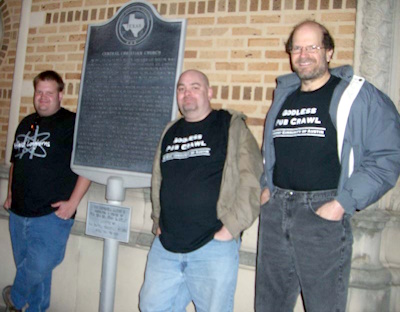
A bunch of the ACA'ers went on a pub crawl last Friday. The crawl started out at Dog & Duck pub, the home of the ACA'ers happy hours; then we went on to 6th street. On the way there we were approached by folks who were handing out fake million dollar bills. It was some kind of Christian evangelist thing. Along the edge of a "bill" in small print there were questions such as "will you go to heaven"? Since most of us wore "Godless pub crawl: pubs, not popes" T-shirts made for this occasion, we must have been a tempting target for evangelists, and there seem to be quite a few of them hunting for souls to save in the nightlife district on a Friday night.

Left to right: Justin, Matt and John on the way to the ACA pub crawl On the way to 6th street, the next destination in the pub crawl, some people felt they had to pose in front of a church. For irony's sake. Left to right: Justin, Matt and John.

Not surprisingly, two of them got into an argument with Matt, the then-president of the ACA. One of those guys told Matt he would prove there is a God in 30 seconds flat. Needless to say, their argument lasted a lot longer, and most of the ACA'ers got bored and wandered off to our next stop, the Darwin pub (no connection to Charles Darwin that I could tell!) It became tedious quickly, but not before I had a chance to hear this gem of an argument. The evangelist attempted to argue from the "first cause", to which Matt replied: if everything must have a cause, then who created God? The evangelist guy said, God doesn't have to have a cause or creator, he always existed. Matt said something along the lines of, you can't simply dismiss a question of whether God has a cause; just like it is meaningful to ask that question about anything else, it is also meaningful to ask it about God; you can't just arbitrarily declare that God has no cause. Matt tried to explain it by analogy: no matter how big a number you can think of, you can also imagine an even greater number, and so on all the way to infinity. The evangelist guy somehow felt existence of infinities threatened his beliefs. He said, no, I don't have to (imagine an even bigger number). I can stop any time. Infinity does not exist in our dimension, he added.

That last remark floored me. I blame science fiction. Seriously. I blame popular sci-fi shows and movies for putting terms like "infinity" and "dimension" into the vocabulary of people who cannot grasp these very simple and intuitive mathematical concepts. But that doesn't stop them from using them in a debate!

After the Darwin pub all the ACA'ers went on to their next stop, but I decided to save my liver and go home.

Wednesday, January 23, 2008

Genuflection aerobics

Once in a while I post quotes from articles I read with a sole purpose of goofing off, and not out of genuine interest. I have no stance on the issues described -- I post these quotes simply because I find them hilarious.

http://www.salon.com/mwt/feature/2008/01/23/partner_yoga/

This is an article on partner yoga, the grossness of. ("Is having my face in a stranger's crotch really helpful for my meditative state?"). The only thing I can say about yoga is I tried it once and found it singularly boring. But the second of the two following paragraphs almost made me squirt coffee out of my nose.

Traditionally, yoga is taught one-on-one, takes years to master and has nothing to do with improving the definition of your shoulder muscles. It also emphasizes emotional detachment, which is difficult to achieve if your head is in someone's junk. But Dharmanidhi's [an Indian yoga master's] biggest point was this: Yoga is an integral part of Hinduism, and Americanized yoga -- whether it's called Ashtanga, Iyengar, Bikram, Vinyasa or anything in between -- is a bastardization of a spiritual practice.

"Imagine you go into a Catholic Church and there's something called genuflection, where you go down on one knee," he said. "What if a person comes out of the ceremony -- which is supposed to be about their relationship with God -- and they say, wow, my legs feel a little sore! And they go home and open up a shop and have people do genuflection for an hour to disco music. And partner genuflection, at that! It's completely taking it out of context."

Thursday, July 19, 2007

Mary Doria Russell "The Sparrow": a CFI Austin book group discussion

4 people attended the CFI Austin Science And Religion In Fiction book group discussion of Mary Doria Russell's book "The Sparrow". 3 out of 4 gave the book a thumbs-up, 1 thumbs-down.

The book presents a wide range of views from atheism to belief

One thing everybody liked about the book was that Mary Doria Russell presented the views of both believers and nonbelievers. The proportions, however, were disappointingly unequal. The only atheist on the mission, George, didn't get much air time. He was more like a token atheist. He was a very nice person, but he didn't say much throughout the book. Russell did better with other characters, who possessed various degrees of belief and nonbelief. Even the believers had complex views about religion; no one was dogmatic. For example, Emilio joined the Jesuit order for practical reasons, not because he was pious. But then he came to believe when the moment of faith washed over him. One reader said it was interesting to read about it, because he never experienced anything like that. Another reader said she wished more Christians read this book, because the author treated the material thoughtfully. Since Mary Doria Russell in her lifetime went from being Catholic to being atheist, and then to Jewish, we guessed she's obviously has thought about stuff a lot, and it shows in the book.

Mary Doria Russell at the ArmadilloCon 2000 Mary Doria Russell at the ArmadilloCon 2000, Austin science fiction convention. She celebrated her 50th birthday at the convention, and the organizers presented her with a cake.

Overall, the readers agreed, "The Sparrow" may be more interesting to believers who may be grappling with questions of faith, than to nonbelievers. For the latter, Emilio's endless questioning of what part God had or didn't have in the events can get tedious after a while. A non-theist would see those questions as based on a false premise.

Other things people liked about the story

  • Witty prose, lots of humor;
  • Remarkably vivid characters, each of them a full-fledged human being, which is rare in science fiction. Often, the characters in science fiction books are hardly more than stick figures who are there to spout author's ideas, or pawns to play out a conflict the author has set up. Not so in the "Sparrow", where each character is a multi-dimensional individual.
  • There were interesting insights in what it means to be a Jesuit;
  • There were lots of interesting tidbits and subthemes in the story, such as predator / prey races or the brain-picking AI "vultures".

I found "The Sparrow" an enjoyable read because it has several very likeable characters, easy to identify and empathize with. But that does not preclude the novel from addressing the dark sides of the human nature. I think the reason why this book spoke to me so strongly is because it asks a question "why do bad things happen to good people", and portrays a group of brilliant people who despite their best intentions make horrible, vast, destructive mistakes. It shows how even the best knowledge can lead to erroneous conclusions; it raises all the hard questions and interesting ethical dilemmas; if anything, it points to randomness and unpredictability of the world, not leaving a place in it for any intelligent supernatural force. At least those were my conclusions. However, our main character at the end of the sequel reaches a different conclusion.

This is not to say that there weren't serious criticisms of the book voiced by the members of the group.

It's not really science fiction

One reader was especially disappointed that the book, despite its science-fictional furnishings, turned out to be not really science fiction. "I'm a sucker for first contact stories," he said, "but it seems like a sham in this book. Instead, the story is all about Emilio's search for discovery. It's a background to ask, is there God, etc.? I was so tired by the end of the book of his inner dialogue about what part God played in the events and in Emilio's personal suffering. Yes, there were rocketships, but the book could have been set in 1700 and the mission could be going to Polynesian islands. So science fiction was just a framework on which to hang the morality flag."

Some plot twists are based on characters acting like idiots

Another flaw of the book is that some critical plot points stretch the reader's credibility a bit too much.

Attention! Spoilers!

Such as: Sophia "borrows" the lander (a rocket that they use to go back and forth between the planet and the ship in the orbit) and uses up most of the fuel, not leaving enough for the mission to get off the planet. A reader called this plot twist ludicrous. "When I drive, I pay attention to how much fuel there is," said a reader. "And when the lander is the only way to get off the planet, when the fuel is your lifeblood, it's just not credible that Sophia would have not checked the fuel levels in advance. It's not like 'ohmigosh, I forgot!'"

It was also hard to believe that the locals were not very impressed to meet the visitors from the stars. "They treat them so blase," said a reader. "We're gonna kill them all, and give one guy as a gift to head honcho. Huh? Maybe, but it seems so unrealistic. It's like, visitors from the stars arrive at the White House lawn, and we just capture them and give them away as presents."

It was also not very believable that the people back on Earth jumped to an easy conclusion that Emilio worked as a prostitute. Did it not occur to them that the most obvious explanation may not be correct when you are dealing with an alien society? Why didn't they interpret Emilio's actions with a more open mind?

End of spoilers