Showing posts with label science. Show all posts

Saturday, August 29, 2009

ArmadilloCon: Orbital Mechanics pantomime

In the "Orbital Mechanics" panel, Bob Mahoney and John Gibbons acted orbital mechanics out with a globe hanging from a microphone stand, hula hoops, and styrofoam noodles. They used lots of words too, of course. :-)

Bob Mahoney demonstrates orbits with a globe and hula hoops

In this image, Bob Mahoney holds up two hula hoops to illustrate a higher orbit and a lower orbit of a hypothetical spaceship. One of the first things he demonstrated on this panel were gravity-assisted fly-bys, that are, in his words, "an almost magical way" for your spaceship to speed up, slow down, or to change direction. He invited two volunteers from the audience to act it out.

First he reminded us that a spacecraft approaches a planet on an asymptote. This gave him an opportunity to use a phrase "grab my asymptote", as he handed Patrick (one of the volunteers) a long styrofoam noodle, the kind children use in the pool. (Well, I think that's what it was, but I may have been sitting too far from the stage to see clearly.)

An unidentified guy, Bob Mahoney, and Patrick demonstrate asymptotes of a hyperbolic trajectory on which a spacecraft approaches a planet.

Left to right: an unidentified guy, Bob Mahoney, and Patrick demonstrate asymptotes of a hyperbolic trajectory on which a spacecraft approaches a planet.

Then he directed Patrick to go to the middle of the stage and walk slowly on a curve, and the shorter guy (this visualization would have been more effective if the other guy would have been a child) approach him. Then Patrick, under Bob's direction, gave a hand to the other guy, and swung him past. (I don't have a picture of that, since I didn't capture the right moment.) This is how the spacecraft gains speed when it flies past a planet. Here is a Wikipedia article on that. If the craft approaches the planet in a direction opposite to the planet's orbital motion, the spacecraft would slow down. Flying past a planet can also help it change direction. It gets all this "for free", without burning fuel. Of course, the energy boost doesn't violate any conservation laws: the momentum transferred to the ship slows the planet down by an infinitesimal amount.

(This, of course, is not a technical explanation, but this panel wasn't technical. It was a visual explanation to convey the basic concepts.)

Space like a marble game board

There are more things you get "for free" in space, and they were part of the discussion on another panel, "Back to the Moon". That discussion involved such arguments as "it's cheaper fuel-wise to go from Earth-Moon Langrange point L1 to geosycnhronous orbit and back to L1, than from a lower orbit to the geosycnhronous orbit" (a quote from Ken Murphy). I didn't make much effort to follow it, because, to be fair, I never found near-space exploration to be very exciting. It's so difficult just to get off of this rock, and any objects worth going to are so incredibly far that we have very little hope of reaching them at velocities that are currently possible in space travel. So I always found this topic a bit depressing. But then Ken Murphy, a panelist on "Back to the Moon", said something really neat. This might have segued from the discussion of Lagrange points, which, as we know, are orbital points where a small object could remain stationary with respect to two larger objects (such as Earth and Sun, or Earth and Moon). According to Ken Murphy, gravitational wells of various planets create "grooves in spacetime" such that you could sent out a probe, and it would go down those spacetime paths and come back to you -- like a marble on a board in an old marble game from the eighties. Perhaps he meant something like these kinds of boards? What a neat image.

Joe McKinney, William Ledbetter, John Gibbons and Ken Murphy on 'Back To The Moon' panel. Joe McKinney, William Ledbetter, John Gibbons and Ken Murphy on "Back To The Moon" panel.

Ken Murphy also said -- and again, I forgot the context in which he argued this -- that NASA modules should be dockable and snapable, like USB or PCMCIA cards, so that any module would be able to dock with any other module. The analogy between very different scales -- computer components versus spacecraft -- immediately brought to my mind the iconic image of a coke can-sized spaceship from Charles Stross' "Accelerando". As we might recall, it contained hardware on which uploaded personalities of space travelers ran. Indeed, one can easily visualize a USB key as a spaceship containing millions of virtual astronauts running on its hardware. But that's a different panel. Such images repeatedly come up in "Stump The Panel", and there WILL be a post on the latter, too!

Tethering objects in orbit

The second part of the "Orbital Mechanics" presentation concerned fun things you could do in space with gravity-gradient stabilization and tethering. The main idea is simple. Bob Mahoney reminds us that objects in a higher orbit are flying at lower speeds, while in a lower orbit they are flying at higher speeds. Imagine that a spaceship's long axis is aligned with the radius of the spaceship's orbit. Bob Mahoney demonstrates it in this image, holding a ruler above the globe. A you see, he is not holding it precisely aligned with the radius of the globe, but the idea is clear. Then the far end of the spaceship will be in a higher orbit than the near end. Meanwhile, the spaceship is moving at a speed at which its center of mass is moving. Thus the far end is going faster than it should for its orbit, whereas the low end is going too slow for its orbit. The outer end of the spaceship is pulling it outward, while the lower end is pulling it down so, if you line it up right, the spaceship will stay in orbit without you having to burn fuel to maintain that orbit. This is called gravity-gradient stabilization.

Bob Mahoney uses a ruler as a stand-in for a spaceship in an orbit around a planet.

If the two ends are separated, centrifugal force will propel the upper end into a higher orbit, whereas the lower end will drop into a lower orbit. This has all sorts of applications, says Mahoney. If you unroll a rope with a ball attached to each end, the upper end will try to go off outward, and the lower end will try to fall inward, so the rope will stay taut without you having to do pretty much anything. This makes it possible for objects to stay in orbit just by being tethered to one another. I think Mahoney was talking about tethered satellites. They are described in this Wikipedia article. And if you tether a conductive wire to your space station and drag it along, you'll get electric current in it. Drawing current off of it will act as a brake, and the space station will drop into a lower orbit.

In practice there are complications with this concept. Vibrations in the tether might cause it to oscillate like a violin string, and that would lead to waves developing in all three dimensions. Then you might get, quote Mahoney, "the dreaded skip-rope effect". But there are ways to counteract it.

The purpose of this panel was to present to a layperson the basics of orbital mechanics, and ideas of various neat ways we can make physical forces work for us in the orbit. There are plenty of ideas here for a writer. I, for one, had never heard about spacecraft tethering, but that's what great about SF conventions -- you accidentally stumble onto things it had never occurred to you to look for.

Pictures from ArmadilloCon 2009 are in my photo gallery.

Tuesday, July 14, 2009

ApolloCon 2009: Wil McCarthy on programmable matter

Wil McCarthy, a scientist and science fiction author, was the Guest of Honor at ApolloCon 2009. He gave a talk on the work he's been doing in programmable matter. He started off by showing the audience a piece of clear glass. Then he heated the glass with a hair dryer. An irregularly shaped reflective blob grew on the glass -- the heat turned the glass reflective. This was McCarthy's demonstration of materials he's working on in his startup.

Definitions and discussion of programmable matter can be found elsewhere on the web, and McCarthy did not dwell on the theory, but talked about his work in this area. His practical work in programmable matter developed from his nonfiction book "Hacking Matter", which it turn was born from his fiction. He talked about the events that lead to writing of "Hacking Matter", and how it attracted investors' interest, leading to creation of programmable matter startup. McCarthy talked about his company's journey to discovery of viable commercial applications for these materials, and why he avoids the word "nanotechnology" for marketing this technology to investors. He briefly discussed weapon potential and security issues of programmable matter with the audience. Finally, he talked about balancing his science and writing careers, or rather, impossibility thereof.

The whole article is available on my web site.

Pictures from ApolloCon 2009 are in my photo gallery.

Tuesday, March 03, 2009

Dr. Michael J. Ryan's Darwin Day talk

Dr. Michael J. Ryan from University of Texas was one of the speakers who gave a talk at the CFI Darwin Day celebration. It was "Sexual Selection, Darwin's Second Great Theory: Why males are dying to mate". A provocative title, somewhat -- and indeed, the idea of sexual selection was thought to be provocative and radical in Darwin's times. To me it was those historical footnotes that made up the main interest of his speech, as the idea itself wasn't new to me.

Sexual selection theory says animals evolve certain traits not because they help them to survive, but because those traits help them to attract mates -- even when doing so runs counter to survival. This helps explain why in some species males and females are so markedly different in their appearance and behavior. This is evident even in humans, if we believe "men are from Mars, women are from Venus" brand of stereotypes. :-) Behavioral differences between men and women sometimes seem so dramatic, they can make you wonder if men and women are from different planets. In the animal realm one of the most striking examples of appearance differences between sexes is a peacock's tail. That tail is what got Darwin thinking that natural selection in itself was not enough to explain how it evolved. How is it that this trait allowed peacocks to survive better? Darwin decided he needed another theory. So he came up with the sexual selection theory.

Often the traits that help males attract mates are also the ones that makes them more likely to die. Such is the case with tungara frogs, which Dr. Ryan has studied at length. The males of this species are more likely to attract females if their calls are more complex. (Here Dr. Ryan amused the audience by imitating tungara frog calls. He had to do it because sound wasn't working in his presentation. This was just as well, because, according to him, he can make frog calls so realistic he can even trick the frogs into conversing with him. Apparently male tungara frogs view conversation as a competitive sport: they respond with calls that are more complex than the ones they hear.)

However, tungara frogs predators, such as bats, also favor males that make more complex calls. So the individuals that are more attractive to females are also more likely to die. Both selection and counter-selection forces play a role in evolution.

Michael Ryan gives a lecture at the Center for Inquiry Austin Darwin Day 2009 celebration

Back in Darwin's time people had hard time accepting the notion that sexual selection is driven by females choosing males with particular characteristics. They said, we only need to reflect on human species to realize how ridiculous this idea is. In Darwin's Victorian England women had very little choice in most things. So Darwin's idea at that time was radical.

Dr. Ryan (who, by the way, considers himself a feminist) noted that even these days there's large feminist literature that absolutely rejects the notion that female choice of mates is the driving force of sexual selection (among animals, at least). They are incredibly critical of this idea.

Pictures from Darwin Day can be found in my photo gallery. I will keep adding new pictures in the days to come.

Wednesday, February 25, 2009

Darwin Day lectures: Zachary Moore, "Evolution: A Theory Confirmed"

Center For Inquiry celebrated Charles Darwin's 200th birthday on February 15 (3 days after his actual birthday, but we had to wait for the weekend) with a day full of educational activities for children, lectures for grownups, and a dinner. There were three hour-long lectures of evolution. That's a lot to sit through in one chunk of time, but the talks were lively enough to hold my attention. Here's the summary of the first talk, given by Dr. Zachary Moore, a molecular biologist, and titled "Evolution: A Theory Confirmed". It doesn't say anything you wouldn't find elsewhere on the web in more detail, but it briefly sums up the ways evolution science has progressed since Darwin's times.

There were many things that Charles Darwin didn't know about evolution. They were discovered by scientists in the centuries to come. Three kinds of evidence for evolution that were discovered after Darwin's times are:

  • speciation in action
  • key transitional species
  • molecular biology evidence

An example of speciation in action is so-called ring species.

When territories of two different, but related species of animals partially overlap, they can often interbreed. So you have a chain of several species, and any two neighboring species can interbreed between themselves. In a way it's like a spectrum: on one end there is "red" species, which then morphs into orange, yellow, green, and blue. Any color (or at least, individuals on the ends of any color) can interbreed with neighboring colors. But if the "blue" species migrates into the territory of the "red" species, they often find they can't interbreed anymore. Too many genetic differences have accumulated. Yet since interbreeding is possible all the way from red to blue, we don't know whether to consider them separate species or one big species. All that it takes for this group to separate into different species, is for some intermediate species to go extinct. This has happened in nature. Ring species illustrates how concept of species is arbitrary "in a cosmic context" (to quote Dr. Moore), but is meaningful in human context.

Zachary Moore gives a lecture at the Center for Inquiry Austin Darwin Day 2009 celebration

Transitional species

Many people imagine transitional species to be something akin to a mythical crocoduck kirkcameronii (here Moore showed a picture with a head of a crocodile and body of a duck). This, of course, is not what transitional species are like. A real example would be Achaeopteryx lithographica, a primitive bird with a lizard tail. It has wings and feathers.

How do you get from a fish to a tetrapod? Most people think there must have been something fishy-like that grew legs. But we haven't found a good example of it until discovery of Tiktaalik roseae in 2006. This shows predictive power of evolution. Scientists were able to predict in what type of rock, what type of location they could find something like this -- a fish-like creature with appendages resembling legs. It has a tail with fins, it also has gills. But the front fins were very different: they had primitive wristbones. It could push itself up with them. It also had a very unfish-like head, and a neck.

Another remarkable transitional species is Ambulocetus natans, a walking whale, discovered in 1996. It's a mammal that's perfectly adapted for aquatic life.

Molecular evidence

While the subtle points of the argument might have escaped me, the gist is that similar molecular sequences in ubiquitous genes indicate a genealogical relationship between species.

Pictures from Darwin Day can be found in my photo gallery. I will keep adding new pictures in the days to come.

Bookmark This on Delicious

Friday, November 28, 2008

Fencon: Gregory Benford on problems facing the world

Finally, a last post from this year's Fencon.

Science fiction writer and physics professor Gregory Benford was the Guest of Honor at Fencon 2008. In his GOH speech he shared his thoughts on topics such as American dominance in the world and its role to play in the technological future. Having been in science fiction fandom for four decades, Benford is proud of American science fiction and fandom influence on the world, which he puts in such blunt terms as "We own the future". At the same time he acknowledges that the future is not all rosy, and that science fiction may be the proverbial canary in the coal mine, signaling of darker times to come. The fact that fantasy genre outsells science outsells science fiction by an order of magnitude is another sign of trouble, says Benford, because, in his opinion, all fantasy is dark.

Benford's keynote speech on Saturday was the problems facing the world and what can be done about them. Of those, global climate change was the most significant issue. He assured us that whatever is being done to counter it isn't working, because global warming is typically viewed as a moral problem (excessive consumption), when it needs to be seen as an engineering problem. To that end he proposed an unconventional -- or perhaps little known -- approach. At the end of his speech he spent some time on space travel and overpopulation.

The whole article can be found on my web site.

Thursday, October 16, 2008

Fencon: Science -- fact or crap?

"Science -- fact or crap?" was a game played by a team of pros against a team of fans... I think. The most prominent pro on the team was Gregory Benford, a physics professor, science fiction writer, and Fencon guest of honor. The purpose of the game was to score points by answering science-related questions. Each question had two parts: a fact-or-crap, i.e. yes-or-no part (but you could not answer "no", you had to say "crap"! :-)), and a follow up freeform" question. The questions drew from many different sciences: anatomy, anthropology, archeology, astronomy, biology, chemistry, geology, physics.

Tim Morgan, dressed as a cartoonish scientist in a lab coat, a propeller hat, goggles and rubber gloves, conducted the game. Team members had to share some of the same humiliation by donning rubber gloves and goggles. In addition they were given very cool plastic hand-shaped rattlers, so as to announce their readiness to answer a question.

Examples of questions


Here are the examples of questions. Most of them were not very hard.

A cow's second stomach chamber is called the reticulum. Fact or crap? (Fact.)

A cow has how many stomachs? Four. Can you name them? Nobody could.

Currently there are only 2 functioning human made satellites in orbit around Mars. Fact or crap? Crap. There are 3 of them.

Name the 3 functioning spacecraft orbiting Mars. Mars Oddyssey, Mars Express, and Mars Reconnaisance Orbiter.

A modern archeological project begins with 1 or more surveys. Fact or crap? (Fact.)

Name two types of archeological surveys. Aerial survey, geophysical survey, region survey.

Carbon dioxide will dissolve in water. Fact or crap? Fact. It's called soda.

The property of a substance to dissolve in water is called what? Solubility.

Climate is usually defined in terms of temperature and rainfall. Fact or crap? Fact.

Climate of a particular place is often summarized by an annual diagram called what? The climate graph.


Among the more difficult questions were "Calcium occurs most commonly in the sedimentary rocks. Name 1 of the 3 minerals that contain calcium." It was answered correctly by Gregory Benford: carbonate. Or: "A hydrate is a crystal that has water molecules trapped inside: fact or crap? (Fact.) Heating hydrates will drive the water out of crystals. It's called what?" Benford tried "water sublimation". Tim Morgan said he had "water crytallization", but deferred to Benford since he has a PhD. Actually, a quick look at Wikipedia does not give me a definite answer one way or the other.

Funny questions


Not all questions were dull and geeky. :-) Tim made sure to put some funny questions into the mix. Some of them were funny mostly because the people were so confident in their knowledge that they did not even wait for Tim to finish the question before jumping in with an answer. This lead to some moments of hilarity.

"The supercontinent that existed before the continents separated into their current configuration was called..." People started waving their rattlers hands without waiting to hear the end. "You're sure you want to answer before you heard the question?" Tim asked. "OK, go ahead." Fact! yelled one person. Crap! answered Tim. It's not Sangria. It's Pangaea.

"Fact or crap?" was the one and only science track event I attended at Fencon 2008. Yay to Fencon for having a science track. Maybe next year, if hotel fairies grant me some sleep, I'll be able to stay till the end and attend more of them.

Pictures from this game and from the rest of Fencon are available in my photo gallery.

Throughout Fencon Gregory Benford shared his thoughts on such topics as American dominance in the world and its role to play in the technological future, and how geoengineering can save the Earth's climate. Read more about it on my web site.

Bookmark This on Delicious

Saturday, August 23, 2008

ArmadilloCon 2008: Getting the Biology Right in SF

On "Getting the Biology Right in SF" the panelists skewered writers for common biology-related blunders we see in books and movies. The aspects of biology covered in this panel ranged from human anatomy and physiology to ecology.

As an emergency room physician, Kimberly Frost was uniquely qualified to educate writers on what kind of injuries a protagonist could sustain and still survive. One of the highlights of the panel was her showing the audience how far her blood would spurt if the arteries in various places of her body were cut. The panelists noted that there are lots of individual differences in how much bodily damage a person can incur and survive, but feats like jogging 500 miles with a gushing wound (one of the panelists has actually read a story where this happened) is flat out impossible. Yet human body is capable of less ridiculous, but still impressive performance under duress. Paige Roberts told a story about her ex-husband, who had half of his right hand blown off by enemy fire; the bullet severed the nerves that controlled the two outermost fingers, but he still had control of his index finger. So he clamped the wound down with his other hand and kept shooting, and saved a dozen soldiers' lives. In a few hours, though, he was flat on his back in a helicopter, being medevac'ed. Adrenaline can only take you so far.

Kimberly Frost has first-hand familiarity with what happens when movies and books use medical facts irresponsibly. For example, too many times in the movies you see people breaking the glass with their limbs when they want to break into a house or out of it, and the glass just breaks away. But in reality it doesn't work that way. Kimberly has seen people who tried to do it: some of them cut themselves only superficially, and doctors were able to fix them up, but others cut their tendons that way. Paige writes erotica, and she is careful not to give readers ideas to try things that would be very dangerous in reality -- like bondage with a rope tied around one's neck.

Later Paige Roberts and John Moore got into an animated argument on whether the difference between your and opponent's body mass is a deciding factor in winning a fight. John Moore argued that it was; Paige, who's done martial arts, thought other factors matter more. She said she would have little difficulty throwing a tall, muscular guy across the room, but would find it impossible to do the same to a short person with a low center of gravity.

On the ecology front, one the most interesting observations was the one Kelly Persons made about Frank Herbert's "Dune". "Dune" is often praised for its ecological theme, but the problem with Dune is that it doesn't have any ecology. "It's a planet with one species on it. There's no energy input into the Dune world," Kelly said. It takes a lot of energy to power a worm that's as big as a locomotive to move underground. What did worms eat? And where does the oxygen come from, given that it's a desert planet? John Moore asked.

Why is carbon, not silicon the basis of life? was a question from the audience. Because, says Kelly Persons, carbon is able to form long chains, while silicon can't. A combination of silicon and oxygen can form long chains, but only under certain conditions. If you are writing about an alien silicon-based life form, the temperatures on the planet where it evolved would have to be very different.

Saturday, July 12, 2008

From itch to Immanuel

The Itch: Its mysterious power may be a clue to a new theory about brains and bodies (New Yorker) is one freaky article. You might not think of itch as a Job-like misfortune, but in the cases featured in the article, it is. Those cases are almost biblical in their bizareness, too. :-) There's a woman whose head itched so persistently and maddeningly that one night, while asleep, she scratched right through her skull and into her brain. Another guy died from an itch on his neck because he scratched into his carotid artery.

Does perception originate in nerve endings, or in the brain itself?


What's worse, the cause of the woman's itch was not any problem her skin; in fact, the nerves in the itchy spot were 96% dead, so they could not have possibly conveyed itch signals to her brain. Rather, a neurologist thought that "the itch system in M's brain had gone haywire, running on a loop all its own."

[This speculation challenges] what neuroscientists call 'the naïve view,' and it is the view that most people, in or out of medicine, still have. We're inclined to think that people normally perceive things in the world directly. We believe that the hardness of a rock, the coldness of an ice cube, the itchiness of a sweater are picked up by our nerve endings, transmitted through the spinal cord like a message through a wire, and decoded by the brain."


But a theory that's emerged lately considers that sensory perceptions originate in the brain itself, where it integrates, rather imperfectly, nerve signals coming from the outside world. So it is entirely possible for a brain to experience a fantom itch in a place where there's nothing to itch. It also explains the phenomenon of phantom limb. It also talks about fascinating therapies to treat pain and discomfort in phantom limbs by tricking brain into accepting contradicting information regarding the missing limb.

Things in themselves (the unknowability of)


All in all a fascinating article, but what's most amazing about it is that it takes evidence from sciences that deals with tangible things, such as biology and neuroscience, and uses it to support a realm of inquiry that's commonly thought of as metaphysical.

"In a 1710 "Treatise Concerning the Principles of Human Knowledge," the Irish philosopher George Berkeley objected to [the naive] view. We do not know the world of objects, he argued; we know only our mental ideas of objects. "Light and colours, heat and cold, extension and figures -- in a word, the things we see and feel -- what are they but so many sensations, notions, ideas?" Indeed, he concluded, the objects of the world are likely just inventions of the mind, put in there by God."


All this reminds me of Kant, with his impossibility of knowing "things in themselves". It makes me want to regret not giving "Critique of Pure Reason" proper attention when it was mandatory reading for a philosophy course I took in college. As dry as it was, I vaguely remember being intrigued by its notion that what we think are experiences of real objects are actually just our own mental structures. My thought was, "there's got to be an idea for a science fiction story somewhere in there". :-) But the idea was too abstract to even try to turn it into a story. Now, however, I have a feeling that neuroscience could provide scaffolding on which to build a story exploring the most abstract (if not to say metaphysical) aspects of our existence. That, to me, is fascinating.

Friday, July 04, 2008

Turns out, cavemen loved to sing, says an article headline on msnbc.com. How, one wonders, do the modern scientists figure out such things? This article is interesting not just in that it reveals specifics of life of prehistoric civilizations, but also that it shows how scientists reach conclusions about things as nebulous as leisure preferences of long-gone civilizations. Namely,

Ancient hunters painted the sections of their cave dwellings where singing, humming and music sounded best, a new study suggests.

Analyzing the famous, ochre-splashed cave walls of France, scientists found that the most densely painted areas were also those with the best acoustics. Humming into some bends in the wall even produced sounds mimicking the animals painted there.


They did it not just for their amusement. Cave dwellers used echolocation to map out the properties of the caves, the article says.

With only dull light available from a torch, which couldn't be carried into very narrow passages, the ancient hunters had to use their voices like sonar to explore the crooks and crannies of a newfound cave.


As an aspiring science fiction writer, I'll certainly keep this article in mind when or if I try to invent an alien civilization for a story I'm writing. It provides enough inspiring details to fill out a picture of an ancient culture.

Friday, April 25, 2008

Richard Dawkins "The Selfish Gene": book review

It's an amazing book. It's been long since I've gotten so much enjoyment out of reading a popular science book, even though at the beginning I thought it was a bit too basic for me. At first it seems to be aimed at an audience with a very minimal understanding of science. For example, Dawkins considers it necessary to clarify that a computer model of an object does not mean that a miniature version of the object lives inside the computer. Here is the quote:

"Recently, computers have taken over large parts of the simulation function, not only in military strategy, but in all fields where prediction of the future is necessary, fields like economics, ecology, sociology and many others. The technique works like this. A model of some aspect of the world is set up in the computer. This does not mean that if you unscrewed the lid you would see a little miniature dummy inside with the same shape as the object simulated. In the chess-playing computer there is no 'mental picture' inside the memory banks recognizeable as a chess board with knights and pawns sitting on it. The chess board and its current position would be represented by lists of electronically coded numbers."

You come across something like that, and you go, huh? Should I significantly lower my expectations for this allegedly landmark popular science book? But then I remembered it was written in the 1976, when not that many people had an idea what a computer was, so such an explanation might have been appropriate back then.

So this book, as one might guess, is easily accessible to a non-scientist. And yet it does not dumb things down. Quite the opposite. Perhaps it's a fortunate choice of subject matter, but this book, like few others, can lead a reader to uncover philosophical implications that go beyond the subject matter.

The eternal game of cheaters versus cooperators


The further I read, the more amazed I was at the incredibly complex, sophisticated games that genes play to propagate themselves. As we all know, a gene will become more common in the genome if it enables a body it inhabits to make more descendants. Occasionally a gene predisposes an individual towards cooperative behavior. A bunch of cooperating individuals (for example, hunters hunting a big prey), are more likely to eat better, live longer and reproduce more. So the gene for cooperative behavior gets replicated more, and becomes more frequent in the population. However, cooperation requires each individual to invest something -- time, energy, muscle power. Investing it means depleting their resources, and possibly putting themselves at risk, so they'll reproduce less than they would if they didn't have to expend those resources. If you could get the goods for free while letting your teammates do all the work, you'd be likely to reproduce more. If by an accidental mutation you acquired a gene that allowed you to trick your teammates into thinking you are cooperating while you are really not -- then you would get to reproduce more at their expense, and your "cheat" gene would become more common in the population.

That's a simple concept. What's fascinating is how complex are evolutionary strategies that arise from this simple premise. I won't go into examples now, because the book is so full of fascinating examples it's hard to pick just one. From the loudness of baby birds' cries, to the reason why there are two sexes instead of just one, and why an egg is so much larger than a sperm -- the theory of cheating versus cooperation can explain all that.

According to Dawkins, the extent of cooperation versus the extent of cheating can be predicted by a degree of genetic relatedness between individuals in a population. The amount of genetic material the individuals have in common can be quantified mathematically; based on game theory one can then predict the ratio of cheaters to cooperators. Dawkins manipulates numbers, but he manages to illustrate his point without a single equation. A reader does not need to know more than addition, multiplication and subtraction of fractions to understand his math.

From a simple premise, an intelligent-like behavior


But it wasn't so much the math that made this book fascinating, as all the diverse, sophisticated strategies the genes engage in to propagate. Sometimes you can't help but get a feeling that the "behavior" of the genes is driven by nothing more than keen intelligence. And yet there is no "behavior" and no "strategy" in the real sense; genes, of course, have no minds and can't consciously come up with strategies to reproduce; what appears to be a behavior is merely a consequence of a very simple fact: a gene that encodes a trait or behavior that helps a body to make more descendants will become more populous. To see how intelligent-like behavior of enormous sophistication emerges from this simple logic was to me the most fascinating aspect of the book. While "emergent behavior" has been a popular buzzword for the last few years (or maybe it came on my radar only recently), I haven't read a popular science work that illustrated this concept so well -- and this book was written 3 decades ago! (Admittedly, I haven't read "The New Kind of Science". But it's been on a lot of smart people's quack radar, so I'm not sure I should invest time in it.) Thus, the philosophical impact of "The Selfish Gene" transcends its subject area.

Saturday, March 29, 2008

Richard Dawkins at UT Austin

I have updated this blog post with correct link to an article on my new website.

On March 19, 2008 Richard Dawkins gave a public lecture at the University of Texas in Austin; it was preceded by a reception hosted by the Center of Inquiry Austin. Though I didn't have a chance to exchange more than a few sentences with Dawkins at the reception, I formed some kind of impression of him as a person.

Dawkins speaks in very well-turned phrases: complete, spare, witty -- pretty much the way he writes. He speaks that way even when he extemporizes, for example when answering questions. No meaningless interjections such as uh's, um's or like's, no trailing thoughts. But, while this may make him seem old-fashioned, his prowess with technology overturns that impression. At the Center Of Inquiry reception he seamlessly combined socializing with working his iPhone and MacBook; for a moment that made me feel validated, as I too like to tap on a keyboard while socializing (but perhaps a VIP is exempt from the gander/goose comparison :-)); later I realized he wasn't idly surfing; he was looking up the Texas Bill of Rights for a quote to include in his speech. How did he quote it in his presentation? You can read about it in this Susan Brown's blog post.

Later a UT student asked him a question: why hasn't the freethought community organized to create a response to the creationist movie "Expelled" -- for example, by raising money and making a movie debunking "Expelled"? Dawkins responded that making an "official" movie and trying to get it into theaters might not be the most effective way. These days, with everyone having a video camera, any one person can make such a movie, and the best way to distribute it might be simply by posting it on YouTube. There it may get more views than it would in movie theaters.

Yay for the older generation scientists who know how to leverage internet for political change!

An entire report on this event can be found on my SFragments web site. Here are some of the highlights (all the links point to various parts of the same article).

I found Dawkins' lecture topics familiar, even though I haven't read his books where he expounds on them. I guess I've absorbed his ideas by osmosis. The questions the audience asked revolved around whether atheists should adopt an in-your-face or a conciliatory tone with general public; some of the questions were more unusual. (Would you ask a well-known skeptic to support his reasoning with astrology? :-)) Then someone asked what Dawkins thinks of transhumanist visions. Finally, a concept he wanted us to take away from this lecture, if it was the only thing we would take away: why evolution is NOT equal to random chance.

Pictures from the reception and the lecture can be found in my photo gallery

Friday, March 21, 2008

I could have sworn I was reading "The Onion"...

if I didn't know this was ABC news:

Because the Bible Tells Me So? During Private Museum Tours, Denver Children Learn About Creationism

A company called BC Tours ("BC" stands for Biblically Correct) "take paying customers on tours of such places as the Denver Museum, the zoo, and fossil sites, giving an explanation of nature, biology and paleontology with a strictly Biblical interpretation."

Here are some examples of how they "interpret" paleontological evidence:

"Standing in the lobby of the Denver Museum of Nature & Science, Bill Jack and Rusty Carter pointed to the enormous teeth on the reproduced skeleton of a Tyrannosaurs Rex, and told a group of children and their parents that the fearsome T-Rex was really a vegetarian.

They said the T-Rex was vegetarian because at the time of the Creation, there was no such thing as death, so a T-Rex could not have eaten meat. There was no death until Adam and Eve ate forbidden fruit from the tree of knowledge, they continued, and God's revenge was to curse the world with death."


And this is how they dance around some uncomfortable evidence:

Out on the museum floor, Jack and Carter stopped the group in front of a window display that contains samples of sandstone that have ripples created by water and fossils of ancient life. Bill Jack asked his group, "How do they date the fossil? By the layer in which they find it. They date the layer by the fossil and the fossil by the layer," he said. "That's circular reasoning."

In the next moment he stepped past and turned his back to a display on radiometric dating, the method by which scientists determine the age of rocks through the rate of decay of their natural radioactivity.

When later asked why he skipped the display, Jack said simply, "We can't cover everything."


And to think that I was shaking my head when one fellow CFI'er told me what her creationist sister-in-law does when she takes her children to a natural history museum. Faced with dinosaur exhibits, she covers the explanatory plaque with her hands and says to kids: "oh look, dinosaurs! They are only 3000 years old!" She couldn't hold a candle to Jack and Carter. :-)

It's kind of ironic that I found this article today. Just yesterday I went to a public lecture by Richard Dawkins, the famous evolutionary biologist and science popularizer. (I'll blog about a meeting with Dawkins later, when I organize my pictures.) I had to read this article to as not to get too comfortable in an illusion that reason will eventually triumph... :-)

Saturday, January 19, 2008

A natural explanation for a woo-woo phenomenon

A recent article in Salon.com made me think that some people's claim of ability to see auras may be neither a lie nor wishful thinking, but simply a case of synesthesia.

http://www.salon.com/mwt/feature/2008/01/15/synesthesia/

To quote the article,

Synesthesia is a neurological phenomenon in which activation of one sensory processing system (e.g., numbers or written language) leads to the automatic engagement of a second, distinct sensory processing system (e.g., color) to create a "crossed" sensory perception. For example, as in my case, numbers appear to have their own colors. Or, in other forms of synesthesia, sensory processing is "crossed" with emotion processing, imbuing letters, words, days of the week or months with their own personalities.

The author further says:

[...] people had colors, too. Not everyone. But many people did, whether I liked them or not, whether I knew them well or not. I didn't have to think about it; it was just so. As apparent to me as their eye color.

And

For much of my childhood, I enjoyed my synesthesia. [...] I'd turn my eyes to a teacher halfway through class to bask in her lavender glow. [...] I'd heard about auras -- radiant light surrounding a person, somehow revealing or reflecting his or her soul -- and I figured the color I saw from certain people, or numbers, was an aura. Had I somehow gained access to a spiritual dimension?

So the so-called "aura" (or, rather, the ability of some people to see it) may actually be a natural phenomenon. Of course, it is useless for any practical purpose -- you can't extract any real information from it -- because it is purely subjective. Any two synesthetes will see the same person's auras in different colors and attribute different emotional qualities to it.

Saturday, October 27, 2007

Maker Faire, part 3

There was also some art where the point wasn't so easily found.

Tree of Secrets, dream recorder

An example of such a contraption was the Tree of Secrets, which was a cardboard tree with microphones hanging off of it. You could speak your secrets into those microphones, and they would get recorded. Then you could play them back. I think you could also listen to other people's secrets (thus making it a tree of no secrets, said S.) When the tree accumulates enough soundtracks, it starts mixing them up. I guess that was supposed to somehow make it more interesting.

Another example was a dream recorder (?) that looked like an old, rusty voltmeter from a high school physics lab. You put it near your bed, and record your dreams in the morning. "Record" is too ambitious a word, though, because the only thing you can do with it is press one of the two buttons: "good" or "bad". Also, if I remember correctly, it's connected to the internet, and the needle on its face shows you the proportion of people who are having good dreams versus bad dreams. (Or maybe my subconscious made up this part as it tried really hard to find some meaning in this project.) Even so, this kind of dream evaluation could be shared only by people who have identical dream recorders near their beds. But... how many of them are there? Isn't the dream recorder a one-of-a-kind thing, given that it was created by a graduate student as a course project?

Yes, both of these exhibits were created as course projects by students of a graduate program with some kind of... umm... trendy name, like Interactive Communications, or Interactive Media, or some such. S told me I wasn't supposed to see a point in these projects: they were Art. Period. I said it wasn't obvious to me that this program was primarily artistic rather than technical, as the name sounded slightly geeky. Well, S shamed me for looking for utility value in this art. Oh well. Yet I kinda felt sorry for those students. While I do remember having to do graduate course projects that seemed about as useful as shoveling sand from one pile to another (i.e. they did not involve original research, only reshuffling the existing data), I still think they were more meaningful than, say, making a tree of secrets. As I said, I'm not cut out to be an artist.

If you were curious what true randomness sounded like...

Along the same lines, I felt, was Kosmophone by Jerry Chamkis, a "musical" instrument that synthesizes sounds from gamma rays. This device measures frequency, wavelength, or energy (he said those things were interchangeable) of gamma rays that are hitting the Earth at all times, and a synthesizer "translates" those measurements into sounds. By the sound of it, gamma rays hit it at varying intervals averaging about once in a couple of seconds, so the device produces a steady ping-pong-pung of random notes at random intervals. This was the gist of the half-an-hour long talk by Jerry Chamkis. I actually figured out what it was doing after hearing the first 5-10 of these "musical" sounds. The rest were the details about how this instrument was made. I more or less slept through the details, but S was interested: his graduate studies in physics were all about chasing elementary particles, so he found some common ground with Chamkis. He had a chat with the creator of the Kosmophone about stuff like what materials you use to make a light-tight casing for your sensitive components.

The obvious -- and perhaps the only -- point of Kosmophone, as Chamkis readily admitted, was to give the listener an experience of true randomness. Try as they may, humans can't create truly random processes. But truly random processes do exist in nature, and spectral characteristics of gamma rays hitting the Earth are one of them. So, before I could open my mouth and say to S "this could make a really good random number generator on a computer", he turned to me and said the same thing. Then one guy in the audience said it out loud. Apparently all the computer geeks in the audience had the same thought. Chamkis replied that while that's true, it wouldn't be practical, because the rays hit the Earth way too infrequently. In computer applications -- mostly cryptography -- random numbers need to be generated much faster than a sequence of gamma rays would allow.

Screaming Babyhead, a robot band at the Maker Faire 2007 Screaming Babyhead, a robot band at the Maker Faire 2007

So, the projects demonstrated at the Maker Faire were a mixed bag. Which of course means there was a lot of good in it too. There were tons of robots, as I said before, but most of them had artistic rather than utilitarian value. For example: a robobabe/angel, or Marvin Niebuhr's Screaming Babyhead band of robots -- a very steampunky bunch of musicians. If they played any music, it must have been lost in the general din of the exhibit hall, as I couldn't hear anything.

Tuesday, September 11, 2007

LoneStaRG 9

On Labor Day weekend, envious of all those cool people who were either at the WorldCon or at the Burning Man, I had to console myself by going to LoneStaRG, a Mensa regional gathering. I spent half a day there (out of 4 possible total). That was about the right amount of time. There were very few costumes at this year's LoneStaRG, and overall it just wasn't as lively as last year. But our air conditioning at home had gone out that weekend, and LoneStaRG seemed as good a place as any to go to recover from the heat.

When Mensans get together, their collective IQ sometimes takes a hit

I overheard a few funny stories at the LoneStaRG. Somebody said he received an offer for a credit card, co-branded by Mensa, with an 24.99% APR. "Whoever Mensa sold members' addresses to, clearly didn't have a good idea who they were dealing with", said the "lucky" recipient of the offer. Because you know, Mensans are way too ridiculously smart to fall for something like that.

Or are they? I got contradictory impressions of the people at the gathering. Many of them are individually as smart as advertised, and quirky enough to make you scratch your head (in a good way). But... when they get together, it sometimes looks like their collective IQ takes a hit.

You get discussions where 30 people sit around and re-hash the obvious. For example, they may devote 15 minutes to stating and re-stating the idea that symbols in general, and brands specifically, serve as shortcuts for people to make decisions about the world. A symbol stands for something; hence, seeing a symbol, a person makes a rapid decision without having to analyze the phenomenon. So what else is new? Everyone is in violent agreement, and no one offers a different perspective. I don't know about all the group discussions at LoneStaRG, but this one discussion I'm thinking about was very much like this.

So, the quality of group discussions seemed less than the sum of the quality of their contributing minds. But the individual people were often funny.

Stories too good to be true

Somebody told the story of a guy who figured out a unique way to bring his shoes into a foreign country. You see, he found it impossible to buy shoes in his size (13) in that country. No stores had them. He brought some footwear from the US, but when it wore out, he was left in a quandary. He could ask his friends in the US to send him shoes, but then he would have to pay exorbitant tarifs imposed on foreign goods. So he asked friends to mail him two separate packages containing a single shoe each. His host country's customs officers didn't know what to make of a package containing a single shoe, so they let him have it without imposing a tariff. Whether that's believable or not, I can't tell. It sounds a bit too much like one of those apocryphal tales of out-of-the-box thinking, that management books are rife with.

Don Baker's talk on Universal Darwinism

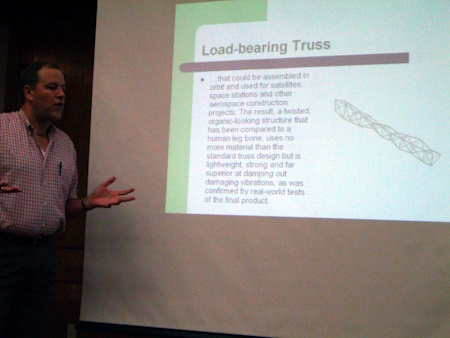
One of the more interesting things at the LoneStaRG was ACA's own Don Baker's presentation "Universal Darwinism: How Computer Science has Validated the Theory of Evolution". It can be summed up in a few sentences thus. Computer simulations can help to study evolution, which is hard to study otherwise, because it occurs very slowly in nature. The benefit flows both ways: the principles of evolution applied to computer science have lead to creation of a class of algorithms called genetic algorithms. I have to admit, I've already heard or read most of the points mentioned in his talk (as is more and more often the case with public science lectures I go to. Is that a downside of ed-joo-ma-cating myself, or what? But it was neat to see them summed up all in one place. The most interesting part of the talk were examples of designs that genetic algorithms have come up with, such as the hemispherical coverage antenna, and the load-bearing truss.

Hemispherical coverage antenna - Don Baker lecture on Universal Darwinism, September 2007 Hemispherical coverage antenna - Don Baker lecture on Universal Darwinism
Load-bearing truss - Don Baker lecture on Universal Darwinism, September 2007 Load-bearing truss - Don Baker lecture on Universal Darwinism
As Don noted, some of those designs seem really non-intuitive; they don't look like anything a human designer could have come up with, but their superiority was confirmed in real-world tests.

Monday, September 10, 2007

Odds are stacked against myth debunkers

Here is an interesting article I've read recently. It has depressing implications for Center Of Inquiry and I guess everyone who would like to see the world thinking more rationally.

Persistence of Myths Could Alter Public Policy Approach

Some highlights from the article:

The conventional response to myths and urban legends is to counter bad information with accurate information. But the new psychological studies show that denials and clarifications, for all their intuitive appeal, can paradoxically contribute to the resiliency of popular myths.

[...]

The research also highlights the disturbing reality that once an idea has been implanted in people's minds, it can be difficult to dislodge. Denials inherently require repeating the bad information, which may be one reason they can paradoxically reinforce it.

Indeed, repetition seems to be a key culprit. Things that are repeated often become more accessible in memory, and one of the brain's subconscious rules of thumb is that easily recalled things are true.


But silently ignoring the lies isn't any better, the article says:

So is silence the best way to deal with myths? Unfortunately, the answer to that question also seems to be no.

Another recent study found that when accusations or assertions are met with silence, they are more likely to feel true, said Peter Kim, an organizational psychologist at the University of Southern California. He published his study in the Journal of Applied Psychology.


The article ends with this pessimistic conclusion:

Myth-busters, in other words, have the odds against them.


It really makes you wonder if humanity is doomed to live in perpetual ignorance (and I know a lot of people would answer with a resounding "yes"! ;-() How did people ever stop believing, for example, that whispering incantations or casting an evil glance on someone can cause a person to fall ill? Actually, it may be too optimistic to say people stopped believing it. :-) There are plenty of people who still do, even these days. But at least the majority doesn't... I would hope. Or, OK, at least the majority doesn't think it's a valid reason to accuse someone of casting spells and burn them at a stake. So how did the humankind ever moved beyond these superstitions? Well, this question runs central to a James Morrow novel "The Last Witchfinder". The novel is about one woman's lifelong quest to banish not just the trials and executions of witches, but the very notion of witchery. We discussed this book in the FACT book club, and it lead to some interesting philosophical debates. I will post the report of the discussion in the next few weeks.

Wednesday, June 13, 2007

"Logical" may be in the eye of the beholder

There is this interesting article in this month's Scientific American.

The Traveler's Dilemma by Kaushik Basu

"When playing this simple game, people consistently reject the rational choice. In fact, by acting illogically, they end up reaping a larger reward -- an outcome that demands a new kind of formal reasoning"

Here is a long quote from the article, describing the game and the "paradox". (I put "paradox" in quotes because I don't think the behavior the author characterizes as illogical is at all illogical.) The quote is long, and the article itself is 5 times as long, but I found it rather interesting, myself, and the mathematics involved in it is very simple; it does not contain a single equation. :-)

The rules of the Traveller's Dilemma game


Lucy and Pete, returning from a remote Pacific island, find that the airline has damaged the identical antiques that each had purchased. An airline manager says that he is happy to compensate them but is handicapped by being clueless about the value of these strange objects. Simply asking the travelers for the price is hopeless, he figures, for they will inflate it.

Instead he devises a more complicated scheme. He asks each of them to write down the price of the antique as any dollar integer between 2 and 100 without conferring together. If both write the same number, he will take that to be the true price, and he will pay each of them that amount. But if they write different numbers, he will assume that the lower one is the actual price and that the person writing the higher number is cheating. In that case, he will pay both of them the lower number along with a bonus and a penalty--the person who wrote the lower number will get $2 more as a reward for honesty and the one who wrote the higher number will get $2 less as a punishment. For instance, if Lucy writes 46 and Pete writes 100, Lucy will get $48 and Pete will get $44.

What numbers will Lucy and Pete write? What number would you write?

Scenarios of this kind, in which one or more individuals have choices to make and will be rewarded according to those choices, are known as games by the people who study them (game theorists). I crafted this game, "Traveler's Dilemma", in 1994 with several objectives in mind: to contest the narrow view of rational behavior and cognitive processes taken by economists and many political scientists, to challenge the libertarian presumptions of traditional economics and to highlight a logical paradox of rationality.

Traveler's Dilemma (TD) achieves those goals because the game's logic dictates that 2 is the best option, yet most people pick 100 or a number close to 100--both those who have not thought through the logic and those who fully understand that they are deviating markedly from the "rational" choice. Furthermore, players reap a greater reward by not adhering to reason in this way. Thus, there is something rational about choosing not to be rational when playing Traveler's Dilemma.


I was stunned that the author would consider the number 2 to be the rational choice.

This is how the authors explains it


To see why 2 is the logical choice, consider a plausible line of thought that Lucy might pursue: her first idea is that she should write the largest possible number, 100, which will earn her $100 if Pete is similarly greedy. (If the antique actually cost her much less than $100, she would now be happily thinking about the foolishness of the airline manager's scheme.)

Soon, however, it strikes her that if she wrote 99 instead, she would make a little more money, because in that case she would get $101. But surely this insight will also occur to Pete, and if both wrote 99, Lucy would get $99. If Pete wrote 99, then she could do better by writing 98, in which case she would get $100. Yet the same logic would lead Pete to choose 98 as well. In that case, she could deviate to 97 and earn $99. And so on. Continuing with this line of reasoning would take the travelers spiraling down to the smallest permissible number, namely, 2. It may seem highly implausible that Lucy would really go all the way down to 2 in this fashion. That does not matter (and is, in fact, the whole point)--this is where the logic leads us.


But logic doesn't really lead us where the author says it does


Logic would lead us there only if Lucy's goal wasn't simply to get a big sum of money for her antique, but to get more, or at least no less, than Pete, at any cost, even at the cost of impoverishing herself.

The rest of this long article attempts to explain why most people, when play this game, behave "illogically", and -- gasp -- reap bigger rewards than if they were behaving "logically" and named 2 as their number. To me, the reason seems both obvious and easy to summarizein a couple of sentences. Most people's goal when playing this game isn't to beat the other guy, but to maximize the amount of money they get. I suppose they are perfectly fine with naming 100 and getting 98, while the other guy names 99 and gets 101. It's still a much better outcome for them than naming 2 and getting 2.

"Maximize" is probably the wrong word here. As long as they can get "close enough" to the maximum possible sum any one player could get (101), they don't care about attaining the absolute maximum. Of course, "close enough" is not easy to quantify mathematically, even though it can be interesting to try. My master's thesis was about heuristic algorithms in mathematical optimization, and heuristics are all about finding a "good enough" solution without worrying about the best.

Anyway, just because the actual human behavior can't be easily (or at all) explained by game theory, it simply means game theory is not perfect at modeling human behaviors (even in very simple scenarios such as this), not that humans behave irrationally.

Wednesday, June 06, 2007

Science fiction writers versus NYTimes science writers

It's time, again, to grumble, marvel, or snicker at the New York Times Science section. Today's essay by Dennis Overbye, The Universe, Expanding Beyond All Understanding, says that our successors (make that very, very distant successors. Like 100 billion years from now) may have no way of finding out about the Big Bang and the expanding universe.

Because...


Because the universe is expanding at an ever-increasing rate,

[Physicists Lawrence Krauss and Robert J. Scherrer] calculate [that] in 100 billion years the only galaxies left visible in the sky will be the half-dozen or so bound together gravitationally into what is known as the Local Group, which is not expanding and in fact will probably merge into one starry ball.

Unable to see any galaxies flying away, those astronomers will not know the universe is expanding and will think instead that they are back in the static island universe of Einstein. [...] Observers in our "island universe" will be fundamentally incapable of determining the true nature of the universe.


From there the author jumps to a conclusion which made me think that science fact writers are a bit lacking in imagination compared to science fiction writers. :-)

Such as...


It is hard to count all the ways in which this is sad. Forget the implied mortality of our species and everything it has or has not accomplished. If you are of a certain science fiction age, like me, you might have grown up with a vague notion of the evolution of the universe as a form of growing self-awareness: the universe coming to know itself, getting smarter and smarter, culminating in some grand understanding, commanding the power to engineer galaxies and redesign local spacetime.


If not for the line "all the ways in which this is sad", this paragraph would seem to indicate Dennis Overbye has read enough science fiction to be optimistic about the fate of the humankind and the universe. But then in the next paragraph he says:

Instead, we have the prospect of a million separate Sisyphean efforts with one species after another pushing the rock up the hill only to have it roll back down and be forgotten.


Wait, hasn't he read, for example, Charles Stross? Does he not know that long before 100 billion years are over, the humanity is destined to experience a technological singularity and transition to a post-human state, where (if they so wish) they will live in the forms of digital consciousnesses and travel through wormholes, thereby overcoming the light speed barrier? :-) But... since Dennis Overbye claims to be "of a certain science fiction age", maybe Charles Stross falls beyond his personal horizon. Perhaps the writers who came after the golden age of science fiction are as invisible to him as those distant galaxies that are flying away at the speed of light will be invisble to our successors. :-)

Otherwise, I would agree, the picture would be sad, if it's true that

As this universe expands and there is more space, there is more force pushing the galaxies outward faster and faster. As they approach the speed of light, the galaxies will approach a sort of horizon and simply vanish from view, as if they were falling into a black hole, their light shifted to infinitely long wavelengths and dimmed by their great speed. The most distant galaxies disappear first as the horizon slowly shrinks around us like a noose.


But really, I think that in a 100 billion years the humanity (though not in its present form, of course) will have both seeded the distant galaxies and mastered FTL communication.

Besides, why assume that our successors will have access to none of the knowledge the humanity has accumulated so far? Given how plentifully scientific knowledge is documented, there is a good chance it will survive for posterity.

And overall, how can you meaningfully speculate about what will happen a 100 billion years from now? For comparison, the current age of the universe is only 14 billion years. Most science fiction writers I know think you can't meaningfully speculate about the future beyond, let's say, 50 years from now. I don't know what is this "certain science fiction" age of which Dennis Overbye claims to be, but time seems to flow many orders of magnitude slower for him. :-)

Overall, though, he makes an interesting point. If you assume that the current astrophysical knowledge won't survive into distant future, then it's possible that, in the words of Dr. Krauss, quoted in this article, future cosmologists "will puzzle about why the visible universe seems to consist of six galaxies. [...] What is the significance of six? Hundreds of papers will be written on that." Moreover, the same thing may be happening today. Our physics and astrophysics research may be leading us down wrong paths because the evidence that would lead to right conclusions simply doesn't exist. Maybe we are already living too late to find critical evidence that would explain why the universe is the way it is. This aspect of the article is interesting. But the hand-wringing over the sad fate of future humans... gimme a break.