Rattlesnake at SXSW
(It's not a band. I don't go to concerts. :-))
Now that I've posted them, I can point the reader to the pictures of an interesting art machine -- a mutant vehicle, if you will -- I saw at the Plutopia party at South By Southwest last week. The party in itself was a bit disappointing compared with last year's; very few costumes, not many art / tech pieces (the Robot Group did not seem to come up anything more interesting since last year than a ping-pong printer; all it does is print text on ping-pong balls. As soon as I approached it, the guy manning the printer gave a long, autoironic spiel acknowledging the printer's uselessness. :-)) There were fewer performers and more speakers, such as Bill McKibben (I remember only one line from his speech about his grassroots movement against global warming: "We realized that it's not enough to screw in a fluorescent bulb over a breakfast table. We needed to screw in a new senator.")
But anyway, the coolest thing at Plutopia was the one I saw after I left. For obvious reasons it could not fit inside Scholz Garden and had to be parked on the street. It was a long white many-ribbed worm powered by bicycles. Nestled between the ribs was a total of 6 bicycles; plus there was a seat in front for drivers, a team of two young women, one of which was clad in a sexy devil costume. She said the name of this vehicle was Rattlesnake. (Not a worm, then.) The woman hopped into the drivers' seats, roped a few bystanders into taking passengers' -- or rather, co-drivers' seats, and took the thing for a ride on a nearly empty street. The snake turned tight corners with surprising grace. One thing I don't understand, though -- as in other projects of collaborative pedalling, like the ones I saw at the Maker Faire -- is, what happens if one of the riders does not pedal. Or pedals out of phase with others. Nothing, perhaps? And what about the steering? Was the driver the only one capable of steering, or the other bikers too? If so, what would happen if one of them tried to steer the thing in the opposite direction?
Showing posts with label art. Show all posts
Showing posts with label art. Show all posts
Tuesday, March 18, 2008


Saturday, December 01, 2007
Towel animals
I must mention one neat experience I had during the cruise, something that offset the flashiness, gaudiness and noise. Towel animals! When making up guests' rooms, the housekeeping crew folded towels into animal shapes and placed them on beds. They did it while guests were at dinner. There was a different animal each night: a seal, a dog, a cat, a frog.
Coming from dinner, it was fun to wonder what kind of towel animal we'll find that night.
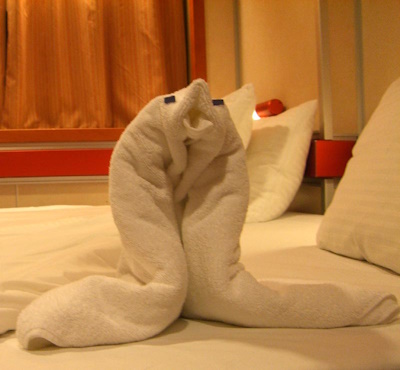
Towel seal, sitting on the bed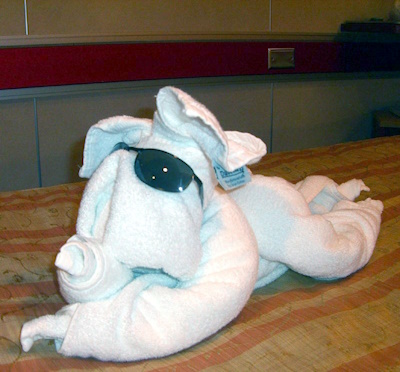
Towel dog with sunglasses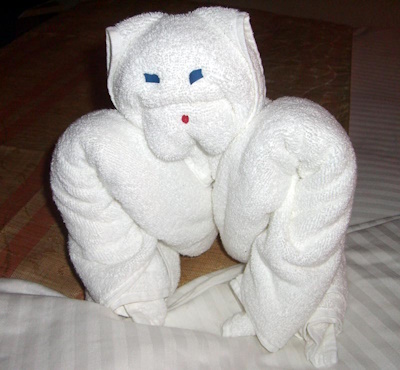
Towel cat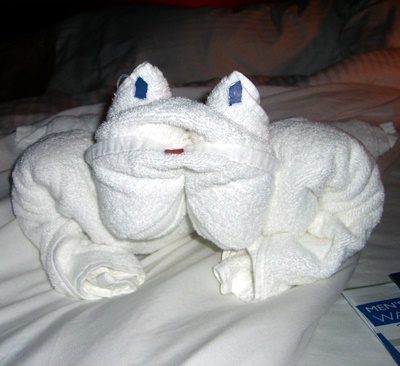
Towel frogThen on the last day of the cruise there was a workshop on how to make your own towel animals. It was only 30 minutes long, so we only had time to make a dog and a seal. Not because they take that long to make, but because the instructors had to explain the same steps over and over to a million people. Here are the pictures from the towel animal-making workshop, as well as pictures of several kinds of towel animals (including a swan and an elephant).
Friday, November 02, 2007
Maker Faire, part 5: of techno-optimism and reconstructed fashion
As one would expect at a faire, there were faire rides and merry-go-rounds. Supposedly they were all homemade? The amazing thing about them was that (I may be wrong on this) none of them ran on electric power. The ones I saw were all pedal-powered.
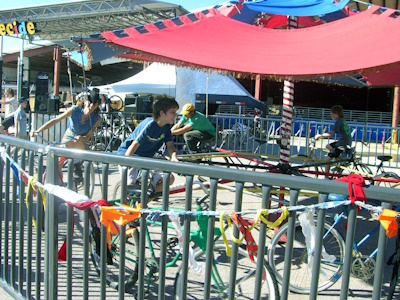
A bicycle merry-go-round at the Maker Faire 2007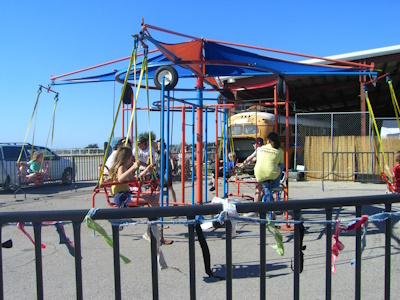
A pedal-powered fair rideSure, these merry-go-rounds were nothing like roller-coasters in industrial entertainment parks, but they also required more active participation on the rider's part than simply giving in to the centrifugal force. And some of them, like this circular see-saw, managed to frighten some riders. Apparently, pedaling was less trivial than they thought. It got me wondering, by the way -- do the riders all need to pedal synchronously, in phase and at the same speed? What happens if one of them slacks off or falls out of phase?
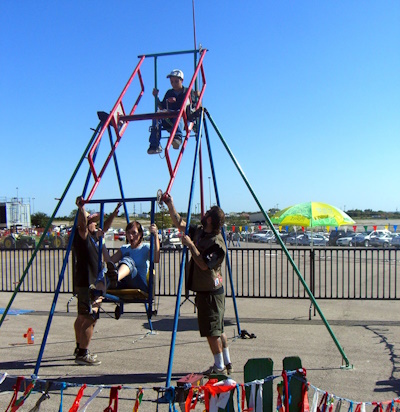
A pedal-powered circular see-saw in motion at the Maker Faire 2007(I didn't go on any of the rides, I must say. I'm way too uncoordinated for that. One look at them makes me lose my balance.)
And this rolling wheel was just stunning, but I wasn't sure if it could move on its own, or if it needed to be pushed. In this picture, a bunch of people are pushing it, but maybe just because they need to help it up the hill?
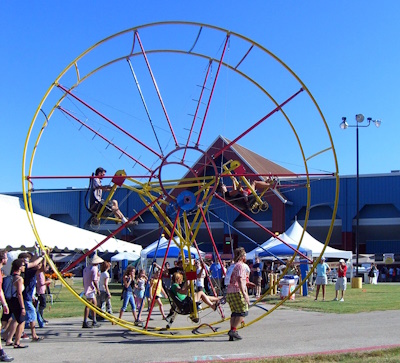
A pedal-powered mini Ferris wheel at the Maker Faire 2007More than anything else in this Faire, the merry-go-rounds and the modified cars left me optimistic in general about the ability of western civilization to survive the looming energy crisis. Oil may run out one day, but human ingenuity is under no such threat, it seems.
And then there was Swap-o-Rama-Rama, a two day event where you were supposed to be able to drop off your used clothing and be taught, or inspired, create new, reconstructed clothes out of stuff people dropped off. I didn't even stop by to check it out, because I knew it would ignite in me a temptation to start making clothes again. Sewing and knitting were my major hobbies in high school and college, but I abandoned them in favor of hobbies that hold a more profound appeal to me, such as writing. But I checked out their fashion show at the end of the day. They demonstrated clothes that were, IIRC, created during the day out of stuff people dropped off. Most of them were quite original. As I understand it, the creators of those clothes were actual fashion designers who specialize in "reconstructed" fashion. An ordinary person off the street, such as myself, would not likely have created something as good in just one day. But it was still interesting to see. Men's ties seemed to be a prominent sub-theme.
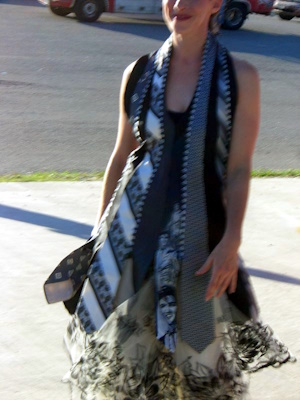
A dress made of ties and other recycled fabricsSeveral of the dresses shown at the fashion show were made out of ties. Well, it was good to see ties can be put to good use: I don't remember the last time I saw anyone wearing a tie according to its purpose.
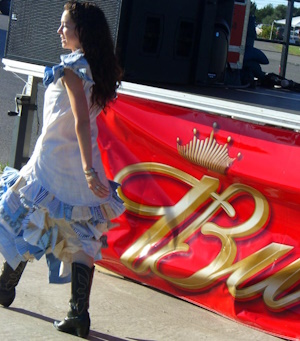
A dress with a ruffle made of ties and other recycled fabricsTuesday, October 30, 2007
Maker Faire, part 4: art cars
Many cars and bicycles exhibited at the Maker Faire made you pause and rethink your definition of a car or a bicycle.
There was a morbid, but fascinating roach mobile; a van covered with cameras (http://www.cameravan.com); an assortment of electric cars.
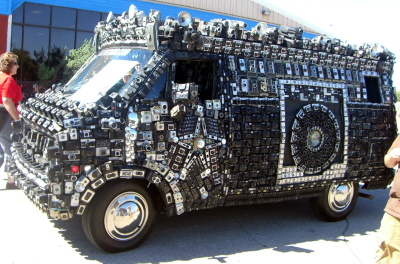
Camera Van at the Maker Faire 2007Some of them were made by companies that plan to make money off of them, others by hobbyists as tongue-in-cheek projects. Some were converted from cars that run on gas. Some allowed you to look under the hood, others (most) had no hood at all.
Then there was a panoply of wonderful bicycles in shapes of butterflies, grasshoppers, and who-knows-what. I felt like I stepped off into a fairy tale world.
Saturday, October 27, 2007
Maker Faire, part 3
There was also some art where the point wasn't so easily found.

Tree of Secrets, dream recorder
An example of such a contraption was the Tree of Secrets, which was a cardboard tree with microphones hanging off of it. You could speak your secrets into those microphones, and they would get recorded. Then you could play them back. I think you could also listen to other people's secrets (thus making it a tree of no secrets, said S.) When the tree accumulates enough soundtracks, it starts mixing them up. I guess that was supposed to somehow make it more interesting.
Another example was a dream recorder (?) that looked like an old, rusty voltmeter from a high school physics lab. You put it near your bed, and record your dreams in the morning. "Record" is too ambitious a word, though, because the only thing you can do with it is press one of the two buttons: "good" or "bad". Also, if I remember correctly, it's connected to the internet, and the needle on its face shows you the proportion of people who are having good dreams versus bad dreams. (Or maybe my subconscious made up this part as it tried really hard to find some meaning in this project.) Even so, this kind of dream evaluation could be shared only by people who have identical dream recorders near their beds. But... how many of them are there? Isn't the dream recorder a one-of-a-kind thing, given that it was created by a graduate student as a course project?
Yes, both of these exhibits were created as course projects by students of a graduate program with some kind of... umm... trendy name, like Interactive Communications, or Interactive Media, or some such. S told me I wasn't supposed to see a point in these projects: they were Art. Period. I said it wasn't obvious to me that this program was primarily artistic rather than technical, as the name sounded slightly geeky. Well, S shamed me for looking for utility value in this art. Oh well. Yet I kinda felt sorry for those students. While I do remember having to do graduate course projects that seemed about as useful as shoveling sand from one pile to another (i.e. they did not involve original research, only reshuffling the existing data), I still think they were more meaningful than, say, making a tree of secrets. As I said, I'm not cut out to be an artist.
If you were curious what true randomness sounded like...
Along the same lines, I felt, was Kosmophone by Jerry Chamkis, a "musical" instrument that synthesizes sounds from gamma rays. This device measures frequency, wavelength, or energy (he said those things were interchangeable) of gamma rays that are hitting the Earth at all times, and a synthesizer "translates" those measurements into sounds. By the sound of it, gamma rays hit it at varying intervals averaging about once in a couple of seconds, so the device produces a steady ping-pong-pung of random notes at random intervals. This was the gist of the half-an-hour long talk by Jerry Chamkis. I actually figured out what it was doing after hearing the first 5-10 of these "musical" sounds. The rest were the details about how this instrument was made. I more or less slept through the details, but S was interested: his graduate studies in physics were all about chasing elementary particles, so he found some common ground with Chamkis. He had a chat with the creator of the Kosmophone about stuff like what materials you use to make a light-tight casing for your sensitive components.
The obvious -- and perhaps the only -- point of Kosmophone, as Chamkis readily admitted, was to give the listener an experience of true randomness. Try as they may, humans can't create truly random processes. But truly random processes do exist in nature, and spectral characteristics of gamma rays hitting the Earth are one of them. So, before I could open my mouth and say to S "this could make a really good random number generator on a computer", he turned to me and said the same thing. Then one guy in the audience said it out loud. Apparently all the computer geeks in the audience had the same thought. Chamkis replied that while that's true, it wouldn't be practical, because the rays hit the Earth way too infrequently. In computer applications -- mostly cryptography -- random numbers need to be generated much faster than a sequence of gamma rays would allow.
Screaming Babyhead, a robot band at the Maker Faire 2007So, the projects demonstrated at the Maker Faire were a mixed bag. Which of course means there was a lot of good in it too. There were tons of robots, as I said before, but most of them had artistic rather than utilitarian value. For example: a robobabe/angel, or Marvin Niebuhr's Screaming Babyhead band of robots -- a very steampunky bunch of musicians. If they played any music, it must have been lost in the general din of the exhibit hall, as I couldn't hear anything.
Wednesday, October 24, 2007
Maker Faire, part 2
Maker Faire in bullet points:
Cute and practical: floating speakers, hidden in Mylar balloons.
Artsy and practical: Stop-Motion Armatures, poseable figures that can be photographed serially to create animation.

Pleo, a robot dinosaur pet at the Maker Faire 2007Artsy and geeky: thereping.
Geeky and cuddly: robotic dinosaur pets, named Pleo, that have a range of sentient-looking behaviors.
Geeky with a hard science edge: Stirling engines.
Quirky technology that has its uses: wood iPods.
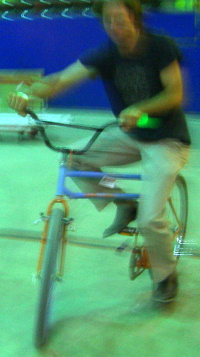
A person trying to ride a bicycle with a hinge in the middle at the Maker Faire 2007Quirky technology that's not useful for anything except to build your character through extreme frustration: bicycle with a hinge in the middle. "You really have to steer it two ways!" said a perplexed guy after making a few wobbly laps on this bicycle. Many people fell trying to ride it.
This peculiar item is in a category that's worth a separate article: quirky / art cars. And it will have a separate post! But first, some snarkiness. Coming up tomorrow.
And here are even more pictures from the Maker Faire 2007
Sunday, October 21, 2007
Maker Faire, part 1
Maker Faire is upon us! According to its website, it is a "two-day, family-friendly event that celebrates arts, crafts, engineering, science projects and the Do-It-Yourself (DIY) mindset". In my own words, I'll say only this: who needs Flipside when you have Maker Faire? It has a much higher concentration of quirky technology and art, it's in an air-conditioned building (part of it, anyway), and -- best of all -- there is no techno music!
The Do-It-Yourself stuff exhibited here ranges from technology to art to food (cooking is the DIY of food, right?), and the exhibits cover every category: from practical, to art-that's-actually-beautiful, to art-that's-kinda-pointless, to practical technology, to technology that has no value except quirk, to technology that has no point at all. Most of the technology demonstrated here only had value as an art piece, however. Or as a proof of concept. There were exceptions, of course. I will cover a bit of all of those categories in a few upcoming posts.
For starters, here is an example of DIY art that struck the sweet spot between beauty and utility like only a few projects at the Faire did: lampshades made of interlocking plastic pieces, here and here.
The overlapping area between art and technology was densely populated by robots created by our own local Robot Group. A robot that unexpectedly appealed to my girly side was Mechanical Flower, created by Denise Scioli and Ms. Puiyee "PY" Hung from the Robot Group. The flower's inner petals are made of a steamer insert, identical to the one I have at home. Mechanical Flower's steamer insert dances, opening and closing to the music, slow or fast.
Here is a video:
The tiny holes in the steamer insert create hypnotizing moving patterns when its "petals" open and close. What an exaltation of a mundane steamer! (To be sure, I don't see mine as mundane. For me it is one of the most beautiful household items I own. Its petalness (petality?) can easily inspire one to think of its potential uses for art. To non-artistic people, like me, this call is barely a passing whisper, but artistic people take things like this and incorporate them into their art projects.
Here are more of my blog posts and pictures about the Maker Faire.
Oh, one more important thing. Steve enjoyed this event as much as I did! It is very rare for him to like the same things I do. Hmm, what else is going on in Austin on a regular basis that resembles Maker Faire?
Saturday, March 03, 2007
A very unusual facial
Mykel and Paul (Steve's and my friends from the ACA) have this hobby, live-casting, where they make a cast of somebody's face or other body parts, fill it with water putty and turn it into a sculpture. Then they make masks based on that sculpture by way of vacuum forming. Mykel wanted to practice making face casts, and she asked if she could practice on me. I happily obliged -- it's not every day that you get to experience something like that. So, last weekend Mykel did a cast of my face.
The technique they use is to cover the "victim's" face with alginate -- gooey stuff that quickly sets and captures your facial features wery well. Too well, as we'll see later. Then when it sets, they put plaster on top of it. The purpose of plaster is to solidify the mold, because alginate alone, even when it's set, is too soft / wobbly.
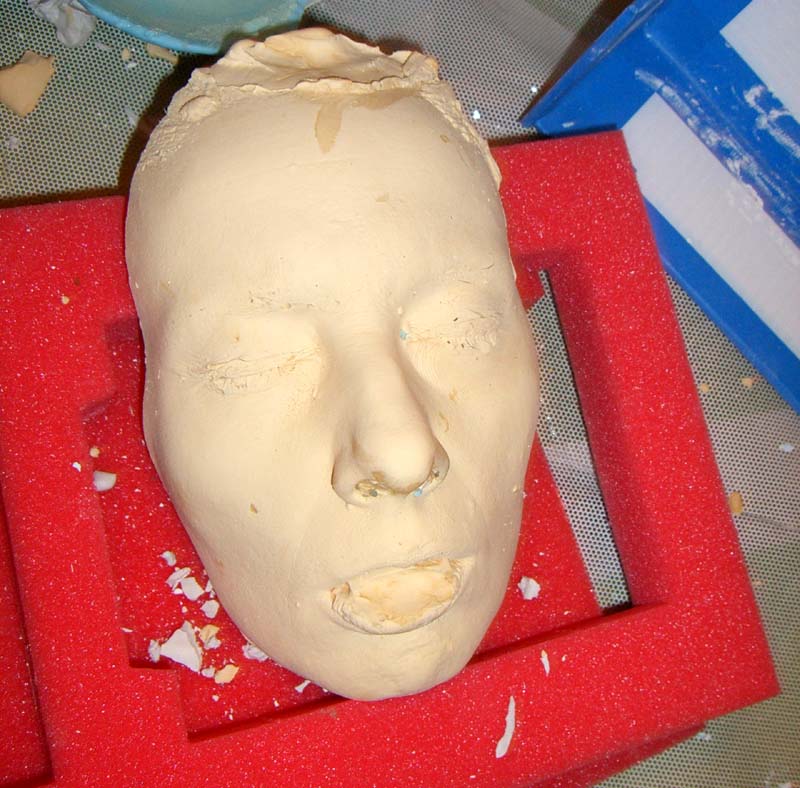 As one can see, my eyes are scrunched and I look like I'm about to vomit. The vomiting effect is due to the mouthpiece I was holding in my mouth for breathing. We concluded it was way too big. To preserve a natural shape of a person's lips, a much, much smaller, discrete mouthpiece would be needed. The best thing, of course, would be to go without it and just breathe through the straws in the nose, which is what Paul and Mykel did when they made casts of each other's faces. Since I can't do that very well, I'm probably not a good candidate for a face-casting model. The scrunching of the eyes is, of course, due to the difficulty maintaining a relaxed facial expression in these circumstances, as I said above. The instinct that screams "I'm being burried alive!" in your head is pretty hard to shut up.
More pictures of face casting can be found in my blog post documenting the facecasting process.
As one can see, my eyes are scrunched and I look like I'm about to vomit. The vomiting effect is due to the mouthpiece I was holding in my mouth for breathing. We concluded it was way too big. To preserve a natural shape of a person's lips, a much, much smaller, discrete mouthpiece would be needed. The best thing, of course, would be to go without it and just breathe through the straws in the nose, which is what Paul and Mykel did when they made casts of each other's faces. Since I can't do that very well, I'm probably not a good candidate for a face-casting model. The scrunching of the eyes is, of course, due to the difficulty maintaining a relaxed facial expression in these circumstances, as I said above. The instinct that screams "I'm being burried alive!" in your head is pretty hard to shut up.
More pictures of face casting can be found in my blog post documenting the facecasting process.
The process made me feel a little more claustrophobic than I would like.
When I say they cover your face with goo, I mean they cover everything, including your eyes (which are, of course, shut), and your mouth. The only hole left open in your face is your nostrils, and only because you have put straws into them prior to casting, otherwise you wouldn't be able to breathe. As one can imagine, having your eyes and mouth glued shut by a thick layer of goop feels a bit disconcerting. Claustrophobic, even. The catch is that anxious or not, you are supposed to maintain a relaxed, pleasant facial expression. Alginate is extremely sensitive to your facial features, it captures every tiniest detail of your skin, including fine lines, pores and zits. Soooo, if you frown or scrunch your eyes, your mask will feature ridges and valleys in the corresponding places. It was a tough order for me and I didn't do well at it, so the results of my cast were a bit disastrous, as we'll see later.It doesn't help that I can't breathe through my nose
Fortunately or not, the first time Mykel applied alginate to my face, it set too quickly, before she could spread it completely. So she had to take it off and try again, using colder water to make alginate mixture. During the first try I realized I won't be able to breathe the whole time (close to an hour) through the straws in my nose. I have trouble breathing through the nose for long periods of time. Paul and Mykel addressed this problem by making a mouthpiece for me corrugated cardboard that allowed me to breathe through my mouth. (The little tunnels in the corrugated cardboard serve that purpose very well.) However, in the end it turned out that it kind of ruined the cast: it was way to big to allow me maintain a natural shape of my lips. Paul and Mykel did not have experience with mouthpieces: all the people they've done casts off were able to breathe with only the straws in their noses. After the alginate was set (which took about 5 minutes this time), Mykel applied plaster to my face. The more plaster is applied, the heavier the mask feels (plaster is heavier than alginate); also, while a layer of alginate on your face still lets you see the light in the back of your eyelids, plaster shuts the light out completely, and you are left sitting in total darkness. It made the claustrophobic feeling a bit more intense. Fortunately, the darkness / heaviness increases gradually, so you have time to adjust to it.The result was not flattering
Once plaster was set (or "cured" -- the word Mykel used) I finally got to peel the mold off my face. I could hardly wait for that moment. Not so much to see the intermediate product, as to be free again! To see the light! Then Mykel mixed some water putty and poured it into the mold. It quickly set. Then she took the cast -- the water putty product -- out of the mold, and I finally got to see the likeness of me!
As one can see, my eyes are scrunched and I look like I'm about to vomit. The vomiting effect is due to the mouthpiece I was holding in my mouth for breathing. We concluded it was way too big. To preserve a natural shape of a person's lips, a much, much smaller, discrete mouthpiece would be needed. The best thing, of course, would be to go without it and just breathe through the straws in the nose, which is what Paul and Mykel did when they made casts of each other's faces. Since I can't do that very well, I'm probably not a good candidate for a face-casting model. The scrunching of the eyes is, of course, due to the difficulty maintaining a relaxed facial expression in these circumstances, as I said above. The instinct that screams "I'm being burried alive!" in your head is pretty hard to shut up.
More pictures of face casting can be found in my blog post documenting the facecasting process.
Subscribe to:
Posts (Atom)

 Posts
Posts


