Showing posts with label cruise. Show all posts

Saturday, December 01, 2007

Towel animals

I must mention one neat experience I had during the cruise, something that offset the flashiness, gaudiness and noise. Towel animals! When making up guests' rooms, the housekeeping crew folded towels into animal shapes and placed them on beds. They did it while guests were at dinner. There was a different animal each night: a seal, a dog, a cat, a frog.

Coming from dinner, it was fun to wonder what kind of towel animal we'll find that night.

Towel seal seen on a cruise ship, November 2007 Towel seal, sitting on the bed
Towel dog with sunglasses, seen on a cruise ship, November 2007 Towel dog with sunglasses
Towel cat seen on a cruise ship, November 2007 Towel cat
Towel frog seen on a cruise ship, November 2007 Towel frog

Then on the last day of the cruise there was a workshop on how to make your own towel animals. It was only 30 minutes long, so we only had time to make a dog and a seal. Not because they take that long to make, but because the instructors had to explain the same steps over and over to a million people. Here are the pictures from the towel animal-making workshop, as well as pictures of several kinds of towel animals (including a swan and an elephant).

Friday, November 30, 2007

A mentally draining vacation

This was definitely one of those cases where you need a vacation to recover from your vacation. For a few days since coming back I was still exhausted and felt a fantom ship rocking under my feet. I also continue to be brain dead.

I'm wondering if we should have gone on a Geek Cruise instead. Yes, there are cruises that have classes on all things geeky, such as becoming a Mac power user, or learning the ins-and-outs for Photoshop, as opposed to what passed for entertainment on our cruise (men's hairy chest contest, a seminar on how to get the best deal on diamonds in Cozumel). My IQ immediately dropped two standard deviations and haven't completely recovered.

Aside from lack of mental stimulation, our cruise was very geek-unfriendly in one other way. Lack of electric outlets. For shame! There was only one -- count them, one -- electric outlet in our room! So our power-thirsty devices (two laptops, two cell phones, one camera) had to take turns being charged. Just as bad, there were very few power outlets all around the ship, in the areas people hang out, such as bars, lounges, and eateries. I was hoping to find a nice, quiet corner on the ship, with a view of the sea, away from people, and camp out there with a laptop for some quality writing and blogging. No luck. I did less writing there than I do on a typical weekend at home. Like I said, the cruise atmosphere is not conducive to intellectual exertion. :-)

Making you feel like a sheep


The second most popular thing here beside feeding, it seems, is taking people's pictures. There are photo stations set up throughout the ship, where you can have your picture taken in a variety of settings: on the grand atrium stairs, in front of a huge poster of the ship Ecstasy, dressed up in a period costume, hugging a showgirl, or with all kinds of other props. A photographer also walks around the tables at dinner time and takes everyone's pictures. You can later purchase the pictures you liked. At one time the photographer was accompanied by a man dressed as a pirate. (We were in the Caribbean, after all! :-)) The "pirate", of course, has a hook for an arm; he shoves his hook under your neck, you smile (or make a scared face if you're feeling creative), the photographer clicks, and they move on to a next person. There are ~ 1500 people dining at the same time, and the photographer / pirate duo needs to process them all. Methodically, without missing a beat, without lingering an extra second, they move from person to person: put a hook under your neck, wait for a smile, click. I guess an assembly line approach is efficient when it comes to, say, bagging groceries, but a bit counterproductive when attempting to create fantasy memories. :-) Still, on a ship with 3000 people, assembly line approach is usually the only possible one, especially where it comes to herding people off the ship and on to tour buses, then back on the ship, etc. At every step there are crew members telling you where to go, where to stand, when to have your card in hand, etc. It's been a long time since I've felt so much like a sheep, what with all that herding, card-swiping, photographing and force-feeding. :-)

But I'm not griping. After all, there was luxury and there was free time, which is more than you can say about most life situations.


Thursday, November 29, 2007

The cruise: tour guides that double as salesmen.

As I said before, these cruises seem to be designed to herd tourists from one money-extracting opportunity to another. The shore tours were just as efficient. On a ride to the ruins, a tour guide doesn't just recite historical facts about the ancient Mayan civilization. He also makes a sales pitch. On the ride to Chichen Itza the guide told us about Mayan calendars. Interesting stuff, and Wikipedia has a lot more on it. Of course, our guide did not give us a lecture of the same length and complexity as the article I'm referring to; he condensed it into a few sentences, from which I took away only that Mayan calendars were systems of interlocking cycles of various length; one of the most important cycles is 260-days long and based on the length of human pregnancy. (Oh, and two major cycles will both end in 2012, and that year will be a beginning of a Mayan new era; some apocalyptic nuts are already preparing for that. :-)). So, the guide told us we now had a unique opportunity to have personalized Mayan calendars made for us, and he passed around forms to fill out with personal info to put on a calendar. The calendars would be made by local artisans while we wander in the ruins of Chichen Itza. In what way a Mayan calendar can be personalized, I don't know; do they just mark your (spouse's, children's, etc.) birthday(s) on those cycles, or what? Or do they mark "significant" dates that result from interlocking of the cycles, as the dates to start major undertakings in your life? Is it a bit like astrology, then? I don't know; I sat too far in the back of the bus to hear the guide very well. ;-) Needless to say, I wasn't tempted by the offer.

Similarly, on the ride to Tulum, the tour guide (a different one) was offering to sell us little silver charms with our names written in Mayan characters. The charms were yet to be made; the guide passed around forms to fill out with personal information that would be collected as we get off the bus, and the charms would be made while we were on tour. But... Mayan characters are funny business. Our Tulum guide said ancient Mayan script was phonetic (i.e. each sound was represented by a letter), hence it should be possible to write any name, including foreign ones, in Mayan. However, our Chichen Itza guide said Mayan language actually used logograms or hieroglyphs. (And Wikipedia confirms it.) In theory at least that would make it impossible to write foreign words in Mayan characters, as I don't believe they had characters for Jim or Bob, or anything like that. :-)) So if anyone ordered those trinkets (I certainly didn't), I can only wonder what the characters on them said. Maybe "kill all the palefaces"? :-)

Wednesday, November 28, 2007

More on Mexico

As I said, I didn't get to see much of Mexico, except for little towns I glimpsed out of a bus window. Those towns, starting with Progresso, were rather dilapidated. To get to the ancient ruins we had to pass a lot of modern day ones. The 1-2 story buildings that lined the streets had gaps between them like missing teeth, where formerly occupied houses had been left to decay. In some places inner courtyards of houses had become open where a front wall had crumbled; I could see smoke, but not a single soul concerned with the fire: were those fires purposeful? Did people cook on an open fire right in the middle of their backyards? Or did they incinerate their trash, or...? Who knows? I didn't have time to speculate as the bus kept moving (too fast for me to take pictures) and new scenes replaced the old ones.

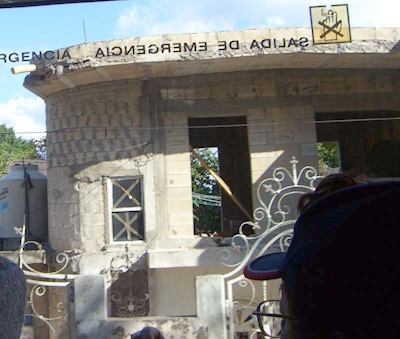
A round house with scrollwork fence, seen out of a bus window in Mexico, November 2007 A round house with scrollwork fence, seen out of a bus window in Mexico. A beautiful house, but clearly it has seen better days, judging by the gaping holes where windows would be.

Even if you only spend a few hours in Mexico and stick to tourist routes, you can still see enough evidence that things are different there than here. Whenever somebody walked into a public restroom in Tulum, a restroom attendant would say: "water ees normal dee color". If you took a look at any of the toilets, you could see why she kept repeating it: the water in the toilets was dark brown, the kind of color that would make you go "ewww". Of course, it may have been more effective to plaster the bathroom with signs in several languages, but then the attendant would be out of job. Stuff like that can lead you to ruminate on topics like poverty, many faces thereof. Poverty is not necessarily having nothing to eat, it is also the only job available to you being one where you have to repeat the same phrase over and over, robotically, every 5 seconds. I'm sure I speak for a lot of people when I say I would turn into a blubbering idiot after doing this kind of work for just a few hours.

Tuesday, November 27, 2007

The cruise: Chichen Itza

Chichen Itza is one of the best known Mayan ruin sites. It's a 2 hour ride from Progresso (Mexico), our second port of call. So we spent 4 hours on the bus and only about 2 hours in Chichen Itza. But even if I had spent several days there, I wouldn't have more to say about it than Wikipedia has. So what can I say that others haven't? I can only speak about my own clumsy attempts to grasp the greatness of this historical site.

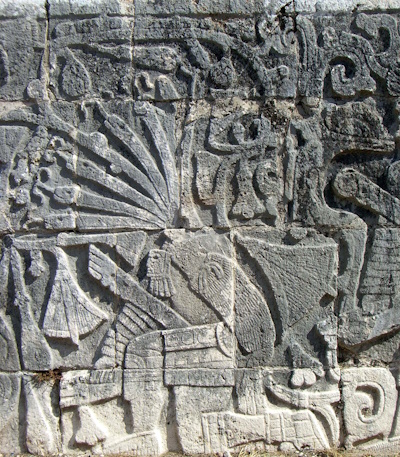
As expected, the tour guide barraged us with information, much of it pertaining to the stone carvings on the walls of the Mayan ritual ball game court. I might have digested it better, had I a bit more time to tune my eye to the ancient Mayans' rather liberal interpretation of human anatomy. The carvings on the wall of the ball game court tell stories of human sacrifices performed at the ball game. Or they would, if you could make out actual human figures in those pictures. You can see a semblance of a face here or there, but mostly the carvings look like abstract ornaments. Yet to our guide they were clear as day. Here a priest holds a knife over a kneeling victim, he said. And over there he holds a severed head. And here is blood gushing forth from the victim's neck. Actually, I think I got a picture of the gushing blood. It might be the one below.

Beheaded player sculpture at Chichen Itza, November 2007 Beheaded player sculpture at Chichen Itza

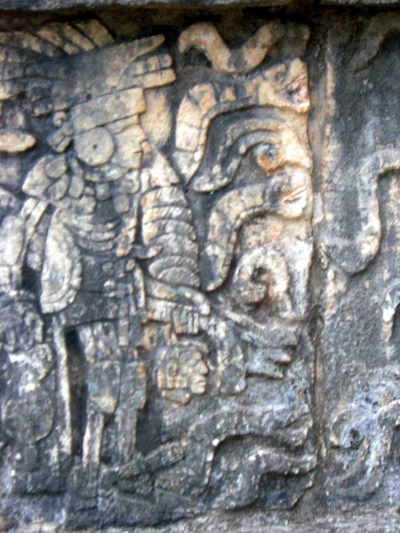
And I think I was able to make out a severed head in this picture (below), although it was hidden really well.

Priest holds a severed head - a Mayan carving in Chichen Itza Priest holds a severed head - a Mayan carving in Chichen Itza

Regardless, S and I were left confused about some important aspects of human sacrifice. We could not agree if the guide said ancient Mayans sacrificed a player from the losing or the winning team. I thought it was logical that a member of the losing team would be sacrificed. However, Steve thought that since being sacrificed to the gods was a great honor, that honor fell to one of the winners!

Here is my bigger blog post with more pictures from Chichen Itza

.

Friday, November 23, 2007

The cruise: ruins of Tulum

The cruise: ruins of Tulum

Steve and I recently went on a Caribbean cruise that stopped at two places in Mexico. So, technically I can say I've been to Mexico, even though I spent at most 16 hours there, a good 10 of them on buses and ships. As little as I've seen of that country, it shall not prevent me from filling up these pages with my detailed impressions. As always, I'll do it in installments.

First, the Mayan ruins of Tulum.

Our ship stopped off at Cozumel and Progresso; a variety of tours was offered at each port of call. One of the options at Cozumel was to tour the Mayan ruins of of Tulum. They are not actually in Cozumel, which is an island; Tulum is in inland Mexico, ~ 1.5 hours bus ride from the coast. So, first you have get to the coast from Cozumel. It means taking a boat. A small boat. (Small, at least, in comparison with the gigantic cruise ship.) The waves are, of course, the same size whether you are on a big or a small boat, but the amplitude of motion felt by passengers is very different. What feels like a gentle rocking on a big ship, feels like a rollercoaster on a small ship. The ride was only 40 minutes, but man, did I get sick! Sea-sickness is a bitch. I felt residual nausea the rest of the day. And then I had to return to Cozumel on the same boat, across the same choppy sea! Fortunately, it wasn't as bad. Perhaps the sea was really calmer, or because I sat in the bottom deck (the amplitude of motion must be smaller at the bottom, at least in theory), or because I kept my eyes closed for the entire ride back (when you don't see the horizon heaving up and down, your brain has fewer clues that the ship is rocking), but I tolerated the ride back fairly well.

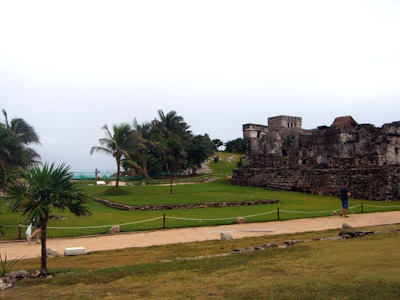
Nausea or not, the trip was worth it, even more so since I haven't seen ancient Mayan cities before. From the ruins of Tulum a beautiful view opens up to the sea

.
View of the sea from the ruins of Tulum, November 2007 View of the sea from the ruins of Tulum

It was there, according to our tour guide, that the Mayans of Tulum first saw the masts of Spanish ships over the horizon. (Or maybe our tour guide was dramatizing, as the ruins themselves weren't very dramatic, at least not in rainy weather.) And we all know what happened next. This adds a twinge of sadness to the beautiful view. Tulum survived only a few years after that. Actually, the tour guide said the Spaniards left Tulum alone, because there was no gold in it. The Spaniards had made their outpost in what is now Cuba, and raided various places along the Mexican coast, mostly looking for gold. But after the Spaniards conquered the Aztec emperor Montezuma, Tulum's days were numbered.

Then again I'm not sure if (a) I heard the guide correctly, and (b) he wasn't making things up. I later noticed some things our guide said were of dubious truthiness. (Like for example, that a certain restaurant at Tulum, run by his friend, had best margaritas in the world. I tried a margarita there, and it was decent, but I've had better in some places in Austin. Ditto for the food. Still, it wouldn't be right to go to Mexico and not have "authentic" Mexican food and drink, now would it?)

Here are more of my pictures from Tulum.