Showing posts with label history. Show all posts

Monday, October 25, 2010

Medieval oddities, and other minor points of interest in Paris

Museum of the Middle Ages. Lots of medieval arts and crafts -- paintings, tapestries, sculptures, religious objects such as reliquaries or incense holders; jewelry, housewares. I remember a tapestry that portrayed a robbery (at least as far as an eye untrained in art and medieval history could guess) -- you have to wonder if back in the day this was a substitute of crime scene photography. Did the maker of the tapestry present it as evidence in court?

Some tapestries from the Middle Ages were hyper-realistic. Look at the monkey (?) at the bottom of this hunting scene -- is it really doing what I think it's doing? And why was it so important to put that in the picture?

Outside of the Museum of the Middle Ages there is a huge pit with uncovered ruins of Roman baths. The whole area is fenced off, and I'm not sure if it is ever open; if there was a door inside of the museum to get to the excavated area, we couldn't find it.

Ruins of Roman baths at the Museum of Middle Ages

Cluny museum. Paintings, lots of paintings -- mostly impressionists and expressionists. Or maybe it was just one special exhibit we visited. Could not spend much time in the museum, as we arrived 1 hour before closing. Turns out that was cutting it very close: we were among the last few people to were admitted. So, there was plenty of Van Gogh and Gauguin, and... well, that's where my familiarity with painters of that era ends, so I can't list other undoubtedly famous names.

Trash in a tomb in Pere Lachaise cemetery

Pere Lachaise cemetery, where many famous people are buried (including Jim Morison). It's a quiet little city-in-the-city with its own streets and alleys. Famous or not, some tombs seem to be abandoned, judging by how trashed they are. It's spooky to be there near closing time: a sign says the cemetery closes at 6, but there are no guard around to usher the stragglers out. Will they lock the gate leaving the slowpokes inside until morning? That's what you wonder as you rush this way and that trying to find the exit, or look for any signs of other people heading towards exits. (Spoiler: we got out! The exit wasn't really locked. No luck in getting to spend a night stretched out on Jim Morison's grave.

More pictures from my trip are in my photo gallery.

Saturday, October 23, 2010

Louvre of the Rings

Louvre is gigantic. Finding Mona Lisa would be like a needle in a haystack, but the helpful signs everywhere assure you won't be lost in making your way to it. All throughout the museum there are arrows pointing you towards the halls where Mona Lisa, Venus of Milo, and other legendary art treasures are displayed. I'm not sure, though, if they are worth seeing for anything other than the sense of irony. You brave the crowds surrounding those famous exhibits, only to check a mental checkmark: yes, Mona Lisa really looks just like in the pictures. Not that you could see anything details by peering at it above the sea of heads. Heck, it's not like you could see anything new if you stared at it up close. And still, a visit to Louvre would feel incomplete without it, wouldn't it?

Glowing inscriptions on the walls of medieval Louvre Glowing inscriptions on the walls of medieval Louvre

But there is more interesting stuff to see at Louvre. Most notably, its basement. Segments of medieval walls of a castle that Louvre once was are displayed here. Walking a circular tunnel (it may be a tunnel between the outer and an inner walls of the castle, but I'm not sure) you can look at roped-off niches and caves, and wonder what their purpose one was -- or did they form as the wall decayed? You can come up close and take a peek into deep wells that plunge into underground depths. Such perfect places for The Eldritch Ones to crawl out of the depths of the Earth. This glowing, cursive lettering above the well -- is it an invocation? :-)

These glowing strings of words were everywhere in the tunnels. On curving walls, they resembled the Dark Speech inscription on Sauron's Ring. :-) I don't know much French, but judging from the few words I could make out, they did not present facts about the medieval Louvre; rather, they were poetic musings about history, or something of that nature.

Some of the museum halls have white, spare walls not to draw attention away from the classical statues housed in them; others have preserved the gaudy splendor of a royal palace back from the days when Louvre was one. Some painting collections are displayed in huge halls on walls that already have every square centimeter of them painted or gilded. The paintings hanging on them are probably as big as my entire living room wall; but they don't look that huge, because they are hanging high on the wall, right underneath a vaulted ceiling (which too is painted with uncountable frescoes, and decorated with gilded ornaments). It's so ridiculously over-the-top -- your mind boggles at the excess kings lived in.

More pictures from my trip to Paris are in my photo gallery.

Friday, July 04, 2008

Turns out, cavemen loved to sing, says an article headline on msnbc.com. How, one wonders, do the modern scientists figure out such things? This article is interesting not just in that it reveals specifics of life of prehistoric civilizations, but also that it shows how scientists reach conclusions about things as nebulous as leisure preferences of long-gone civilizations. Namely,

Ancient hunters painted the sections of their cave dwellings where singing, humming and music sounded best, a new study suggests.

Analyzing the famous, ochre-splashed cave walls of France, scientists found that the most densely painted areas were also those with the best acoustics. Humming into some bends in the wall even produced sounds mimicking the animals painted there.


They did it not just for their amusement. Cave dwellers used echolocation to map out the properties of the caves, the article says.

With only dull light available from a torch, which couldn't be carried into very narrow passages, the ancient hunters had to use their voices like sonar to explore the crooks and crannies of a newfound cave.


As an aspiring science fiction writer, I'll certainly keep this article in mind when or if I try to invent an alien civilization for a story I'm writing. It provides enough inspiring details to fill out a picture of an ancient culture.

Friday, November 23, 2007

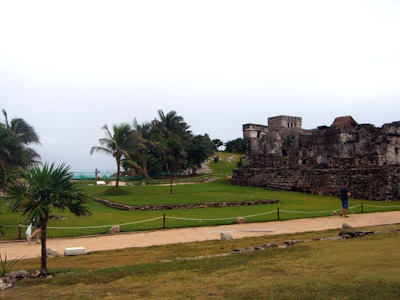
The cruise: ruins of Tulum

The cruise: ruins of Tulum

Steve and I recently went on a Caribbean cruise that stopped at two places in Mexico. So, technically I can say I've been to Mexico, even though I spent at most 16 hours there, a good 10 of them on buses and ships. As little as I've seen of that country, it shall not prevent me from filling up these pages with my detailed impressions. As always, I'll do it in installments.

First, the Mayan ruins of Tulum.

Our ship stopped off at Cozumel and Progresso; a variety of tours was offered at each port of call. One of the options at Cozumel was to tour the Mayan ruins of of Tulum. They are not actually in Cozumel, which is an island; Tulum is in inland Mexico, ~ 1.5 hours bus ride from the coast. So, first you have get to the coast from Cozumel. It means taking a boat. A small boat. (Small, at least, in comparison with the gigantic cruise ship.) The waves are, of course, the same size whether you are on a big or a small boat, but the amplitude of motion felt by passengers is very different. What feels like a gentle rocking on a big ship, feels like a rollercoaster on a small ship. The ride was only 40 minutes, but man, did I get sick! Sea-sickness is a bitch. I felt residual nausea the rest of the day. And then I had to return to Cozumel on the same boat, across the same choppy sea! Fortunately, it wasn't as bad. Perhaps the sea was really calmer, or because I sat in the bottom deck (the amplitude of motion must be smaller at the bottom, at least in theory), or because I kept my eyes closed for the entire ride back (when you don't see the horizon heaving up and down, your brain has fewer clues that the ship is rocking), but I tolerated the ride back fairly well.

Nausea or not, the trip was worth it, even more so since I haven't seen ancient Mayan cities before. From the ruins of Tulum a beautiful view opens up to the sea

.
View of the sea from the ruins of Tulum, November 2007 View of the sea from the ruins of Tulum

It was there, according to our tour guide, that the Mayans of Tulum first saw the masts of Spanish ships over the horizon. (Or maybe our tour guide was dramatizing, as the ruins themselves weren't very dramatic, at least not in rainy weather.) And we all know what happened next. This adds a twinge of sadness to the beautiful view. Tulum survived only a few years after that. Actually, the tour guide said the Spaniards left Tulum alone, because there was no gold in it. The Spaniards had made their outpost in what is now Cuba, and raided various places along the Mexican coast, mostly looking for gold. But after the Spaniards conquered the Aztec emperor Montezuma, Tulum's days were numbered.

Then again I'm not sure if (a) I heard the guide correctly, and (b) he wasn't making things up. I later noticed some things our guide said were of dubious truthiness. (Like for example, that a certain restaurant at Tulum, run by his friend, had best margaritas in the world. I tried a margarita there, and it was decent, but I've had better in some places in Austin. Ditto for the food. Still, it wouldn't be right to go to Mexico and not have "authentic" Mexican food and drink, now would it?)

Here are more of my pictures from Tulum.