Showing posts with label Maker Faire. Show all posts

Saturday, November 08, 2008

Highlights from Maker Faire 2008 (October 18-19, Austin, Texas)

I won't blog much about Maker Faire this year, because the most interesting exhibits were the same as last year. This includes art cars and bicycles, and pedal-powered merry-go-rounds by Cyclecide. You can read about those wonders by accessing all posts with the label "Maker Faire".

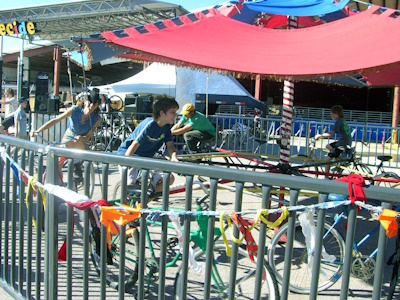
I took two new pictures of the Cyclecide devices that weren't here last year (or at least I missed them): a merry-go-round of two hanging bicycles that may or may not be known by a more elegant name Bike Rodeo, and Axe Grinder that plays sounds resembling an electric guitar when a rider pedals it. I guess you can play some rudimentary music this way. For some reason there was a written sign forbidding Stairway to Heaven. ;-)

Last year I somehow also managed to miss the Life Size Mousetrap. It is a giant Rube Goldberg-style chain of devices inspired by the desktop Mousetrap game.

Here are some images of Life Size Mousetrap: 1: the mousetrap rests between demonstrations, 2: the curiously dressed people who run the mousetrap, 3: a one-woman band Esmeralda Strange, 4: the guy bring in the "cheese" for the mousetrap, 5: the World's Sexiest Mice come in, 6: the World's Sexiest Mice are bound with ropes, 7: volunteers hoist the 4000-pound black cube, 8: the 4000-pound black cube has been hoisted into the air, 9: a "mouse" collects donations after the show, 10: collection of donations, 11: a World's Sexiest Mouse and a Lizard Boy make a victory tour, 12: the desktop Mousetrap game that inspired the life-size one.

Here is my YouTube video of the Life Size Mousetrap in action.

A low-tech but cute gift for a science fiction fan in your life: journals with covers made of vintage science fiction paperbacks.

Technical and cute: Armadillo-shaped car.

Among the more offbeat: knit plarn bags. Plarn is "plastic yarn", made by cutting up plastic grocery bags into long strips.

There were robots and robot competitions too numerous to name. And microcontrolled devices were really popular at Maker Faire. In addition to homegrown makers making toys with microcontrollers, Microsoft had an entire pavillion devoted to promotion of their .NET Micro Framework. It gave people an opportunity to create their own applications right there at the Maker Faire. One could also enter a Microsoft contest that starts later this year. A Microsoft guy attending the booth told me that people like me, who have only developed web applications in .NET, are a prime audience for .NET Micro Framework. But... doesn't programming embedded devices requires knowledge of hardware? I asked, puzzled. No, said the guy, .NET Micro Framework abstracts it all away. According to him, all you need to do is to read the manufacturer's specifications that came with your microcontroller, so that you would know how its pins are numbered, and then you can write code directly to the pins. He encouraged me to enter the contest. Yet, as an application programmer, this is hardly my idea of fun. The conversation wasn't in vain, though: he gave me a Microsoft t-shirt. Now, would I dare to wear it, given how much I associate with free software people? What a conundrum.

Friday, November 02, 2007

Maker Faire, part 5: of techno-optimism and reconstructed fashion

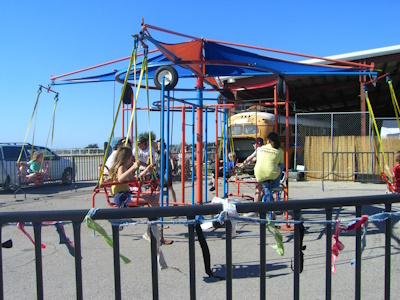
As one would expect at a faire, there were faire rides and merry-go-rounds. Supposedly they were all homemade? The amazing thing about them was that (I may be wrong on this) none of them ran on electric power. The ones I saw were all pedal-powered.

A bicycle merry-go-round at the Maker Faire 2007 A bicycle merry-go-round at the Maker Faire 2007
A pedal-powered fair ride at the Maker Faire 2007 A pedal-powered fair ride

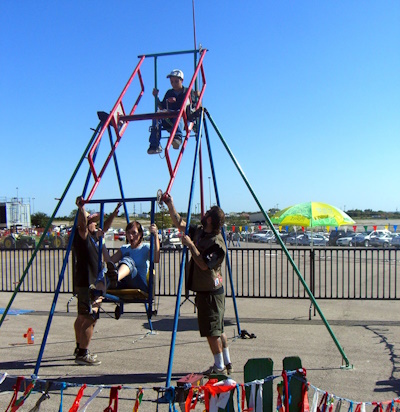
Sure, these merry-go-rounds were nothing like roller-coasters in industrial entertainment parks, but they also required more active participation on the rider's part than simply giving in to the centrifugal force. And some of them, like this circular see-saw, managed to frighten some riders. Apparently, pedaling was less trivial than they thought. It got me wondering, by the way -- do the riders all need to pedal synchronously, in phase and at the same speed? What happens if one of them slacks off or falls out of phase?

A pedal-powered circular see-saw in motion A pedal-powered circular see-saw in motion at the Maker Faire 2007

(I didn't go on any of the rides, I must say. I'm way too uncoordinated for that. One look at them makes me lose my balance.)

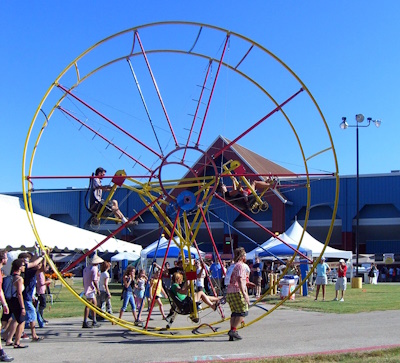
And this rolling wheel was just stunning, but I wasn't sure if it could move on its own, or if it needed to be pushed. In this picture, a bunch of people are pushing it, but maybe just because they need to help it up the hill?

A pedal-powered mini Ferris wheel A pedal-powered mini Ferris wheel at the Maker Faire 2007

More than anything else in this Faire, the merry-go-rounds and the modified cars left me optimistic in general about the ability of western civilization to survive the looming energy crisis. Oil may run out one day, but human ingenuity is under no such threat, it seems.

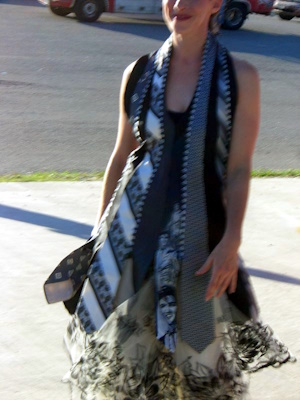
And then there was Swap-o-Rama-Rama, a two day event where you were supposed to be able to drop off your used clothing and be taught, or inspired, create new, reconstructed clothes out of stuff people dropped off. I didn't even stop by to check it out, because I knew it would ignite in me a temptation to start making clothes again. Sewing and knitting were my major hobbies in high school and college, but I abandoned them in favor of hobbies that hold a more profound appeal to me, such as writing. But I checked out their fashion show at the end of the day. They demonstrated clothes that were, IIRC, created during the day out of stuff people dropped off. Most of them were quite original. As I understand it, the creators of those clothes were actual fashion designers who specialize in "reconstructed" fashion. An ordinary person off the street, such as myself, would not likely have created something as good in just one day. But it was still interesting to see. Men's ties seemed to be a prominent sub-theme.

A dress made of ties and other recycled fabrics A dress made of ties and other recycled fabrics

Several of the dresses shown at the fashion show were made out of ties. Well, it was good to see ties can be put to good use: I don't remember the last time I saw anyone wearing a tie according to its purpose.

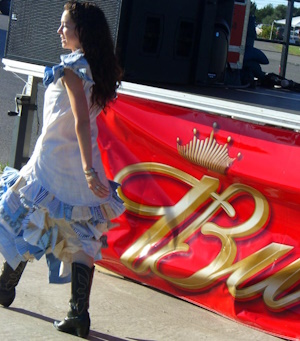
A dress with a ruffle made of ties and other recycled fabrics A dress with a ruffle made of ties and other recycled fabrics

Tuesday, October 30, 2007

Maker Faire, part 4: art cars

Many cars and bicycles exhibited at the Maker Faire made you pause and rethink your definition of a car or a bicycle.

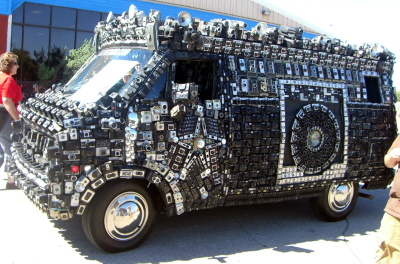
There was a morbid, but fascinating roach mobile; a van covered with cameras (http://www.cameravan.com); an assortment of electric cars.

Camera Van at the Maker Faire 2007 Camera Van at the Maker Faire 2007

Some of them were made by companies that plan to make money off of them, others by hobbyists as tongue-in-cheek projects. Some were converted from cars that run on gas. Some allowed you to look under the hood, others (most) had no hood at all.

Then there was a panoply of wonderful bicycles in shapes of butterflies, grasshoppers, and who-knows-what. I felt like I stepped off into a fairy tale world.

Saturday, October 27, 2007

Maker Faire, part 3

There was also some art where the point wasn't so easily found.

Tree of Secrets, dream recorder

An example of such a contraption was the Tree of Secrets, which was a cardboard tree with microphones hanging off of it. You could speak your secrets into those microphones, and they would get recorded. Then you could play them back. I think you could also listen to other people's secrets (thus making it a tree of no secrets, said S.) When the tree accumulates enough soundtracks, it starts mixing them up. I guess that was supposed to somehow make it more interesting.

Another example was a dream recorder (?) that looked like an old, rusty voltmeter from a high school physics lab. You put it near your bed, and record your dreams in the morning. "Record" is too ambitious a word, though, because the only thing you can do with it is press one of the two buttons: "good" or "bad". Also, if I remember correctly, it's connected to the internet, and the needle on its face shows you the proportion of people who are having good dreams versus bad dreams. (Or maybe my subconscious made up this part as it tried really hard to find some meaning in this project.) Even so, this kind of dream evaluation could be shared only by people who have identical dream recorders near their beds. But... how many of them are there? Isn't the dream recorder a one-of-a-kind thing, given that it was created by a graduate student as a course project?

Yes, both of these exhibits were created as course projects by students of a graduate program with some kind of... umm... trendy name, like Interactive Communications, or Interactive Media, or some such. S told me I wasn't supposed to see a point in these projects: they were Art. Period. I said it wasn't obvious to me that this program was primarily artistic rather than technical, as the name sounded slightly geeky. Well, S shamed me for looking for utility value in this art. Oh well. Yet I kinda felt sorry for those students. While I do remember having to do graduate course projects that seemed about as useful as shoveling sand from one pile to another (i.e. they did not involve original research, only reshuffling the existing data), I still think they were more meaningful than, say, making a tree of secrets. As I said, I'm not cut out to be an artist.

If you were curious what true randomness sounded like...

Along the same lines, I felt, was Kosmophone by Jerry Chamkis, a "musical" instrument that synthesizes sounds from gamma rays. This device measures frequency, wavelength, or energy (he said those things were interchangeable) of gamma rays that are hitting the Earth at all times, and a synthesizer "translates" those measurements into sounds. By the sound of it, gamma rays hit it at varying intervals averaging about once in a couple of seconds, so the device produces a steady ping-pong-pung of random notes at random intervals. This was the gist of the half-an-hour long talk by Jerry Chamkis. I actually figured out what it was doing after hearing the first 5-10 of these "musical" sounds. The rest were the details about how this instrument was made. I more or less slept through the details, but S was interested: his graduate studies in physics were all about chasing elementary particles, so he found some common ground with Chamkis. He had a chat with the creator of the Kosmophone about stuff like what materials you use to make a light-tight casing for your sensitive components.

The obvious -- and perhaps the only -- point of Kosmophone, as Chamkis readily admitted, was to give the listener an experience of true randomness. Try as they may, humans can't create truly random processes. But truly random processes do exist in nature, and spectral characteristics of gamma rays hitting the Earth are one of them. So, before I could open my mouth and say to S "this could make a really good random number generator on a computer", he turned to me and said the same thing. Then one guy in the audience said it out loud. Apparently all the computer geeks in the audience had the same thought. Chamkis replied that while that's true, it wouldn't be practical, because the rays hit the Earth way too infrequently. In computer applications -- mostly cryptography -- random numbers need to be generated much faster than a sequence of gamma rays would allow.

Screaming Babyhead, a robot band at the Maker Faire 2007 Screaming Babyhead, a robot band at the Maker Faire 2007

So, the projects demonstrated at the Maker Faire were a mixed bag. Which of course means there was a lot of good in it too. There were tons of robots, as I said before, but most of them had artistic rather than utilitarian value. For example: a robobabe/angel, or Marvin Niebuhr's Screaming Babyhead band of robots -- a very steampunky bunch of musicians. If they played any music, it must have been lost in the general din of the exhibit hall, as I couldn't hear anything.

Wednesday, October 24, 2007

Maker Faire, part 2

Maker Faire in bullet points:

Cute and practical: floating speakers, hidden in Mylar balloons.

Artsy and practical: Stop-Motion Armatures, poseable figures that can be photographed serially to create animation.

Pleo, a robot dinosaur pet Pleo, a robot dinosaur pet at the Maker Faire 2007

Artsy and geeky: thereping.

Geeky and cuddly: robotic dinosaur pets, named Pleo, that have a range of sentient-looking behaviors.

Geeky with a hard science edge: Stirling engines.

Quirky technology that has its uses: wood iPods.

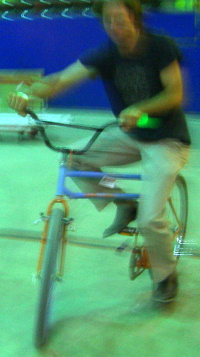
A person trying to ride a bicycle with a hinge in the middle A person trying to ride a bicycle with a hinge in the middle at the Maker Faire 2007

Quirky technology that's not useful for anything except to build your character through extreme frustration: bicycle with a hinge in the middle. "You really have to steer it two ways!" said a perplexed guy after making a few wobbly laps on this bicycle. Many people fell trying to ride it.

This peculiar item is in a category that's worth a separate article: quirky / art cars. And it will have a separate post! But first, some snarkiness. Coming up tomorrow.

And here are even more pictures from the Maker Faire 2007

Sunday, October 21, 2007

Maker Faire, part 1

Maker Faire is upon us! According to its website, it is a "two-day, family-friendly event that celebrates arts, crafts, engineering, science projects and the Do-It-Yourself (DIY) mindset". In my own words, I'll say only this: who needs Flipside when you have Maker Faire? It has a much higher concentration of quirky technology and art, it's in an air-conditioned building (part of it, anyway), and -- best of all -- there is no techno music!

The Do-It-Yourself stuff exhibited here ranges from technology to art to food (cooking is the DIY of food, right?), and the exhibits cover every category: from practical, to art-that's-actually-beautiful, to art-that's-kinda-pointless, to practical technology, to technology that has no value except quirk, to technology that has no point at all. Most of the technology demonstrated here only had value as an art piece, however. Or as a proof of concept. There were exceptions, of course. I will cover a bit of all of those categories in a few upcoming posts.

For starters, here is an example of DIY art that struck the sweet spot between beauty and utility like only a few projects at the Faire did: lampshades made of interlocking plastic pieces, here and here.

The overlapping area between art and technology was densely populated by robots created by our own local Robot Group. A robot that unexpectedly appealed to my girly side was Mechanical Flower, created by Denise Scioli and Ms. Puiyee "PY" Hung from the Robot Group. The flower's inner petals are made of a steamer insert, identical to the one I have at home. Mechanical Flower's steamer insert dances, opening and closing to the music, slow or fast.

Here is a video:

The tiny holes in the steamer insert create hypnotizing moving patterns when its "petals" open and close. What an exaltation of a mundane steamer! (To be sure, I don't see mine as mundane. For me it is one of the most beautiful household items I own. Its petalness (petality?) can easily inspire one to think of its potential uses for art. To non-artistic people, like me, this call is barely a passing whisper, but artistic people take things like this and incorporate them into their art projects.

Here are more of my blog posts and pictures about the Maker Faire.

Oh, one more important thing. Steve enjoyed this event as much as I did! It is very rare for him to like the same things I do. Hmm, what else is going on in Austin on a regular basis that resembles Maker Faire?