Showing posts with label sxsw. Show all posts

Friday, November 29, 2013

SXSW 2013: blending bendy materials and bendy life

A talk by Ping Fu at SXSW 2013 blended, in an odd way, self-help advice and 3D-printing technology. The only thing in common between the two may be her own personality, which, like those raw materials shaped into an infinite collection of shapes, succeeded by flexibility and adaptability.

Ping Fu at her SXSW 2013 speech 'Digital Reality: Life in Two Worlds'.

The title of her speech, "Digital Reality: Life in Two Worlds" ostensibly refers to the merge of physical and digital reality. She reviewed exciting things happening in three-dimensional scanning and printing technologies -- and her company, Geomagic, is among the players in the field. Standing on the stage in 3D-printed platform wedge shoes, she said you may be able to walk into a Nike store tomorrow, have their feet scanned, and pick up custom-made shoes tomorrow. You may also have custom-made prosthetics that would let artificial limbs look like real ones, "because currently they look like airplane landing gear". You just have to scan a soccer player's "good" leg, and print an artificial one based on that model. 3D-printing can produce filling for dental cavities, and repair tiles on NASA space shuttle -- two technologies that surprisingly (or not), are related. Preservation of historical artifacts is also a big application for 3D-scanning. Mount Rushmore took a hell of a long time to scan, but it was eventually done, and US Parks and Wildlife has a scan, said Ping Fu.

Ping Fu's 3D-printed shoes she wore at her SXSW 2013 speech 'Digital Reality: Life in Two Worlds'.
Ping Fu's 3D-printed shoes she wore at her SXSW 2013 speech 'Digital Reality: Life in Two Worlds'. More pictures from this speech and overall SXSW 2013 are in my photo gallery.

On the other hand, life in two worlds can be a metaphor for Ping Fu's own life, that has certainly spanned two vastly different worlds. As a young child she was taken from her loving family in Shanghai during the Cultural Revolution, and raised in a camp. She was put through communist brainwashing, being forced to go up on stage and scream "I am nobody!" So she has no stage fright, she jokes. If anything saved her, it was her father's advice to be like a bamboo, that bends but does not break in the wind. She even made it the title of her book, "Bend, not Break".

A soccer player's 3D-printed prostethic leg: a slide from Ping Fu SXSW 2013 speech 'Digital Reality: Life in Two Worlds'.
A soccer player's 3D-printed prostethic leg. More pictures from this speech and overall SXSW 2013 are in my photo gallery.

Looking up this book on amazon.com, I saw that many reviewers accuse her of fabricating her life story. They claim her actual life was not nearly as horrible as described in the book, and that she might not have lived in a labor camp. I have no way to verify the claims of either side, though there is no doubt that the horrors of Chinese labor camps, where middle class children were sent for "re-education", actually existed. There is also no doubt that Ping Fu at some point immigrated into the US, and went from a person who knew just 3 English words, to a tech entrepreneur. And though she chose a technical field, she credits her love of language for her design skills. She may have known little of English, but she had a love of language all her life.

In China, she went to graduate school for journalism around the time when China's one-child policy started. It made not just subsequent-child births, but also pregnancies, illegal. When Ping Fu heard rumors that baby girls were being killed in the countryside, she went there as a journalist to investigate. There she witnessed "abortions" done via C-section in 8th or 9th month of pregnancy. For writing publicly about these atrocities she was put in jail, and was certain she would die there. Luckily, Cultural Revolution soon ended -- this was a few years before the Tiananmen Square -- and Ping Fu was released. (Again, I have no way of verifying how much of it is true.) Then the government gave her a choice: quietly leave the country, or be exiled to a remote corner of China. She chose to go to America, and took a crash course in English on the plane. By the time she landed in San Francisco, en route to the University of New Mexico, she already knew a few English words. Not enough to be accepted into comparative literature program, which was her first choice, but enough for computer science.

Mobile 3D-printer demonstrated during Ping Fu SXSW 2013 speech 'Digital Reality: Life in Two Worlds'.
Mobile 3D-printer. This guy and another one with a similar printer walked up and down the aisles to let the audience take a look at the printers. They, however, did not demonstrate how it works. More pictures from this speech and overall SXSW 2013 are in my photo gallery.

Myself, as someone who had a love for languages all my life, but didn't go into linguistics because I didn't think there were any jobs in it beyond school teacher, felt vindicated. There are not many people (or perhaps we're just not visible) who come into computer science not because of fascination with technology, but because we enjoy teasing out complex logical structures from the code as we do from human languages. And so when Ping Fu said that somebody back in the day suggested to her that she check out this new field, computer science, because it's a "language" that lets you make stuff, I thought that it was the same kind of thing that attracted me to the field of computing. Her life tale of a foreign student turned tech entrepreneur also has a special resonance to me because I, too, initially came to the US to go to graduate school. She, however, did not think she was a good programmer, because she lacked a science background, so she became a designer and project manager. Her secret to working with programmers is to ply them with Coke to keep their juices flowing. It must have worked, because at some point she hired Marc Andreesen, who developed Mosaic, and eventually licensed it to Microsoft to become Internet Explorer.

For a long time she didn't consider becoming entrepreneur, and when she finally started her company, Geomagic, people were still skeptical. Of the first seven employees all but her had PhDs, and 4 of them were mathematicians. People said you can't start a company with a bunch of mathematicians, as math doesn't make money. But Ping Fu replied that she liked to do impossible things, so she did it. A win for language nerds and foreign students everywhere!

Monday, May 20, 2013

Diversity hiding in plain view, or my thoughts from a SXSW 2013 panel

Conversations about diversity in technology are as interesting for who they include as who they leave out. Their goal should be to challenge the stereotype of a programmer as a young white male, unencumbered with anything that would keep him from coding 18 hours a day. The panelists who got together to discuss diversity in the Austin tech community were not in this category. But diversity is more than just being female or a person of color.

Those categories are, however, the most visible, and no wonder that the conversation revolved around them. There are companies who have been setting examples in how to bring under-represented groups into engineering. One of them is Etsy, the online craft marketplace, where one of the panelists, Garann Means, worked as a software engineer. Etsy noticed that while most of its customers were women, most of its engineers were men, and they set out to change that. Instead of poaching women developers from other companies, they started the Hacker School, and gave scholarships for women learning programming. Many of its women graduates found software engineering jobs. Moderator Mark Phillip noted that when Etsy committed to diversity, it also benefited male developers -- they became better team players.

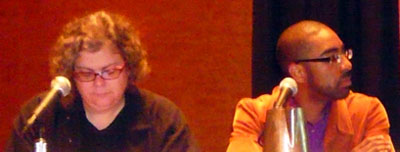
Mark Phillip, Nicole Cofield, Garann Means, and Gerardo Treviño.
Mark Phillip (CEO/Founder Are You Watching This?!), Nicole Cofield (president/CEO of Capital City African American Chamber), Garann Means (software developer), and Gerardo Treviño (founder and CEO of Paybook). More pictures from SXSW 2013 are in my photo gallery.

Garann (who is also the founder of All Girl Hack Night, Austin women developers' group) says that diversity efforts are often criticized as "we shouldn't separate women from men, we want to keep them in the same group". But she says that this kind of separation is never an issue, at least in her own experience. Many white guys talked to her about how things that are "supposed" to offend women and people of color, actually offend them as well. It is sometimes said that a special effort to attract more people from underrepresented groups to software industry would bring a lot of underqualified people. But there are examples showing that that doesn't have to happen. Garannn says her friend Divya put together a conference in San Franscisco, with very diverse speakers, and it was technically excellent -- you didn't have to sacrifice the quality.

People categorize themselves in interesting ways that can be different from the categories we assign them to. I saw this play out in my own life as well, and I was reminded of it by what Natalie Cofield, president/CEO of Capital City African American Chamber, said. Many black engineers in tech are not Americans: they come from African countries. She has heard Nigerian programmers say "African American Chamber is not for me, because I'm not African-American. I'm Nigerian." So she saw a need for AAC to be more internationally inclusive. I can relate to this from my own experience. As an international graduate student in America, I felt I was more of a minority here than the officially recognized minorities. They were at home with this country's ways, and I was not. (I know it's a subjective feeling, and a white foreigner still benefits from the white privilege without realizing it, so I would not put my experience on the same footing as that of truly underprivileged minorities.) But when the Natalie Cofield mentioned a need to include foreign-born engineers in the tech community, it was the first time I felt that somebody was inclusive towards immigrants in this country. It was certainly the first time in my experience that somebody wanted to make them a part of the diversity discourse, as opposed to treating them as a job-stealing, wage-depressing nuisance, which is how high-tech immigrants are usually talked about in this country.

Then there is another dimension to diversity, hidden in plain view. It came to my mind when the fourth participant of the panel brought up something, and his story was considered a success story without anyone noticing the darker undertones. Gerardo Treviño was talking about Paybook, his recently launched startup. It lets people take pictures of their receipts, and Paybook will parse them for you. He and most of his developers are from Mexico. At first he wanted to base his company in Austin, but it was very difficult to get USA work visas for the whole development team. Abandoning that plan, they decided that the company's home will be Monterey, Mexico. They wanted a safe place with landscapes that help creativity. So they got the whole team of a dozen developers to live together in Playa de Carmen, an organic food paradise, in a utopian commune of sorts: for example, the whole team collectively decides what to eat for dinner that night.

Mark Phillip, Gerardo Treviño, Nicole Cofield, and Garann Means.
Mark Phillip (CEO/Founder Are You Watching This?!), Gerardo Treviño (founder and CEO of Paybook), Nicole Cofield (president/CEO of Capital City African American Chamber), and Garann Means (software developer). More pictures from SXSW 2013 are in my photo gallery.

No one in the audience indicated they viewed it as anything but a creative move, and perhaps it was; but such a move would only work for a team of people who have no other responsibilities outside of work. Clearly, someone who has children would hardly be able to leave their family and move somewhere for months at at time. This is especially true about people who have been traditionally responsible for childcare, namely, women. So I wouldn't say that it's really diversity when you pick employees who are free of family obligations. And since they tend to be in their 20s, you are clearly not aiming for age diversity either.

This goes against bringing more women into computing, because women would be the first to quit a company, or entire industry, that makes it hard to combine a job with a family. Even child-free women are less likely to stay in such a company, because they still want to have friends and personal lives. Encouraging your employees to relax on a beach or eat organic food is not a true support of work-life balance; the balance needs to be the kind that lets people fulfill their other responsibilities.

It reminds me of a story I read in our local newspaper, Austin American-Statesman, about tech startups that open offices downtown. They want to be in an attractive location, because their engineers like to to live music clubs or to the lake after work. Clearly, they are trying to attract only a certain kind of engineers, namely, those whose after-work hours are spent on leisure. They are not positioning themselves for another kind of employee who goes home to their family in the evening. It just so happens that the first kind is usually in their 20s, while the other kind is older and more likely to be female. So in the era when sex and age discrimination is illegal, this is a roundabout way to tell the non-20-something-male applicants that they are not particularly wanted here. And I think that as long as companies have implicit preferences for certain kinds of demographics -- expressed by supporting some lifestyles but not others -- I think that all the talk about bringing more diversity into tech won't yield much fruit.

Monday, May 23, 2011

You want to attend this conference? Become an optimization expert!

Imagine a conference so big, so sprawling, that navigating it requires you to draw multiple decision trees and redraw them on the fly as needed. Why? The conference is spread out across a convention center the size of four city blocks, several neighborhood hotels, as well as some hotels a few miles away. Just walking from one room in the conference center to another takes 5 minutes; a walk to a neighborhood hotel takes 10 minutes, and to a faraway one, as much as half an hour.

And when you get to your destination, you discover that the organizers picked too small a room for the panel, and there's a line to get in the door*. You can only get in if someone leaves, and no one is going to leave because they are as interested in the panel as you. The speakers don't use a microphone, so you can't hear a single word from outside the door.

Imagine all this, and -- that's right! -- you'll get SXSW.

People wait to take an escalator down from the 4th floor of Austin Convention Center

To get an idea of just how many people were at SXSWi, consider that this amorphous line is just the people waiting to take an escalator down from the 4th floor of Austin Convention Center (and some getting off the escalator in the opposite direction). More pictures from SXSW 2011 are in my photo gallery.

Congratulations, you have walked 10 minutes for nothing. It's time to pull out your handy decision tree. Say node A represents your preferred panel. It is linked to nodes B, C, etc., that designate the next most interesting panels to go to in case panel A is full. Each node is assigned a weight according to its desirability. The edges that connect the panel-nodes in turn should be weighted according to walking times required to get from building X to building Y. And if you want to make the problem more realistic, you could make those weights depend on pedicab availability, or your willingness to pay for a pedicab, as well as a probability that the free sponsored shuttle will be waiting outside the hotel at that moment. Then voila! Solve the optimization problem, and you know where to go next!

Is there an app for that? I don't know, I still don't have a smartphone. (That alone should disqualify me from SXSW attendance, I suppose.) I know SXSW has an official app, but I doubt it solves optimization problems. If it doesn't, should I spawn yet another clone to write such an app (joining the league of all my clones in parallel universes that are writing other applications I've dreamed up, while I'm toiling at my job)? Then, and perhaps only then, I would have a real reason to come here again. After all, as everybody says, the real purpose of going to SXSW Interactive is to schmooze with other entrepreneurs and wannabes. Panels be damned.

Cloaking geeky topics in cutesy terms

Maybe panels should be damned. Most panels were for internet marketers, since that's what most SXSWi attendees are, and marketing is not that interesting to me. Software developer panels were dominated by mobile development, a perennial hot topic; unfortunately, I haven't done any mobile development and I don't know if I'll ever get a chance to do it where I could get paid for it. There was a good presentation on the basics of semantic web -- a loose set of methodologies that let us mark up the meaning of the text, instead of just its structure, in an HTML-like way. This allows computers extract meaning from texts they "read". The panel would have been even better if it hadn't tried to hard to achieve mainstream appeal by drawing parallels between semantic web and dating. But even renaming Linked Data Principles "The Bro Code", and urging people to "get your data a date" (i.e. link it to other data on the web) did not attract more than 10 people into the room. What the presenters did right, though, was to illustrate the notion of a semantic triple as something we routinely create in our daily lives when we fill out forms. This, and not sketchy dating analogies, would make the concept of semantic web more interesting to people.

A patient information form illustrates a semantic triple A patient information form illustrates a semantic triple. More pictures from SXSW 2011 are in my photo gallery.
A triple: the person filling out the form is the subject, field labels are predicates, what you put in the blanks are objects An subject-predicate-object triple: the person filling out the form is the subject, field labels are predicates, what you put in the blanks are objects. Thus by filling out a patient information form you are creating triples such as {Joe Schmoe, Home Address, 1000 Main Street} or {Joe Schmoe, Date of Birth, 1/1/1900}.

General interest panels on emerging technology, such as gesture interfaces, or "internet of things" weren't all that worthwhile to me because I read a lot on those topics, and the presentations didn't add anything to my knowledge. The curse of being ed-yoo-ma-cated.

So after a while I lost motivation to pick the best panels and brave the crowds to get to them. Instead I spent big chunks of time just milling around the convention center, parties, and satellite events, not going anywhere, and cursing myself for wasting the time I'm paying for with my own precious future time, that is to say, those volunteer hours I'm obligated to put in. Speaking of which...

Volunteering shows its dark side

After I had an easy time volunteering at SXSW in 2011, I expected something similar this year. Yet volunteering showed its sharp claws this time. As before, I spent most of my time at Film Venue. Most Film Venue volunteers perform a vague function of "line management", which is to say, they stand around and see that the audience lines up in an orderly fashion: one line for SXSW film badge holders, another for film pass holders, and yet another for those with individual tickets. Most movies don't get a lot of audience, so there isn't much standing around to be done. However, on my first day the theater manager told us to take our positions an hour and a half before the movie started. We were supposed to stand at attention the whole time. Needless to say, standing on your feet while 6 months pregnant isn't a picnic. It's also excruciatingly boring. I would rather have spent that time moving furniture (well, lightweight furniture) than standing still. So I went to the theater manager and told her I couldn't do this while pregnant. She said she didn't realize my condition (what, did she think I carried a basketball under my shirt?), and told me to go home for the day. The next day the management agreed to transfer me to another theater where I got a desk job. For the rest of my volunteering week, I sat at a desk and answered customers' questions. That was much better.

All in all, I should try coming here one day as a wannabe turn-your-side-project-into-a-startup entrepreneur. I heard those people get the most out of SXSWi. Until then... I don't know.

----

* That was the case with "Agile Self-Development" panel. Having been introduced to agile software development concepts at my recent job, I was curious how this would apply to self-development. Should I hold daily scrum meetings among multiple facets of my personality?

Wednesday, May 04, 2011

SXSW 2011: People as Peripherals: The Future of Gesture Interfaces

"People as Peripherals". The title of this speech conveys unease about a future where humans are little more than input devices for our computer overlords. Not surprisingly, presenter Lee Shupp segued from gesture interfaces to brain implants, and from there to technological Singularity.

At the first glance, there is neither much to fear, nor great promise to expect from such gesture interfaces as Kinect, a Microsoft game console. Current interfaces suffer from the case of "gorilla arms": you have to wave your arms vigorously in big, sweeping gestures to make yourself understood to the machine. You are also limited by a small square of space where you need to stand so the computer would capture your gestures correctly. Even so, it's all too often inaccurate, if Kinect is any indication. It's a long way from here to detecting micro-gestures, such as subtle finger movements.

Lee Shupp Lee Shupp speaks about gestural interfaces, brain interfaces and Singularity. More pictures from SXSW 2011 are in my photo gallery.

Not unlike at a science fiction convention, the audience pointed out plenty of other problems gesture interfaces will have to solve before they are seamlessly integrated into our lives. How would a gesture-driven plane cockpit respond if a pilot sneezes? How would such interfaces adjust for body language differences between cultures? For example, in many oriental cultures it's considered extremely rude to point your foot to anyone. Never mind the bugs -- the potential of well-implemented gesture interfaces can be equally disturbing. A guy in the audience expressed a wish for an interface that would understand sign language. He can sign much faster than type, and he'd like to "text" while driving without raising his hands from the wheel. (I sure hope for the sake of the humanity that his wish won't come true.)

But before we can even make sensors that understand sign language, there are more basic problems to be solved. As a person in the audience pointed out, current interfaces require that you come to them. You are supposed to stand in front of the machine and wave your arms at it. That doesn't integrate well with our daily lives. However, I saw this Technology Review article, Talking to the Wall, about an experimental technology that lets you turn any wall in a building into a touch-sensitive surface. Now that surely has a few killer apps in it.

Lee Shupp's vision of transhumans Lee Shupp's vision of transhumans. More pictures from SXSW 2011 are in my photo gallery.

Brain interfaces are still in a rudimentary stage too, says Lee Shupp. So far brain implants haven't done much more than allowed people control a cursor on the computer. There are serious obstacles to their adoption. To connect a brain to a machine you have to drill holes in the skull, and sending thought commands requires concentration, which is hard for humans to achieve in the multitasking world. Finally, Shupp says, if people can't read people, how can computers? For that matter, if computers can read our brain signals, does that mean we can't lie anymore? To the guy who asked that last question, Shupp recommended "The Truth Machine" by James Halperin, a SF novel where this is addressed.

Despite these nontrivial problems, he believes brain implants will take off. Already 80000 people worldwide have them. An informal survey of the room shows that most people here think we will be using brain interfaces in 50 years. At some point brain implants will likely augment our intelligence, and we'll on the road to Singularity. And then, if this slide correctly reflects Shupp's vision of transhumans, we will spend our time with our brains plugged in directly into simulated medieval worlds. Swords: the original gestural interfaces. ;-)

(Tangentially related, here is another take on Singularity, where the original popularizer of the concept, Vernor Vinge, discusses the concept with several science fiction writers.)

Monday, April 11, 2011

SXSW 2011: The Singularity: Humanity's Huge Techno Challenge

Will supercomputing intelligences outsmart human-level intelligence? "The Singularity: Humanity's Huge Techno Challenge" panel claimed to dissect the very core of the Singularity, if and when it will occur, and what we can expect to happen. The question was debated by Doug Lenat, founder of an artificial intelligence project CYC, Michael Vassar, president of the Singularity Institute for Artificial Intelligence, and Natasha Vita-More, vice chair of Humanity +.

Technological Singularity is considered to be a hypothetical event occurring when technological progress becomes so rapid that it makes the future impossible to predict. It is commonly thought that such event would happen if superhuman intelligence was created. For starters, Doug Lenat gave an overview of possible scenarios of how technological singularity would happen, or why it wouldn't happen. He lists these forces driving us towards creation of superhuman intelligence: demand for competitive, cutting edge software applications (commercial and government); demand for personal assistants, such as SIRI, but enhanced; demand for "smarter" AI in games; mass vetting of errorful learned knowledge, such as in Wikipedia. And the forces that may preclude Singularity? Large enterprises can stay on top in other ways than being technologically competitive; humans, too, may be satisfied with bread and circuits, immersing themselves in games to distract them from pressing realities. Also, Singularity may not happen if some event or trend kills all the advanced technology: an energy crisis, neo-luddite backlash, or AI's merciful suicide (say, AI realizes it's a threat to humanity, and kills itself). Then there are pick-your-favorite doomsday scenarios, such as grey goo, wherein nanobots multiplying out of control munch up all the matter on Earth.

Doug Lenat speaks about forces pushing us towards Singularity Doug Lenat speaks about forces pushing us towards Singularity. More pictures from SXSW 2011 are in my photo gallery.

Which is more likely -- that the Singularity will happen, or that some forces will prevent it from happening? How dangerous will it be for us, humans? How compatible it will be with our continuing existence?

As one would expect from a president of Singularity institute, Michael Vassar seems to think Singularity is likely, and that we would get there much sooner if we planned technology more deliberately than we do. "The more you study history, the more you'll see that we don't do very much deliberation. And the little that we do, really goes a very long way," he says. For millenia, technology was evolving in a random, unplanned way, similar to biological evolution. About 300 years ago humans started thinking more deliberately. (I don't know where Vassar gets this number -- Industrial Revolution started 200 rather than 300 years ago.) Automating the kind of human thought that can be well performed by machines, and combining it with the kind of thought that's not easy to automate, may lead us to a very rapid technological acceleration. But to close the gap between machine and human intelligence, we need to build a very good understanding of human intelligence. At some point in history humanity discovered scientific method, which is a very rudimentary understanding of how reasoning works. It allowed us to build institutions that will shape the future, the way no other institutions have been able to, says Vassar.

As to us being able to control whether nonhuman superintelligences will help us or cause our extinction, Vassar is not too optimistic. "Ray Kurzweil thinks we can get emerging superhuman intelligences to slow down. But we, humans, don't have a good track record of getting potentially dangerous trends to slow down."

Michael Vassar, Dougt Lenat, and Natasha Vita-More on the Singularity panel at SXSW 2011 Michael Vassar, Dougt Lenat, and Natasha Vita-More. More pictures from SXSW 2011 are in my photo gallery.

In every panel on Singularity, you'll get people who understand that Singularity may happen entirely without the humans' control, and then you'll get those who view Singularity only as a tool for progress, especially social progress, and have no interest in it otherwise. This was the case, for example, at the Singularity panel at ArmadilloCon 2003, when one writer said, if Singularity isn't going to enforce social justice, it's not going to happen. I got an impression that Natasha Vita-More is in the second camp. She spoke about how advancing technologies need to solve aging, healthcare, and social problems, especially those that still needlessly exist in the third world, as if technology will only do what we need it to do. She did not address the possibility that Singularity might take off without our control or influence.

She started by saying: "The Singularity is presumed to be an event that happens to us rather than an opportunity to boost human cognitive abilities. The very same technology that proposes to build superintelligences could also dramatically enhance human cognition. Rather than looking at the Singularity as a fait accompli birthing of superintelligences that might foster human extinction risk, an alternative theory forms an intervention between human and technology. [...] The Singularity needs smart design to solve problems." According to her, humans would achieve that by "evolving at the speed of technology", in other words, cyborgizing themselves.

Humans may have to deliberately redesign their brains and bodies to keep up or merge with the machines, but it still does not preclude the chance that Singularity might not come about by our design. If nonhuman superintelligences evolve, what incentive would they have to merge with humans? Why carry around flesh bodies, even engineered with excessive strength, resilience, or longevity? I'm reminded of what Bruce Sterling said on another occasion about trying to fit new technology into a conceptual framework of old technology: it would be like putting a papier-mache horse head on the hood of your car.

Doug Lenat disagrees that integration of our physical bodies with machines is necessary or sufficient for Singularity to happen. He would focus on not dramatic cyborgization, but just the information technology. Having information processing apliances that amplify our brain power would change us the same way that 100 years ago electrical devices amplifed our muscles. We travelled farther than our legs would carry us, we communicated farther than we could shout -- it changed our lives in fundamental ways and never changed back. Approaching Singularity, we'll see appliances amplifying our minds the same way. The society will amplify as well, become smarter in general, and will be able to solve the problems that Natasha Vita-More was talking about. At the same time, he doesn't think technology is a panacea for that. "When technology automated a number of things that were done manually before, social stratification only increased."

Michael Vassar goes even further: "We have technologies to solve most social problems today. But what we don't have is ability to engage ourselves in solving the problems we don't care about."

Somebody in the audience asked: "do you think a consciousness that exists outside human body (e.g. in a machine) can be spontaneously generated?" Michael Vassar replied: "I don't know what you mean by spontaneously generated, but I think, not likely. Consciousness would not be generated without a great deal of design." Doug Lenat thought this question was too vague. In a limited sense of consciousness, programs are conscious. You can interrogate CYC (Lenat's AI project) programs about their goals or methods, so they do have some self-reflection built into them. But it's probably nothing like what a human observer would perceive as consciousness. To answer this question, a better definition of consciousness is needed.

Also, in the future we will each have many avatars doing many different things, says Doug Lenat. Mental aids will direct our attention to where it's most needed at the moment. In that sense, each person's consciousness will exist everywhere.

Another question from the audience. "To be truly creative, you have to unplug yourself from technology often enough. So how would uploaded brains do that? Would inability to do that kill their creativity?"

Michael Vassar. "If I was an uploaded or enhanced being, I would be able to unplug myself much better. I would not only unplug from my laptop or the internet, but even from my visual cortex."

And here is another take on Singularity, where the original popularizer of the concept, Vernor Vinge, discusses the concept with several science fiction writers.

Friday, April 01, 2011

SXSW 2011: Social Media is Science Fiction

One of my most anticipated SXSW 2011 panels was "Social Media is Science Fiction". What do science fiction stories tell us about how social networking and user-generated content will evolve? How it will affect us as a civilization? These topics were debated by Annalee Newitz and Charlie Jane Anders of the futurist magazine io9.com, Matt Thompson from NPR, science fiction writer Maureen McHugh, and artist Molly Crabapple.

So, what future trends in the society are driven by social media?

Pushing us to create authentic selves

Social media, especially Facebook, pushes us to maintain a single, solid avatar, says Annalee Newitz. (Interestingly, the panelists used the word "avatar" to mean not just userpics, but entire digital selves, or digital personas.) It wants us to expose all the different aspects of our lives, and to consolidate them into one. For the first time in human society we are seeing a new man, who has to be authentic, who has to be the same person in every context: as a worker, as a "john", as a father or as a child. Maybe this authenticity is good, it's pushing us not to be hypocrites, says Newitz. But also it's making us more and more of an open book, vulnerable in new ways. Molly Crabapple says: "A delusion we have is that only cool people will read our updates. At 13, I genuinely believed that my updates will be read only by sympathetic audience." The reality is, says Newitz, that you might tweet "I just got my period", and you'll get an ad from Tampax. (She says she marks all Facebook ads as offensive.)

Maureen McHugh and Matt Thompson at SXSW 2011

Maureen McHugh and Matt Thompson. More pictures from SXSW 2011 are in my photo gallery.

Controlling the image we present to the world on social networks is becoming more difficult. A teenager may carefully pose in a mirror to make sure their self-portrait looks just right, but Google, already on the way to becoming an AI, may outrank it with more candid shots of him or her. It is as if, after all that posing, you walk by a shop window, and catch a glimpse of yourself, and think "OMG, do I look like that?" says Maureen McHugh.

If you don't control your own "avatar", who does? If you interact with another person, does the content of that interaction equally belong to both people to record, tweet, post, and make as public as either of them wishes? Do you reserve a right to make just your half public? But since that's usually impossible without revealing too much about the other party, how should this be resolved? Back in the day when most conversations and interactions left no record, it was not a question. A society where everything is recorded requires new rules and protocols. This is already being addressed by science fiction. Annalee Newitz recommends a novel "Quantum Thief" by Hannu Rajaniemi, a far future fantasy where everybody has an organ in their brain that's a privacy negotiator. Such a negotiation may determine, for example, what information you will remember after a meeting with somebody.

Societal memory

Matt Thompson observes that social media is increasingly about memory. He would like to see social media serve as a storage component of the society. All the tweets, pictures and videos could provide an incredibly detailed look at our society for future historians. (If that data is appropriately organized and mined, I might add.)

Has social media changed storytelling?

This was a question from the audience to Maureen McHugh, who is a science fiction writer that also writes for an alternate reality game company, Fourth Wall Studios. McHugh says that in the last 10 years she has discovered that traditional story still works very well, and interactive storytelling doesn't make it better. Hamlet does not become a better play if the audience gets to select the ending. Audiences want characters to be either happy or punished, and sometimes the story isn't good if the characters are happy or punished too soon. Charlie Jane Anders adds that she allowed the audiences to select a story ending twice. She tweeted, which story ending do you like better? And she chose the ending they selected.

By the sound of it, the panelists are more inclined to be grim than optimistic about social media-shaped future. Molly Crabapple observed that the recent trend of gamification may restructure future workplace in such a way that it would require us participate in game-like challenges with no pay -- the "fun" we'll be having will be its own reward. "You will go to Walmart and participate in the box-lifting challenge. You'll see who can lift and stack the most boxes and the prize will be what used to be your salary." (Thanks to Dale Roe for that quote. His own take on this panel can be found in this Austin American-Statesman blog post.)

Molly Crabapple, Charlie Jane Anders, and Annalee Newitz at SXSW 2011

Molly Crabapple, Charlie Jane Anders, and Annalee Newitz. More pictures from SXSW 2011 are in my photo gallery.

In the end, Annalee Newitz asked all panelists to end the panel on a positive note on social media. The panelists took turns telling what good things social media has brought into their lives.

Maureen McHugh. I keep in touch with my kid via social media every day.

Molly Crabapple. I founded a company with no money that has branches in 28 cities, because of social media.

Matt Thompson. Craigslist is a miracle. It has helped my life in giant, immeasurable ways, including that this is where I found my partner. There are opportunities for connection, and for us to step outside our worlds, that we are only just beginning to appreciate.

Annalee Newitz. I work at home alone with my cats, so for me Twitter is like being at work, it's my social contact. I sit there and have all those conversations via Twitter.

Tuesday, March 29, 2011

SXSW 2011: Bruce Sterling admonishes

If social media can be used for social good, this good can't come soon enough for Bruce Sterling, science fiction writer and a long time SXSW keynote speaker. Bruce Sterling's speech is traditionally the last SXSW session. I don't know if this is his usual habit, but for the last two years he implored 20-somethings ("some of you are younger than SXSW") to go out and be the force for a better world. He demanded to know why we aren't using social networks for political change. If Texans knew what was good for them, they would be marching in the streets and taking to social networks demanding wind power, he said.

We, the crowds, should also be funding projects to study bacteria that can convert materials to biofuel or break down pollution, said Sterling. As it is now, a certain scientist (whose name escapes me) got 300 billion from Exxon Mobile to study them, but that's because people on the street don't know what's good for them. I guess he implies that it is a job of social media-savvy people, such as SXSW'ers, to disseminate these ideas to the general public. Craig Venter, the famous biologist and entrepreneur who sequenced the human genome, may have come to SXSW this year with just this goal. Bruce told the audience that Venter's goal for coming to SXSW was "to reframe 20th century genetic engineering as 21st century synthetic biology". To put simply, it may mean that Venter was trying to create good PR for genetic engineering. Bruce Sterling has hopes for public support of synthetic biology, specifically, the kind that creates pollution-neutralizing or fuel-producing bacteria. There shouldn't be knee-jerk objections to it neither from the left (microbes are not cuddly baby seals) nor from the right (microbes are not in the Bible).

But for all his lamenting that SXSWers' tweets are all parties and name-dropping, Bruce Sterling himself is not without celebrity obsession. He spent part of his speech rambling about Italy's prime minister Berlusconi's escapades, which seemed beside the point to me. He also pointed out that Catholic Church in Italy stands with Berlusconi, supporting behavior they have condemned for centuries. Hypocrisy of the Catholic Church isn't news to anyone, but it's still an easy way to score points with the audience, which unfailingly applauded. In his Twitter feed he also regularly updates us on the lives of the failed femme fatale spy Anna Chapman and other has-beens... so I don't know how this ties into a call to use social media for greater good.

While ranting is Bruce's typical mode of speech, I noticed that over the last two years his rants have become less edgy and irony-tempered, and more plain and despairing. "Where is the moral compass of these people?" he says about the Catholic Church's support of Berlusconi. "Do they think it will make pedophile scandals look better?" But his speeches are still enjoyable because he peppers them with phrases that you can't decide whether they are too pretentious to mean anything, or perfectly capture what he's talking about -- such as "There are infinite wars on abstract now's". (Ed. -- maybe he said abstract nouns, such as terror? Then it makes more sense.)

Sunday, March 27, 2011

SXSW 2011: Gamification: a buzzword streaks across SXSW sky

Gamification was high on the radar at this year's SXSW, judging by how many panels it was mentioned at. To put it simply, gamification means devising a system of points, rewards and incentives to motivate people to do certain things -- in a software application or in real life. It's funny, but 2-3 years before it became big at SXSW, this trend was noted by "old media" newspapers like New York Times. Even I blogged about an application idea that could combine gamification and lifelogging three years ago. This year at SXSW however, it was brought into spotlight by Seth Priebatsch, creator of location-based game SCVNGR, who gave a keynote address about building a game layer on top the world.

Like other keynotes, it was broadcast live in many SXSW venues -- convention center rooms, and probably those in the satellite hotels. I caught the beginning of it in the Samsung Blogger lounge. For the first 10-15 minutes of Priebatsch's speech the room was quiet, but as he continued, most people tuned out and went back to their conversations. So I missed the rest of what was said. A pity, because Seth Priebatsch is a lively and energetic speaker. (That would be an understatement, according to this New York Times article, which uses Priebatsch to illustrate an idea that hypomania may be an essential trait of an entrepreneur.)

Seth Priebatsch gives his keynote address at SXSW 2011 Seth Priebatsch, as seen on a TV in the bloggers' lounge. More pictures from SXSW 2011 are in my photo gallery.

Of course, I could have gone to one of the conference ballrooms that were dedicated entirely to watching the keynote, but I was tired from all the walking I did that day, and loath to leave the power strip I found in Blogger's lounge, which I used to recharge my laptops. The opening part of the speech, that held everyone's attention, was Priebatsch saying that many human behaviors are ripe for gamification. For example, parents give young children stickers and points for brushing teeth. School is another area that could be gamified, but in Priebatsch's opinion, incentives are set up in such a way that you can only fail. I think what he meant was that bad grades are penalized, but high grades do not provide any noticeable rewards. (I don't know if that's universal -- it probably depends on a teacher, and also on a curious phenomenon called regression to the mean, described by Doug Lenat in his speech on artificial intelligence.) In any case, it was around that point that the audience in the Blogger lounge lost interest in Priebatsch keynote, and the failed gamification of schooling was the last observation from this speech that my Twitter friends tweeted.

And so yet another trend streaks like a meteor across the SXSW sky, and retreats to... not obscurity, but a long, pothole-ridden path to maturity.

Saturday, March 26, 2011

SXSW 2011: Where are the women in startups? Um, everywhere!

Carla Thompson, the founder of women's entrepreneurial network Sharp Skirts, and a Forbes reporter Meghan Casserly moderated a discussion "Where are the women in startups? Um, everywhere!" at SXSW. Carla Thompson is often asked why is there a need for an entrepreneur organization for women. The answer comes from the audience. Talking about her startup in a group of men, a woman first has to get past the "woman" issue. "Oh yes, I'm a woman, but I'm looking for an app developer".

However, not everyone in the audience has had the same experience. Another woman, who is in a tech startup with a bunch of MIT grads, does not feel she is judged differently. Investors ask her the same questions as everyone else. Others commented that this may be a difference between East Coast and Texas. Texas still lags behind treating women equally.

Carla Thompson and Meghan Casserly in the Women in Startups panel at SXSW 2011

Carla Thompson and Meghan Casserly. More pictures from SXSW 2011 are in my photo gallery.

There were about 5 bootstrappers (startup founders who focus on making their business profitable from Day 1, as opposed to living off investment money) in the room, and none of them had venture capitalist (VC) funding. Only one woman had angel investor funding. Her experiences trying to get VC funding had been, in her own words, terribly demoralizing. 9 years ago she went from VC to VC, and was given messages that she was the wrong gender and wrong everything. Then she found an angel network, and raised some funding from them.

Then we got to hear from the other side, a venture capitalist in the room, named Laura. She noted that over the years, women who come to her for funding don't ask for as much money as they will need, and a business plan they show can't be executed on that money. She challenges women to think about growing their business, and ask for as much money as they need. However, considering the difficulties women have when they ask for even more modest amounts of funding, this may be a vicious circle.

Sunday, March 20, 2011

SXSW 2011: Google's Marissa Mayer

Marissa Mayer, vice president of consumer products at Google, spoke at SXSW 2011 about new products Google is developing. She focused on location-based services. She started her speech with a demonstration of some kind of Google service that shows skiers on mountain slopes. Coming in late, I wasn't sure if this was a new Google Earth feature, or a new product. Superimposed on the live video of skiers was an augmented reality view that provided the information about the ski routes and the weather. Seeing tiny, ant-like skiers zipping around on the slopes, Marissa Mayer emitted a low, warm chuckle, so infectious that the audience giggled with her. Or maybe they laughed at the contrast of a Google VP being amused by the little silly things in life, such as ant-like humans bustling around like particles in Brownian motion.

Augmented reality -- applications that overlay information about objects around you over their images -- can give you a richer, more detailed experience of those objects than real life itself can. Google Art project is an example of that. Google Art images of famous paintings, such as Van Gogh's "Starry Night" were made with a giga-pixel camera, said Marissa Mayer. This lets you zoom into any part of it, and examine every square inch, every brushstroke as close as you would never be able in a museum.

Marissa Mayer at her keynote speech at SXSW Marissa Mayer at her keynote speech at SXSW

Augmented reality is no doubt a hot trend in location-based services, but Mayer spent more time on context-based discovery. That's a new direction of Google's location-based services. If you are standing in front of the Capitol (to non-Austinites, that's where Texas Legislature meets), and whip out your phone, that doesn't always mean you want information about the Capitol. If you are a first-time visitor to Austin, you may indeed be interested in its history, the date it was built, its architectural style, etc. But if you are an Austinite, you probably just want to check your email. So context is the key.

Then there was time for questions and answers. A guy in the audience asked Marissa Mayer if Google Maps will ever have customer service. Currently it takes up to a year to remove "deadly routes" from Google Maps, he said. Given that it has 8 or 9 million users, Google Maps ought to really do a better job of that. Marissa replied that customer support would be a good idea, as she herself has ended up in wrong places following Google Maps routes. From that I inferred that "deadly routes" meant "dead" routes, or ones that no longer exist -- as opposed to routes with high lethal accident counts. :-)

More pictures from SXSW 2011 are in my photo gallery.

Monday, March 14, 2011

SXSW 2011: Life as a Startup Parent

Synopsis: You're starting a startup, freelancing as a designer / developer, working on the next Big Thing, or otherwise being a web entrepreneur. But at home, your little one is toddling around in a playpen, learning how to play soccer, working on a science fair experiment, and growing up. How do you balance your role as a parent with your role as a co-founder? How do you reconcile these two worlds, each of which would happily consume you completely? How much do you rely on your (life) partner? Your (business) partners? How do you reconcile the tension between these two worlds? Come talk with other awesome web workers with kids. Share secrets of success, awkward failures, and other startup / parenting war stories.

The first half of this panel the people were divided into groups and asked to come up with ideas for applications that will make their life as a startup parent easier. Over the last few years this has become a common approach to web and technology-related panels. I, however, have become more skeptical whether software applications can be a solution to many real-life problems, let alone parenting problems. But several groups came up with similar sets of ideas: (1) a coworking space that's also a day care (though this wouldn't be a computer application), (2) locating other parents who live nearby and are in the same boat, e.g. starting startups. So you could get together with them and take turns watching kids while everybody works on their projects.

Charlie Park in Life of a Startup Parent panel Charlie Park, the moderator. More pictures from SXSW 2011 are in my photo gallery.

Some people asked questions that could not be answered by technology. Somebody wondered if there are any investors out there that understand that sometimes an entrepreneur's family time comes first? Moderator Charlie Park said that such investors, while a minority, do exist. You can tell them that you can't take their call right now because you're putting your child to bed, and they'll understand. A guy in the audience added that angel investors are typically more often family-friendly than venture capitalists. Venture capitalists invest more and expect more returns, so they feel entitled to demand that you work all the time. Angel investors invest less and correspondingly expect less.

Among the more lighthearted smart phone app ideas was a hologram of the parent that repeatedly says "no".

Saturday, April 10, 2010

SXSW 2010: Coding for pleasure (or martyrdom?): Developing Killer Spare-Time Apps

The "Coding for pleasure" panel's synopsis, "Every startup origin story is about a couple of developers who abscond to a garage and end up building the Next Big Thing. But money and fame don't need to be your end goal. You can significantly improve your life -- and impact others' lives--by coding for pleasure in your spare time," was rather more optimistic than what the panel was really about. I caught only the second half of it, so perhaps I missed the part where they discussed how you significantly improve your own life by coding for pleasure. Well, there is the obvious -- you hone your programming skills, have something to put on your portfolio, and perhaps attain some visibility in the tech community. But if the audience expected advice how to attain fame or lucre by developing spare-time apps, they would have been disappointed. In fact, most of the panel was spent to caution the wide-eyed would-be garage entrepreneurs NOT to expect worldly goods, or even too much acknowledgement to come from it.

Realistically you can expect that maybe in 6 months someone will mention your application on a popular blog, and its web site will get lots of traffic. So don't build it for money. Instead, build it for yourself -- write an application you will use every day, or one that's useful for your career. Gina Trapani says she developed her application (she didn't say what it was called, or maybe I missed it) for 9 months before it got noticed. Even if your creation starts getting paying users, don't expect that it will ever make more money than what's needed cover web hosting (about $100 / month), says Adam Pash. That's what is considered success in the world of spare-time projects, unlike the world of commercial software that thinks in terms of 100 million dollar projects.

(I would hope that there is a long tail potential in this -- a few lucky and hard-working hobbyists may be able to make a living writing niche software that no big company will bother with, because its revenue won't be even a blip in its budget.)

How do you get users, asked a guy from the audience, who admitted he was the only user of about half a dozen of his apps. Matt Haughey replied that it was a difficult topic, worth an entire panel of its own. "Integrate them into whatever you do to communicate," suggested Haughey somewhat vaguely, and explained: "We made badges for personal blogs." Badges... hmm... I remember there was a time when many website had Flickr or Twitter "badges", but I haven't seen them too many of them lately. Other than that, the panelists didn't have many ideas on attracting users, except to mention your app on Twitter, and pester your friends to use it. I'm guessing, as with all things, for your app to find an audience, it needs to be useful first.

Matt Haughey, Adam Pash, and Gina Trapani

Matt Haughey, Adam Pash, and Gina Trapani at the Coding for pleasure: Developing Killer Spare-Time Apps. More pictures from SXSW 2010 can be found in my photo gallery.

Not only there are no shortcuts to making money or attracting users, but there isn't any panacea to finding time for working on your pet project either. "The first thing that needs to go is television," said Haughey, not leaving much hope to those us who, like me, don't watch any television. Then there is common sense advice that most programmers probably use anyway, like reusing code, e.g. Javascript libraries and plug-ins that exist for all imaginable computing tasks.

Thus, a coder-for-pleasure faces the same dilemmas as any artist who has to work at a day job while finding time for his / her art at night, without any guarantees that anybody will ever be interested in it. So was there any advice specific to coders, and preferrably non-depressing?

Maybe this: programmer, don't try to also be a designer. Because let's face it, you are probably not artistically inclined, and your website design will look awful. (Ahem -- if you are anything like me. Or if you are lucky, it will merely look amateurish. :-))

Since you can't afford to pay a designer, trade work with him or her. That's what Gina Trapani does. In her experience, every web designer wishes he or she could program something. If you do some free coding for your designer, they'll design for you.

Is is a good idea to open-source your application? Surprisingly, even at SXSWi, in a context that preaches all things open and progressive, the answer isn't automatically "yes". Open-sourcing your application requires enormous amount of management. Matt Haughey says he's had horrible problems with open source code management. As everywhere, there will be personality conflicts here too. There will be issues of control over code, and petty disagreements. You may find yourself, like Haughey did, with 15 people arguging about a newspaper photo engine.

Tweets from Coding for pleasure: Developing Killer Spare-Time Apps: #codingforpleasure

Thursday, April 08, 2010

SXSW 2010: Clay Shirky on monkeys with internet access

Among notable speakers on internet culture at SXSW, Clay Shirky gave a talk "Monkeys with Internet Access: Sharing, Human Nature, and Digital Data".

For starters, Clay Shirky made fun of the notion of "decade of the millennials". It's about as valid as designating a year to be a year of the donkey, or rooster, or dog, etc., as in Chinese horoscope. It's as if a particular animal, or particular generation to which a decade "belongs" to, brings something substantial into it, that's supposed to affect you deeply. But in reality human nature changes very very slowly, says Shirky.

Three kinds of sharing

So slowly, perhaps, that the "monkeys" in the title of the talk suggest that Clay Shirky thinks our fundamental mentality hasn't changed much since we were apes. He calls up results from primate behavior studies to explain the types of sharing people do on the internet, which are no different from the ones primates engaged in since time immemorial. There are three types of sharing.

Imagine you're walking down the street, and you see an old woman walking towards you. You would feel different if you thought she was going to ask you for money, than if you thought she was going to ask you to help her cross the street. The former -- a request to share the goods -- triggers a feeling of stinginess, even if you later overcome it; the second -- a request for services -- leaves people more amenable to share, even if the time they invest in providing the service is worth more than money. And if she asked you for directions, you would feel even more inclined to help. Sharing of information -- the third kind -- is the easiest. It comes at little to no cost to you.

In the world where music was always shared as goods or services, says Shirky, all Napster did was made it possible to share music as information. This means music industry was freaking out that we didn't voluntarily withhold something that was at no cost to us. What do you call withholding something that comes at no cost to you? The word for it is spiteful. Music industry was shocked that we weren't acting spiteful!

Humans being social primates, sharing of information is our natural drive. It follows that privacy is not a binary on/off concept (this ties in with to danah boyd's keynote speech of privacy). For example, as much as we are determined to keep our medical information out of the hands of insurance companies, there is an equally strong drive to share relevant details with selected audience -- for example, other sufferers of the same diseases. This can have a greater purpose than just patients' mutual self-education: patients' symptoms are data that researchers may be able to mine to come up with cures faster. This kind of sharing actually changes the environment. It's co-creation of public good.

More pictures from SXSW 2010 can be found in my photo gallery.
Clay Shirky speaks at SXSW 2010

Another example of internet collaboration leading to public good can be Facebook groups -- yes, those pesky Facebook groups that promote various causes. Sometimes they do succeed in attaining their goal, as did the group Clay Shirky talked about.

A Hindu fundamentalist organization, known for beating up women who were drinking in bars, issued a threat to attack any woman who was out with a man on Valentine's Day. So Indian women started a Facebook group, Association of Loose, Forward, Pub-going Women. (I recall many of my female Facebook friends joining this group in solidarity.) The women in the Facebook group mailed pink panties to the head of the fundamentalist organization for Valentine's Day. The effect of this on Indian politics was quite remarkable, says Shirky. Once it became clear that women, as a group, were going to stand up to attacks, Indian authorities arrested the members of the fundamentalist organization, and there were no attacks on Valentine's day. The Facebook group demonstrated that there was constituency that cared enough about this issue.

Someone asked Clay Shirky in what domains does public sharing and collaboration have the greatest potential. He answered that the greatest "points of inflection" for sharing or colaboration are ones where no one is looking closely. (I suppose it's trivially true -- if people could predict where the next successful idea will come from, they would be pursuing it already.) But Clay meant it in a more pessimistic way. "The minute everybody understands that something is important to everybody, all progress stops," he said. (Audience applauded). As an example, there is still no single standard interoperable instant messaging platform. Yahoo, AOL and other instant messaging platforms never agreed on a single standard, because each of them wanted to be the one to set a standard.

Friday, March 26, 2010

Yet another application contest -- Alcatel-Lucent crowdsourcing at SXSW 2010

Alcatel-Lucent Eleven API lounge at SXSW was a fabulous place to hang out when I didn't have another place to be. Dimly lit, with sleek white couches arranged in a circle resembling a vaguely familiar corporate logo (but not the Alcatel-Lucent logo, so perhaps the similarity was incidental) it had plenty of power outlets to charge laptops and devices. Even better, it had free breakfast and free happy hours with amazing food in the afternoons. At those happy hours Alcatel-Lucent held application pitch contests. People in the room were asked to come up with ideas for software applications that would incorporate content and networking, and describe them in 5-minute pitches.

Such contests are popular at social media events. Last year I wrote about the Half-Baked Game that took place at the Social Media Camp 2008. Most of the ideas proposed at the game were endless, rather uninnovative mashups of existing social networking functionality. Alcatel-Lucent contest was like that too, only more so. Then again, the ideas presented here weren't meant to be taken seriously.

As people pitched, an artist wrote down the application titles on a white board, creating a graph that resembled a game board. It started out blank and fresh, as seen in the picture below, and ended up full (see bottom picture).

Alcatel-Lucent Eleven API lounge and the application-pitching board

Alcatel-Lucent Eleven API lounge (BTW, that's some random person, not me), and the white board that will fill up with application ideas in the course of the weekend.

Here are some of the ideas.

One guy proposed an application that would capture all the educational content that your child is exposed to, as the child progresses from nursery to preschool to higher levels of education.

Another guy pitched a "build-your-perfect-mate" application. He didn't explain how it would work.

A woman pitched getfriended.com, an application that would help you find friends. "How many of you have ever been new to town?" she asked the audience in a cheerful tone of a motivational speaker lobbing a rhetorical question at the audience. "Did you find it hard to meet new friends?" Nods all around. Her application, she said, would let you meet new friends. Nobody asked her what it would do better than Meetup.com or Facebook, reminding me of the famous headline from The Onion: "Classmates.com employees don't have the heart to tell CEO about Facebook".

Then there were not just one but two guys who pitched two different post-apocalyptic survival applications. Those apps would provide instructions on finding food, shelter, etc. in a primitive environment, such as "how to strangle a sable-toothed tiger with your bare hands". They just neglected to mention where the electricity for your iPhone would come from. No, I didn't say this was a serious contest.

Among all this, I remember somebody proposing an application that sounded like it actually made sense -- it was somewhat innovative and useful. Not surprisingly, it did NOT win, possibly because it took more than 30 seconds for the judges to digest the idea. Unfortunately, I didn't write it down either, because, not fitting in 140 characters, it wasn't tweetable. And then I forgot what it was about.

Finally, some guy had an idea for an anti-search engine: instead of showing you in search results, it will scramble them so no one will find you. We all have people in our lives that we wish used just that kind of search engine, but what's to keep them from using a real one?

However, this lead me to further thinking about search engines, which will be explored in my next post.

Application-pitching board all filled up with app ideas at the Alcatel-Lucent Eleven API lounge

By the end of the weekend the white board at Alcatel-Lucent Eleven API lounge all filled up with application ideas, rendered by an artist in the likeness of a game board. Clicking on the link, you can get a big version of the picture and see most of those ideas for yourself. There were many more than what I described in this post.

The guy with the educational experiences-capturing application won. I think his idea is not bad, just hard to implement because it's too vague. Educational content is a very eclectic and unstructured notion, hard to capture in a unified format. Also it would put the burden of collecting such content either on various educational institutions your child would go to (but how would you bring all those institutions on board with this idea?) or on the child himself/herself, which is obviously impossible while he/she is a toddler, but may not be practical even when he/she is older. How many children actually pay attention to the teacher? How can they be expected to capture teacher's every word or scribble in a digital medium? This kind of software falls in the general category of lifelogging, which, to me, is a very interesting area, but few practical applications have come out of it so far.

The educational content guy won some kind of domestic appliance or gadget for his idea, though. The box suggested a toaster, but perhaps not. :-)

Saturday, March 20, 2010

SXSW 2010: Online dating panel

In the "Seven Years in Online Dating" panel ("Since 2003, online dating has evolved in how web sites, profiles and photos are constructed to attract potential mates. Expectations and resultant relationships have changed as well. In this talk we illustrate how web site design and user savvy have created an alternate universe of intimate social protocols.", Twitter: #7yearsonlinedating), the audience participated in the discussion, setting the room abuzz with sex differences. Men and women have different expectations for dating-related online interaction. Women said they are most likely to respond to well-written emails, especially if the guy mentions, or responds to, to something interesting he saw in her profile. Guys, on the other hand, prefer to send short messages or "winks", and forego writing altogether. Being used to low rates of women's responses, they don't see a point in investing too much time in elaborate emails. (This looks like a vicious circle to me. If they wrote better messages, maybe women would respond more often?) It is also more common among guys to treat back-and-forth messaging as a chat, rather than exchange of letters. In that context, a short "hi, how are you" type of message is not "lazy", but merely an invitation to chat. But women more commonly expect every message to be a complete email.

The panelists and audience briefly touched on new kinds of online dating sites that have sprung up in the last few years. The most notable among them, Gelato, lets members integrate their social media feed -- Twitter, Facebook statuses, Netflix queue, favorite Youtube videos -- into their dating profile. The idea is that this gives other members a clearer idea of what kind of personality you truly are. If you say you love art movies, better make sure your Netflix queue reflects that. :-) (Gelato dating was one of the featured startups at Innotech 2009. I wrote about it in this blog post.)

Erhardt Graeff and Jonathan Beilin in the Seven Years in Online Dating panel

Erhardt Graeff and Jonathan Beilin in the Seven Years in Online Dating panel. More pictures from SXSW 2010 are in my photo gallery.

Both the panelists and the audience were a bit skeptical how useful social media was in dating. Once people start uploading their entire life on the web, you may start feeling like you are dating a resume, not a person, said a guy in the audience. When you finally meet him or her, you may discover you liked their electronic version better. Erhardt Graeff, the panelist, admitted he broke up with a girl because she wasn't as interesting in real life as online.

Still, online dating isn't going to go away, and new iterations on the concept are always waiting in the wings. Somebody in the audience suggested that BuddyPress (web application from Wordpress that lets you build your own social network) will let everyone to create their own online dating site. I personally am not certain how much good it will do, because any online dating site is only successful once it reaches a critical mass of members. So your homespun dating site would only stand a chance if it could transparently interoperate with the giants, such as match.com or okcupid.com, making their member profiles available to your members. But the giants wouldn't want another site to siphon off their revenues, would they? Off the top of my head I can't think what business model would make such make such interoperation possible.

Tuesday, March 31, 2009

SXSW: Facebook Developer Garage

Facebook Developer Garage, another open-to-the-public event I went to during SXSWi, left me with mixed impressions. It took place in the Pangaea lounge. With its curvy, low, plush benches, dim light, and a wooden decor accent resembling a giant pipe organ, it's a sleek place to hang out, but a poor venue to hold an educational tech event. There was no WiFi and no power outlets there to plug one's laptop into, and not many batteries last 3 hours. Wouldn't you want to take notes at an event of this kind? I'm sure I wasn't the only one who did, because every other person had a laptop. That is, if they found a place to sit. The line for the event snaked halfway around the block. After all those people crammed into Pangaea, a goodly percentage of them had nowhere to sit. The early birds who did find a place to perch weren't necessarily lucky, because people standing in the isles blocked the view of the projector screen.

I'm not sure what I expected from this "garage". Probably not a discussion of technical details such as Facebook API. No doubt it can be found on the web, and it makes more sense to study technical specifics at a computer than in a lecture. I guess I was hoping for a rationale of why would one build Facebook applications, ways to monetize them (not sure anyone has ever found one :-)), or social engineering strategies that would get Facebook users to adopt your application.

The first presenter, Josh Williams from Alamo Fire, talked about Facebook applications his company has built. He shared some interesting insights. Their applications were born of discovery that some people like to collect icons. Some people like to collect userpics and avatars for no specific purpose. They don't necessarily use them in games, websites or discussion forums -- they collect them just because they like icons. So Alamo Fire tapped into this hobby. I think he was speaking about the Packrat application. Here's a downside of not having WiFi at the event: you can't just go to the company's web site and check out what they're talking about!

They also have another application, Gowalla, which is kind of like digital collecting combined with -- or inspired by -- geocaching. Gowalla encourages people to take pictures of places they visited, and rewards them points for that. So for example, you can get points for taking a picture of yourself at the state Capitol. It sounds pretty useless at first. But a lot of people like to do useless things on the internet, and the fascinating thing about it is how such applications make little quirky time wasters socially acceptable. Maybe you secretly like to collect pictures of state capitols, but you don't show them to your friends for fear of looking too dorky. I can identify with it: in my teen years I liked to collect street names, despite them being not very tangible collectibles. :-) I even drew my own street maps, and was proud of finding obscure, well-hidden streets that I was sure none of my friends heard about. Not that I asked -- there was that weirdness factor. And what do you know: these days there is an Open Street Mappers group in Austin! I was 20 years ahead of my time. :-) Alas, I found more interesting hobbies since then.

But I digress.

This shows how internet gives you a medium for turning quirky, nerdy things into something cool. Pretty much anything you can do for points can be turned into competitive sport. And competitive sports is a paradigm our society understands.

This wasn't the first time I stopped to think about it, but the Alamo Fire presentation provided yet another take of this general idea. I've said in the past that a lot of tedious things can be incentivized by turning them into the game. Have people do chores for points (they don't even have to be monetary rewards) and they'll get excited about housework. Chore Wars game is based on this concept. Gowalla taps into human nature in a similar way. As I make progress in building my dream application, I'll have to keep in mind that this social engineering aspect may be crucial in its adoption.

Josh Williams from Alamo Fire talked about the social mechanics of the application, but not about how they are relevant to Facebook. Among them, he discussed the point system, and how to set it up so that the players won't try to "game" it. For one thing, the point system shouldn't reward players for doing mindless repetitive things over and over, because then they'll rack up points with no effort. He covered formation of groups. Yet all those things are not specific to Facebook.

All of this was interesting, but I did not stay to listen to other presentations. With SXSWi being as busy and full of wonders as it was, there was no justification for continuing to be deprived of power outlets and ability to take notes.

Pictures from Facebook Developer Garage, Barcamp, Dorkbot and other SXSWi events are in my photo gallery.

Bookmark This on Delicious

Thursday, March 26, 2009

SXSW: Barcamp 4

I didn't get to see much of Barcamp. Because Steve had classes that weekend, I stayed home with Erika most of Saturday. I got to BarCamp close to 5 pm. Since it started at 9 am, I missed most presentations. The few remaining ones that were still going on were by various companies (startups, probably) demonstrating their products. Most of them were specialized websites (e.g. a travel website) with a social networking element. None of them really intrigued me, but maybe I was too tired to pay full attention. I was more fascinated by tattoo artists plying their trade right there at BarCamp. They've set up a little shop in a corner of the room, and were doing brisk business. They tattooed 3 clients in about half an hour (and that was just while I watched). One guy got a barcode on the back of his neck. Must have been a pun on BarCamp? Not that anyone would recognize it in the outside world. The "victims" seemed fairly relaxed -- none of those people were screaming or writhing in pain, or even gritting their teeth. It made me even wonder if I should spontaneously get a tattoo as well. But no, I'm really not that spontaneous. :-)

Aside from product demos, there was a presentation on "death of advertising". But as my experience shows, a talk or an article touting the death of advertising is really just about new ways to advertise, and this one was no different. I don't know if the whole BarCamp was like that, but product demos and conversations about marketing are not why I would go to this event. Learning about other companies' products is not the kind of techie learning that would bring me to a BarCamp. But really, I can't judge it, having caught only the tail end of it. Still there were a few people around -- both old acquaintances and new ones -- to chat about our Twitter strategies and what not. :-)

I really liked the "bar" in which BarCamp took place -- the former Paradox night club, which is currently vacant. Our devoted organizers set it up with plenty of folding chairs and tables to put laptops on. I had no trouble finding an extension cord to plug my laptop into -- but maybe only because it was half empty at the moment? It turns out a nightclub can work very well as a conference room. All its interior details -- balconies, stages, little side lounges -- separate the room into many cozy spaces for groups to hold conversations. And we had sponsors that provided free (though mediocre) fish burritos for lunch, and munchies with a curious name "dillodog" for dinner. The name lead to a goodly number of puns. But really it was just a hotdog with bacon crumbles... I think. That's as far as I could tell in the dark. :-)

Pictures from BarCamp and other SXSWi events are in my photo gallery.

Bookmark This on Delicious

Sunday, March 22, 2009

SXSW: Dorkbot

You would think that everyone at an event with a name like Dorkbot would be fond of technology. Certainly the presence of the Robot Group could lead you to think that. Almost fooled me! I saw an interesting sculpture, and assumed it was interactive, like everything else there, only at that time it wasn't interacting with anything. I would have never found out what it signified, if I hadn't run into Silona, who was standing next to it and chatting with its creator, a guy of mediterranean looks and vaguely european accent. So I stopped to chat with the artist as well. He said he was actually against "these guys", meaning the robo-geeks. Not only his sculpture didn't have a techno-element, its whole point was to illustrate a thesis that "technology is a virus". Now that I've been told, I saw it really resembled a virus. The body of the sculpture was made out of wood, perhaps a tree branch. The head was studded with various spiky techno junk -- old light bulbs, thingamabobs and such. They were very definitely not going to blink. I wonder if this artist felt like a sole fundamentalist Christian protester at a gay parade, or what. :-)

Then I saw people doing something I've previously heard about, but haven't seen with my own eyes: playing iPhone like a flute. Here's a short video of an iPhone duet.


Overall, though, I didn't see many new exhibits at Dorkbot. By "new" I mean something I haven't seen at every event where Robot Group is present. That includes local science fiction conventions (e.g. ArmadilloCon), Maker Faire, and some SXSW events, such as Plutopia party. I even wondered if it will make any sense to go Maker Faire this year -- will I really see anything new? Not that I blame the Robot Group for not coming up with new things several times a month. Their interactive art pieces are still amazing when you see them for the first time, as I'm sure many out-of-town visitors to SXSW did. I just have a mixed blessing of living in a town where they frequently exhibit their creations.

Bookmark This on Delicious

Tuesday, March 17, 2009

SXSW: prelude

I can finally summon some energy and time to blog, not just tweet, about South by Southwest. First of all, I didn't even go to SXSW, only to public events. That alone was enough to keep me very busy.

My SXSW experience started out with Austin Tech Happy Hour on Thursday. One of the startups featured at ATHH was Other Inbox. (I didn't find out what the other 2 were -- either there weren't any, or they were well hidden.) A woman at the Other Inbox table approached me with a pitch: "Do you need a cure for email overload?" I decided to play a devil's advocate for a while. I said I didn't really have email overload. That's not quite true -- I would feel very overloaded if I had to read the posts from all the email lists I am on, but I didn't go into detail. She replied that I am a lucky person. I said it's not a matter of luck: the only real cure for email overload is real-life management, not email management. In my opinion, the email you get is merely a reflection of responsibilities you take on. Don't take too many responsibilities, commit to only what you can accomplish, say "no" more often, unsubscribe from mailing lists that don't add much value to your life, and you won't be overwhelmed with email

I asked how can Other Inbox technology do all that to a person. They admitted it can't, but it can recognize which emails in your inbox come from real people versus mailing lists and such. Hmm. I was quite surprised one needs an application to do that -- I never had trouble telling real people's messages from mailing list messages. But you never know what kind of interesting difficulties some folks might have! :-)

I still think that no matter how you organize your inbox, if you have an average of x emails to read every day, it will take you the same amount of time. That's not to say that certain approaches to email don't help. Some people read it all first thing in the morning, others last thing at night, and so on -- to avoid being constantly interrupted by new emails. That's all good. But ultimately I think a cure for email overload is simply not to get too much of it.

Then I inadvertently crashed Austin Interactive Marketing Association meetup. I was told about it by one guy from Austin Linux Group, who said it was a "welcome out-of-towners to SXSW" happy hour. AIMA people at the registration desk have not heard of such a thing, though sure enough they took me for an out-of-towner. With my accent it was almost guaranteed. :-) (They asked me if I was from Sweden.) Anyway, I met with two people from Austin Linux Group, and we chatted for a bit. In their experience, Linux user groups are dying, at least in Austin. Or if not dying, they are going virtual. Some of them, including ALG, have strong email lists, but they don't feel much need to meet in person. Some people think it's a matter of there being so much good info about Linux on the internet, you can google anything, so you don't have to meet in person to ask for advice or help with hands-on installations, etc. But that's not what these two ALG people thought. The high likelihood that a typical newbie will run into serious problems with WiFi and thus lose interest in Linux, is one reason that Linux desktop is not gaining popularity. But there's also a more interesting reason. For many young people Linux is not in the running if they're considering an alternative to Windows. And not because they are Mac afficionados. A smartphone is a more likely competitor. Many people these days no longer want to carry around laptops when a smartphone is enough for their daily computing tasks. Thus, a phone becomes their primary computer.

Pictures from this Austin Tech Happy Hour and other SXSW events can be found in my photo gallery.

Bookmark This on Delicious

Tuesday, March 18, 2008

Rattlesnake at SXSW

Rattlesnake at SXSW

(It's not a band. I don't go to concerts. :-))

Now that I've posted them, I can point the reader to the pictures of an interesting art machine -- a mutant vehicle, if you will -- I saw at the Plutopia party at South By Southwest last week. The party in itself was a bit disappointing compared with last year's; very few costumes, not many art / tech pieces (the Robot Group did not seem to come up anything more interesting since last year than a ping-pong printer; all it does is print text on ping-pong balls. As soon as I approached it, the guy manning the printer gave a long, autoironic spiel acknowledging the printer's uselessness. :-)) There were fewer performers and more speakers, such as Bill McKibben (I remember only one line from his speech about his grassroots movement against global warming: "We realized that it's not enough to screw in a fluorescent bulb over a breakfast table. We needed to screw in a new senator.")

But anyway, the coolest thing at Plutopia was the one I saw after I left. For obvious reasons it could not fit inside Scholz Garden and had to be parked on the street. It was a long white many-ribbed worm powered by bicycles. Nestled between the ribs was a total of 6 bicycles; plus there was a seat in front for drivers, a team of two young women, one of which was clad in a sexy devil costume. She said the name of this vehicle was Rattlesnake. (Not a worm, then.) The woman hopped into the drivers' seats, roped a few bystanders into taking passengers' -- or rather, co-drivers' seats, and took the thing for a ride on a nearly empty street. The snake turned tight corners with surprising grace. One thing I don't understand, though -- as in other projects of collaborative pedalling, like the ones I saw at the Maker Faire -- is, what happens if one of the riders does not pedal. Or pedals out of phase with others. Nothing, perhaps? And what about the steering? Was the driver the only one capable of steering, or the other bikers too? If so, what would happen if one of them tried to steer the thing in the opposite direction?