Showing posts with label freethought. Show all posts

Thursday, September 29, 2011

Are most internet ads scam?

This is an example why I will never try to make money off my website and blog by running ads. I saw this on Freethought Blogs website.

'Invention to heal water' ad on Freethought Blogs

Yes, the notion of "healing the water" meshes so well with a scientific approach to the world. And yet the ad selection software (probably run by a third party) keeps putting ads on Freethought Blogs that directly undermine their message. (Even if Freethought Blogs aren't specifically oriented against pseudoscience, it is a big area of scrutiny in the freethought community.) At the very least the ad rotation software needs to be more semantic-aware, to gauge the attitude of the target audience towards the ad. There was a time when New York Times could also benefit from a similar intelligent filter, at least in their Science section; ads for a "quantum healing" change-reality-with-your-thoughts self-help course might not sit well with the audience who wants to read about physics. (I haven't seen those ads on nytimes.com in a while; maybe they got wise to it.)

But if better semantic analysis eliminated every ad promising $$$$/week working from home, or one "weird" tip for a flat belly, would there be any ads left to run?

I'm exaggerating, because I do see ads for useful products, like shoes, handbags and cell phones, or Dell servers and programmer outsourcing firms (I guess data mining algorithms must have concluded I'm a female CTO of some company. I should feel flattered. :-)), but those are no more than 1/3 of all the internet ads I see. It is just me, or is it really true that overwhelming majority of internet ads are snake oil products and scams?

If so, what does it say about the whole business model of advertising-supported websites? Companies that have something valuable to sell don't seem too interested in advertising on the web. And yet many startups count on being able to survive off ad revenue. I wonder if they are being naive about this whole concept (and given the rate at which they go under, they may be) -- unless they count on there always being plenty of idiots to fall for scams. (That may be not a bad assumption, sadly.)

I've seen some too-good-to-be-true ads, e.g. hot stocks and ridiculously cheap car insurance, even on websites of major U.S. newspapers like Washington Post. Is that an indication of just how desperate for cash newspapers are?

Wednesday, February 02, 2011

Real-life skeptic humor

Freethinkers have been known to throw a monkey wrench in the works of institutions that rely on citizens' not questioning them. Sometimes this results in amusing stories told at Center For Inquiry happy hours. One guy got a jury summons for a trial where someone sued a business because he fell on their slippery floor. During the jury selection, the lawyers asked all potential jurors: have your ever slipped and fell for no reason? Everybody said yes. The CFI guy said no. A surprised lawyer asked: really? never? The guy said: I've fallen when I've tripped on something, or when I was drunk, or clumsy, but never for no reason. The lawyers briefly discussed it among themselves, and told him to immediately leave the building and not even talk with anyone on his way out. The way they explained it, "we don't want people who actually *think* about the questions we're asking".

Thursday, March 11, 2010

Job search and religion, or lack thereof

As I said on Facebook, the reason I go to job search clubs at churches is because Texas Workforce Commision requires you to make 5 "job search activities" to receive unemployment benefits, and going to a job search club counts as one activity. (Somebody has informed me that it's easier to meet those requirements than I thought. Thanks, you-know-who-you-are, I'll keep your advice in mind and will revise my job search strategy in the upcoming weeks.)

All three clubs meet in churches, but two of them don't require any religious involvement. The third one, though... time will only show if I can stomach all their god-talk.

However, the third one also has some good stuff going on, such as resume critique sessions or personal statement help sessions. A personal statement is an answer you would give when an interviewer asks you, "tell me about yourself". The most vague and trecherous of all interview questions, it's so ubiquitous it has its own acronym: TMAY. It's also known as elevator pitch. If this club prepares you for interview pitfalls, it may be worth going to. I just don't know how much religious involvement it demands of its members. Some evidence suggests that they ask way more than I could comfortably ignore. For example, it encourages everyone to find their accountability partner -- a person to who you would be accountable for things you've done in your job search on any given week; that would be good except you are supposed to pray for your partner.

I didn't expect that when I went to my first meeting. The club's profile on LinkedIn says they welcome people "without faith background". Yet it was pretty clear at the meeting they assume everyone is a religious person. The Friday of the same week the president of the club called me -- he probably does that for all new members -- and asked about my experience with the club. So I asked him bluntly if have to be religious to be a member. He took my question calmly, and said I didn't have to pray. I was surprised by how he was completely unfazed when I said I was a nonbeliever. Maybe it's the whole "love the sinner, hate the sin" thing. :-) Many Christians may be intolerant of liberal point of view, but some of them show a surprising amount of tolerance when dealing with individual heathens, such as me.

Wednesday, March 10, 2010

Gender imbalance in American atheism, as discussed by two foreigners

I went to brunch at Hickory Street Bar and Grille with friends from the Atheist Community of Austin and Center for Inquiry last Sunday. One of my table neighbors was from Sweden. He pointed out the glaring gender imbalance in the room. Out of 25 people at brunch, only 3 were women. He asked me if I had thoughts why there are so few women at atheist events in the U.S. In Sweden, he said, the balance was much closer to 50%/50%.

In my opinion -- and this is really just my personal opinion, for which I know I'm going to catch flak -- it has to do with the tone of discourse at atheist meetings. Freethought communities tend to attract people with radical socio-economic views, that are also quite loud about expressing those views. It takes only a few of such personalities to set a confrontational, even combative tone for the discussion. When a meeting turns into one-upmanship between a handful of individuals, most women (though not necessarily men) are put off.

The Swedish guy evidently didn't expect this answer. In his opinion, the reason women are underrepresented in freethought groups in the US is because of "family cult", which demands perfectionism from American mothers. He wonders that maybe most women don't find atheism compatible with the standard of a selfless, devoted mother. In Sweden, he said, the concept of a family is more loose and flexible; Sweden is far less obsessed with the idea of nuclear family. He even went so far as to say -- but maybe I just didn't hear him right across the noisy table -- that Swedish language does not have a word for family, or that it has a different, looser shade of meaning than the English word. An absence of such a word would seem mighty strange to me, so I'll assume, for now, that I misunderstood. I'll have to ask my friend who lives in Sweden, to what extent this is true.

Thus the Swedish guy thought gender imbalance in the US freethought groups merely reflects gender imbalance in the population of nonbelievers. I, however, doubt it. I think there are many more nonbelieving women than come to meetings. My case in point is the Ethical Society. They don't self-identify as atheist, though most of their members probably are. I didn't meet anyone in it who believed in gods. But they built their society not around nonbelief, but around finding a moral way of living based on secular principles. And guess what -- at least two thirds of the society (at least here in Austin) are women. Their discussions revolve not around atheism, but around topics of ethical living, learning, and meaning of life in general. The tone is very different -- cooperative, non-combative, with the whole group making sure all individuals are being heard. It makes a huge difference, though these two groups come from very similar premises.

Tuesday, January 26, 2010

Myths to live by: a case study of communication difficulties

When I make time to go to discussion groups, even if the topic interests me, I often come away disappointed. It's happened at science fiction conventions, and at Center For Inquiry gatherings too. And I think I'm starting to see what it is.

At the Center For Inquiry Austin we had a discussion "Myths we live by". I thought it would be interesting to hear what kinds of myths freethinkers will admit to living by. But the dicsussion did not progress very far, because we could not agree on a definition of myth, despite spending the whole time trying to define it. That's not nearly as interesting as examining which myths we are susceptible to. But perhaps we could have gotten to that point, if most of us had studied this subject academically.

When a group of well-meaning dilettantes discuss topics of philosophy, sociology, society, economics, religion and such, many times the discussion goes nowhere, because it takes too long just to define the terms. This last gathering was an example of that. What exactly did we mean by "myths"? We can't meaningfully discuss "myths we live by", if we go by the strictly anthropological definition of the word. We don't believe that thunder is Sky God driving his chariot across the sky, or that a mountain range is actually a dead giant, or that a god impregnated a human woman who then gave birth to the ancestor of our clan. We only believe scientific explanations of the world. So what kinds of stories are we talking about when we are talking about myths?

Myths We Live By discussion group

Counterclockwise from the left: Patrick, Shuping, Bobbie, Stephen, Joe, Kevin, James Dee. Click on the image for a bigger version in my photo gallery.

A myth is not just any tale, but one that attempts to explain the world, and to give an individual an understanding of his/her place in it. So urban legends, Santa Claus and Tooth Fairy are not myths in that sense. Creationism -- a belief that the world was made by a creator -- might fit the bill, but that's not a myth we, CFI'ers, live by. Our myths would have to be stories that do not contradict scientific worldview, but are not verified empirically. Add to it a requirement that such a story should be able to speak to its believer on a personal level, to imbue his/her life with meaning, and it becomes clear that this concept is rather elusive. Consider also that some people think myths are by definition false (making the subject of this discussion a contradiction in terms), and it becomes clear why it was so hard for us to agree what we are talking about. This was one of rare cases when I wished that my higher education had been in the field of semiotics and literary theory, as opposed to mathematics, computer science and engineering. :-) Perhaps then I would have had a vocabulary to define what we were talking about.

To keep us from casting about futilely for a definition we could all agree on, Joe, the moderator of the discussion, asked everyone to give their definition of myth, and examples of myths they considered worthy of examination.

Joe writes definitions and examples of myths on the whiteboard

Joe Lapp writes people's supplied definitions and examples of myths on the whiteboard. Click on the image for a bigger version in my photo gallery.

The best definition was given by James Dee, a retired classics professor (surely the greatest expert on the subject matter among us). He says myths are storylines we cast ourselves in. They are structures in which we view such aspects of reality as gender and class (among others).

Myself, I consider modern day myths to be all kinds of widespread cultural beliefs, especially those that are too complex to be deemed unequivocally true or false; or those that are often evaluated emotionally, rather than by rational analysis. Examples of such myths are "working mothers are bad for kids", "women are inherently worse than men at math", "gay couples can't raise children as well as a mother-father couple", "markets regulate themselves and state should stay out"; these are all myths I personally don't believe, but despite a large amount of research to invalidate them, they are still deeply entrenched in the society.

Some CFI'ers, on the other hand, submitted examples of other modern day axioms, the truthfulness of which is even harder to determine, since empirical study of them is often impossible. Regardless, many of us believe them because they are comforting. Examples of them are "technology can find a solution to every problem", "faster-than-light travel is possible", or even "Universe is knowable". The concept of "I", of self, may also be considered a myth. Brain injury or illness can cause one's notion of self to fragment so much, it makes you wonder if "there is no there there". For example, a person might recognize only half of his/her body, and not even see the other half.

To deepen our confusion about what exactly falls into the category of myth, somebody said models for perceiving reality -- e.g. optimism or cynicism -- may also be considered myths. When asked to clarify, this person offered such examples as law of attraction, or positive thinking. "Work hard, make your best effort, and everything will work out" -- that's a myth. "You make your own reality", and other cherished slogans of positive thinking, are myths.

We could have had an interesting discussion about some of those myths, but by the time we got around to them, an hour and a half had passed. It was mostly spent, if not to say wasted, on dismissing "myths" like Santa Claus or creationism.

I've seen other discussions derailed by similar confusion of terms. This often happens at science fiction conventions. I remember a panel on religion in fantasy and science fiction at ArmadilloCon, a local SF convention. (Every ArmadilloCon has at least one such panel, and I stopped going to them soon after I noticed how unproductive such discussions are, but before I could fathom why that is.) A panelist asked the audience how many of them believed in science, and how many believed in magic. The panelist must have thought these two things are juxtaposable. To me, that's category confusion. Science is a method of gaining knowledge about the world. Magic is a way to circumvent natural laws. So really, they are in different categories. It can't be one versus another. A certain rocket-scientist-turned-science-fiction-writer, who was sitting in the audience at that time, pointed it out. The discussion might have gone differently if the panelist had asked how many of us believed that the world is governed only by laws of nature (a.k.a. scientific worldview), and how many believed that laws of nature can be arbitrarily circumvented (a.k.a. magical worldview). But those kinds of precise questions are never asked. Instead, people are left to interpret the questions as they like, and they go in circles, violently agreeing with each other without realizing it, or talking at cross purposes.

Thursday, October 29, 2009

Conventions, cliquishness, barcamps

I haven't blogged for a while (have been writing mostly fiction lately), and it's been even longer since I've actually posted anything controversial. So maybe I should put aside my impartial observer blogger-voice, and indulge in some personal opinion.

I liked this review of Atheist Alliance International (AAI) convention by Santi Tafarella. It's snarky, but it has a truthful ring. Even though I haven't been to an AAI convention, this review mirrors what happens in so many science fiction cons. The cliquishness, hierarchical structure, the constant "schmoozing up" to the pro writers, editors and agents. I especially liked this quote:

By the average age, affluence, ethnic, and gender makeup of the conference (more men than women), you might well have imagined that you had stumbled upon a conference of Republican activists. I thought it was ironic that the nearly all white and affluent crowd mouthing off about the evils of religion were being catered to all weekend by a coterie of working class Hispanics who, on Sunday, would no doubt be at Catholic Mass or in attendance at one of the local Protestant megachurches.


and

And as you approached the screen, it was like entering the theater of Dionysus, with all the chief priests of atheism gathered at the front and center tables closest to the stage, and sitting together in a clubby way. The best tables were reserved for VIPs. Some people had VIP on their name cards. Perhaps they made big contributions to the event. The rest of us were losers. We were not very important people. This two-tier system was at work throughout the day (or you might think of it as a three tier system if you count the virtually all Hispanic conference staff). Whatever else atheism is, it's not a critique of hierarchy. Hierarchical religion may be bad, but hierarchical irreligion is, well, natural. Every train needs a caboose.


[...]

Atheism is great! Just like high school. At supper time, when all the nonwhite hotel workers were moving around vigorously, I noticed that Michael Shermer and PZ Myers were sitting together also, chuckling it up. Seeing all this front and center social bonding, I couldn't help but think of George Orwell's Animal Farm. (Oh, so this is what the victorious revolution will look like!)


It always made me wonder: we, atheists and/or science fiction writers, are presumably working towards a better world, or at least would like to think that we are -- so is *this* what our better world would look like? Indistinguishable from the old world?

By now I guess you'd be asking the obvious -- so why do I go to conventions at all? Well, as a writer, I need to know what speculative fiction readers think of the genre, so I go where the readers congregate. Lately, though, I have been inspired by the concept of BarCamp. A BarCamp is an "unconference" where everybody is, or can be, a presenter. People give 15-30 minute presentations on any subject they like (that's relevant to the conference topic), and they break out into discussion sessions as they see fit. I've written about Barcamps I attended in these blog posts.

BarCamps have been gaining popularity in the tech world, which I think speaks volumes for the credibility of this format. After all, technical world is highly meritocratic; they have little patience for people who talk the talk and can't walk the walk. If technical professionals think hierarchy-free structure is a good enough way to organize presentations, in the sense that people who don't have much to say will weed themselves out, then it may also be good format for a SF convention. Or maybe I'm naive, because the liberal arts mafia that runs conventions will reject meritocracy. :-) Still I've been thinking of organizing science fiction BarCamp. I casually mentioned this to one guy who used to organize science fiction and Linux conventions, and he thought it was a good idea. I probably won't get around to it in the next few years, as I don't want to distract myself from other pursuits, for which I already don't have enough time. Besides, I would probably get stuck in the analysis-paralysis stage.

I don't even know whether I would want to do it in the middle of a science fiction convention, or as a separate event altogether. It's quite likely that the organizers of a SF convention would not let me attach a BarCamp to it anyway. Why do I think they wouldn't let me? Because in the past I had submitted programming ideas to a convention program chair, and those ideas differed in style and formatting from the usual SF convention panel items. I got no response except some form of "your suggestions were noted". It is clear that at most conventions the programming committee wants to keep giving the attendees the same old with slight variations (e.g., one year there's a panel on vampires, next year it's on werevolves. Oh well, maybe that's not a good example: vampires have been de rigueur at any genre convention, any recent year. :-)) So I haven't felt much encouraged. In any case I won't try to do this any time soon. But if someone else wanted to run with my idea, I'd come to their camp.

Sunday, June 21, 2009

Symptoms of getting older

The other day I heard an excerpt from a play on the radio that went something like this. An older person says to a young one: "I was 56 when you were born, and nothing you say can possibly be new to me; any debate you might start is something I've already had, probably verbatim, with someone else decades back". I could only nod and smile. This, more than anything else, is my main symptom of getting older. Not physical decrepitude -- I'm lucky to have no health problems (knock on wood), and I have more energy now than I had at 18 (I credit exercise and time management) -- but this endless deja vu. For that reason I stopped reading most discussion groups I used to subscribe to, especially those of political or philosophical nature, such as freethinker / atheist groups. Like the character of the above-mentioned play, I already know pretty much every argument people trot out. The most popular discussion questions on freethinker groups are liberalism vs. conservatism; what degree of regulation and state interference in economic and social matters is appropriate; abortion; animal rights -- all those "third rail" topics that get people riled up. Oddly enough, precise definitions of atheist and agnostic (and other, subtler shades of nonbelief) can also be a heated topic in freethought communities. I've been on a number of discussion groups, and the arguments are always the same. Not that I would expect them to be different: I realize there's only a limited number of arguments. But this also means I have long ago stopped participating in debates, especially after I concluded that no amount of debating ever convinced opposing sides to budge from their positions. :-)

I never thought that age works that way on people, but as I get older, I become more neophiliac. The more I hear or read, the less of what I read or hear seems new to me; the more I look for something that's truly different. I find myself puzzled by the prevailing notion that only teenagers and twentysomethings are drawn to radically different forms of art. To me, it's the opposite. So much of pop-culture and music teens and young adults are drawn to seems like regurgitation of artistic memes of decades ago. I realize it's new to them; for me, on the other hand, it takes long and hard looking to find something I haven't heard before.

Bookmark This on Delicious

Monday, March 23, 2009

Once in a while I get drawn into those debates...

As I said on Facebook and Twitter, I had an argument about atheism at the Ethical Society gathering. The other person said every atheist will experience God during their lifetime, just like everybody experiences love, even the people who say they don't believe in it.

Contrary to what some people said on Facebook, this guy was not at all an idiot; he seemed quite smart. But his argument was not very well thought out, even if it was superficially based on the latest neurological discoveries. Basically he said that God, like love, is one of those things human brains are hardwired to experience. I know God belief is not hardwired into everybody's brains, and I'm not even sure love is. There is a minority of people who never fall in love, much as they would like to. The same way, even as neuroscientists have found some evidence that many (if not most) people's brain have a "God module", there is a sizeable minority who do not "experience" God. It's possible that it comes down to differences in brain wiring, though I don't know how that would explain all the deconverted former theists (of which I met many). Maybe their former religious beliefs came from social conditioning, not from a direct, mystical experience of the ineffable. :-)

So I asked the guy to clarify in what sense does everyone "experiences God". Maybe he meant it in a primarily secular sense, such as "awe at the beauty and mystery of the natural world". Most people, including atheists, get that feeling that at some point. Some choose to call that God, but in reality that's a perfectly secular experience. But the guy declined to clarify. He said, how would you explain to a deaf person what music is? It's something that you know when you find it. I said, if you start from a position that experience of God can't be explained in rational words, then this argument is meaningless. If we don't have the language to talk about it, you can't present any arguments supporting your opinion, nor can I present arguments supporting mine. And so the topic was exhausted. We were too nice to ruin the afternoon going at each other's throats. :-)

Bookmark This on Delicious

Tuesday, March 03, 2009

Dr. Michael J. Ryan's Darwin Day talk

Dr. Michael J. Ryan from University of Texas was one of the speakers who gave a talk at the CFI Darwin Day celebration. It was "Sexual Selection, Darwin's Second Great Theory: Why males are dying to mate". A provocative title, somewhat -- and indeed, the idea of sexual selection was thought to be provocative and radical in Darwin's times. To me it was those historical footnotes that made up the main interest of his speech, as the idea itself wasn't new to me.

Sexual selection theory says animals evolve certain traits not because they help them to survive, but because those traits help them to attract mates -- even when doing so runs counter to survival. This helps explain why in some species males and females are so markedly different in their appearance and behavior. This is evident even in humans, if we believe "men are from Mars, women are from Venus" brand of stereotypes. :-) Behavioral differences between men and women sometimes seem so dramatic, they can make you wonder if men and women are from different planets. In the animal realm one of the most striking examples of appearance differences between sexes is a peacock's tail. That tail is what got Darwin thinking that natural selection in itself was not enough to explain how it evolved. How is it that this trait allowed peacocks to survive better? Darwin decided he needed another theory. So he came up with the sexual selection theory.

Often the traits that help males attract mates are also the ones that makes them more likely to die. Such is the case with tungara frogs, which Dr. Ryan has studied at length. The males of this species are more likely to attract females if their calls are more complex. (Here Dr. Ryan amused the audience by imitating tungara frog calls. He had to do it because sound wasn't working in his presentation. This was just as well, because, according to him, he can make frog calls so realistic he can even trick the frogs into conversing with him. Apparently male tungara frogs view conversation as a competitive sport: they respond with calls that are more complex than the ones they hear.)

However, tungara frogs predators, such as bats, also favor males that make more complex calls. So the individuals that are more attractive to females are also more likely to die. Both selection and counter-selection forces play a role in evolution.

Michael Ryan gives a lecture at the Center for Inquiry Austin Darwin Day 2009 celebration

Back in Darwin's time people had hard time accepting the notion that sexual selection is driven by females choosing males with particular characteristics. They said, we only need to reflect on human species to realize how ridiculous this idea is. In Darwin's Victorian England women had very little choice in most things. So Darwin's idea at that time was radical.

Dr. Ryan (who, by the way, considers himself a feminist) noted that even these days there's large feminist literature that absolutely rejects the notion that female choice of mates is the driving force of sexual selection (among animals, at least). They are incredibly critical of this idea.

Pictures from Darwin Day can be found in my photo gallery. I will keep adding new pictures in the days to come.

Wednesday, February 25, 2009

Darwin Day lectures: Zachary Moore, "Evolution: A Theory Confirmed"

Center For Inquiry celebrated Charles Darwin's 200th birthday on February 15 (3 days after his actual birthday, but we had to wait for the weekend) with a day full of educational activities for children, lectures for grownups, and a dinner. There were three hour-long lectures of evolution. That's a lot to sit through in one chunk of time, but the talks were lively enough to hold my attention. Here's the summary of the first talk, given by Dr. Zachary Moore, a molecular biologist, and titled "Evolution: A Theory Confirmed". It doesn't say anything you wouldn't find elsewhere on the web in more detail, but it briefly sums up the ways evolution science has progressed since Darwin's times.

There were many things that Charles Darwin didn't know about evolution. They were discovered by scientists in the centuries to come. Three kinds of evidence for evolution that were discovered after Darwin's times are:

  • speciation in action
  • key transitional species
  • molecular biology evidence

An example of speciation in action is so-called ring species.

When territories of two different, but related species of animals partially overlap, they can often interbreed. So you have a chain of several species, and any two neighboring species can interbreed between themselves. In a way it's like a spectrum: on one end there is "red" species, which then morphs into orange, yellow, green, and blue. Any color (or at least, individuals on the ends of any color) can interbreed with neighboring colors. But if the "blue" species migrates into the territory of the "red" species, they often find they can't interbreed anymore. Too many genetic differences have accumulated. Yet since interbreeding is possible all the way from red to blue, we don't know whether to consider them separate species or one big species. All that it takes for this group to separate into different species, is for some intermediate species to go extinct. This has happened in nature. Ring species illustrates how concept of species is arbitrary "in a cosmic context" (to quote Dr. Moore), but is meaningful in human context.

Zachary Moore gives a lecture at the Center for Inquiry Austin Darwin Day 2009 celebration

Transitional species

Many people imagine transitional species to be something akin to a mythical crocoduck kirkcameronii (here Moore showed a picture with a head of a crocodile and body of a duck). This, of course, is not what transitional species are like. A real example would be Achaeopteryx lithographica, a primitive bird with a lizard tail. It has wings and feathers.

How do you get from a fish to a tetrapod? Most people think there must have been something fishy-like that grew legs. But we haven't found a good example of it until discovery of Tiktaalik roseae in 2006. This shows predictive power of evolution. Scientists were able to predict in what type of rock, what type of location they could find something like this -- a fish-like creature with appendages resembling legs. It has a tail with fins, it also has gills. But the front fins were very different: they had primitive wristbones. It could push itself up with them. It also had a very unfish-like head, and a neck.

Another remarkable transitional species is Ambulocetus natans, a walking whale, discovered in 1996. It's a mammal that's perfectly adapted for aquatic life.

Molecular evidence

While the subtle points of the argument might have escaped me, the gist is that similar molecular sequences in ubiquitous genes indicate a genealogical relationship between species.

Pictures from Darwin Day can be found in my photo gallery. I will keep adding new pictures in the days to come.

Bookmark This on Delicious

Friday, December 19, 2008

George Hrab concert in Austin

George Hrab was one of the line of atheist singers and songwriters (Roy Zimmerman, Paul Martin a.k.a Aspiring Atheist, Linda Chorney) that performed for the Center For Inquiry Austin in the recent months. He gave a concert at La Madeleine on November 22, 2008.

I was impressed by his songwriting more than that of others (except maybe Roy Zimmerman, who is quite witty too). Hrab's lyrics are fast -- both in the sense that his tongue goes a mile a minute, and also that they are so full of unexpected witticisms and intellectual references, you blink and you'll miss them. Speaking of Blink -- Malcom Gladwell's book by the same title -- the musician takes a jab at its premise in his song "Assumption". Here's a YouTube video of it.

He takes on all sorts of skepticism-related topics. One of his songs' topic was "grief rapists", psychics that will "communicate" -- for a fee, of course -- with your dead loved one, making money off people's grief and prolonging their suffering. As he says, if your dead loved one was really able to bend time and space and laws of nature to communicate with the living, do you really think the only thing he/she had to say would be along the lines of "you own a locket"?

Here is the video of his live performance of this song. It may or may not be called "Why would they only speak to you?" (That's a line in the chorus.)


Then there is a song "think for yourself" that admonishes the reader to use their mind and read the fine print. If something sounds too good to be true, it probably is. Here is the video:


Many of his songs do not explicitly deal with nonbelief in god(s), but address some of the universal themes like relationships or grief. "Small comfort" is a song he wrote after his beloved dog died, during the time at which he had to really resist a comforting fantasy that his dog is living carefree somewhere in the doggy heaven. So he sang about comfort that can be found in an atheist's view of death: at least his dog would not have to miss him. If the dog passed away with a thought of waking up and going for a walk, that was it -- he did not get to find out otherwise.

A video of the grief song:


Then there was a memorable song "How do you do what you do", dedicated to all those people that are more successful than us at the things we strive to do. In the presence of people who are superior to you in the the area that really matters to you it's very hard not to fold and give up. This song, with its edgy, anxious melody, has stuck with me.

A video of "How do you do what you do"


Then again, he had some very outspokenly atheistic songs, like "God is not great" (a YouTube video) -- the same title as Christopher Hitchens' book. Hrab said he secretly hopes Hitchens will get to hear it and maybe like it. This would not be unprecedented, as Hrab's experience shows. He spent a lot of his between-song patter talking about his encounters with famous skeptics and atheists. At one convention he introduced himself to Mike Chapman, the great-great...-great-grandson of Charles Darwin. Chapman had him floored by recognizing his work: "George Hrab? You're funny." Hrab recounts shaking hands with Chapman as "I touched Charles Darwin's DNA!" He had more such encounters with the who-is-who of the freethought pantheon (so to speak :-)). The crowning moment came when James Randi, sitting in the front row of Hrab's concert, was singing along -- he knew the words of Hrab's songs! Hrab fake-swooned when he recounted this. Then again, one must wonder if such idol-worship doesn't run counter to the spirit of freethought? :-)

His most memorable song was "brainsbodyboth", about his dream girl who would have a killer body and brains to match. It's full of funny and politically incorrect double entendres, and each line gives you something to chuckle at (or occasionally cringe). The line that really gave me a pause was where he compares his dream woman's brain and body to a... wait for it... "domain name that's case-specific". I'm not completely sure what that meant. Perhaps there's some kind of a visual analogy created by uppercase and lowercase letters strung together? Hmmm.... :-)


Another source of amusement in his concert was audience's questions. At the beginning of the show he asked people to write down questions for him (about anything in the world) on pieces of paper, and he was going to answer them during the show. He promised to reward the author of the best question with a "Think for yourself" t-shirt. The slip of paper with the question he deemed the best held these words:

" "? This is a homeopatic question.

So we had funny people in the audience on par with the performer -- our own CFI'ers no less!

Bookmark This on Delicious

Sunday, May 04, 2008

Parenting Beyond Belief: a Dale McGowan seminar

Dale McGowan gave a seminar "Parenting Beyond Belief", hosted by the Center For Inquiry in Austin on May 3, 2008. A lot of things he said were common sense advice for secular parenting. Expose your children to as many religions and myths as you can. Talk about baby Jesus in the same breath as about baby Hercules. Don't shield them from religious ideas, because if you do, some day in their teens they'll hit a confidence crisis and may be receptive to their peers' suggestion to seek help in Jesus. Let them hear all sorts of religious stories, so that no one religion will seem uniquely believable.

Interestingly, Dale McGowan is the second person (the first was Nica Lalli) who said that their kid, when told the story of birth of Jesus, said, wait, wait, I know this story -- God came down from above and put a baby in a woman -- that's Life of Brian! (Hmm. It makes me wonder if I'm showing my daughter the right movies. ;-))


Dale McGowan. More pictures from various Center For Inquiry events can be found in my photo gallery.

It must be said that despite exposing his children to all sorts of myths, there are two religious notions Dale McGowan does not give equal air time to: the concept of hell (because it has a potential to scare young children very badly), and demonization of doubt (as in, you are only a good person if you don't question authority). He says he wants his kids to develop these three things: an ability to think well (critical thinking), self confidence, and a deep love of reality. If they develop these 3 things, they probably won't seek comfort in the supernatural.

When his 9-year-old daughter came home from school and said three of her friends told her she's gonna burn in hell, his stomach sank. He asked the daughter, how did it make you feel? She said, bad, but also silly. She already thought burning in hell was unlikely. Exposure to many religious ideas over the years inoculated her against fear of hell.

So, common sense advice. But the way he says it is very entertaining. He has a ton of wonderful little phrases and anecdotes to illustrate his point.

Who will lay a blankie on my grave?


It is tradionally thought that it's the role of religion to address questions of death and morality.

Regarding death, Dale McGowan's position is this. If you want your child to develop a love of reality, you need them to consider the question of death. The fact that our life ends is the most profound fact of our existence, rivaled only by the idea that it begins. Engaging with this fact can lead with the most profound engagement with life. We need to talk with kids about death as if it is normal, which it is. A 150 years ago this wasn't a problem; all children were exposed to death. And children won't have trouble accepting the notion of death if they are told about it early, because we have a limitless ability to accept the weirdest things as normal, if they are presented to us in the daily life.

"Here's a strange thing we accept as normal, says Dale. "We emerge into the world from our mothers. My mother is visiting us in Atlanta right now. I'm having coffee with my portal to the world. And I think it's normal, whereas the whole time I should be..." (his jaw hits the floor in an exaggerated expression of astonishment).

"So when a young child asks "who will put my blankie on my grave when I die?" don't start bawling "you're not gonna die!" If you do, you are not respecting their question. And the 4-year-old was not even crying when she asked that question! She just wanted to know. So I assured her I'll be the one to do that."


Teaching kids morality the secular way


Then there is the concept of a child's moral development -- another area where religion is widely considered indispensable. Dale says questions of morality are no harder for atheist parents than for religious parents, simply because those questions are hard for everybody, including religious people. It's just that secular parents have a different set of tools for addressing those questions.

We know a lot about moral development, says Dale. No matter whether kids go to church or don't, most kids reliably hit the salient points of moral understanding at about the same age. There are small exceptions for children who had experienced childhood neglect, such as in orphanages. In those cases they reach that understanding later, but not by much.

There is one exception. If kids are raised in an authoritarian moral situation -- if they are told to act a certain way because mom or dad says so, God says so, police says so -- it impedes their moral development. So instead of appealing to an authority such as God, you teach the child about consequences of their immoral behavior. For example, when his 6-year-old hit a lying phase (which happens when children develop a "theory of the mind" and suddenly realize that other people may not necessarily know everything, so it's possible to lie to them!) he asked her: you know why is lying bad? Because next time I won't trust you. Next time she said she washed her hands, he said, but you lied to me yesterday, so now I'll have to check.

Also, according to development psychologists, it is important to tie identity to morality, says Dale. So you tell children: I know you are an honest person, and your lying doesn't make any sense, it's out of character for you. Children become protective of who they are. If they self-identify as an honest person, they don't want to violate the sense of what they are.

There were many more things he said, which I have to omit, because I didn't take very thorough notes. He seasoned his talk with many funny personal stories. It all made for a memorable seminar.

Saturday, March 29, 2008

Richard Dawkins at UT Austin

I have updated this blog post with correct link to an article on my new website.

On March 19, 2008 Richard Dawkins gave a public lecture at the University of Texas in Austin; it was preceded by a reception hosted by the Center of Inquiry Austin. Though I didn't have a chance to exchange more than a few sentences with Dawkins at the reception, I formed some kind of impression of him as a person.

Dawkins speaks in very well-turned phrases: complete, spare, witty -- pretty much the way he writes. He speaks that way even when he extemporizes, for example when answering questions. No meaningless interjections such as uh's, um's or like's, no trailing thoughts. But, while this may make him seem old-fashioned, his prowess with technology overturns that impression. At the Center Of Inquiry reception he seamlessly combined socializing with working his iPhone and MacBook; for a moment that made me feel validated, as I too like to tap on a keyboard while socializing (but perhaps a VIP is exempt from the gander/goose comparison :-)); later I realized he wasn't idly surfing; he was looking up the Texas Bill of Rights for a quote to include in his speech. How did he quote it in his presentation? You can read about it in this Susan Brown's blog post.

Later a UT student asked him a question: why hasn't the freethought community organized to create a response to the creationist movie "Expelled" -- for example, by raising money and making a movie debunking "Expelled"? Dawkins responded that making an "official" movie and trying to get it into theaters might not be the most effective way. These days, with everyone having a video camera, any one person can make such a movie, and the best way to distribute it might be simply by posting it on YouTube. There it may get more views than it would in movie theaters.

Yay for the older generation scientists who know how to leverage internet for political change!

An entire report on this event can be found on my SFragments web site. Here are some of the highlights (all the links point to various parts of the same article).

I found Dawkins' lecture topics familiar, even though I haven't read his books where he expounds on them. I guess I've absorbed his ideas by osmosis. The questions the audience asked revolved around whether atheists should adopt an in-your-face or a conciliatory tone with general public; some of the questions were more unusual. (Would you ask a well-known skeptic to support his reasoning with astrology? :-)) Then someone asked what Dawkins thinks of transhumanist visions. Finally, a concept he wanted us to take away from this lecture, if it was the only thing we would take away: why evolution is NOT equal to random chance.

Pictures from the reception and the lecture can be found in my photo gallery

Friday, March 21, 2008

I could have sworn I was reading "The Onion"...

if I didn't know this was ABC news:

Because the Bible Tells Me So? During Private Museum Tours, Denver Children Learn About Creationism

A company called BC Tours ("BC" stands for Biblically Correct) "take paying customers on tours of such places as the Denver Museum, the zoo, and fossil sites, giving an explanation of nature, biology and paleontology with a strictly Biblical interpretation."

Here are some examples of how they "interpret" paleontological evidence:

"Standing in the lobby of the Denver Museum of Nature & Science, Bill Jack and Rusty Carter pointed to the enormous teeth on the reproduced skeleton of a Tyrannosaurs Rex, and told a group of children and their parents that the fearsome T-Rex was really a vegetarian.

They said the T-Rex was vegetarian because at the time of the Creation, there was no such thing as death, so a T-Rex could not have eaten meat. There was no death until Adam and Eve ate forbidden fruit from the tree of knowledge, they continued, and God's revenge was to curse the world with death."


And this is how they dance around some uncomfortable evidence:

Out on the museum floor, Jack and Carter stopped the group in front of a window display that contains samples of sandstone that have ripples created by water and fossils of ancient life. Bill Jack asked his group, "How do they date the fossil? By the layer in which they find it. They date the layer by the fossil and the fossil by the layer," he said. "That's circular reasoning."

In the next moment he stepped past and turned his back to a display on radiometric dating, the method by which scientists determine the age of rocks through the rate of decay of their natural radioactivity.

When later asked why he skipped the display, Jack said simply, "We can't cover everything."


And to think that I was shaking my head when one fellow CFI'er told me what her creationist sister-in-law does when she takes her children to a natural history museum. Faced with dinosaur exhibits, she covers the explanatory plaque with her hands and says to kids: "oh look, dinosaurs! They are only 3000 years old!" She couldn't hold a candle to Jack and Carter. :-)

It's kind of ironic that I found this article today. Just yesterday I went to a public lecture by Richard Dawkins, the famous evolutionary biologist and science popularizer. (I'll blog about a meeting with Dawkins later, when I organize my pictures.) I had to read this article to as not to get too comfortable in an illusion that reason will eventually triumph... :-)

Sunday, March 16, 2008

Nica Lalli at the CFI Austin, March 15, 2008

Nica Lalli, author of "Nothing: Something to Believe In" met with the people of the Center For Inquiry Austin for a discussion on raising children without religion in a predominantly religious society. The meeting took place at a Unitarian Universalist church in Austin. Here are a few memorable quotes from the discussion.

"Your children will get religious education from their classmates. They will also get sex education from their classmates," said Nica Lalli. "[And they'll hear all sorts of wrong things.] If what learn from their classmates about sex is any indication, children need to get religious education from us [parents]."

When her daughter heard the story of Jesus' virgin birth, she said: oh wait, there is another story like that! uh... umm... Life of Brian!

Nica Lalli at CFI Austin, March 15, 2008
Nica Lalli at CFI Austin, March 15, 2008.

At some point someone wondered what do young-Earth creationist parents do when they take children to a natural science museum, and are faced with dinosaur exhibits? One woman said her sister-in-law covers the explanatory plaque with her hands and tells children: oh look, these are dinosaurs. They are 3000 years old!

While adults had their conversation, children played in the UU church playground under the supervision of babysitters. Later that evening we took Nica Lalli out for dinner at the County Line barbeque restaurant.

Tuesday, March 11, 2008

"Infinity does not exist in our dimension"

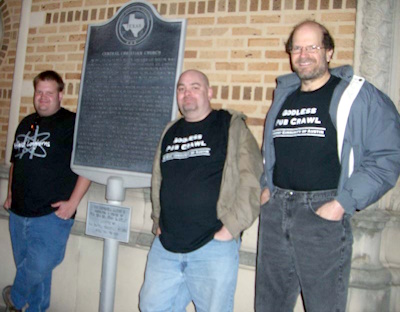
A bunch of the ACA'ers went on a pub crawl last Friday. The crawl started out at Dog & Duck pub, the home of the ACA'ers happy hours; then we went on to 6th street. On the way there we were approached by folks who were handing out fake million dollar bills. It was some kind of Christian evangelist thing. Along the edge of a "bill" in small print there were questions such as "will you go to heaven"? Since most of us wore "Godless pub crawl: pubs, not popes" T-shirts made for this occasion, we must have been a tempting target for evangelists, and there seem to be quite a few of them hunting for souls to save in the nightlife district on a Friday night.

Left to right: Justin, Matt and John on the way to the ACA pub crawl On the way to 6th street, the next destination in the pub crawl, some people felt they had to pose in front of a church. For irony's sake. Left to right: Justin, Matt and John.

Not surprisingly, two of them got into an argument with Matt, the then-president of the ACA. One of those guys told Matt he would prove there is a God in 30 seconds flat. Needless to say, their argument lasted a lot longer, and most of the ACA'ers got bored and wandered off to our next stop, the Darwin pub (no connection to Charles Darwin that I could tell!) It became tedious quickly, but not before I had a chance to hear this gem of an argument. The evangelist attempted to argue from the "first cause", to which Matt replied: if everything must have a cause, then who created God? The evangelist guy said, God doesn't have to have a cause or creator, he always existed. Matt said something along the lines of, you can't simply dismiss a question of whether God has a cause; just like it is meaningful to ask that question about anything else, it is also meaningful to ask it about God; you can't just arbitrarily declare that God has no cause. Matt tried to explain it by analogy: no matter how big a number you can think of, you can also imagine an even greater number, and so on all the way to infinity. The evangelist guy somehow felt existence of infinities threatened his beliefs. He said, no, I don't have to (imagine an even bigger number). I can stop any time. Infinity does not exist in our dimension, he added.

That last remark floored me. I blame science fiction. Seriously. I blame popular sci-fi shows and movies for putting terms like "infinity" and "dimension" into the vocabulary of people who cannot grasp these very simple and intuitive mathematical concepts. But that doesn't stop them from using them in a debate!

After the Darwin pub all the ACA'ers went on to their next stop, but I decided to save my liver and go home.

Wednesday, October 03, 2007

James Morrow "The Last Witchfinder": FACT reading group discussion

James Morrow "The Last Witchfinder": FACT reading group discussion

Another review of a book by James Morrow!

Everybody started "The Last Witchfinder" by James Morrow. Half of the people finished it. Everybody but one person read James Morrow before. The novel chronicles the life of Jennet Sterne, a fictional 17th century woman. After her beloved aunt and mentor is accused of witchcraft and executed, the 12-year-old Jennet decides to make it her life mission to put an end to witch trials. For that she needs to come up with an incontrovertible argument that would convince everybody that the notion of witchcraft is absurd and impossible. She devotes her life to this grand task, and it takes her on many interesting, even improbable adventures.

Everybody said the book was beautifully written. The prose was full of archaic turns of phrase, yet it didn't seem stilted or artificial. I personally was amazed that the characters' speech consistently sounded like it really could have been spoken three centuries ago. It must have taken some effort for a writer to maintain this prose style throughout a 500+-page-long novel!

The book too realistic for some people

Nonetheless, a few people commented that the book was very easy to put down. It is written in a picaresque form, which is uncommon nowadays, and it may distance a reader from the characters, so that it's difficult to get engrossed in a page-turning way in a book. Some readers admitted having wanted something a bit more escapist at the moment, so they did not continue. One reader said he could not enjoy the story, as good as it was, because it was too realistic. While appreciating the beautiful prose and the philosophical depth of the novel, he "could not forgive" James Morrow for torturing the reader. "I cared about the characters and I really feared for what was going to happen to them. I really figured he was going to kill [the protagonist]. [...] I know a little bit about witchhunting, and just the knowledge of pennyroyal for birth control was sufficient to be tried as a witch. Just herbal practices. There is an estimate that "Malleus Maleficarum" (the witchhunters' handbook) cost the lives from 600,000 to 9 million people. In Europe there were at least 40,000 documented witch trial cases in 5 years. It was unpleasant reality. This book was unpleasant for that reason. It was so hideous. I read SF to escape. If I wanted to find [about real-life horrors], I would turn on the news. [...] It's not that it wasn't well written, I just didn't want to be there, I didn't want to experience this." (Despite that, he read through the end.)

On the other hand, another reader found the witch trial scenes funny at the beginning; a scene where a accused witch is being "floated" even reminded him of Monty Python. However, as he realized the witchhunting specifics described in this book were historically accurate, he started to find them a little disturbing.

I myself admit I found this book very disturbing and emotionally harrowing. It was hard to read about a brave, admirable heroine who risks everything, including her life, for an improbable cause. I was pretty sure that the forces she was up against were going to kill her. I even had to look to the end of the book to see how it turns out, something I almost never do. However, the fast pace of the book kept me engaged. There were a few of us who found the story riveting and did not want to put the book down.

A discussion of the book's philosophical themes

It wasn't just the adventures that kept people absorbed in the book, but first and foremost its philosophical themes. One reader has a special interest in the time period the book is set in, the era when Newton made his great discoveries. He has read biographies of many members of the Royal Society, the salient points of which he generously shared with us. I myself was intrigued by the Newton era when I read Neal Stephenson's "Quicksilver", but in my humble opinion, James Morrow did a better job portraying this historical period than Neal Stephenson. At the very least, I think James Morrow shows us very convincingly how the principles of scientific inquiry came into being -- something "Quicksilver" doesn't do as well.

What is the significance of the book-writing-a-book device?

The narrative in "The Last Witchfinder" is contained in an unusual framing device. The story is presented as if written by another book, Newton's "Principia Mathematica". Interspersed with the main story are Principia's personal reflections. We learn from them that Newton's masterpiece is engaged in a centuries-long war with "Malleus Maleficarum", in which each book tries to destroy the existing copies of the other, sometimes resorting to comical measures, such as sending troops of insects to eat the enemy's volumes. "Principia Mathematica" also admits it's been in love with Jennet ever since it laid eyes on her. One reader said she found those confessions of love very tender, but very weird; and another reader countered: "Hey, people love books -- why shouldn't a book love a person!" The notion of a book as a sentient being and an author of another book is probably the only science-fictional element in "The Last Witchfinder". But even then, it is only a framing device. Other than that, readers noted, the only way "The Last Witchfinder" could fit within the SF/F genre is it if were put it in a "secret history" niche subgenre.

But the book-writing-a-book device isn't merely for grins; in fact, it inspired some of the more interesting discussions in the reading group. One reader wondered, why was this framing device was needed at all? Perhaps because Morrow was trying to make a point that books have lives independent of what their authors intended? He said: "When an author releases the work into a literary world, the author can't say what it means anymore. It means what it means to the reader. Newton's "Principia Mathematica" feels very strongly about the demon hypothesis, even if Newton didn't. And I think Morrow is quite correct that the character's conclusion that Newton's Principia is the death knell of demon's hypothesis is quite true, even though Newton didn't see it that way."

Indeed, Jennet got out of "Principia Mathematica" more than Newton intended: it prompted her to establish the principle of "sufficiency of the world" -- the idea that phenomena of the world can be sufficiently explained by the natural world itself, without resorting to demons and the supernatural.
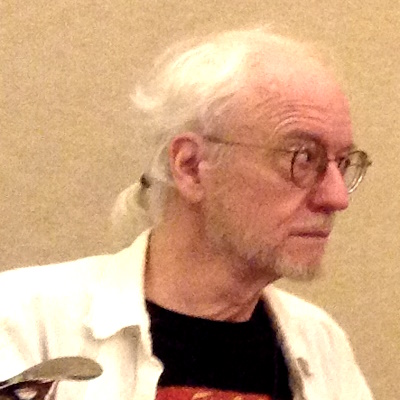
James Morrow being interviewed at ArmadilloCon 2015 James Morrow being interviewed at ArmadilloCon 2015, a speculative fiction convention in Austin, Texas

As for me, I thought the concept of a book as a conscious entity was simply meant to underscore the importance of wars of ideas that have been going on for... well, for as long as there have been ideas. One reader speculated that the war between rationalism and superstition did not die off in the age of Enlightenment; quite the opposite, it intensified. "Witchhunts began to happen in Renaissance, at a time in human history when we got a greater command of the physical world," he said. "I've long been convinced that religious fundamentalism is a product of Enlightenment, not a reaction to the Enlightenment. Because it was then that we started to take the world literally enough, not as a collection of metaphors. Then we started taking those commands about not suffering a witch to live literally. At the same time, Newton's view of the world really did destroy that."

Regardless of the reasons why James Morrow chose to make "Principia Mathematica" a sentient being, many people in this group are no strangers to a feeling that books have lives of their own. One reader said she had this point made very clear to her at one time during her college days. She was taking a tour of the restricted rooms of her university library. One of those rooms contained one of the early editions of "Principia Mathematica". Suddenly she realized that book was worth more than her life, because in case of fire, the room where the book was would be filled with flame retardant gas, which would kill her.

The protagonist too modern to be realistic... or is she?

A couple of us thought Jennet, while a very admirable and brave character, was a bit too unrealistic for a 17th century woman. She was very independent, treated men as equal and expected to be treated as equal by them. Her notions about women's place in the society were those of a 21st century woman. We found it unlikely that she, as well as her mentor, aunt Isobel, could have been brought up with such modern attitudes, and that they were completely unaffected by expectations of submissiveness and passivity that were beaten into many of their contemporary women. However, one reader, who is better familiar with that time period, said there were a lot of very educated women in the 1600s and 1700s, who wrote books, even very technical books. So while such women were unusual, it's not like they didn't exist.

Personally I have to say I liked "The Last Witchfinder" very much, both because of its beautiful prose and because of its themes: heroism, going against the dominant system of beliefs, trying to single-handedly right monstrous wrongs while pursuing scientific understanding. I think I would have liked this novel just for that, even if it wasn't so well written, even if storytelling wasn't so engaging. But since it has those other qualities too, this book is a real gem. I have only read two books by James Morrow so far, but I think he's going to be my Favorite Writer Of The Year. (Last year's title went to Robert Charles Wilson.)

Friday, September 21, 2007

James Morrow "Towing Jehovah": CFI book club discussion

4 people attended a Center For Inquiry book group discussion of James Morrow "Towing Jehovah". 3 of them liked it, one not so much.

Unexpectedly to myself, I liked this novel very much. This book was first recommended to me by a guy in the Atheist Community of Austin. When he told me about the book's premise -- God dies, falls to Earth, and his 2-mile-long body needs to be towed -- I thought it was absurd. He said, yes, but it's very good and very funny.

I am cautious of stories based on absurd premises. Too often they are simply incoherent, as if the author thought that absurdity alone makes a story funny, or that it is a good substitution for satire. This wasn't the case with "Towing Jehovah". Even though the premise patently doesn't make sense to either atheists or believers (only a vanishingly small minority of the latter believe that God has a physical body), the plot develops completely logically, and all of the major characters behave rationally in the bizarre circumstances. When I picked it up, little did I know how much I will enjoy it.

Lots of funny ideas

But not everybody in the CFI book club thought this book was great. One reader felt that while "Towing Jehovah" had a few funny ideas, it "didn't jell". There were plenty of comical moments, like the Pope watching big screen videos of Bing Crosby; or the whole subplot with World War II re-enactors. Or the scenes that give us an appreciation of how humongous God's body was. The mechanics of attaching chains to the eardrums in order to tow the body. Or driving the Jeep into God's bellybutton. Or individual hairs thick enough to tie things to. Or being underwater and swimming into a divine ear with scuba gear. (I would say those scenes were extremely gross, and just as fascinating. Overall, this book does not shy from the gross. It examines it in loving detail, even. If you think an up-close scrutiny of pores the size of moon craters is repulsive, just wait to see what happens when the ship gets stuck on the shallows near the coast of an uninhabited island.)

Some characters' motivations were hard to understand

So overall, one reader thought "Towing Jehovah" had lots of interesting little ideas, but overall didn't quite jell. "In the end," he said, "I was wondering, what was it all about"? He also did not quite buy Cassie and Oliver's reasons for wanting to destroy God's body. Cassie supposedly wanted to get rid of it because, as an arch-feminist, she was afraid that a discovery of God's body by the general public would plunge the world into the new Dark Ages. This reasoning sounded somewhat flimsy to this reader. If God was dead, wouldn't it be logical to show it to the world, so that they would know they were wrong in their belief? The ironic thing is, a discovery of a dead god did not serve either Christians or atheists. The former would find out they were right before, because God really did exist, but they are wrong now; the latter would be right, but not for reasons they thought.

James Morrow at ArmadilloCon 2015 James Morrow at ArmadilloCon 2015, a speculative fiction convention in Austin, Texas

A reader also noted that the lighthearted farcical tone of the book was inconsistent with certain tragic moments scattered throughout the book, where people die or getting seriously injured in ways that are not funny at all.

Satire equally directed towards believers and non-believers

Other people enjoyed the satire in the book. They appreciated that it was directed not just towards religion, but towards atheism in equal measure. Readers recognized some aspects of groups like CFI in the fictional Enlightenment League, and admitted that the barbs pointed at it were pretty accurate. "Despite having a lot of money, the Enlightenment League is pretty ineffective, and what they mostly do is pranks, silly stuff", a reader said.

An interesting dialogue between those groups

While this book is written from an atheist perspective, it is notable that the author does not side with militant atheists. Rather, he lets the three main characters -- the Jesuit priest, the religion-neutral captain, and the atheist Cassie -- have a conversation about God and related matters. One reader said their discussions were one of the enjoyable points of the book. "I thought the priest was interesting, reasonable, the professor. And the captain was interesting too. To me he represented the moderate middle. He wasn't willing to say the didn't believe in God, but he wasn't religious by any means. And then the atheist coming in... I liked the interplay between these 3 individuals, and the way they discussed their beliefs, and that it didn't degrade into awful fighting," she said.

Sympathetic characters and a humanist message

The protagonist, captain Van Horn, who was commissioned to tow the God's body, is probably the most sympathetic character of the book. He has his own deeply felt reasons for wanting to deliver the God's body to its final resting place in the Arctic. They originate in his unfulfilling relationship with his father, a relationship he is still trying and failing to heal. Too many works of satire have left me feeling empty, because there weren't any characters to root for, but this clearly isn't the case here: there are several characters one can easily identify with.

This novel does an excellent job of delivering a humanist message. I really like how it demonstrates the point that whether God existed or not, the civilization would be no different. In the absence of a basis for religion, society is held together by human social and moral norms, which remain the same. The ship crew's brief experiment with giving up those norms ends as a disaster to all of them, and the social order is restored by people's need to cooperate for the sake of their own survival.

Tuesday, August 21, 2007

Center For Inquiry presence at ArmadilloCon

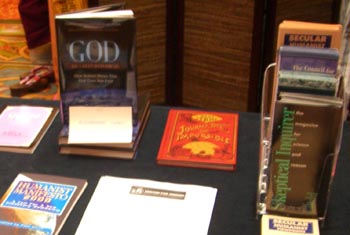
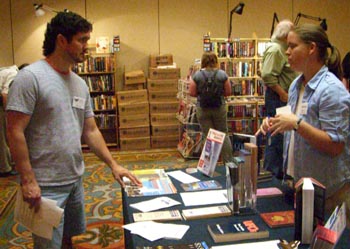
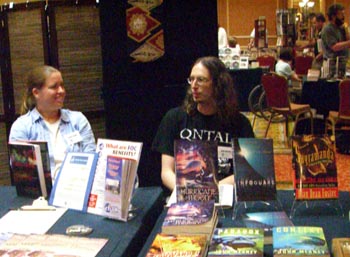
At this ArmadilloCon I spent a substantial amount of time in the dealer room -- on the dealers' side of the table! I was volunteering at the Center For Inquiry table. We would grab the passers-by by their sleeves and proselytize to them our doctrine of freethought and rationalist mindset. No, I'm kidding. We did not try to engage anyone in the conversation against their own will. And the nature of materials on the CFI table -- books and booklets on freethought, skepticism and humanism -- indeed had an ability to make some people uncomfortable. Jenni (the person who coordinated the CFI activities at the ArmadilloCon, and who spent quite a few hours at the table) observed more than one person scurrying away after taking one look at the titles of books on our table.

CFI booth at ArmadilloCon 2007 CFI booth at ArmadilloCon 2007

Still, some other people struck up conversations with us. Long ones, sometimes. I guess that compensated somewhat for their scarcity. One guy argued that religious fundamentalism is losing its strength and is on the way to extinction, at least in the US if not worldwide. We pointed out there were a lot of signs to the contrary, such as (to take the most obvious example) encroachment on abortion rights.Then he started a long discussion on why the recently passed laws to curtail abortion rights in several states aren't really important. Since I stay away from politics in this blog, I'll say no more, but it suffices to say it was an interesting discussion. It could have gone on even longer, but at some point we were joined by a woman who brought a different perspective to the discussion. She teaches at a university, and in the last few years she has had hard time with some students who demand that she bring a religious perspective into the classroom. I don't remember the exact way she phrased it, but I think she was saying some students want her to address the subjects she teaches from a biblical perspective. They are a minority, but a vocal one, and they have gotten increasingly louder over the years.

By joining our discussion, she drew the guy's argumentative zeal towards herself, and soon they drifted off into the crowd where they continued their agitated debate.

Jenni talks with Matt Cardin Jenni talks with Matt Cardin

We also had a handful of people sign up for the CFI email list. Another thing we did -- with less than stellar results -- was sell books. All the books were from Pyr, a publishing house that has a close relationship to CFI. They sent us a shipment of science fiction and popular science books at a discount, so we could, in theory, make a profit selling them... but we sold only about 7 books throughout the entire weekend. The dealers' room was teeming with booksellers, and the competition was stiff.

Center For Inquiry volunteers at ArmadilloCon 2007 Center For Inquiry volunteers at ArmadilloCon 2007

I can't say if participation in ArmadilloCon was really beneficial to CFI in terms of attracting new members, but I personally had a nice time sitting at the table and chatting with some people (mostly with fellow volunteers, and sometimes with other congoers who wandered by).

Here are more of my pictures and blog posts from ArmadilloCon 2007.

Thursday, July 19, 2007

Mary Doria Russell "The Sparrow": a CFI Austin book group discussion

4 people attended the CFI Austin Science And Religion In Fiction book group discussion of Mary Doria Russell's book "The Sparrow". 3 out of 4 gave the book a thumbs-up, 1 thumbs-down.

The book presents a wide range of views from atheism to belief

One thing everybody liked about the book was that Mary Doria Russell presented the views of both believers and nonbelievers. The proportions, however, were disappointingly unequal. The only atheist on the mission, George, didn't get much air time. He was more like a token atheist. He was a very nice person, but he didn't say much throughout the book. Russell did better with other characters, who possessed various degrees of belief and nonbelief. Even the believers had complex views about religion; no one was dogmatic. For example, Emilio joined the Jesuit order for practical reasons, not because he was pious. But then he came to believe when the moment of faith washed over him. One reader said it was interesting to read about it, because he never experienced anything like that. Another reader said she wished more Christians read this book, because the author treated the material thoughtfully. Since Mary Doria Russell in her lifetime went from being Catholic to being atheist, and then to Jewish, we guessed she's obviously has thought about stuff a lot, and it shows in the book.

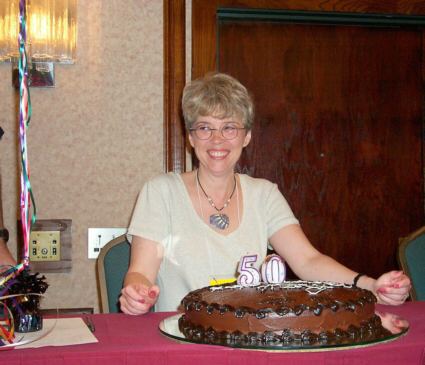
Mary Doria Russell at the ArmadilloCon 2000 Mary Doria Russell at the ArmadilloCon 2000, Austin science fiction convention. She celebrated her 50th birthday at the convention, and the organizers presented her with a cake.

Overall, the readers agreed, "The Sparrow" may be more interesting to believers who may be grappling with questions of faith, than to nonbelievers. For the latter, Emilio's endless questioning of what part God had or didn't have in the events can get tedious after a while. A non-theist would see those questions as based on a false premise.

Other things people liked about the story

  • Witty prose, lots of humor;
  • Remarkably vivid characters, each of them a full-fledged human being, which is rare in science fiction. Often, the characters in science fiction books are hardly more than stick figures who are there to spout author's ideas, or pawns to play out a conflict the author has set up. Not so in the "Sparrow", where each character is a multi-dimensional individual.
  • There were interesting insights in what it means to be a Jesuit;
  • There were lots of interesting tidbits and subthemes in the story, such as predator / prey races or the brain-picking AI "vultures".

I found "The Sparrow" an enjoyable read because it has several very likeable characters, easy to identify and empathize with. But that does not preclude the novel from addressing the dark sides of the human nature. I think the reason why this book spoke to me so strongly is because it asks a question "why do bad things happen to good people", and portrays a group of brilliant people who despite their best intentions make horrible, vast, destructive mistakes. It shows how even the best knowledge can lead to erroneous conclusions; it raises all the hard questions and interesting ethical dilemmas; if anything, it points to randomness and unpredictability of the world, not leaving a place in it for any intelligent supernatural force. At least those were my conclusions. However, our main character at the end of the sequel reaches a different conclusion.

This is not to say that there weren't serious criticisms of the book voiced by the members of the group.

It's not really science fiction

One reader was especially disappointed that the book, despite its science-fictional furnishings, turned out to be not really science fiction. "I'm a sucker for first contact stories," he said, "but it seems like a sham in this book. Instead, the story is all about Emilio's search for discovery. It's a background to ask, is there God, etc.? I was so tired by the end of the book of his inner dialogue about what part God played in the events and in Emilio's personal suffering. Yes, there were rocketships, but the book could have been set in 1700 and the mission could be going to Polynesian islands. So science fiction was just a framework on which to hang the morality flag."

Some plot twists are based on characters acting like idiots

Another flaw of the book is that some critical plot points stretch the reader's credibility a bit too much.

Attention! Spoilers!

Such as: Sophia "borrows" the lander (a rocket that they use to go back and forth between the planet and the ship in the orbit) and uses up most of the fuel, not leaving enough for the mission to get off the planet. A reader called this plot twist ludicrous. "When I drive, I pay attention to how much fuel there is," said a reader. "And when the lander is the only way to get off the planet, when the fuel is your lifeblood, it's just not credible that Sophia would have not checked the fuel levels in advance. It's not like 'ohmigosh, I forgot!'"

It was also hard to believe that the locals were not very impressed to meet the visitors from the stars. "They treat them so blase," said a reader. "We're gonna kill them all, and give one guy as a gift to head honcho. Huh? Maybe, but it seems so unrealistic. It's like, visitors from the stars arrive at the White House lawn, and we just capture them and give them away as presents."

It was also not very believable that the people back on Earth jumped to an easy conclusion that Emilio worked as a prostitute. Did it not occur to them that the most obvious explanation may not be correct when you are dealing with an alien society? Why didn't they interpret Emilio's actions with a more open mind?

End of spoilers