Showing posts with label CFIBookClub. Show all posts

Sunday, September 30, 2012

Center For Inquiry fiction book club fall 2012-spring 2013 reading list

Update: we will have a meeting in November 2012 -- see below.

Here is the list of books we'll be discussing in the next few months in the CFI Austin fiction book club.

October 2012: Nancy Kress "Steal Across The Sky"

From amazon.com:

"The aliens appeared one day, built a base on the moon, and put an ad on the internet:

"We are an alien race you may call the Atoners. Ten thousand years ago we wronged humanity profoundly. We cannot undo what has been done, but we wish humanity to understand it. Therefore we request twenty-one volunteers to visit seven planets to Witness for us. We will convey each volunteer there and back in complete safety. Volunteers must speak English. Send requests for electronic applications to witness@Atoners.com."

At first, everyone thought it was a joke. But it wasn't.

This is the story of three of those volunteers, and what they found on Kular A and Kular B."

November 2012: Mark Twain "Mysterious Stranger". In this Mark Twain's last, unfinished novel, a young Satan comes to a remote Austrian village. He claims to be able to foresee the future and informs the group of unfortunate events that will soon befall those they care about. The boys don't believe Satan's claims until one of his predictions comes true.

December 2012: Octavia Butler "Parable of the Sower"

From amazon.com: "When unattended environmental and economic crises lead to social chaos, not even gated communities are safe. In a night of fire and death Lauren Olamina, a minister's young daughter, loses her family and home and ventures out into the unprotected American landscape. But what begins as a flight for survival soon leads to something much more: a startling vision of human destiny... and the birth of a new faith."

January 2012: Michael Bishop "Close Encounters with a Deity" - a story collection.

From amazon.com: "The book's unifying theme is man's concept of the Deity. Bishop's stories intermingle humor, horror, and awe in a manner similar to Vonnegut."

February 2012: Jonathan Strahan, editor, "Godlike Machines"

From goodreads.com: "In science fiction, nothing says sensawunda like a Big Dumb Object--a colossal, extremely powerful machine of unknown purpose and origin. It's that feeling that editor Jonathan Strahan was after when he asked six of today's finest authors to write for Godlike Machines. And they succeed brilliantly!"

March 2012: Greg Egan "Clockwork Rocket"

From amazon.com:

"Set in another universe where light does not travel at a constant speed but instead has a velocity that depends on its wavelength, Clockwork Rocket recounts the personal life journey of an inhabitant in this fictional universe."

"Alongside a taut and well imagined story set in a very alien world - complete with a sympathetic range of characters and a well imagined society - Greg Egan develops an entire alternative physics. This isn't just done in a hand waving way, it is properly worked out. The story of Yalda, the scientist who is the main protagonist, is also the story of the discovery of "rotational physics" in her universe, of the implications of that, good and bad, for her planet, and finally - in the construction of the rocket of the title - the story of the action she takes to safeguard that world."

Monday, August 27, 2012

Book review: Charles Yu "How To Live Safely In A Science-Fictional Universe"

seudo science fiction with a certain melancholy beauty -- that's what we concluded about Charles Yu "How To Live Safely In A Science-Fictional Universe" at the Center For Inquiry book club discussion. It is pseudo science fiction, because while it has science fiction trappings, most of it is author's exploration of how he feels about things. It felt self-indulgent, and for a good reason: the protagonist is the author himself, or at least his namesake. That's not to say that many of us wouldn't be able to identify with the protagonist sometimes. He is a technician who travels in a time machine, and attends the most heartbreaking moments of people's lives. It also means that he doesn't spend almost any time in the present -- most of his life is spent outside time, and he is a stranger in his own era. His capsule, barely big enough to stretch out, is completely bland and featureless. I was all the more surprised that I found its description compelling. Something about it resonated with me. Could it be because many of us spend most of our days in similar blank rooms, a.k.a. office cubicles, performing actions that are, in a way, outside of time? Their impact on other people is softened by many layers of infrastructure, depersonalized, not traceable directly to us. So it's not hard to identify with the protagonist's alienation. I found his father, a quietly brilliant, stoic, underappreciated Asian engineer, to be a more vivid character than the protagonist himself. But that may be just because I identify with an immigrant engineer's experience. That said, the explorations of the character's psyche did not make up for plot shortfalls. It seemed that the author intended for the time-travel mechanism to make sense (it wasn't just a vessel for psychological exploration), but in that sense it failed. At the end, we are expected to believe that the protagonist resolved a deadly time loop he accidentally created. But the ending is so ambiguous that we didn't understand what was going on. It's as if the author tried to hand-wave over the fact that no real resolution was possible. This book has a few interesting science-fictional tidbits, which I can't really call ideas, since they are way too undeveloped. For example, what does it mean to time-travel by grammatical tenses? Or what does it mean to live in a universe that's only 93% installed? Each of those ideas could be tantalizingly interested, if properly developed, but in the book they are just throwaway sentences. One of the book club members said that while he enjoyed the book enough, he wouldn't recommend it except to someone who really wanted a "different" kind of science fiction. This book may be best enjoyed for its melancholy mood, an exploration of a father-son relationship, and a tragedy of a brilliant, but modest person without an ability to sell himself well (the father). That last plotline is where the book really shines.

Thursday, February 23, 2012

Center For Inquiry fiction book club selections for the first half of 2012

April 2012


H. G. Wells "The Sleeper Awakes" -- a short novel about a nineteen century Englishman who falls in a deep sleep only to awake over two hundred years later.

May 2012


Nnedi Okorafor "Who Fears Death"

-- "The young sorceress Onyesonwu -- whose name means Who fears death? -- was born Ewu, bearing a mixture of her mother's features and those of the man who raped her mother and left her for dead in the desert. As Onyesonwu grows into her powers, it becomes clear that her fate is mingled with the fate of her people, the oppressed Okeke, and that to achieve her destiny, she must die. Okorafor examines a host of evils in her chillingly realistic tale'gender and racial inequality share top billing, along with female genital mutilation and complacency in the face of destructive tradition -- and winds these disparate concepts together into a fantastical, magical blend of grand storytelling." -- a review from amazon.com

June 2012


James Blish "A Case of Conscience"

-- "The citizens of the planet Lithia are some of the most ethical sentient beings Father Ramon Ruiz-Sanchez has ever encountered. True, they have no literature, no fine arts, and don't understand the concept of recreation, but neither do they understand the concepts of greed, envy, lust, or any of the sins and vices that plague humankind. Their world seems darned near perfect. And that is just what disturbs the good Father."

-- "A fast-paced, intelligent story that offers plenty of action while at the same time explores complex questions of values and ethics. In this case, Blish has taken on the age-old battle of good vs. evil. Lithia poses a theological question that lies at the heart of this book: is God necessary for a moral society?" -- reviews from amazon.com

July 2012


Brandon Sanderson "Mistborn"

A description of this novel on amazon.com calls it a mystico-metallurgical fantasy. I heard it has an unusual and well thought-out magic system. An attempt to create a "scientific" magic system might make this book of interest to CFI readers who like fantasy.

August 2012


Philip K. Dick "VALIS"

-- "When a beam of pink light begins giving a schizophrenic man visions of an alternate Earth where the Roman Empire still reigns, he must decide whether he is crazy, or whether a godlike entity is showing him the true nature of the world."

-- "From the cancer ward of a bay area hospital to the ranch of a fraudulent charismatic religious figure who turns out to have a direct com link with God, Dick leads us down the twisted paths of Gnostic belief, mixed with his own bizarre and compelling philosophy." -- reviews from amazon.com

Sunday, March 06, 2011

Candidate books for Science and Religion in Fiction book club

This post will be mainly of interest to the members of, or those who have an interest in, the Science And Religion In Fiction book club at the Center For Inquiry Austin. Here are the books we are considering for our upcoming discussions.

March meeting will be an encore of Ted Chiang "Stories of Your Life and Others", which was originally scheduled for January, but none of the interested parties could make it to the meeting. It's a collection of relatively short speculative fiction stories, though some are novella-length. They cover many fascinating topics such as superintelligence, religion, Singularity, how language shapes our perception of time, and others.

Here are the candidate books for the upcoming months:

Greg Egan "Incandescence"

From Amazon.com review: "Hugo-winner Egan, champion of ultra-hard SF, devotes most of this slim novel to the efforts of the Arkmakers, who live in a neutron star's accretion disk at the center of the galaxy, to develop orbital physics from first principles and save the artificial world created by their more sophisticated ancestors. Meanwhile, Rakesh, a more or less human member of a distant posthuman society, sets off on an unrelated quest to find the Arkmakers and is soon trying to save them from their current danger. Whole chapters are devoted to physics problems and include a variety of diagrams and cited sources."

John Scalzi "The God Engines"

From Amazon.com review: "Captain Ean Tephe is a man of faith, whose allegiance to his lord and to his ship is uncontested. The Bishopry Militant knows this -- and so, when it needs a ship and crew to undertake a secret, sacred mission to a hidden land, Tephe is the captain to whom the task is given.

Tephe knows from that the start that his mission will be a test of his skill as a leader of men and as a devout follower of his god. It's what he doesn't know that matters: to what ends his faith and his ship will ultimately be put -- and that the tests he will face will come not only from his god and the Bishopry Militant, but from another, more malevolent source entirely...

Say your prayers...and behold The God Engines."

John Scalzi is mostly known for light, humorous space opera, but this bok promises to be a much darker fantasy novella that "takes your expectations of what fantasy is and does, and sends them tumbling".

Helen Collins "Neurogenesis"

From Amazon.com review: "Helen Collins' second SF novel, NeuroGenesis, continues her compelling exploration of the meaning of "intelligence" that she began with her first novel, Mutagenesis." According to a reader review, it involves a spaceship with a carbon-based operating system that "begins to evolve in erratic and unexpected ways, and finally reprograms the ship to land on a planet inhabited by an intelligent and startling human-size saurian species called Corvi. The crew struggles to survive, to determine how the Corvi sensed the OS and saved the ship, and to find a link between the race of humans and the race of Corvi."

Ellen Klages "The Green Glass Sea"

A young adult novel. From Amazon.com review: "Two girls spend a year in Los Alamos as their parents work on the secret gadget that will end World War II. Dewey is a mechanically minded 10-year-old who gets along fine with the scientists at the site, but is teased by girls her own age. When her mathematician father is called away, she moves in with Suze, who initially detests her new roommate. The two draw closer, though, and their growing friendship is neatly set against the tenseness of the Los Alamos compound as the project nears completion. Clear prose brings readers right into the unusual atmosphere of the secretive scientific community, seen through the eyes of the kids and their families. Dewey is an especially engaging character, plunging on with her mechanical projects and ignoring any questions about gender roles."

Sunday, February 07, 2010

Book review: Chris Beckett "The Holy Machine"

For our October 2009 meeting, Center For Inquiry Austin book club read "The Holy Machine" by Chris Beckett, a novel that fit perfectly the science and religion in fiction theme of our club. Unfortunately, instead of our usual attendance of 4-5, we had only 2 people, one of which was me. So instead of a usual discussion writeup, I'm posting my own review. (The other guy mostly agreed with my opinion. :-))

"The Holy Machine" portrays a world completely dominated by religious fundamentalism, except for one secular state, Illyria, the only country still pursuing science and technology. Having the best-equipped military in the world allows Illyria to coexist in uneasy peace with militant fundamentalist states. But trouble is brewing within this secular paradise. Having witnessed violent religious uprisings that caused mass murders of scientists and rational-minded people in other countries, Illyria won't tolerate any religion within its borders. Even peaceful expressions of religion are persecuted. It also limits immigration from the outside world, since immigrants bring their faith with them. It grudgingly tolerates low numbers of guest workers, though, because somebody needs to perform menial jobs. Even so, it manufactures trainable androids with the eventual goal of replacing imported labor.

Yet none of this goes smoothly. Immigrants demand a right to peacefully practice their religions, and a growing number of native Illyrians support them, as they become dissilusioned by the lack of freedom of speech in their country. Meanwhile, robot training goes awry. As robots learn to better interact with humans, they quickly go insane. Their designers propose to counteract this with the only way they know how: by wiping robots' brains clean every 6 months, reinstalling the original program. This, however, means that any learning will be lost, making it impossible for robots to ever become ubiquitous, skilled, undemanding servants.

In other words, the premise of the book is a metaphor, though a highly exaggerated one, for the current state of the world. Aging populations in the developed world necessitate import of guest workers for low-skilled labor, and those workers usually come from poor and highly religious countries, bringing religious intolerance with them. Much has been said about threats to democracy posed by the influx of Islamic fundamentalism into Europe. I liked that "The Holy Machine" addresses several hotly debated issues of today, among which I count the unexpected consequences of artificial intelligence. Combine these issues, and you have a kind of novel most people in our club would like to read.

The plot revolves around a shy, socially inhibited 20-year-old named George Simling. To escape his sheltered, lonely life, he gets involved with a robot-prostitute named Lucy, and starts teaching her to become human. He falls in love with her, abducts her and skips the country. As they roam from one small town to another, their lives become increasingly endangered, since androids are considered abominations in religious fundamentalist countries. George tries to pass Lucy off as human, which, paradoxically, becomes harder the closer she comes to developing human-like intelligence and emotions. It suffices to say that of many things that happen to George and Lucy, few are good.

What I liked about this coming-of-age story is that it does not offer any fluffy, heart-warming, predictable lessons. George gets disillusioned in his idealism. Religious people, of who he imagined himself a champion, turn out to be close-minded and terrifying in their dogmatic beliefs; Lucy the sex robot whose stunning beauty, desire to please him all the time, and lack of human complexities caused him to fall in love with her, turns out to be less than ideal companion in the real world. As she can't relate to his shock and inner turmoil, he ends up feeling emotionally alone. He does not handle it well, and ends up in very bad circumstances.

Some of this book's science-fictional plot treads, such as Lucy the robot's first slow, faltering steps towards consciousness, are more convincing than others. A certain transformation at the end that resulted in the birth of the Holy Machine did not seem credible. Maybe because we, as readers, did not get to witness it at the same level of detail as Lucy's awakening, it appeared to be tacked on at the end in a Deus Ex Machina fashion (no pun intended).

Lucy's coming into consciousness is the most engaging plot thread in the book. Her sex-robot programming was directing her behavior in ways that were both comically inappropriate and very creepy, especially as they put the couple in danger. This particular mixture of comedy, horror and suspense kept me turning the pages.

The ending was anticlimactic. It's not clear what happened to Illyria, except that it got into even worse trouble than it already was; it's not clear whether The Holy Machine changed the world even in a minor way. Basically, at the end of the book things are worse than they were, but nothing is really resolved, at least not on a global scale. For George, the main character, his horrifying adventures resulted in hard-earned maturity, so in that sense the book delivers.

Tuesday, January 27, 2009

Christopher Moore "Lamb": CFI book club discussion

4 people attended the CFI Science And Religion In Fiction book club discussion of Christopher Moore's book "Lamb: The Gospel According to Biff, Christ's Childhood Pal". Only one of them has read other novels by Christopher Moore (6-7 or them, in fact, and he was the one who recommended "Lamb" to the group).

"Lamb" is a humorous account of the life of Jesus Christ, as told by his childhood pal Biff. If we believe this novel (and we have as much reason to believe it as the Bible, as far as I'm concerned :-)) Biff was Jesus' trusty sidekick all throughout his life. The story focuses on Jesus' missing years between ages 14 and 30; it shows Jesus and Biff traveling all over the world in search of the three wise men. Their travels take them to Middle East, China, and India, where they get entangled into many fantastic adventures, each one more bizarre than the previous one.

We all acknowledged that "Lamb" is intended as a funny book rather than serious deconstruction of Christianity. It's a humorous what-if scenario of how doctrines of Christianity came together. "I think Christianity has pulled its ethics from a whole lot of sources, and that's what Moore showed here, that made for a serious message in the book, if there is any," said a reader. Our group liked that aspect of it.

A serious message is not easily found in this book, however. A few readers found the book very lightweight. This is not a book you would learn a lot from. But we all found it hilarious. The humor and the adventures are enough to pull you through the book. One reader said he tried to read a passage from the first 100 pages to his wife, and could not finish, because he fell over laughing. Another person compared the humor in this book to that in "The Simpsons". "A lot of Homer's humor is naivete, taking things seriously," said a reader, pointing out parallels with the "Lamb": "For example, when Gaspar tells Biff the parable of the boat -- when you cross the river, do yo carry the boat with you? And Biff asks, well, how big is the boat, etc.?" The very manner of Biff's speech is modern American. But there were undoubtedly wisecrackers in biblical times, too.

The humor in "Lamb" really shines when it's used to explain the origin of Jesus' famous sayings. From "turn the other cheek" to "you will be the rock I'll build my church upon", they all are shown as having arisen from profane, goofy situations, rather than divine revelation.

The ending was found to be a little too sweet by some people. But it's consistent with the general feel-good tone of this novel that stays funny without hardly ever becoming sarcastic. Indeed, a remarkable feature of "Lamb" is that this tale of young Jesus' escapades manages to be completely non-offensive to Christianity. Some of us noted that it has a surprisingly sympathetic view of Jesus. "I really felt for the guy," said a reader, "he was such a good person. He really was. If the Bible was written more like this, I think a lot more people would end up Christians. At least I might have." Chris Moore mentions in the epilogue that practically no religious person ever came up to him and complained. "Lamb" is full of blasphemy, but it's presented so well that it's almost impossible to feel insulted.

I personally found it funny and sad -- or maybe just sad -- that Biff is considered by everyone to be an idiot, when he is really quite brilliant. He's certainly smarter than Jesus himself. He comes up with theories of round Earth, and of evolution, millenia before anyone else. It seems Chris Moore could not resist the irony of Jesus pal discovering theories that are so viciously opposed by fundamentalist Christians.

Bookmark This on Delicious

Monday, March 10, 2008

Khaled Hosseini "A Thousand Splendid Suns": a CFI book club discussion

4 people attended a CFI Science And Religion in Fiction book club discussion of "A Thousand Splendid Suns" by Khaled Hosseini. The two main characters of this novel are two women who were given away in marriage, against their will, to the same brutal, abusive man. The story follows them over a quarter of a century, during which Afghanistan endures a few dictatorships and a long, grueling war.

Most of the attendees liked the novel very much. 3 people have read Khaled Hosseini's first novel, "The Kite Runner", and thought both were terrific books, though one reader liked "The Kite Runner" a "teensy bit" better, as it had a more interesting story line. Two readers thought that the author struggled a bit to show things from the female perspective in "A Thousand Splendid Suns", but it nonetheless provided something "The Kite Runner" did not -- a window into lives of women in Afghanistan. Those lives were every bit as bad as one would imagine, and then some. The author indeed does a good job of giving the reader a taste of what it's like to be the most powerless of the powerless people. The two heroines of the book struggle to survive in a double dictatorship: as the Taliban rule the country with terror, the women's husband rules the house by brutality and intimidation. Hosseini does not shy away of portraying the most horrible moments of their lives, but he does it gently, lyrically.

Some of the insights into women's life may appear counterintuitive to a western reader. For example, some of us found it striking that when when Mariam first put on a burqa, she felt a little more safe, as if she had a place to hide from the world and all those people she was afraid of. So a burqa wasn't just a tool of oppression, it unexpectedly turned out to be protective, in a way. There are other nuances in portrayal of characters, even the most evil of them, Rasheed (the husband). As much as he abused his wives, Rasheed wasn't a complete monster, a reader noted; he was a product of his times. Wife beating was considered the norm in that place and time. Some of his behavior has redeeming value -- for example, silently accepting Laila's daughter, despite secretly knowing he was not the father. In a situation where men had absolute power over wives, one of our readers gave Rasheed credit for not murdering Laila and her daughter outright, which he could have easily done. The reader acknowledged, though, it probably wasn't magnanimity that made Rasheed tolerate an out-of-the-wedlock child, but fear of embarrassment if the community found out.

"A Thousand Splendid Suns" is very easy to read text-wise: the plot is straightforward, the motivations of the characters transparent. One reader was impressed that the author, despite coming from a different culture, was able to make this novel accessible to an American reader.

However, on an emotional level this book may be difficult to get through. It's hard to read about heroic women whose lives are dire from the start (at least Mariam's was; but Laila didn't have an easy childhood either), and they were going to only get worse with time. You know their lives will get worse when the Soviets invade Afghanistan, and much worse when the Soviet occupation will be replaced by the infighting mujahideen fractions, and then worse again when a Taliban dictatorship will replace the mujahideen war.

Here I must note something I found a little disappointing about this book. I expected that a novel set in Afghanistan during the rule of Taliban would at least touch upon the topic of the nature of religious fundamentalism. Perhaps I was hoping that it would reveal how a theocratic dictatorship comes into being, or that it would put me in the mind of a jihadist. Of course, this wasn't this novel's mission; there are other books about that, although I think they might have fitted the topic of the CFI Science and Religion In Fiction book club better. Another reader thought the reason why the book avoided a Jihadist perspective altogether was because it very clearly shows that the Taliban's grabbing of power was not motivated by religion. It was all about grabbing resources in a land of limited resources. People joined the Taliban so that they could feel powerful and push other people around.

Saturday, January 26, 2008

Philip Pullman "The Golden Compass": CFI book club discussion

4 people attended the CFI Science and Religion in Fiction reading group discussion of Philip Pullman's "The Golden Compass". Overall the impressions were positive. These were some of the main points discussed.

World building

World building may be one of the most interesting aspect of the book. A significant component of the intrigue was to try to figure out what time period it was set in. Several readers at first assumed it was set in the Middle Ages. There's a big school made of stone, they light lamps. But then they mention things like Aerodock, and a center for Atom craft, and they talk about photons, and there is even some vague quantum physics-babble. So it's obviously not Middle Ages. But just when you may begin to think the story is set in the modern times, the world still feels subtly wrong. A lot of kids in it seem to live in Dickensian circumstances, working menial jobs (like Roger, the kitchen boy) or simply running around in the streets, instead of going to school. Apparently in this world there are no laws concerning child labor or mandating universal education.

Adherence to, and departure from, fantasy archetypes

This book played up some fantasy cliches (or shall I say archetypes), while parting with others, and it was interesting to see how the readers reacted to the presence or absence of their favorite archetypes. I vaguely felt that this novel neglected to follow a couple of essential plot requirements for a SF/F book.

  • The stakes against which the character is fighting must be high. Of course, for a young girl to go to the North to rescue children from the hands of an evil organization does sound like pretty tall order, but the stakes are not global: it's just a handful of children under threat, not the world in itself (though there is some talk that shady entities experimenting with Dust are trying to change the world forever, it is very vague). So this does not quite qualify as an archetypal hero's quest story.
  • Unlike in the best stories of this kind, things don't get worse before they get better. Lyra's progress goes rather smoothly, although she has some disconcerting experiences. Still, we don't get a feeling of thickening doom, of dark consequences that would befall the world if she fails.
  • However, another reader said he liked the way "Golden Compass" wasn't based on the familiar "a hero saves the world" fantasy formula. Other cliches were more palatable to him. For example, most characters Lyra meets are exceptional in some way. It's not just an ordinary bear, it's the king of bears. The witch is not an ordinary witch, she's the queen of the clan. But the reader who did not like formulaic plots had no problem with larger-than-life characters. He said it must be "easier to write about extraordinary characters like kings and leaders of clans. For me it's boring to read about ordinary people leaving ordinary lives, because I live one."

The philosophical premises of the book received praise from CFI

CFI being a club of rationally-minded people, philosophical premises of the book got some attention. A reader noted that while this book has several fantasy tropes -- witches that fly on a piece of pine wood, or talking bears -- it really doesn't have magic. There is no mind-reading or spell casting in it, that's not how this world operates. Readers praised Pullman for making the science-fictional elements in this book part of the natural world. This is where the worldview of this novel differs from "conventional" fantasy, in which the ability to see paranormal, or magical, phenomena is often depends on being "pure of heart"; people who are unable to see / experience magic, are often shown as deniers or simply stupid; in other words, in traditional fantasy and magical realism, ability to experience the supernatural element is subjective. Pullman does the opposite. In his world, fantastic elements exist objectively. Another appealing quality of the novel is that the author plays fair with his world. He sets boundaries and rules in his world, and he doesn't violate them on a whim. That's a problem in certain fantasy, where certain characters get to do what they want and violate what they want, but Pullmann stuck with the rules.

The science-fictional elements are rich with meaning

Science-fictional elements in Pullman's world are rich with meaning. None of them are tacked on arbitrarily or as plot MacGuffins. For example, daemons. It is a testimony to Pullman's great job exploring implications of daemons, that the readers in this group found various daemon-moments the most memorable parts of this book. One reader's favorite scene was where the evildoers try to separate Lyra form her daemon, as this scene demonstrates that a daemon is an intimate aspect of a person, and losing it is a horrible catastrophe. It's not like losing your pet dog. It's like having their arms and legs cut off, or losing part of your personality. Another reader admitted finding that scene traumatic, which attests to its power. The role of daemons was so central to the book, it caused one reader to speculate that the plot of the book will be based on Lyra getting separated from her daemon and trying to get it back. Pullmann is good at exploring many nuances of human/daemon interdependence. For example, children's daemons change shape up until adolescence, when a daemon settles into a shape that best represents the person. As a result, some daemons may acquire a guise undesirable to their human -- for example, a poodle, though the owner might have wanted to have a tiger or a lion instead. And now his daemon will trumpet to the whole world that this person, in his essence, is a poodle.

Daemons are also an expressive instrument to convey the characters' emotions and the deeper undercurrents of their psyches, because a daemon outwardly expresses what goes on inside a character. For example, a reader pointed out, the scene where Mrs. Coulter's monkey daemon attacks Lyra's daemon shows that Mrs. Coulter's true intent towards Lyra is very different from her outward sweetness.

The tropes are rich, but confusing

The presence of daemons doesn't explain as many things as the questions it raises. For example, a reader asked, when a baby is born, where does the daemon come from? We also agreed it was a bit simplistic to to think that a demon represented a soul.

Other fantasy elements in the novel are even more puzzling. For example, what to make of experimental theology? "It's weird that in this world theology involves machinery, and you can do experiments with it! It's very tantalizing, and then he doesn't go anywhere with it," said a reader.

Or the notion that Dust may be a leftover from the original sin. "Huh? What's that about?" a reader asked. "How can particles coming from space have anything to do with a religious concept?"

The aletheiometer was seen by a reader as presenting a paradox; on one hand, it was a cop-out because it told you everything you want to know; on the other hand, it made the reader wonder why didn't Lyra spend all of her time reading it, to find out as much as possible about who the bad and the good guys were?

So, the conclusions. Plusses: a convincing, richly detailed fantasy world that whets the reader's appetite by hinting at deeper links between seemingly unrelated magical elements; likeable characters; the fantastical elements exist objectively in this world. Minuses: some fantasy archetypes in the book are too cliche; some science-fictional elements don't seem to be internally consistent.

Thursday, December 20, 2007

Neil Gaiman "American Gods": a CFI book club discussion

5 members of the CFI book club attended the discussion. 3 of them have finished the book, 2 haven't but were planning to finish. For some reason we didn't get much discussion mileage out of this book. It did not prompt discussions as lively as the two previous books the CFI book club read, "The Sparrow" and "Towing Jehovah".

Everybody agreed the story starts out interesting but loses steam towards the end. A reader who characterized "American Gods" as half mythology, half modern road movie, said this setup pulled him through the first two thirds of the novel, but then he started to lose interest. Everybody felt pretty much the same.

The best part of the book: details, subplots, digressions

What people found the most memorable about "American Gods" was not the overarching idea or characters, but the details: various little tidbits, plot snippets and sub-stories that made this book a rather unusual piece of work. It is full sub-plots and sub-sub-plots that sometimes threw the readers off course, even if in a good way. For example, a few readers wondered about the significance of the taxi driver episode. Or the life story of an African woman who was sold into slavery and brought to colonial America. What role did these interludes play in the plot? Was it just to illustrate various ways gods from all over the world migrated to the US? One reader observed that Neil Gaiman usually manages to tie the plot threads that seem disparate (for example, "Sandman" has dozens upon dozens of plot threads, but most of them have an effect on the story), whereas in "American Gods" a lot of plot threads didn't have a connection.

And the concept of importing gods does not seem to be consistently thought out. Someone in the group wondered: when people came to America and brought their gods, did they duplicate them, or did they bring the only instance of a god to America? At the time when they came, there must have been a lot of people in the home country believing in the particular god, so this would imply most of those gods had "forked" (if you put it that way). Actually, I think the afterword answers that question: the immigrants indeed brought replicas of gods with them. In that case the central conflict is a bit myopically American-centered. You would wonder why the originals of the old gods did not back up the duplicates in the final battle? (Unless they too were dying out in their home countries, which seems plausible.)

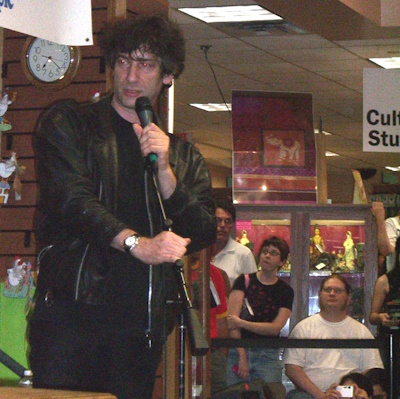
Neil Gaiman book reading at Book People in Austin, TX, September 2005 Neil Gaiman book reading at Book People in Austin, TX, September 2005.

The most interesting characters end up as "furniture"

Speaking about the uniquely American flavor of the book, its main redeeming quality, in my eyes, is Gaiman's pitch-perfect rendition of small town America and all the colorful weirdos that live in it. I was impressed how Gaiman portrayed each of Shadow's quirky, kind, mysterious neighbors as a distinct person, with unique patterns of speech; how he brought those characters to life with just a few details. However, until the very end it didn't seem that those secondary and tertiary characters were more than "furniture" in Gaiman's picture of small town America. Admittedly, it was an interesting picture, bleak and cozy at the same time, and worth of a book in and of itself, but still, it was hard to see how those characters were significant. Shadow's interactions with them appeared to be digressions an author resorts to when he doesn't know how to advance the plot. I amended my opinion somewhat after reading the last 20-30 pages, as it turns out that some of the subplots involving secondary characters get tied up in the main plot line. Still it is less than satisfactory to have them tied up after the fact, rather than organically woven into the plot.

The plot loses steam towards the end

The general opinion of our group was that you may have fun with the details, but the book lacks something... overarching. Well, you can't say it lacks a concept, because it does have a rather unusual central concept. It's the notion that gods exist only as long as there are people who believe in them, and that believers brought their gods along as they migrated around the world. But a good premise is not enough to make a good novel. For one thing, this idea is not entirely new: as one reader pointed out, Terry Pratchett played with it in "Small Gods". The execution is what makes a book worth reading, and the execution of this novel fell apart towards the end. None of the 5 readers that took part in the discussion thought the ending made much sense, or had a clear idea of Shadow's role in the resolution of the central conflict. The way the plot petered out towards the end made it hard for me to sustain interest. I'm not sure if this testifies to my degree of sleep deprivation, or to some real flaws of the book, that I fell asleep while reading what was supposed to be the climactic scene, the battle of the gods.

I also wasn't sure what was even the point of a battle between old and new gods, given that most of the old gods were dying anyway. The conflict, as it was presented in the book, had little relevance to the world at large. Most people, unaware of those gods' existence, would not have noticed their disappearance.

I'm also surprised that neither old nor new gods tried to make an alliance with Jesus or Allah, as the latter two are still among the most powerful imaginary entities on the planet. However, introducing players of this caliber into the plot would have made it much more complicated, so I can understand the reason for this omission.

The book is oddly in favor of religion?

I guess this book may feel rewarding is if you are among people who bemoan lack of spirituality in the modern western society. Such a person may find themselves sagely nodding their head in agreement. Gaiman's observations about America's lack of soul, lack of spiritual places and a need to create artificial spiritual places would certainly seem poignant to me... if I believed that "spirituality" is a definable notion, and that there was more of it in the past (or in less advanced societies) than there is now. But since I don't believe that, those observations, while witty, sounded hollow to me. CFI being what it is, most of our group members did not identify with that sentiment either. "The book is oddly in favor of religion," concluded one of our readers.

Friday, September 21, 2007

James Morrow "Towing Jehovah": CFI book club discussion

4 people attended a Center For Inquiry book group discussion of James Morrow "Towing Jehovah". 3 of them liked it, one not so much.

Unexpectedly to myself, I liked this novel very much. This book was first recommended to me by a guy in the Atheist Community of Austin. When he told me about the book's premise -- God dies, falls to Earth, and his 2-mile-long body needs to be towed -- I thought it was absurd. He said, yes, but it's very good and very funny.

I am cautious of stories based on absurd premises. Too often they are simply incoherent, as if the author thought that absurdity alone makes a story funny, or that it is a good substitution for satire. This wasn't the case with "Towing Jehovah". Even though the premise patently doesn't make sense to either atheists or believers (only a vanishingly small minority of the latter believe that God has a physical body), the plot develops completely logically, and all of the major characters behave rationally in the bizarre circumstances. When I picked it up, little did I know how much I will enjoy it.

Lots of funny ideas

But not everybody in the CFI book club thought this book was great. One reader felt that while "Towing Jehovah" had a few funny ideas, it "didn't jell". There were plenty of comical moments, like the Pope watching big screen videos of Bing Crosby; or the whole subplot with World War II re-enactors. Or the scenes that give us an appreciation of how humongous God's body was. The mechanics of attaching chains to the eardrums in order to tow the body. Or driving the Jeep into God's bellybutton. Or individual hairs thick enough to tie things to. Or being underwater and swimming into a divine ear with scuba gear. (I would say those scenes were extremely gross, and just as fascinating. Overall, this book does not shy from the gross. It examines it in loving detail, even. If you think an up-close scrutiny of pores the size of moon craters is repulsive, just wait to see what happens when the ship gets stuck on the shallows near the coast of an uninhabited island.)

Some characters' motivations were hard to understand

So overall, one reader thought "Towing Jehovah" had lots of interesting little ideas, but overall didn't quite jell. "In the end," he said, "I was wondering, what was it all about"? He also did not quite buy Cassie and Oliver's reasons for wanting to destroy God's body. Cassie supposedly wanted to get rid of it because, as an arch-feminist, she was afraid that a discovery of God's body by the general public would plunge the world into the new Dark Ages. This reasoning sounded somewhat flimsy to this reader. If God was dead, wouldn't it be logical to show it to the world, so that they would know they were wrong in their belief? The ironic thing is, a discovery of a dead god did not serve either Christians or atheists. The former would find out they were right before, because God really did exist, but they are wrong now; the latter would be right, but not for reasons they thought.

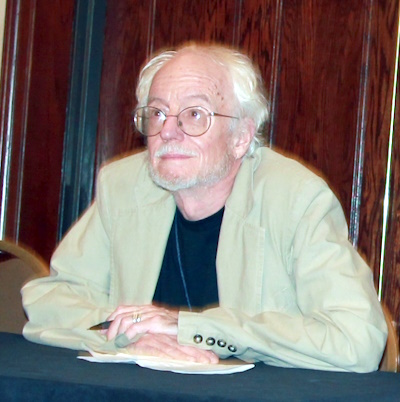
James Morrow at ArmadilloCon 2015 James Morrow at ArmadilloCon 2015, a speculative fiction convention in Austin, Texas

A reader also noted that the lighthearted farcical tone of the book was inconsistent with certain tragic moments scattered throughout the book, where people die or getting seriously injured in ways that are not funny at all.

Satire equally directed towards believers and non-believers

Other people enjoyed the satire in the book. They appreciated that it was directed not just towards religion, but towards atheism in equal measure. Readers recognized some aspects of groups like CFI in the fictional Enlightenment League, and admitted that the barbs pointed at it were pretty accurate. "Despite having a lot of money, the Enlightenment League is pretty ineffective, and what they mostly do is pranks, silly stuff", a reader said.

An interesting dialogue between those groups

While this book is written from an atheist perspective, it is notable that the author does not side with militant atheists. Rather, he lets the three main characters -- the Jesuit priest, the religion-neutral captain, and the atheist Cassie -- have a conversation about God and related matters. One reader said their discussions were one of the enjoyable points of the book. "I thought the priest was interesting, reasonable, the professor. And the captain was interesting too. To me he represented the moderate middle. He wasn't willing to say the didn't believe in God, but he wasn't religious by any means. And then the atheist coming in... I liked the interplay between these 3 individuals, and the way they discussed their beliefs, and that it didn't degrade into awful fighting," she said.

Sympathetic characters and a humanist message

The protagonist, captain Van Horn, who was commissioned to tow the God's body, is probably the most sympathetic character of the book. He has his own deeply felt reasons for wanting to deliver the God's body to its final resting place in the Arctic. They originate in his unfulfilling relationship with his father, a relationship he is still trying and failing to heal. Too many works of satire have left me feeling empty, because there weren't any characters to root for, but this clearly isn't the case here: there are several characters one can easily identify with.

This novel does an excellent job of delivering a humanist message. I really like how it demonstrates the point that whether God existed or not, the civilization would be no different. In the absence of a basis for religion, society is held together by human social and moral norms, which remain the same. The ship crew's brief experiment with giving up those norms ends as a disaster to all of them, and the social order is restored by people's need to cooperate for the sake of their own survival.

Thursday, July 19, 2007

Mary Doria Russell "The Sparrow": a CFI Austin book group discussion

4 people attended the CFI Austin Science And Religion In Fiction book group discussion of Mary Doria Russell's book "The Sparrow". 3 out of 4 gave the book a thumbs-up, 1 thumbs-down.

The book presents a wide range of views from atheism to belief

One thing everybody liked about the book was that Mary Doria Russell presented the views of both believers and nonbelievers. The proportions, however, were disappointingly unequal. The only atheist on the mission, George, didn't get much air time. He was more like a token atheist. He was a very nice person, but he didn't say much throughout the book. Russell did better with other characters, who possessed various degrees of belief and nonbelief. Even the believers had complex views about religion; no one was dogmatic. For example, Emilio joined the Jesuit order for practical reasons, not because he was pious. But then he came to believe when the moment of faith washed over him. One reader said it was interesting to read about it, because he never experienced anything like that. Another reader said she wished more Christians read this book, because the author treated the material thoughtfully. Since Mary Doria Russell in her lifetime went from being Catholic to being atheist, and then to Jewish, we guessed she's obviously has thought about stuff a lot, and it shows in the book.

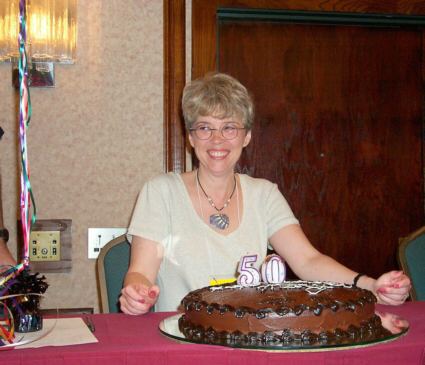
Mary Doria Russell at the ArmadilloCon 2000 Mary Doria Russell at the ArmadilloCon 2000, Austin science fiction convention. She celebrated her 50th birthday at the convention, and the organizers presented her with a cake.

Overall, the readers agreed, "The Sparrow" may be more interesting to believers who may be grappling with questions of faith, than to nonbelievers. For the latter, Emilio's endless questioning of what part God had or didn't have in the events can get tedious after a while. A non-theist would see those questions as based on a false premise.

Other things people liked about the story

  • Witty prose, lots of humor;
  • Remarkably vivid characters, each of them a full-fledged human being, which is rare in science fiction. Often, the characters in science fiction books are hardly more than stick figures who are there to spout author's ideas, or pawns to play out a conflict the author has set up. Not so in the "Sparrow", where each character is a multi-dimensional individual.
  • There were interesting insights in what it means to be a Jesuit;
  • There were lots of interesting tidbits and subthemes in the story, such as predator / prey races or the brain-picking AI "vultures".

I found "The Sparrow" an enjoyable read because it has several very likeable characters, easy to identify and empathize with. But that does not preclude the novel from addressing the dark sides of the human nature. I think the reason why this book spoke to me so strongly is because it asks a question "why do bad things happen to good people", and portrays a group of brilliant people who despite their best intentions make horrible, vast, destructive mistakes. It shows how even the best knowledge can lead to erroneous conclusions; it raises all the hard questions and interesting ethical dilemmas; if anything, it points to randomness and unpredictability of the world, not leaving a place in it for any intelligent supernatural force. At least those were my conclusions. However, our main character at the end of the sequel reaches a different conclusion.

This is not to say that there weren't serious criticisms of the book voiced by the members of the group.

It's not really science fiction

One reader was especially disappointed that the book, despite its science-fictional furnishings, turned out to be not really science fiction. "I'm a sucker for first contact stories," he said, "but it seems like a sham in this book. Instead, the story is all about Emilio's search for discovery. It's a background to ask, is there God, etc.? I was so tired by the end of the book of his inner dialogue about what part God played in the events and in Emilio's personal suffering. Yes, there were rocketships, but the book could have been set in 1700 and the mission could be going to Polynesian islands. So science fiction was just a framework on which to hang the morality flag."

Some plot twists are based on characters acting like idiots

Another flaw of the book is that some critical plot points stretch the reader's credibility a bit too much.

Attention! Spoilers!

Such as: Sophia "borrows" the lander (a rocket that they use to go back and forth between the planet and the ship in the orbit) and uses up most of the fuel, not leaving enough for the mission to get off the planet. A reader called this plot twist ludicrous. "When I drive, I pay attention to how much fuel there is," said a reader. "And when the lander is the only way to get off the planet, when the fuel is your lifeblood, it's just not credible that Sophia would have not checked the fuel levels in advance. It's not like 'ohmigosh, I forgot!'"

It was also hard to believe that the locals were not very impressed to meet the visitors from the stars. "They treat them so blase," said a reader. "We're gonna kill them all, and give one guy as a gift to head honcho. Huh? Maybe, but it seems so unrealistic. It's like, visitors from the stars arrive at the White House lawn, and we just capture them and give them away as presents."

It was also not very believable that the people back on Earth jumped to an easy conclusion that Emilio worked as a prostitute. Did it not occur to them that the most obvious explanation may not be correct when you are dealing with an alien society? Why didn't they interpret Emilio's actions with a more open mind?

End of spoilers

Friday, April 27, 2007

The CFI book club meeting

I did not get to work peacefully on my laptop throughout the first meeting of the CFI fiction book club: I was kept from it by the other 4 people who attended! So much for my hope that no one would show up! :-) (Just kidding. Though I was prepared for a possibility that no one would show up.) The experience was a bit unexpected. Not just because I don't often find myself in a position of leadership (or coordinator, which isn't quite the same, of course :-)) but because people's expectations were quite different from mine. Before the meeting, I sent out a notice that pretty much repeated what the director of the CFI Austin told me in the past: his idea was that this should be primarily a science fiction book club, though it does not have to be limited to this genre. Since the theme of the club is "Science and religion in fiction", SF would fit well, but mainstream fiction that ponders questions of science and religion would qualify too. I also asked people to bring their suggestions of books they would like to read and discuss at the club.

Well, one guy brought a list of books that left me a bit stunned. Two of the three books he suggested were "The Lovely Bones" by Alice Sebold and "The Five People You Meet in Heaven" by Mitch Albom. I didn't know what to think. After all he was a member of (or affiliated with) Center for Inquiry, which, according to their mission statement, "encourages evidence-based inquiry into science, pseudoscience, medicine and health, religion, ethics, secularism, and society". Based on that, I thought that exploring the theme of religion in fiction would mean reading books that critically examine religion, not books that affirm / promote religious feelings! :-) Recovering from momentary speechlessness, I stammered: "uh, actually, the <director> thought this should be primarily a science fiction club." The guy said, "oh, never mind then!" Apparently he had not read the announcement I sent out.

But I had more luck with other people's recommendations. There were some books that the majority of the attendees found appealing. We gradually worked out a list that represents a little from genres of hard SF, light SF, fantasy, and satire. (Not that we deliberately tried to cover all subgenres, it just so happened that the favorite books of the attendees covered the whole spectrum.)

To make a long story short, the book slated for discussion at the next meeting is "Sparrow" by Mary Doria Russell, and the one after that is "Towing Jehovah" by James Morrow. I've read "Sparrow" before, and liked it very much. It's a great read, a very moving story (even though I disagree with some of its philosophy). The next meeting is Thursday, May 24, at the Barnes & Noble at the Arboretum.