Tuesday, June 26, 2012
Pipelined motherhood


Sunday, May 04, 2008
Parenting Beyond Belief: a Dale McGowan seminar
Interestingly, Dale McGowan is the second person (the first was Nica Lalli) who said that their kid, when told the story of birth of Jesus, said, wait, wait, I know this story -- God came down from above and put a baby in a woman -- that's Life of Brian! (Hmm. It makes me wonder if I'm showing my daughter the right movies. ;-))

Dale McGowan. More pictures from various Center For Inquiry events can be found in my photo gallery.It must be said that despite exposing his children to all sorts of myths, there are two religious notions Dale McGowan does not give equal air time to: the concept of hell (because it has a potential to scare young children very badly), and demonization of doubt (as in, you are only a good person if you don't question authority). He says he wants his kids to develop these three things: an ability to think well (critical thinking), self confidence, and a deep love of reality. If they develop these 3 things, they probably won't seek comfort in the supernatural.
When his 9-year-old daughter came home from school and said three of her friends told her she's gonna burn in hell, his stomach sank. He asked the daughter, how did it make you feel? She said, bad, but also silly. She already thought burning in hell was unlikely. Exposure to many religious ideas over the years inoculated her against fear of hell.
So, common sense advice. But the way he says it is very entertaining. He has a ton of wonderful little phrases and anecdotes to illustrate his point.
Who will lay a blankie on my grave?
It is tradionally thought that it's the role of religion to address questions of death and morality.
Regarding death, Dale McGowan's position is this. If you want your child to develop a love of reality, you need them to consider the question of death. The fact that our life ends is the most profound fact of our existence, rivaled only by the idea that it begins. Engaging with this fact can lead with the most profound engagement with life. We need to talk with kids about death as if it is normal, which it is. A 150 years ago this wasn't a problem; all children were exposed to death. And children won't have trouble accepting the notion of death if they are told about it early, because we have a limitless ability to accept the weirdest things as normal, if they are presented to us in the daily life.
"Here's a strange thing we accept as normal, says Dale. "We emerge into the world from our mothers. My mother is visiting us in Atlanta right now. I'm having coffee with my portal to the world. And I think it's normal, whereas the whole time I should be..." (his jaw hits the floor in an exaggerated expression of astonishment).
"So when a young child asks "who will put my blankie on my grave when I die?" don't start bawling "you're not gonna die!" If you do, you are not respecting their question. And the 4-year-old was not even crying when she asked that question! She just wanted to know. So I assured her I'll be the one to do that."
Teaching kids morality the secular way
Then there is the concept of a child's moral development -- another area where religion is widely considered indispensable. Dale says questions of morality are no harder for atheist parents than for religious parents, simply because those questions are hard for everybody, including religious people. It's just that secular parents have a different set of tools for addressing those questions.
We know a lot about moral development, says Dale. No matter whether kids go to church or don't, most kids reliably hit the salient points of moral understanding at about the same age. There are small exceptions for children who had experienced childhood neglect, such as in orphanages. In those cases they reach that understanding later, but not by much.
There is one exception. If kids are raised in an authoritarian moral situation -- if they are told to act a certain way because mom or dad says so, God says so, police says so -- it impedes their moral development. So instead of appealing to an authority such as God, you teach the child about consequences of their immoral behavior. For example, when his 6-year-old hit a lying phase (which happens when children develop a "theory of the mind" and suddenly realize that other people may not necessarily know everything, so it's possible to lie to them!) he asked her: you know why is lying bad? Because next time I won't trust you. Next time she said she washed her hands, he said, but you lied to me yesterday, so now I'll have to check.
Also, according to development psychologists, it is important to tie identity to morality, says Dale. So you tell children: I know you are an honest person, and your lying doesn't make any sense, it's out of character for you. Children become protective of who they are. If they self-identify as an honest person, they don't want to violate the sense of what they are.
There were many more things he said, which I have to omit, because I didn't take very thorough notes. He seasoned his talk with many funny personal stories. It all made for a memorable seminar.
Sunday, March 16, 2008
Nica Lalli at the CFI Austin, March 15, 2008
Nica Lalli, author of "Nothing: Something to Believe In" met with the people of the Center For Inquiry Austin for a discussion on raising children without religion in a predominantly religious society. The meeting took place at a Unitarian Universalist church in Austin. Here are a few memorable quotes from the discussion.
"Your children will get religious education from their classmates. They will also get sex education from their classmates," said Nica Lalli. "[And they'll hear all sorts of wrong things.] If what learn from their classmates about sex is any indication, children need to get religious education from us [parents]."
When her daughter heard the story of Jesus' virgin birth, she said: oh wait, there is another story like that! uh... umm... Life of Brian!
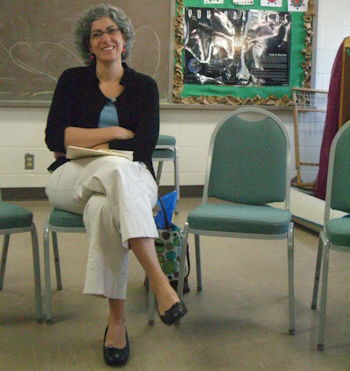
Nica Lalli at CFI Austin, March 15, 2008.At some point someone wondered what do young-Earth creationist parents do when they take children to a natural science museum, and are faced with dinosaur exhibits? One woman said her sister-in-law covers the explanatory plaque with her hands and tells children: oh look, these are dinosaurs. They are 3000 years old!
While adults had their conversation, children played in the UU church playground under the supervision of babysitters. Later that evening we took Nica Lalli out for dinner at the County Line barbeque restaurant.

 Posts


