Showing posts with label quotes. Show all posts

Tuesday, March 11, 2008

"Infinity does not exist in our dimension"

A bunch of the ACA'ers went on a pub crawl last Friday. The crawl started out at Dog & Duck pub, the home of the ACA'ers happy hours; then we went on to 6th street. On the way there we were approached by folks who were handing out fake million dollar bills. It was some kind of Christian evangelist thing. Along the edge of a "bill" in small print there were questions such as "will you go to heaven"? Since most of us wore "Godless pub crawl: pubs, not popes" T-shirts made for this occasion, we must have been a tempting target for evangelists, and there seem to be quite a few of them hunting for souls to save in the nightlife district on a Friday night.
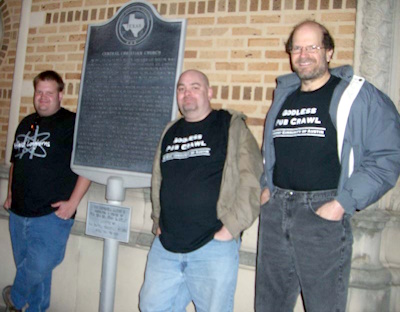
Left to right: Justin, Matt and John on the way to the ACA pub crawl On the way to 6th street, the next destination in the pub crawl, some people felt they had to pose in front of a church. For irony's sake. Left to right: Justin, Matt and John.

Not surprisingly, two of them got into an argument with Matt, the then-president of the ACA. One of those guys told Matt he would prove there is a God in 30 seconds flat. Needless to say, their argument lasted a lot longer, and most of the ACA'ers got bored and wandered off to our next stop, the Darwin pub (no connection to Charles Darwin that I could tell!) It became tedious quickly, but not before I had a chance to hear this gem of an argument. The evangelist attempted to argue from the "first cause", to which Matt replied: if everything must have a cause, then who created God? The evangelist guy said, God doesn't have to have a cause or creator, he always existed. Matt said something along the lines of, you can't simply dismiss a question of whether God has a cause; just like it is meaningful to ask that question about anything else, it is also meaningful to ask it about God; you can't just arbitrarily declare that God has no cause. Matt tried to explain it by analogy: no matter how big a number you can think of, you can also imagine an even greater number, and so on all the way to infinity. The evangelist guy somehow felt existence of infinities threatened his beliefs. He said, no, I don't have to (imagine an even bigger number). I can stop any time. Infinity does not exist in our dimension, he added.

That last remark floored me. I blame science fiction. Seriously. I blame popular sci-fi shows and movies for putting terms like "infinity" and "dimension" into the vocabulary of people who cannot grasp these very simple and intuitive mathematical concepts. But that doesn't stop them from using them in a debate!

After the Darwin pub all the ACA'ers went on to their next stop, but I decided to save my liver and go home.

Saturday, March 01, 2008

Old article, good quote

Sorry, Boys, This Is Our Domain

The story explores why there are more girls creating content online than boys, especially textual content, such as blogs (boys still dominate video creation).

Some scholars argue [that] girls are the dominant online content creators because both sexes are influenced by cultural expectations.

"Girls are trained to make stories about themselves," said Pat Gill, the interim director for the Institute for Communications Research and an associate professor of gender and women's studies at the University of Illinois at Urbana-Champaign."

The following quote, I think, illuminates not just different modes of online participation, but also why women are in general more verbal than men. Girls score higher on language skills in school than boys; women read more; storytelling plays a greater part in women's lives than men's. Many words had been shed on this subject, yet I've never seen it summed up in a sentence so succinct, so starkly precise.

From a young age they learn that [girls] are objects, Professor Gill said, so they learn how to describe themselves.

Wednesday, January 23, 2008

Genuflection aerobics

Once in a while I post quotes from articles I read with a sole purpose of goofing off, and not out of genuine interest. I have no stance on the issues described -- I post these quotes simply because I find them hilarious.

http://www.salon.com/mwt/feature/2008/01/23/partner_yoga/

This is an article on partner yoga, the grossness of. ("Is having my face in a stranger's crotch really helpful for my meditative state?"). The only thing I can say about yoga is I tried it once and found it singularly boring. But the second of the two following paragraphs almost made me squirt coffee out of my nose.

Traditionally, yoga is taught one-on-one, takes years to master and has nothing to do with improving the definition of your shoulder muscles. It also emphasizes emotional detachment, which is difficult to achieve if your head is in someone's junk. But Dharmanidhi's [an Indian yoga master's] biggest point was this: Yoga is an integral part of Hinduism, and Americanized yoga -- whether it's called Ashtanga, Iyengar, Bikram, Vinyasa or anything in between -- is a bastardization of a spiritual practice.

"Imagine you go into a Catholic Church and there's something called genuflection, where you go down on one knee," he said. "What if a person comes out of the ceremony -- which is supposed to be about their relationship with God -- and they say, wow, my legs feel a little sore! And they go home and open up a shop and have people do genuflection for an hour to disco music. And partner genuflection, at that! It's completely taking it out of context."

Sunday, October 14, 2007

An authentication scheme cooked up by a pointy-haired boss

There was this article in Washington Post that reminded me of a conversation I had with a friend via his blog about authentication questions, the kind you have to answer in order to login to online banking systems and such. In this post he pointed out that security questions based on users' wishes, preferences and hobbies were useless. (My, has it been almost a year? It feels like we had this conversation just yesterday.) Well, things have only gone downhill in the security world since then, if this article is any indication.

This Is Your Life*... *As Determined by Confounding Identity-Protection Safeguards

Old authentication systems, as imperfect as their questions were, at least allowed you to select a question and an answer that suited you best (or that was less useless to you than others). But how would you like an authentication system that does not even let you choose the questions? Instead, it asks you your biographical facts that you are "supposed" to know. For example, your great-grandmother's birthday. I wish it was a joke, but it isn't.

How does the authentication system know your great-grandmother's birthday in the first place? To quote the article, "unlike traditional shared knowledge authentications, in which the user picks the test and the answer and regurgitates it with each sign-on, Verid [the company that makes this uniquely egregious kind of authentication software -- E.] vacuums public records for factoids, then tosses them at the user at random."

The birthdays of long-gone relatives are not even the most obnoxious example of authentication questions. Others are, for example, "what was your high school mascot" or "the name of your homecoming queen". So what do you do if you come from a country like mine, where not only high schools don't have mascots or homecoming traditions, but the very concept of high school does not exist (all grades from from first to twelfth are taught under the same roof. You don't have to change schools when you transition from primary to secondary education.) Well, OK, a non-existent homecoming queen of a non-existent high school would not appear in public records, and would not serve as a basis for an authentication question. But if you dared to forget her majesty's name, you are screwed. :-)

The article does address the issue that some people's lives don't follow a typical middle class American route, thus some people don't have, or don't remember, the biographical facts enabling them to answer security questions. What the article does not address, is the invasion of privacy committed by a company that "vacuums up the public records" and collects all the knowledge about you, up to your great-grandparents' names and birthdays.

Only a pointy-haired boss could have come up with this kind of authentication scheme. I just hope that the company I work for -- which happens to write software for online banking -- never comes up with something like this.


The best quote from the article:

"Computers are like very dumb people, but they're very fast at being dumb," says Jason Hong, a professor at Carnegie Mellon's Human-Computer Interaction Institute (HCII).

Monday, September 17, 2007

eBay as a giant museum

Many words have been spilled on Web 2.0 and how it's supposed to change the world -- from Pulitzer prize-winning pundits to rank-and-file bloggers, everybody seems to have weighed in. Still I haven't read many observations as sharp or fresh as this one from William Gibson. This quote is from William Gibson's interview in Washington Post. Yes, this article is a couple of weeks old, but, as I mentioned before, I'm a leisurely blogger, not a professional one. :-)

"Google is the piece de resistance of weird [stuff] finding," he says. "One of the things I've been doing in the eBay era -- I've become a really keen observer of the rationalization of the world's attic. Every class of human artifact is being sorted and rationalized by this economically driven machine that constantly turns it over and brings it to a higher level of searchability. . . . The tentacles of that operation extend into every flea market and thrift shop and basement and attic in the world. . . .

"Every hair is being numbered -- eBay has every grain of sand. EBay is serving this very, very powerful function which nobody ever intended for it. EBay in the hands of humanity is sorting every last Dick Tracy wrist radio cereal premium sticker that ever existed. It's like some sort of vast unconscious curatorial movement. (emphasis mine -- E.)

"Every toy I had as a child that haunted me, I've been able to see on eBay. [...]

"This is new. People in really small towns can become world-class connoisseurs of something via eBay and Google. This didn't used to be possible. If you are sufficiently obsessive and diligent, you can be a little kid in some town in the backwoods of Tennessee and the world's premier info-monster about some tiny obscure area of stuff. That used to require a city. It no longer does."


The whole article can be found here.

I think I may lobby the FACT reading group coordinator to put Gibson's new book, "Spook Country" on the FACT group candidate list. Even though FACT group on the average didn't like Gibson's earlier novel, "Pattern Recognition", I am quite intrigued by Gibson's perspective.

Sunday, August 12, 2007

A few quotes from ArmadilloCon 2007

John Moore

John Moore

From the panel "The story unwritten" (A discussion on what stories are left to be told and why they haven't been written yet): "Fortunately, writers today are no longer shackled to the idea that writing is original creative process," said John Moore. If you can think of a spinoff, go with it. "For example, who's to say Dudley Dursley shouldn't have his own fantasy series? In each book he could team up with another 10-year-old wizard," he said.

From "Mythology/Schmythology" panel
Laura Anne Gilman

Laura Anne Gilman

Laura Anne Gilman: "Is a hero someone who knows he has a destiny, or someone who fights against the odds to do something heroic? Somebody like Harry Potter, who knew he had a destiny, who was told by everybody he was special, and people trained him for that and protected him? I don't think that's a hero, that's cannon fodder."

Here are more of my pictures and blog posts from ArmadilloCon 2007.

Wednesday, January 17, 2007

Cute analogies

A few posts ago I was musing about the best ways to introduce scientific ideas in science fiction, to explain them in terms vivid enough to intrigue a reader, instead of slowing down the action. In Sunday's New York Times magazine I found an inspiring example of how it can be done. (I put the particularly memorable sentence in bold.)

Where Protons Will Play

To be sure, the article I'm referring to is a science fact article, not fiction, but I think there's something to be learned from this little perl of explanation. I'm not being sarcastic -- this excerpt seems silly and clever at the same time:


[F]locks of protons will be made to zip around the tunnel in opposite directions at nearly the speed of light. Then they will be forced to crash into each other, with (it is hoped) spectacular results for physics.

Physicists, you see, learn about the subatomic world by smashing things together and then looking at the debris. Imagine a midair collision between two watermelons; it would make quite a mess, but nothing very interesting would result. Suppose, though, you get two protons to collide head-on. If they are moving fast enough, the energy of their collision, converted into mass à la Einstein's E=mc2, will produce a shower of new particles. (It would be as if colliding watermelons splattered into a shower of pineapples, blueberries, mangoes and more exotic fruits.)