On "Getting the Biology Right in SF" the panelists skewered writers for common biology-related blunders we see in books and movies. The aspects of biology covered in this panel ranged from human anatomy and physiology to ecology.
As an emergency room physician, Kimberly Frost was uniquely qualified to educate writers on what kind of injuries a protagonist could sustain and still survive. One of the highlights of the panel was her showing the audience how far her blood would spurt if the arteries in various places of her body were cut. The panelists noted that there are lots of individual differences in how much bodily damage a person can incur and survive, but feats like jogging 500 miles with a gushing wound (one of the panelists has actually read a story where this happened) is flat out impossible. Yet human body is capable of less ridiculous, but still impressive performance under duress. Paige Roberts told a story about her ex-husband, who had half of his right hand blown off by enemy fire; the bullet severed the nerves that controlled the two outermost fingers, but he still had control of his index finger. So he clamped the wound down with his other hand and kept shooting, and saved a dozen soldiers' lives. In a few hours, though, he was flat on his back in a helicopter, being medevac'ed. Adrenaline can only take you so far.
Kimberly Frost has first-hand familiarity with what happens when movies and books use medical facts irresponsibly. For example, too many times in the movies you see people breaking the glass with their limbs when they want to break into a house or out of it, and the glass just breaks away. But in reality it doesn't work that way. Kimberly has seen people who tried to do it: some of them cut themselves only superficially, and doctors were able to fix them up, but others cut their tendons that way. Paige writes erotica, and she is careful not to give readers ideas to try things that would be very dangerous in reality -- like bondage with a rope tied around one's neck.
Later Paige Roberts and John Moore got into an animated argument on whether the difference between your and opponent's body mass is a deciding factor in winning a fight. John Moore argued that it was; Paige, who's done martial arts, thought other factors matter more. She said she would have little difficulty throwing a tall, muscular guy across the room, but would find it impossible to do the same to a short person with a low center of gravity.
On the ecology front, one the most interesting observations was the one Kelly Persons made about Frank Herbert's "Dune". "Dune" is often praised for its ecological theme, but the problem with Dune is that it doesn't have any ecology. "It's a planet with one species on it. There's no energy input into the Dune world," Kelly said. It takes a lot of energy to power a worm that's as big as a locomotive to move underground. What did worms eat? And where does the oxygen come from, given that it's a desert planet? John Moore asked.
Why is carbon, not silicon the basis of life? was a question from the audience. Because, says Kelly Persons, carbon is able to form long chains, while silicon can't. A combination of silicon and oxygen can form long chains, but only under certain conditions. If you are writing about an alien silicon-based life form, the temperatures on the planet where it evolved would have to be very different.
Showing posts with label John Moore. Show all posts
Showing posts with label John Moore. Show all posts
Saturday, August 23, 2008


Wednesday, April 30, 2008
Nebula Awards 2008: speeches and anecdotes
Being in Texas, the Nebula award ceremony had to have some Texas flavor, and that was amply supplied by the MC John Moore and the toastmaster Joe Lansdale. Moore started by explaining Texas dialect to the out-of-state folks. He said, "in Texas you don't say 'I'm going to have a glass of wine', you say 'I'm fixing to mosey down to Hospitality Suite and rustle up a Shiner Bock'. And right now I'm fixing to introduce our toastmaster. He's a kick-ass Texas writer, and I mean it literally: he founded a school of martial arts."
Joe Lansdale's speech was the highly anticipated highlight of the award ceremony. Everyone in the Texas fandom knows Lansdale is pretty damn funny. And his speech was funny indeed, although a bit rambling. I managed to remember a couple of anecdotes Joe told; for the sake of brevity, I'll compress the details which, in my opinion, didn't add much to the story. (Though what do I know? Perhaps readers adore Joe Lansdale precisely because of those details I consider rambly.)
His point was that Texas is such a weird place it can't help but inspire science fiction. Here is an incident that happened to him and an even stranger one, to another Texas writer. Lansdale also listed his rules for the attendees of science fiction conventions.
Michael Moorcock, who was bestowed a title of SFWA grandmaster, gave an acceptance speech I found (rushes to pull on asbestos underwear :-)) as unmemorable as any of his books. I've read three of those before giving up. Moorcock's speech still did not inspire me to read his prose. So shoot me. I think he was saying something about those dark ages when science fiction was despised by the society-at-large, and when the mainstream media viewed SF writers and fans as "geeks with slide rules for genitals" -- the only phrase I remember from his talk. :-)
But he had his own funny stories to tell about life in Texas -- and why he likes it here.
Pictures from the Nebula awards can be found in my photo gallery.
Joe Lansdale's speech was the highly anticipated highlight of the award ceremony. Everyone in the Texas fandom knows Lansdale is pretty damn funny. And his speech was funny indeed, although a bit rambling. I managed to remember a couple of anecdotes Joe told; for the sake of brevity, I'll compress the details which, in my opinion, didn't add much to the story. (Though what do I know? Perhaps readers adore Joe Lansdale precisely because of those details I consider rambly.)
His point was that Texas is such a weird place it can't help but inspire science fiction. Here is an incident that happened to him and an even stranger one, to another Texas writer. Lansdale also listed his rules for the attendees of science fiction conventions.
Michael Moorcock, who was bestowed a title of SFWA grandmaster, gave an acceptance speech I found (rushes to pull on asbestos underwear :-)) as unmemorable as any of his books. I've read three of those before giving up. Moorcock's speech still did not inspire me to read his prose. So shoot me. I think he was saying something about those dark ages when science fiction was despised by the society-at-large, and when the mainstream media viewed SF writers and fans as "geeks with slide rules for genitals" -- the only phrase I remember from his talk. :-)
But he had his own funny stories to tell about life in Texas -- and why he likes it here.
Pictures from the Nebula awards can be found in my photo gallery.
Sunday, August 12, 2007
A few quotes from ArmadilloCon 2007
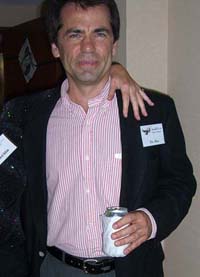
John Moore
From the panel "The story unwritten" (A discussion on what stories are left to be told and why they haven't been written yet): "Fortunately, writers today are no longer shackled to the idea that writing is original creative process," said John Moore. If you can think of a spinoff, go with it. "For example, who's to say Dudley Dursley shouldn't have his own fantasy series? In each book he could team up with another 10-year-old wizard," he said.
From "Mythology/Schmythology" panel
Laura Anne Gilman
Laura Anne Gilman: "Is a hero someone who knows he has a destiny, or someone who fights against the odds to do something heroic? Somebody like Harry Potter, who knew he had a destiny, who was told by everybody he was special, and people trained him for that and protected him? I don't think that's a hero, that's cannon fodder."
Here are more of my pictures and blog posts from ArmadilloCon 2007.
Sunday, August 21, 2005
ArmadilloCon 2005: When and How Will the 21st Century Get More Interesting?
What this panel was supposed to be about, according to the ArmadilloCon program book: "The 20th Century saw great advancements in technology and many cultural changes, but the new one's been pretty dull. It may even be going backward. Seen any moonwalks lately? Is there interesting stuff we just haven't noticed, is good stuff about to happen, or is the highlight of the century going to be a multiple-button mouse from Apple?"
Panelists: Alexis Glynn Latner, Sean McMullen, John Moore, Chris Nakashima-Brown, Mark L. Williams
Chris Nakashima-Brown rejected the premise that 21st century so far hasn't been interesting. On one hand, he admitted that cyberpunk becoming the reality turned out to be pretty dull: nobody gets excited about online billpay. But the geopolitical scene, he says, is quite a bit more interesting. We live in a Lord of the Rings world, where there is Mordor and medieval stateless necromancers. (He tossed the phrase "stateless necromancers" around in the last year's ArmadilloCon, too, and I actually expected him to bring it into this discussion. I anticipated that Chris Nakashima-Brown will focus on the geopolitical aspects of the 21st century, and how can you do it without medieval necromancers? And I wasn't disappointed!)
Sean McMullen. We've been concentrating on minutia. But I don't want a jet car, I don't want stupid [people] flying over my real estate. They are damaging enough in 2 dimensions, I don't want them in 3 dimensions. Nutrition pills? Bad idea: I like eating, I like drinking. Just because something is possible doesn't mean people will pay for it. We could have been on Mars in 1980. Being viable and having a good reason to do it in the first place is not the same thing.
Peak oil or sex robots?
John Moore asks the audience which of the two likely realities of the 21st century they would like to talk about: peak oil or sex robots? The audience goes for the less disturbing topic, sex robots, and the positive aspect of it: the demand for them will drive robotics and a lot of other scientific disciplines. After all, sex has long been driving technological change: in the last century porn created enough demand for photographic chemicals so they started to be produced in factories. Before that, you had to mix them yourself. And blue movies provided a critical mass for VCRs. And, of course, porn drove the rise of the internet. Sean McMullen is convinced robots and virtual reality will never replace live interaction with other human beings because they won't provide the same richness of experience. "Look at what's on a video game. It's nothing like reality. People who put those games together, they are totally out of sync with reality. Real environment, if you're over here, plug into the virtual reality thing; on the other hand, there is a party next door, and there are nice people; You're not guaranteed to score, but those nice people may change your life. So I would take the real life adventure every time."Relationship of real and virtual words is not as cut-and-dried
People from the audience argue that the relationship of real and virtual words is not as cut-and-dried. One audience member says that the virtual community of his MMPG is having a real life barbeque tomorrow. The novel form of interaction is mixing the two worlds. He plays a female character, even though the players know he's a guy, and it has been a wonderful experience. He bonded over it with his daughter. It's been a liberating concept. He's now one of the girls. They invite him to those things and just have the girl chatter. John Moore. When you're watching Motorcross on television versus real life, virtual reality improves upon reality. Things that are tedious and not interesting in real life can be made more interesting in virtual reality. Like motorcycle jumps when shown with a camera. A discussion ensues whether we will see radical, drastic technological changes, or will technical advances be more of an incremental kind, like "progressing" from Word 2000 to Word 2003. Some of the stranger ideas, tossed about by Alexis Glynn Latner, was that maybe 9/11 scenario was inspired by the violent special effects in movies and video games. "Could 9/11 have hapepend in a world where there were no special effects in the movies?" she asks. She thinks the terrorist used this particular scenario, crashing planes into buildings, because it provided very violent visuals, the kind they must have seen in the movies and video games.
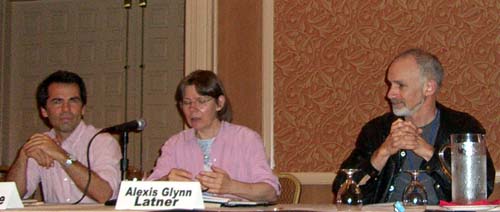
Left to right: John Moore, Alexis Glynn Latner and Sean McMullen. Here are more posts from ArmadilloCon 2005.
Subscribe to:
Posts (Atom)

 Posts
Posts


