Showing posts with label Louise Marley. Show all posts

Friday, August 10, 2007

Losing my writers' workshop virginity

Ah, the ArmadilloCon writers' workshop.

This is the first writers' workshop I've ever been to -- actually, the first time I've had my writing critiqued. It's like crack. I'm hooked. I want more, more of this experience!

Not because the critiquers praised my work. Of course they didn't, nor did I expect them to. I'm very aware of the flaws in my writing. But it was so interesting to have other people read -- really read -- my work and analyze it in detail, and tell me what they did and didn't like. This was so much better than reader comments I received on some of my stories that were published in fanzines and on the internet. Those were limited to "it sucked" or "I didn't get it". This was the whole new dimension of critique.
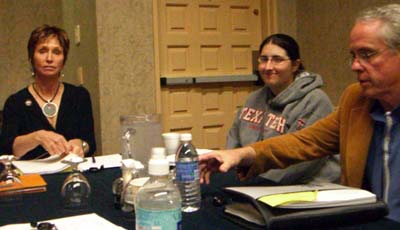
Louise Marley, Sarah Arnold and Chuck Emerson at ArmadilloCon 2007 writers' workshop Author Louise Marley (the teacher of our group), and students Sarah Arnold and Chuck Emerson. More pictures from ArmadilloCon 2007 are in my photo gallery

As I said in one of my earlier posts, due to size restrictions I could only submit half a story. Because of that, I did not expect to get helpful critique, but what I got exceeded my expectations. To summarize the readers' comments: my ideas were interesting and BIIG. But the story wasn't so much a story as an outline. For a novel. Some comments were of a nature "this sentence needs to be a chapter", or "I really want to know how this or that happened". I guess that's not too different from the ole "show, not tell". There were infodumps in some places. Several reviewers commented that the story was completely devoid of setting and the action was totally internal -- and that's very true. All the reviewers asked me to put in more images, some sensory stuff, to help them see the characters. That's an entirely valid comment. My characters are devoid of external descriptions. Not just because descriptions are desperately difficult for me to come up with. I don't see my characters as 3-dimensional people... or even 1-dimensional ones. They are just moving points in space that draw trajectories connecting my ideas.
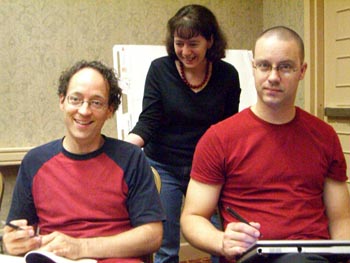
Steve Wilson, Patrice Sarath and Matthew Bey at ArmadilloCon 2007 writers' workshop Patrice Sarath, the coordinator of the writers' workshop (center), Steve Wilson, and Matthew Bey (instructors). More pictures from ArmadilloCon 2007 are in my photo gallery

The most fascinating thing for me was to see how people saw different things in my story than what I've put in there. A topic I thought was secondary, they perceived as primary. And they had very few comments on the topic I myself perceived as primary -- perhaps because the primary topic does not reveal itself in earnest until the second half of the story, which they didn't have a chance to read.

A curious fact: based on the text alone, only 2 of 6 critiquers figured out English isn't my first language. That's not to say they didn't find flaws in my writing style; they did. The most common criticism was repetitiveness.

In any case, the workshop experience was rich beyond my expectations. I still haven't had a chance to absorb all the comments. What I said here is just scratching the surface. What saddens me is that the aspects of the story that require fixing are probably beyond my skills right now... and may be for a long time.

Here are more of my pictures and blog posts from ArmadilloCon 2007.

Thursday, August 09, 2007

Louise Marley "Glass Harmonica": a book review

Louise Marley will be a Guest of Honor at this year's ArmadilloCon, so I made an effort to read one of her books. I like to have an idea what the Guest of Honor is "about". "Glass Harmonica" was a fun book to read.

The most straightforward plot I've seen in years

It's set in the near future about a decade from now. The protagonist is a young woman named Erin, a world-renowned musician who plays glass harmonica, the title instrument of the book. It's a device that's played by running one's fingers over the rims of spinning glasses. Her twin brother, Charlie, is a composer who suffers from a neurodegenerative illness that made him incapable of walking. He undergoes an experimental treatment that supposedly has a chance to help him walk again.

Then there is a parallel story line set in the late 1700s in England, where the protagonist is a teenage girl Eilish, a street musician who, too, plays a glass harmonica. She's been lifted out of poverty by Benjamin Franklin when Franklin constructed a glass harmonica, and needed a talented musician to play it and help him improve its design. He was impressed by Eilish's talent and employed her in that capacity.

And that's about it. This pretty much describes the plot of the book. It is very straightforward. There are no twists or surprises. Not any major ones, anyway. It's so devoid of mystery or suspense, that you start to wonder, will anything notable, shocking, or simply unexpected, ever happen in the book? Even as things get worse for some characters, they do so in a very gradual, predictable manner.

Science and pseudoscience

I'm actually not sure I would call this book science fiction. Maybe science fantasy. Actually, Louise Marley once said her favorite genre is science fantasy. There are two kinds of science-fictional elements in this novel:

(1) the two girls occasionally see one another as a ghost-like presence;

(2) Charlie's experimental treatment consists of stimulating his brain by certain sounds, to help route neural impulses to his legs around the damaged neuron pathways.

(1) The ghosts are "explained" by "quantum weirdness". As soon the word "quantum" is uttered, the characters throw up their hands and admit they don't know first thing about it, yet they believe they found a good explanation. Because hey, everybody knows quantum physics is "weird", so who's to say it can't explain ghosts? As well as a whole slew of paranormal phenomena, such as remote viewing? Maybe I'm being unjustly sarcastic here, as well as oversimplifying a little, but pseudoscience irks me. Anyone who actually understands quantum physics (not that I do) will tell you that quantum physics can't explain paranormal phenomena... if they really exist. And I don't believe they do. I wouldn't be involved in the Center For Inquiry otherwise.

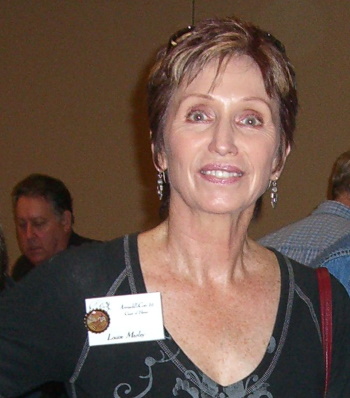
Louise Marley at ArmadilloCon 2007 Author Louise Marley at the ArmadilloCon 2007

I find (2) a lot more credible than (1). Some research into rerouting neural impulses in the brain is already taking place. There's been some fascinating research that suggested it may be possible for blind people to "see" with their tongues (video signals from a camera are routed to a sensor placed on a person's tongue, which translates them into electrical impulses that "tingle" the tongue in certain patterns. The patterns the tongue senses are interpreted by the brain as images). Similarly, people suffering from chronic vertigo can use a tongue sensor to teach the brain to compensate for confusing signals from inner ear (that are causing the vertigo). In light of this, reprogramming your brain with sound doesn't seem too infeasible, but I still have strong doubts. Since it's a relatively low-tech concept, it would seem somebody would have tried it already. Perhaps someone had. But we haven't heard of any discoveries in that area.

A perfect escapist book

However, if you don't ask too many questions, this book can be quite enjoyable. It's a fast, lighthearted read. So fast it practically read itself! Such a contrast to several "high concept" SF books I've read lately that were loaded with plot speed bumps. The story in this book flows smoothly like a melody from a musician's fingertips (not that I ever heard glass harmonica music, so perhaps my metaphor isn't appropriate.

The main characters are all likeable, and it's fun to get glimpses into a rarefied world of classical musicians, their jet-setting lifestyle of concerts, press interviews, and spur-of-the-moment jaunts to London. And romance is handled very well in this book! It's not something I see often in SF. In most books I read (perhaps because they are written by male writers) the romance storyline consists of two scenes: first, the heroine and the hero find each other attractive, second, they fall into bed. That's it. How boring. Where's the suspense, the mystery, the pining, the uncertainty? Not so in "Glass Harmonica". There's plenty of suspense here: will the two would-be lovers get together or not? There's plenty of pining, and shyness, and teasing, and pulling back at the last minute. Very well done! It is, in a word, a perfect escapist book.

Sunday, February 11, 2007

The God or the Machine: A World Fantasy Convention 2006 panel

(Yes, World Fantasy Convention 2006 was 3 months ago, but so what? The words spoken there were timeless!)

Panelists: Ted Chiang, Louise Marley, Michael A. Stackpole, W. J. Williams, Janine Ellen Young (moderator)

What it was supposed to be about (synopsis from the program book): When do "scientific" worldview elements move a concept out of fantasy? Systematic magic, planetary bodies, rudimentary experimentation, the cusp of alchemy into chemistry...

What it was really about

First, the panelists admitted they didn't really understand the topic of the panel as stated in the program book. They didn't get much mileage out of "scientific worldview elements moving a concept out of fantasy". After addressing the distinction between technology and magic, and Ted Chiang stating why he believes Clarke's famous adage is incorrect, the panelists quickly became mired in the age-old debate of what is science fiction, and what is fantasy. Oh no, not again, you say! Well, this discussion wasn't quite like beating a dead horse. I heard some interesting insights.

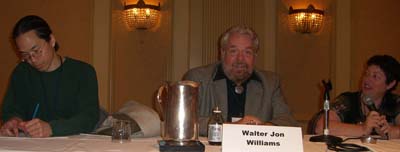
Ted Chiang, Walter Jon Williams and Janine Ellen Young at The God or The Machine panel at the World Fantasy Convention 2006

A lot of western fantasy writers prefer magic to be systematic, i.e. to have laws, rules, constraints. An arbitrary magic, where everything is possible or impossible, depending on whether it is convenient for the author, they don't find very interesting. But does systematizing magic move it closer to science? Not necessarily.

Traditionally it's thought that it's the presence or absence of scientific / technological elements -- the so-called furniture -- that causes most people to view a certain story as science fiction or fantasy. But actually, the worldview expressed in a story may be more relevant. (Though apparently there are no universal criteria how to determine the genre a particular story belongs to, because some people in the audience disagreed over which genre certain books belonged to.)

The full article can be found on my website.