Showing posts with label what you should have read. Show all posts

Saturday, October 10, 2015

Short Fiction You Should Have Read Last Year: ArmadilloCon 2015 panel

For starters, panelists K. B. Rylander (moderator), Eugene Fischer, and Rebecca Schwarz list their favorite short stories of the year.

Rebecca Schwarz. Ken Liu "Cassandra".

K. B. Rylander. Eugie Foster "In the end, he catches her". It was published the day she died, just by coincidence.

Best sources of short stories

Rebecca Schwarz. I listen to a lot of stories. There are lots of great ways to listen to them, such as the podcasts by Clarkesworld, Cast of Wonders (Young Adult fiction), Beneath the Ceaseless Skies, Strange Horizons. Tor is on and off with their podcasting, but sometimes you can discover great stories there, like Kij Johnson. Escape Pod -- they do a lot of reprints. (It also exists in the print form.) Starship Sofa also does a lot of reprints. Bourbon Penn.

Eugene Fischer. Lightspeed, Strange Horizons. Oddly, the best publication for finding new authors these days is Twitter. Follow authors, they will recommend a lot of stories. This year majority of the stories I found is not because I read Asimov's cover to cover, but because I follow authors, and when they have a story out, they'll tweet a link. You can harness social network effects to curate your reading for you.

Short Stories You Should Have Read This Year panel, left to right: K. B. Rylander (moderator), Eugene Fischer, Rebecca Schwarz.
Short Stories You Should Have Read This Year panel, left to right: K. B. Rylander (moderator), Eugene Fischer, Rebecca Schwarz. More pictures from ArmadilloCon 2015 (37) are in my photo gallery.

K. B. Rylander. When you think about stories you loved, what makes a great story? What makes them stand out?

Eugene Fischer quotes Kevin Brockmeier, who said that every great fiction owes its greatness to fidelity to one of 3 things: fidelity to language, fidelity to lived human experience, or fidelity to authorial obsession. An example of fidelity to language would be Ursula le Guin. An example of fidelity to authorial obsession -- J. G. Ballard. His writing is off the wall, but the images were strongly felt to the author. If a story doesn't bring at least one of those things to the table, says Kevin Brockmeier, then it won't work.

Rebecca Schwarz. I like stories that play with form, such as "Five Stages of Grief After The Alien Invasion" by Caroline Yoachim, who hangs the story on the traditional five stages of grief. Another example would be "Noise Pollution" by Allison Wilgus in Strange Horizons. It's punk as in cyberpunk. It's a young rebellious kid narrator telling a story.

K. B. Rylander. The way I approach story, the story needs to elicit emotion from the reader. Even in hard science fiction there needs to be emotional interest for that reader.

Eugene Fischer. "Cimmeria: From the Journal of Imaginary Anthropology" by Theodora Goss, published in Lightspeed, resembles Borghes: it's about how reality actually works. Lorrie Moore, in an introduction to "Best American Short Stories", said that a novel comes to us already half-ruined by its length, but in short story we can experience something pristine: a single moment. It is not necessarily in time, but a single esthetic moment. In "Cimmeria", students go to a field study in a country that exists only because they made it up. One of them falls in love with the daughter of a king. In this country there are strange cultural differences that they invented when they designed this country. One of them is, twins are actually the same person. The esthetic moment is, a shift from viewing cultural experience as an outsider, to viewing it as an insider. It's not a moment in time, but a moment in cognition.

K. B. Rylander. A lot of time in a story there is a very visceral emotion that people can relate to: loss, love, revenge. Those strong emotion stories are often ones that become the big stories for the year.

Rebecca Schwarz. Annie Bellet "Goodnight Stars": it was nominated for Hugos, but she withdrew.

Eugene Fischer Sam J. Miller "We are the cloud".

The panelists mention that they've found many notable stories that draw from global mythology, such as Chinese or Pakistani. An example would be Carmen Maria Machado "The Husband Stitch", nominated for the Nebula Award.

Humor stories

Rebecca Schwarz. Daily SF publishes a lot of humor. Also, Alex Shvartsman publishes humor anthologies, Unidentified Funny Objects.

K. B. Rylander. Two flash pieces: "I am Graalnak of the Vroon Empire, Destroyer of Galexies, Supreme Overlord of the Planet Earth. Ask Me Anything." by Laura Pearlman. It's a Reddit with an alien who has came to earth. Oliver Buckram "Half a Conversation, Overheard While Inside An Enormous Sentient Slug".

Eugene Fischer. Alice Sola Kim "Mothers, lock up your daughters because they are terrifying" -- a ghost story of Korean adoptees loking for the biological parents with the help of Cthulhu.

K. B. Rylander. Kris Dikeman "Madhouse on Aisle 12" -- a woman goes to a grocery store, and the food talks to her. It's hilarious.

Great stories that didn't get much attention

K. B. Rylander. What stories were great, but didn't get a lot of attention?

Eugene Fischer. Guernica magazine published a story by Anna Noyes, "Becoming", from a point of view of chimpanzee who grew up in an 1950s experiment of raising a chimp in a human family to see if it grows up like human. It's not going to get attention in genre fiction awards, and there's no such thing as realist fiction awards.

K. B. Rylander. Story by William Ledbetter, "That Other Sea", publsihed on Escape Pod (available in both podcast and text versions). It takes place on Europa, on the theory that there is life under ice on Europa. It's a first contact story from the point of view of the aliens. What drew me into the story is that the alien has overwhelming curiosity about the world, the yearning for what's out there.

Rebecca Schwarz. A story in Strange Horizons, Kate Heartfield, "Limestone, Lye and the Buzzing of Flies". It leans a little literary, it's a little interior. It's a fantastic coming-of-age story with magic elements.

Must-read short story writers

K. B. Rylander. Do you have any must-read writers?

Eugene Fischer. Carmen Maria Machado, Ted Chiang, Alice Sola Kim, Kelly Link, Meghan McCarron.

Rebecca Schwarz. Karen Russell, M. Bernardo (she recommends his story in Beneath the Ceaseless Skies, possibly "The Penitent" or "After Compline, Silence Falls"), Kevin Brockmeier.

K. B. Rylander. Sarah Pinsker, Caroline Yoachim.

Controversial, influential, wave-making stories

K. B. Rylander. What stories do you think were very important to the industry as a whole, that really made waves, that were controversial?

Rebecca Schwarz. Cruel stories well done are just perfect. Chuck Palahniuk wrote a story "Loser" in Neil Gaiman anthology, it's aboujt a guy on The Price is Right, he's tripping on acid, and he gets called on the stage.

Eugene Fischer. Kij Johnson "Spar". Kij Johnson experimented with stripping as much as possible from the story. It produced incredible winners, including "26 Monkeys". Rachel Swirsky "If You Were A Dinosaur, My Love".

Rebecca Schwarz. "Dinosaur" became politicized in the Hugos, and that had nothing to do with the story.

Eugene Fischer. "Dinosaur" became a token, a symbol for people for who stories with emotional load is not sufficient. People who think they have ownership over what the speculative fiction genre should be.

Trends in short fiction

K. B. Rylander. Do you want to talk about any trends in short fiction? Do you see it evolving recently?

Eugene Fischer. Last year it shifted to digital publication. Print is fully an afterthought. Charlie Finley's new regime in Fantasy and Science Fiction produces very good stuff. Print venues are continuing to do good job, but the critical mass of attention has shifted online.

Rebecca Schwarz. I'm seeing more diversity. Ken Liu has now translated several short stories from Chinese.

Eugene Fischer. Chris Brown two years ago co-edited an anthology "3 messages and a warning" of Mexican science fiction stories translated into English.

Then Eugene Fischer asks the other two panelists: What's out there that people should read of yours?

Rebecca Schwarz. "Black Friday". It is a story of a future dystopic Thanksgiving that has become codified, football game to the death, in a big box store, that everybody watches. It is in Devilfish Review.

K. B. Rylander. "We Fly", about trying to find life in Alpha Centauri system. It's based on real science. The story opens when an uploaded human mind, a woman, wakes up in a spaceship. She wakes up, and something is completely wrong, but there is no external damage. It's her trying to work through these things.

Monday, August 03, 2015

ArmadilloCon 2015: What You Should Have Read in 2014-2015

A bunch of authors, editors, critics and booksellers discuss their science fiction, fantasy and horror picks of the year.

Some books got a nod from more than one panelist. This year those were Emily St. John Mandel Station Eleven, Ken Liu Grace of Kings, Kim Stanley Robinson Aurora, and Neal Stephenson Seveneves.

Below are each panelist's recommended books, and his or her comments about why they are worth reading.

John DeNardo recommends

Year's Best Science Fiction: Thirty-Second Annual Collection, edited by Gardner Dozois. If you don't read short fiction, here are 3 reasons why you should read this collection. 1. "The Regular" by Ken Liu. I made a mistake of starting it late at night. it pulls you in, and you can't wait to find out what happens next. The way he does it, alternating viewpoints. The way he reveals these plot twists. 2. Rachel Swirsky "Grand Jeté (The Great Leap)". A pinocchi'esque story about father and inventor whose daughter has cancer, so he transfers her memories into a lookalike automaton. It is heartbreaking, but not for a reason you think. It is very moody and emotional. 3. Nancy Kress "Yesterday's Kin", also sold as a short novel by Tachyon. A story of first contact -- a ship landed in New York, and has been there for several weeks, and nobody is able to make contact, because the ship is surrounded by a force field. A geneticist is called to make contact. She also has family issues. The aliens affect her family and relationships.

Emily St. John Mandel Station Eleven. It is is a great character study of people. For our muggle friends, who don't like science fiction, this is a very accessible book -- it is something we could share with our friends mainstream readers. (Also recommended by Justin Landon.)

Stories for Chip: A Tribute to Samuel R. Delany, edited by Nisi Shawl & Bill Campbell.

Neal Stephenson Seveneves.

John DeNardo. One of the things I like about science fiction is worldbuidling, and Seveneves is stuffed with it. I even thought there was too much worldbuilding. I never thought I would say it about any SF. But you'll learn about orbital mechanics in a way that you'll never think you are learning about orbital mechanics.
Willie Siros. It is Stephenson's best work since Baroque Cycle. It is Moonfall done right. Bad stuff happens, and mankind doesn't step up to the plate well. It's not really apocalyptic, and it ends with a more hopeful ending than you would think halfway through the book. It is amazingly well-written, very tight, more accessible than his other books.

Andy Weir The Martian. It's all about problem-solving. John DeNardo could especially relate to it because he's an engineer by day, and engineering is all about solving problems. In "The Martian" you don't feel like you're getting a science lesson. And it is very positive, at least for someone who is stuck alone on Mars. The most the character would say is "I'm not feeling up to it today", so you know what he is going through, but it's not in your face.

Justin Landon recommends

Joe Abercrombie Half a King, Half the World and Half a War (forthcoming). Justin Landon is a sworn fanboi of Joe Abercrombie. 'Nuff said.

Bradley P. Beaulieu Twelve Kings in Sharakhai -- Middle Eastern-flavored world; protagonist is 18-year-old woman who is a gladiator and a smuggler.

Becky Chambers The Long Way to a Small, Angry Planet. It was self-published before it was published traditionally. It's like Firefly, but better. Cleverer, more charming, more real. It is social science fiction about a family living on a spaceship, and how they deal with relationships and xenophobia.

(Forthcoming) Kate Elliott Black Wolves, coming out this fall. It is phenomenal. The protagonist is 70-year-old beaten up woman, well past her prime, and has to figure out a way to protect her father's legacy, king's legacy, her grandson's legacy. Show me another fantasy that shows a capable old woman!

Robin Hobb Fool's Assassin

Rebecca Levene Smiler's Fair. Rebecca Levene used to be a Dr Who writer. It is Night Circus if G. R. R. Martin wrote it.

Sara Lotz The Three. The story is a thriller that may or may not be supernatural -- it is up to you. Four airplanes crash around the world simultaneously. Everybody dies. But on 3 of them, a young child survives. On the fourth there is apparently no such child, but there are rumors that a child might have survived. And so the rumors start that those children are the 4 horsemen of apocalypse. The book is written as a memoir of a woman reporter.

Alex Marshall A Crown for Cold Silver. Epic fantasy but without all the stuff that we hate about epic fantasy: progressive, not sexist, without all the baggage. Very aware of the tropes in the genre, and tries to do something unique.

Michelle Muenzler recommends

Darin Bradley Chimpanzee. In an economic downturn, a professor is in danger of having his education repossessed. So he tries to give it out for free, teaching people in public parks, so he could give it away before it's taken from him. But it's not legal, so he gets caught in a revolution.

Kameron Hurley The Mirror Empire -- great worldbuilding.

John Hornor Jacobs The Incorruptibles is set on an Earth a few dimensions way over there. It has one of the most frightening descriptions of Elves. They take the place of native Americans in this weird version of a western. Is it a terrifying and wonderful story. (Justin Landon added: "And it is not available for purchase in the US, except here in the dealers' room.")

Nicole Kornher-Stace Archivist Wasp is about a girl whose job is to kill ghosts, to make them stop bugging people. But instead she decides to help one of them. She gets pulled into a weird underground world, and learns the real reasons of apocalypse.

Mary Rickert Memory Garden is about old women who may or may not be witches.

Kazuki Sakuraba Red Girls -- three generations of a family, three very engrossing narratives. It spans the time from 1970s to the 2000s.

Willie Siros recommends

Ben Aaronovitch The Hanging Tree

Paolo Bacigalupi Water Knife. Published as a trilogy, but it is not. It has a discussion of the future water wars that are coming to the US as the drought continues. An asssassin arranges for water to go from one place to another, regardless of what the people who think it's their water, think. Texas is such a wasteland that refugees who are trying to get in to Colorado and Oregon, are dismissed as Perry's ramblers.

Author Michelle Muenzler gave out cookies to everyone as a way to combat the midday crash. Next to her, fan guest John DeNardo looks on.
Author Michelle Muenzler gave out cookies to everyone as a way to combat the midday crash. Next to her, fan guest John DeNardo looks on. More pictures from ArmadilloCon 2015 (37) are in my photo gallery.

James S. A. Corey Nemesis Games

(Forthcoming) Julie Czerneda This Gulf of Time and Stars. In this book, Czerneda returns to her main species universe, which was the setting of the books she wrote many years ago.

William Gibson The Peripheral. Willie said that after thinking that Gibson's best work was in the past, he was very pleasantly surprised by The Peripheral.

Peter F. Hamilton The Abyss Beyond Dreams

Robin Hobb Fool's Quest

Stina Leicht Cold Iron

Jack McDevitt Coming Home and Thunderbird (forthcoming)

(Forthcoming) David Mitchell Slade House - a much looked-forward-to novel from the author of Cloud Atlas

Michael Moorcock The Whispering Swarm

Alastair Reynolds Poseidon's Wake is part of Alistair Reynolds series that began with Blue Remembered Earth. It is set in near future and examines how society deals with space travel in various ways. A family is raising elephants to intelligence, and by the end of the third novel it seems like elephants will have surprises for us. It is somewhere between popcorn fiction and serious fiction (the same applies to James S. A. Corey Nemesis Games too).

Kim Stanley Robinson Aurora. It asks: if man in 2000 years only managed to keep things made of stone, that could last 2000 years, how are we going to keep a generation ship going? It is really well done and fabulous. Justin Landon adds: "Aurora is tols form a perspective of a developmentally-challenged person, and Kim Stanley Robinson does a very good job of putting us in this person's head."

Several forthcoming books:

John Scalzi The End of All Things

Charles Stross The Annihilation Score

Michael Swanwick Chasing the Phoenix

Robert Charles Wilson The Affinities

Gene Wolfe A Borrowed Man

Skyler White recommends

Max Barry Lexicon has system of magic that's based on language. If you're a word person, or a magic person, it is so delicious.

Elizabeth Bear Karen Memory. Steampunk-inflected western with a very interesting protagonist. It's set in a bordello. It is Elizabeth Bear's strongest novel yet. It is as conceptually interesting as her other stuff, and also has interesting relationships between people.

Karen Joy Fowler We Are All Completely Beside Ourselves.

(To tell the truth, the panelists were not completely clear if they were talking about this book -- which came out more than a year ago, so technically it does not qualify for this year's What You Should Have Read -- or about We Are All Completely Fine by Daryl Gregory. No one could remember the exact title and author of the book they were thinking of. Then a brief argument broke out whether in Karen Joy Fowler's book there was mention of aliens arriving to Earth's orbit: some of us in the audience who have read it swore up and down that there were no aliens, but one of the panelists claimed that there were maybe a total of 5 lines in the book mentioning the aliens. This made it further confusing which panelists had which book in mind. -- E.)

Max Gladstone Three Parts Dead -- magic is legal-based. There is nothing boring about legal contracts.

Ann Leckie Ancillary Justice, Ancillary Sword, and Ancillary Mercy (forthcoming)

Ken Liu Grace of Kings. Incredibly bold, incredibly global, has amazing ability to introduce you to a huge cast of characters, and they are each unique. According to several panelists -- Skyler White, Justin Landon, and Willie Siros -- it has an incredibly unique storytelling structure, a non-traditional, non-western narrative. If you read traditional Chinese novels, it fits into that structure. And if you haven't, it feels completely unique.

Christopher Priest The Adjacent. There is some kind of hop between times, that we don't really understand, but it has powerful applications. It's not hard SF, it is a character study of people who are wrapped up in this event. It is the impending feeling, that things will be terrible, but you don't know why.

Jeff VanderMeer Area X: The Southern Reach Trilogy also has creeping dread. It is set in a postapocalyptic future of the American South. This book explores not just conceivable ways in which everything can go terribly wrong, but also impact on survivors, and the ruthlessness of the quarantine. Willingness to sacrifice a few for the good of the many.

Jo Walton The Just City. Jo Walton writes dialogue for Socrates. Just City is a utopian city created by the goddess Athene. They buy enslaved 10-year-olds, who will be become the citizens of that city.

Wednesday, August 01, 2012

ArmadilloCon 2012: What You Should Have Read in 2011 - 2012

A bunch of authors, editors, critics and booksellers discuss their science fiction, fantasy and horror picks of the year.

It's worth noting which of the books or authors got a nod from more than one panelist. This year those were N. K. Jemisin The Kingdom Of Gods, Kameron Hurley God's War and Infidel, Will Macintosh Soft Apocalypse, and anthology Welcome to Bordertown.

Below are each panelist's recommended books, and his or her comments about why they are worth reading.

Willie Siros's recommended books

Margaret Atwood In Other Worlds: SF and the Human Imagination

N. K. Jemisin The Kingdom Of Gods and The Killing Moon. -- N. K. Jemisin is one of the most amazing new writers. She has strong ties to Africa, and writes in non-Western ways. The structure of her novels are so amazingly different than what you find in American fantasy.

Ian McDonald Planesrunner -- When someone decides, after a lifetime of writing hard SF, to write a teen novel, it's interesting to see how he's trying not to talk down to the reader. We, adult readers, have seen many science fiction and fantasy tropes, such as alternate realities, but teens might have not seen them yet, and require a different approach.

Neal Stephenson REAMDE".

Bruce Sterling Gothic High-Tech -- short story collection.

Francis Spufford Red Plenty -- Willie called it "my epic fail of the year", though it wasn't clear to me why, because his comments about this book were quite flattering. It's a novel about Soviet space race, and it's not clear whether it's science fiction -- maybe not, says Willie. It could be secret history. In any case, having lived through American space era, it's very interesting to read the same events from the other side. We in the US thought American space program got it wrong, but Russians also thought THEY got it wrong, and had to go back to the roots of Marxism to start over.

Terry Bison Any Day Now is another big secret history novel. It starts out with the usual version of the 1960s, but then you discover that Kennedy doesn't die, and the story drifts just further and further from our history. Willie says that he was amazed by Terry Bison's sense of inertia in history. It's hist best novel since Talking Man.

Laird Barron The Croning -- a horror novel.

James S. A. Corey space series Caliban's War -- American writers trying to retake space opera from Alastair Reynolds and Peter F. Hamilton and other Brits.

Kim Stanley Robinson 2312. You can see it as a sequel to Mars trilogy, or not, as you wish. But, according to Willie, it is Robinson best novel since Mars.

Charles Stross Apocalypse Codex is the 4th Laundry novel, and it's as strong as the 1st one. Much stronger than the 2nd and 3rd.

Jeremy Lassen's recommended books

Lauren Beukes Zoo City -- She is an amazing writer from South Africa. She got a handle on the non-western-European future science fiction.

Mark Lawrence, Prince of Thorns -- Really weird fantasy series. The setting makes it unique.

N. K. Jemisin The Kingdom Of Gods, and the rest of her The Inheritance trilogy.

Jo Walton Among Others.

Michael Swanwick Dancing With Bears

Greg Egan Clockwork Rocket, a start of a new trilogy, and no, it's not steampunk.

Kameron Hurley God's War -- another real science-fiction book. Incredibly unique setting, a cast of characters that features strong women taking control of their hyperviolent world. The wold is ruled by a Queen, all men are sent off to war. So it's just old men, and women, and children running this world.

Will Macintosh Soft Apocalypse -- very depressing, a gut punch of a book. It looks at Apocalypse as something that happens not with explosions, but with lowered expectations, something that happens when unemployment reches 40% and Walmart runs out of stuff. The protagonist's life just gets grimmer and grimmer. It's a hard book to read.

Rob Ziegler Seed. It's similar to Paolo Bacigalupi's "Windup Girl", but with faster pacing, and with more likeable protagonist. Rob and Paolo live in the same small town, so it's an interesting bit of serendipity.

As an aside, someone from the audience recommends Paolo Bacigalupi's Shipbreaker as being much better and with nicer characters than Windup Girl.

Rudy Rucker Jim and the Flims, in which Rudy Rucker comes to terms with his own mortality.

Geoff Ryman Paradise Tales, short story collection from Small Beer Press.

Holly Black and Ellen Kushner, ed. Welcome to Bordertown, an anthology. They rebooted the Bordertown anthologies, which were urban fantasy before urban fantasy was created, and got a whole new cast of writers.

Jeremy Lassen, Bill Parker, Willie Siros, Michelle Muenzler, and Bev Hale on What You Should Have Read in 2011 - 2012 panel.
Jeremy Lassen, Bill Parker, Willie Siros, Michelle Muenzler, and Bev Hale on What You Should Have Read in 2011 - 2012 panel. More pictures from ArmadilloCon 2012 are in my photo gallery.

Bill Parker's recommended books

Ernest Cline Ready, Player One. Ernest Cline is native to Austin. This science fiction novel is set in 2044, and society has changed quite a lot. One character is a game designer from the 80s, and there are lots of references to 80s music, movies, and culture. It takes you through the game industry in little bits and pieces that are plugged into the story. By 2044 a game company has shut down, and opened up with a new product they called Oasis -- a virtual reality world. Kids don't go to school anymore -- they study in the Oasis. People don't go to the office, they work in the Oasis. One character lives in a trailer park, where trailers are stacked 30-high. The gist of the story is that the creator of Oasis has died, and left 3 Easter eggs for people. Who finds them, becomes rich. The story is about people who are looking for eggs, while an evil corporation wants to find them and make everyone pay for Oasis (which is currently free).

Some readers from the audience mentioned that there are also 3 Easter eggs in the book, and whoever finds them can win a prize.

Michelle Muenzler's recommended books

Haruki Murakami 1Q84 -- a very long and intricate story, that's very Murakami in the sense that every detail in it is very important. You can't just skip over chunks of text, because every detail is needed in order to understand what happens.

Johnathan L. Howard Johannes Cabal The Detective.

Ayize Jama-Everett The Liminal People -- a novel about underworld people who have powers, but you wouldn't consider it a superhero novel. It's a bit more gritty, realistic than most superhero novels Michelle has read. The protagonist's daughter disappears, he tries to track her down, and gets entangled with people with horrible powers.

J. M. McDermott When We Were Executioners

Martha Wells The Serpent Sea and The Cloud Roads -- very creative, vast world-building. Exploration of crazy-ass alien cultures clashing and interacting.

Jason Heller Taft 2012 -- hilarious, brilliant book. President Taft disappears, and 100 years later he wakes up on the White House lawn. The book is extremely fast-paced. It has Twitter conversations discussing his political views.

Kameron Hurley Infidel

Will Macintosh Soft Apocalypse

John Love Faith -- a massive battle, a dance between two spaceships, really fun.

Stina Leicht And Blue Skies from Pain

Rose Lemberg, ed. The Moment of Change -- a speculative poetry anthology. Very story-oriented poetry, resembles Year's Best SF anthologies.

Bev Hale's recommended books

Kage Baker Best of Kage Baker.

Holly Black and Ellen Kushner, ed. Welcome to Bordertown.

Pip Ballantine and Tee Morris Phoenix Rising -- steampunk.

Jim Butcher Ghost Story.

Rachel Caine Bite Club and Last Breath -- the last of her two Morganville Vampires books.

Gail Carriger Heartless

Kendare Blake Anna Dressed in Blood

Laura Anne Gilman Pack of Lies

Laurie R. King The Pirate King

Seanan Mcguire Discount Armageddon

Kim Newman, Professor Moriarty: The Hound Of the D'Urbervilles -- a spin-off of "Further Adventures of Sherlock Holmes" series, where Sherlock Holmes got retired, got married, and still doing stuff. This book has Professor Moriarty as protagonist.

Tim Powers Hide Me Among The Graves

Cherie Priest Hellbent

Ransom Riggs Miss Peregrine's Home for Peculiar Children

John Scalzi Fuzzy Nation and Redshirts -- Bev Hale liked Fuzzy Nationbetter than she liked Redshirts, though both were fun.

F. Paul Wilson Nightworld

George R. R. Martin and Gardner Dozois, ed. Down these Strange Streets -- an anthology.

Willie's recommendations of books that are very new, or are yet to come out

Neal Stephenson, Greg Bear, and a couple of other authors The Mongoliad -- because Neal Stephenson has an obsession with swords.

Mark Teppo Sinner: A Prequel to the Mongoliad, and Earth First

Terry Pratchett and Stephen Baxter The Long Earth. Someone said it would be funny if Terry Pratchett wrote the science in that book, and Stephen Baxter the characters.

Iain Banks Stonemouth and Hydrogen Sonata. The latter revels bits and pieces from the beginning of the Culture.

Robin Maxwell Jane: The Woman Who Loved Tarzan -- a Tarzan novel written from Jane's point of view. Burroughs estate gave Robin Maxwell, an award winning historical writer, access to Burroughs notes about Tarzan's backstory.

Monday, September 12, 2011

ArmadilloCon 2011: What You Should Have Read

A bunch of authors, editors, critics and booksellers discuss their science fiction, fantasy and horror picks of the year. Willie Siros usually presents his list of notable genre books that came out in the last year or two, but he forgot the list at home. So he recalled from memory five recent books that left the biggest impression to him. Here they are.

Willie's five most recommended genre books of the year

China Mieville "Embassy Town"

Greg Egan "Clockwork Rocket"

Robert Charles Wilson "Vortex"

Charles Stross "Rule 34"

Gene Wolf "Home Fires"

Willie's less memorable, but still good novels of the year

James Corey (Daniel Abraham's pen name) "Leviathan Wakes"

Greg Bear "Hull Zero Three"

Charles Stross "Scratch Monkey", his very first novel that has been unpublished until now. Willie Siros thinks it was good for Stross' career that his debut novel was "Singularity Sky", and not "Scratch Monkey". But now it has been published by NESFA. (I wonder, then, if this novel is only good in the "look how far this author has come!" sense.)

John Scalzi "Fuzzy Nation"

Rudy Rucker "Jim and the Flims"

Novels that inspired a discussion

Nnedi Okorafor "Who Fears Death"

Elizabeth Bear, Michelle Muenzler, and Willie Siros

Elizabeth Bear, Michelle Muenzler, and Willie Siros. More pictures from ArmadilloCon 2011 are in my photo gallery.

This book was highly praised by Michelle Muenzler and Martin Wagner. Martin recalled that one of its critics didn't think the future world in this novel was very well explained, at least not in a typical hard SF fan manner. Martin said that was because the world in which the narrator is living is not very clear to the people living in them. In the post-apocalyptic future Sudan, its inhabitants know only a little bit about our present day from some book, but most of the human history is lost to them. What is interesting is the narrator's personal journey. She is a product of weaponized rape, and an outcast in her society. This enables her to go on a journey she goes on. Martin characterized this book as an interesting hybrid that couples African mysticism with some very contemporary politics.

Willie Siros said that even though Nnedi Okorafor grew up America (she is of Nigerian origin), she has an interesting post-colonial view. He compared her to Ian McDonald, who is having "a lot of fun postulating future Brazil and India"

Hannu Rajaniemi "Quantum Thief"

Thomas M. (Martin) Wagner and Elizabeth Bear

Thomas M. (Martin) Wagner and Elizabeth Bear. More pictures from ArmadilloCon 2011 are in my photo gallery.

Martin Wagner wasn't quite disappointed by this book, but despite being a wonderful exercise in imagination, it didn't live up to the hype. Elizabeth Bear agreed: among other things, it is an uploaded brain book, a book on skinning reality, on being able to tune your reality in the "I don't like you, so you won't exist for me anymore" sense. But the author doesn't warm the water up for you, he throws you right in. Martin said he was processing the information so much that the story didn't hold any suspense for him. The premise of the book is like nothing he has ever seen: there's a city that walks around the surface of Mars. Time is currency there. After living for a while, its citizens become impersonal drones who work to support the walking city. Despite the imaginative setting, only one scene in the whole story has any heart on it: the hero brings a girl, the secondary protagonist, to a bar where she sings, because it's her hobby. Martin thinks this book had potential, but it will take the author 2-3 books to fully establish emotional connection with the reader.

Elizabeth Bear too said she didn't connect with that book. She felt distanced from the characters. It also does not testify to the author's writerly skills that when we meet a lesbian character for a first time, she is having sex. There are other ways to tell us she's a lesbian, says Elizabeth Bear.

John Scalzi "Fuzzy Nation"

Willie Siros counts this book in his "memorable, but not Top 5" category, but Martin Wagner was extremely impressed by it. Scalzi's take on that world was very faithful to H. Beam Piper (the author who originally thought up the fuzzies), but also uniquely his own. Martin liked a contemporary take on that particular story.

Mary Robinette Kowal "Shades of Milk and Honey" was another debut novel Willie was impressed with, and Martin liked it too. It's a Jane Austen pastiche.

Michelle Muenzler recommends

Darren Bradley "Noise"

Connie Willis "Blackout" and "All Clear" (a two-part novel, 2011 Hugo Award winner)

Michelle's most interesting fantasy books were all by Nightshade this year. "God's War" by Kameron Hurley has an interesting heroine who craps on everything, including herself. "No Hero" by Jonathan Wood is Lovecraft with the sense of humor. Michelle is a really big fan of Jonathan Woods voice. It's classic funny British, and if you ever talk to this author, you'll find he has the same kind of voice. You can imagine him in this book, talking with that voice.

Martha Wells "Cloud Roads". Though Michelle Muenzler strongly dislikes fantasy that has 5 million characters, "Cloud Roads" pulls it off. Every town has a new species. It has an ant culture mixed in with flying creatures. What Martha Wells did with different cultures is really fascinating.

Martin Wagner recommends

A whiteboard with the list of the recommended science fiction, fantasy and horror books of 2010-2011

A whiteboard with the list of the recommended science fiction, fantasy and horror books of 2010-2011. Scott Lynch did the honors of writing it all down. More pictures from ArmadilloCon 2011 are in my photo gallery.

Joe Abercrombie "The Heroes". It's about how war teaches people who they are. Characters discover that what they wanted out of life wasn't necessarily what they thought. Heroism doesn't mean the same things to the same people. Abercrombie has an amazing way to convey battle scenes. Everything comes from the POV of the person in front of you. It's all filtered through the character you are relating to. It's like the Omaha battle scene in Saving Private Ryan. That's what makes it not just mindless violent fantasy writing.

Stina Leicht "Of Blood and Honey", a novel about a young man who finds out who he is in the times of the Troubles in Ireland. Fantasy elements are so subtly intervowen into this story that for hundreds of pages you don't realize you're reading fantasy. It's Martin's favorite fantasy debut this year.

Dan Abnett "Embedded", a military science fiction novel that appealed to Martin even though he's not a fan of that genre. The main character is a journalist, whose mind is going to piggyback on the mind of a grunt in a battlefield. The problem is, the soldier he's piggybacking on is immediately killed when he gets out in the field. So the journalist's awareness, his consciousness has to take over, and help to bring this soldier home, so he could tell the truth of what's going on out there. Martin described this book as trenchant satire about how politics and media come together to justify what we do at the time of war.

Under the radar book: "Enigmatic Pilot" by Kris Saknussem, whose style Martin compared to Mark Twain.

Elizabeth Bear recommends

Gemma Files "Book of Tongues", a very high grit fantasy western with hexslingers and ancient gods. The characters are terrible human beings who do terrible things for terrible reasons, but they really still care about each other. This keeps it from being a depressing book. And it has interesting worldbuilding.

Genevieve Valentine "Mechanique" is Elizabeth Bear's favorite debut is. It's a novel about a circus of people who had parts of themselves replaced by clocks and machines. Circus performers are competing for the role fo a ringmaster, who committed suicide. It's a wonderfully creepy, atmospheric, surreal little book. Willie Siros agrees that this one was on his list of favorite first novels, with not many lapses into first-time-writer'ness.

Disappointing Books

Martin said he has read two very, very, very long books by Patrick Rothfuss, and still waits for them to be about something. The last 1000-page book was about a kid "who goes here and does some stuff, and goes there and does some stuff, and gets into an argument with his girlfriend, does more stuff and goes home".

Brandon Sanderson "Way of Kings" was a bit disappointing too.

The book that takes a cake in this category (according to Martin) was "Hellhole" by Bryan Herbert and Kevin J. Anderson. It has magic aliens.

Willie Siros' most dispaointing book of the year was "Magician King" by Lev Grossman. To tell the truth, Willie was also critical of its predecessor "The Magicians". "You have a magic school, and magicians who graduate, but they don't do anything. They sit around with their trust funds and piddle. Students go off, have adventures, and then give up on anything difficult. What's the point of learning something if you don't do anything that's hard? I didn't like any characters," says Willie. "So I said, OK, I'll see what happens in his Narnia (called Fillory in the book -- E.), where they become a king of an alternate world. And that didn't go anywhere. They haven't learned anything how to survive as an adult."

>Willie was not impressed by George R. R. Martin's long awaited "Dance With Dragons" was very impressive either.

Audience recommends

Several members of the audience recommended these books:

Iain Banks "Surface Detail" has fabulous ideas, fabulous writing, says a guy in the audience.

Alyx Dellamonica "Indigo Springs".

Ian Macdonald "Dervish House" should have won a Hugo, says an audience member.

Pictures from Armadillocon 2011 are in my photo gallery.

Thursday, September 02, 2010

ArmadilloCon 2010: What You Should Have Read This Year

In this traditional ArmadilloCon session, panelists recommend recently published science fiction and fantasy titles to the audience. The people entrusted with this honor are usually ones whose work or hobbies cause them to read lots of new genre fiction. This year, the team of "pundits" is Anne Sowards (ArmadilloCon 32 editor guest), Lawrence Person (a once-and-future editor of fanzine "Nova Express"), Willie Siros (an Austin bookseller), and Thomas Martin Wagner (a SF/F reviewer).

Anne Sowards describes herself as an editor who, in her own words, only edits "fun books", such as Jim Butcher and Ilona Andrews. She doesn't do award-winning books, and she likes it that way. Here is what she recommends:

Patricia Briggs "Wolfsbane", a sequel to "Masques";

Jim Butcher "Changes";

Caitlin Kiernan "Red Tree", a very dark fantasy nominated for World Fantasy award this year;

K. A. Stewart "The Devil Is In The Details", a Jim Butcher-like urban fantasy.

Martin Wagner's recommendations

Kay Kenyon "The Entire and the Rose", a 4-volume series about a pocket universe that uses our own universe for fuel. Martin says Kenyon writes humanist science fiction.

Kit Reed "Enclave", a book about a bunch of spoiled rich kids, whose parents were hoodwinked into sending kids to a school on a remote island. It's a "Lord of the Flies" type of situation, says Martin. He adds that Kit Reed is a New Wave author that has been off of everyone's radar until now.

Willie Siros recommendations Novels

Kage Baker, The Bird of the River (Tor)

Iain M. Banks, Surface Detail (Orbit US)

Greg Bear, Hull Zero Three (Orbit US)

Steven Brust, Iorich (Tor)

Lois McMaster Bujold, Cryoburn (Baen)

C. J. Cherryh, Deceiver (DAW)

Suzanne Colins, Mockingjay (Scolastic Press)

Greg Egan, Zendegi (Gollanz; Night Shade Books)

Jasper Fforde, Shades of Gray (Hodder & Stoughton; Viking)

Michael Flynn, Up Jim River (Tor)

William Gibson, Zero History (Putnam)

Joe Haldeman, Starbound (Ace)

Peter F. Hamilton, The Evolutionary Void (Ballantine Del Rey)

Joe Hill, Horns (Gollancz; Morrow)

Robin Hobb, Dragon Haven (HarperVoyager)

Robin Hobb, Dragon Keeper (Eos)

Alexander Jablokov, Brain Thief (Tor)

N. K. Jemisin, The Broken Kingdoms (Orbit US)

Diana Wynne Jones, Enchanted Glass (HarperCollins UK, HarperCollins / Greenwillow)

Guy Gavriel Kay, Under Heaven (Penguin Canada; Roc)

Ken MacLeod, The Restoration Game (Orbit)

Jack McDevitt, Echo (Ace)

Ian McDonald, The Dervish House (Pyr)

Robin McKinley, Pegasus (Putnam)

China Mieville, Kraken (Macmillan UK)

Elizabeth Moon, Oath of Fealty (Orbit; Ballantine Del Rey)

Christopher Moore, Bite Me (Morrow)

Nnedi Okorafor, Who Fears Death (DAW)

Daniel Pinkwater, Adventuers of a Cat-Whiskered Girl (Houghton Mifflin)

Terry Pratchett, I Shall Wear Midnight (Doubleday UK; HarperCollins US)

Cherie Priest, Dreadnought (Tor)

Alastair Reynolds, Terminal World (Gollancz)

Kim Stanley Robinson, Gallileo's Dream (Ballantine Spectra)

Michael Shea, The Extra (Tor)

Lucius Shepard, The Taborin Scale (Subterranean Press)

Sharon Shinn, Troubled Waters (Ace)

Dan Simmons, Black Hills (Little Brown / Reagan Arthur Books)

Peter Straub, A Dark Matter (Doubleday)

Charles Stross, The Fuller Memorandum (Ace)

Charles Stross, The Trade Of Queens (Tor)

Scott Westerfeld, Behemoth (Simon Pulse)

Connie Willis, Blackout (Ballantine Spectra)

Connie Willis, All Clear (Ballantine Spectra)

David Wingrove, Son of Heaven (Atlantic Books UK / Corvus)

Gene Wolfe, The Sorcerer's House (Tor)

Jane Yolen & Midori Snyder, Except the Queen (Roc)

Collections and Anthologies

Poul Anderson, Young Flandry (Baen, collection)

Poul Anderson, Captain Flandry: Defender of the Terran Empire (Baen, collection)

Poul Anderson, Sir Dominic Flandry: The Last Knight of Terra (Baen, collection)

Peter S. Beagle, Mirror Kingdoms: The Best of Peter Beagle (Subterranean Press, collection)

Kevin Brockmeier, ed., Real Unreal: Best American Fantasy, Vol 3 (Underland Press, anthology)

Terry Dowling, Amberjack: Tales of Fear and Wonder (Subterranean Press, collection)

Karen Joy Fowler, What I Didn't See And Other Stories (Small Beer Press, collection)

Neil Gaiman & Al Sarrantonio, eds., Stories (Headline Review; William Morrow, anthology)

Nick Gevers, ed., The Book of Dreams (Subterranean Press, anthology)

Joe R. Lansdale, Flaming Zeppelins: The Adventures of Ned the Seal (Tachyon Publications, collection)

Fritz Leiber, Selected Stories (Night Shade Books, collection)

George R. R. Martin and Gardner Dozois, eds., Songs of Love and death (Simon & Shuster / Gallery, anthology)

Kim Stanley Robinson, The Best Of Kim Stanley Robinson (Night Shade Books, collection)

Theodore Sturgeon, Case and the Dreamer: The Complete Sturgeon: V XIII (North Atlantic, collection)

Ann Vandermeer & Jeff Vandermeer, eds., Steampunk Reloaded (Tachyon Publications, anthology)

Walter John Williams, The Green Leopard Plague and Other Stories (Night Shade Books, collection)

Thomas Martin Wagner, Willie Siros, Lawrence Person, and Anne Sowards on the What You Should Have Read This Year panel

Thomas Martin Wagner, Willie Siros, Lawrence Person, and Anne Sowards on the What You Should Have Read This Year panel.

Books recommended by more than one person

China Mieville "Kraken". Recommended by Martin Wagner and Willie Siros. Martin says it's the most accessible of China Mieville's books, pure pop-corn entertainment. The end of the world takes place in London, and there are squid worshippers. Mieville's earlier books, like "City in the City" (that was on last year's recommended list) is a literary novel, but "Kraken" has explosions. Willie Siros adds that "Kraken" is not as angry as Mieville's first novels. In this book he has settled down and matured.

Guy Gavriel Kay "Under Heaven". Recommended by Martin Wagner and Willie Siros.

Connie Willis "Blackout" and its sequel "All Clear" -- a time-travel story set during the blitz in London. Historicians travel to London during World War II to see how London coped with bombings, but then they get stuck in there, and also worry if they changed direction of history. Recommended by Martin Wagner and Willie Siros.

Gene Wolfe "The sorcerer's house" -- a Gene Wolfe Cthulhu mythos book. Recommended by Lawrence Person and Willie Siros.

Several panelists also discussed "Ariel" by Steve Boyett, a postapocalyptic fantasy, in which magic happens. Electricity stops working, and a dragon rises into the sky. "There is a unicorn in it, but it's gritty and edgy. It won't emasculate you if you read it," promised Lawrence. Last year, two decades since "Ariel", its sequel came out, titled "Elegy Beach". In it a boy uses magic in a programmatic way. "Also has totally bad-ass swordplay," Lawrence added.

Pictures from Armadillocon 2010 are in my photo gallery.

Sunday, August 23, 2009

ArmadilloCon: What You Should Have Read This Year

This is a traditional ArmadilloCon panel, where panelists give their recommendations of best recently published science fiction and fantasy we might want to read. The "pundits" are usually people whose work or hobbies cause them to read lots of recent fiction. This year, it's Willie Siros (an Austin bookseller), Madeleine Dimond (an author), Eric Marin (editor of Lone Star Tales), and Thomas Martin Wagner (a SF/F reviewer). So without further ado, here are their lists of must-read fiction. (Note: some of the books in Willie's list are yet to come out later this year or early 2010; I guess Willie's opinion of them is formed from the ARC's he's read.)

Willie Siros' list

Science fiction

Nancy Kress: Steal Across The Sky

Iain Banks: Transition

Robert Sawyer: www:wake

Rudy Rucker: Hylozoic

Thomas Pynchon: Inherent Vice

Jack McDevitt: Time Travelers Never Die

China Mieville: City and the City

Paul McAuley: Gardens of the Sun

Ken MacLeod: Restoration Game (actually, a search for author and title combination on Amazon.com did not return any matches, and a search for "Restoration Game" alone did not return any science fiction titles. I don't know if Willie was confused about the title or the author, or if he inadvertently revealed that he has a window into Ken MacLeod's mind, where a book by that title is perhaps being conceived right now. :-))

Walter Jon Williams: This Is Not A Game

Bruce Sterling: Caryatids

Collections

J. G. Ballard: Complete stories

Lewis Shiner: Collected Stories

Poe: New Tales Inspired by Edgar Allan Poe, edited by Ellen Datlow

Joe R. Lansdale: Son of Retro Pulp Tales

Greg Egan: Crystal Nights and Other Stories

Theodore Sturgeon: Slow Sculpture: Volume XII: The Complete Stories of Theodore Sturgeon

Fantasy

Lois Bujold: Horizon

Robin Hobb: Dragon Keeper

Ken Scholes: Lamentation

Joe Abercrombie: Best Served Cold

Nina Kiriki Hoffman: Fall of Light

Charles De Lint: Mystery of Grace

Steven Erikson: Dust of Dreams

Daniel Abraham: Price of Spring

Robert Holdstock: Avilion

Steph Swainston: Above the Snowline

Terry Pratchett: Unseen Academicals

John Crowley: Four Freedoms

Dan Simons: Drood

Madeleine Dimond, Willie Siros, Thomas Martin Wagner, and Eric Marin on the What You Should Have Read This Year panel

Madeleine Dimond, Willie Siros, Thomas Martin Wagner, and Eric Marin on the What You Should Have Read This Year panel.

Eric Marin's list

of Nifty Short Fiction and Poetry Appearing in 2009 and Places to Find More

A few anthologies (and a collection) he's heard good things about:


We Never Talk About My Brother by Peter Beagle (recent fantasy fiction and poetry reprints)


Songs of the Dying Earth, eds. George R.R. Martin and Gardner Dozois (a Jack Vance tribute anthology)


Federations, ed. John Joseph Adams (original and reprinted science fiction)


The New Space Opera 2, ed. Gardner Dozois (original science fiction)


Clockwork Phoenix 2, ed. Mike Allen (original SF/F fiction)


Poe, ed. Ellen Datlow (original dark fantasy/horror fiction)


The Year's Best Science Fiction: Twenty-Sixth Annual Collection, ed. Gardner Dozois (reprints of 2008 science fiction)


Year's Best SF 14, eds. David G. Hartwell and Kathryn Cramer (reprints of 2008 science fiction)


The 2009 Rhysling Anthology, ed. Drew Morse (speculative poetry published in 2008 and nominated for the 2009 Rhysling Award)


Some Online, Nontraditionally Published Fiction:


Shadow Unit, Seasons 1 and 2, various authors such as Elizabeth Bear and Emma Bull (an ongoing series in a shared world): http://www.shadowunit.org


Bone Shop by Tim Pratt (a Marla Mason fantasy novella posted online): http://www.marlamason.net/boneshop/


The Girl Who Circumnavigated Fairyland in a Ship of Her Own Making by Catherynne M. Valente (a YA fantasy novel posted online in weekly installments): http://www.catherynnemvalente.com/fairyland/


Some print magazines you have heard of and many you likely haven't but should have:


Analog (hard/traditional science fiction): http://www.analogsf.com


Asimov's (SF/F fiction and speculative poetry) http://www.asimovs.com


The Magazine of Fantasy & Science Fiction (SF/F fiction): http://www.sfsite.com/fsf/


Realms of Fantasy (fantasy fiction): http://realmsoffantasymag.com/


Postscripts (SF/F fiction in a yearly anthology format) http://store.pspublishing.co.uk/acatalog/postscripts_magazine.html


Polyphony (SF/F fiction in a yearly anthology format -- publisher on hiatus for the year, but books still available): http://www.wheatlandpress.com


Interzone (SF/F fiction): http://ttapress.com/interzone


Black Static (dark/strange speculative fiction): http://ttapress.com/blackstatic


Weird Tales (dark/strange speculative fiction): http://www.weirdtales.net/


Black Gate (Fantasy fiction): http://www.blackgate.com


Lady Churchill's Rosebud Wristlet (cross genre fiction and poetry): http://www.lcrw.net/lcrw


Electric Velocipede (SF/F fiction and speculative poetry): http://www.electricvelocipede.com


Zahir (literary SF/F fiction) http://www.zahirtales.com/currentissue.html


Shimmer (SF/F fiction): http://www.shimmerzine.com


GUD (cross genre fiction and poetry): http://www.gudmagazine.com/


Mythic Delirium (speculative poetry): http://www.mythicdelirium.com/


Dreams and Nightmares (speculative poetry): http://dreamsandnightmares.interstellardustmites.com/


Star*Line (speculative poetry--official magazine of the Science Fiction Poetry Association) http://www.sfpoetry.com/


Some online magazines you should explore, if you haven't already done so:


Strange Horizons (SF/F fiction, speculative poetry): http://www.strangehorizons.com


Tor.com (publishes new short SF/F on a regular basis) http://www.tor.com


ChiZine (dark fiction and poetry): http://www.chizine.com


Clarkesworld Magazine (SF/F fiction): http://www.clarkesworldmagazine.com


Fantasy Magazine (SF/F fiction): http://www.darkfantasy.org/fantasy


Subterranean Magazine (SF/F fiction): http://www.subterraneanpress.com/


Orson Scott Card's Intergalactic Medicine Show (SF/F fiction—requires subscription): http://www.intergalacticmedicineshow.com


Beneath Ceaseless Skies (secondary world fantasy fiction): http://www.beneath-ceaseless-skies.com


Apex Magazine (dark science fiction): http://www.apexbookcompany.com/apex-online


Lone Star Stories (SF/F fiction and speculative poetry -- now closed but the site will remain up) http://literary.erictmarin.com


Ideomancer (SF/F fiction and speculative poetry): http://www.ideomancer.com


Abyss & Apex (SF/F fiction and speculative poetry): http://www.abyssandapex.com


Goblin Fruit (fantasy poetry): http://www.goblinfruit.net

Odds And Ends, And Other Panelists' Recommendations

Madeleine Dimond recommends Naomi Novik's "Victory of the Eagles", and Small Beer Press reprints of lesser known, but very fine authors, such as Carol Emshwiller. She also mentions some non-science fiction books that may be of interest to many fans of the genre. One of them is "Newton and the Counterfeiter: The Unknown Detective Career of the World's Greatest Scientist" by Thomas Levenson, which she heard described as science fiction that's neither science nor fiction. Another is "White Sands, Red Menace" by Ellen Klages, a sequel to "Green Glass Sea". It's historical fiction about children growin up in 1940s in Los Alamos. Because science figures prominently in this book, Madeleine recommends it to all SF fans.

Thomas Martin Wagner recommends "Ariel" by Steve Boyett, a post-apocalyptic novel about a boy and his unicorn, that's been reprinted this year. There's also a sequel coming out this fall, "Elegy Beach". Having been published 28 years after the first book, it's one of the longest-awaited sequels in history, says Martin. He also recommends China Mieville's "The City and the City" (that's two recommendations for this book, since it is also in Willie's list). According to Martin, it's shorter, more accessible, more to the point than Mieville's earlier works. He calls it "China's pulp novel".

Eric Marin recommends Haruki Murakami "Kafka on the Shore", and Jay Lake's "Green".

Willie Siros is glad some publishers are publishing standalone novellas. Some writers, he says, are excellent at novella-length works, but don't do novels well. He thinks Michael Bishop is the finest novella writer in the known universe, but after 30000 - 40000 words he loses focus. Of recently published novellas, Willie recommends "Shambling Towards Hiroshima" by James Morrow.

One of the panelists (I don't remember which one) recommends "Cardboard Universe", an exploration of life of a fictional SF novelist Phoebus K. Dank, loosely based on Philip K. Dick.

Here are lists of books recommended on other "What You Should Have Read" panels: at ArmadilloCon 2005, ArmadilloCon 2006, ArmadilloCon 2007, and ArmadilloCon 2008.

Pictures from ArmadilloCon 2009 are in my photo gallery.

Saturday, August 30, 2008

ArmadilloCon 2008: What You Should Have Read

"The Year is Half Over: What I Should Have Read" is a traditional panel at ArmadilloCon, where a bunch of avid and discriminating readers recommend recent must-read books in the science fiction / fantasy genre. The panelists are an assortment of writers, editors and booksellers. Without further ado --

Rick Klaw recommends "Somnambulist" by Jonathan Barnes. It's a late Victorian era / Edwardian novel about a magician. It's the oddest novel you'll read this year, or perhaps any other year, says Rick. The ending is a little weak, but by that time you don't care. He also recommends Ann and Jeff Vandermeers' anthologies "Best American Fantasy" and "The New Weird" -- a collection of really odd stories. They also have a collection named "Steampunk". When you finish reading it, you'll have an idea exactly what steampunk is.

Rusty Hevelin recommends reprints of Robert Heinlein, and Jack Williamson, who's still as good as when he started selling in the 20s.

Sheila Williams didn't recommend any specific novel or story collection, but mentioned a few new authors she likes very much, such as Ted Kosmatka (especially his story "Divining Light" which came out in a recent issue of Asimov's, and got many fan letters from engineers and scientists, who all wanted to perform the double slit experiment described in the story), also Felicity Shoulders, who has a story "Burgerdroid" in Asimov's. She also mentioned recent stories by Elizabeth Bear (March), Stephen Baxter (September) and Nancy Kress, but I didn't catch the titles of those stories.

Willie Siros' list of this year's must-read books


Science fiction:

Charles Stross: Saturn's Children -- his take on the later Heinlein. If Heinlein hadn't gone crazy and was still writing well.

Iain Banks: Matter -- a new Culture novel. Incredibly fascinating far future.

Greg Egan: Incandescence -- Greg Egan is probably the most out there hard SF writer there is; keeps up with the cutting edge of matehmatics.

Greg Bear: City At The End Of Time

Melissa Snodgrass: Edge of Reason

Joe Scalzi -- Zoe's Tale

Joe Haldeman: Marsbound

Chris Roberson: The Dragon's Nine Sons

Cory Doctorow: Little Brother

Peter Hamilton: Temporal Void -- finishes current duology

Richard Morgan: Steel Remains -- a very bizarre far future world

Alistair Reynolds: House of Suns -- new space opera

Neal Stephenson: Anathem

Fantasy:

Thomas Disch: Word of God -- in this novel Thomas Disch reveals that he's God, and that his opponent is Phillip K. Dick, which he's been fighting for all eternity.

Ursula Le Guin: Lavinia

Terry Pratchett: Nation

Diana Wynne Jones: House of Many Ways -- a sequel to Howl's Moving Castle. Willie thinks D.W. Jones is the one who God should have tapped on the shoulder, saying, hey, I'm gonna give you millions -- instead of JK Rowling.

Naomi Novik: Victory of Eagles

Adam. Roberts: Swiftly -- Jonathan Swift's Gulliver's Travels turn out to be real.

Jeffrey Ford: Shadow Year

James Morrow: Philosopher's Apprentice

Gene Wolfe: Evil Guest

Joe Abercrombie: Last Argument of Kings

J. M. McDermott: Last Dragon

Matt Hughes: Hespira

Tim Scott: Love In The Time Of Fridges -- surreal. Too absurd to try to explain in 2 sentences.

Sean McMullen: Time Engine

Steve Erickson: Toll The Hounds


In addition to all this, Willie mentioned "Go-Go Girls of the Apocalypse" by Victor Gischler. I'm not sure which category it falls into.

UPDATE:

Another person emailed me other recommendations that were mentioned on the panel, that I didn't catch.

Eric Marin recommends: ShadowUnit.org -- crime fiction with a supernatural twist, from TV concepts

Sheila Williams:

-- a Gulliver' Travels redux thingie by Gord Seller

-- "Lester Young and the Jupiter's Moons Blues" in the July Asimov's

-- David ????, "Flowers of Nikosia" in December Asimov's, about a Nirvana cover band

Madeleine Dimond: Michael Chabon, The Yiddish Policemen's Union

Some other people recommended:

-- Scott Lynch, The Lies of Locke Lamora

-- Michael Swanwick, The Dog Said Bow-Wow

Here are lists of books recommended on other "What You Should Have Read" panels: at ArmadilloCon 2005, ArmadilloCon 2006, ArmadilloCon 2007, ArmadilloCon 2009, ArmadilloCon 2010.

Tuesday, August 14, 2007

What I Should Have Read This Year: an ArmadilloCon 2007 panel

I've noticed over the years that some of the "What I Should Have Read" panelists have tastes so unlike mine, it's as if we are from different planets. (It's different people each year, by the way.) For example, some people's idea of good science fiction is a Sherlock Holmes-type detective story with time travel, as you'll see further in the text. I'm sure a time-travelling Sherlock Holmes can be done very well, but... I've already read the original Sherlock Holmes, so why would I want to read the same story again? I read science fiction for something new, although it becomes increasingly harder to find. But the moment I truly realized I landed on a wrong planet came when I listed to Rick Klaw praising a comic book "I shall destroy all the civilized planets" by Flether Hanks. (More about it behind the cut). I sat there thinking, well, I'm not against weird, but I would never read SF just for that. Even the weird needs to have logic.

I found it a bit comical that while the panelists praised obscure, bizarre books like the one mentioned above, they had hardly anything to say on this year's Hugo nominees. A person in the audience asked which of this year's Hugo nominees they would recommend most highly, and Willie admitted he drew a blank on who the nominees were. Jessica Reisman corrected the situation somewhat by recommending "Blindsight" by Peter Watts.

Without further ado, here is the list of the recommended books.

Some of this year's must-read books garnered nominations from more than one panelist, and we shall start with them.

Books recommended by 2 people:

Two-handed Engine, a Henry Kuttner story collection. Joe Lansdale says: "Kuttner is one of the best SF writers, although he's a better short story writer than a novelist. The reason Kuttner still survives is because he's a damn good writer. Ideas, charcters, writing -- he's got all that."

"Thirteen" by Richard Morgan

Books recommended by 1 person:

Rick Klaw and Jessica Reisman at ArmadilloCon 2007 Rick Klaw and Jessica Reisman.

Here is the list of Willie's recommended science fiction books (each title is followed by Willie's short comment):

Brasyl by Ian McDonald -- In McDonald's "River Of Gods" it was India taking over the Universe, now he's doing Brazil taking over the universe.

The Prefect by Alastair Reynolds -- a quintessential space opera.

Execution Channel by Ken MacLeod -- an almost mainstream thriller that has pretty amazing stuff in it.

Mainspring by Jay Lake -- trying to imagine a world where Newtonian clockwork idea is in fact true, and where the world is composed of springs.

The Yiddish Policemen's Union by Michael Chabon -- alternate history.

Hurricane Moon by Alexis Glynn Latner

Here is the list of Willie's recommended fantasy books (each title is followed by Willie's short comment):

Un Lun Dun by China Mieville -- the villain is amazing.

Renegade's Magic by Robin Hobb -- a conclusion to her current series.

Heart Shaped Box by Joe Hill -- Stephen King's son who writes under a pseudonym.

Interworld by Neil Gaiman and Michael Reaves

Reaper's Gale by Steven Erikson

Ysabel -- Guy Gavriel Kay

Legacy -- Lois Bujold

Here are books recommended by CJ Mills. (All of these books were more than a year old.)

The Prodigal Troll by Charles Coleman Finlay

The Terrorists of Irustan and The Maquisarde by Louise Marley

Anansi Boys by Neil Gaiman

Books recommended by Joe Lansdale

Pearls from Peoria and The Best of Philip Jose Farmer: story collections by Phil Jose Farmer.

Books recommended by Jessica Reisman:

Territoryby Emma Bull -- alternative history.

Precious Dragon by Liz Williams

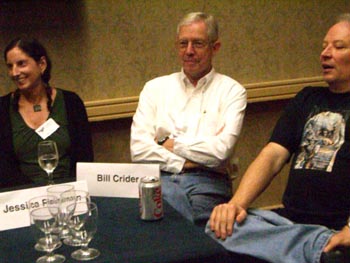
Jessica Reisman, Bill Crider and Joe Lansdale at ArmadilloCon 2007 Jessica Reisman, Bill Crider and Joe Lansdale.

Books recommended by Rick Klaw:

Fast Forward 1, edited by Lou Anders -- a pretty incredible anthology. It's got an incredible Robert Charles Wilson story. There's also a story by Tony Balantyne about a world operating system, infected by a virus.

Acacia by David Durham. It's a violent fantasy with no magic. It's closer to George R. R. Martin, not to Lord of the Rings.

Michael Moorcock's detective stories -- they essentially Sherlock Holmes stories. They go to plaes you would never expect.

I Shall Destroy All the Civilized Planets: the Comics of Fletcher Hanks. Rick Klaw says: "You have these cosmic power shadow charaters who would punish people for doing the wrong things. They would freeze people's heads, they would dissect them. There is a guy there with flaming hands who goes around killing people."

Or -- and I'm not sure I got this right -- there are people who want to kill everyone on Earth except themselves, so they tie themselves to Earth and spin up the Earth so that everyone would fly off of it. The last idea sounded so absurd that I really don't know if I got it right. At that point I just sat there thinking, well... this panel is going to be less helpful to me than I hoped.

Books recommended by Bill Crider:

The Dead Fathers Club by Matt Haig -- a riff on Hamlet. A dark, but hilarious book. And if you've read Hamlet several times, you'll get a lot of in-jokes about Hamlet.

There was also a book that, in my calculation, collected 0 nominations, despite being mentioned by two people. One of the mentions was positive, the other negative, so I guess they canceled out. That was Un Lun Dun by China Mieville.

Here are more of my pictures and blog posts from ArmadilloCon 2007.