Showing posts with label ApolloCon 2007. Show all posts

Wednesday, July 11, 2007

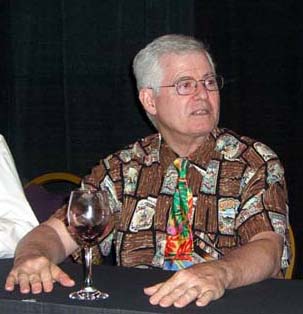
Can't Sew? Duc' it! Costuming with Duct Tape: an ApolloCon 2007 panel

Panelists: Chuck Coshow (moderator), Mary Miller, Shai Mohammed, Val Villareal

Description in the program book: It's light on one side and dark on the other and holds the universe together. Now you can use it to hold your costume together. Our team of guerilla costumers show tricks and techniques for non-sewn costumes using duct tape.

Who would have thought that duct tape is the unsung hero of costuming? The panelists could not praise its versatility high enough. It comes in a variety of surface colors and textures, and you can make all sorts of costume parts out of it. It is also infinitely repairable. To repair a tear, simply tape another piece over it. The panelists demonstrated some basic costume parts you can make with duct tape. For example, in the picture below is a boot, completely covered with shiny red duct tape. (The boot is reclaimable: the tape can be peeled off and the boot restored to its original condition.)

Shai with a boot covered in red tape Picture of a picture of Chuck and Val's costume
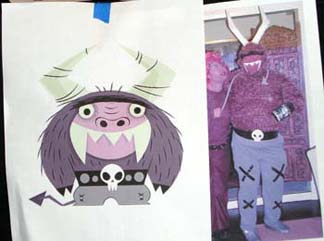
Shai with a boot covered in red tape Picture of a picture of Chuck and Val's costume, made with (among other things) tons of duct tape.

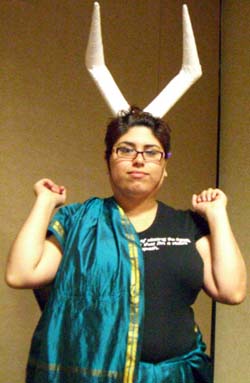
The horns Chuck is wearing in the costume above are shown up close below on Val. Yes, they are made mostly out of duct tape. The tape is wrapped around the frame that was made -- IIRC -- cardboard tubes from used-up paper towel rolls.

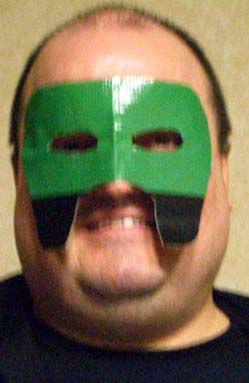
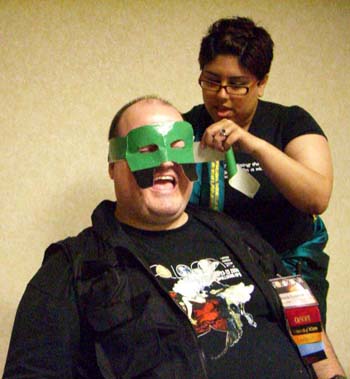
Valerie's horns Chuck's mask
Val with horns Chuck's duct tape mask.
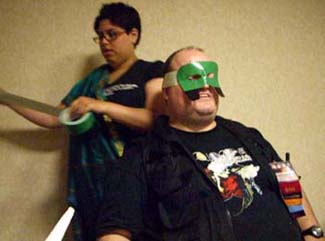
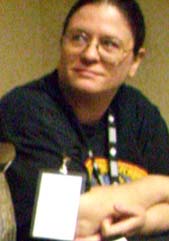
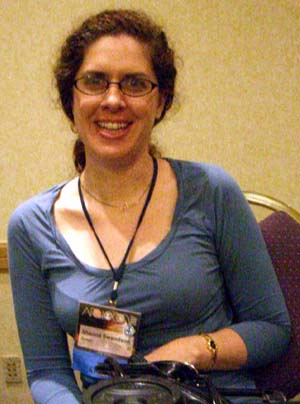
Val with a roll of tape, making Chuck's mask Mary Miller

In the course of the panel Chuck and Val made a simple mask. Chuck cut the mask out of a paper towel and covered one of its sides with strips of green and black tape (see above). Then Val made a two-sided headband (left) out of tape and attached it to the sides of Chuck's mask.

Val with a roll of tape, making Chuck's mask

The paper towel backing is a good thing not just because you don't want the tape to stick to your skin, but also because the towel provides an absorbent (albeit minimally) layer. And this brings us to the an oft-emphasized advice. The wearer should keep in mind that duct tape does not breathe. He or she will be sweating like hell under all that tape. It is imperative to wear absorbent garments underneath, unless, quoth Mary Miller, your character is a slug and is supposed to drip-drip-drip across the stage.

I must say, this panel nearly inspired me to get into costuming. Or get back into costuming, actually, after a brief foray I made into it 15 years ago. If only I didn't already suffer from hobby overload...

Here are more of my pictures and blog posts from ApolloCon 2007.

Monday, July 09, 2007

101 Uses for a Paper Clip (McGyver, eat your heart out) : an ApolloCon 2007 panel

Panelists: Kimber Chessmore, Dusty Rainbolt

Description in the program book: Ever wonder what McGyver might do with a paper clip? Our panelists, specially selected for their devious minds, consider McGyver-esque uses for the humble paper clip, and a variety of other small, household objects... as they toss back one bottle of beer after another.

No, actually the program book didn't say anything about beer. But it was a crucial ingredient in the panel. Some of the paperclip uses were not likely to be imagined without some brain chemistry alterations.

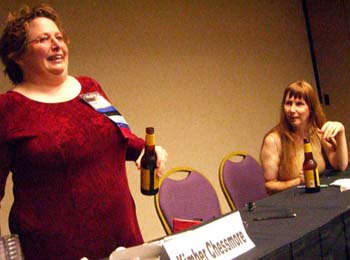
Kimber Chessmore and Dusty Rainbolt Kimber Chessmore and Dusty Rainbolt at ApolloCon 2007

People-poking, jewelry, cleaning; other household uses

Quite obviously, a straightened paperclip can serve as a tool for various kinds of poking, prodding or goading. That was a major set of its uses. For example, you could prod gamers with it to get them out of your way. (I didn't think gamers were a major nuisance at the convention, though.) It can be used for straightforward torture. A guy in the audience said, in Clockwork Orange you can use it to prop people's eyes open.

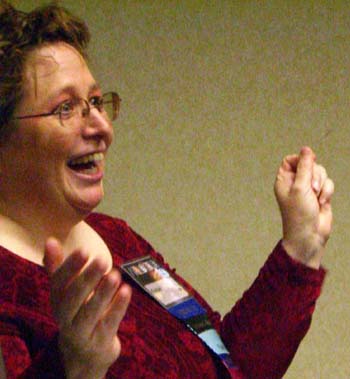
Kimber Chessmore with a straightened paperclip Kimber Chessmore with a straightened paperclip in her left hand (barely visible) for people-prodding

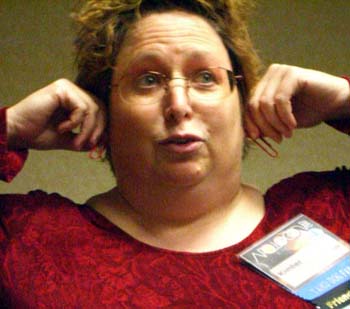
Paper clips can also double as jewelry, for example, earrings for unpierced ears, as Kimber Chessmore demonstrated; or an emergency wedding ring, if you suddenly have to pretend to be married (straighten it and wrap it around your finger).

Kimber Chessmore with paperclips as earrings Kimber Chessmore with paperclips as earrings

Cleaning / hygiene: on a desert island, use a paperclip to clean teeth and various orifices. At home it's handy for digging the hair out of your sink trap (for those with long hair).

Art: if you are making clay pots, a paper clip is a sculpting tool (suggested by a woman in the audience). For cosplay or masquerade, you can fashion an instant antenna out of paperclip if you left the real one at home.

Mundane uses: In all its immeasurable flexibility, a paperclip can be any of these things: a dart tip. A thingy to hang a Christmas ornament from. Or a picture on the wall. For bra repair (if those plastic thingies at the ends of your bra straps break unexpectedly). To puncture an orange peel, so you could peel the orange more easily. A back scratcher. A bookmark. A package opener. Shoe laces. A swizzlestick. A cheap man's cigar punch. A cat toy (not necessarily a safe cat toy, says Dusty).

Farm uses (I've no idea if any of them are valid -- I wasn't raised on a farm): a tool for branding cattle. For horse tack repair. As a bailing wire substitution.

Offbeat uses

Some of the more "out there" uses suggested by people in the audience: on a desert island, paperclips (if you have at least two of them) can be dowsing rods for finding water. Also on a desert island, for lancing a hematoma. Another medical use: as an acupuncture tool. Oh, and speaking of which, Dusty suggested a paperclip could serve as a tattoo needle, though you may need a lot more than two drinks for that, she added.

Kimber said she once posed the paperclip usage question to a group of very polite girls, and the politest of them immediately went: nipple clamps!

Nara (a member of the audience) observed that a paperclip can be handy for stealthy kilt lifting.

Here are more of my pictures and blog posts from ApolloCon 2007.

Friday, July 06, 2007

Size Matters! Knowing or Choosing the Correct Length to Tell Your Tale: An ApolloCon 2007 panel

Panelists: Katharine Eliska Kimbriel, Alexis Glynn Latner (moderator), Julia Mandala, Chris Roberson, Shanna Swendson

Description in the program book: How do writers know how long a story should be? Is it something they decide or something the story demands? Our panel discusses questions of size, from flash to series. (Don't worry guys, it's perfectly safe.)

It's as if this panel was created with me in mind, so closely it fit my writing predicament (inability to write short stories). But since this was yet another panel on writing and editing, there was bound to be some overlap with the previous two I went to. And so I was able to distill the noteworthy tips or observations into a few sentences.

Shanna Swendson Shanna Swendson

Apparently a lot of people, including accomplished writers, have trouble writing short stories. Shanna Swendson says she certainly does. All her stories turn into novels. (The same thing happens to me.) She wonders if she trained herself that way, to think in novels. The only time she managed to write short stories was when she wrote a series of connected fanfic stories, that all made up a big 100,000 word story.

Alexis Glynn Latner thinks that people who think in short stories are in the minority. She gave this advice: if you have trouble writing short, pick the most narrowly focused idea you can come up with. She also warned that worldbuilding adds to the word count. So it's much easier to make a story short if it's set in a consensus world -- for example, if it's alternative history. Or elves in the mall.

Alexis Glynn Latner Alexis Glynn Latner

A woman in the audience said that every time she writes a story, it comes out as series of dialogs, connected with two-sentence transitions. She asked how to make her stories more balanced between dialog and narrative. Alexis Glynn Latner recommended that she take another author's short story she really liked, highlight the dialog and see what the author does between the bits of dialog.

Here are more of my blog posts from ApolloCon 2007.

Tuesday, July 03, 2007

Pay No Attention to the Pro Behind the Curtain: Editors: An ApolloCon 2007 panel

Panelists: David G. Hartwell, Selina Rosen, Mel. White, Steve Wilson

Description in the program book: Learn about the secret world of the editor, the unsung hero of the literary world. Who are they, what do they do, and what is their impact on the fiction we read?

Mel. White at ApolloCon 2007 Mel. White

What was it really about: Unlike Editing 101: Self-editing panel, this one did not have specific advice to writers. (Nor was it supposed to.) Rather, it was one of those panels where pros hash out about little-known aspects of their jobs. Which can be fun!

The most memorable things in all such panels are funny stories "from the trenches", and industry tidbits you don't normally get to hear. Mel. White told this howler of a story. When science fictional elements started to percolate into paranormal romance, those novels were edited by editors who knew everything about romance, but very little about science. So you would get absurdities like a new star appearing between Earth and Jupiter. And nobody noticed it before, beause it appears only once in 200 years.

The Procrustean bed of book publishing economics

David Hartwell went back to the some of the same elements he covered at his kaffeeklatsch where he talked (among other topics) about the economics of book publishing and selling. Back then he gave some interesting examples of how a book word count translates into its price and how that impacts the book's distribution and sales. It turns out the word count economics is far more nuanced than he let us in on at first. Optimal word counts preferred by publishers are dictated not just by the cost of paper, but also by such factors as different printing processes required for books of different thickness -- some are costlier than others; the thickness of the book also determines how many books would fit into a box, thereby influencing shipping costs. The most bizarre factor (though it was completely logical -- it was only weird because I haven't thought about it that way) was pointed out by a guy in the audience. He said books need to be a certain number of inches thick to make it possible to print the author's name in large enough letters on the spines. After all, books in bookstores are stacked so that only their spines are visible (except those lucky tomes that are stored facing front). A customer of less than perfect vision (which is to say, most reading folks) should be able to see the author's name and book's title from 7-9 feet away. This requirement dictates the size of the font on book's back, hence a need for certain thickness.

David Hartwell at ApolloCon 2007 David Hartwell
So on one hand, less is more (a 120,000 word count sells better than a 140,000 word count), but on the other hand, more is more (a book should not be too thin). It doesn't surprise me (especially since I took several courses in mathematical optimization in grad school, which examined this type of problems -- optimizing against several conflicting criteria), it's only weird because we are talking here not about gadgets and widgets, but about a product that flows from an author's deep, innermost self. I always imagined only the author can decide how many words a story needs in order to be told. And yet, having heavily edited my own stuff, I know that number is much more flexible than I thought at first.

Apropos of which, David Hartwell said: "My favorite writers / editors relationship is the kind where both writer and editor agree that the text is just words on paper that could be rearranged any way they want. If the text is the writer's heart's blood, then I can't edit it."

Friday, June 29, 2007

Editing 101: Self-editing for the Spec Fic Writer: An ApolloCon 2007 panel

Panelists: Rosemary Clement-Moore, Melanie Miller Fletcher, Alexis Glynn Latner (moderator), Julia Mandala, Barbara Winter

Description in the program book: Panelists discuss the process of self-editing. And no, we don't mean just chucking it out the window and starting over. How can you honestly and dispassionately proof and edit your writing.

Start with the ending and write toward the beginning

... is a good advice if you are getting bogged down in the middle of your story and don't know how to progress your plot, or if you are not sure what's supposed to happen at a certain place in the book.

In one of the books she was writing, Rosemary Clement-Moore had beautiful first six chapters, but no ending. She had characters riding in cars. After she wrote the end of the book, she knew what they were going to talk about when they rode in cars.

Alexis Glynn Latner advises: outline ahead. Tolkien plotted LOTR all the way through and then wrote it backwards from the ending.

One panelist observes that a lot of people don't outline because they say they are "organic" writers who work better without an outline. Oh, come on! she says. You don't outline because you can't!

Editing out self-indulgent parts

The panelists addressed a problem that a lot of writers, especially beginners, apparently have: becoming so enamored with some of your characters that you want your readers to know everything about them, including the complete life history of those characters. But the reader usually doesn't need to know all about a certain character. The reader only needs to know enough to understand what's going on in the story right now. To make it easier to part with those extraneous bits, Julia Mandala suggests to think about it this way.

Julia Mandala. I like the editing part because I do that for the reader. I had my fun writing the first draft [where I got to play with the characters as much as I liked]. But [when you are editing, you need to] wonder, what will make the reader enjoy the story the most?

Alexis Glynn Latner agrees: the first draft is totally self indulgent. She also offers this bit of advice on how to assuage the pain of throwing out the passages that are dear to your heart but not necessary to the story.

Alexis Glynn Latner. When you write exciting, but unnecessary scenes about a secondary character who would like to have a book for himself or herself, you don't want to just dump them -- that's bad for you psychologically. Make a file of them so that you could reuse them for another book.
If your problem is like mine -- not that I get too attached to my characters (if anything, by the time I finish a story, I can't stand them anymore :-)), but that there's a lot going on in the story and you are uncertain in which order the events should be told, Barbara Winter offered a good piece of advice. Not that I asked her, but I was happy to hear something relevant to my own editing struggles.
Barbara Winter (left) and Melanie Miller Fletcher at ApolloCon 2007
Barbara Winter. One of the best tools anyone ever gave me was this. For every scene in your book, write on one page a sentence what the scene is about (e.g. Joe says "bla"), and on the other page, what's the purpose of this scene. If you do that for each scene, you will be able to say: oh, this scene obviously has to come before that one. Or: the purpose of these two scenes is exactly the same. In this case, do I need both of them, or can one of them be cut and go in that other file?

In any case cutting is probably necessary for any story. Apropos of which, Alexis Glynn Latner offered this poetic observation: a story that's alive would heal when you cut it.

No panel on editing is complete without funny tales from editors' trenches. The following story was probably supposed to illustrate mistakes novice writers make with insufficient / inadequate characterization of their characters.

One of the panelists was teaching at a writers' workshop, and one girl turned in a story that had a homosexual pedophiliac bondage relationship in it. The panelists told the girl: I can handle homosexuality and bondage, but an 8-year-old doing those things? That's a big no-no. The girl became really flustered: OMG, the protagonist was NOT a young boy, he was just a very slender, slim-built adult! The panelist did a hillarious impression of the girl becoming a blabbering mess as she tripped all over herself to explain there was no pedophilia in the story. She just wasn't skilled enough to describe her protagonist in a way that would let the reader see him accurately.

Choosing the correct tense and point of view

There was also a lot of talk about writing techniques such as choosing the correct tense and point of view for the story. The panelists were unanimously conservative on these two points. The past tense is almost always the right tense for a story, unless there is a compelling reason to choose present tense. A limited third person point of view is usually the right point of view, or the least problematic anyway.

Most readers, as well as most writers and editors, don't like stories told in present tense. The panelists said the present tense is very hard to do right. Rosemary Clement-Moore said even though present tense is supposed to immerse you in the story and make you feel as if you are experiencing it directly, for some reason it makes you more distant from the story.

The same with first person point of view, said Julia Mandala. It is good only when it's done right. You want to put the reader inside the character, to fully immerse the reader in the character's experiences. E.g. instead of "I was tired", you need to say, for example, "oh, my limbs were like noodles". ("Yes, I know it's a cliche," Julia added, "but you get the point".)

There had been stories done with multiple first-person points of view, but there had to be a very good reason for that. For example, if the hero and the villain are on separate parts of the country, and won't get together for many chapters, and don't know about each other, it is OK to use both first person viewpoints.

Alexis Glynn Latner offered an interesting observation regarding male versus female viewpoint. She likes to write from a male point of view, because, to quote her, "it snaps down productive filters: a guy wouldn't say that, a guy wouldn't notice that". She can become more easily bogged down in a female point of view -- perhaps because women notice more minute details.

How do you know when you're done editing?

A fitting question to end a panel with is how do you tell when you've done all the editing you could do? How do you know when the story is ready to be shown to the first reader (usually a friend or a fellow writer in a critique group)? The panelists say that point comes when you find yourself making minor word changes here and there rather than doing actual editing.

Melanie Miller Fletcher visualizes her stories as a board with nails in it that have loose colorful threads drawn between the nails. She says that she knows the story has been finished and is ready to be shown to the first reader when the strings are all tight.

Wednesday, June 27, 2007

Geeks in Love: Finding Love in Fandom: an ApolloCon 2007 panel

Description in the program book: Maybe it's flirting; maybe it's friendship; maybe it's a lifelong relationship. Finding romance in all its forms and guises in the ever-surprising world of fandom.

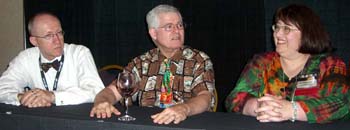
Panelists: Chuck Coshow, Jonathan Guthrie, Becca Leathers, Graham Leathers (moderator), Tim Miller, Val Villareal

What it was like: pretty much as advertised, only I was hoping it would be funnier and would have more quirky dating stories that are only likely to happen to geeks. In comparison, Eric and Cathy Raymonds' panel Dating 101: Remedial Flirting at Linucon 2004 was funnier.

Not surprisingly, common interests play a part in geek dating

All of the panelists met their significant others in the SF fandom, or, in the case of Tim, because of shared interests and sense of humor. Tim met his wife in high school and fell in love with her when she laughed at one of his jokes -- unlike the majority of the population, who doesn't get his sense of humor. She was also into Dr. Who. "Imagine that," he said, "a girl who had the same interests!" Val and Chuck... well, I don't remember how or where they met, but Chuck said his love for Val was clinched when he made a vaguest reference to a Disney kids show, and Val responded by singing a line from the theme song of the show. (Or something like that.) Becca and Graham Leathers met at DuckCon at Chicago 2 or 4 years ago. They were each an independent music guest, and they met in a music circle. They ended up hooking up again at a folk music festival at Winnipeg. Jonathan Guthrie met his his wife at a convention, but he had some experience with fannish women long before that: his first serious girlfriend, when he met her, was wearing a Don't Panic t-shirt.

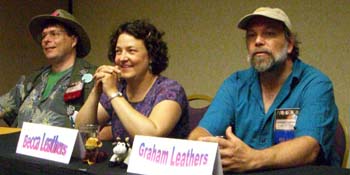
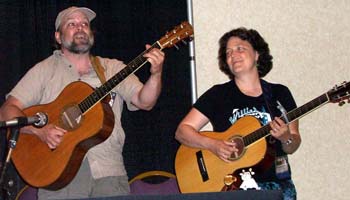
Jonathan Guthrie, Becca and Graham Leathers Jonathan Guthrie, filk Guests of Honor Graham and Becca Leathers

So, common interests fueled the attraction these people felt for their mates. As Becca said, it's hard to explain her interest in filk to somebody who's not a musician (or even to some fellow musicians?). The panelists valued the "he/she gets me" factor so highly that one of them even asked the audience, has anyone here ever had a successfulx relationship with a non-fan? Tim compared an interest in things fannish to an interest in politics. He knows couples where one is hard left and the other hard right, who work a lot better than couples where one is politically very involved and the other doesn't care at all. Because in the first case at least both understand each other's passion for politics. I, a sole contrarian voice, argued that a success of a relationship has little to do with whether the other person is in the fandom. But of course I have only one data point -- myself, and can't speak for the whole fandom.

But it wasn't just the geeky or fannish interests that brought those couples together. Graham said when he saw dogs listed as one of Becca's interests on her LiveJournal, it clinched his interest in her, since he had been a dog trainer himself.

How hard or easy is it to find romance at SF conventions?

Chuck. When I first started coming to conventions, in the mid-80s, there were a lot more women than men. And then you tried to meet these women, and everyone's shields were up. They were like, here is one of those assholes. Nowadays it feels OK to meet people. Does everyone feel it was like that? Women go to cons to have fun, and those geeky guys come to them and say, I roll hundreds on <some kind of RPG?>! Let's go have a coke!

A woman in the audience: it's the opposite for me. I work in theater and I don't go to bars, so my pool of available straight men is not very big. So I hope that a nice geeky guy will come talk to me [at a con]. But it doesn't happen often. They happen to be libertarians.

Tim. There is a reputation that fandom in general is a big open tent [?]. In the 70s and 80s everyone in the fandom was considered an outcast. So geeky guys thought that the girls in the fandom would automatically accept them, and then they discovered that the general rules of dating still applied even in the fandom.

So maybe there was a reason why this panel did not have much of a novelty factor: geek dating isn't very different from mundane dating.

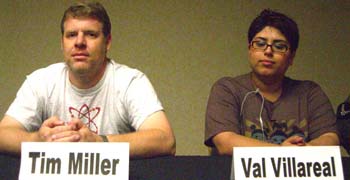
Tim Miller and Val Villareal Tim Miller and Val Villareal

Some said a difficulty of finding a romantic interest may also vary from con to con. One in-the-know fan in the audience dropped names of conventions that have reputations of being events where people go to get laid. Jonathan said that he had never experienced a hookup party at any convention. "Either I'm doing something wrong," he said, "or it really doesn't work this way."

Also, Becca reminded, a lot of people you meet at conventions are from out of town, so if you find romance, it's likely to be long-distance. That comes with its own challenges, and the odds for it surviving are not good (although a long distance relationship did work out for Becca and Graham). On the other hand, Graham added, if a relationship ends, the distance makes it less likely that you'll run into that person at future conventions.

Common sense advice, or conventions as churches

Overall, any advice given in this panel was only common sense. The panelists gave plenty of reminders for the guys to keep bathing and brushing their teeth if they ever want to get a date.

Chuck. It's a truism: a lot of guys come to a con and decide it's a 3-day excuse to abandon all hygiene. But [there are also] fans who go to cons try to socialize others, in the sense of teach them acceptable behaviors.

Tim. Remember the 5-3-1 rule: you have to have either 5 hours of sleep and 3 meals, or 3 hours of sleep and 5 meals, and 1 shower a day, and this will get you through the convention.

Chuck. The tub in your room doesn't just exist for icing down beer.

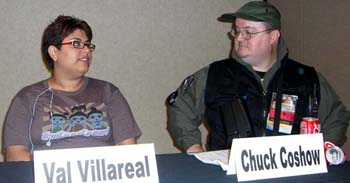
Val Villareal and Chuck Coshow Val Villareal and Chuck Coshow

Other advice:

Graham. One of the worst things you can do is come across as desperate. I was pretty much resigned to being single, and I was OK with that. I just had to bump into someone who I thought we can be friends with, but it progressed beyond that. I have no regrets about that. So, be yourself.

Tim. Don't look at cons a a singles bar: look at them more like a church, where you go for a some other purpose, but may meet people.

Jonathan added that some people treat church as a singles bar.

Here are more of my blog posts and pictures from ApolloCon 2007.

Monday, June 25, 2007

How Friendly Were Frodo and Sam? An ApolloCon 2007 panel

Description in the program book: Was there a homoerotic subtext to Lord of the Rings? Is subtext in the eye of the beholder, or is Spec Fic friendlier to GLBT characters and readings than the mainstream? Panelists discuss the perception of alternative sexualities in SF/F.

Panelists: Alexis Glynn Latner (moderator), Lee Martindale, Jess Nevins, Selina Rosen, Mel. White

Selina Rosen and Jess Nevins at ApolloCon 2007

What was it really about: The discussion didn't focus so much about a relationship between Frodo and Sam, or even gay / lesbian / bi / transsexual (GLBT) characters in SF. Mostly it revolved about fan fiction, especially slash fiction.

At first there was some speculation about Frodo and Sam. Were they or weren't they?

One panelist was vehemently opposed not just to slash fiction, but to most kinds of fan fiction. Others defended fan fiction, but acknowledged that slash fiction did nothing to address GLBT issues, and was overall not very relevant to the panel topic. Some panelists tried to get the panel back on track, but in the end they did not produce anything other than a few rather obvious observations.

My full article can be found on my web site.

Saturday, June 23, 2007

ApolloCon 2007, Friday: kaffeeklatsch with David Hartwell

Here are some interesting tidbits that were said at the kaffeeklatsch with the editor-legend David Hartwell.

A lot of people have very different opinions as to what hard science fiction means. Some count J. G. Ballard amont the writers working in this subgenre. In fact, J. G. Ballard had once stood up and said he was a hard science fiction writer: the hard science within which he was working were medicine and psychology. He may have had a point, because he was trained as a doctor, and he used those sciences rigorously in his fiction.

David Hartwell at the ApolloCon 2007 opening ceremony David Hartwell at the opening ceremony of ApolloCon 2007

About the economics of book sales. Apparently, mainstream books sell much worse than genre books. Of all 5 books nominated to the National Book award one year, none of them sold even a 1000 copies. Meanwhile it's a rare SF hardback that doesn't sell at least 2000 copies. Hartwell quotes Norman Spinrad, who said that publishing a SF novel that's a complete failure would be as unlikely as constipating yourself by active will.

Hartwell juggled some numbers, converting word count into dollars. For example, an extra 20,000 words translate into extra $2 added to the price of a hardcover. So if a 120,000 word hardcover would cost $24.95, a 140,000 hardcover would cost 26.95; and that means bookstores would order 25% fewer copies of it. (Or something like that. I'm not sure I am quoting those numbers right.) He shed light on the complex relationship between book distributors and publishing houses; a major portion of books are sold through supermarkets and other superstores, and if a superstore stops buying books from a publishing house, that publishing house may go bankrupt. Basically, he said, most books are now sold through superstores rather than small bookstores, which means that most of America lives 40 - 60 miles from a bookstore.

Hartwell says one of the best things one can do to promote the genre of science fiction, to keep it alive and thriving, is to write book reviews, an publish them somewhere. No matter how obscure is a web site where it's published, someone will find it and read it. It's especially true when you are reviewing an author's first novel. Even if the review is negative, if it is engaging and well thought-out, it will do a lot to promote the new author. 500 -- 1000 word review is better than a 300 word review. A 1500 word review is even better.

I feel so validated! My verbose book reviews are therefore worthwhile -- at least in Hartwell's opinion!

Here are more of my blog posts about Apollocon.

Friday, June 22, 2007

ApolloCon 2007: opening ceremony

The ApolloCon 2007 opening ceremony was short and simple. The convention chair, Mark Hall said they started ApolloCon because they wanted to have a con in Houston they wanted to go to. After 2 years of being the ApolloCon chair he will take the next two decades off, because this is a con he wants to go to. He added: "at least I think there's a con going on out there. Let me know if there isn't."
Mark B. Hall, David Hartwell, and C. S. Friedman at the opening ceremony Mark B. Hall, David Hartwell, and writer Guest of Honor C. S. Friedman at the opening ceremony of ApolloCon 2007. Here are more of my blog posts about Apollocon.
Introducing David Hartwell, Mark said: if David is wearing a tie, and you're an epileptic, you should truly try not to stare at it. I don't know if Hartwell's tie made anyone sick, but his voice must have soothed the audience's brain waves when he sang them a song "Teen Angel". Then the filk Guests of Honor Graham and Becca Leathers sang another song.
Graham and Becca Leathers at the opening ceremony Filk Guests of Honor Graham and Becca Leathers sing at the opening ceremony of ApolloCon 2007. Here are more of my blog posts about Apollocon.
The con has been reasonably fun so far. It started when an eminent Austin fan K and his wife M gave me a ride to Houston. We had some good conversation along the way. Then I hung out at some panels and room parties. All has been good so far, but not without a glitch. I found out I have forgotten my camera's cradle at home. A cradle is a thingy my camera must be docked into for transferring files into the computer, and for recharging. Forgetting it at home is a bummer. Fortunately, I have 2 spare batteries, so if I'm frugal, I may have enough juice to take pictures tomorrw and Sunday, but just barely. It's hard to break a habit of snapping away with abandon. As far as transferring the pictures, one guy offered to put my camera's memory card into a slot in his computer, and to plug in my external USB hard drive into his computer too, and that way transfer the pictures from one to the other. So that worked. Then again, that guy may not be here tomorrow, and I may not have another opportunity to transfer the pictures. Here are more of my blog posts about Apollocon.