Friday, January 18, 2008

When a laptop crush burns you

I have not yet admitted it in this journal, but for the last 2 weeks I've been conducting a torrid love affair with another laptop, a Fujitsu Lifebook Q2010. In this post I identified it as my newest laptop crush. Well, our romance was tumultuous and crashed spectacularly. Such a seducer, it was! Spectacularly thin (though not anorexic like the new MacBook Air), light as a feather; small, but with a comfortably sized keyboard. I thought it would make a great companion for me everywhere I go.

Long on beauty, short on capacity

I knew this extreme portability came with some sacrifices. For example, it lacks a CD / DVD drive. This didn't matter, because I use CDs and DVDs very rarely; I keep all my data on external hard drives or flash drives. What did give me a pause was that this laptop had only 512 MB memory. That's the same amount of memory I have in my old Fujitsu laptop (the one that had mouse-ectomy performed on it), and I bought it 3.5 years ago! It gets bogged down easily when I run the minimal number of applications I need every day: Firefox, emacs, Open Office and Photoshop. So it wouldn't make much sense to buy another lappy with just as little computing power.

I blame the wingmen

Why did I buy it, then? It's not that infatuation made me blind: I blame the wingmen -- sales guys at Fry's Electronics -- for my bad decision. (Let's see how far can I stretch the analogy!) They assured me I can upgrade the memory to 2GB, and that it's very easy to do it at home. At home, S and I opened the memory compartment and peeked inside. Not only it didn't have the promised levers that let you lift the memory out and replace it with a new one, it didn't seem to have the same kind of connectors as the memory chip I bought. So I took the laptop to Fry's service department to see if they can upgrade it for me (for a price, of course). They kept it for a day, then called me and said the memory was not upgradeable: it was soldered on the motherboard!

I still didn't want to return the lappy at this point. I had already made 4 trips to Fry's within a week (the 4th one was to pick up the laptop's power supply, which I forgot the previous time) and I simply felt I have invested too much time in this laptop to write it off. So I tried to pretend I could work around this. Only I didn't get very far.

I don't click links that say "Click me!"

S set it up to access our home wireless network, but the laptop was unable to connect. I took it to a few coffeeshops with public, unencrypted access points, and it could not connect to any of them. Finally I called Fujitsu tech support from one of those coffeeshops. The tech support guy told me there's an icon on the desktop entitled "Click Me" and that I needed to click it before I could do anything else with the laptop. Clicking it will unpack a bunch of drivers and programs that are necessary for the laptop to work, he said. When I idly wondered why weren't those programs installed on the laptop to begin with, the guy replied only that Fujitsu has always done it this way. A compelling explanation if there ever was one.

I did not even see the tricky little icon at first, because I guess my brain has wired itself to tune out spammy word combinations such as "click [here|me]". Links that beg me to click them without making a compelling case why I should, are usually the kind I would never click if I knew what was behind them.

But now I had to, so I did. I got a bunch of errors. After making me repeat the operation twice, the tech support guy concluded that the operating system (Windows XP) on the laptop was corrupted, because I had not clicked the icon before doing anything else on this laptop. I asked, "so you are telling me that the operating system got corrupted because I tried to access internet without unpacking those programs?" He said yes. I said it was beyond ridiculous.

Sometimes it's best to let that one get away

But then he asked me if by any chance, the laptop I bought was a a store loaner / demo unit. Why, yes, I replied. Indeed it was a demo unit. In fact, part of why I bought it was that it was the last unit in store! They've been discontinued, and this was my last chance to buy a laptop of this kind. Nothing can inflate an item's desirability like knowing that this is your last chance to nab it! The tech support guy said, ah-ha! You never know what its previous users did to it, that might have corrupted the OS. Well, uh, maybe, but Fry's told me they wipe the lappy clean and reinstall the OS from scratch! Still, the guy said, my only recourse at this point was to reinstall Windows myself from recovery discs.

Thank you, I said. And I went back to Fry's and returned it.

So now I'm back on the market for laptops. I'll be more careful next time -- with my time and money, if not my heart.

Friday, January 11, 2008

XO networking at an Austin Linux Group meeting

After grumbling in solitude for the last few weeks, I got a chance to try XO out the way $deities intended it to be used: networked with other XOs at an Austin Linux Users Group meeting. These capabilities are supposed to make it the coolest laptop known to humankind.

In theory, at least.

Beside me, 2 people brought their XO laptops to the meeting: Mr. The Joe Barr (who gave a presentation), and a guy I shall call Mr. Emily, because that was the name of his wife's computer, and by extension, his wife. A few more people came to play with these 3 lappies.

A ghost laptop

We tried to see if the three computers could see each other. They did, to various degrees of success and with various permutations. I could see Joe's computer in my neighborhood view, but not Emily. Joe's computer could see Emily, and occasionally me. My icon popped on and off on its screen unpredictably, regardless of what I was doing. Emily could see both of us, plus a fourth XO -- a ghost computer! It was named Clatrissa. None of us had any idea who she or he was, except that she must have been somewhere in the building, or nearby. Spooky! How many other XO users does any XO user run into on an average day? And how likely are you to run into one randomly when there's already an XO meeting going on in the building? But maybe there was a more mundane explanation for the ghost XO. Could it be possible that the real Emily had networked her XO with a "Clatrissa" in the recent past, and the laptop had not been rebooted since then, so Clatrissa's icon hung around? I've experienced something similar with wireless access point icons. I may move from one location to another miles apart, but the icons of some of the wireless access points in the previous location (all of them, not just the one I had connected to) still hang around. Only rebooting the computer makes them disappear.

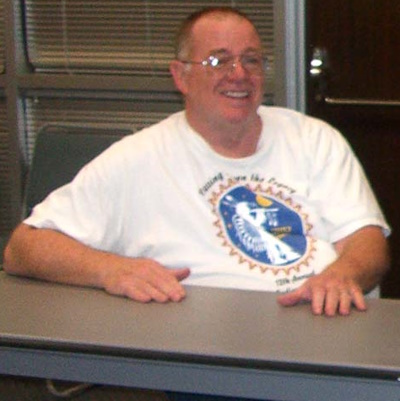
The owner of the laptop named Emily at the Austin Linux Group XO networking event in January 2008 The owner of the laptop named Emily at the Austin Linux Group XO networking event in January 2008.

Invitation confusion

Mr. Emily issued an "invitation" to Clatrissa, but s/he didn't respond. Probably because s/he didn't exist, but perhaps because invitations are a bit of a tricky business an XO, as we discovered. Well, at least for novices. When you move a mouse over another XO user's icon, two options pop up: Make a friend, or Issue an invitation to browse. Apparently, all Make a friend does is add the other user's icon to your Group view. It does not seem to inform your "friend" that you have friended them. Inviting someone to browse had seemingly just as little effect. I issued an invitation to browse to Joe's laptop and then went over to see if the invitation was received. No sign of that. But perhaps Joe didn't get my invitation because his laptop couldn't see mine at all? It's anybody's guess. And I did not try to orchestrate invitations between two laptops that were definitely seeing one another (such as Joe and Emily), because they were at that time both swarmed by other people who seemed to be more interested in dissecting the operating system rather than putting Sugar through its paces.

Apparently there is also a misconception that you can't see other XO users nearby if you are connected to a wireless access point, but that's not true. You can. But then I guess the ultimate test for XO networking would be for one of us to start a mesh network and for others to connect to it and get on the internet via the first person's computer. We didn't even try, since there were problems to even try to see other users. Besides, Joe wasn't sure if you don't need a school server for that. Maybe only the school server can serve as an access point for all the laptops to connect to.

Mr The Joe Barr at the Austin Linux Group XO networking event in January 2008 Mr The Joe Barr at the Austin Linux Group XO networking event in January 2008.

I also was very -- how shall I put it -- vocal about the XO deficiencies I've experienced so far. I was semi-expecting to be called a Microsoft shill for that, but actually Mr. The Joe Barr was sympathetic and said I should report my troubles to the OLPC developers -- I would be helping them out. So maybe I will, once I get around to it. While Joe said he had not experienced the same problems, I felt somehow validated that some people agreed the limitations of this laptop were real. There was some discussion as to whether the laptop's intended audience, third world schoolchildren, will perceive them as limitations. For example, inability to back up large batches of files to a USB drive is not a limitation if you, umm, don't own a USB drive. Joe thinks backups are intended to be stored on school servers. Perhaps that's a correct assumption on the designers' part, who knows. But even Joe agreed that this laptop (or at least the Sugar interface) is not intended for power users. As the schoolchildren ramp up to become power users, they may have to switch to more powerful systems. But that may come sooner than such systems become affordable in the developing countries.

Austin Linux Group secretary Paul Elliot did us all a service by asking questions on an OLPC IRC channel on our behalf. Thanks to him I found out how to import images into Paint application, and got a few other questions answered.

Monday, January 07, 2008

XO: conclusions

Update on backups. It really is possible to back up an "activity" by dragging and dropping it from the Journal to a USB drive icon at the bottom of the Journal. I did this to an activity named test1.txt, and a file by that name actually appeared on the USB drive. But, as I expected, it appeared in the top-level folder. I could not have placed it in any of the folders on the USB drive, because the XO operating system does not recognize folders. For the sake of accuracy I must say the underlying Linux system does recognize folders / directories, it's just the Journal (which is essentially a dumbed-down file manager) doesn't. But you can't copy files to the appropriate folders using command line, because you don't know the "real" file names (they are encrypted, I heard). The user-friendly file names are only visible in the Journal, but the Journal doesn't recognize folders. So whatever files you back up will only be backed up to the top level folder of an external drive. Not very useful in real life situations.

No easy way to organize your data

Absence of folders me wonder whether this laptop can be adequate for any kind of real life use, even in the lives of third world kids. Here's why I doubt it:

-- if you can't organize your files into folders, the external hard drive you store them on will be nearly useless if transferred to a non-XO computer. If you store hundreds or thousands of files in a top-level directory, the information in them becomes practically unfindable. (Yes, you can search, but only the files that have text in them. Search won't help you tell if a file named DCF2519.jpg is a vacation picture or a birthday picture, or something else, unless you store it in a folder "Vacation" or "Birthday".)

-- to back files up, you have to drag-and-drop them to an external drive icon one by one. There is no ability to select multiple files, at least not that I see. It would quickly make any kind of real-life file backup tasks very tedious; and tedious tasks usually get neglected until oops, your hard drive has crashed.

Speaking about findability of files, I realize XO interface is built around a different paradigm of data organization than the one we are used to (hierarchical system of folders). The XO Journal stores everything in a chronological stream. The "activities" in it are sorted by date. You can also search them -- there is a search bar at the top of the Journal. You can filter the view by a file type, or by "recentness", though it has very limited options for that: today, since yesterday, last week, last month, last year. You can't enter an exact date range. The "search, don't file" philosophy has a serious limitation of being applicable only to text, not binary files.

Plus, the search takes forever (or hangs) if your external drive has a realistic number of files. In my previous post I said I have thousands of files on my USB drive. To see how far I need to scale things down before XO stops choking on them, I tried another drive with only a couple hundred files, most of them text. The search still hanged.

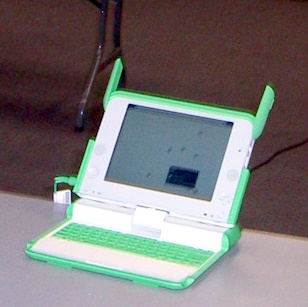
An XO / OLPC laptop An XO / OLPC laptop.

One might point out that the Journal allows you to add tags and description to each activity. Tagging image, video and audio files would make them searchable (the search mechanism does look inside tags, I'm glad to say). But how many people are going to do that? What is easier: to mass-select a bunch of images and drag-and-drop them to a folder named "Birthday" or to paste a tag "Birthday" a 100 times next to each and every picture you took on your birthday?

A toy, not a tool

To reiterate,

1. XO does not let you organize the files in a way that's (a) scalable, and (b) preserved if transferred to a non-XO computer.

2. To whatever extent it lets you organize your files, it can only handle ridiculously small amounts of data. I suppose if I only had 10 files on my external drive, the search might work. But do you know any person who has only so few files on their drives?

So if you do no more than 3-4 activities at a time, and if you don't want to keep most of the files you generate, then I guess this laptop may be adequate. In other words, you have to be using it as a toy, not a tool, to avoid running into its limitations. But this can't be how school students are supposed to use a laptop (any laptop, not just this). Aren't students supposed to save their class notes to use them in the future, as the class material each year builds upon the previous year? If so, you would expect students to generate tons of files, most of which should be easily searchable and accessible. Also, if the laptop chokes upon large chunks of data, what's the point of giving it an ability to generate large binary files, such as video and audio? Especially if you keep in mind that a handy video camera might tempt a child to go on a wild creative spree, recording everything in sight (heck, it even makes me, an adult, do that!) What's the point of creating hundreds of binary files, if a mere attempt to view their names in the Journal crashes the Journal?

Note that I haven't even talked about the video and audio recording functionality of this laptop; I was discouraged from trying to manipulate huge binary files by seeing how XO's memory chokes on ~ 2K of text data. I'm sure the recording capabilities are neat, but to me, they are icing on the cake; the cake itself -- or rather the daily bread -- is ability to organize and access your data. If this laptop can't do that, in any real-life situation, then I'm not sure what's the point to try to do anything with it.

Saturday, January 05, 2008

XO: forget about folders. Where are my FILES?

No, dear reader, I'm not done complaining. I saved the best for last.

XO has some even more fundamental problems... sorry, weirdnesses. Sorry, design features.

If you are computer-literate person, wouldn't you feel a bit embarrassed to ask where your files are? XO makes you stoop to new lows of embarrassment. Let's say you save a file, and then open a terminal and try to find it from the command line. Well, not only I wasn't able to find them using the UNIX find command, but several Linux experts at a meeting of the Austin Linux Group were unable to find those files using find with all sorts of advanced options. Then after some googling one of them found an indication the file names on XO may be encrypted. So no matter what you call your file, you won't be able to find it.

An XO / OLPC laptop An XO / OLPC laptop.

By the way, what exactly is a file name on OLPC is not entirely clear. Nor is a mechanism by which one saves a file in the text editor. The editor has no "Save" menu option. The only thing that resembles saving a file is clicking on "Activity" tab in the text editor (or, to use XO terminology, in the Write Activity) and then you'll see a little bar in the upper left corner; by default, this bar says "Write Activity". You can change this text to anything you want, which is akin to giving file a name. Then if you switch to Journal, you'll see this activity referred to by the name you just gave it. So it is indeed like a file name. Like is the keyword here. Because nowhere on the machine you'll find a file by that name.

Can you back up your files without knowing where they are?

Well, perhaps the XO computing paradigm does not require you to know file names in order to find them again? At a first glance, yes. You can see all your "activities" in the Journal, so you don't really have to search for them by their file names. Which leads to a question: is Journal capacity infinite? Will every activity you've ever done be listed there? Or do the oldest activities "expire" after a while? Because if they do, and you can't find them by the file name, you're screwed if you ever want to access them again.

But of course Journal can't be infinite, because XO hard drive (sorry, flash drive) isn't infinite. Which brings us to the next, critical question. How do you back up your files?

When I plugged in a USB drive, I opened it in the Journal (by clicking the USB icon at the bottom of the Journal), then switched back to the Journal, and tried to drag-and-drop an item from the Journal onto the USB icon. The icon seemed to move, so I thought I'd switch back to the USB drive view and see if the file will appear there. I could not switch back to Journal (by clicking its icon at the bottom). Then I tried to unmount the USB drive (by clicking Unmount), and then unplugged it. This action crashed my Journal! It disappeared.

So now I'll have to reboot to see if the Journal is restored, and if my test file actually appears on the USB drive. What fun!

Friday, January 04, 2008

XO: where are my folders?

I shall not stop until I've vented all I have to vent about XO. Hey, for those $400 if I did not buy a functional computing device, I at least bought a right to complain, no? :-)

When you plug in an USB drive, it's supposed to show up at the bottom of Journal as a USB drive icon. Of all times I plugged it in, the icon showed up perhaps half the time.

Actually, it was like this: I plugged it in, it showed up. I unplugged it, then plugged it back in. It did not show up again. I rebooted the computer, it showed up.

An XO / OLPC laptop An XO / OLPC laptop.

Then I was for in for another disappointing surprise. I have several thousands of images and hundreds of videos on my USB drive, all filed in folders according to my own system (when you have that many files, it's not trivial to find a filing system that would quickly let you find what you want). Guess what -- this laptop does not recognize folders. It displays all thousands of files in a flat list, sorted by date/time. I could not believe my eyes. But perhaps I could have guessed that a system that did away with a window manager would go one step further and get rid of the folder paradigm altogether.

You can open a Linux terminal on this laptop (thank goodness for small graces) and cd through directories from a command prompt. So in that sense you can see folders on your disk. But you shouldn't have to be a geek to use folders, no? At least the children this laptop is designed for can't be assumed to be Linux geeks.

Wednesday, January 02, 2008

Laptop surgery

Yesterday was another first. I observed surgery performed on a laptop. On mine, that is. On my dearest old laptop (not the XO), the one that mistakenly swallowed a gulp of my coffee. :-) Fry's could not fix it. The liquid has leaked into the system board, they said. It's not possible to fix. But to work around the problem of a mouse that thinks its button is permanently pressed, they recommended that I get an external mouse. So I did. Plugging in an external mouse is supposed to disable the built-in one... only it doesn't. So I asked a local IT expert how to disable it. It was supposed to be a quick question, but we all know how quick those questions actually are. This one lead to an-hour-and-a-half long troubleshooting session (you can't disable the built-in mouse from the BIOS, and you can't uninstall its driver, because every time you
reboot, Windows re-detects it and reinstalls the darn driver!) that culminated in opening up my laptop and exposing its guts. Oh, what a white-knuckled feeling it was to see my dear laptop laid open and helpless! And how weird it is that to get to the internal mouse (or "trackpad", I should say) you have to go in from the bottom, by opening the hard drive compartment! Well, the IT expert cleaned off the trackpad parts and put the laptop back together, but no cigar. The mouse still thinks its button is "on", and it overrides the signalsfrom the external mouse. More surgery, then. The guy disconnected the trackpad cable, finally disabling the trackpad. So, thanks to this good person, I have a working system for now, but I'll start to look for a
new laptop soon.

Tuesday, January 01, 2008

I'm no better critiquer than I am a writer

I try to do one new thing on the first day of the new year. I went to a meeting of a science fiction writers' critique group. One of my SF writer friends had said that the critique delivered by this group is so mild as to be useless: they'll never tell you if your story sucks. But I wanted to see for myself. Well, they didn't trash anyone's story, but they pointed out a lot of things in it that I thought were very helpful to the author. I felt a bit useless without having to offer any helpful critique to the authors, as I'm really not that perceptive. I'm blind to literary style, and I'm not bothered by stuff like frequent shifts of POV, and such. The only critique I can offer is "can you make it a little bit more interesting?", which of course is not helpful. :-) (I didn't bring any of my stuff to be critiqued -- maybe I will someday, but this was my exploratory meeting.)

And I am totally not equipped to critique vampire erotica. I have no idea what distinguishes a good story in this genre from a bad one. :-)

Monday, December 31, 2007

XO: the slowness

XO is so slow that if you open 5 applications (sorry, "activities") it slows down significantly. If you open 6 of them, it slows down to a complete grind. And I'm talking about such low-intensity activities as text editing and web browsing! I haven't even tried video or sound recording or editing yet!

Having a minimal number of activities open is also not a guarantee that the laptop won't slow down. If you copy a large quantity of text to a clipboard, it will slow the XO down just as effectively as opening 6 applications. By "large" I mean "about 2 pages worth". For me it's typical to copy / paste chunks of text this size as I write and edit my stories or blog entries.

An XO / OLPC laptop An XO / OLPC laptop.

Well then, perhaps I should clear out my clipboard frequently to avoid computer freezing up? Yeah, that's a step you don't have to do in a traditional computer, but what's some small effort for the honor of using this radically innovative machine? It should be easy given that all your clipboard entries are conveniently lined up on the left side of your workspace. Hmm... but now how am I supposed to know which of them are the "huge" chunks that are hogging the memory, versus tiny one-word chunks? In my writing / editing process I generate both kinds, but much more of the latter. When you move the mouse over each clipboard entry, it obligingly pops up a menu allowing you to choose to remove the entry, add it to Journal, or to open it in an activity (such as "write", if it's text). However, it does not show you what the entry is (not until you open it in an activity, I suppose. And I already said what happens when you open more than 4-5 activities). So there is no easy way to know which entries to delete. Would it have been so hard to program the clipboard so that moving the mouse over a clipboard entry would show the initial words of the text (if it's a text)?

I guess you can point out that poor kids in the 3rd world are not graphomaniacs like me (actually, very few kids anywhere are), so they won't manipulate large chunks of text. Yet, this laptop gives kids an ability to record video and audio, and video / audio objects are bound to be much bigger than segments of text! If the laptop memory chokes on text, how will it handle multimedia? I'm afraid to even try it.

Sunday, December 30, 2007

No X's or O's for this toy

It's not the chiclet-sized rubbery keys (though I suppose I wouldn't try to type a dissertation on this keyboard. I haven't had a chance to type out long text documents on it yet, because I am still trying to find out the how to do the basic functions I do on a computer. ) No, there are several other reasons why I think this thing is crippled.

I know, I know. I can hear a bunch of voices yelling back at me that I don't get it, that XO was not supposed to be a "regular" laptop, and the fact that it can't do a lot of things a regular computer can do was a design decision, not a flaw. But then you have to wonder if the assumptions the designers made about the target audience (children in poor countries) were any close to being realistic.

You don't realize how much you rely on this feature until you miss it

Suppose you regularly update a web site, and you do it via a CMS (content management software). CMSes have web-based interfaces; you update them via a web browser. Often you want to upload pictures. Web browsers have upload widgets where you click "Browse" and a dialog box comes up that lets you select a file to upload. So you go to your CMS URL in the XO web browser, and you see your usual upload widgets, and you click the "Browse" button, and your computer cranks and flashes its blinkenlights, and you wait, and wait... while the itching feeling it's not going to pop up a dialog window grows stronger. You can't say why, not yet, but you just know it's not going to happen. When, after a lot of grinding, the XO web browser fails to pop up a dialog window (with no error message or anything), you realize why.

There are NO windows on this system!

An XO / OLPC laptop An XO / OLPC laptop.

The damn operating system does not have a window manager! All popular operating systems, whether Microsoft Windows, Mac or Linux, use a windowing system as a basic user interface paradigm. Any application you open opens in a window. Not so here. In OLPC interface, an application (or "activity", as they call them here) occupies the whole screen. Sure, there are ways to get from your "activity" screen to the Home screen and other activity screens. But the windowing paradigm is about more than that.

If you are a very linear person, XO may be for you

For one thing, a lot of mainstream applications, such as web browser, require opening another window in order to accomplish routine actions (such as uploading files), and they can't do that on XO. But the significance of windows is more fundamental. You can lay them out side by side and overlap them, enabling you to see several sets of data, several applications, several... um, activities, at once. It lets you shift your attention from window to window whenever something interesting happens in some window (for example, a friend IMs you). Our computing activities are rarely linear. You may be chatting in one window, while waiting for a video to load in another, while checking email in yet another window. You need to be able to see all that's happening at once! And children these days are even more used to that than adults. Everything that's been said about the contemporary kids and teenagers emphasizes that they are embracing multitasking the way no generation has done before -- IM'ing several friends, watching videos, and doing homework all at the same time, continuously managing multiple streams of attention. I would add that this is typical not just to kids, but to programmers too, of all ages. It is inevitable for us. While a program compiles, we don't dumbly stare at the screen: we research some other issue for another project, or answer somebody's question in an IM window -- only to interrupt those "secondary" issues when our primary project finishes compiling. And it should be enough to glance at it to know when it finished -- we shouldn't have to Alt+Tab to the other window repeatedly. Similarly, we need to know immediately when a colleague or a friend sent us a new instant message. For that, one needs overlapping windows on the screen.

XO doesn't let you do that.

So like I said, it may be good for kids who haven't been around regular computers, but any kid who's grew up in a modern digital lifestyle will find it crippling.

But maybe a window manager would be too power-intensive? It is a computationally intensive feature, I'm sure, at least as far as memory is concerned. And I've just talked with a guy at a coffeshop who has been following the OLPC program closely and he said that all these design decisions were dictated by the need to make the laptop consume as little power as possible.

Friday, December 28, 2007

Laptop crushes

My broken laptop is at the Fry's repair shop, where they will keep it for a week just to run some diagnostics on it! The diagnostics will cost me over 100 bucks. And that's not counting the cost of repairs. There's no telling how much that will be. The technician at Fry's said "it may not be economical" for me to get this laptop fixed versus buying a new one. I don't know if there are laptop repair shops in town that do the job faster and cheaper, there may very well be, but I had already spent one of my vacation days running errands and didn't want to spend the second one searching all over the town for a cheap computer repair shop. So I thought what the hell. But I prepared to reconcile myself with the possibility that I may have to put my beloved laptop to rest. So while I was at Fry's, I started looking at other laptops.

Even if a relationship ends, you can say it was good if it taught you what is important to you in relationships. And so it is with computers. If a laptop taught you what is important to you in laptops, it was worth it. And this laptop taught me a lot. When I bought it, I was confused about what I wanted -- all I had from my previous relationships with laptops was a vague sense of dissatisfaction, of spending too much effort working around their quirks; there was no balance of give and take. But now I know. Portability is extremely important, because I carry my laptop everywhere -- in a way it is a life partner. And for me, portability means primarily weight, and only then size. So, a 10" screen is only a marginal win over a 12 " screen, but 1.5 pounds is worlds better than 2.5 pounds! Reduction in weight often comes at an expense of an optical drive. And that's fine by me. I use a CD / DVD drive so rarely that I'll be perfectly happy with having an external drive to plug into the lappy when I'm at home. I don't need one "on the go". On the other hand, since I type a lot and in all sorts of places, the laptop's keyboard needs to be decent-sized. Chiclet keysx won't do.

That said, I announce my newest crush: Fujitsu Q2010! I looked at it at Fry's, and it's full of awesome! 1.5 lbs, 12" screen, no optical drive, but a keyboard suitable for marathon typing.

I feel awful saying this. I still hope my old laptop can be fixed.

An XO / OLPC laptop An XO / OLPC laptop.

Where does the XO come into picture, you ask? (No, you didn't, but I can dream, can't I?) It's not really in the running. It's a boy-toy, a rebound relationship. No, it's more complicated than that. If I was single, it would be a wingman / -woman. Or a wingpet, as it were. For all its inadequacies, it's really good at starting conversations. The last couple of days, being on vacation, I camped out with my XO at various WiFi-enabled coffeeshops and eateries, and half the time guys come up to me asking what it is. Hey single women! The Give 1, Get 1 program has been extended until December 31st! For just $400 you can buy yourself a perfect guy magnet!

Tuesday, December 25, 2007

Lumps of coal

This Christmastime the universe brought me an assortment of small nuggets of anthracite in the form of annoying and disappointing events. None of them is big enough to justify a whine (so consider this an unjustified whine); they are rather like small, delicate chocolates in the box -- as you bite into each one, you wonder which shade of bitter taste it will leave in your mouth.

Perhaps I shouldn't blame the universe: some of these things were brought about by my own clumsiness. First, I damaged my beloved laptop: not just once, but twice. I spilled coffee on it at a coffeeshop. Only a tiny bit of coffee, but it was enough to do a lasting damage. My 3 years of being very careful with this laptop came to naught. I am usually very aware of the placement of coffee and tea cups within one meter radius of the laptop. I don't put cups with liquid on the table where the lappy sits: I put them on a chair or on the floor, so that there would be no chance of spilling them. But all it takes is one time. My hand trembled, or something, and a few drops of coffee ended up on the keyboard. As a result, the mouse pad stopped working. The mouse acts as if its button is permanently pressed. So if you move the mouse over any window, it will wreck havoc as it "clicks" everything within that window, opening files, launching applications you didn't know you had, etc.

So I took it to Fry's yesterday to see if it could be fixed. But when I showed it to a technician, the mouse worked fine. I brought it back home, and the mouse is back to being unruly. So another trip to Fry's is in the stars for me tomorrow. I just hope the problem won't temporarily go away this time, only to reappear at home.

What's worse, as I was taking the laptop out of the bag at Fry's, I dropped it on the floor! Some parts of it outer shell cracked and chipped, but the fall didn't seem to affect it... at least not yet. I still feel very bad about harming my laptop, as if I had harmed a child.

Or perhaps it's a way my sneaky subconscious was trying to get rid of the old laptop so as to make way for what was supposed to be my holiday present to myself: an XO laptop (also known as OLPC, or One Laptop Per Child). I bought an XO as part of their "Buy 1, Get 1" program (you pay for 2 laptops, and get 1, while the other gets shipped to a child in a developing country, which is what the OLPC program was intended for). It arrived yesterday. My Christmas Eve night was spent on figuring out the XO interface, which is, in Tom Lehrer's words, "so simple, so very simple, that only a child can use it".

An XO / OLPC laptop An XO / OLPC laptop.

And not just any child, but a child who's never been around real computers before. For youngsters in African villages it may be perfectly adequate. But a western child who's been using computers since preschool, may find it about as comfortable as tying her shoe laces with her elbows. Yes, XO is cute. I grant it that. But a cute lump of coal does not a diamond make.

That's my verdict for now. I'll write more about it after I take a few deep breaths and spend hours on OLPC forums and wikis to see if there is even a circuitous way (much less a direct one) to do my everyday computing tasks.

Thursday, December 20, 2007

Neil Gaiman "American Gods": a CFI book club discussion

5 members of the CFI book club attended the discussion. 3 of them have finished the book, 2 haven't but were planning to finish. For some reason we didn't get much discussion mileage out of this book. It did not prompt discussions as lively as the two previous books the CFI book club read, "The Sparrow" and "Towing Jehovah".

Everybody agreed the story starts out interesting but loses steam towards the end. A reader who characterized "American Gods" as half mythology, half modern road movie, said this setup pulled him through the first two thirds of the novel, but then he started to lose interest. Everybody felt pretty much the same.

The best part of the book: details, subplots, digressions

What people found the most memorable about "American Gods" was not the overarching idea or characters, but the details: various little tidbits, plot snippets and sub-stories that made this book a rather unusual piece of work. It is full sub-plots and sub-sub-plots that sometimes threw the readers off course, even if in a good way. For example, a few readers wondered about the significance of the taxi driver episode. Or the life story of an African woman who was sold into slavery and brought to colonial America. What role did these interludes play in the plot? Was it just to illustrate various ways gods from all over the world migrated to the US? One reader observed that Neil Gaiman usually manages to tie the plot threads that seem disparate (for example, "Sandman" has dozens upon dozens of plot threads, but most of them have an effect on the story), whereas in "American Gods" a lot of plot threads didn't have a connection.

And the concept of importing gods does not seem to be consistently thought out. Someone in the group wondered: when people came to America and brought their gods, did they duplicate them, or did they bring the only instance of a god to America? At the time when they came, there must have been a lot of people in the home country believing in the particular god, so this would imply most of those gods had "forked" (if you put it that way). Actually, I think the afterword answers that question: the immigrants indeed brought replicas of gods with them. In that case the central conflict is a bit myopically American-centered. You would wonder why the originals of the old gods did not back up the duplicates in the final battle? (Unless they too were dying out in their home countries, which seems plausible.)

Neil Gaiman book reading at Book People in Austin, TX, September 2005 Neil Gaiman book reading at Book People in Austin, TX, September 2005.

The most interesting characters end up as "furniture"

Speaking about the uniquely American flavor of the book, its main redeeming quality, in my eyes, is Gaiman's pitch-perfect rendition of small town America and all the colorful weirdos that live in it. I was impressed how Gaiman portrayed each of Shadow's quirky, kind, mysterious neighbors as a distinct person, with unique patterns of speech; how he brought those characters to life with just a few details. However, until the very end it didn't seem that those secondary and tertiary characters were more than "furniture" in Gaiman's picture of small town America. Admittedly, it was an interesting picture, bleak and cozy at the same time, and worth of a book in and of itself, but still, it was hard to see how those characters were significant. Shadow's interactions with them appeared to be digressions an author resorts to when he doesn't know how to advance the plot. I amended my opinion somewhat after reading the last 20-30 pages, as it turns out that some of the subplots involving secondary characters get tied up in the main plot line. Still it is less than satisfactory to have them tied up after the fact, rather than organically woven into the plot.

The plot loses steam towards the end

The general opinion of our group was that you may have fun with the details, but the book lacks something... overarching. Well, you can't say it lacks a concept, because it does have a rather unusual central concept. It's the notion that gods exist only as long as there are people who believe in them, and that believers brought their gods along as they migrated around the world. But a good premise is not enough to make a good novel. For one thing, this idea is not entirely new: as one reader pointed out, Terry Pratchett played with it in "Small Gods". The execution is what makes a book worth reading, and the execution of this novel fell apart towards the end. None of the 5 readers that took part in the discussion thought the ending made much sense, or had a clear idea of Shadow's role in the resolution of the central conflict. The way the plot petered out towards the end made it hard for me to sustain interest. I'm not sure if this testifies to my degree of sleep deprivation, or to some real flaws of the book, that I fell asleep while reading what was supposed to be the climactic scene, the battle of the gods.

I also wasn't sure what was even the point of a battle between old and new gods, given that most of the old gods were dying anyway. The conflict, as it was presented in the book, had little relevance to the world at large. Most people, unaware of those gods' existence, would not have noticed their disappearance.

I'm also surprised that neither old nor new gods tried to make an alliance with Jesus or Allah, as the latter two are still among the most powerful imaginary entities on the planet. However, introducing players of this caliber into the plot would have made it much more complicated, so I can understand the reason for this omission.

The book is oddly in favor of religion?

I guess this book may feel rewarding is if you are among people who bemoan lack of spirituality in the modern western society. Such a person may find themselves sagely nodding their head in agreement. Gaiman's observations about America's lack of soul, lack of spiritual places and a need to create artificial spiritual places would certainly seem poignant to me... if I believed that "spirituality" is a definable notion, and that there was more of it in the past (or in less advanced societies) than there is now. But since I don't believe that, those observations, while witty, sounded hollow to me. CFI being what it is, most of our group members did not identify with that sentiment either. "The book is oddly in favor of religion," concluded one of our readers.

Sunday, December 16, 2007

"The Golden Compass": movie review

A couple of days ago I saw "The Golden Compass", based on Philip Pullman's book by the same title, the first one in "His Dark Materials" trilogy. We read and discussed this book at the Science And Religion In Fiction book club, and I'll write a report sometime soon; in this post I will mention some differences between the movie and the book. Of course, that's not what a proper movie review is supposed to do. But, being artistically challenged, I'm not in a position to judge things like acting or director's skill. To me the most important factor is how good the story is.

The movie sticks very closely to the book. It hits all the key plot points (except one: see later); no major characters were sacrificed for the sake of brevity or simplicity. That's more than one can expect from most movie adaptations. And yet that's not to say the story has not been simplified for the movie. It has been, and the result is a bit disappointing.

The most interesting thing about the book was the world Philip Pullman created. Since his goal was to write rational fantasy, one expects that the magical aspects of his creation -- daemons, Dust, parallel universes -- are all manifestations of an underlying order of his world, rather than memes / cliches an author pulls out of the hat whenever they are handy. In the book, Pullman does not immediately reveal what Dust or daemons are; he gives us a chance to put the puzzle together. For me that was the main intrigue of the book. Doubly so because those mysterious forces are ambiguous; even at the end of the book it's not clear whether they serve more good than bad.

But the movie deprives us of speculation, since it gives a simplified explanation of those things at the beginning, in a form of an infodump. In the same way, the scenes of Lyra reading the aletheiometer were too simplistic. In the book the deeper meanings of aletheiometer symbols came to Lyra gradually and after much thinking, not instantly or magically. The reader is invited to speculate along with her what those symbols mean. In the movie, she takes one look at the device, and the images appear in all their glory among psychedelic swirls of Dust.

I can see, though, how complexities of Pullman's world do not lend themselves easily to a visual format. It makes me wonder if the reason this book appealed to movie producers at all was because armed bear fights provide some majestic cinematic sequences. :-) And the hot air balloon flights don't disappoint in that department either. All that shiny, steampunky brass!

Speaking about the movie not being completely faithful to the book: there is a plot twist at the end of the novel that's missing in the movie. It involves Lyra's parents and it totally makes you reconsider who the good guys and the bad guys are! You have to wonder why they cut off the ending: to fit under a certain time limit, or did they think it made the story unnecessarily complex?

Saturday, December 01, 2007

Towel animals

I must mention one neat experience I had during the cruise, something that offset the flashiness, gaudiness and noise. Towel animals! When making up guests' rooms, the housekeeping crew folded towels into animal shapes and placed them on beds. They did it while guests were at dinner. There was a different animal each night: a seal, a dog, a cat, a frog.

Coming from dinner, it was fun to wonder what kind of towel animal we'll find that night.

Towel seal seen on a cruise ship, November 2007 Towel seal, sitting on the bed
Towel dog with sunglasses, seen on a cruise ship, November 2007 Towel dog with sunglasses
Towel cat seen on a cruise ship, November 2007 Towel cat
Towel frog seen on a cruise ship, November 2007 Towel frog

Then on the last day of the cruise there was a workshop on how to make your own towel animals. It was only 30 minutes long, so we only had time to make a dog and a seal. Not because they take that long to make, but because the instructors had to explain the same steps over and over to a million people. Here are the pictures from the towel animal-making workshop, as well as pictures of several kinds of towel animals (including a swan and an elephant).

Friday, November 30, 2007

A mentally draining vacation

This was definitely one of those cases where you need a vacation to recover from your vacation. For a few days since coming back I was still exhausted and felt a fantom ship rocking under my feet. I also continue to be brain dead.

I'm wondering if we should have gone on a Geek Cruise instead. Yes, there are cruises that have classes on all things geeky, such as becoming a Mac power user, or learning the ins-and-outs for Photoshop, as opposed to what passed for entertainment on our cruise (men's hairy chest contest, a seminar on how to get the best deal on diamonds in Cozumel). My IQ immediately dropped two standard deviations and haven't completely recovered.

Aside from lack of mental stimulation, our cruise was very geek-unfriendly in one other way. Lack of electric outlets. For shame! There was only one -- count them, one -- electric outlet in our room! So our power-thirsty devices (two laptops, two cell phones, one camera) had to take turns being charged. Just as bad, there were very few power outlets all around the ship, in the areas people hang out, such as bars, lounges, and eateries. I was hoping to find a nice, quiet corner on the ship, with a view of the sea, away from people, and camp out there with a laptop for some quality writing and blogging. No luck. I did less writing there than I do on a typical weekend at home. Like I said, the cruise atmosphere is not conducive to intellectual exertion. :-)

Making you feel like a sheep


The second most popular thing here beside feeding, it seems, is taking people's pictures. There are photo stations set up throughout the ship, where you can have your picture taken in a variety of settings: on the grand atrium stairs, in front of a huge poster of the ship Ecstasy, dressed up in a period costume, hugging a showgirl, or with all kinds of other props. A photographer also walks around the tables at dinner time and takes everyone's pictures. You can later purchase the pictures you liked. At one time the photographer was accompanied by a man dressed as a pirate. (We were in the Caribbean, after all! :-)) The "pirate", of course, has a hook for an arm; he shoves his hook under your neck, you smile (or make a scared face if you're feeling creative), the photographer clicks, and they move on to a next person. There are ~ 1500 people dining at the same time, and the photographer / pirate duo needs to process them all. Methodically, without missing a beat, without lingering an extra second, they move from person to person: put a hook under your neck, wait for a smile, click. I guess an assembly line approach is efficient when it comes to, say, bagging groceries, but a bit counterproductive when attempting to create fantasy memories. :-) Still, on a ship with 3000 people, assembly line approach is usually the only possible one, especially where it comes to herding people off the ship and on to tour buses, then back on the ship, etc. At every step there are crew members telling you where to go, where to stand, when to have your card in hand, etc. It's been a long time since I've felt so much like a sheep, what with all that herding, card-swiping, photographing and force-feeding. :-)

But I'm not griping. After all, there was luxury and there was free time, which is more than you can say about most life situations.

Thursday, November 29, 2007

The cruise: tour guides that double as salesmen.

As I said before, these cruises seem to be designed to herd tourists from one money-extracting opportunity to another. The shore tours were just as efficient. On a ride to the ruins, a tour guide doesn't just recite historical facts about the ancient Mayan civilization. He also makes a sales pitch. On the ride to Chichen Itza the guide told us about Mayan calendars. Interesting stuff, and Wikipedia has a lot more on it. Of course, our guide did not give us a lecture of the same length and complexity as the article I'm referring to; he condensed it into a few sentences, from which I took away only that Mayan calendars were systems of interlocking cycles of various length; one of the most important cycles is 260-days long and based on the length of human pregnancy. (Oh, and two major cycles will both end in 2012, and that year will be a beginning of a Mayan new era; some apocalyptic nuts are already preparing for that. :-)). So, the guide told us we now had a unique opportunity to have personalized Mayan calendars made for us, and he passed around forms to fill out with personal info to put on a calendar. The calendars would be made by local artisans while we wander in the ruins of Chichen Itza. In what way a Mayan calendar can be personalized, I don't know; do they just mark your (spouse's, children's, etc.) birthday(s) on those cycles, or what? Or do they mark "significant" dates that result from interlocking of the cycles, as the dates to start major undertakings in your life? Is it a bit like astrology, then? I don't know; I sat too far in the back of the bus to hear the guide very well. ;-) Needless to say, I wasn't tempted by the offer.

Similarly, on the ride to Tulum, the tour guide (a different one) was offering to sell us little silver charms with our names written in Mayan characters. The charms were yet to be made; the guide passed around forms to fill out with personal information that would be collected as we get off the bus, and the charms would be made while we were on tour. But... Mayan characters are funny business. Our Tulum guide said ancient Mayan script was phonetic (i.e. each sound was represented by a letter), hence it should be possible to write any name, including foreign ones, in Mayan. However, our Chichen Itza guide said Mayan language actually used logograms or hieroglyphs. (And Wikipedia confirms it.) In theory at least that would make it impossible to write foreign words in Mayan characters, as I don't believe they had characters for Jim or Bob, or anything like that. :-)) So if anyone ordered those trinkets (I certainly didn't), I can only wonder what the characters on them said. Maybe "kill all the palefaces"? :-)

Wednesday, November 28, 2007

More on Mexico

As I said, I didn't get to see much of Mexico, except for little towns I glimpsed out of a bus window. Those towns, starting with Progresso, were rather dilapidated. To get to the ancient ruins we had to pass a lot of modern day ones. The 1-2 story buildings that lined the streets had gaps between them like missing teeth, where formerly occupied houses had been left to decay. In some places inner courtyards of houses had become open where a front wall had crumbled; I could see smoke, but not a single soul concerned with the fire: were those fires purposeful? Did people cook on an open fire right in the middle of their backyards? Or did they incinerate their trash, or...? Who knows? I didn't have time to speculate as the bus kept moving (too fast for me to take pictures) and new scenes replaced the old ones.

A round house with scrollwork fence, seen out of a bus window in Mexico, November 2007 A round house with scrollwork fence, seen out of a bus window in Mexico. A beautiful house, but clearly it has seen better days, judging by the gaping holes where windows would be.

Even if you only spend a few hours in Mexico and stick to tourist routes, you can still see enough evidence that things are different there than here. Whenever somebody walked into a public restroom in Tulum, a restroom attendant would say: "water ees normal dee color". If you took a look at any of the toilets, you could see why she kept repeating it: the water in the toilets was dark brown, the kind of color that would make you go "ewww". Of course, it may have been more effective to plaster the bathroom with signs in several languages, but then the attendant would be out of job. Stuff like that can lead you to ruminate on topics like poverty, many faces thereof. Poverty is not necessarily having nothing to eat, it is also the only job available to you being one where you have to repeat the same phrase over and over, robotically, every 5 seconds. I'm sure I speak for a lot of people when I say I would turn into a blubbering idiot after doing this kind of work for just a few hours.

Tuesday, November 27, 2007

The cruise: Chichen Itza

Chichen Itza is one of the best known Mayan ruin sites. It's a 2 hour ride from Progresso (Mexico), our second port of call. So we spent 4 hours on the bus and only about 2 hours in Chichen Itza. But even if I had spent several days there, I wouldn't have more to say about it than Wikipedia has. So what can I say that others haven't? I can only speak about my own clumsy attempts to grasp the greatness of this historical site.

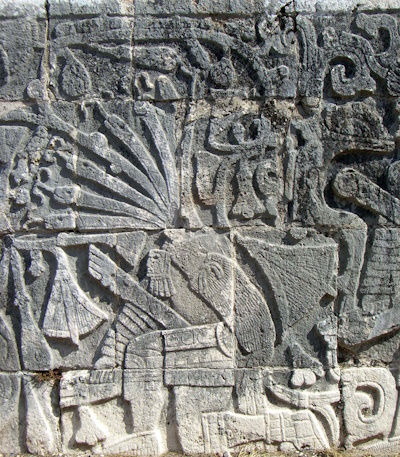
As expected, the tour guide barraged us with information, much of it pertaining to the stone carvings on the walls of the Mayan ritual ball game court. I might have digested it better, had I a bit more time to tune my eye to the ancient Mayans' rather liberal interpretation of human anatomy. The carvings on the wall of the ball game court tell stories of human sacrifices performed at the ball game. Or they would, if you could make out actual human figures in those pictures. You can see a semblance of a face here or there, but mostly the carvings look like abstract ornaments. Yet to our guide they were clear as day. Here a priest holds a knife over a kneeling victim, he said. And over there he holds a severed head. And here is blood gushing forth from the victim's neck. Actually, I think I got a picture of the gushing blood. It might be the one below.

Beheaded player sculpture at Chichen Itza, November 2007 Beheaded player sculpture at Chichen Itza

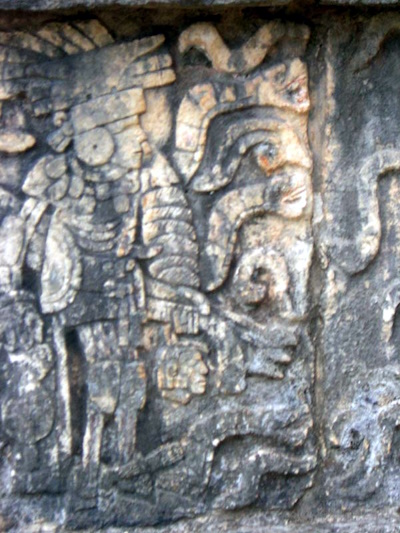
And I think I was able to make out a severed head in this picture (below), although it was hidden really well.

Priest holds a severed head - a Mayan carving in Chichen Itza Priest holds a severed head - a Mayan carving in Chichen Itza

Regardless, S and I were left confused about some important aspects of human sacrifice. We could not agree if the guide said ancient Mayans sacrificed a player from the losing or the winning team. I thought it was logical that a member of the losing team would be sacrificed. However, Steve thought that since being sacrificed to the gods was a great honor, that honor fell to one of the winners!

Here is my bigger blog post with more pictures from Chichen Itza

.

Friday, November 23, 2007

The cruise: ruins of Tulum

The cruise: ruins of Tulum

Steve and I recently went on a Caribbean cruise that stopped at two places in Mexico. So, technically I can say I've been to Mexico, even though I spent at most 16 hours there, a good 10 of them on buses and ships. As little as I've seen of that country, it shall not prevent me from filling up these pages with my detailed impressions. As always, I'll do it in installments.

First, the Mayan ruins of Tulum.

Our ship stopped off at Cozumel and Progresso; a variety of tours was offered at each port of call. One of the options at Cozumel was to tour the Mayan ruins of of Tulum. They are not actually in Cozumel, which is an island; Tulum is in inland Mexico, ~ 1.5 hours bus ride from the coast. So, first you have get to the coast from Cozumel. It means taking a boat. A small boat. (Small, at least, in comparison with the gigantic cruise ship.) The waves are, of course, the same size whether you are on a big or a small boat, but the amplitude of motion felt by passengers is very different. What feels like a gentle rocking on a big ship, feels like a rollercoaster on a small ship. The ride was only 40 minutes, but man, did I get sick! Sea-sickness is a bitch. I felt residual nausea the rest of the day. And then I had to return to Cozumel on the same boat, across the same choppy sea! Fortunately, it wasn't as bad. Perhaps the sea was really calmer, or because I sat in the bottom deck (the amplitude of motion must be smaller at the bottom, at least in theory), or because I kept my eyes closed for the entire ride back (when you don't see the horizon heaving up and down, your brain has fewer clues that the ship is rocking), but I tolerated the ride back fairly well.

Nausea or not, the trip was worth it, even more so since I haven't seen ancient Mayan cities before. From the ruins of Tulum a beautiful view opens up to the sea

.
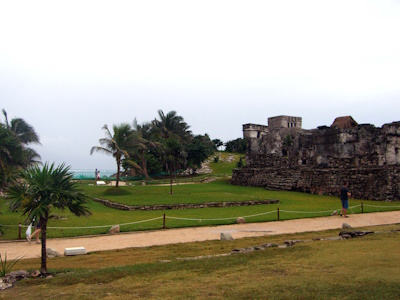
View of the sea from the ruins of Tulum, November 2007 View of the sea from the ruins of Tulum

It was there, according to our tour guide, that the Mayans of Tulum first saw the masts of Spanish ships over the horizon. (Or maybe our tour guide was dramatizing, as the ruins themselves weren't very dramatic, at least not in rainy weather.) And we all know what happened next. This adds a twinge of sadness to the beautiful view. Tulum survived only a few years after that. Actually, the tour guide said the Spaniards left Tulum alone, because there was no gold in it. The Spaniards had made their outpost in what is now Cuba, and raided various places along the Mexican coast, mostly looking for gold. But after the Spaniards conquered the Aztec emperor Montezuma, Tulum's days were numbered.

Then again I'm not sure if (a) I heard the guide correctly, and (b) he wasn't making things up. I later noticed some things our guide said were of dubious truthiness. (Like for example, that a certain restaurant at Tulum, run by his friend, had best margaritas in the world. I tried a margarita there, and it was decent, but I've had better in some places in Austin. Ditto for the food. Still, it wouldn't be right to go to Mexico and not have "authentic" Mexican food and drink, now would it?)

Here are more of my pictures from Tulum.

Thursday, November 15, 2007

Alexis Glynn Latner "Hurricane Moon": FACT reading group discussion

Alexis Glynn Latner "Hurricane Moon": FACT reading group discussion

10 people attended the discussion of Alexis Glynn Latner's debut novel "Hurricane Moon". 4 people have read Latner's short stories before. 7 people started the book, 4 of them finished. Some others didn't finish it because they got it too late. This book had not been in stores for long at the time of the discussion. Some of these people were planning to finish it, if for no other reason then because they know Alexis personally (she has been coming to ArmadilloCons for many years).

"Hurricane Moon" is a story of an interstellar mission to find a habitable planet for humans to colonize. Finding the right planet takes longer than expected, and having spent a thousand years in a stasis, the colonists wake up with significant gene damage. Unless the damage is somehow fixed, they'll be unable to procreate; hence, the mission will have failed. The only person capable of coming up with a way to fix the damage is Joe, a brilliant geneticist who is somewhat of a difficult character. The other protagonist is a ship doctor named Katharin. Joe and Katharin feel attracted to one another despite disagreeing on just about everything.

Readers quibbled with science and with romance

People's opinions on the romance thread varied. Two people commented that the book lost their interest when the courtship of the two main characters took the central stage. Some others said the romance wasn't done very well: it wasn't as sophisticated as, for example, the kind of romance you find in Lois Bujold novels. "Those two people seemed to forget they were scientists, they didn't behave like scientists," said a reader. Other readers argued that the love story didn't dominate the novel; this was still hard SF, not a romance novel with a spaceship thrown in. The love story was merely part of the character development.

Some people found quibbles with the science in the book. One reader said it's strange for an Analog writer like Alexis to have pools of anaerobic bacteria on the surface of the planet (where they are presumably exposed to oxygen). Then he thought the explanation why the plants on the planet were blue was scientifically infeasible. These two perceived errors ruined his enjoyment of the book so much he put it down. Regarding the blue color of the plants, another reader tried to convince him he misunderstood the explanation. Somebody also thought Alexis Glynn Latner played fast and loose with deceleration. The numbers didn't add up -- the engine didn't have enough power to slow the ship down over a short period of time.

The plot lost its focus in the second half

Others, including readers well-versed in science, did not see serious problems in that respect. They found the science plausible, and they liked how the book started out as a classical hard SF story. The decision making that went into selecting the right planet, the weighing of the risks -- to stay at the originally selected planet, even though it turned out to be much worse than expected, or to travel further in search for a more suitable planet and risk greater gene damage -- all of this caught their interest. However, some of those who were initially impressed, thought the story lost focus in the second half. When the crew settled on the planet, it seemed the author didn't always know what to do with them. A reader said: "I could tell it was the first really long thing Alexis has written, because the plot was in some places, OK, I don't know what I should do next, so let's let Joe (one of the two main characters, the brilliant geneticist) wonder around and get lost. It happened 2-3 times. One time I could have handled, but 2-3 times? And he's the only guy who can figure out how to fix the genome so that the people could reproduce? And they let him get lost? And the plot depends on him getting lost?"

It can make you ponder logistics of running an interstellar mission

There were other indications that the plot wasn't well thought out. One reader said: "I would have wished that they would have done more exploration of Green, Blue and the other planet, sending drones or something, before settling down. Particularly because Blue is in the title of the book. They never go there, and yet it's in the title." Another reader reminded him that the mission had only enough drones for one planet. This led to an observation that the expedition seemed rather poorly equipped. They only had 1 doctor and one person with training in first aid, which is rather strange for an expedition that has landed on an unknown planet. (Not counting, of course, hundreds of doctors and people of all specialties that were in the stasis, waiting for their turn to wake up -- perhaps decades after the first colonists have landed. Those people were "passengers", not the crew.) This led to an interesting discussion of what is an optimal crew composition for an expedition exploring an alien planet. One reader, after thinking about it for a while, concluded it was a rational idea to have just the absolute minimum of people awake until they determine who else they actualy need. Because the more people you wake up, the more demands you have on resources, and then it becomes a challenge to find out what combination of human resources you need to wake up in order to support all those additional people that have woken up.

So it seems there are readers in this group who have given more than a passing thought to the logistics of running an interstellar mission. They've also read enough books in this particular subgenre where you have a spaceship with colonists in a stasis. Despite the debatable flaws of logic, "Hurricane Moon" came out ahead of many books in this subgenre. It may sound like this discussion report focuses mostly on the negative, but actually a lot of people in the group liked it. I guess they just didn't make it very clear to me what exactly they liked it for.

Alexis Glynn Latner Alexis Glynn Latner at ArmadilloCon 2007

Or maybe they did, to some extent. They liked the culture, for example. The new culture the colonists are trying to build in this new world, the rituals they create, was seen as some of the more interesting things of the novel. One reader, though, was thrown off by the characters changing their last names, as it made it difficult for him to keep track of them. He also found the motivations of the colonists not very credible. Not just the motivations for taking on the names of their home cities ("if they are forever cut off from Earth, why are they holding on the geographical areas that have divided us for a long time?"), but also the fundamental reason for leaving the Earth. Several main characters seemed to be driven by the notion that the Earth society was too screwed up, so they had to go somewhere else to establish a better society. But the colonists are only human, and human society is not going to be all that much better elsewhere, the reader pointed out.

Overall, most readers thought all of these flaws could be attributed to this being Alexis Glynn Latner's first novel. They thought Latner had potential, and her subsequent books are bound to be better.

I wanted to like this book, because I have a weakness for hard SF, and because Alexis Glynn Latner is such a nice person, but I found it less than satisfactory for several reasons. The pacing is, to borrow a word from another FACT reading group member, a bit "pedestrian". From the time the mission lands on planet Green, nothing much science-fictional happens. There are no interesting scientific discoveries until the very end. Instead, the pages are filled with interpersonal drama.Even though the colonists in the end make two significant discoveries that challenge their assumptions about this planet, those discoveries play no part in solving the main problem they are facing -- healing the damage to their genes.

SPOILERS!

It is especially strange that the colonists conclude that the aliens made Blue what it is and put it there in orbit for religious purposes. It's hard to believe that a very advanced technological civilization would attach so much significance to religious symbols as to make an artifact of planetary proportions and put it in orbit. As an explanation of Blue's origin and purpose, it seems rather like a cop-out. It's almost as if scientists can't be bothered to seriously study Blue, so they conveniently label it a religious artifact, because then you don't have to explain anything -- who can begin to guess what the alien religion was like; whereas if you assumed there were good scientific, technological or political reasons for the Blue to be made what it is and placed where it is, you would have to continue to look for them.

END OF SPOILERS

When I pointed out that those discoveries play very little role in the story, one reader suggested that maybe their implications are left to be explored in a sequel.

Another way the resolution of the book was unsatisfactory is that the ending depends on a protagonist's psychological transformation rather than scientific / technical ingenuity. That's not what I would expect from a classic hard SF tale.

Sunday, November 11, 2007

Book review: Richard Matheson "I Am Legend"

I read this book as "homework" for the FACT reading group, but ended up not going to the discussion because I've been steamrolled by work. Regardless, here is my review.

To sum up my opinion, it's a good character study, but a bit lacking in originality, and certainly lacking in scientific credibility.

The story follows a guy who (believes he) is the last surviving human after the Earth has been overrun by vampires. A cover blurb says Matheson was a big influence to Stephen King, and I wonder if that was the reason this book gave me a continuous deja vu. Stephen King has dealt with apocalyptic scenarios in some of his books, as well as with supernatural horror, though I think he did a better job of these two genres.

I was intrigued not so much by a premise that the humankind has been wiped out by / transformed into vampires, as with the notion that you can make an entire novel out of the last survivor's experiences (a short novel, but still). If the protagonist is the only person left alive in the world, what is the book going to be about? Him living out his days and dying? That would hardly make an interesting story. Thus, to fill up those 171 pages, something unexpected has to happen. Was the protagonist wrong in his assumption that he was the last person on Earth? The story is in no rush to reveal it. As the story goes on, you start to wonder if you were wrong and this is really a book about a lonely guy living out his sad, meaningless existence in a world without a future. He starts out desperate and pathetic. He is devastated by the loss of his wife and daughter to the vampire plague, and even more so by the realization that he is doomed to be alone until the end of his life. Even so, he's focused on survival. Each day he swings between alcohol-fueled rage and a tenacious, clear-headed effort to do what he needs to do to make it through one more day. Matheson portrays the character's emotional state so vividly and movingly that not only I sympathized with the protagonist, but I also started to think, grudgingly, that even if nothing more happens to him, the book will still be interesting enough as a character study of the last survivor.

Then the story gets better still, as the guy overcomes his alcoholism and becomes determined to find a scientific explanation of the vampire plague. That was the part I could really identify with. His frustrations reminded me a lot of my days in graduate school, when I used to bang my head against particularly ornery projects, or even of my current bouts with writer's block, as I struggle to think my way out of plot dead ends.

Yet when he found an explanation, it was very disappointing -- to me, at least -- because it was so implausible. Even more implausible was that nobody found this answer before him. And he wasn't even a scientist by training! He was merely a smart guy who taught himself biology from textbooks. Even though the plague was fast and the humanity, including all "real" scientists, was gone in a matter of weeks, it's still not likely that the CDC and other experts did not have time to make the same discovery that this self-taught scientist eventually did. Science is not this book's strong suit. Also, the ending did not seem well thought out. Certain things happened for no good reason.

The rest of the stories in the book were even more Stephen King'ish in their spirit. Their dominant genre is supernatural horror. There isn't much science fiction in them. But the characters are vivid, and their situations resonated with me in ways that held my interest despite the fact that this isn't my genre.

Friday, November 02, 2007

Maker Faire, part 5: of techno-optimism and reconstructed fashion

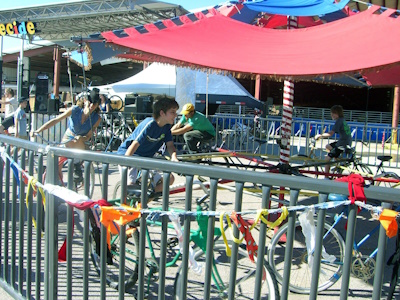
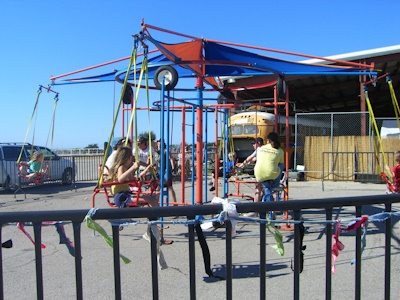
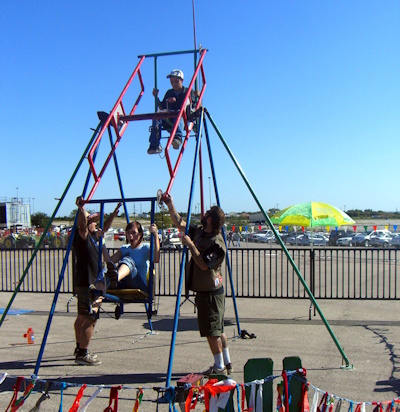
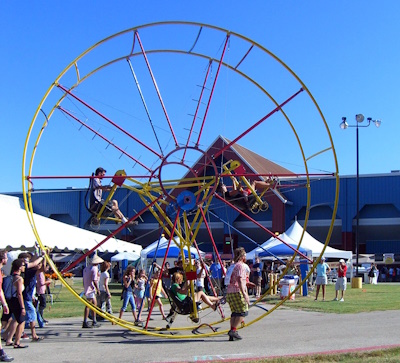
As one would expect at a faire, there were faire rides and merry-go-rounds. Supposedly they were all homemade? The amazing thing about them was that (I may be wrong on this) none of them ran on electric power. The ones I saw were all pedal-powered.

A bicycle merry-go-round at the Maker Faire 2007 A bicycle merry-go-round at the Maker Faire 2007
A pedal-powered fair ride at the Maker Faire 2007 A pedal-powered fair ride

Sure, these merry-go-rounds were nothing like roller-coasters in industrial entertainment parks, but they also required more active participation on the rider's part than simply giving in to the centrifugal force. And some of them, like this circular see-saw, managed to frighten some riders. Apparently, pedaling was less trivial than they thought. It got me wondering, by the way -- do the riders all need to pedal synchronously, in phase and at the same speed? What happens if one of them slacks off or falls out of phase?

A pedal-powered circular see-saw in motion A pedal-powered circular see-saw in motion at the Maker Faire 2007

(I didn't go on any of the rides, I must say. I'm way too uncoordinated for that. One look at them makes me lose my balance.)

And this rolling wheel was just stunning, but I wasn't sure if it could move on its own, or if it needed to be pushed. In this picture, a bunch of people are pushing it, but maybe just because they need to help it up the hill?

A pedal-powered mini Ferris wheel A pedal-powered mini Ferris wheel at the Maker Faire 2007

More than anything else in this Faire, the merry-go-rounds and the modified cars left me optimistic in general about the ability of western civilization to survive the looming energy crisis. Oil may run out one day, but human ingenuity is under no such threat, it seems.

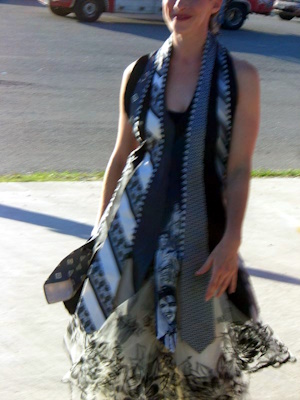
And then there was Swap-o-Rama-Rama, a two day event where you were supposed to be able to drop off your used clothing and be taught, or inspired, create new, reconstructed clothes out of stuff people dropped off. I didn't even stop by to check it out, because I knew it would ignite in me a temptation to start making clothes again. Sewing and knitting were my major hobbies in high school and college, but I abandoned them in favor of hobbies that hold a more profound appeal to me, such as writing. But I checked out their fashion show at the end of the day. They demonstrated clothes that were, IIRC, created during the day out of stuff people dropped off. Most of them were quite original. As I understand it, the creators of those clothes were actual fashion designers who specialize in "reconstructed" fashion. An ordinary person off the street, such as myself, would not likely have created something as good in just one day. But it was still interesting to see. Men's ties seemed to be a prominent sub-theme.

A dress made of ties and other recycled fabrics A dress made of ties and other recycled fabrics

Several of the dresses shown at the fashion show were made out of ties. Well, it was good to see ties can be put to good use: I don't remember the last time I saw anyone wearing a tie according to its purpose.

A dress with a ruffle made of ties and other recycled fabrics A dress with a ruffle made of ties and other recycled fabrics

Tuesday, October 30, 2007

Maker Faire, part 4: art cars

Many cars and bicycles exhibited at the Maker Faire made you pause and rethink your definition of a car or a bicycle.

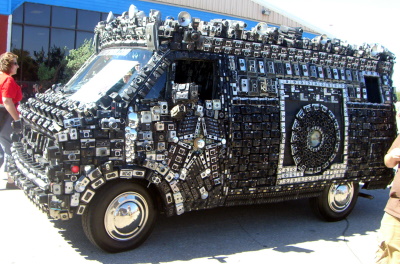
There was a morbid, but fascinating roach mobile; a van covered with cameras (http://www.cameravan.com); an assortment of electric cars.

Camera Van at the Maker Faire 2007 Camera Van at the Maker Faire 2007

Some of them were made by companies that plan to make money off of them, others by hobbyists as tongue-in-cheek projects. Some were converted from cars that run on gas. Some allowed you to look under the hood, others (most) had no hood at all.

Then there was a panoply of wonderful bicycles in shapes of butterflies, grasshoppers, and who-knows-what. I felt like I stepped off into a fairy tale world.

Saturday, October 27, 2007

Maker Faire, part 3

There was also some art where the point wasn't so easily found.

Tree of Secrets, dream recorder

An example of such a contraption was the Tree of Secrets, which was a cardboard tree with microphones hanging off of it. You could speak your secrets into those microphones, and they would get recorded. Then you could play them back. I think you could also listen to other people's secrets (thus making it a tree of no secrets, said S.) When the tree accumulates enough soundtracks, it starts mixing them up. I guess that was supposed to somehow make it more interesting.

Another example was a dream recorder (?) that looked like an old, rusty voltmeter from a high school physics lab. You put it near your bed, and record your dreams in the morning. "Record" is too ambitious a word, though, because the only thing you can do with it is press one of the two buttons: "good" or "bad". Also, if I remember correctly, it's connected to the internet, and the needle on its face shows you the proportion of people who are having good dreams versus bad dreams. (Or maybe my subconscious made up this part as it tried really hard to find some meaning in this project.) Even so, this kind of dream evaluation could be shared only by people who have identical dream recorders near their beds. But... how many of them are there? Isn't the dream recorder a one-of-a-kind thing, given that it was created by a graduate student as a course project?

Yes, both of these exhibits were created as course projects by students of a graduate program with some kind of... umm... trendy name, like Interactive Communications, or Interactive Media, or some such. S told me I wasn't supposed to see a point in these projects: they were Art. Period. I said it wasn't obvious to me that this program was primarily artistic rather than technical, as the name sounded slightly geeky. Well, S shamed me for looking for utility value in this art. Oh well. Yet I kinda felt sorry for those students. While I do remember having to do graduate course projects that seemed about as useful as shoveling sand from one pile to another (i.e. they did not involve original research, only reshuffling the existing data), I still think they were more meaningful than, say, making a tree of secrets. As I said, I'm not cut out to be an artist.

If you were curious what true randomness sounded like...

Along the same lines, I felt, was Kosmophone by Jerry Chamkis, a "musical" instrument that synthesizes sounds from gamma rays. This device measures frequency, wavelength, or energy (he said those things were interchangeable) of gamma rays that are hitting the Earth at all times, and a synthesizer "translates" those measurements into sounds. By the sound of it, gamma rays hit it at varying intervals averaging about once in a couple of seconds, so the device produces a steady ping-pong-pung of random notes at random intervals. This was the gist of the half-an-hour long talk by Jerry Chamkis. I actually figured out what it was doing after hearing the first 5-10 of these "musical" sounds. The rest were the details about how this instrument was made. I more or less slept through the details, but S was interested: his graduate studies in physics were all about chasing elementary particles, so he found some common ground with Chamkis. He had a chat with the creator of the Kosmophone about stuff like what materials you use to make a light-tight casing for your sensitive components.

The obvious -- and perhaps the only -- point of Kosmophone, as Chamkis readily admitted, was to give the listener an experience of true randomness. Try as they may, humans can't create truly random processes. But truly random processes do exist in nature, and spectral characteristics of gamma rays hitting the Earth are one of them. So, before I could open my mouth and say to S "this could make a really good random number generator on a computer", he turned to me and said the same thing. Then one guy in the audience said it out loud. Apparently all the computer geeks in the audience had the same thought. Chamkis replied that while that's true, it wouldn't be practical, because the rays hit the Earth way too infrequently. In computer applications -- mostly cryptography -- random numbers need to be generated much faster than a sequence of gamma rays would allow.

Screaming Babyhead, a robot band at the Maker Faire 2007 Screaming Babyhead, a robot band at the Maker Faire 2007

So, the projects demonstrated at the Maker Faire were a mixed bag. Which of course means there was a lot of good in it too. There were tons of robots, as I said before, but most of them had artistic rather than utilitarian value. For example: a robobabe/angel, or Marvin Niebuhr's Screaming Babyhead band of robots -- a very steampunky bunch of musicians. If they played any music, it must have been lost in the general din of the exhibit hall, as I couldn't hear anything.

Wednesday, October 24, 2007

Maker Faire, part 2

Maker Faire in bullet points:

Cute and practical: floating speakers, hidden in Mylar balloons.

Artsy and practical: Stop-Motion Armatures, poseable figures that can be photographed serially to create animation.

Pleo, a robot dinosaur pet Pleo, a robot dinosaur pet at the Maker Faire 2007

Artsy and geeky: thereping.

Geeky and cuddly: robotic dinosaur pets, named Pleo, that have a range of sentient-looking behaviors.

Geeky with a hard science edge: Stirling engines.

Quirky technology that has its uses: wood iPods.

A person trying to ride a bicycle with a hinge in the middle A person trying to ride a bicycle with a hinge in the middle at the Maker Faire 2007

Quirky technology that's not useful for anything except to build your character through extreme frustration: bicycle with a hinge in the middle. "You really have to steer it two ways!" said a perplexed guy after making a few wobbly laps on this bicycle. Many people fell trying to ride it.

This peculiar item is in a category that's worth a separate article: quirky / art cars. And it will have a separate post! But first, some snarkiness. Coming up tomorrow.

And here are even more pictures from the Maker Faire 2007

Sunday, October 21, 2007

Maker Faire, part 1

Maker Faire is upon us! According to its website, it is a "two-day, family-friendly event that celebrates arts, crafts, engineering, science projects and the Do-It-Yourself (DIY) mindset". In my own words, I'll say only this: who needs Flipside when you have Maker Faire? It has a much higher concentration of quirky technology and art, it's in an air-conditioned building (part of it, anyway), and -- best of all -- there is no techno music!

The Do-It-Yourself stuff exhibited here ranges from technology to art to food (cooking is the DIY of food, right?), and the exhibits cover every category: from practical, to art-that's-actually-beautiful, to art-that's-kinda-pointless, to practical technology, to technology that has no value except quirk, to technology that has no point at all. Most of the technology demonstrated here only had value as an art piece, however. Or as a proof of concept. There were exceptions, of course. I will cover a bit of all of those categories in a few upcoming posts.

For starters, here is an example of DIY art that struck the sweet spot between beauty and utility like only a few projects at the Faire did: lampshades made of interlocking plastic pieces, here and here.

The overlapping area between art and technology was densely populated by robots created by our own local Robot Group. A robot that unexpectedly appealed to my girly side was Mechanical Flower, created by Denise Scioli and Ms. Puiyee "PY" Hung from the Robot Group. The flower's inner petals are made of a steamer insert, identical to the one I have at home. Mechanical Flower's steamer insert dances, opening and closing to the music, slow or fast.

Here is a video:

The tiny holes in the steamer insert create hypnotizing moving patterns when its "petals" open and close. What an exaltation of a mundane steamer! (To be sure, I don't see mine as mundane. For me it is one of the most beautiful household items I own. Its petalness (petality?) can easily inspire one to think of its potential uses for art. To non-artistic people, like me, this call is barely a passing whisper, but artistic people take things like this and incorporate them into their art projects.

Here are more of my blog posts and pictures about the Maker Faire.

Oh, one more important thing. Steve enjoyed this event as much as I did! It is very rare for him to like the same things I do. Hmm, what else is going on in Austin on a regular basis that resembles Maker Faire?

Sunday, October 14, 2007

An authentication scheme cooked up by a pointy-haired boss

There was this article in Washington Post that reminded me of a conversation I had with a friend via his blog about authentication questions, the kind you have to answer in order to login to online banking systems and such. In this post he pointed out that security questions based on users' wishes, preferences and hobbies were useless. (My, has it been almost a year? It feels like we had this conversation just yesterday.) Well, things have only gone downhill in the security world since then, if this article is any indication.

This Is Your Life*... *As Determined by Confounding Identity-Protection Safeguards

Old authentication systems, as imperfect as their questions were, at least allowed you to select a question and an answer that suited you best (or that was less useless to you than others). But how would you like an authentication system that does not even let you choose the questions? Instead, it asks you your biographical facts that you are "supposed" to know. For example, your great-grandmother's birthday. I wish it was a joke, but it isn't.

How does the authentication system know your great-grandmother's birthday in the first place? To quote the article, "unlike traditional shared knowledge authentications, in which the user picks the test and the answer and regurgitates it with each sign-on, Verid [the company that makes this uniquely egregious kind of authentication software -- E.] vacuums public records for factoids, then tosses them at the user at random."

The birthdays of long-gone relatives are not even the most obnoxious example of authentication questions. Others are, for example, "what was your high school mascot" or "the name of your homecoming queen". So what do you do if you come from a country like mine, where not only high schools don't have mascots or homecoming traditions, but the very concept of high school does not exist (all grades from from first to twelfth are taught under the same roof. You don't have to change schools when you transition from primary to secondary education.) Well, OK, a non-existent homecoming queen of a non-existent high school would not appear in public records, and would not serve as a basis for an authentication question. But if you dared to forget her majesty's name, you are screwed. :-)

The article does address the issue that some people's lives don't follow a typical middle class American route, thus some people don't have, or don't remember, the biographical facts enabling them to answer security questions. What the article does not address, is the invasion of privacy committed by a company that "vacuums up the public records" and collects all the knowledge about you, up to your great-grandparents' names and birthdays.

Only a pointy-haired boss could have come up with this kind of authentication scheme. I just hope that the company I work for -- which happens to write software for online banking -- never comes up with something like this.


The best quote from the article:

"Computers are like very dumb people, but they're very fast at being dumb," says Jason Hong, a professor at Carnegie Mellon's Human-Computer Interaction Institute (HCII).