The story is almost Shakespearean, if not for that little deviation where Sweeney Todd and his baker girlfriend set up a rather bizarre business that leverages a perfect synergy of their respective skills. :-) Though I guess when your characters wear heavy goth makeup you can't expect them to play by the rules of classical tragedies. :-)
Their makeup also made it near impossible for me to tell them apart, at least for the first half of the movie. I think I've said before that all actors in any movie look the same to me, modulo distintive hairstyles, haircolor, beards, glasses, height, body type etc., which are visual clues I use to tell actors apart. That's true even when they are not wearing harsh black-and-white makeup! (Exceptions are actors who I've seen in at least 3-4 movies, so that their faces start to look distinct to me. So for example, if I hadn't stopped watching Harry Potter movies after the third one, I may be able to recognize its cast already ;-)) But the makeup in "Sweeney Todd" makes it hard to even tell men and women apart!
This is just one reason why I have difficulty understanding what's happening in the movies. "Sweeney Todd" made it exponentially more difficult because everybody in it spoke very quiet, very fast, and with a British accent (which is so alien to me it might as well be Chinese). This is one of those movies that gives your fingers a two-hour long workout on a remote control. When the music surges, you scramble to turn down the volume (especially when a child is sleeping upstairs). When dialogue starts, you frantically pound the buttons to turn the volume up. I don't understand what's the logic behind that. Shouldn't the dialogue be loud, while the music kept down to a non-irritating level?
Despite all this, I was surprised the plot seemed fairly cohesive to me. Except for one thing. At the very end Sweeney Todd is shattered to discover that a very important character has died. How did that character get into the basement? The last I saw of that character, he/she/it was in the barbershop. I wasn't even sure of this character's identity, but Steve (who says I am hopelessly imperceptive) assured me it had to be what it was in order for the movie to make sense. Still, he could not explain how that character got in there. So it's not just me. Either he is imperceptive too, or there is a hole in the plot.
The best thing about "Sweeney Todd" is its music. It's beautiful. The melodies are very complex. Such a beautiful reprieve from one-dimensional pop tunes. (Not that I listen to pop tunes much, but some of them infiltrate even the public radio (the only kind of radio I listen to).) If I found a legal and free download of Sweeney Todd soundtrack, I might even lift a finger to click on the link! ;-)
Saturday, May 31, 2008


Saturday, May 17, 2008
An article that dredged up some memories
There is an article in New York Times about an upcoming report of a study of women's experiences in the science, technology and engineering fields.
Diversity Isn't Rocket Science, Is It?
I would sure like to read this report, if it is ever made available on the internet. It would be interesting to compare those 1493 women's stories with mine. I am lucky to be in a workplace where I haven't experienced a bias against me, despite me being one of the few women in a mostly male technical team. My previous workplace wasn't so good. While I haven't experienced any overt sexism, I ran into some subtle forms of... weirdness, a lot of which could have been attributed to gender perceptions. They were subtle enough to not evoke outrage, and to make me feel it was all my fault (which is actually my default operating assumption in many life's situations).
My previous workplace, a software company in Dallas, had a huge software development team of ~ 100 people, divided into many groups. I was assigned to a group that was focused mostly on R&D, rather than pedal-to-the-metal, get-the-product-out-the-door stuff. My group wrote prototypes of plugins for the company's main product (they didn't call them plugins, but that's kind of what it was -- different algorithms for doing tasks that our product did), and then the Big Brains decided which of them might be worth integrating into the company's product. Out of 10 people on this team, everybody except two people had a PhD. Most of them had spent a significant time in the academia as post-docs or professors. I was one of the two people who only had a Master's degree, and one of only two women. The other woman was a seasoned software developer, who played along very well with the rules and social norms expected in such an environment. I was, on the other hand, a complete rookie. This was my first job as a software developer, and also my first job in the US! I had no idea what to expect or how to behave.
One thing I completely did not expect is that nobody would give me any work to do. :-)
I'm serious. It became clear to me that my team lead did not see me as an available resource. Apparently, when he assigned team members to projects, I simply did not come to his mind. It was kind of like in an old detective story, the title or author of which I forgot. The mystery in it centered around the fact that there were footsteps in the snow leading to the house, yet the witness who's been at the house the whole time swore there were no visitors. It turned out, somebody had indeed come to the house: a postman (or a milkman -- details elude me). But for a member of English upper class in the beginning of the 20th century postmen and milkmen were simply not persons. So the postman flew completely under the witness's radar; when asked who came to the house, the witness did not even think to mention the postman. The same way, when thinking who to assign the work to, my boss simply did not think of me.
How was I supposed to interpret this? Was it because
(a) I didn't have a PhD like most of the group members? But then why did he take me on his group to begin with? Ostensibly it was because the research I did for my Master's thesis was related to the research his group did. Still, he knew I had only a Master's, not a PhD. If he thought this wasn't enough, he should not have taken me on.
(b) I was a woman, and therefore incompatible with a notion of a software developer?
(c) I was considered unworthy to be given a chance for some other reason?
I was so puzzled by his attitude (hey, they are paying me -- don't they want me to work?) that I (a) internalized it, assuming it was my own fault, and (b) tried to rectify the situation by repeatedly asking him to give me tasks to do. Sometimes he did, by assigning me some little research project; the problem was that when I tried to get him to review what I did and determine how to proceed further, he would never, never have time to review it. Weeks would go by, and he still would not find time.
I also asked him to give me bugs to fix in the existing code, because what's a better way to become familiar with the company's code if not by fixing bugs? And his reply literally was "there aren't that many bugs in our group code".
I just didn't know whether I should continue to "bug" him to give me work, or to give up. Since, as I said, I internalized the message that he behaved that way because something was wrong with me (women are really good at this -- at assuming everything is their fault! It's the default operating mode for many women, and I used to be no different), I gave up. I did not dare to continue to pester him. Besides, how many times could I pester him without starting to feel like an attention-starved wife being brushed off by a husband who's "just not that into her"? :-) There's this odd gender dynamics there, that wouldn't be present if both employees were the same sex.
And yet, at the meetings with the director of software development, my boss constantly complained he did not have enough developers to implement all the projects he has planned! I felt Kafkaesque. Should I wave -- hey, look at me over here! I'm not a roach on the wall! I'm a developer too! What about me? How about you give me some work? but of course I couldn't do that, as it would have been very embarrassing for all parties involved, even if it was said in the most polite form.
In retrospective I know my biggest mistake was to try to make the whole thing work, instead of going to the development director and asking him to reassign me to another team. But I could not bring myself to ask for it, because I was afraid that if I admit to the development director I haven't been doing much work, I would be shown the door! Eventually though, he and my team lead jointly decided to reassign me. And it made a big difference. My new team had concrete projects, deadlines, and -- surprise, surprise -- bugs to fix. :-)
So I don't know if this was just a weird case of a boss who's clueless about management, but I suspect he would have treated me differently if I had been a guy. When some new guys joined the team after me, he integrated them right away, giving them work to do. But he never gave me a chance to begin with, as if he simply could not imagine me being on the team. Go figure.
Diversity Isn't Rocket Science, Is It?
"It's almost a time warp," said Sylvia Ann Hewlett, the founder of the Center for Work-Life Policy, a nonprofit organization that studies women and work. "All the predatory and demeaning and discriminatory stuff that went on in workplaces 20, 30 years ago is alive and well in these professions."
That is the conclusion of the center's latest study, which will be published in the Harvard Business Review in June.
Based on data from 2,493 workers (1,493 women and 1,000 men) polled from March 2006 through October 2007 and hundreds more interviewed in focus groups, the report paints a portrait of a macho culture where women are very much outsiders, and where those who do enter are likely to eventually leave.
I would sure like to read this report, if it is ever made available on the internet. It would be interesting to compare those 1493 women's stories with mine. I am lucky to be in a workplace where I haven't experienced a bias against me, despite me being one of the few women in a mostly male technical team. My previous workplace wasn't so good. While I haven't experienced any overt sexism, I ran into some subtle forms of... weirdness, a lot of which could have been attributed to gender perceptions. They were subtle enough to not evoke outrage, and to make me feel it was all my fault (which is actually my default operating assumption in many life's situations).
They were paying me -- why didn't they want me to work?
My previous workplace, a software company in Dallas, had a huge software development team of ~ 100 people, divided into many groups. I was assigned to a group that was focused mostly on R&D, rather than pedal-to-the-metal, get-the-product-out-the-door stuff. My group wrote prototypes of plugins for the company's main product (they didn't call them plugins, but that's kind of what it was -- different algorithms for doing tasks that our product did), and then the Big Brains decided which of them might be worth integrating into the company's product. Out of 10 people on this team, everybody except two people had a PhD. Most of them had spent a significant time in the academia as post-docs or professors. I was one of the two people who only had a Master's degree, and one of only two women. The other woman was a seasoned software developer, who played along very well with the rules and social norms expected in such an environment. I was, on the other hand, a complete rookie. This was my first job as a software developer, and also my first job in the US! I had no idea what to expect or how to behave.
One thing I completely did not expect is that nobody would give me any work to do. :-)
I'm serious. It became clear to me that my team lead did not see me as an available resource. Apparently, when he assigned team members to projects, I simply did not come to his mind. It was kind of like in an old detective story, the title or author of which I forgot. The mystery in it centered around the fact that there were footsteps in the snow leading to the house, yet the witness who's been at the house the whole time swore there were no visitors. It turned out, somebody had indeed come to the house: a postman (or a milkman -- details elude me). But for a member of English upper class in the beginning of the 20th century postmen and milkmen were simply not persons. So the postman flew completely under the witness's radar; when asked who came to the house, the witness did not even think to mention the postman. The same way, when thinking who to assign the work to, my boss simply did not think of me.
Feeling Kafkaesque
How was I supposed to interpret this? Was it because
(a) I didn't have a PhD like most of the group members? But then why did he take me on his group to begin with? Ostensibly it was because the research I did for my Master's thesis was related to the research his group did. Still, he knew I had only a Master's, not a PhD. If he thought this wasn't enough, he should not have taken me on.
(b) I was a woman, and therefore incompatible with a notion of a software developer?
(c) I was considered unworthy to be given a chance for some other reason?
I was so puzzled by his attitude (hey, they are paying me -- don't they want me to work?) that I (a) internalized it, assuming it was my own fault, and (b) tried to rectify the situation by repeatedly asking him to give me tasks to do. Sometimes he did, by assigning me some little research project; the problem was that when I tried to get him to review what I did and determine how to proceed further, he would never, never have time to review it. Weeks would go by, and he still would not find time.
I also asked him to give me bugs to fix in the existing code, because what's a better way to become familiar with the company's code if not by fixing bugs? And his reply literally was "there aren't that many bugs in our group code".
I just didn't know whether I should continue to "bug" him to give me work, or to give up. Since, as I said, I internalized the message that he behaved that way because something was wrong with me (women are really good at this -- at assuming everything is their fault! It's the default operating mode for many women, and I used to be no different), I gave up. I did not dare to continue to pester him. Besides, how many times could I pester him without starting to feel like an attention-starved wife being brushed off by a husband who's "just not that into her"? :-) There's this odd gender dynamics there, that wouldn't be present if both employees were the same sex.
And yet, at the meetings with the director of software development, my boss constantly complained he did not have enough developers to implement all the projects he has planned! I felt Kafkaesque. Should I wave -- hey, look at me over here! I'm not a roach on the wall! I'm a developer too! What about me? How about you give me some work? but of course I couldn't do that, as it would have been very embarrassing for all parties involved, even if it was said in the most polite form.
In retrospective I know my biggest mistake was to try to make the whole thing work, instead of going to the development director and asking him to reassign me to another team. But I could not bring myself to ask for it, because I was afraid that if I admit to the development director I haven't been doing much work, I would be shown the door! Eventually though, he and my team lead jointly decided to reassign me. And it made a big difference. My new team had concrete projects, deadlines, and -- surprise, surprise -- bugs to fix. :-)
So I don't know if this was just a weird case of a boss who's clueless about management, but I suspect he would have treated me differently if I had been a guy. When some new guys joined the team after me, he integrated them right away, giving them work to do. But he never gave me a chance to begin with, as if he simply could not imagine me being on the team. Go figure.
Sunday, May 11, 2008
Robert Heinlein "The Moon Is A Harsh Mistress": book review
I read "The Moon Is A Harsh Mistress" by Robert Heinlein because it was on FACT reading group's schedule. I ended up not being able to go to the discussion, which was just as well, because I had read only 2/3rds of the book by then. Now that I've finished it, it's time to write a review. Actually, my opinion of the book had not changed much after reading the final third.
To quote from amazon.com, this is a story of "revolution on the moon in 2076, where "Loonies" are kept poor and oppressed by an Earth-based Authority that turns huge profits at their expense. A small band of dissidents, including a one-armed computer jock, a radical young woman, a past-his-prime academic and a nearly omnipotent computer named Mike, ignite the fires of revolution despite the near certainty of failure and death. "
I liked the story, though I wasn't too impressed by characters. The characters are believable, but perhaps too simple for my taste. The radical young woman, Wyoming, and the Professor are more or less cardboard cutouts. The only reason for Wyoming's existence seems to be to make rash, immature statements so as to give the Professor a chance to say: "no, dear lady, we can't do that, here's why..." and then expound on one of his theories. But I didn't mind because his theories were quite interesting. It was worth reading the book just for them. It was interesting to see how Luna's revolutionaries put those theories into practice. I was intrigued to find out what kind of leverage the Loonies will find in their negotiation with Earth. Luna's economically and technologically disadvantaged position should have made it near impossible, and yet they found it. That was interesting. Still the story would have pulled me along much better if there was some character development, some interpersonal drama.
To me the most interesting aspect of this book was Heinlein's portrayal of Lunar society. The community of Luna started out as a penal colony. At the time period the story is set in, Earth has been shipping its criminals to the Moon for many decades. Over several generations the Lunar population came to consist mostly of descendants of the original "settlers", with an influx of new convicts constantly trickling in. Since most convicts were men, the initial demographics of the Lunar population suffered from a huge gender imbalance; even after all those decades men still outnumbered women 2:1. This society has no laws; rules of behavior are enforced by nothing more than people's mutual consent.
The book is sprinkled through with little incidents that help us get a feel for Lunar reality. For example, there is the episode where the protagonist, Manuel, is asked to be a judge in a dispute between a bunch of local boys and a visitor from Earth. I found it very exotic, since it is unimaginable to us that a dispute involving possible capital punishment might be left for any random citizen to arbitrate. While those episodes had an authentic feel (possibly because of Lunar slang used heavily throughout the book), they did not convince me a society could function without laws. Heinlein's explanations of how such a society works are a bit too simplistic. For example, he says: who needs laws to enforce contracts, when a person's reputation should be sufficient? I think while fear of loss of reputation might work in very small societies, in bigger societies it is impossible for everyone to have accurate knowledge of everyone else's reputation. As far as allowing random citizens to act as judges and make arbitrary rulings not based in any laws, there is so much room for abuse of power. I think what would have happened in a completely anarchist society (especially one that was made up primarily of criminals), is that this society would have devolved into a dictatorship of gangs. I also don't believe women would have enjoyed a special status because they were a minority. I don't think men would leave all the freedom of choice to women and quietly abide by women's decisions. Most likely they would put women in burqas, lock them up, and sell and trade them like chattel.
So, Heinlein's picture of an anarchist paradise seems quite unrealistic to me. Another dubious premise on which the book is based is that a sentient computer (Mike) would remain in service of people who think millions of times slower than he. Wouldn't he find human affairs to be intolerably tedious? Wouldn't such a computer pursue goals of its own, which may differ greatly from humans' goals?
Overall, "The Moon is a Harsh Mistress" is an interesting speculation about societies and revolutions, though I didn't find it convincing. But it's easy to sympathize with a story of a small, ostensibly powerless entity like Luna breaking free from an immensurably more powerful authority. To pull it off required no small amount of cleverness. All in all a worth read.
(As an aside, I really like the main character's manner of speech in which he often drops pronouns, articles and auxiliary verbs. I loved the Lunar slang too, it's quite charming. It gave the harsh setting an oddly cozy feel.)
To quote from amazon.com, this is a story of "revolution on the moon in 2076, where "Loonies" are kept poor and oppressed by an Earth-based Authority that turns huge profits at their expense. A small band of dissidents, including a one-armed computer jock, a radical young woman, a past-his-prime academic and a nearly omnipotent computer named Mike, ignite the fires of revolution despite the near certainty of failure and death. "
Ideas: interesting. Characters that spout them: rather flat.
I liked the story, though I wasn't too impressed by characters. The characters are believable, but perhaps too simple for my taste. The radical young woman, Wyoming, and the Professor are more or less cardboard cutouts. The only reason for Wyoming's existence seems to be to make rash, immature statements so as to give the Professor a chance to say: "no, dear lady, we can't do that, here's why..." and then expound on one of his theories. But I didn't mind because his theories were quite interesting. It was worth reading the book just for them. It was interesting to see how Luna's revolutionaries put those theories into practice. I was intrigued to find out what kind of leverage the Loonies will find in their negotiation with Earth. Luna's economically and technologically disadvantaged position should have made it near impossible, and yet they found it. That was interesting. Still the story would have pulled me along much better if there was some character development, some interpersonal drama.
Exquisite worldbuilding, based on shaky premises
To me the most interesting aspect of this book was Heinlein's portrayal of Lunar society. The community of Luna started out as a penal colony. At the time period the story is set in, Earth has been shipping its criminals to the Moon for many decades. Over several generations the Lunar population came to consist mostly of descendants of the original "settlers", with an influx of new convicts constantly trickling in. Since most convicts were men, the initial demographics of the Lunar population suffered from a huge gender imbalance; even after all those decades men still outnumbered women 2:1. This society has no laws; rules of behavior are enforced by nothing more than people's mutual consent.
The book is sprinkled through with little incidents that help us get a feel for Lunar reality. For example, there is the episode where the protagonist, Manuel, is asked to be a judge in a dispute between a bunch of local boys and a visitor from Earth. I found it very exotic, since it is unimaginable to us that a dispute involving possible capital punishment might be left for any random citizen to arbitrate. While those episodes had an authentic feel (possibly because of Lunar slang used heavily throughout the book), they did not convince me a society could function without laws. Heinlein's explanations of how such a society works are a bit too simplistic. For example, he says: who needs laws to enforce contracts, when a person's reputation should be sufficient? I think while fear of loss of reputation might work in very small societies, in bigger societies it is impossible for everyone to have accurate knowledge of everyone else's reputation. As far as allowing random citizens to act as judges and make arbitrary rulings not based in any laws, there is so much room for abuse of power. I think what would have happened in a completely anarchist society (especially one that was made up primarily of criminals), is that this society would have devolved into a dictatorship of gangs. I also don't believe women would have enjoyed a special status because they were a minority. I don't think men would leave all the freedom of choice to women and quietly abide by women's decisions. Most likely they would put women in burqas, lock them up, and sell and trade them like chattel.
So, Heinlein's picture of an anarchist paradise seems quite unrealistic to me. Another dubious premise on which the book is based is that a sentient computer (Mike) would remain in service of people who think millions of times slower than he. Wouldn't he find human affairs to be intolerably tedious? Wouldn't such a computer pursue goals of its own, which may differ greatly from humans' goals?
Overall, "The Moon is a Harsh Mistress" is an interesting speculation about societies and revolutions, though I didn't find it convincing. But it's easy to sympathize with a story of a small, ostensibly powerless entity like Luna breaking free from an immensurably more powerful authority. To pull it off required no small amount of cleverness. All in all a worth read.
(As an aside, I really like the main character's manner of speech in which he often drops pronouns, articles and auxiliary verbs. I loved the Lunar slang too, it's quite charming. It gave the harsh setting an oddly cozy feel.)
Sunday, May 04, 2008
Parenting Beyond Belief: a Dale McGowan seminar
Dale McGowan gave a seminar "Parenting Beyond Belief", hosted by the Center For Inquiry in Austin on May 3, 2008. A lot of things he said were common sense advice for secular parenting. Expose your children to as many religions and myths as you can. Talk about baby Jesus in the same breath as about baby Hercules. Don't shield them from religious ideas, because if you do, some day in their teens they'll hit a confidence crisis and may be receptive to their peers' suggestion to seek help in Jesus. Let them hear all sorts of religious stories, so that no one religion will seem uniquely believable.
Interestingly, Dale McGowan is the second person (the first was Nica Lalli) who said that their kid, when told the story of birth of Jesus, said, wait, wait, I know this story -- God came down from above and put a baby in a woman -- that's Life of Brian! (Hmm. It makes me wonder if I'm showing my daughter the right movies. ;-))

It must be said that despite exposing his children to all sorts of myths, there are two religious notions Dale McGowan does not give equal air time to: the concept of hell (because it has a potential to scare young children very badly), and demonization of doubt (as in, you are only a good person if you don't question authority). He says he wants his kids to develop these three things: an ability to think well (critical thinking), self confidence, and a deep love of reality. If they develop these 3 things, they probably won't seek comfort in the supernatural.
When his 9-year-old daughter came home from school and said three of her friends told her she's gonna burn in hell, his stomach sank. He asked the daughter, how did it make you feel? She said, bad, but also silly. She already thought burning in hell was unlikely. Exposure to many religious ideas over the years inoculated her against fear of hell.
So, common sense advice. But the way he says it is very entertaining. He has a ton of wonderful little phrases and anecdotes to illustrate his point.
It is tradionally thought that it's the role of religion to address questions of death and morality.
Regarding death, Dale McGowan's position is this. If you want your child to develop a love of reality, you need them to consider the question of death. The fact that our life ends is the most profound fact of our existence, rivaled only by the idea that it begins. Engaging with this fact can lead with the most profound engagement with life. We need to talk with kids about death as if it is normal, which it is. A 150 years ago this wasn't a problem; all children were exposed to death. And children won't have trouble accepting the notion of death if they are told about it early, because we have a limitless ability to accept the weirdest things as normal, if they are presented to us in the daily life.
Then there is the concept of a child's moral development -- another area where religion is widely considered indispensable. Dale says questions of morality are no harder for atheist parents than for religious parents, simply because those questions are hard for everybody, including religious people. It's just that secular parents have a different set of tools for addressing those questions.
We know a lot about moral development, says Dale. No matter whether kids go to church or don't, most kids reliably hit the salient points of moral understanding at about the same age. There are small exceptions for children who had experienced childhood neglect, such as in orphanages. In those cases they reach that understanding later, but not by much.
There is one exception. If kids are raised in an authoritarian moral situation -- if they are told to act a certain way because mom or dad says so, God says so, police says so -- it impedes their moral development. So instead of appealing to an authority such as God, you teach the child about consequences of their immoral behavior. For example, when his 6-year-old hit a lying phase (which happens when children develop a "theory of the mind" and suddenly realize that other people may not necessarily know everything, so it's possible to lie to them!) he asked her: you know why is lying bad? Because next time I won't trust you. Next time she said she washed her hands, he said, but you lied to me yesterday, so now I'll have to check.
Also, according to development psychologists, it is important to tie identity to morality, says Dale. So you tell children: I know you are an honest person, and your lying doesn't make any sense, it's out of character for you. Children become protective of who they are. If they self-identify as an honest person, they don't want to violate the sense of what they are.
There were many more things he said, which I have to omit, because I didn't take very thorough notes. He seasoned his talk with many funny personal stories. It all made for a memorable seminar.
Interestingly, Dale McGowan is the second person (the first was Nica Lalli) who said that their kid, when told the story of birth of Jesus, said, wait, wait, I know this story -- God came down from above and put a baby in a woman -- that's Life of Brian! (Hmm. It makes me wonder if I'm showing my daughter the right movies. ;-))

Dale McGowan. More pictures from various Center For Inquiry events can be found in my photo gallery.It must be said that despite exposing his children to all sorts of myths, there are two religious notions Dale McGowan does not give equal air time to: the concept of hell (because it has a potential to scare young children very badly), and demonization of doubt (as in, you are only a good person if you don't question authority). He says he wants his kids to develop these three things: an ability to think well (critical thinking), self confidence, and a deep love of reality. If they develop these 3 things, they probably won't seek comfort in the supernatural.
When his 9-year-old daughter came home from school and said three of her friends told her she's gonna burn in hell, his stomach sank. He asked the daughter, how did it make you feel? She said, bad, but also silly. She already thought burning in hell was unlikely. Exposure to many religious ideas over the years inoculated her against fear of hell.
So, common sense advice. But the way he says it is very entertaining. He has a ton of wonderful little phrases and anecdotes to illustrate his point.
Who will lay a blankie on my grave?
It is tradionally thought that it's the role of religion to address questions of death and morality.
Regarding death, Dale McGowan's position is this. If you want your child to develop a love of reality, you need them to consider the question of death. The fact that our life ends is the most profound fact of our existence, rivaled only by the idea that it begins. Engaging with this fact can lead with the most profound engagement with life. We need to talk with kids about death as if it is normal, which it is. A 150 years ago this wasn't a problem; all children were exposed to death. And children won't have trouble accepting the notion of death if they are told about it early, because we have a limitless ability to accept the weirdest things as normal, if they are presented to us in the daily life.
"Here's a strange thing we accept as normal, says Dale. "We emerge into the world from our mothers. My mother is visiting us in Atlanta right now. I'm having coffee with my portal to the world. And I think it's normal, whereas the whole time I should be..." (his jaw hits the floor in an exaggerated expression of astonishment).
"So when a young child asks "who will put my blankie on my grave when I die?" don't start bawling "you're not gonna die!" If you do, you are not respecting their question. And the 4-year-old was not even crying when she asked that question! She just wanted to know. So I assured her I'll be the one to do that."
Teaching kids morality the secular way
Then there is the concept of a child's moral development -- another area where religion is widely considered indispensable. Dale says questions of morality are no harder for atheist parents than for religious parents, simply because those questions are hard for everybody, including religious people. It's just that secular parents have a different set of tools for addressing those questions.
We know a lot about moral development, says Dale. No matter whether kids go to church or don't, most kids reliably hit the salient points of moral understanding at about the same age. There are small exceptions for children who had experienced childhood neglect, such as in orphanages. In those cases they reach that understanding later, but not by much.
There is one exception. If kids are raised in an authoritarian moral situation -- if they are told to act a certain way because mom or dad says so, God says so, police says so -- it impedes their moral development. So instead of appealing to an authority such as God, you teach the child about consequences of their immoral behavior. For example, when his 6-year-old hit a lying phase (which happens when children develop a "theory of the mind" and suddenly realize that other people may not necessarily know everything, so it's possible to lie to them!) he asked her: you know why is lying bad? Because next time I won't trust you. Next time she said she washed her hands, he said, but you lied to me yesterday, so now I'll have to check.
Also, according to development psychologists, it is important to tie identity to morality, says Dale. So you tell children: I know you are an honest person, and your lying doesn't make any sense, it's out of character for you. Children become protective of who they are. If they self-identify as an honest person, they don't want to violate the sense of what they are.
There were many more things he said, which I have to omit, because I didn't take very thorough notes. He seasoned his talk with many funny personal stories. It all made for a memorable seminar.
Thursday, May 01, 2008
Overheard at the ArmadilloCon programming brainstorming meeting
At the yesterday's ArmadilloCon programming brainstorming meeting, people were asked to come up with ideas for discussion panels, also indicating who they think would be good on that panel. No ideas were off limits, except totally unrealistic ones -- don't come up with an idea that requires a presence of a person who certainly won't be there So for example, a panel on Pirates with Johnny Depp and Keira Knightley won't be considered. An interview with a dead writer wouldn't work either. To which K replied: why, we could have a "seance fiction" panel with Arthur C. Clarke!
Wednesday, April 30, 2008
Nebula Awards 2008: speeches and anecdotes
Being in Texas, the Nebula award ceremony had to have some Texas flavor, and that was amply supplied by the MC John Moore and the toastmaster Joe Lansdale. Moore started by explaining Texas dialect to the out-of-state folks. He said, "in Texas you don't say 'I'm going to have a glass of wine', you say 'I'm fixing to mosey down to Hospitality Suite and rustle up a Shiner Bock'. And right now I'm fixing to introduce our toastmaster. He's a kick-ass Texas writer, and I mean it literally: he founded a school of martial arts."
Joe Lansdale's speech was the highly anticipated highlight of the award ceremony. Everyone in the Texas fandom knows Lansdale is pretty damn funny. And his speech was funny indeed, although a bit rambling. I managed to remember a couple of anecdotes Joe told; for the sake of brevity, I'll compress the details which, in my opinion, didn't add much to the story. (Though what do I know? Perhaps readers adore Joe Lansdale precisely because of those details I consider rambly.)
His point was that Texas is such a weird place it can't help but inspire science fiction. Here is an incident that happened to him and an even stranger one, to another Texas writer. Lansdale also listed his rules for the attendees of science fiction conventions.
Michael Moorcock, who was bestowed a title of SFWA grandmaster, gave an acceptance speech I found (rushes to pull on asbestos underwear :-)) as unmemorable as any of his books. I've read three of those before giving up. Moorcock's speech still did not inspire me to read his prose. So shoot me. I think he was saying something about those dark ages when science fiction was despised by the society-at-large, and when the mainstream media viewed SF writers and fans as "geeks with slide rules for genitals" -- the only phrase I remember from his talk. :-)
But he had his own funny stories to tell about life in Texas -- and why he likes it here.
Pictures from the Nebula awards can be found in my photo gallery.
Joe Lansdale's speech was the highly anticipated highlight of the award ceremony. Everyone in the Texas fandom knows Lansdale is pretty damn funny. And his speech was funny indeed, although a bit rambling. I managed to remember a couple of anecdotes Joe told; for the sake of brevity, I'll compress the details which, in my opinion, didn't add much to the story. (Though what do I know? Perhaps readers adore Joe Lansdale precisely because of those details I consider rambly.)
His point was that Texas is such a weird place it can't help but inspire science fiction. Here is an incident that happened to him and an even stranger one, to another Texas writer. Lansdale also listed his rules for the attendees of science fiction conventions.
Michael Moorcock, who was bestowed a title of SFWA grandmaster, gave an acceptance speech I found (rushes to pull on asbestos underwear :-)) as unmemorable as any of his books. I've read three of those before giving up. Moorcock's speech still did not inspire me to read his prose. So shoot me. I think he was saying something about those dark ages when science fiction was despised by the society-at-large, and when the mainstream media viewed SF writers and fans as "geeks with slide rules for genitals" -- the only phrase I remember from his talk. :-)
But he had his own funny stories to tell about life in Texas -- and why he likes it here.
Pictures from the Nebula awards can be found in my photo gallery.
Sunday, April 27, 2008
Nebula Awards -- general recap
Here is my brief recap of Nebula Awards, which were in Austin last weekend. I could not pass up a chance to go, although there wasn't much for fans to do. It's a pro event, after all. The only fannish opportunities were to mingle with the pros at the autographing session on Friday and to watch the Nebula awards ceremony on Saturday. So I did both.
The only autograph I got at the autographing session was Connie Willis', since none of my favorite writers were there, and neither was anyone so famous that I would want their autograph no matter what. Before getting Connie to sign a book, I got to eavesdrop to her amusing rant on Bush, in which she supplied some factoids about Bush I never heard before. Later at home I reviewed the pictures I took Friday night, and googled some of the names on the name tags, just being curious who those people were. The guy sitting next to Connie Willis was called Barry Longyear. Teh Intarwebs told me he was the author of "Enemy Mine", a story (and later a cycle of novels) on which a movie by the same name was based. That movie was my fondest remembered SF movie of the 80s. It pushed all the right emotional buttons for me. But I was no more than 18 when I saw it. If I had known that almost two decades later I'll encounter its creator! I probably would have prepared a speech and carried it in my memory for years to come, agonizing about the necessity to wait longer than I had been alive until I meet this person. :-)

As it were, I briefly regretted not knowing who this guy was, and then realized that even if I had known him, I wouldn't have had much to say. I'm not under the spell anymore, and haven't been in a long time. Though I still remember what the spell felt like, and that's good.
On Saturday, as I was driving to the award ceremony, my camera stopped working. No, it does not mean I take pictures while driving. :-) The camera was hanging on my neck, and it turned on by itself. It does that occasionally, I don't know why. Even a little jostling can cause it to turn on. But when I tried to turn it back off, it did not -- it got stuck in a halfway state with its lens partially extended. I tried to troubleshoot it the only way I knew -- by changing the battery. :-) It didn't work. I'll take it to a camera shop to see if they know of a quick fix. If not, I'll root through drawers for an extended warranty, on the off chance I bought one for this camera.
So it sucked not to be able to photograph the Nebula awards ceremony with equipment any more decent than my cell phone camera, which produces postage stamp-sized pictures so blurry your own mother wouldn't recognize you. And that's a shame, because there were some faces that begged for crystal-clear pictures. I'm talking, of course, of Michael Chabon, the winner of this year's Nebula for best novel ("The Yiddish Policemen's Union"). I remember when Chabon's wife, Ayelet Waldman, wrote that famous column for New York Times where she said she loved her husband more than her children. She said she could survive a death of any of their 4 kids, as horrible as such event would be, but if anything happened to her husband, she would see no reason to go on. Oh, what a shitstorm this column set off in the blogosphere! How horrified all the sanctimommies were that any woman would admit such feelings! So what I'm saying is, after I laid my eyes on Michael Chabon, I could kind of see how she might feel this way. :-) Even though my taste in men does not run towards delicate Elvish features combined with boyish charm, but... a face like that made me wish I had a good camera to immortalize it. I'm just sayin'. :-)
I'll write more about the highlight of the award ceremony -- Joe Lansdale's speech. I made sure to write down the stories he told before I forgot them. Some were funny; some were way too rambling for my taste. If I post them, I'll make sure to trim down the word fat (fortunately, I already forgot the details I consider irrelevant :-)) ... But what do I know -- maybe the rambliness is why people adore Lansdale?
Missed a chance I would have killed for 20 years ago
The only autograph I got at the autographing session was Connie Willis', since none of my favorite writers were there, and neither was anyone so famous that I would want their autograph no matter what. Before getting Connie to sign a book, I got to eavesdrop to her amusing rant on Bush, in which she supplied some factoids about Bush I never heard before. Later at home I reviewed the pictures I took Friday night, and googled some of the names on the name tags, just being curious who those people were. The guy sitting next to Connie Willis was called Barry Longyear. Teh Intarwebs told me he was the author of "Enemy Mine", a story (and later a cycle of novels) on which a movie by the same name was based. That movie was my fondest remembered SF movie of the 80s. It pushed all the right emotional buttons for me. But I was no more than 18 when I saw it. If I had known that almost two decades later I'll encounter its creator! I probably would have prepared a speech and carried it in my memory for years to come, agonizing about the necessity to wait longer than I had been alive until I meet this person. :-)

Connie Willis, Barry and Regina Longyear. More pictures from the Nebula Awards 2008 can be found in my photo gallery.As it were, I briefly regretted not knowing who this guy was, and then realized that even if I had known him, I wouldn't have had much to say. I'm not under the spell anymore, and haven't been in a long time. Though I still remember what the spell felt like, and that's good.
Broken camera and photogenic faces
On Saturday, as I was driving to the award ceremony, my camera stopped working. No, it does not mean I take pictures while driving. :-) The camera was hanging on my neck, and it turned on by itself. It does that occasionally, I don't know why. Even a little jostling can cause it to turn on. But when I tried to turn it back off, it did not -- it got stuck in a halfway state with its lens partially extended. I tried to troubleshoot it the only way I knew -- by changing the battery. :-) It didn't work. I'll take it to a camera shop to see if they know of a quick fix. If not, I'll root through drawers for an extended warranty, on the off chance I bought one for this camera.
So it sucked not to be able to photograph the Nebula awards ceremony with equipment any more decent than my cell phone camera, which produces postage stamp-sized pictures so blurry your own mother wouldn't recognize you. And that's a shame, because there were some faces that begged for crystal-clear pictures. I'm talking, of course, of Michael Chabon, the winner of this year's Nebula for best novel ("The Yiddish Policemen's Union"). I remember when Chabon's wife, Ayelet Waldman, wrote that famous column for New York Times where she said she loved her husband more than her children. She said she could survive a death of any of their 4 kids, as horrible as such event would be, but if anything happened to her husband, she would see no reason to go on. Oh, what a shitstorm this column set off in the blogosphere! How horrified all the sanctimommies were that any woman would admit such feelings! So what I'm saying is, after I laid my eyes on Michael Chabon, I could kind of see how she might feel this way. :-) Even though my taste in men does not run towards delicate Elvish features combined with boyish charm, but... a face like that made me wish I had a good camera to immortalize it. I'm just sayin'. :-)
I'll write more about the highlight of the award ceremony -- Joe Lansdale's speech. I made sure to write down the stories he told before I forgot them. Some were funny; some were way too rambling for my taste. If I post them, I'll make sure to trim down the word fat (fortunately, I already forgot the details I consider irrelevant :-)) ... But what do I know -- maybe the rambliness is why people adore Lansdale?
Friday, April 25, 2008
Richard Dawkins "The Selfish Gene": book review
It's an amazing book. It's been long since I've gotten so much enjoyment out of reading a popular science book, even though at the beginning I thought it was a bit too basic for me. At first it seems to be aimed at an audience with a very minimal understanding of science. For example, Dawkins considers it necessary to clarify that a computer model of an object does not mean that a miniature version of the object lives inside the computer. Here is the quote:
"Recently, computers have taken over large parts of the simulation function, not only in military strategy, but in all fields where prediction of the future is necessary, fields like economics, ecology, sociology and many others. The technique works like this. A model of some aspect of the world is set up in the computer. This does not mean that if you unscrewed the lid you would see a little miniature dummy inside with the same shape as the object simulated. In the chess-playing computer there is no 'mental picture' inside the memory banks recognizeable as a chess board with knights and pawns sitting on it. The chess board and its current position would be represented by lists of electronically coded numbers."
You come across something like that, and you go, huh? Should I significantly lower my expectations for this allegedly landmark popular science book? But then I remembered it was written in the 1976, when not that many people had an idea what a computer was, so such an explanation might have been appropriate back then.
So this book, as one might guess, is easily accessible to a non-scientist. And yet it does not dumb things down. Quite the opposite. Perhaps it's a fortunate choice of subject matter, but this book, like few others, can lead a reader to uncover philosophical implications that go beyond the subject matter.
The further I read, the more amazed I was at the incredibly complex, sophisticated games that genes play to propagate themselves. As we all know, a gene will become more common in the genome if it enables a body it inhabits to make more descendants. Occasionally a gene predisposes an individual towards cooperative behavior. A bunch of cooperating individuals (for example, hunters hunting a big prey), are more likely to eat better, live longer and reproduce more. So the gene for cooperative behavior gets replicated more, and becomes more frequent in the population. However, cooperation requires each individual to invest something -- time, energy, muscle power. Investing it means depleting their resources, and possibly putting themselves at risk, so they'll reproduce less than they would if they didn't have to expend those resources. If you could get the goods for free while letting your teammates do all the work, you'd be likely to reproduce more. If by an accidental mutation you acquired a gene that allowed you to trick your teammates into thinking you are cooperating while you are really not -- then you would get to reproduce more at their expense, and your "cheat" gene would become more common in the population.
That's a simple concept. What's fascinating is how complex are evolutionary strategies that arise from this simple premise. I won't go into examples now, because the book is so full of fascinating examples it's hard to pick just one. From the loudness of baby birds' cries, to the reason why there are two sexes instead of just one, and why an egg is so much larger than a sperm -- the theory of cheating versus cooperation can explain all that.
According to Dawkins, the extent of cooperation versus the extent of cheating can be predicted by a degree of genetic relatedness between individuals in a population. The amount of genetic material the individuals have in common can be quantified mathematically; based on game theory one can then predict the ratio of cheaters to cooperators. Dawkins manipulates numbers, but he manages to illustrate his point without a single equation. A reader does not need to know more than addition, multiplication and subtraction of fractions to understand his math.
But it wasn't so much the math that made this book fascinating, as all the diverse, sophisticated strategies the genes engage in to propagate. Sometimes you can't help but get a feeling that the "behavior" of the genes is driven by nothing more than keen intelligence. And yet there is no "behavior" and no "strategy" in the real sense; genes, of course, have no minds and can't consciously come up with strategies to reproduce; what appears to be a behavior is merely a consequence of a very simple fact: a gene that encodes a trait or behavior that helps a body to make more descendants will become more populous. To see how intelligent-like behavior of enormous sophistication emerges from this simple logic was to me the most fascinating aspect of the book. While "emergent behavior" has been a popular buzzword for the last few years (or maybe it came on my radar only recently), I haven't read a popular science work that illustrated this concept so well -- and this book was written 3 decades ago! (Admittedly, I haven't read "The New Kind of Science". But it's been on a lot of smart people's quack radar, so I'm not sure I should invest time in it.) Thus, the philosophical impact of "The Selfish Gene" transcends its subject area.
You come across something like that, and you go, huh? Should I significantly lower my expectations for this allegedly landmark popular science book? But then I remembered it was written in the 1976, when not that many people had an idea what a computer was, so such an explanation might have been appropriate back then.
So this book, as one might guess, is easily accessible to a non-scientist. And yet it does not dumb things down. Quite the opposite. Perhaps it's a fortunate choice of subject matter, but this book, like few others, can lead a reader to uncover philosophical implications that go beyond the subject matter.
The eternal game of cheaters versus cooperators
The further I read, the more amazed I was at the incredibly complex, sophisticated games that genes play to propagate themselves. As we all know, a gene will become more common in the genome if it enables a body it inhabits to make more descendants. Occasionally a gene predisposes an individual towards cooperative behavior. A bunch of cooperating individuals (for example, hunters hunting a big prey), are more likely to eat better, live longer and reproduce more. So the gene for cooperative behavior gets replicated more, and becomes more frequent in the population. However, cooperation requires each individual to invest something -- time, energy, muscle power. Investing it means depleting their resources, and possibly putting themselves at risk, so they'll reproduce less than they would if they didn't have to expend those resources. If you could get the goods for free while letting your teammates do all the work, you'd be likely to reproduce more. If by an accidental mutation you acquired a gene that allowed you to trick your teammates into thinking you are cooperating while you are really not -- then you would get to reproduce more at their expense, and your "cheat" gene would become more common in the population.
That's a simple concept. What's fascinating is how complex are evolutionary strategies that arise from this simple premise. I won't go into examples now, because the book is so full of fascinating examples it's hard to pick just one. From the loudness of baby birds' cries, to the reason why there are two sexes instead of just one, and why an egg is so much larger than a sperm -- the theory of cheating versus cooperation can explain all that.
According to Dawkins, the extent of cooperation versus the extent of cheating can be predicted by a degree of genetic relatedness between individuals in a population. The amount of genetic material the individuals have in common can be quantified mathematically; based on game theory one can then predict the ratio of cheaters to cooperators. Dawkins manipulates numbers, but he manages to illustrate his point without a single equation. A reader does not need to know more than addition, multiplication and subtraction of fractions to understand his math.
From a simple premise, an intelligent-like behavior
But it wasn't so much the math that made this book fascinating, as all the diverse, sophisticated strategies the genes engage in to propagate. Sometimes you can't help but get a feeling that the "behavior" of the genes is driven by nothing more than keen intelligence. And yet there is no "behavior" and no "strategy" in the real sense; genes, of course, have no minds and can't consciously come up with strategies to reproduce; what appears to be a behavior is merely a consequence of a very simple fact: a gene that encodes a trait or behavior that helps a body to make more descendants will become more populous. To see how intelligent-like behavior of enormous sophistication emerges from this simple logic was to me the most fascinating aspect of the book. While "emergent behavior" has been a popular buzzword for the last few years (or maybe it came on my radar only recently), I haven't read a popular science work that illustrated this concept so well -- and this book was written 3 decades ago! (Admittedly, I haven't read "The New Kind of Science". But it's been on a lot of smart people's quack radar, so I'm not sure I should invest time in it.) Thus, the philosophical impact of "The Selfish Gene" transcends its subject area.
Sunday, April 20, 2008
Alfred Bester's "Stars My Destination": FACT reading group discussion
13 people attended the FACT reading group discussion of Alfred Bester's "Stars My Destination" in January of 2008. Almost everyone has read something by Bester before. Most of the group has read this book when it first came out. Almost all of them re-read it anew before the discussion. Only one person did not finish the book.
This novel is set in the 24th century, when most humans have developed an ability to "jaunt", or to teleport. The protagonist, a bad-guy antihero named Gully Foyle, seeks to avenge an injustice done to him in the past. His corporate masters left him for certain death, which he escaped against all odds, and now his mission in life becomes to destroy them. They are hunting him too, since he knows a secret so important they'll stop at nothing to extract it from him. During this wild interplanetary chase, he (supposedly) matures mentally and emotionally, and discovers he has a special ability on which the fate of the world hinges.
Many people admired the visual impact of Bester's writing. Even if they initially read the book decades ago, the images from the book stayed with them: the burning man, the tattoo, the woman who saw in infrared (Olivia), the prison in France, the colony on Mars. One reader said the very fact that he remembered the events in this book was extraordinary, since he reads hundreds of books a year and can't remember what he read six months ago. The scene that left an unforgettable impression on him was the one where the blind woman Olivia "saw" Gully's face mask, and drew it out for her father. When he re-read the book, he was very surprised the scene was only 2 sentences. It had been etched into his mind as one of the most important scenes of the novel. Several readers noted that Bester uses "the proper words instead of a lot of words" to make a point, and in that "Stars My Destination" differs from many novels of today, that would take many more words to tell the same story.
Since the language of the book itself was highly visual, some people thought the graphical effects at the end were unnecessary. They even felt those effects aged the book a bit. A reader guessed Bester must have thought it was original, but he simply might not have been familiar with non-genre writers who had done it before. Other readers liked the graphical effects, however. One person said it reminded her of the Space Odyssey.
The aging of the book, or lack thereof, was an important part of the discussion. Most readers agreed that "Stars My Destination" held up very well over time. "It didn't have computers, so we couldn't make fun of them using slide rules, etc." said a reader. But some others pointed out little details that gave the novel a dated feel in some places. For one thing, the rich people all seem to be heirs of the 20th century mega-corporations, for example Gilette. It is as if new industries did not emerge for the next four hundred years. Second, the cities and the infrastructure looked the same as in the 20th century. Some argued, though, that with the prevalence of jaunting, the cities might have stagnated, because people did not have to live in the cities anymore. They could live anywhere they wanted and jaunt to work, so there was little reason to improve cities.
Another thing people thought was out-of-date was Bester's attitude towards and descriptions of women, especially "the ice princess thing about Olivia" (to quote a reader). No one, however, gave a concrete reason why it felt that way, except for a vague feeling that "the common way you talk about women and spaceships" has changed. I didn't find it believable that in the age of mass teleportation women were kept under lock and key. If they can teleport, how is it possible to keep them from escaping?
The readers noted also that the main theme of psychic power-assisted teleportation was very 50s. Back then there was a widespread belief that ability for teleportation lay buried in the human psyche, waiting for the right circumstances to be brought out. There was even military research done in that direction, or rumors thereof. Unsupported by any evidence, this notion fell out of fashion.
Personally I found the premise of jaunting a big flaw of the novel. For millions of years humans didn't have teleportation powers, and then all of a sudden everybody found out they had them? To me this seemed absurd, and it undermined my enjoyment of the book from the very beginning. Another reader countered that it's not impossible for new mental abilities to evolve in a short period of time. He referred me to "The Origin of Consciousness in the Breakdown of the Bicameral Mind" by Julian Jaynes, who argues that consciousness, or self-awareness, developed in humans in just a few generations around 3000 years ago. I still think that if humans had all of a sudden developed psychic powers, the society would have changed unrecognizably. The social structures would not have remained frozen in the fifties, as they are in "Stars My Destination".
In case this review sounds too negative so far, I must say most people in the group liked the book very much, though I can't say I understood why. I was the only person in the group who didn't like it. They liked Bester's highly visual style, and the story itself; to me, the plot of the book seemed a bit rambling, full of arbitrary digressions, and the style didn't save the book. I still don't understand why they liked it. :-(
One area where Bester was acknowledged to be innovative was the choice of protagonist. From the beginning Gully is described as a person with no redeeming values, and this impression only deepens early into the novel. The scene where Gully rapes a woman gave many female readers a pause. This prompted some debate in the group whether the protagonist's behavior reflected Bester's own attitudes towards women. It probably didn't, concluded the readers: there are indications in the book that the authors was critical of his character's behavior. One person said: "This isn't one of the books where attitude towards women is stark and negative, and the author seems to accept it... The author is very critical here. The ethical question is whether you can accept that this is understandable, although despicable [...] in light of things he's been through, and whether you believe there is redemption in the end. His final scene with scientific people is also a hint at the redemption he was trying to get."
Nonetheless, a few readers had mixed feelings about a novel that featured such an unlikeable protagonist. One person said he used to feel he had better things to do than to read books where protagonists were assholes; however, somebody convinced him to give "Stars My Destination" another chance, and he didn't regret it. Apparently at the time Bester wrote this book, an anti-hero was a novelty in science fiction. It was common for science fiction to portray future in which people got better and better. "Stars My Destination" changed that. To quote a reader, "Bester brought SF out of Campbellian worldview. Campbell would not have touched these stories. They are not as engineered as Campbell liked."
As far as the protagonist's redemption, most readers agreed Gully experienced character growth. After being so obsessed with revenge, he finally starts to mature and realizes that revenge is not really where it's at. One reader speculated, though, that the ending might have been the best kind of revenge Gully could have over the humankind. On the face of it, Gully's final act is supposed to teach the humanity to become better, but its consequences are ambiguous, and it's not clear what his intentions were. Despite that, or perhaps because of that, some readers called the ending "brilliant".
This novel is set in the 24th century, when most humans have developed an ability to "jaunt", or to teleport. The protagonist, a bad-guy antihero named Gully Foyle, seeks to avenge an injustice done to him in the past. His corporate masters left him for certain death, which he escaped against all odds, and now his mission in life becomes to destroy them. They are hunting him too, since he knows a secret so important they'll stop at nothing to extract it from him. During this wild interplanetary chase, he (supposedly) matures mentally and emotionally, and discovers he has a special ability on which the fate of the world hinges.
Visual impact of Bester's writing
Many people admired the visual impact of Bester's writing. Even if they initially read the book decades ago, the images from the book stayed with them: the burning man, the tattoo, the woman who saw in infrared (Olivia), the prison in France, the colony on Mars. One reader said the very fact that he remembered the events in this book was extraordinary, since he reads hundreds of books a year and can't remember what he read six months ago. The scene that left an unforgettable impression on him was the one where the blind woman Olivia "saw" Gully's face mask, and drew it out for her father. When he re-read the book, he was very surprised the scene was only 2 sentences. It had been etched into his mind as one of the most important scenes of the novel. Several readers noted that Bester uses "the proper words instead of a lot of words" to make a point, and in that "Stars My Destination" differs from many novels of today, that would take many more words to tell the same story.
Since the language of the book itself was highly visual, some people thought the graphical effects at the end were unnecessary. They even felt those effects aged the book a bit. A reader guessed Bester must have thought it was original, but he simply might not have been familiar with non-genre writers who had done it before. Other readers liked the graphical effects, however. One person said it reminded her of the Space Odyssey.
The aging of the book, or lack thereof
The aging of the book, or lack thereof, was an important part of the discussion. Most readers agreed that "Stars My Destination" held up very well over time. "It didn't have computers, so we couldn't make fun of them using slide rules, etc." said a reader. But
Another thing people thought was out-of-date was Bester's attitude towards and descriptions of women, especially "the ice princess thing about Olivia" (to quote a reader). No one, however, gave a concrete reason why it felt that way, except for a vague feeling that "the common way you talk about women and spaceships" has changed. I didn't find it believable that in the age of mass teleportation women were kept under lock and key. If they can teleport, how is it possible to keep them from escaping?
The readers noted also that the main theme of psychic power-assisted teleportation was very 50s. Back then there was a widespread belief that ability for teleportation lay buried in the human psyche, waiting for the right circumstances to be brought out. There was even military research done in that direction, or rumors thereof. Unsupported by any evidence, this notion fell out of fashion.
The premise of jaunting seems flawed
Personally I found the premise of jaunting a big flaw of the novel. For millions of years humans didn't have teleportation powers, and then all of a sudden everybody found out they had them? To me this seemed absurd, and it undermined my enjoyment of the book from the very beginning. Another reader countered that it's not impossible for new mental abilities to evolve in a short period of time. He referred me to "The Origin of Consciousness in the Breakdown of the Bicameral Mind" by Julian Jaynes, who argues that consciousness, or self-awareness, developed in humans in just a few generations around 3000 years ago. I still think that if humans had all of a sudden developed psychic powers, the society would have changed unrecognizably. The social structures would not have remained frozen in the fifties, as they are in "Stars My Destination".
In case this review sounds too negative so far, I must say most people in the group liked the book very much, though I can't say I understood why. I was the only person in the group who didn't like it. They liked Bester's highly visual style, and the story itself; to me, the plot of the book seemed a bit rambling, full of arbitrary digressions, and the style didn't save the book. I still don't understand why they liked it. :-(
A novel choice of a protagonist
One area where Bester was acknowledged to be innovative was the choice of protagonist. From the beginning Gully is described as a person with no redeeming values, and this impression only deepens early into the novel. The scene where Gully rapes a woman gave many female readers a pause. This prompted some debate in the group whether the protagonist's behavior reflected Bester's own attitudes towards women. It probably didn't, concluded the readers: there are indications in the book that the authors was critical of his character's behavior. One person said: "This isn't one of the books where attitude towards women is stark and negative, and the author seems to accept it... The author is very critical here. The ethical question is whether you can accept that this is understandable, although despicable [...] in light of things he's been through, and whether you believe there is redemption in the end. His final scene with scientific people is also a hint at the redemption he was trying to get."
Nonetheless, a few readers had mixed feelings about a novel that featured such an unlikeable protagonist. One person said he used to feel he had better things to do than to read books where protagonists were assholes; however, somebody convinced him to give "Stars My Destination" another chance, and he didn't regret it. Apparently at the time Bester wrote this book, an anti-hero was a novelty in science fiction. It was common for science fiction to portray future in which people got better and better. "Stars My Destination" changed that. To quote a reader, "Bester brought SF out of Campbellian worldview. Campbell would not have touched these stories. They are not as engineered as Campbell liked."
As far as the protagonist's redemption, most readers agreed Gully experienced character growth. After being so obsessed with revenge, he finally starts to mature and realizes that revenge is not really where it's at. One reader speculated, though, that the ending might have been the best kind of revenge Gully could have over the humankind. On the face of it, Gully's final act is supposed to teach the humanity to become better, but its consequences are ambiguous, and it's not clear what his intentions were. Despite that, or perhaps because of that, some readers called the ending "brilliant".
Saturday, March 29, 2008
Richard Dawkins at UT Austin
I have updated this blog post with correct link to an article on my new website.
On March 19, 2008 Richard Dawkins gave a public lecture at the University of Texas in Austin; it was preceded by a reception hosted by the Center of Inquiry Austin. Though I didn't have a chance to exchange more than a few sentences with Dawkins at the reception, I formed some kind of impression of him as a person.
Dawkins speaks in very well-turned phrases: complete, spare, witty -- pretty much the way he writes. He speaks that way even when he extemporizes, for example when answering questions. No meaningless interjections such as uh's, um's or like's, no trailing thoughts. But, while this may make him seem old-fashioned, his prowess with technology overturns that impression. At the Center Of Inquiry reception he seamlessly combined socializing with working his iPhone and MacBook; for a moment that made me feel validated, as I too like to tap on a keyboard while socializing (but perhaps a VIP is exempt from the gander/goose comparison :-)); later I realized he wasn't idly surfing; he was looking up the Texas Bill of Rights for a quote to include in his speech. How did he quote it in his presentation? You can read about it in this Susan Brown's blog post.
Later a UT student asked him a question: why hasn't the freethought community organized to create a response to the creationist movie "Expelled" -- for example, by raising money and making a movie debunking "Expelled"? Dawkins responded that making an "official" movie and trying to get it into theaters might not be the most effective way. These days, with everyone having a video camera, any one person can make such a movie, and the best way to distribute it might be simply by posting it on YouTube. There it may get more views than it would in movie theaters.
Yay for the older generation scientists who know how to leverage internet for political change!
An entire report on this event can be found on my SFragments web site. Here are some of the highlights (all the links point to various parts of the same article).
I found Dawkins' lecture topics familiar, even though I haven't read his books where he expounds on them. I guess I've absorbed his ideas by osmosis. The questions the audience asked revolved around whether atheists should adopt an in-your-face or a conciliatory tone with general public; some of the questions were more unusual. (Would you ask a well-known skeptic to support his reasoning with astrology? :-)) Then someone asked what Dawkins thinks of transhumanist visions. Finally, a concept he wanted us to take away from this lecture, if it was the only thing we would take away: why evolution is NOT equal to random chance.
Pictures from the reception and the lecture can be found in my photo gallery
Friday, March 21, 2008
I could have sworn I was reading "The Onion"...
if I didn't know this was ABC news:
Because the Bible Tells Me So? During Private Museum Tours, Denver Children Learn About Creationism
A company called BC Tours ("BC" stands for Biblically Correct) "take paying customers on tours of such places as the Denver Museum, the zoo, and fossil sites, giving an explanation of nature, biology and paleontology with a strictly Biblical interpretation."
Here are some examples of how they "interpret" paleontological evidence:
And this is how they dance around some uncomfortable evidence:
And to think that I was shaking my head when one fellow CFI'er told me what her creationist sister-in-law does when she takes her children to a natural history museum. Faced with dinosaur exhibits, she covers the explanatory plaque with her hands and says to kids: "oh look, dinosaurs! They are only 3000 years old!" She couldn't hold a candle to Jack and Carter. :-)
It's kind of ironic that I found this article today. Just yesterday I went to a public lecture by Richard Dawkins, the famous evolutionary biologist and science popularizer. (I'll blog about a meeting with Dawkins later, when I organize my pictures.) I had to read this article to as not to get too comfortable in an illusion that reason will eventually triumph... :-)
Because the Bible Tells Me So? During Private Museum Tours, Denver Children Learn About Creationism
A company called BC Tours ("BC" stands for Biblically Correct) "take paying customers on tours of such places as the Denver Museum, the zoo, and fossil sites, giving an explanation of nature, biology and paleontology with a strictly Biblical interpretation."
Here are some examples of how they "interpret" paleontological evidence:
"Standing in the lobby of the Denver Museum of Nature & Science, Bill Jack and Rusty Carter pointed to the enormous teeth on the reproduced skeleton of a Tyrannosaurs Rex, and told a group of children and their parents that the fearsome T-Rex was really a vegetarian.
They said the T-Rex was vegetarian because at the time of the Creation, there was no such thing as death, so a T-Rex could not have eaten meat. There was no death until Adam and Eve ate forbidden fruit from the tree of knowledge, they continued, and God's revenge was to curse the world with death."
And this is how they dance around some uncomfortable evidence:
Out on the museum floor, Jack and Carter stopped the group in front of a window display that contains samples of sandstone that have ripples created by water and fossils of ancient life. Bill Jack asked his group, "How do they date the fossil? By the layer in which they find it. They date the layer by the fossil and the fossil by the layer," he said. "That's circular reasoning."
In the next moment he stepped past and turned his back to a display on radiometric dating, the method by which scientists determine the age of rocks through the rate of decay of their natural radioactivity.
When later asked why he skipped the display, Jack said simply, "We can't cover everything."
And to think that I was shaking my head when one fellow CFI'er told me what her creationist sister-in-law does when she takes her children to a natural history museum. Faced with dinosaur exhibits, she covers the explanatory plaque with her hands and says to kids: "oh look, dinosaurs! They are only 3000 years old!" She couldn't hold a candle to Jack and Carter. :-)
It's kind of ironic that I found this article today. Just yesterday I went to a public lecture by Richard Dawkins, the famous evolutionary biologist and science popularizer. (I'll blog about a meeting with Dawkins later, when I organize my pictures.) I had to read this article to as not to get too comfortable in an illusion that reason will eventually triumph... :-)
Wednesday, March 19, 2008
This is the first time I'm writing a tribute to an Important Person Who Has Died. But of all the writers who have shaped my taste in science fiction, Arthur C. Clarke was probably the most influential.
I'm sure the net is already full of tributes to Clarke by people who personally knew him, and I can't brag having personally met any of the classical SF legends. (Though I know people here in Austin who had met Asimov!) In a world of six-degree connectedness, the closest connection to Clarke I can claim is 3rd degree. I once knew an Indian guy who told me Clarke funded a scholarship for one of his classmates, a brilliant girl who wanted to study aeronautical / astronautical engineering.
And yet I feel compelled to write some kind of tribute to this author, because few other writers' works invoked in me a Sense Of Wonder in all capital letters the way Arthur Clarke's did. It may be because I read most of Clarke's works in my childhood and teenage years, when I was far more impressionable than now; I probably would not have been as impressed with them if I read them first as an adult.
Or maybe I would have. Since an early age I was drawn to eschatological themes, and those themes figure prominently in Clarke's major works, such as 2001: The Space Odyssey, Childhood's End. The obituary in the New York Times touches this aspect of Clarke's writing indirectly. It says: "For a scientifically trained writer whose optimism about technology seemed boundless, Mr. Clarke delighted in confronting his characters with obstacles they could not overcome without help from forces beyond their comprehension."
I find this curious too, now that NYTimes has put it this way, and yet I identify with Clarke's fascination with "forces beyond comprehension." That's what attracted me to his stories too. It may be even more odd given that I never believed in any deities, not even as a child. However, in Clarke's stories the incomprehensibly powerful entities and the eschatological changes they bring to the humanity are never supernatural. Their power comes from mastery of science and technology. I don't know what Clarke's religious views were, but a worldview that comes through in his writing is definitely secular humanist.
I can't say I liked each and every of Clarke's books I've read; they seemed of rather uneven quality to me. For example, "Rendezvous with Rama" left me indifferent. I find Robinson Cruso'esque scenarios boring. :-) Throughout the book I was hoping the explorers will eventually meet the aliens that built Rama, but no such luck. I vaguely recall that one of his novels (forgot the title!) seemed to be written solely to praise the idea of raising whales for dairy and meat. Whale milk is a great replacement for cow's milk! That was the only science fictional element in the book. :-)
And I remember losing my interest in the Space Odyssey sequels around the 3rd book. I don't remember much about them anymore, except that it seemed they devolved from the Sense of Wonder to the characters' interpersonal drama.
However, there is a certain novel by Clarke that consists mostly of interpersonal drama, that I hold very dear. A Fall of Moondust. The plot is very simple: a tourist vehicle on the Moon falls into a lake composed of dust, where it gets stranded without even an ability to emit a call for help (radio signals do not penetrate moondust). A diverse bunch of individuals are brought together in a mission to find it and rescue the crew and passengers before they run out of oxygen. Despite llack of far-fetched science fiction concepts, the charm of this novel lies in how this event changes everyone involved.
While I don't think Clarke's writing stood out for exquisite style, I remember one of his lines (don't remember which book it came from). It goes something like this: "He found not happiness, but peace, which is just as important, and lasts much longer". (This can't possibly be an accurate quote, because I read that book in a language other than English. This is my translation of an inaccurate memory of Clarke's quote in another language. Only the gist of it stayed with me.)
So anyway, even though I haven't read anything by Clarke in a long time, and my current favorite writers are half a century younger than he was, I still feel an empty spot after his passing. Back when I was a child just starting to discover wonders of science fiction, writers like Clarke loomed larger than life in my imagination. And now that he's gone, it's like closing a door to that period of my life.
I'm sure the net is already full of tributes to Clarke by people who personally knew him, and I can't brag having personally met any of the classical SF legends. (Though I know people here in Austin who had met Asimov!) In a world of six-degree connectedness, the closest connection to Clarke I can claim is 3rd degree. I once knew an Indian guy who told me Clarke funded a scholarship for one of his classmates, a brilliant girl who wanted to study aeronautical / astronautical engineering.
And yet I feel compelled to write some kind of tribute to this author, because few other writers' works invoked in me a Sense Of Wonder in all capital letters the way Arthur Clarke's did. It may be because I read most of Clarke's works in my childhood and teenage years, when I was far more impressionable than now; I probably would not have been as impressed with them if I read them first as an adult.
Or maybe I would have. Since an early age I was drawn to eschatological themes, and those themes figure prominently in Clarke's major works, such as 2001: The Space Odyssey, Childhood's End. The obituary in the New York Times touches this aspect of Clarke's writing indirectly. It says: "For a scientifically trained writer whose optimism about technology seemed boundless, Mr. Clarke delighted in confronting his characters with obstacles they could not overcome without help from forces beyond their comprehension."
I find this curious too, now that NYTimes has put it this way, and yet I identify with Clarke's fascination with "forces beyond comprehension." That's what attracted me to his stories too. It may be even more odd given that I never believed in any deities, not even as a child. However, in Clarke's stories the incomprehensibly powerful entities and the eschatological changes they bring to the humanity are never supernatural. Their power comes from mastery of science and technology. I don't know what Clarke's religious views were, but a worldview that comes through in his writing is definitely secular humanist.
I can't say I liked each and every of Clarke's books I've read; they seemed of rather uneven quality to me. For example, "Rendezvous with Rama" left me indifferent. I find Robinson Cruso'esque scenarios boring. :-) Throughout the book I was hoping the explorers will eventually meet the aliens that built Rama, but no such luck. I vaguely recall that one of his novels (forgot the title!) seemed to be written solely to praise the idea of raising whales for dairy and meat. Whale milk is a great replacement for cow's milk! That was the only science fictional element in the book. :-)
And I remember losing my interest in the Space Odyssey sequels around the 3rd book. I don't remember much about them anymore, except that it seemed they devolved from the Sense of Wonder to the characters' interpersonal drama.
However, there is a certain novel by Clarke that consists mostly of interpersonal drama, that I hold very dear. A Fall of Moondust. The plot is very simple: a tourist vehicle on the Moon falls into a lake composed of dust, where it gets stranded without even an ability to emit a call for help (radio signals do not penetrate moondust). A diverse bunch of individuals are brought together in a mission to find it and rescue the crew and passengers before they run out of oxygen. Despite llack of far-fetched science fiction concepts, the charm of this novel lies in how this event changes everyone involved.
While I don't think Clarke's writing stood out for exquisite style, I remember one of his lines (don't remember which book it came from). It goes something like this: "He found not happiness, but peace, which is just as important, and lasts much longer". (This can't possibly be an accurate quote, because I read that book in a language other than English. This is my translation of an inaccurate memory of Clarke's quote in another language. Only the gist of it stayed with me.)
So anyway, even though I haven't read anything by Clarke in a long time, and my current favorite writers are half a century younger than he was, I still feel an empty spot after his passing. Back when I was a child just starting to discover wonders of science fiction, writers like Clarke loomed larger than life in my imagination. And now that he's gone, it's like closing a door to that period of my life.
Tuesday, March 18, 2008
Rattlesnake at SXSW
Rattlesnake at SXSW
(It's not a band. I don't go to concerts. :-))
Now that I've posted them, I can point the reader to the pictures of an interesting art machine -- a mutant vehicle, if you will -- I saw at the Plutopia party at South By Southwest last week. The party in itself was a bit disappointing compared with last year's; very few costumes, not many art / tech pieces (the Robot Group did not seem to come up anything more interesting since last year than a ping-pong printer; all it does is print text on ping-pong balls. As soon as I approached it, the guy manning the printer gave a long, autoironic spiel acknowledging the printer's uselessness. :-)) There were fewer performers and more speakers, such as Bill McKibben (I remember only one line from his speech about his grassroots movement against global warming: "We realized that it's not enough to screw in a fluorescent bulb over a breakfast table. We needed to screw in a new senator.")
But anyway, the coolest thing at Plutopia was the one I saw after I left. For obvious reasons it could not fit inside Scholz Garden and had to be parked on the street. It was a long white many-ribbed worm powered by bicycles. Nestled between the ribs was a total of 6 bicycles; plus there was a seat in front for drivers, a team of two young women, one of which was clad in a sexy devil costume. She said the name of this vehicle was Rattlesnake. (Not a worm, then.) The woman hopped into the drivers' seats, roped a few bystanders into taking passengers' -- or rather, co-drivers' seats, and took the thing for a ride on a nearly empty street. The snake turned tight corners with surprising grace. One thing I don't understand, though -- as in other projects of collaborative pedalling, like the ones I saw at the Maker Faire -- is, what happens if one of the riders does not pedal. Or pedals out of phase with others. Nothing, perhaps? And what about the steering? Was the driver the only one capable of steering, or the other bikers too? If so, what would happen if one of them tried to steer the thing in the opposite direction?
(It's not a band. I don't go to concerts. :-))
Now that I've posted them, I can point the reader to the pictures of an interesting art machine -- a mutant vehicle, if you will -- I saw at the Plutopia party at South By Southwest last week. The party in itself was a bit disappointing compared with last year's; very few costumes, not many art / tech pieces (the Robot Group did not seem to come up anything more interesting since last year than a ping-pong printer; all it does is print text on ping-pong balls. As soon as I approached it, the guy manning the printer gave a long, autoironic spiel acknowledging the printer's uselessness. :-)) There were fewer performers and more speakers, such as Bill McKibben (I remember only one line from his speech about his grassroots movement against global warming: "We realized that it's not enough to screw in a fluorescent bulb over a breakfast table. We needed to screw in a new senator.")
But anyway, the coolest thing at Plutopia was the one I saw after I left. For obvious reasons it could not fit inside Scholz Garden and had to be parked on the street. It was a long white many-ribbed worm powered by bicycles. Nestled between the ribs was a total of 6 bicycles; plus there was a seat in front for drivers, a team of two young women, one of which was clad in a sexy devil costume. She said the name of this vehicle was Rattlesnake. (Not a worm, then.) The woman hopped into the drivers' seats, roped a few bystanders into taking passengers' -- or rather, co-drivers' seats, and took the thing for a ride on a nearly empty street. The snake turned tight corners with surprising grace. One thing I don't understand, though -- as in other projects of collaborative pedalling, like the ones I saw at the Maker Faire -- is, what happens if one of the riders does not pedal. Or pedals out of phase with others. Nothing, perhaps? And what about the steering? Was the driver the only one capable of steering, or the other bikers too? If so, what would happen if one of them tried to steer the thing in the opposite direction?
Sunday, March 16, 2008
Nica Lalli at the CFI Austin, March 15, 2008
Nica Lalli, author of "Nothing: Something to Believe In" met with the people of the Center For Inquiry Austin for a discussion on raising children without religion in a predominantly religious society. The meeting took place at a Unitarian Universalist church in Austin. Here are a few memorable quotes from the discussion.
"Your children will get religious education from their classmates. They will also get sex education from their classmates," said Nica Lalli. "[And they'll hear all sorts of wrong things.] If what learn from their classmates about sex is any indication, children need to get religious education from us [parents]."
When her daughter heard the story of Jesus' virgin birth, she said: oh wait, there is another story like that! uh... umm... Life of Brian!
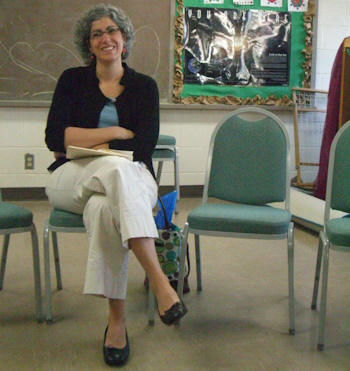
Nica Lalli at CFI Austin, March 15, 2008.At some point someone wondered what do young-Earth creationist parents do when they take children to a natural science museum, and are faced with dinosaur exhibits? One woman said her sister-in-law covers the explanatory plaque with her hands and tells children: oh look, these are dinosaurs. They are 3000 years old!
While adults had their conversation, children played in the UU church playground under the supervision of babysitters. Later that evening we took Nica Lalli out for dinner at the County Line barbeque restaurant.
Thursday, March 13, 2008
TechOnWeb -- frUAdulent, or just clueless?
I've been shopping for a new ultraportable laptop for a while now. There is a particular laptop I think is really neat, but it's not available at the local stores. So I've been trying to order it online. The first place I ordered it from told me they are out of stock (even though their website said it was in stock) and didn't know when they were going to have them, so I canceled my order. Then I placed an order for the same laptop on TechOnWeb.com. You would think a store with a motto "where geeks go shopping" would know what they are doing.
The next day I got an email from their fruad (sic!) department. Yes, their representative misspelled the name of his department in his signature line! Anyway, the email said I needed to call their customer service to confirm my order. It was "a security measure that we take to ensure your online purchase is secure". I called, spoke with a customer service rep, answered the questions he asked me. The rep told me my laptop will ship the next day.
A week has passed and I haven't got any notice that the laptop has shipped. I logged into my account at TechOnWeb.com website to check the status of my order. It said "canceled". I called them to ask why was my order canceled (and why didn't they inform me by email or phone call? That's just rude.) The customer service lady said, my order was flagged as fraudulent and won't be processed. I was very surprised. I told her I had called the customer service as soon as they told me to do so, and answered all their questions; what was the problem? She couldn't answer that, only said that my order was sent up to the fraud department supervisor to investigate, and they determined my order was fraudulent. Period. I asked, what do I need to do to prove that I am who I say I am? She said, nothing can be done at this point, we won't process your order. That's it.
I asked to speak to the supervisor; she said sure, and "transferred" me; I've long guessed that by "transfer" customer service reps mean hang up. The call was disconnected -- this has happened to me many times when calling customer service.
All this gave me a creepy feeling if, perchance, TechOnWeb was some kind of scam outfit that pretends to be an online store but is actually out to de"fruad" its customers. Come to think about it, during the "security measure" phone call they had asked me several kinds of information which may make it easier for someone to steal my identity. I checked the status of the credit card I gave them, and I didn't see any suspicious activity on it. Of course, that doesn't mean anything in itself. Anyway, I don't seriously think they are a scam; most likely just rude and clueless. Some place for geeks to shop, indeed.
I thought I was a geek. It turned out I'm a frUAd
The next day I got an email from their fruad (sic!) department. Yes, their representative misspelled the name of his department in his signature line! Anyway, the email said I needed to call their customer service to confirm my order. It was "a security measure that we take to ensure your online purchase is secure". I called, spoke with a customer service rep, answered the questions he asked me. The rep told me my laptop will ship the next day.
A week has passed and I haven't got any notice that the laptop has shipped. I logged into my account at TechOnWeb.com website to check the status of my order. It said "canceled". I called them to ask why was my order canceled (and why didn't they inform me by email or phone call? That's just rude.) The customer service lady said, my order was flagged as fraudulent and won't be processed. I was very surprised. I told her I had called the customer service as soon as they told me to do so, and answered all their questions; what was the problem? She couldn't answer that, only said that my order was sent up to the fraud department supervisor to investigate, and they determined my order was fraudulent. Period. I asked, what do I need to do to prove that I am who I say I am? She said, nothing can be done at this point, we won't process your order. That's it.
I asked to speak to the supervisor; she said sure, and "transferred" me; I've long guessed that by "transfer" customer service reps mean hang up. The call was disconnected -- this has happened to me many times when calling customer service.
All this gave me a creepy feeling if, perchance, TechOnWeb was some kind of scam outfit that pretends to be an online store but is actually out to de"fruad" its customers. Come to think about it, during the "security measure" phone call they had asked me several kinds of information which may make it easier for someone to steal my identity. I checked the status of the credit card I gave them, and I didn't see any suspicious activity on it. Of course, that doesn't mean anything in itself. Anyway, I don't seriously think they are a scam; most likely just rude and clueless. Some place for geeks to shop, indeed.
Tuesday, March 11, 2008
"Infinity does not exist in our dimension"
A bunch of the ACA'ers went on a pub crawl last Friday. The crawl started out at Dog & Duck pub, the home of the ACA'ers happy hours; then we went on to 6th street. On the way there we were approached by folks who were handing out fake million dollar bills. It was some kind of Christian evangelist thing. Along the edge of a "bill" in small print there were questions such as "will you go to heaven"? Since most of us wore "Godless pub crawl: pubs, not popes" T-shirts made for this occasion, we must have been a tempting target for evangelists, and there seem to be quite a few of them hunting for souls to save in the nightlife district on a Friday night.
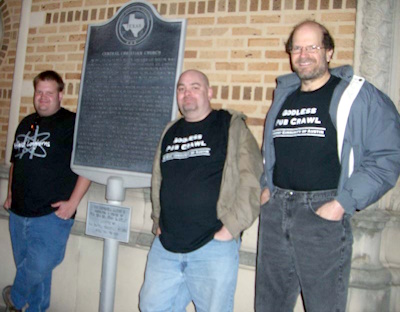
On the way to 6th street, the next destination in the pub crawl, some people felt they had to pose in front of a church. For irony's sake. Left to right: Justin, Matt and John.Not surprisingly, two of them got into an argument with Matt, the then-president of the ACA. One of those guys told Matt he would prove there is a God in 30 seconds flat. Needless to say, their argument lasted a lot longer, and most of the ACA'ers got bored and wandered off to our next stop, the Darwin pub (no connection to Charles Darwin that I could tell!) It became tedious quickly, but not before I had a chance to hear this gem of an argument. The evangelist attempted to argue from the "first cause", to which Matt replied: if everything must have a cause, then who created God? The evangelist guy said, God doesn't have to have a cause or creator, he always existed. Matt said something along the lines of, you can't simply dismiss a question of whether God has a cause; just like it is meaningful to ask that question about anything else, it is also meaningful to ask it about God; you can't just arbitrarily declare that God has no cause. Matt tried to explain it by analogy: no matter how big a number you can think of, you can also imagine an even greater number, and so on all the way to infinity. The evangelist guy somehow felt existence of infinities threatened his beliefs. He said, no, I don't have to (imagine an even bigger number). I can stop any time. Infinity does not exist in our dimension, he added.
That last remark floored me. I blame science fiction. Seriously. I blame popular sci-fi shows and movies for putting terms like "infinity" and "dimension" into the vocabulary of people who cannot grasp these very simple and intuitive mathematical concepts. But that doesn't stop them from using them in a debate!
After the Darwin pub all the ACA'ers went on to their next stop, but I decided to save my liver and go home.
Monday, March 10, 2008
Khaled Hosseini "A Thousand Splendid Suns": a CFI book club discussion
4 people attended a CFI Science And Religion in Fiction book club discussion of "A Thousand Splendid Suns" by Khaled Hosseini. The two main characters of this novel are two women who were given away in marriage, against their will, to the same brutal, abusive man. The story follows them over a quarter of a century, during which Afghanistan endures a few dictatorships and a long, grueling war.
Most of the attendees liked the novel very much. 3 people have read Khaled Hosseini's first novel, "The Kite Runner", and thought both were terrific books, though one reader liked "The Kite Runner" a "teensy bit" better, as it had a more interesting story line. Two readers thought that the author struggled a bit to show things from the female perspective in "A Thousand Splendid Suns", but it nonetheless provided something "The Kite Runner" did not -- a window into lives of women in Afghanistan. Those lives were every bit as bad as one would imagine, and then some. The author indeed does a good job of giving the reader a taste of what it's like to be the most powerless of the powerless people. The two heroines of the book struggle to survive in a double dictatorship: as the Taliban rule the country with terror, the women's husband rules the house by brutality and intimidation. Hosseini does not shy away of portraying the most horrible moments of their lives, but he does it gently, lyrically.Some of the insights into women's life may appear counterintuitive to a western reader. For example, some of us found it striking that when when Mariam first put on a burqa, she felt a little more safe, as if she had a place to hide from the world and all those people she was afraid of. So a burqa wasn't just a tool of oppression, it unexpectedly turned out to be protective, in a way. There are other nuances in portrayal of characters, even the most evil of them, Rasheed (the husband). As much as he abused his wives, Rasheed wasn't a complete monster, a reader noted; he was a product of his times. Wife beating was considered the norm in that place and time. Some of his behavior has redeeming value -- for example, silently accepting Laila's daughter, despite secretly knowing he was not the father. In a situation where men had absolute power over wives, one of our readers gave Rasheed credit for not murdering Laila and her daughter outright, which he could have easily done. The reader acknowledged, though, it probably wasn't magnanimity that made Rasheed tolerate an out-of-the-wedlock child, but fear of embarrassment if the community found out.
"A Thousand Splendid Suns" is very easy to read text-wise: the plot is straightforward, the motivations of the characters transparent. One reader was impressed that the author, despite coming from a different culture, was able to make this novel accessible to an American reader.
However, on an emotional level this book may be difficult to get through. It's hard to read about heroic women whose lives are dire from the start (at least Mariam's was; but Laila didn't have an easy childhood either), and they were going to only get worse with time. You know their lives will get worse when the Soviets invade Afghanistan, and much worse when the Soviet occupation will be replaced by the infighting mujahideen fractions, and then worse again when a Taliban dictatorship will replace the mujahideen war.
Here I must note something I found a little disappointing about this book. I expected that a novel set in Afghanistan during the rule of Taliban would at least touch upon the topic of the nature of religious fundamentalism. Perhaps I was hoping that it would reveal how a theocratic dictatorship comes into being, or that it would put me in the mind of a jihadist. Of course, this wasn't this novel's mission; there are other books about that, although I think they might have fitted the topic of the CFI Science and Religion In Fiction book club better. Another reader thought the reason why the book avoided a Jihadist perspective altogether was because it very clearly shows that the Taliban's grabbing of power was not motivated by religion. It was all about grabbing resources in a land of limited resources. People joined the Taliban so that they could feel powerful and push other people around.
Friday, March 07, 2008
Ursula K. Le Guin "The Left Hand of Darkness": FACT reading group discussion
11 people attended a FACT reading groupdiscussion of The Left Hand of Darkness by Ursula Le Guin on October 1, 2007. Most of the group, except 2 people, had read this novel before. Some had read it when it first came out in 1969.
In this book, a human named Genly Ai who is an Envoy from Ecumena, a multi-world union, is sent to a planet Gethen to convince its government to join Ecumena. The most unusual quality of Gethenians is that they don't have two sexes, at least not permanent ones. Most of the time they are sexless, but for a few days each month they go into a state called kemmer, where they acquire either male or female characteristics and are able to reproduce. Their ambisexuality influences Gethenian social and political life in ways unpredictable for Genly. Fate brings him together with Estraven, a local political figure, and they embark on an unexpected journey.
"You are only judged as a human being. It is terrifying."
Most people liked the book, and some felt profoundly influenced by it. A reader regretted there was no Tiptree award at the time The Left Hand of Darkness came out, because, in his opinion, Le Guin pushed the gender-bending envelope way harder than most Tiptree award recipients. He said, "Le Guin made an incredibly clever choice in the sexuality of the Gethenians. She truly understands that the alien is us, far more than the aliens I've ever read in any SF story."
Somebody remembered a couple of years ago there was a panel at ArmadilloCon on women who grew up on this book. Women were saying, this book changed my whole life, this book is the reason I'm writing. One reader said her favorite line from the book is "you are only judged as a human being. It is terrifying." "It captures the longing that a lot of us had," she said, "when we first became aware that we women were not been judged as human beings, that we were not judged on our work. [We had a longing for a world where] everybody is in the same boat, where 5/6 of the time sex doesn't matter."
A few people were not as impressed by this book. One reader said he vaguely remembered The Left Hand Of Darkness as a novel where "nothing really happens in the end. It's just describing the alien culture that goes through it." Another reader said while he admires what Le Guin is doing and the way she's dealing with important issues, for some reason her work doesn't connect with him.
Memorable gender- and mind-bending episodes
Some people reminisced about their favorite scenes from the novel. One reader's most memorable part was the one where Estraven went into kemmer during the ice trip. Up until then Estraven, despite his sexlessness, was perceived by Genly as a man. Having entered kemmer, he temporarily becomes a woman. This happens against Estraven's will, as neither he nor Genly want the complications of changing gender perceptions, but now they have to deal with them. It is especially hard on Genly, who, despite the years spent among the Gethenians, is still not used to thinking of gender as fluid. This reader found that episode really mind-twisting. Another reader thought the scene where Genly teaches Estraven to "bespeak", or communicate telepathically, was especially vivid. The mind communication between them had a strong erotic aspect, even though their relationship remained platonic. Yet another reader found the Foretelling scene especially interesting, and wished there was more about it in the book. He liked the comment of the futility of getting the correct answer to the wrong question.
My own impressions
I read "The Left Hand Of Darkness" around 15 years ago for the first time; upon rereading I had to admit I liked it less than I expected. Though even the first time around this book seemed kinda slow to me. Slow and full of politics I didn't much care about. I guess I remember liking it mostly for its mood, very dark, chilly, intense, full of sexual undercurrents the two main characters did not seem to realize, and did not speak about. Ursula LeGuin gives you a vivid, visceral feel of what it is like to be in a very cold, harsh, stark place, with nothing but ice and snow for thousands of miles. I liked the mysticism that surrounds the characters' daily existence; the family legends, the cult of prescient priests / seers; the metaphors, such as "casting a short / long shadow"; remember wondering what it meant symbolically that Genly and Estraven were not casting any shadows when they were crossing the ice. Not that I completely understood why casting a long shadow was considered a good thing among the Gethenites. There is certainly a huge metaphorical depth to this novel. One can easily speculate that a species that's neither male nor female must have a different view of duality, of light and shadow, than a bi-gender species. "Left Hand Of Darkness" can inspire you to speculate until the end of the world about how their perception of the world would be different from ours, and what we can learn from them, and vice versa.
Exploration of genderless society did not go beyond expository lump
At the same time, I can't say the book did a lot to explore the socio-political aspects of an ambisexual society. It says somewhere briefly, almost in an expository lump, that their society knows nothing of gender-based discrimination; that there don't exist stark differences between two halves of the society in terms of their career opportunities, etc., because bearing and raising on children does not disproportionately fall on half of the society; the single most important thing that determines a human person's life -- whether they are male or female -- is not true about Gethenians. I wish the ramifications of this were explored further, and illustrated more abundantly. Because it is the most interesting thing about this society, and it was mentioned only in passing.
Genly put the mission at risk not because he harbored unconscious expectations about the natives acting male or female; no, I think his troubles came from not understanding political games played by the Gethenian powers, and how they used him as their tool. But I think an outsider is always bound to misunderstand the nuances of local political games, regardless of how many sexes there are in the society.
Genly: saint or gay?
It was interesting to see how people's opinions about the protagonist reflected their own notions about gender. I pointed out that Genly, despite his mission to bring a more enlightened era to Gethen, harbored a few backward stereotypes about women. For example, he sees Estraven as feminine because Estraven is indirect, devious, and scheming; later he says that women don't have much capacity for abstract thinking. Shouldn't an Envoy see beyond such stereotypes, especially if you keep in mind that the book is set in a much more enlightened era of far future? He was sent by Ekumena to bring progressive attitudes to the little "backward" corner of the universe that was Gethen, to convince the Gethenian states put aside their little petty differences, to open their minds and become part of a greater whole; but on the other hand, his own attitudes towards women are backward. So I wondered if Ursula Le Guin deliberately meant to create a character with these contradictions, or if she thought Genly's views of women were accurate.
Two readers pointed out to me that Genly's attitudes towards women were far more generous than those of most men in the US today. I replied that this may be true of men of our era, but the book is set in far future; the fact that Ekumena is succeeding at its improbable mission to bring peaceful cooperation to all alien races, must mean this world is based on far more enlightened attitudes than ours. And Genly, an Envoy to an alien planet, must be even more enlightened than most! So I see a contradiction here. Nonetheless, the other two readers insisted that Genly's views make him a saint, especially as compared to an average man of today. One reader even said this saintliness makes Genly not a credible character, definitely not as a young man. He also wasn't clear on whether Genly was straight or gay, because he thought Genly behaved in ways we associate with gays. However, he concluded Genly was straight, "because Le Guin is trying to write a strong male character". This elicited laughter from several women: do you have to be straight to be a strong male character?
So, while the discussion never degenerated into a war of the sexes, there were a few opportunities for that, which I guess is more than you say about most books.
Saturday, March 01, 2008
Old article, good quote
Sorry, Boys, This Is Our Domain
The story explores why there are more girls creating content online than boys, especially textual content, such as blogs (boys still dominate video creation).
Some scholars argue [that] girls are the dominant online content creators because both sexes are influenced by cultural expectations.
"Girls are trained to make stories about themselves," said Pat Gill, the interim director for the Institute for Communications Research and an associate professor of gender and women's studies at the University of Illinois at Urbana-Champaign."
The following quote, I think, illuminates not just different modes of online participation, but also why women are in general more verbal than men. Girls score higher on language skills in school than boys; women read more; storytelling plays a greater part in women's lives than men's. Many words had been shed on this subject, yet I've never seen it summed up in a sentence so succinct, so starkly precise.
From a young age they learn that [girls] are objects, Professor Gill said, so they learn how to describe themselves.
Friday, February 22, 2008
Apostrophe carriers shall be assimilated
Apostrophes in names stir lot o' trouble
It can stop you from voting, destroy your dental appointments, make it difficult to rent a car or book a flight, even interfere with your college exams.
More than 50 years into the Information Age, computers are still getting confused by the apostrophe. It's a problem familiar to O'Connors, D'Angelos, N'Dours and D'Artagnans across America.
[...]
"It's standard shortsightedness," he said. "Most programs set a rule for first name and last name. They don't think of foreign-sounding names."
[...]
That's what happened during the Michigan caucus in 2004, when thousands of O'Connors, Al-Husseins, Van Kemps and others who went to the polls didn't have their votes counted.
[...]
All of this confusion has prompted some people to surrender to technology. Iraqi immigrant Lina Alathari was once known as Lina Al-Athari, but dropped the hyphen in America. "There is no pronunciation difference, so I'm fine with it," she said.
My own brand of apostrophe problem
It's not just apostrophes. You don't have to do anything so reckless as inherit a name with an apostrophe in it, to throw computers off whack. We mortals can offend computer's sensibilities by something far more innocuous -- for example, by not possessing a middle name. This has happened to me. I indeed don't have a middle name. It may be unusual in the US, but not back where I'm from. But the computer at Texas Department of Motor Vehicles did not want to believe me. When I got married and changed my last name, I had to update my driver's license. A DMV clerk told me their computer is not letting her leave the middle name field blank. So she said she was going to put in my maiden name in the middle name field. I protested, but she said there was no way around it. Can't argue with a computer.
The funny thing was that a few years before that, when I first got a driver's license in Texas, the DMV computers accepted my middle-name-less-ness with no problem.
A few ArmadilloCons ago I had a conversation about this with an artist named Ctein. As one might imagine, it's not his given name. Whatever name he was born with, many years ago he officially changed it to Ctein. So he now has only one name -- and computers so far have not given him grief about that! Computers must be a lot more liberal in California, where he lives. He was surprised by my account of the stringency of Texas DMV computers.
He wasn't the first one-name-only person I've met. The first one was my roommate in a graduate student dorm. She was from Indonesia. Apparently there is a minority of Indonesians (maybe they belong to a certain ethnicity, I don't know) who go by just one name. She constantly kept running into situations where she was demanded to provide some kind of a surrogate first name. Usually clerks would give up and enter "Ms" as her first name, or sometimes "Fnu" (I guess that stands for "First name undefined").
I bet the digerati who keep saying that the internet would liberate us did not think of this particular way computers would try to force everybody into conformity.
Subscribe to:
Posts (Atom)

 Posts
Posts


