Friday, February 22, 2008

Apostrophe carriers shall be assimilated

Apostrophes in names stir lot o' trouble

It can stop you from voting, destroy your dental appointments, make it difficult to rent a car or book a flight, even interfere with your college exams.

More than 50 years into the Information Age, computers are still getting confused by the apostrophe. It's a problem familiar to O'Connors, D'Angelos, N'Dours and D'Artagnans across America.

[...]

"It's standard shortsightedness," he said. "Most programs set a rule for first name and last name. They don't think of foreign-sounding names."

[...]

That's what happened during the Michigan caucus in 2004, when thousands of O'Connors, Al-Husseins, Van Kemps and others who went to the polls didn't have their votes counted.

[...]

All of this confusion has prompted some people to surrender to technology. Iraqi immigrant Lina Alathari was once known as Lina Al-Athari, but dropped the hyphen in America. "There is no pronunciation difference, so I'm fine with it," she said.

My own brand of apostrophe problem

It's not just apostrophes. You don't have to do anything so reckless as inherit a name with an apostrophe in it, to throw computers off whack. We mortals can offend computer's sensibilities by something far more innocuous -- for example, by not possessing a middle name. This has happened to me. I indeed don't have a middle name. It may be unusual in the US, but not back where I'm from. But the computer at Texas Department of Motor Vehicles did not want to believe me. When I got married and changed my last name, I had to update my driver's license. A DMV clerk told me their computer is not letting her leave the middle name field blank. So she said she was going to put in my maiden name in the middle name field. I protested, but she said there was no way around it. Can't argue with a computer.

The funny thing was that a few years before that, when I first got a driver's license in Texas, the DMV computers accepted my middle-name-less-ness with no problem.

A few ArmadilloCons ago I had a conversation about this with an artist named Ctein. As one might imagine, it's not his given name. Whatever name he was born with, many years ago he officially changed it to Ctein. So he now has only one name -- and computers so far have not given him grief about that! Computers must be a lot more liberal in California, where he lives. He was surprised by my account of the stringency of Texas DMV computers.

He wasn't the first one-name-only person I've met. The first one was my roommate in a graduate student dorm. She was from Indonesia. Apparently there is a minority of Indonesians (maybe they belong to a certain ethnicity, I don't know) who go by just one name. She constantly kept running into situations where she was demanded to provide some kind of a surrogate first name. Usually clerks would give up and enter "Ms" as her first name, or sometimes "Fnu" (I guess that stands for "First name undefined").

I bet the digerati who keep saying that the internet would liberate us did not think of this particular way computers would try to force everybody into conformity.

Monday, February 18, 2008

"Jumper": a movie review

I went to see "Jumper" because it is based on a book by a Texas writer, Steven Gould, who I met a time or two at local conventions, and he was fun on panels. "Jumper" is a story of a guy who puts his powers of teleportation to a "good use" by teleporting into bank vaults, robbing them and setting himself up with a life of leisure. He continues to do that until he attracts attention of a guy who hunts jumpers. Yes, that's a plural: there is handful of other people in the world who have this inborn psychic ability. Confrontation ensues, wherein the two parties chase one another across the world's most scenic backdrops. To be sure, I haven't seen other movies that exploited the potential of teleportation to spice up boring old fistfights. You punch a teleporter in the face on Mount Everest, and he lands on a pyramid in Egypt. Or something like that. But that's where artistic and conceptual merits of the movie ended. The plot was completely empty. The stakes were not high enough to keep the plot suspenseful. There was no "the fate of the world hinges on the good guy's success" cliche to make you care about the outcome. While the protagonist was easy to sympathize with, I personally didn't see why we, the viewers, should be on his side, as if he was entitled to the life of luxury and ease he made by abusing his unique powers. On the other hand, the motivation of the guys who hunted the jumpers is even harder to fathom. It's not like they wanted to avenge the harm done by jumpers robbing banks. Rather, they come across as far more evil than jumpers, because they torture and kill jumpers for no good reason, except perhaps a supernatural revulsion. The only justification that escapes the main baddie's lips is "only God can be in many places at once".

Or maybe the baddies were just jealous of the jumpers ill-gotten gains? Maybe not, because towards the end of the movie we find out that the bad guys have a teleportation machine! This strikes another blow to the movie's credibility. Are we to understand somebody invented a teleportation machine, and kept it secret from anyone else on Earth? That's plain ridiculous.

I chatted with some FACT people after the show, and they said the movie had hardly anything to do with Steven Gould's book! The hunters were entirely a Hollywood invention. They don't exist in the book. Instead, the story is about the guy facing the consequences of his actions (bank robbing) and coming around to use his powers for the good of the humanity. I think I would have liked this kind of plot much better, but apparently that's not what the Hollywood allows me to want.

Monday, February 11, 2008

New reasons not to use XO!

It may be hard to believe that my XO experience could become even worse, but it did. I must admit that as much as I curse it, I still use it. I don't have much choise: my de-trackpad'ed Fujitsu laptop is no longer mobile, because using an external mouse means having to find a flat surface to move it around on, and that's often infeasible when I'm out and about. So I'm still using XO as my mobile computing device.

But lately the XO laptop has given me two new reasons not to use it. In fact, it has declared it won't tolerate my presence any more.

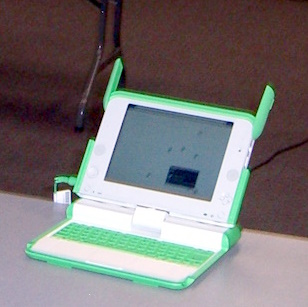
An XO / OLPC laptop An XO / OLPC laptop.

1. One (if not more) of its keys is sticking. It is, unfortunately, one of the "key" keys, heh heh. I don't even know precisely which one it is, but I think it's Ctrl, or Alt, or some such key that modifies the behavior of other keys. It malfunctioned in the worst possible way: it's acting as if it is always pressed. So when I press any other key, the computer reacts as if I issued a special command, and does something unpredictable. And no, I did not spill anything on the keyboard. The funny thing is that it does not stick all the time. When I boot the lappy, all the keys work fine for a short while, and then out of the blue the problem starts. So the laptop has become practically unusable.

But that's not all.

So far the biggest perk I got out of my XO ownership was not the computer itself, but a free subscription to T-Mobile wireless access. T-Mobile rewarded "Give 1, get 1" customers with a year of free access to its hotspots. It's been a good deal so far because all Starbucks are T-Mobile hotspots, and there is a Starbucks on every corner, so my WiFi-enabled pasture has become much bigger. And I can use the subscription with any wireless device, not just with XO. So far so good.

Guess what I've read in the news yesterday?

Starbucks to Offer Free Wi-Fi With AT&T

Starbucks Corp. and AT&T Inc. will start offering a mix of free and paid wireless Internet service in most of the global coffee retailer's U.S. shops, beginning this spring.

The move announced Monday ends a six-year Starbucks partnership with T-Mobile, which did not include free Wi-Fi and charged higher fees than AT&T will.

So my T-Mobile access is about to become worthless. I don't know of any of their hotspots outside of Starbucks (well, there is one at a Borders' bookstore, but I haven't been able to connect to it). Oh well, it's seriously time to look for a computer museum to donate my XO to (since I now believe that these laptops, far from taking the world by storm, will become, to quote a friend, "tech curios".)

It's high time for me to buy a new "real" laptop. I have a few ultra-portable candidates in mind, but I haven't seen them in stores, and I am squeamish about buying a laptop on the internet sight unseen.

By the way, the Starbucks news is not all bad:

Starbucks said it will give customers who use a Starbucks purchase card two hours of free wireless access per day.

So if I limit my Starbucks visits to 2 hours (and I rarely have the time for a longer stay), I should still be able to enjoy free WiFi. But definitely on a different laptop.

Friday, February 08, 2008

Book review of John Scalzi "Android's Dream"

Many people post book reviews on their blogs, but I usually post reports on reading group discussions. In my general opinion, a survey of what a bunch of people said about a book is more informative than my opinion alone. While it is often true, sometimes we have discussions that are not very informative. This usually happens when instead of analyzing a book in depth, people chat about various cute, trivial bits of it that they liked. (Usually it happens with books that are not very deep in and of themselves.) As a result I sometimes look at the discussion report and realize it contains no clue whether a particular novel is worth reading. So once in a while I'll haughtily assume that my own opinion may be more informative than a survey of others' opinions. Today is one of such days, and John Scalzi's "Android's Dream" is one of those books.

I got started on this book in a skeptical frame of mind. The cover blurb clearly showed this lighthearted space romp did not exemplify "literature of ideas", the kind of SF I like best. Indeed, if you check out its summary on Amazon --

"An interstellar scandal explodes when a human diplomat assassinates an alien diplomat by farting at him, albeit using a scent-emitting communicator. To forestall interspecies war, the government enlists former war hero and current uberhacker Harry Creek. His mission: to placate the aliens by finding a unique form of sheep used in the aliens' upcoming coronation ritual."

it becomes obvious that the value of this novel lies mostly in the humor. The fact that it opens with a very elaborate fart joke also didn't encourage me to read further. The only reason I read it was because John Scalzi is the Guest of Honor at the upcoming ArmadilloCon.

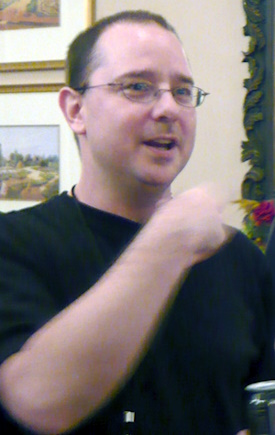
John Scalzi at the ArmadilloCon, an Austin, Texas speculative fiction convention, in 2008 John Scalzi at the ArmadilloCon, an Austin, Texas speculative fiction convention, in 2008.

But I liked it! It's a really fun book. There is humor, there are unexpected plot twists, there is irony, there is neat technological trivia. Scalzi very humorously merges the familiar with the alien, the mundane with the high-tech. Harry Creek and his damsel-in-distress Robin escape the Earth on a cruise liner; later, its endless buffets, slow elevators, plush lounges and obnoxious picture-snapping tourists provide a comical backdrop for our protagonists' fight against lizard-like alien marines.

Then there is the way kosher laws provide inspiration for the legal argument that established Robin's citizenship status. That was a brilliant, or at least a very funny, twist. Using something so quaint and irrational as kosher laws to make an argument about legal implications of genetic engineering, is an example of what makes this book more than a source of cheap chuckles.

Neither the humor, nor suspense abates until the very few last pages. This thriller did a very good job in keeping me guessing how Creek and Robin are going to get out of all the tight spots they found themselves in.

By the way, it's not for nothing that I called Robin a damsel in distress. That's one real issue I take with this book. While Robin is tough, spunky, witty and unflappable, she does not have an independent role in the book. She just goes along for a ride with Harry, who calls all the shots. Her only purpose of existence is to be rescued by him. It's a bit of a throwback to how women used to be portrayed in SF of a less enlightened era.

Other than that, it's a really fun read.

Sunday, January 27, 2008

Keep Austin woo-woo

It's tempting to say it's a "keep Austin weird" thing, but I believe in every place there are people with these kinds of beliefs. But perhaps Austin is a more likely place than some others for a waiter to feel free to come to a customer and ask "excuse me, are you an indigo?"

Yes, a waiter -- a young guy, barely over 20 -- asked me this question as I was sitting at a table in a cafe, typing on a laptop, minding my own business. "Huh, I'm sorry?" I said. He repeated: "Are you an indigo?"

Now, I've heard about the so-called "indigo children", but assumed (and still do) that it's just a type of ammunition in the never-ending battle of competitive parenting, my favorite spectator sport. I guess for some parents it's not enough to have their child enrolled in several different sports teams, musical and dance activities; they also need to claim that their child is an "indigo". In fact it's an easier way to one-up other parents: first, it requires no proof (unlike excellence at sports and arts); and second, once you declare your child to be an indigo, any other parent in your circle would feel very silly parroting the same; so whoever says it first, wins.

However, I never heard adults calling themselves indigo; in fact since I gravitate towards rationalists, I would be rather unlikely to encounter such a person. So, when the waiter put this question to me, I was unsure if he meant it in that sense. So I asked "what does it mean?" He said, "it's an... uh, a different person. It's a person with a very strong aura." I mumbled about not believing things like that. He smiled, apologized and walked away.

But damn it, if someone implying that you are "special" doesn't make you want to be on your best behavior, even if for a short while! However, he wasn't my waiter, so if I left a bigger than usual tip, he didn't directly benefit.

Saturday, January 26, 2008

Philip Pullman "The Golden Compass": CFI book club discussion

4 people attended the CFI Science and Religion in Fiction reading group discussion of Philip Pullman's "The Golden Compass". Overall the impressions were positive. These were some of the main points discussed.

World building

World building may be one of the most interesting aspect of the book. A significant component of the intrigue was to try to figure out what time period it was set in. Several readers at first assumed it was set in the Middle Ages. There's a big school made of stone, they light lamps. But then they mention things like Aerodock, and a center for Atom craft, and they talk about photons, and there is even some vague quantum physics-babble. So it's obviously not Middle Ages. But just when you may begin to think the story is set in the modern times, the world still feels subtly wrong. A lot of kids in it seem to live in Dickensian circumstances, working menial jobs (like Roger, the kitchen boy) or simply running around in the streets, instead of going to school. Apparently in this world there are no laws concerning child labor or mandating universal education.

Adherence to, and departure from, fantasy archetypes

This book played up some fantasy cliches (or shall I say archetypes), while parting with others, and it was interesting to see how the readers reacted to the presence or absence of their favorite archetypes. I vaguely felt that this novel neglected to follow a couple of essential plot requirements for a SF/F book.

  • The stakes against which the character is fighting must be high. Of course, for a young girl to go to the North to rescue children from the hands of an evil organization does sound like pretty tall order, but the stakes are not global: it's just a handful of children under threat, not the world in itself (though there is some talk that shady entities experimenting with Dust are trying to change the world forever, it is very vague). So this does not quite qualify as an archetypal hero's quest story.
  • Unlike in the best stories of this kind, things don't get worse before they get better. Lyra's progress goes rather smoothly, although she has some disconcerting experiences. Still, we don't get a feeling of thickening doom, of dark consequences that would befall the world if she fails.
  • However, another reader said he liked the way "Golden Compass" wasn't based on the familiar "a hero saves the world" fantasy formula. Other cliches were more palatable to him. For example, most characters Lyra meets are exceptional in some way. It's not just an ordinary bear, it's the king of bears. The witch is not an ordinary witch, she's the queen of the clan. But the reader who did not like formulaic plots had no problem with larger-than-life characters. He said it must be "easier to write about extraordinary characters like kings and leaders of clans. For me it's boring to read about ordinary people leaving ordinary lives, because I live one."

The philosophical premises of the book received praise from CFI

CFI being a club of rationally-minded people, philosophical premises of the book got some attention. A reader noted that while this book has several fantasy tropes -- witches that fly on a piece of pine wood, or talking bears -- it really doesn't have magic. There is no mind-reading or spell casting in it, that's not how this world operates. Readers praised Pullman for making the science-fictional elements in this book part of the natural world. This is where the worldview of this novel differs from "conventional" fantasy, in which the ability to see paranormal, or magical, phenomena is often depends on being "pure of heart"; people who are unable to see / experience magic, are often shown as deniers or simply stupid; in other words, in traditional fantasy and magical realism, ability to experience the supernatural element is subjective. Pullman does the opposite. In his world, fantastic elements exist objectively. Another appealing quality of the novel is that the author plays fair with his world. He sets boundaries and rules in his world, and he doesn't violate them on a whim. That's a problem in certain fantasy, where certain characters get to do what they want and violate what they want, but Pullmann stuck with the rules.

The science-fictional elements are rich with meaning

Science-fictional elements in Pullman's world are rich with meaning. None of them are tacked on arbitrarily or as plot MacGuffins. For example, daemons. It is a testimony to Pullman's great job exploring implications of daemons, that the readers in this group found various daemon-moments the most memorable parts of this book. One reader's favorite scene was where the evildoers try to separate Lyra form her daemon, as this scene demonstrates that a daemon is an intimate aspect of a person, and losing it is a horrible catastrophe. It's not like losing your pet dog. It's like having their arms and legs cut off, or losing part of your personality. Another reader admitted finding that scene traumatic, which attests to its power. The role of daemons was so central to the book, it caused one reader to speculate that the plot of the book will be based on Lyra getting separated from her daemon and trying to get it back. Pullmann is good at exploring many nuances of human/daemon interdependence. For example, children's daemons change shape up until adolescence, when a daemon settles into a shape that best represents the person. As a result, some daemons may acquire a guise undesirable to their human -- for example, a poodle, though the owner might have wanted to have a tiger or a lion instead. And now his daemon will trumpet to the whole world that this person, in his essence, is a poodle.

Daemons are also an expressive instrument to convey the characters' emotions and the deeper undercurrents of their psyches, because a daemon outwardly expresses what goes on inside a character. For example, a reader pointed out, the scene where Mrs. Coulter's monkey daemon attacks Lyra's daemon shows that Mrs. Coulter's true intent towards Lyra is very different from her outward sweetness.

The tropes are rich, but confusing

The presence of daemons doesn't explain as many things as the questions it raises. For example, a reader asked, when a baby is born, where does the daemon come from? We also agreed it was a bit simplistic to to think that a demon represented a soul.

Other fantasy elements in the novel are even more puzzling. For example, what to make of experimental theology? "It's weird that in this world theology involves machinery, and you can do experiments with it! It's very tantalizing, and then he doesn't go anywhere with it," said a reader.

Or the notion that Dust may be a leftover from the original sin. "Huh? What's that about?" a reader asked. "How can particles coming from space have anything to do with a religious concept?"

The aletheiometer was seen by a reader as presenting a paradox; on one hand, it was a cop-out because it told you everything you want to know; on the other hand, it made the reader wonder why didn't Lyra spend all of her time reading it, to find out as much as possible about who the bad and the good guys were?

So, the conclusions. Plusses: a convincing, richly detailed fantasy world that whets the reader's appetite by hinting at deeper links between seemingly unrelated magical elements; likeable characters; the fantastical elements exist objectively in this world. Minuses: some fantasy archetypes in the book are too cliche; some science-fictional elements don't seem to be internally consistent.

Wednesday, January 23, 2008

Genuflection aerobics

Once in a while I post quotes from articles I read with a sole purpose of goofing off, and not out of genuine interest. I have no stance on the issues described -- I post these quotes simply because I find them hilarious.

http://www.salon.com/mwt/feature/2008/01/23/partner_yoga/

This is an article on partner yoga, the grossness of. ("Is having my face in a stranger's crotch really helpful for my meditative state?"). The only thing I can say about yoga is I tried it once and found it singularly boring. But the second of the two following paragraphs almost made me squirt coffee out of my nose.

Traditionally, yoga is taught one-on-one, takes years to master and has nothing to do with improving the definition of your shoulder muscles. It also emphasizes emotional detachment, which is difficult to achieve if your head is in someone's junk. But Dharmanidhi's [an Indian yoga master's] biggest point was this: Yoga is an integral part of Hinduism, and Americanized yoga -- whether it's called Ashtanga, Iyengar, Bikram, Vinyasa or anything in between -- is a bastardization of a spiritual practice.

"Imagine you go into a Catholic Church and there's something called genuflection, where you go down on one knee," he said. "What if a person comes out of the ceremony -- which is supposed to be about their relationship with God -- and they say, wow, my legs feel a little sore! And they go home and open up a shop and have people do genuflection for an hour to disco music. And partner genuflection, at that! It's completely taking it out of context."

Saturday, January 19, 2008

A natural explanation for a woo-woo phenomenon

A recent article in Salon.com made me think that some people's claim of ability to see auras may be neither a lie nor wishful thinking, but simply a case of synesthesia.

http://www.salon.com/mwt/feature/2008/01/15/synesthesia/

To quote the article,

Synesthesia is a neurological phenomenon in which activation of one sensory processing system (e.g., numbers or written language) leads to the automatic engagement of a second, distinct sensory processing system (e.g., color) to create a "crossed" sensory perception. For example, as in my case, numbers appear to have their own colors. Or, in other forms of synesthesia, sensory processing is "crossed" with emotion processing, imbuing letters, words, days of the week or months with their own personalities.

The author further says:

[...] people had colors, too. Not everyone. But many people did, whether I liked them or not, whether I knew them well or not. I didn't have to think about it; it was just so. As apparent to me as their eye color.

And

For much of my childhood, I enjoyed my synesthesia. [...] I'd turn my eyes to a teacher halfway through class to bask in her lavender glow. [...] I'd heard about auras -- radiant light surrounding a person, somehow revealing or reflecting his or her soul -- and I figured the color I saw from certain people, or numbers, was an aura. Had I somehow gained access to a spiritual dimension?

So the so-called "aura" (or, rather, the ability of some people to see it) may actually be a natural phenomenon. Of course, it is useless for any practical purpose -- you can't extract any real information from it -- because it is purely subjective. Any two synesthetes will see the same person's auras in different colors and attribute different emotional qualities to it.

Friday, January 18, 2008

When a laptop crush burns you

I have not yet admitted it in this journal, but for the last 2 weeks I've been conducting a torrid love affair with another laptop, a Fujitsu Lifebook Q2010. In this post I identified it as my newest laptop crush. Well, our romance was tumultuous and crashed spectacularly. Such a seducer, it was! Spectacularly thin (though not anorexic like the new MacBook Air), light as a feather; small, but with a comfortably sized keyboard. I thought it would make a great companion for me everywhere I go.

Long on beauty, short on capacity

I knew this extreme portability came with some sacrifices. For example, it lacks a CD / DVD drive. This didn't matter, because I use CDs and DVDs very rarely; I keep all my data on external hard drives or flash drives. What did give me a pause was that this laptop had only 512 MB memory. That's the same amount of memory I have in my old Fujitsu laptop (the one that had mouse-ectomy performed on it), and I bought it 3.5 years ago! It gets bogged down easily when I run the minimal number of applications I need every day: Firefox, emacs, Open Office and Photoshop. So it wouldn't make much sense to buy another lappy with just as little computing power.

I blame the wingmen

Why did I buy it, then? It's not that infatuation made me blind: I blame the wingmen -- sales guys at Fry's Electronics -- for my bad decision. (Let's see how far can I stretch the analogy!) They assured me I can upgrade the memory to 2GB, and that it's very easy to do it at home. At home, S and I opened the memory compartment and peeked inside. Not only it didn't have the promised levers that let you lift the memory out and replace it with a new one, it didn't seem to have the same kind of connectors as the memory chip I bought. So I took the laptop to Fry's service department to see if they can upgrade it for me (for a price, of course). They kept it for a day, then called me and said the memory was not upgradeable: it was soldered on the motherboard!

I still didn't want to return the lappy at this point. I had already made 4 trips to Fry's within a week (the 4th one was to pick up the laptop's power supply, which I forgot the previous time) and I simply felt I have invested too much time in this laptop to write it off. So I tried to pretend I could work around this. Only I didn't get very far.

I don't click links that say "Click me!"

S set it up to access our home wireless network, but the laptop was unable to connect. I took it to a few coffeeshops with public, unencrypted access points, and it could not connect to any of them. Finally I called Fujitsu tech support from one of those coffeeshops. The tech support guy told me there's an icon on the desktop entitled "Click Me" and that I needed to click it before I could do anything else with the laptop. Clicking it will unpack a bunch of drivers and programs that are necessary for the laptop to work, he said. When I idly wondered why weren't those programs installed on the laptop to begin with, the guy replied only that Fujitsu has always done it this way. A compelling explanation if there ever was one.

I did not even see the tricky little icon at first, because I guess my brain has wired itself to tune out spammy word combinations such as "click [here|me]". Links that beg me to click them without making a compelling case why I should, are usually the kind I would never click if I knew what was behind them.

But now I had to, so I did. I got a bunch of errors. After making me repeat the operation twice, the tech support guy concluded that the operating system (Windows XP) on the laptop was corrupted, because I had not clicked the icon before doing anything else on this laptop. I asked, "so you are telling me that the operating system got corrupted because I tried to access internet without unpacking those programs?" He said yes. I said it was beyond ridiculous.

Sometimes it's best to let that one get away

But then he asked me if by any chance, the laptop I bought was a a store loaner / demo unit. Why, yes, I replied. Indeed it was a demo unit. In fact, part of why I bought it was that it was the last unit in store! They've been discontinued, and this was my last chance to buy a laptop of this kind. Nothing can inflate an item's desirability like knowing that this is your last chance to nab it! The tech support guy said, ah-ha! You never know what its previous users did to it, that might have corrupted the OS. Well, uh, maybe, but Fry's told me they wipe the lappy clean and reinstall the OS from scratch! Still, the guy said, my only recourse at this point was to reinstall Windows myself from recovery discs.

Thank you, I said. And I went back to Fry's and returned it.

So now I'm back on the market for laptops. I'll be more careful next time -- with my time and money, if not my heart.

Friday, January 11, 2008

XO networking at an Austin Linux Group meeting

After grumbling in solitude for the last few weeks, I got a chance to try XO out the way $deities intended it to be used: networked with other XOs at an Austin Linux Users Group meeting. These capabilities are supposed to make it the coolest laptop known to humankind.

In theory, at least.

Beside me, 2 people brought their XO laptops to the meeting: Mr. The Joe Barr (who gave a presentation), and a guy I shall call Mr. Emily, because that was the name of his wife's computer, and by extension, his wife. A few more people came to play with these 3 lappies.

A ghost laptop

We tried to see if the three computers could see each other. They did, to various degrees of success and with various permutations. I could see Joe's computer in my neighborhood view, but not Emily. Joe's computer could see Emily, and occasionally me. My icon popped on and off on its screen unpredictably, regardless of what I was doing. Emily could see both of us, plus a fourth XO -- a ghost computer! It was named Clatrissa. None of us had any idea who she or he was, except that she must have been somewhere in the building, or nearby. Spooky! How many other XO users does any XO user run into on an average day? And how likely are you to run into one randomly when there's already an XO meeting going on in the building? But maybe there was a more mundane explanation for the ghost XO. Could it be possible that the real Emily had networked her XO with a "Clatrissa" in the recent past, and the laptop had not been rebooted since then, so Clatrissa's icon hung around? I've experienced something similar with wireless access point icons. I may move from one location to another miles apart, but the icons of some of the wireless access points in the previous location (all of them, not just the one I had connected to) still hang around. Only rebooting the computer makes them disappear.

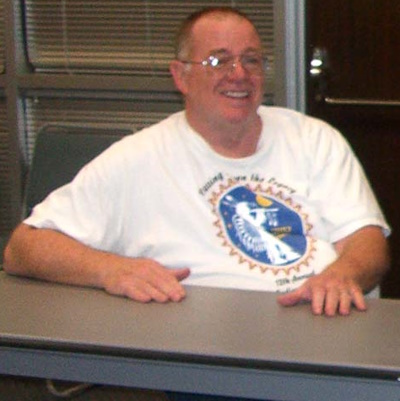
The owner of the laptop named Emily at the Austin Linux Group XO networking event in January 2008 The owner of the laptop named Emily at the Austin Linux Group XO networking event in January 2008.

Invitation confusion

Mr. Emily issued an "invitation" to Clatrissa, but s/he didn't respond. Probably because s/he didn't exist, but perhaps because invitations are a bit of a tricky business an XO, as we discovered. Well, at least for novices. When you move a mouse over another XO user's icon, two options pop up: Make a friend, or Issue an invitation to browse. Apparently, all Make a friend does is add the other user's icon to your Group view. It does not seem to inform your "friend" that you have friended them. Inviting someone to browse had seemingly just as little effect. I issued an invitation to browse to Joe's laptop and then went over to see if the invitation was received. No sign of that. But perhaps Joe didn't get my invitation because his laptop couldn't see mine at all? It's anybody's guess. And I did not try to orchestrate invitations between two laptops that were definitely seeing one another (such as Joe and Emily), because they were at that time both swarmed by other people who seemed to be more interested in dissecting the operating system rather than putting Sugar through its paces.

Apparently there is also a misconception that you can't see other XO users nearby if you are connected to a wireless access point, but that's not true. You can. But then I guess the ultimate test for XO networking would be for one of us to start a mesh network and for others to connect to it and get on the internet via the first person's computer. We didn't even try, since there were problems to even try to see other users. Besides, Joe wasn't sure if you don't need a school server for that. Maybe only the school server can serve as an access point for all the laptops to connect to.

Mr The Joe Barr at the Austin Linux Group XO networking event in January 2008 Mr The Joe Barr at the Austin Linux Group XO networking event in January 2008.

I also was very -- how shall I put it -- vocal about the XO deficiencies I've experienced so far. I was semi-expecting to be called a Microsoft shill for that, but actually Mr. The Joe Barr was sympathetic and said I should report my troubles to the OLPC developers -- I would be helping them out. So maybe I will, once I get around to it. While Joe said he had not experienced the same problems, I felt somehow validated that some people agreed the limitations of this laptop were real. There was some discussion as to whether the laptop's intended audience, third world schoolchildren, will perceive them as limitations. For example, inability to back up large batches of files to a USB drive is not a limitation if you, umm, don't own a USB drive. Joe thinks backups are intended to be stored on school servers. Perhaps that's a correct assumption on the designers' part, who knows. But even Joe agreed that this laptop (or at least the Sugar interface) is not intended for power users. As the schoolchildren ramp up to become power users, they may have to switch to more powerful systems. But that may come sooner than such systems become affordable in the developing countries.

Austin Linux Group secretary Paul Elliot did us all a service by asking questions on an OLPC IRC channel on our behalf. Thanks to him I found out how to import images into Paint application, and got a few other questions answered.

Monday, January 07, 2008

XO: conclusions

Update on backups. It really is possible to back up an "activity" by dragging and dropping it from the Journal to a USB drive icon at the bottom of the Journal. I did this to an activity named test1.txt, and a file by that name actually appeared on the USB drive. But, as I expected, it appeared in the top-level folder. I could not have placed it in any of the folders on the USB drive, because the XO operating system does not recognize folders. For the sake of accuracy I must say the underlying Linux system does recognize folders / directories, it's just the Journal (which is essentially a dumbed-down file manager) doesn't. But you can't copy files to the appropriate folders using command line, because you don't know the "real" file names (they are encrypted, I heard). The user-friendly file names are only visible in the Journal, but the Journal doesn't recognize folders. So whatever files you back up will only be backed up to the top level folder of an external drive. Not very useful in real life situations.

No easy way to organize your data

Absence of folders me wonder whether this laptop can be adequate for any kind of real life use, even in the lives of third world kids. Here's why I doubt it:

-- if you can't organize your files into folders, the external hard drive you store them on will be nearly useless if transferred to a non-XO computer. If you store hundreds or thousands of files in a top-level directory, the information in them becomes practically unfindable. (Yes, you can search, but only the files that have text in them. Search won't help you tell if a file named DCF2519.jpg is a vacation picture or a birthday picture, or something else, unless you store it in a folder "Vacation" or "Birthday".)

-- to back files up, you have to drag-and-drop them to an external drive icon one by one. There is no ability to select multiple files, at least not that I see. It would quickly make any kind of real-life file backup tasks very tedious; and tedious tasks usually get neglected until oops, your hard drive has crashed.

Speaking about findability of files, I realize XO interface is built around a different paradigm of data organization than the one we are used to (hierarchical system of folders). The XO Journal stores everything in a chronological stream. The "activities" in it are sorted by date. You can also search them -- there is a search bar at the top of the Journal. You can filter the view by a file type, or by "recentness", though it has very limited options for that: today, since yesterday, last week, last month, last year. You can't enter an exact date range. The "search, don't file" philosophy has a serious limitation of being applicable only to text, not binary files.

Plus, the search takes forever (or hangs) if your external drive has a realistic number of files. In my previous post I said I have thousands of files on my USB drive. To see how far I need to scale things down before XO stops choking on them, I tried another drive with only a couple hundred files, most of them text. The search still hanged.

An XO / OLPC laptop An XO / OLPC laptop.

One might point out that the Journal allows you to add tags and description to each activity. Tagging image, video and audio files would make them searchable (the search mechanism does look inside tags, I'm glad to say). But how many people are going to do that? What is easier: to mass-select a bunch of images and drag-and-drop them to a folder named "Birthday" or to paste a tag "Birthday" a 100 times next to each and every picture you took on your birthday?

A toy, not a tool

To reiterate,

1. XO does not let you organize the files in a way that's (a) scalable, and (b) preserved if transferred to a non-XO computer.

2. To whatever extent it lets you organize your files, it can only handle ridiculously small amounts of data. I suppose if I only had 10 files on my external drive, the search might work. But do you know any person who has only so few files on their drives?

So if you do no more than 3-4 activities at a time, and if you don't want to keep most of the files you generate, then I guess this laptop may be adequate. In other words, you have to be using it as a toy, not a tool, to avoid running into its limitations. But this can't be how school students are supposed to use a laptop (any laptop, not just this). Aren't students supposed to save their class notes to use them in the future, as the class material each year builds upon the previous year? If so, you would expect students to generate tons of files, most of which should be easily searchable and accessible. Also, if the laptop chokes upon large chunks of data, what's the point of giving it an ability to generate large binary files, such as video and audio? Especially if you keep in mind that a handy video camera might tempt a child to go on a wild creative spree, recording everything in sight (heck, it even makes me, an adult, do that!) What's the point of creating hundreds of binary files, if a mere attempt to view their names in the Journal crashes the Journal?

Note that I haven't even talked about the video and audio recording functionality of this laptop; I was discouraged from trying to manipulate huge binary files by seeing how XO's memory chokes on ~ 2K of text data. I'm sure the recording capabilities are neat, but to me, they are icing on the cake; the cake itself -- or rather the daily bread -- is ability to organize and access your data. If this laptop can't do that, in any real-life situation, then I'm not sure what's the point to try to do anything with it.

Saturday, January 05, 2008

XO: forget about folders. Where are my FILES?

No, dear reader, I'm not done complaining. I saved the best for last.

XO has some even more fundamental problems... sorry, weirdnesses. Sorry, design features.

If you are computer-literate person, wouldn't you feel a bit embarrassed to ask where your files are? XO makes you stoop to new lows of embarrassment. Let's say you save a file, and then open a terminal and try to find it from the command line. Well, not only I wasn't able to find them using the UNIX find command, but several Linux experts at a meeting of the Austin Linux Group were unable to find those files using find with all sorts of advanced options. Then after some googling one of them found an indication the file names on XO may be encrypted. So no matter what you call your file, you won't be able to find it.

An XO / OLPC laptop An XO / OLPC laptop.

By the way, what exactly is a file name on OLPC is not entirely clear. Nor is a mechanism by which one saves a file in the text editor. The editor has no "Save" menu option. The only thing that resembles saving a file is clicking on "Activity" tab in the text editor (or, to use XO terminology, in the Write Activity) and then you'll see a little bar in the upper left corner; by default, this bar says "Write Activity". You can change this text to anything you want, which is akin to giving file a name. Then if you switch to Journal, you'll see this activity referred to by the name you just gave it. So it is indeed like a file name. Like is the keyword here. Because nowhere on the machine you'll find a file by that name.

Can you back up your files without knowing where they are?

Well, perhaps the XO computing paradigm does not require you to know file names in order to find them again? At a first glance, yes. You can see all your "activities" in the Journal, so you don't really have to search for them by their file names. Which leads to a question: is Journal capacity infinite? Will every activity you've ever done be listed there? Or do the oldest activities "expire" after a while? Because if they do, and you can't find them by the file name, you're screwed if you ever want to access them again.

But of course Journal can't be infinite, because XO hard drive (sorry, flash drive) isn't infinite. Which brings us to the next, critical question. How do you back up your files?

When I plugged in a USB drive, I opened it in the Journal (by clicking the USB icon at the bottom of the Journal), then switched back to the Journal, and tried to drag-and-drop an item from the Journal onto the USB icon. The icon seemed to move, so I thought I'd switch back to the USB drive view and see if the file will appear there. I could not switch back to Journal (by clicking its icon at the bottom). Then I tried to unmount the USB drive (by clicking Unmount), and then unplugged it. This action crashed my Journal! It disappeared.

So now I'll have to reboot to see if the Journal is restored, and if my test file actually appears on the USB drive. What fun!

Friday, January 04, 2008

XO: where are my folders?

I shall not stop until I've vented all I have to vent about XO. Hey, for those $400 if I did not buy a functional computing device, I at least bought a right to complain, no? :-)

When you plug in an USB drive, it's supposed to show up at the bottom of Journal as a USB drive icon. Of all times I plugged it in, the icon showed up perhaps half the time.

Actually, it was like this: I plugged it in, it showed up. I unplugged it, then plugged it back in. It did not show up again. I rebooted the computer, it showed up.

An XO / OLPC laptop An XO / OLPC laptop.

Then I was for in for another disappointing surprise. I have several thousands of images and hundreds of videos on my USB drive, all filed in folders according to my own system (when you have that many files, it's not trivial to find a filing system that would quickly let you find what you want). Guess what -- this laptop does not recognize folders. It displays all thousands of files in a flat list, sorted by date/time. I could not believe my eyes. But perhaps I could have guessed that a system that did away with a window manager would go one step further and get rid of the folder paradigm altogether.

You can open a Linux terminal on this laptop (thank goodness for small graces) and cd through directories from a command prompt. So in that sense you can see folders on your disk. But you shouldn't have to be a geek to use folders, no? At least the children this laptop is designed for can't be assumed to be Linux geeks.

Wednesday, January 02, 2008

Laptop surgery

Yesterday was another first. I observed surgery performed on a laptop. On mine, that is. On my dearest old laptop (not the XO), the one that mistakenly swallowed a gulp of my coffee. :-) Fry's could not fix it. The liquid has leaked into the system board, they said. It's not possible to fix. But to work around the problem of a mouse that thinks its button is permanently pressed, they recommended that I get an external mouse. So I did. Plugging in an external mouse is supposed to disable the built-in one... only it doesn't. So I asked a local IT expert how to disable it. It was supposed to be a quick question, but we all know how quick those questions actually are. This one lead to an-hour-and-a-half long troubleshooting session (you can't disable the built-in mouse from the BIOS, and you can't uninstall its driver, because every time you
reboot, Windows re-detects it and reinstalls the darn driver!) that culminated in opening up my laptop and exposing its guts. Oh, what a white-knuckled feeling it was to see my dear laptop laid open and helpless! And how weird it is that to get to the internal mouse (or "trackpad", I should say) you have to go in from the bottom, by opening the hard drive compartment! Well, the IT expert cleaned off the trackpad parts and put the laptop back together, but no cigar. The mouse still thinks its button is "on", and it overrides the signalsfrom the external mouse. More surgery, then. The guy disconnected the trackpad cable, finally disabling the trackpad. So, thanks to this good person, I have a working system for now, but I'll start to look for a
new laptop soon.

Tuesday, January 01, 2008

I'm no better critiquer than I am a writer

I try to do one new thing on the first day of the new year. I went to a meeting of a science fiction writers' critique group. One of my SF writer friends had said that the critique delivered by this group is so mild as to be useless: they'll never tell you if your story sucks. But I wanted to see for myself. Well, they didn't trash anyone's story, but they pointed out a lot of things in it that I thought were very helpful to the author. I felt a bit useless without having to offer any helpful critique to the authors, as I'm really not that perceptive. I'm blind to literary style, and I'm not bothered by stuff like frequent shifts of POV, and such. The only critique I can offer is "can you make it a little bit more interesting?", which of course is not helpful. :-) (I didn't bring any of my stuff to be critiqued -- maybe I will someday, but this was my exploratory meeting.)

And I am totally not equipped to critique vampire erotica. I have no idea what distinguishes a good story in this genre from a bad one. :-)

Monday, December 31, 2007

XO: the slowness

XO is so slow that if you open 5 applications (sorry, "activities") it slows down significantly. If you open 6 of them, it slows down to a complete grind. And I'm talking about such low-intensity activities as text editing and web browsing! I haven't even tried video or sound recording or editing yet!

Having a minimal number of activities open is also not a guarantee that the laptop won't slow down. If you copy a large quantity of text to a clipboard, it will slow the XO down just as effectively as opening 6 applications. By "large" I mean "about 2 pages worth". For me it's typical to copy / paste chunks of text this size as I write and edit my stories or blog entries.

An XO / OLPC laptop An XO / OLPC laptop.

Well then, perhaps I should clear out my clipboard frequently to avoid computer freezing up? Yeah, that's a step you don't have to do in a traditional computer, but what's some small effort for the honor of using this radically innovative machine? It should be easy given that all your clipboard entries are conveniently lined up on the left side of your workspace. Hmm... but now how am I supposed to know which of them are the "huge" chunks that are hogging the memory, versus tiny one-word chunks? In my writing / editing process I generate both kinds, but much more of the latter. When you move the mouse over each clipboard entry, it obligingly pops up a menu allowing you to choose to remove the entry, add it to Journal, or to open it in an activity (such as "write", if it's text). However, it does not show you what the entry is (not until you open it in an activity, I suppose. And I already said what happens when you open more than 4-5 activities). So there is no easy way to know which entries to delete. Would it have been so hard to program the clipboard so that moving the mouse over a clipboard entry would show the initial words of the text (if it's a text)?

I guess you can point out that poor kids in the 3rd world are not graphomaniacs like me (actually, very few kids anywhere are), so they won't manipulate large chunks of text. Yet, this laptop gives kids an ability to record video and audio, and video / audio objects are bound to be much bigger than segments of text! If the laptop memory chokes on text, how will it handle multimedia? I'm afraid to even try it.

Sunday, December 30, 2007

No X's or O's for this toy

It's not the chiclet-sized rubbery keys (though I suppose I wouldn't try to type a dissertation on this keyboard. I haven't had a chance to type out long text documents on it yet, because I am still trying to find out the how to do the basic functions I do on a computer. ) No, there are several other reasons why I think this thing is crippled.

I know, I know. I can hear a bunch of voices yelling back at me that I don't get it, that XO was not supposed to be a "regular" laptop, and the fact that it can't do a lot of things a regular computer can do was a design decision, not a flaw. But then you have to wonder if the assumptions the designers made about the target audience (children in poor countries) were any close to being realistic.

You don't realize how much you rely on this feature until you miss it

Suppose you regularly update a web site, and you do it via a CMS (content management software). CMSes have web-based interfaces; you update them via a web browser. Often you want to upload pictures. Web browsers have upload widgets where you click "Browse" and a dialog box comes up that lets you select a file to upload. So you go to your CMS URL in the XO web browser, and you see your usual upload widgets, and you click the "Browse" button, and your computer cranks and flashes its blinkenlights, and you wait, and wait... while the itching feeling it's not going to pop up a dialog window grows stronger. You can't say why, not yet, but you just know it's not going to happen. When, after a lot of grinding, the XO web browser fails to pop up a dialog window (with no error message or anything), you realize why.

There are NO windows on this system!

An XO / OLPC laptop An XO / OLPC laptop.

The damn operating system does not have a window manager! All popular operating systems, whether Microsoft Windows, Mac or Linux, use a windowing system as a basic user interface paradigm. Any application you open opens in a window. Not so here. In OLPC interface, an application (or "activity", as they call them here) occupies the whole screen. Sure, there are ways to get from your "activity" screen to the Home screen and other activity screens. But the windowing paradigm is about more than that.

If you are a very linear person, XO may be for you

For one thing, a lot of mainstream applications, such as web browser, require opening another window in order to accomplish routine actions (such as uploading files), and they can't do that on XO. But the significance of windows is more fundamental. You can lay them out side by side and overlap them, enabling you to see several sets of data, several applications, several... um, activities, at once. It lets you shift your attention from window to window whenever something interesting happens in some window (for example, a friend IMs you). Our computing activities are rarely linear. You may be chatting in one window, while waiting for a video to load in another, while checking email in yet another window. You need to be able to see all that's happening at once! And children these days are even more used to that than adults. Everything that's been said about the contemporary kids and teenagers emphasizes that they are embracing multitasking the way no generation has done before -- IM'ing several friends, watching videos, and doing homework all at the same time, continuously managing multiple streams of attention. I would add that this is typical not just to kids, but to programmers too, of all ages. It is inevitable for us. While a program compiles, we don't dumbly stare at the screen: we research some other issue for another project, or answer somebody's question in an IM window -- only to interrupt those "secondary" issues when our primary project finishes compiling. And it should be enough to glance at it to know when it finished -- we shouldn't have to Alt+Tab to the other window repeatedly. Similarly, we need to know immediately when a colleague or a friend sent us a new instant message. For that, one needs overlapping windows on the screen.

XO doesn't let you do that.

So like I said, it may be good for kids who haven't been around regular computers, but any kid who's grew up in a modern digital lifestyle will find it crippling.

But maybe a window manager would be too power-intensive? It is a computationally intensive feature, I'm sure, at least as far as memory is concerned. And I've just talked with a guy at a coffeshop who has been following the OLPC program closely and he said that all these design decisions were dictated by the need to make the laptop consume as little power as possible.

Friday, December 28, 2007

Laptop crushes

My broken laptop is at the Fry's repair shop, where they will keep it for a week just to run some diagnostics on it! The diagnostics will cost me over 100 bucks. And that's not counting the cost of repairs. There's no telling how much that will be. The technician at Fry's said "it may not be economical" for me to get this laptop fixed versus buying a new one. I don't know if there are laptop repair shops in town that do the job faster and cheaper, there may very well be, but I had already spent one of my vacation days running errands and didn't want to spend the second one searching all over the town for a cheap computer repair shop. So I thought what the hell. But I prepared to reconcile myself with the possibility that I may have to put my beloved laptop to rest. So while I was at Fry's, I started looking at other laptops.

Even if a relationship ends, you can say it was good if it taught you what is important to you in relationships. And so it is with computers. If a laptop taught you what is important to you in laptops, it was worth it. And this laptop taught me a lot. When I bought it, I was confused about what I wanted -- all I had from my previous relationships with laptops was a vague sense of dissatisfaction, of spending too much effort working around their quirks; there was no balance of give and take. But now I know. Portability is extremely important, because I carry my laptop everywhere -- in a way it is a life partner. And for me, portability means primarily weight, and only then size. So, a 10" screen is only a marginal win over a 12 " screen, but 1.5 pounds is worlds better than 2.5 pounds! Reduction in weight often comes at an expense of an optical drive. And that's fine by me. I use a CD / DVD drive so rarely that I'll be perfectly happy with having an external drive to plug into the lappy when I'm at home. I don't need one "on the go". On the other hand, since I type a lot and in all sorts of places, the laptop's keyboard needs to be decent-sized. Chiclet keysx won't do.

That said, I announce my newest crush: Fujitsu Q2010! I looked at it at Fry's, and it's full of awesome! 1.5 lbs, 12" screen, no optical drive, but a keyboard suitable for marathon typing.

I feel awful saying this. I still hope my old laptop can be fixed.

An XO / OLPC laptop An XO / OLPC laptop.

Where does the XO come into picture, you ask? (No, you didn't, but I can dream, can't I?) It's not really in the running. It's a boy-toy, a rebound relationship. No, it's more complicated than that. If I was single, it would be a wingman / -woman. Or a wingpet, as it were. For all its inadequacies, it's really good at starting conversations. The last couple of days, being on vacation, I camped out with my XO at various WiFi-enabled coffeeshops and eateries, and half the time guys come up to me asking what it is. Hey single women! The Give 1, Get 1 program has been extended until December 31st! For just $400 you can buy yourself a perfect guy magnet!

Tuesday, December 25, 2007

Lumps of coal

This Christmastime the universe brought me an assortment of small nuggets of anthracite in the form of annoying and disappointing events. None of them is big enough to justify a whine (so consider this an unjustified whine); they are rather like small, delicate chocolates in the box -- as you bite into each one, you wonder which shade of bitter taste it will leave in your mouth.

Perhaps I shouldn't blame the universe: some of these things were brought about by my own clumsiness. First, I damaged my beloved laptop: not just once, but twice. I spilled coffee on it at a coffeeshop. Only a tiny bit of coffee, but it was enough to do a lasting damage. My 3 years of being very careful with this laptop came to naught. I am usually very aware of the placement of coffee and tea cups within one meter radius of the laptop. I don't put cups with liquid on the table where the lappy sits: I put them on a chair or on the floor, so that there would be no chance of spilling them. But all it takes is one time. My hand trembled, or something, and a few drops of coffee ended up on the keyboard. As a result, the mouse pad stopped working. The mouse acts as if its button is permanently pressed. So if you move the mouse over any window, it will wreck havoc as it "clicks" everything within that window, opening files, launching applications you didn't know you had, etc.

So I took it to Fry's yesterday to see if it could be fixed. But when I showed it to a technician, the mouse worked fine. I brought it back home, and the mouse is back to being unruly. So another trip to Fry's is in the stars for me tomorrow. I just hope the problem won't temporarily go away this time, only to reappear at home.

What's worse, as I was taking the laptop out of the bag at Fry's, I dropped it on the floor! Some parts of it outer shell cracked and chipped, but the fall didn't seem to affect it... at least not yet. I still feel very bad about harming my laptop, as if I had harmed a child.

Or perhaps it's a way my sneaky subconscious was trying to get rid of the old laptop so as to make way for what was supposed to be my holiday present to myself: an XO laptop (also known as OLPC, or One Laptop Per Child). I bought an XO as part of their "Buy 1, Get 1" program (you pay for 2 laptops, and get 1, while the other gets shipped to a child in a developing country, which is what the OLPC program was intended for). It arrived yesterday. My Christmas Eve night was spent on figuring out the XO interface, which is, in Tom Lehrer's words, "so simple, so very simple, that only a child can use it".

An XO / OLPC laptop An XO / OLPC laptop.

And not just any child, but a child who's never been around real computers before. For youngsters in African villages it may be perfectly adequate. But a western child who's been using computers since preschool, may find it about as comfortable as tying her shoe laces with her elbows. Yes, XO is cute. I grant it that. But a cute lump of coal does not a diamond make.

That's my verdict for now. I'll write more about it after I take a few deep breaths and spend hours on OLPC forums and wikis to see if there is even a circuitous way (much less a direct one) to do my everyday computing tasks.

Thursday, December 20, 2007

Neil Gaiman "American Gods": a CFI book club discussion

5 members of the CFI book club attended the discussion. 3 of them have finished the book, 2 haven't but were planning to finish. For some reason we didn't get much discussion mileage out of this book. It did not prompt discussions as lively as the two previous books the CFI book club read, "The Sparrow" and "Towing Jehovah".

Everybody agreed the story starts out interesting but loses steam towards the end. A reader who characterized "American Gods" as half mythology, half modern road movie, said this setup pulled him through the first two thirds of the novel, but then he started to lose interest. Everybody felt pretty much the same.

The best part of the book: details, subplots, digressions

What people found the most memorable about "American Gods" was not the overarching idea or characters, but the details: various little tidbits, plot snippets and sub-stories that made this book a rather unusual piece of work. It is full sub-plots and sub-sub-plots that sometimes threw the readers off course, even if in a good way. For example, a few readers wondered about the significance of the taxi driver episode. Or the life story of an African woman who was sold into slavery and brought to colonial America. What role did these interludes play in the plot? Was it just to illustrate various ways gods from all over the world migrated to the US? One reader observed that Neil Gaiman usually manages to tie the plot threads that seem disparate (for example, "Sandman" has dozens upon dozens of plot threads, but most of them have an effect on the story), whereas in "American Gods" a lot of plot threads didn't have a connection.

And the concept of importing gods does not seem to be consistently thought out. Someone in the group wondered: when people came to America and brought their gods, did they duplicate them, or did they bring the only instance of a god to America? At the time when they came, there must have been a lot of people in the home country believing in the particular god, so this would imply most of those gods had "forked" (if you put it that way). Actually, I think the afterword answers that question: the immigrants indeed brought replicas of gods with them. In that case the central conflict is a bit myopically American-centered. You would wonder why the originals of the old gods did not back up the duplicates in the final battle? (Unless they too were dying out in their home countries, which seems plausible.)

Neil Gaiman book reading at Book People in Austin, TX, September 2005 Neil Gaiman book reading at Book People in Austin, TX, September 2005.

The most interesting characters end up as "furniture"

Speaking about the uniquely American flavor of the book, its main redeeming quality, in my eyes, is Gaiman's pitch-perfect rendition of small town America and all the colorful weirdos that live in it. I was impressed how Gaiman portrayed each of Shadow's quirky, kind, mysterious neighbors as a distinct person, with unique patterns of speech; how he brought those characters to life with just a few details. However, until the very end it didn't seem that those secondary and tertiary characters were more than "furniture" in Gaiman's picture of small town America. Admittedly, it was an interesting picture, bleak and cozy at the same time, and worth of a book in and of itself, but still, it was hard to see how those characters were significant. Shadow's interactions with them appeared to be digressions an author resorts to when he doesn't know how to advance the plot. I amended my opinion somewhat after reading the last 20-30 pages, as it turns out that some of the subplots involving secondary characters get tied up in the main plot line. Still it is less than satisfactory to have them tied up after the fact, rather than organically woven into the plot.

The plot loses steam towards the end

The general opinion of our group was that you may have fun with the details, but the book lacks something... overarching. Well, you can't say it lacks a concept, because it does have a rather unusual central concept. It's the notion that gods exist only as long as there are people who believe in them, and that believers brought their gods along as they migrated around the world. But a good premise is not enough to make a good novel. For one thing, this idea is not entirely new: as one reader pointed out, Terry Pratchett played with it in "Small Gods". The execution is what makes a book worth reading, and the execution of this novel fell apart towards the end. None of the 5 readers that took part in the discussion thought the ending made much sense, or had a clear idea of Shadow's role in the resolution of the central conflict. The way the plot petered out towards the end made it hard for me to sustain interest. I'm not sure if this testifies to my degree of sleep deprivation, or to some real flaws of the book, that I fell asleep while reading what was supposed to be the climactic scene, the battle of the gods.

I also wasn't sure what was even the point of a battle between old and new gods, given that most of the old gods were dying anyway. The conflict, as it was presented in the book, had little relevance to the world at large. Most people, unaware of those gods' existence, would not have noticed their disappearance.

I'm also surprised that neither old nor new gods tried to make an alliance with Jesus or Allah, as the latter two are still among the most powerful imaginary entities on the planet. However, introducing players of this caliber into the plot would have made it much more complicated, so I can understand the reason for this omission.

The book is oddly in favor of religion?

I guess this book may feel rewarding is if you are among people who bemoan lack of spirituality in the modern western society. Such a person may find themselves sagely nodding their head in agreement. Gaiman's observations about America's lack of soul, lack of spiritual places and a need to create artificial spiritual places would certainly seem poignant to me... if I believed that "spirituality" is a definable notion, and that there was more of it in the past (or in less advanced societies) than there is now. But since I don't believe that, those observations, while witty, sounded hollow to me. CFI being what it is, most of our group members did not identify with that sentiment either. "The book is oddly in favor of religion," concluded one of our readers.