Tuesday, March 20, 2007

The Steampunk party

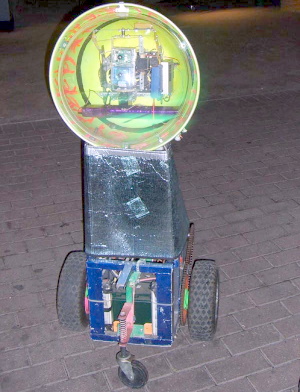
Last Monday S and I went to the Steampunk party "Futures Past", thrown by EFF and some other organizations as part of the South By Southwest conference. S had to be dragged down there kicking and screaming, although I thought he would enjoy the robot exhibit by the Robot Group, who demoed several new cool robots (new being those I haven't seen at their earlier exhibits). But S wasn't impressed with robots-as-art. He thinks robots are only cool if they do something functional. Oh well. I myself went there primarily for the costumes galore. Steampunk costumes! Victoriana with a techy twist! Yum. Mile after a square mile of lace-up boots and fishnet stockings, and much more.

An upright robot - bubble on wheels

An upright robot - a bubble on wheels, made by The Robot Group of Austin, Texas

I'm reporting on this event only now, because it took me this long to sift through the 200 pictures I took and post them on my photo gallery.

I got a glimpse of Bruce Sterling and his wife Jasmina. And somebody played a theremin, of which I dutifully made a video, but my buggy camera often causes the audio be out of synch with the movie; and while that's tolerable in baby videos, it makes a theremin video completely pointless, since you can't see the correspondence between hand movements and sounds. Too bad the sounds he made weren't very melodious; it was, I'm afraid to say, a rather tuneless improvisation. I've heard some theremin performances where it played actual music.

But the biggest attraction was a duo of two young women acrobats, Popsy Purvy. The name very well describes what they do. Since a picture is better than a thousand words, I'll say no more. The pictures are at the bottom of my blog post at this link. I also took a couple of videos of their acts, embedded below.

Monday, March 12, 2007

"Accelerando" by Charles Stross: FACT reading group discussion

On January 23, 2007 the FACT reading group discussed "Accelerando" by Charles Stross. Here are the main observations made at the discussion. These links lead to the full write-up of the discussion on my SFragments website.

"Accelerando" is too discontinuous to be called a novel. The stories that make up "Accelerando" revolve around the same set of characters, but there is no plot arch to unify them. That can be a good thing, too. The characterization was mediocre. But it was offset by innovative ideas, which "Accelerando" is chockfull of. The readers were most impressed by: Charles Stross' portrayal of the technological Singularity; his answer to the Fermi paradox; his humorous treatment of lawyers, spam, pyramid schemes and other life's small annoyances.

Charles Stross in the British SF panel at ArmadilloCon 2007
Charles Stross in the "Current Trends in British SF" panel at ArmadilloCon 2007

Some people thought that parts of Stross' futuristic vision were too sketchy. Especially Economics 2.0, which, many readers agreed, was explained in no more than a hand-waving fashion.

Everybody acknowledged that this book is not for mass audiences. Its extremely high "geek quotient" prompted comments such as these:

-- It definitely is rapture of the nerds.

-- You have to have a background in sciene fiction to understand it. Mainstream book clubs shouldn't read it. Stross is not pandering. Well, he's pandering to a geek audience. If you're not reading science fiction and you're not getting any of this, he doesn't care.

-- It's definitely written for a SF computer nerd. Specifically, computer science SF nerd. 90% of reference he makes are computer science references that's he's playing around.

Somebody also observed that despite being set in the future, Accelerando is very closely tied to today's technological and pop-culture landscape: "I'm not sure you can understand if you don't read Dilbert and Slashdot. I'm not sure if a bright person who's not from that community would understand it." Which may be seen as a drawback for this book, as it unnecessarily narrows down the audience that might be able to enjoy it otherwise. For the same reason the book may not age well, as in 20 years Dilbert references may be obsolete.

Friday, March 09, 2007

BarCamp Austin, Friday night

Tonight I went to BarCamp Austin. The schedule said there was supposed to be a BarCamp party at 8 pm. So I got off from work, picked up E from day care, had a bite to eat, and headed there, to the Bourbon Rocks bar downtown. I got there at around 8 pm, and discovered I was too late. A handful of people who were left at the bar told me the main event was already over. There was something going on earlier today, some kind of presentation. Those who hadn't left yet milled around a little, and then a bunch of them headed out for dinner. They said they were going to come back later and then there was supposed to be some drinking and geeking out. A few stragglers left at the bar were staring at a laptop screen where some guy explained to them finer points of Drupal caching.

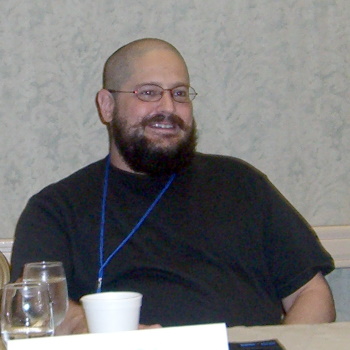
A Drupal developer named David (right) at BarCamp 2007

So far, the only thing I've learned at this so-called "unconference": Drupal does not rhyme with PayPal. It's pronounced more like DROO-ple!

Even though most BarCampers had left, I still got to talk with some people who were hanging around. In particular there was one guy who showed me (like everybody there, he had a laptop with him) a mind-mapping system he has created for himself. Of course, it does not map his entire mind, only the part that's involved with various IT projects. I didn't get the details of it (it was very loud; the bar was filling up with non-BarCamp people, and a live band started to play) that it had something to do with mapping plain English words to emacs macros; it enabled him to conjure code snippets for various common programming tasks, therefore freeing him from keeping those code snippets in his memory; that and a lot more -- though I'm not sure what else. I have this problem too -- of remembering the detailed "how-to's" of various programming tasks, and it was a relief to know that other people have the same problem as me, and interesting to see how different are each person's ways of coping with it. I do suspect, however, that each person's solution is very idiosyncratic and suitable for that person's mind, but less so for anybody else's.

Right: Shane, the guy who created a mind-mapping system, a.k.a. 'emacs wiki' on his laptop. BarCamp 2007
Right: Shane, the guy who created a mind-mapping system, a.k.a. "emacs wiki" on his laptop. BarCamp 2007

This guy called his system an "emacs wiki"; he said that it was wiki-like in nature even though he created it before he even heard of wiki.

It was also unexpected to discover at the end of our conversation, that this guy was somebody I knew from a certain mailing list. "Knew" in the sense of having read his posts, but never met him in person.

Thursday, March 08, 2007

Movie review: Pan's Labyrinth

Steve's mother is visiting us since last weekend, and she is kindly letting Steve and I to go out in the evening as often as we want to, while she takes care of Erika. So last weekend we did something as exotic as going to the movies. If one sees at most two movies a year, it's hard to decide which movies are worthy of that honor. So I make like a sheep and go with those that have generated the most buzz, provided their plot or genre appeals to me. The one movie this year that has penetrated the little text-only bubble I live in, was "Pan's Labyrinth", so I dragged Steve out to see it. (By the way, why is the title translated "Pan's Labyrinth" and not "Faun's Labyrinth", if the creature after which it is named is referred to as a faun? Even though it's the same thing.)

Yes, it justified the buzz. It was a highly watchable movie. The magic in it is pretty much of a generic Harry Potter-like kind, but the mood / plot is diametrically opposite. I wouldn't categorize it as a fantasy movie, though. In my opinion, a work belongs to a genre of fantasy or science fiction if it suggests that the events depicted in it are reality, rather than just happening in somebody's imagination. In "Pan's Labyrinth", it is pretty clear that the fantastic events are happening in the protagonist's imagination only, as they don't affect anyone else in the real world. It becomes apparent that in the near future she'll probably find out that all those things she imagined were not real, unless... there is no near future for her. And so the real world and the fantasy world were reconciled in the only way that was possible. In that sense the plot was quite predictable. But despite its tragic ending, this movie indeed provided a Very Satisfying Viewing Experience.

Saturday, March 03, 2007

A very unusual facial

Mykel and Paul (Steve's and my friends from the ACA) have this hobby, live-casting, where they make a cast of somebody's face or other body parts, fill it with water putty and turn it into a sculpture. Then they make masks based on that sculpture by way of vacuum forming. Mykel wanted to practice making face casts, and she asked if she could practice on me. I happily obliged -- it's not every day that you get to experience something like that. So, last weekend Mykel did a cast of my face. The technique they use is to cover the "victim's" face with alginate -- gooey stuff that quickly sets and captures your facial features wery well. Too well, as we'll see later. Then when it sets, they put plaster on top of it. The purpose of plaster is to solidify the mold, because alginate alone, even when it's set, is too soft / wobbly.

The process made me feel a little more claustrophobic than I would like.

When I say they cover your face with goo, I mean they cover everything, including your eyes (which are, of course, shut), and your mouth. The only hole left open in your face is your nostrils, and only because you have put straws into them prior to casting, otherwise you wouldn't be able to breathe. As one can imagine, having your eyes and mouth glued shut by a thick layer of goop feels a bit disconcerting. Claustrophobic, even. The catch is that anxious or not, you are supposed to maintain a relaxed, pleasant facial expression. Alginate is extremely sensitive to your facial features, it captures every tiniest detail of your skin, including fine lines, pores and zits. Soooo, if you frown or scrunch your eyes, your mask will feature ridges and valleys in the corresponding places. It was a tough order for me and I didn't do well at it, so the results of my cast were a bit disastrous, as we'll see later.

It doesn't help that I can't breathe through my nose

Fortunately or not, the first time Mykel applied alginate to my face, it set too quickly, before she could spread it completely. So she had to take it off and try again, using colder water to make alginate mixture. During the first try I realized I won't be able to breathe the whole time (close to an hour) through the straws in my nose. I have trouble breathing through the nose for long periods of time. Paul and Mykel addressed this problem by making a mouthpiece for me corrugated cardboard that allowed me to breathe through my mouth. (The little tunnels in the corrugated cardboard serve that purpose very well.) However, in the end it turned out that it kind of ruined the cast: it was way to big to allow me maintain a natural shape of my lips. Paul and Mykel did not have experience with mouthpieces: all the people they've done casts off were able to breathe with only the straws in their noses. After the alginate was set (which took about 5 minutes this time), Mykel applied plaster to my face. The more plaster is applied, the heavier the mask feels (plaster is heavier than alginate); also, while a layer of alginate on your face still lets you see the light in the back of your eyelids, plaster shuts the light out completely, and you are left sitting in total darkness. It made the claustrophobic feeling a bit more intense. Fortunately, the darkness / heaviness increases gradually, so you have time to adjust to it.

The result was not flattering

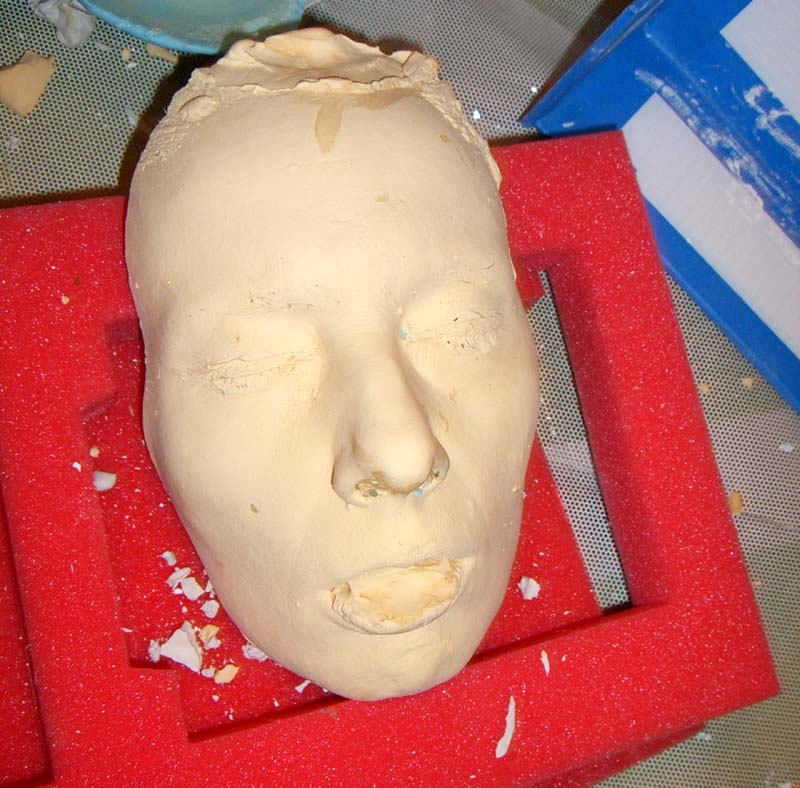
Once plaster was set (or "cured" -- the word Mykel used) I finally got to peel the mold off my face. I could hardly wait for that moment. Not so much to see the intermediate product, as to be free again! To see the light! Then Mykel mixed some water putty and poured it into the mold. It quickly set. Then she took the cast -- the water putty product -- out of the mold, and I finally got to see the likeness of me! As one can see, my eyes are scrunched and I look like I'm about to vomit. The vomiting effect is due to the mouthpiece I was holding in my mouth for breathing. We concluded it was way too big. To preserve a natural shape of a person's lips, a much, much smaller, discrete mouthpiece would be needed. The best thing, of course, would be to go without it and just breathe through the straws in the nose, which is what Paul and Mykel did when they made casts of each other's faces. Since I can't do that very well, I'm probably not a good candidate for a face-casting model. The scrunching of the eyes is, of course, due to the difficulty maintaining a relaxed facial expression in these circumstances, as I said above. The instinct that screams "I'm being burried alive!" in your head is pretty hard to shut up. More pictures of face casting can be found in my blog post documenting the facecasting process.

Wednesday, February 28, 2007

Book review: "Looking for Jake" by China Mieville

It's been a few months since I read China Mieville's story collection "Looking for Jake". I thought I'd write this review without re-reading the stories. That way I'll write only about those aspects of the book that stuck in my mind, without being distracted by details.

Having found China Mieville's "Perdido Street Station" fascinating, I must say I was a bit disappointed with his story collection "Looking For Jake". It still has Mieville's great writing, but the story plots left me wanting. Wanting for an original resolution -- or any kind of resolution, for that matter.

However, as I think back to what China Mieville said on some of last year's Readercon panels, I can see why resolutions in his stories are not forthcoming. I suspect that he considers a "satisfactory" ending to be a bourgeois thing. This must follow from the fact that Mieville dislikes the belief that lies at the core of most of the SF/F literature: a belief that a single person can change the world. Such thinking, according to Mieville, attributes much more power to an individual than any one person has in real life. By doing so, it downplays the power of adverse circumstances that many people (especially poor people) face in their lives. Worse, an illusion that a single person can change the world keeps people from organizing and attaining any real capacity to change the world.

(Personally, while I think it's a valid point, I don't think that world-changing individuals in fantasy serve only reactionary purposes. But this post isn't about my views, so I won't go into this.)

At least one of the stories in this book -- "The Go-Between" -- very clearly expresses resistance to the belief in a power of an individual. The protagonist of this story, an ordinary, insignificant person, is made to believe that he is playing a key part in some kind of shadowy, mysterious historical events. Perhaps it's not too much of a spoiler to say that it doesn't quite turn out that way. But the lack of a resolution in this story isn't disappointing; it is the whole point. This is perhaps the only story in the book that delivers what it promises, by way of not delivering.

This story is perhaps the only one I found truly satisfying -- probably because it is an excellent vehicle to convey the views Mieville expressed at the convention. Some of the other stories had much more original ideas, and thereby were more disappointing when those ideas didn't pan out as well as they could have.

But if a writer thinks that people need to organize to address their problems, this may put him or her in a quandary. You can hardly write short stories about organized masses. A short story allows you to have one, at most two, main characters. So, if one believes that showing those characters achieve their goals and solve their problems would be reactionary, then I'm afraid there's nothing left but to let your characters lose. Indeed, most characters in "Looking for Jake" lose or surrender. It wouldn't be bad in itself, since I'm not necessarily a fan of happy endings -- I accept a bad ending if that's the only possible outcome despite a character having put up a good fight. But the worst thing is, most protagonists of these stories don't put up any kind of fight. They are often passive observers of dark things that threaten their world.

That's sad, because many of these stories are based on interesting premises. But the passivity of the characters make the stories disappointing.

China Mieville at Readercon 2006
China Mieville at Readercon 2006, a science fiction convention in Boston

"Different Skies" is the clearest example of what I was talking about -- a story based on an interesting premise that goes nowhere. An old man's life starts to suck. Badly. An urgent need mounts to do something about it. Aaaaand?... Does he do anything? No, he mostly sits there and feels helpless.

"The Tain" is another example. It's built around a fascinating idea, that images of animate objects, such as people or animals, are sentient creatures inhabiting their own universe. It is "parallel" to ours, or coexisting with ours, but whenever someone in our universe looks at a reflective surface, one or more of those creatures in the "reflection universe" is forced to acquire the shape of the person or animal who is looking, and mimic their movements. This greatly deprives them of their freedom. They see it not just as a significant nuisance, but also as an offense, to be forced to imitate the lives of those who they deem unworthy of such imitation -- us. So, one day those creatures, the so-called imagos, break out of the reflection universe and attack the humans.

It's an amazing idea for a story, but it is executed poorly. Half the story focuses on a human protagonist who roams the city ravaged by war. The dread of the war is portrayed in much detail, and it wore me out before I even got to the fantasy part, the chapter about imagos and their philosophy. Then the protagonist sets his mind on confronting the leader of the imagos, but instead of achieving a resolution, the story starts to hover around the nuances of the protagonist's psyche, and kind of... hangs there. This story left me with a feeling I get when my computer freezes. At first its little lights are still blinking, and the hard drive is grinding, as if promising to come back to its senses any moment now, but every passing second brings closer a realisation that the computer has gone catatonic and won't recover short of reboot. Sadly, stories don't have reboot buttons.

It's too bad that a story with so much potential did not deliver. But then, as I've noticed myself, turning ideas with potential into great science fiction is much, much harder than it seems.

Another example of what I'm talking about is "The Ball Room". It is a fine story about ghosts and haunting, and is given an especially realistic feel by the fact that it is set in a certain very familiar furniture megastore. The store is never named, but various details make it easy to identify.

This store likes to project a super-wholesome image, so isn't it deliciously ironic that this image in the story gets tarnished by the death of a child (which is never spoken of, just implied. The above-mentioned ghost belongs to a child.) This corporation also proudly advertises the fact that it mass-produces its goods in enormous quantities, so I wouldn't be surprised if Mieville saw it as a symbol of global capitalism. Taking an jab at this megastore would then be akin to poking a needle at the voodoo doll of capitalism. I don't know, maybe that was the whole point of this story. Because otherwise it's a rather passive story. For a while, tension builds up nicely, and then... we are suddenly told that it's been resolved. We are not told how it happened, except that there was little bit of witchcraft involved. That's it. The protagonist isn't sure how it happened, because again he was just a passive observer of things -- he did not even attempt to solve the problem. It was rather disappointing. I was hoping for something clever to happen in the end, but... no.

"Jack" is hardly a story at all, in the sense that it doesn't have much of a plot. It's a set of anecdotes about a certain minor character, Jack Half-A-Prayer, from Perdido Street Station. If you were very fond of or intrigued by this one-hit-wonder from PSS (he appears in just one scene, but he saves the day... kind of like a little deus-ex-machina), you may love learning some of his background. Since I wasn't, I could hardly care less.

And now, let's speak of the stories I more or less liked, or at least thought their strong points outweigh their weak points. (By the way, this review covers only about half of the works in the collection -- the rest did not stick in my mind long enough to form an opinion about them.

The premise of the story "Details" is a distant relative of "The Tain". However, revealing it would in itself be a spoiler, because once you know the premise, you can pretty much predict how it ends -- in the most obvious way. But the idea in itself is pretty cool. Even though it lacks plot twists or "aha!" moments, this story is worth reading.

"Familiar" harkens back to "Perdido Street Station". Not because it's based in Bas-Lag universe -- it's not; not because it has the same characters -- it does not; but because it depicts clever, fascinating grossness, with which "Perdido Street Station" is brimming. A certain plot line from "Perdido Street Station" is re-explored in this story, but with twice as much detail, horror, and grossness. Unfortunately, like almost all the works in this collection, it ends unresolved. An odd little creature is accidentally let loose in the world, and bootstraps itself into an ingenious, twisted, and very alien menace. You really get the chills as you read about the process of its transformation and realize its potential. However, very little, if anything, is done by anybody to confront it.

"Report of Certain Events in London" is built around one of the most unusual fantasy ideas I've ever seen. The idea is very whimsical, offbeat... and a little chilling. It's pretty cool. But I can't reveal the idea, because you have to work through the story in order to "get" what's going on. And Mieville doesn't make it easy: the story is written in a form of a series of letters, mysterious half-legible little notes, old newspaper clippings, scraps of paper torn from old faded notebooks, and such. This heap of disjoint material adds up to something interesting and completely incredulous. When you finally piece it together, you go "hmmm... I haven't seen this done before".

Overall, I realize that my criticism reflects nothing but my taste. "Looking for Jake" has garnered quite a few good reviews on Amazon.com, so there must be many readers who don't mind passive characters or lack of problem solving in their science fiction or fantasy. (I, on the other hand, do mind -- as if it wasn't obvious from my review. To me, problem-solving is an essential ingredient of good science fiction.) Some people find the ideas alone to be satisfying -- and there are certainly some original ideas in the book. Some people are fascinated by China Mieville's prose, which indeed is very good. However, the review I personally agree the most with is the one by Fantasygod with subject line "No stories". (I don't think there is a way to link to a single review on Amazon, but here is a link to all customer reviews. He said pretty much what I wanted to say, only much more succinctly.
Thursday, February 22, 2007

From an email address trap to social software

Since my company takes President's day off, I spent a couple of hours on Monday at 360 Primo. It's a good place to write: not only it is a very cool coffeeshop, it has flaky WiFi as a bonus. :-) Flaky WiFi, while annoying, is just what you need while writing. It keeps you from temptation of surfing the web. Fewer distractions.

But a mind, determined to find distraction, will find it. And so, unable to access the internet, I started to explore the only thing I could connect to: Less Networks site. Less Networks is the WiFi provider for 360 Primo and a number of other wireless hotspots around Austin (and elsewhere, apparently). For some reason, while every other page on the internet was loading very slowly, Less Networks site was speedy and responsive.

Lame excuses: why would you need an account to access a wireless network?


Less Networks WiFi differs from other WiFi spots in Austin in that you need to sign in to use their network. Meaning, you need to create an account, and for that you need to give out your email address. When I first came across one of their hotspots at (some other) Austin coffeeshop a couple of years ago, I thought, great! Yet another company found a novel excuse for harvesting email addresses! There was an article in the local newspaper about Less Networks, where they said this feature was for user convenience: it will allow Less Networks users to access all of Less Networks hotspots with the same username. I could not believe what a lame excuse it was: after all, everybody knows that you don't need an account to access a wireless network! Your computer can connect to any wireless network (that does not use encryption) without you having to give out any of your personal information! :-) Did this company think WiFi users were complete idiots?

Then a couple years later I read another article about Less Networks, where this misfeature was spun as a security feature. Supposedly, if users are required to log in, that will prevent them from doing evil things on the internet, because Less Networks will know who they are. I found this explanation to be insincere as well. Your account is tied to nothing but your email address, and that's not a solid piece of identity, given how easy it is to get a disposable email address.

But on Monday I explored their site further to see what all "benefits" I might get from my account at Less Networks, and I was surprised to discover that they have branched out into social software. (Or maybe they've been there all along, and I just didn't know it. :-)) It turns out you can see the profiles of other Less Networks users in the same coffeeshop (but only if you choose to make your own profile visible, so no one can see you against your will). And not only you can customize your profile with your picture, you can also indicate your relationship status. Available options are "seeking men", "seeking women", and "not looking".

A marriage of wireless networks and dating software


Seeing that, I thought: dammit, I had a similar idea in 2002!.. even as I realized I was probably one of thousands of people who had the same idea. :-) Marrying wireless network software with dating software sounds like a match made in heaven. :-) Indeed, many people who hang out in cofeeshops with their laptops for hours on end are single. And many of them may see a cute or interesting person in the coffeeshop, but rarely approach them, as that would feel rather awkward (try to chat up a stranger in a quiet place like a coffeeshop, and you'll feel as exposed as an actor on stage). Wouldn't it be better to silently send an instant message to that cute person, to gauge their interest? This idea had occurred to me back in 2002; I thought it would be cool if WiFi-enabled coffeeshops ran software that would enable people in the coffeeshop to connect. But of course, I'm one of the 99% of the population that dreams up all sorts of ideas but would never even think of putting them into practice (there's no market for something like that... who would ever want such a thing?.. people can barely do x on their computers, you can't expect them to do y... if there was money to be made of off something so simple, someone would have done it already). Not to mention that my personal circumstances back in 2002 were very inconducive to entrepreneurship. And wireless networks in Austin were still nascent -- you were lucky if you could get a good signal at a WiFi coffeeshop. Anything more was a pipe dream. And then soon my single days ended, so I lost interest in the subject. :-)

And now I see Less Networks is going somewhere with this idea. Though I don't think they provide a way for users to instant-message other users, which is a feature I would think as most useful for people trying to connect with others in the same coffeeshop. But I shall not bemoan their running away with "my" idea, because I'm pretty sure 10000 other people in the US had the same idea at the time, and no one lifted a finger to do something about it. As the saying goes, many hear the call but few are chosen. :-)

Sunday, February 11, 2007

The God or the Machine: A World Fantasy Convention 2006 panel

(Yes, World Fantasy Convention 2006 was 3 months ago, but so what? The words spoken there were timeless!)

Panelists: Ted Chiang, Louise Marley, Michael A. Stackpole, W. J. Williams, Janine Ellen Young (moderator)

What it was supposed to be about (synopsis from the program book): When do "scientific" worldview elements move a concept out of fantasy? Systematic magic, planetary bodies, rudimentary experimentation, the cusp of alchemy into chemistry...

What it was really about

First, the panelists admitted they didn't really understand the topic of the panel as stated in the program book. They didn't get much mileage out of "scientific worldview elements moving a concept out of fantasy". After addressing the distinction between technology and magic, and Ted Chiang stating why he believes Clarke's famous adage is incorrect, the panelists quickly became mired in the age-old debate of what is science fiction, and what is fantasy. Oh no, not again, you say! Well, this discussion wasn't quite like beating a dead horse. I heard some interesting insights.

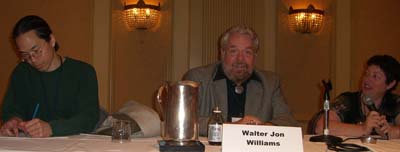
Ted Chiang, Walter Jon Williams and Janine Ellen Young at The God or The Machine panel at the World Fantasy Convention 2006

A lot of western fantasy writers prefer magic to be systematic, i.e. to have laws, rules, constraints. An arbitrary magic, where everything is possible or impossible, depending on whether it is convenient for the author, they don't find very interesting. But does systematizing magic move it closer to science? Not necessarily.

Traditionally it's thought that it's the presence or absence of scientific / technological elements -- the so-called furniture -- that causes most people to view a certain story as science fiction or fantasy. But actually, the worldview expressed in a story may be more relevant. (Though apparently there are no universal criteria how to determine the genre a particular story belongs to, because some people in the audience disagreed over which genre certain books belonged to.)

The full article can be found on my website.

Friday, February 09, 2007

"Email this story": a spammer-exploitable feature?

Yesterday I disabled the "Mail story to a friend" feature on my SFragments site. Why? I think it's parasitic, because it may be exploited by spammers. Since I posted my musings on the spam-exploitability of this feature on my other blog, I got responses from some people that confirmed my suspicions.

Why my website logs were making me suspicious


My SFragments website (where I write about science fiction conventions I've been to and authors I've met) runs Geeklog content management system (though to call it a content management system may be too pompous; it's more like a group blogging system). Every article, or a blog entry if you will, has a "Mail story to a friend" button. By clicking this button, a user is taken to a page where he or she has to enter his own and recipient's email addresses and an optional "personalized" message, then click a button "Send message", which would email this article to the recipient.

Every time a user clicks on something in my website, the HTTP request sent by the user's browser is logged in my website's logs. So when a user goes to "Mail story to a friend" page, it will show up in the logs. And for a few days last week the logs have been showing me that there had been quite a few attempts to email some of my articles -- over 10 attempts per article, ~ 50 attempts a day. No way is my web site so popular that people would be emailing my articles by the dozen. Any time I see high numbers of anything in my logs, my first thought is, spammers. More so because I've already had a problem in the past with my website being flooded with comment spam, of which I wrote in this post. I disabled comments, but I think spammers are ingenious enough to exploit other ways of abuse.

Here is what I suspect spammers were doing


What I suspect they were doing is running a program that accesses the "Mail story to a friend" page, fills in the sender and recipient addresses, fills in the personalized message field with spam content, and clicks the "Send message" button. It all can be done by a script, with no human effort. That way they may be tricking my Geeklog system into sending out spam. Two advantages of this method are that (1) the spammers are not risking that their ISP will shut them down, because the mail is not originating at their ISP; and (2) since the spam message is attached to my article, it has a chance of fooling the spam filters, because the bulk of the text -- my article -- would not appear as spam to spam filters. I've heard that one of the ways to trick Bayesian filters is to mix in spam with huge chunks of "legitimate" text.

I wasn't sure, and still am not sure if that's what was really happening, because the volume of emailing -- ~ 50 messages a day -- was been a bit too low for what you would expect from a spammer. AFAIK, spammers send out ~ 5 MILLION messages a day. At the same time, the volume I'm seeing was a bit too high for "legitimate" users. So I said in my other blog.

Then a blogger Zerolove left this comment:

Could be using multiple Geeklogs!

I use Razor2 and DCC (Distributed CheckSum) to find spam that passes bayesian filtering. If I see that your post was to x number of other users I would block it. So by using multiple Geeklogs it would be coming from multiple IP's there for not only passing Bayes but also passing Razor and DCC. So if they use 100 websites x50 emails each it would add up!


That's an even better reason to disable the "Mail story to a friend" feature, and I did so. (To be fair, the flurry of emailed stories in the logs was a one-time occurrence -- I watched the logs for about a week before disabling this feature, and I didn't notice it again.) But I decided to be on the safe side.

In any case, I can't think of a more useless feature a content management system may have. Does anyone ever use them? I mean, not on my site, but in general? When people want to forward me something interesting, they just copy and paste the link in the email message. I never got stories forwarded to me by way of "Mail this story" feature. So I conclude it is one of those things that perfectly illustrate the law of unintended (and in this case, ironic) consequences: a thing that's only marginally useful to its intended users is widely open to abuse.

Friday, February 02, 2007

Internet phone companies: good for managing your wireless router, if nothing else

A week after we moved into our new house, the internet service at the house disappeared. The wireless router still worked. The signal was strong as ever. But none of the machines could get on the internet.

At first it looked like a screw-up on Roadrunner's part, which was easily fixed


Plugging a laptop directly into the cable modem (we have Roadrunner) verified that the the wireless access point wasn't the point of failure. Steve's laptop, plugged in directly into the cable modem (bypassing the wireless access point), was unable to get an IP address. So the problem was lack of service from Roadrunner. Steve's call to Roadrunner's tech support revealed that Roadrunner messed up switching our account from the old apartment to the new house. Interestingly, this happened a week after the move. At the beginning, they turned on the service at the house on the day of the move, and it worked with no problems. Then a week later they decided to finally cut the service off at the old apartment, and accidentally disabled both. Well, anyway: a short phone call later Roadrunner got it fixed. Their tech support had Steve plug his laptop into the cable modem again, and verified that the laptop was getting an IP address and was able to access the internet. So Roadrunner considered its end of the problem solved.

But the story didn't end here


But the story didn't end there. As we found out a few minutes after Steve hung up with Roadrunner, for all intents and purposes we still didn't have internet access. Despite the cable modem now working, the wireless router wasn't getting an IP address. Various rebootings and resettings didn't help. And we could not call Roadrunner back and ask for more help. Here's why. As I understand it, the type of service we signed up for with Roadrunner has a funny loophole. The contract does not allow more than one computer to use Roadrunner. If we wanted to use multiple computers, we would have to sign up for a more expensive type of service. And if you have a wireless access point at home, it's obvious that you are connecting multiple computers to it. Though in theory, even if you had only one computer, you might still want to have WiFi, so that you could to carry the computer around the house. So I guess Roadrunner can't automatically claim you are violating the contract if you have a wireless router... but still. So there is what I would describe as an uneasy truce between one-computer subscribers and Roadrunner. Roadrunner ignores it if a one-computer subscriber has a wireless router, but they tell you they won't help you administrate your router. That's your responsibility.

Who to call, then, if your router still doesn't work after Roadrunner fixed the problem? (And, I repeat, the wireless part was working well: it was emitting a signal. It's just that it wasn't getting an IP address from Roadrunner. So it definitely had something to do with what RR did on their end -- it would have been too much coincidence if the router just started malfunctioning at the same time.) I suppose we could have called Linksys (the manufacturer of the router). But Steve had a better idea...

Next step: call Vonage


...let's call Vonage. For you see, we subscribe to an internet phone service from Vonage.

Actually, we don't use it. There's no logic in that. Steve got Vonage because it provides very cheap long distance phone calls. The problem is, neither of us makes long distance phone calls very often. It's not like we have no one to call: Steve's and my families live correspondingly halfway across the US and halfway across the world. And the result? Steve talks with his mom on his cell phone; whereas I, since my emigration 12 years ago, have talked with my family on the phone exactly twice. :-) Not because I am an ungrateful daughter and sibling (though I might be :-)) but because spoken word is soooo not my medium. I am a written word person. I like a medium where I can edit myself and present the other party with complete thoughts, instead of half-finished phrases. I like a medium that does not require me to rack my brain trying to come up with filling for "uncomfortable" pauses. So, long distance phone service to me is like a proverbial bicycle for a fish. :-) And there is a significant downside of having a phone service that uses your internet connection: when the internet is down, your phone is down. OTOH, a conventional land line would stay up when the internet is down. So if one needs a land line of any kind (which I don't -- a cell phone is enough for me), a conventional land line makes a lot more sense than an IP phone. So frankly, I don't know why Steve wants to keep Vonage service.

If you are paranoid about privacy, Vonage may not be for you


There is just one little detail about Vonage service that may raise the hackles of anyone who is paranoid about privacy; I on the other hand, believing my files may only hold interest as a fast remedy for insomnia, don't mind surrendering a little privacy for convenience. :-) When you subscribe to Vonage, Vonage "locks" your wireless router so that its tech support could administrate it. By "locking" the router I mean that Vonage has the password to the administrator's account. They still let you administrate it yourself (at least partially) by creating a different account for you. Regardless, you don't have a complete control over your router.

I'm not clear on details of this. Steve said that he bought our wireless router already pre-locked for Vonage! I don't know if all Linksys routers sold in the US are that way (doesn't seem likely to me) or if this one was one of a batch of pre-locked routers sold as part of a deal between Linksys and Vonage, where you could get a Vonage subscription cheap by buying a Linksys router.

How did Vonage tech support fix our router problem?


But when you are racking your brain over what's wrong with your router, it's handy to be able to call Vonage and say "your phone service isn't working" (omitting that we really just want to get on the internet, not to use their IP phone) and get them to fix it. And fix it they did -- they had to. The problem turned out to be interesting. To me, at least. Not technically, but politically.

The answer, suggested by Vonage tech support, was to change the MAC address of our wireless router to be the same as that of Steve's laptop. (I didn't know MAC addresses were changeable, but apparently they are.) Why? Because when Steve made his previous phone call to Roadrunner and had them fix the problem on their side, Roadrunner made it so that only Steve's laptop would be able to connect to their service. Remember, Steve had his laptop plugged into the cable modem during the phone call for the purposes of testing. Roadrunner recognizes his laptop by its MAC address.

So, in order to make the wireless router to connect to Roadrunner, the router now had to be given the same MAC address as Steve's laptop. Once Steve did that, it started to work.

Because they knew a secret Roadrunner kept from us


Of course, Roadrunner didn't tell Steve that they will limit our service to this particular MAC address. Steve had no way of knowing that. If not for Vonage, we would not have found out. And I don't know how Vonage's tech support knows those things: maybe from experience? Maybe they have to deal every day with customers whose service stopped working after they moved to a new house?

So the whole situation looks pretty weird to me. Roadrunner messes with your settings and they won't tell you what they changed. And you can't call them to find out, because hey -- they've done their job, and any problems you may have afterwards are your router problems, not Roadrunner's. Even though RR effectively disabled your router by keeping a key piece of information from you.

I don't know, maybe I misunderstood something, maybe there's more to this story. Steve wasn't most forthcoming with the details. He was in a grumbly mood after those two phone calls, and I don't blame him. Running a tech support gauntlet does that to you. So I didn't press him for details.

Wednesday, January 31, 2007

XML and doilies

I found this blog post on the web that resonated very well with my own thoughts about writing science fiction. Since it was in a password-protected blog, I shall not identify the poster (not that he / she has anything to be embarrassed about).

"Plot always seems to get in the way of nifty ideas. I've realized this recently while looking at Americomics and fanficking; there are so many neat ideas that can happen in scifi/fantasy/superhero universes, but to have a story those ideas must be tempered (and burdened) by an actual plot, having someone do something with or because of the idea.

Personally, this is why I prefer my profession as a programmer/web developer, and my hobby as a writer of bad fanfic. As a programmer I get paid to make nifty ideas, but I'm not drudged down with actually having to do anything with them. That's what users are for. :)"


It sums up so well what I've been experiencing as I toil away at my own writing. Plot indeed gets in the way of nifty ideas. And programming lets you express your ideas without burdening them with a plot. But, unlike the author of the comment, I haven't given up a search for a perfect balance of plot and ideas. Or I should say, a search for a plot that would work with the ideas, not against them. It's very hard, but it's also one of the most interesting things I've done in a long time.

(And I don't write fanfic, BTW.)

It could be that my daily mindset, imposed on me by my work as a programmer, works against these efforts. To me, thinking about programming is not verbal, it is spatial / visual. Ideas come to me as visual structures, not as words.

The images they may take are sometimes amusing. One sleepless night, when I ruminated on some programming problems I'm currently working on (because it was more entertaining and less futile than trying to force myself to sleep), this visual popped into my head. XML files were hanging from a clothesline by their angle brackets. They looked like doilies. Or maybe paper snowflakes. They had jagged / scalloped edges, where the jaggedness was realized on several different scales. The angle brackets made up the lowest-level jaggedness, and the identations of nested XML tags provided several scales of higher-level "scallops". Doilies (or paper snowflakes) are like that, too. I was probably 9-10 years old by the time I made my last doily. In the time and place I grew up, girls were required to take classes in "feminine" crafts, such as sewing, knitting and crocheting. And doilies are the easiest thing to crochet, so they were the staple of the craft classes. Even my 10-year-old self realized how lame this particular element of home decor is, but not before its imagery invaded my figurative thinking. Such are the vagaries of a girly mind. :-)

Wednesday, January 17, 2007

Cute analogies

A few posts ago I was musing about the best ways to introduce scientific ideas in science fiction, to explain them in terms vivid enough to intrigue a reader, instead of slowing down the action. In Sunday's New York Times magazine I found an inspiring example of how it can be done. (I put the particularly memorable sentence in bold.)

Where Protons Will Play

To be sure, the article I'm referring to is a science fact article, not fiction, but I think there's something to be learned from this little perl of explanation. I'm not being sarcastic -- this excerpt seems silly and clever at the same time:


[F]locks of protons will be made to zip around the tunnel in opposite directions at nearly the speed of light. Then they will be forced to crash into each other, with (it is hoped) spectacular results for physics.

Physicists, you see, learn about the subatomic world by smashing things together and then looking at the debris. Imagine a midair collision between two watermelons; it would make quite a mess, but nothing very interesting would result. Suppose, though, you get two protons to collide head-on. If they are moving fast enough, the energy of their collision, converted into mass à la Einstein's E=mc2, will produce a shower of new particles. (It would be as if colliding watermelons splattered into a shower of pineapples, blueberries, mangoes and more exotic fruits.)

Tuesday, January 16, 2007

A suggestion for IKEA: how to get customers buy more while helping them less

At IKEA (where I went last weekend to look for dining tables and other furniture for the new house) I got an impression that it prides itself on having streamlined the shopping process to a fault, on getting the customer to glide smoothly through their shopping apparatus without disturbing a single cog (read: employee) in the machine.

Communist-style customer service with a positive spin!


All throughout the store you can find tips on how you, the customer, can save work for the store's employees, thus keeping IKEA's costs down. IKEA is the first store I've seen that actively, openly discourages you from using its workers for what they are for: to help. "Why should I clear my table?" asks a sign in the cafeteria. Answer: because it reduces the amount of work for the employees, and with fewer employees, we can keep our prices low. Why should I try to figure out where to find things on my own, instead of asking for help? asks another sign (in a much more polite/cheerful language, though). Answer: the less help you need, the fewer employees we need, and that helps us to... all together now: Keep Our Prices Low! :-)

In other words, IKEA customer service concept eerily reminds me of the Communist-style service, where the customer was treated as invisible at best, or worse, as an intruder. However, I have to admire IKEA for putting such a positive spin on it: you, the customer, are not unwanted or invisible, you are smart, capable and self-sufficient for doing things yourself, figuring out things on your own! We are not ignoring you -- we are empowering you! :-)

And the store is indeed well organized to help you be self-sufficient, from take-home maps with shopping lists on the back, to the flat car-friendly packaging. And despite all the discouragement, the store employees are friendly and helpful when you dare to approach them. So I'm not griping. But there is one more thing they could do to be more consistent with their spirit of efficiency and customer empowerment.

Namely...

Technology that has a potential to send people on a shopping spree


Currently IKEA provides blank shopping lists on the back of take-home maps, so that you could scribble down model names and prices of things you want. That's better than nothing, but it would be much better if they invested in a bunch of scanning wands, which the customer could wave over the barcodes of items they are interested in, and automatically add them to their shopping list or wish list. The shopping/wish list could be instantly posted on IKEA's website (protected by a username and password, of course). The customer could keep it private, or make it public, or available to friends, and such. The list could even be made accessible to the customer's friends from LiveJournal, MySpace or any social networking site, with their login credentials obtained from that site (eliminating a need for friends to create a separate account); or it could be integrated into one's Amazon wish list. Or some combination thereof. Of course, the customer would also have an option to keep the list private and use it for their own reference instead of as a gift registry.

And if they wanted to go really fancy, scanning wands could be equipped by digital cameras (a cheapo kind, as in cell phones, would suffice) so that the customer could take his/her own pictures of the furniture, which would be instantly added to the item's description in the wish list. Even though IKEA website already provides images of things, in my eyes they are not represenatative of how the items look in reality. I, as a customer, may want to take pictures of things from different angles, to capture the aspects that are important to me.

A wand-generated online shopping list would be much better than scribbling your list on a scrap of paper, because scraps of paper get lost, pencil marks fade and smear and what-have-you. Also, an online shopping/wish list can easily be shared between, and added to by, other family members.

And think of the "going wild" aspect of it! To point and click at things is just... cool! It's a game! It makes you want to point and click more! And the more items you have on your list, the more you may end up buying!

As far as I understand, some stores already use scanning wands to enable customers create gift registries. I saw customers wielding wands in Babies'R'Us. So it's not a new idea. But it would be nice to extend it to creation of shopping lists. Anything that makes it easier for customer to keep track of what he/she wants, makes it easier for them to buy. I wonder if investing in such things would actually result in bigger sales for the store.

Sunday, January 14, 2007

A review of "Cross Plains Universe"

I recently finished a short story anthology titled "Cross Plains Universe: Texans celebrate Robert E. Howard". It was the official book of the World Fantasy Convention 2006. I'm not sure what "an official book of a convention" means, but in practical terms it meant that every convention member got a free copy of it.

I haven't read anything by Robert E. Howard and don't really plan to, since barbarians are not really my thing; so I can't say that a tribute to Howard is of great interest to me. The main reason I read this anthology was for its social value. The FACT reading group was going to discuss it at one of their meetings. I thought this book might be worth reading as a facilitator for socializing with the FACT people. :-) Another reason I read it was because I kind of/sort of know many of those authors -- not very well, but I've run into many of them at various SF-related events in Austin, and talked with them on some occasions. So it was interesting to see what they werex like as writers.

There were two kinds of stories in the "Cross Plains Universe" anthology. One, stories about Robert E. Howard. Maybe I would have appreciated them more if I had known a fact or two from Howard's biography. The only one of those stories that amused me was "A Whim of Circumstance" by Mark Finn, because it's funny even if you (like me) know nothing about Howard and are not interested in his writing: this story stands on its own.

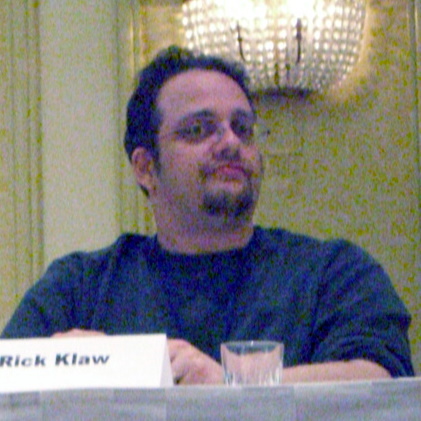
Rick Klaw's "A Penny A Word" also has a nice crypto-historical twist.

Rick Klaw at the Lone Star State of Fantasy panel at the World Fantasy Convention 2006
Rick Klaw at the Lone Star State of Fantasy panel at the World Fantasy Convention 2006, discussing other famous Texas fantasy writers besides Robert E. Howard.

The second kind of stories in this book did not have Robert E. Howard as a character, so I can only guess the reason they were included was because they were written in Robert E. Howard's spirit or style. But I can't be sure because I haven't read anything by him.

From the tribute stories I inferred certain things about Howard's writing. Such as...

If my guess is correct, I got an impression that Robert E. Howard's stories

  1. were adventure fantasy (which I already knew);
  2. were often set in exotic countries;
  3. featured scheming seductresses who get men to do their will and then betray them;
  4. featured a quest for diamonds or some interesting artifacts hidden in chambers, and
  5. the chambers were guarded by supernatural beings.

Of several tales in "Cross Plains Universe" that featured these plot elements, I found Chris Roberson's "The Jewel of Leystall" to be more interesting than others, because the diamond turned out to be not what it seemed. There was even a slight science-fictional aspect to the story. Also, the centipedes were cool.

Oh, and (6): to a lesser extent Howard must have written about large apes as well, because two of the tributes featured such animals. That's a far lesser number than the number of stories about seductresses and diamonds, but still, there was a minor trend there.

Overall, this collection was a pleasant read -- none of the stories, except one or two, were actually boring -- but the reason why this book won't stick in my mind is because most of those tales seemed rather pointless to me.

Because?

Most stories seem unfinished, as if they were excerpts from a larger adventure

They were snippets of adventures that may make sense if they were chapters in a novel, and you could imagine that a resolution awaits a few chapters later. But the stories themselves were often without a resolution. Howard Waldrop's story about two guys who go to Mexico and see weird things there, or Jessica Reisman's story about two girls who get transported into a fantasy world, are examples of such. Too bad, because they are written quite amusingly -- they have cool "furniture" (to borrow a phrase from Walter Jon Williams). It's just that you expect something important, life-changing to happen to the characters, or at least something that would justify the whole adventure... or barring that, an unpredictable plot twist... and nothing happens. The very first story in the book, about a Roman warrior who encounters ghosts in the forest, is another example of a pointless adventure. And it does not even have cool furniture.

Of all the adventure stories, the one I liked the most was Lawrence Person's "The Toughest Jew in the West", because it does have a meaningful and somewhat unexpected ending.

Can this book inspire one to read Robert E. Howard? Hardly.

Was this book supposed to inspire me to read Robert E. Howard? If so, it failed. Then again, the idea of judging the quality of Robert E. Howard's work from the tribute stories reminds me of a joke that used to be popular in $my_home_country. This joke is usually told about a certain ethnic group, and it's not fair to it (as if any joke is), so I need to scrub it of all the references to that ethnicity. So let's say the characters were named simply Bob, Joe and Jim.

Bob tells Joe that Luciano Pavarotti is in town on a tour, and will sing in a local opera production for one night. He grumbles over the fact that he can't afford the outrageously expensive tickets. Joe says: "You're not missing much: Pavarotti can't sing worth crap. I know -- Jim sang one of his arias for me over the phone".

Now that I think about it, what I find fascinating about this joke is not so much its punchline, as its premise: a bunch of ordinary, straight guys fretting about not being able to go to opera! This joke would not make any sense in the US. Did I grow up in a strange place and time, or what?

Sunday, December 31, 2006

Part 4: possible solutions

Approach 2: use a fantasy setting for a science fiction novel.


How does it address problem 1? Obvious. My characters can be ordinary humans, and I can bring them to life using the common tools writers use to characterize the protagonists and their surroundings: appearance, clothing, gestures, descriptions of nature, architecture, etc. A bonus: I can use fantasy cliches -- in a good way, as shorthand. (The Fantasy Cliches panel in this year's World Fantasy Convention validated my temptation to use this approach. :-))

How does it address problem 3? Well, a fantasy world can be anything I want it to be, and it does not have to correspond to any real-life setting with which my readers may be familiar, so there is no requirement of accuracy. Thus, I don't have to imitate a cowboy dialect, or street slang, or British upper class speech mannerisms, or any of those things I'm completely ignorant of.

How does it address problem 2, the problem of introducing unusual ideas and explaining them without slowing down the action? Perhaps it doesn't; it's just that at least a fantasy setting doesn't work against it, because cliches-as-shorthand can move the story along to counteract the slowdown caused by explanation. The trickiness of this appraoch is, of course, how to reconcile science-fictional ideas with a fantasy setting. Advanced scientific ideas can't spring out of nowhere in a non-technological society. Well, there is an old cop-out: the science in question was introduced by an advanced technological civilization that long ago had visited the world where the action takes place, and left its artifacts, or perhaps passed some of its knowledge to a special caste of priests or wizards. It's an old, hackneyed setup, but I'm not going to reject it just because of that. The editors on the Fantasy Cliches panel swore up and down that cliches are OK if the story is good. They also said 90% of attempts to completely avoid cliches lead to a dull story without a plot. Who am I to argue? :-)

I already have some ideas for a story or, hopefully, a series of stories, that will use Approach 2. Of course, I can't use this approach in each and every story I write (unless it's a series of connected stories), or it will get old very soon. Still, now that I've thought of two ways to navigate around my roadblocks, it gives me something to do. For the next couple of years, even. :-) If I successfully implement both, I'll be in good shape. Then I'll have to worry about what to do next, but perhaps by then I will have built stronger writerly muscles and will have acquired a bigger arsenal of tools.

Though it's not easy to feel too optimistic about it at the moment.

Saturday, December 30, 2006

Part 3: possible solutions

Addressing problem 1. How to "flesh-out" protagonists that don't live in the flesh?


Approach 1. Maybe my protagonists could live in virtual reality. That is, while they are crossing the unfathomable depths of space incarnated as rays of elementary particles, they could imagine that they are something else somewhere else, floating in some kind of consensus reality, projected by the same computational devices that encode their personalities. That way they could build all kinds of imaginary worlds and imaginary bodies for themselves; without human constraints, their interactions could be even richer than they are in the human world.

Advantages of this approach


Indeed, if one lives as a ray of particles, which sounds like a rather boring life, wouldn't they want to spruce up their bland reality with a little imagination, by pretending to be, say, a giant squid or a cartoon character?

Something in me whispers, no, they wouldn't. Their reality only looks stark to us, meat-humans; the encoded personalities would probably see it as something entirely different and much richer. To paraphrase a Confucian saying, to suggest to them that they may add variety to their lives by re-enacting a fictional reality based on human imagination would be like asking a lion to become a cockroach. :-)

But this approach would solve all 3 of my problems (which I talked about in the two previous posts) pretty well. It's obvious how it would solve problem 1: in a virtual world the characters can be fleshed out in as much detail as I want. It would also go a long way toward solving problem 2. Whatever idea you come up with, it's easier to show its consequences in action in a virtual world, governed just by your imagination, than in a physical world with its "hard" constraints. And problem 3 can be avoided too, because a world governed by your imagination does not have to match the reality your readers know. So you can get away with knowing fairly little about it.

And since I write my stories for my contemporary human readers, not for the actual future humans who may encode their personalities onto rays of light, I need not try to attain a realistic portrayal of the existence of photon-encoded personalities, the way it may actually be some day. (As if I could). I only need to make the story entertaining, and the characters convincing, to my contemporary humans. And if lions have to become cockroaches in order to become accessible to us, so be it.

All in all it seems not too bad an idea, to let my "abstract" protagonists live in a virtual reality of their own creation. And they may even have a reason to want it, given that they originated as humans. Their personalities were copied from actual human personalities. So they may still have some human sensibilities (until they discover how much richer is the reality once you eliminate human constraints).

Disadvantages:


This approach is basically a one-trick pony. I can set one of my stories in virtual reality, but not all of them. I already tried this device in one of the stories I worked on this year. After spending several months on it and rewriting it in at least two different versions, I was so unsatisfied with it that I pushed it way, way to the back of the back burner. :-) Also, it ballooned way beyond a short story and into the territory of novella. In which case, I thought, hell, why not make it a full-blown novel? But it will have to wait until I have built stronger writing muscles. Because in the state it is now, I still haven't found that proverbial Archimedes lever for this story that would move its world. :-) (Even though I've mulled over the ideas suggested by my friend D, I still can't satisfactory wrap my mind around it. One of my fonder wishes for the New Year is to find the Archimedes lever for this story in time for the next year's NaNoWriMo. :-))

Regardless, there is a limited mileage I can get out of the virtual reality setting. After I used it once, I won't be able to reuse it. So I need to think of other approaches as well. More about them in the next post.

Friday, December 29, 2006

Part 2: Other problems I face when writing science fiction

Problem 2. It's hard to incorporate science-fictional ideas into a story without slowing the action down.


Introducing science-fictional ideas that are -- at least I hope -- somewhat new, is a double-edged sword. Of course, all SF writers strive for originality. (I'm trying to silence the cynic in me who says a lot of writers have no aspirations to originality and simply write what readers are known to like. "Extruded science fiction product", to paraphrase Lawrence.) New ideas help to achieve originality. New ideas also mean you can't rely on cliches, or on popular science fiction tropes. New ideas mean there is much more you have to explain to the reader before he or she can make sense of your story. This was one of the thoughts expressed in the World Fantasy Convention panel on cliches, and it's funny that it took me perhaps several weeks to realize how relevant that panel was to what was going on in my writing life.

For example, you can use tropes such as faster-than-light without explaining them to your readers, since everybody understands the concept. But if your story is based on an idea less overused than this -- for example, on quantum entanglement, which I haven't seen satisfactorily explored in most SF I've read (Greg Egan notwithstanding) -- you have to explain it. This is always hard, as such an explanation needs to be woven into the action, instead of presented as an infodump. Not only it is not easy to generate a chunk of plot that would clarify a particular concept by letting the reader see its workings, but it also makes the story longer. And (this is just my rule of thumb, though) the longer the story is, the more interesting it should be in order to keep a reader's attention.

Problem 1 and Problem 2 feed upon one another, magnifying one another. On one hand you have bare-bones characters (or should I say, bare-particles characters? :-)) without literally much meat on them :-) . They resist vivid characterization, making it harder for readers to identify with them, hence, making the story less interesting. On the other hand, complex or novel ideas, or at least their explanation, slow down the movement of the story. To recap, giving up the familiar for the sake of innovative makes the writer's job much harder.

Problem 3. To write about the familiar is hard in its own way.


The above did not imply that familiar stuff is easy to write about. Definitely not, at least not for me. Portraying the conventional reality is a tall enough order in itself, because my readers, too, are familiar with it (often better than me), and they can call me to task if I haven't portrayed it convincingly. I am always in awe of writers who can accurately convey speech patterns of various ethnic and socio-economical groups in such an evocative way that a few sentences uttered by a character vividly paints him or her as belonging to a certain group, leaving the reader's imagination to fill in the details. For me, this skill seems just as unattainable as a figure skater's triple axels. All my characters sound the same. I don't know if I'll ever make progress in this respect. So I try to find a way around it by avoiding writing about anything that has recognizable traits of our everyday reality. It's a cop-out. But at this point I feel I have to do it if I want to write at all. If I wracked my brain trying to think of a speech mannerisms and turns of phrase that would best characterize my protagonist, I would not make any progress at all. I would stare all day at the blank screen and feel incredibly demoralized.

So, writing imaginary stuff interestingly is hard, and writing familiar stuff is hard in its own way. But writing imaginary stuff is easier to me overall, so I'll stick with it. For now. I just need to think of ways to conquer problems (1) and (2).

How am I going to address these problems? How should I balance familiar against the unfamiliar? What is the perfect ratio of familiar and the unfamiliar, so that the story would feel innovative, but not so alien that the reader would lose interest? I thought of a couple of approaches, which I shall explore in the next installment.

Thursday, December 28, 2006

A long essay on why writing is hard for me, part 1

I have almost finished writing another science fiction story. The third this year. Or maybe a third-and-a-half, if we count a short-short story I wrote as a semi-joke. However, this story is not completely finished. Nor is it truly unfinished. It is in a strange state where most or all of its content is written down, but paragraphs, or entire blocks of paragraphs, need to be reshuffled, so that the content could be presented more convincingly. I doubt I'll do it this year.

It needs to sit and marinate for a while, and I will have to return to it with fresh eyes.

I tried to identify to myself the difficulties I experienced with this story. I thought I'll be able to explain them in a few simple sentences. Once I started putting them on paper, the few sentences ballooned into a long essay. But the final week of the year is an appropriate time for long essays on things I've learned this year, is it not? Thus, I'll present my musings in installments over the next few days.

Problem 1. Protagonists without outward characteristics are boring.


It is hard (for me, anyway) to write a story with characters that don't exist in human flesh. (I'm speaking about my most recent, not-quite-finished story, but the problems I'll describe here are specific not just to this story, but also to almost all story ideas I have in mind. They preclude those ideas from turning into finished work.)

The characters of my most recent story used to be humans, but their personalities have long ago been digitized and encoded onto rays of elementary particles. They still have ties to the humanity, though -- in fact, they are working in service of humanity. They are hurtling at light speed across the universe on a mission directed by a human government. So they are not total strangers to humanity, far from it.

Regardless, the physical reality surrounding them is nothing like ours. They don't have anything like our senses, perceptions or body language. So I can't describe their interactions among themselves, and with the environment, in the usual way one would describe human interactions. For example, the whole aspect of appearance and body language is lost. I can't add depth to the characters by describing their clothes or their posture or bearing. Rays of particles don't wear clothes, they can't shrug their shoulders or smile. ;-) I can't even use expressions like "he saw" or "she heard", because their perceptions of the world -- the information they get from cosmic radiation and the like -- are nothing like hearing or seeing.

In a word, when you remove all the outer human characteristics, it's hard to keep these protagonists from coming out very one-dimensional, and their conversations rather dry and flat. This has made me doubt whether this story was viable at all. That's why I'm letting it marinate, on paper and in my head.

There is a real dilemma here. If you want your story to be set in a distant future, it would be silly if your protagonists looked and acted and had similar mannerisms as the 21st century people. It would be even sillier if we created far-future humans by taking our contemporaries and decorating them with superficial "futuristic" high-tech and body-mod bling. I've seen this done in science fiction, and those characters inevitably came out looking like a little more radical version of a 21st century pagan-bisexual-pierced-tattooed-burning-man-going urban hipster. That's not at all what I wanted for my characters. So it would seem wise to give up any pretenses at being able to extrapolate their outward appearance, and forego the appearance entirely, focusing only on their thoughts and dialog. But that leads to protagonists being rather flat and boring.

That's one aspect of the difficulty I'm having. I'll talk about another aspect in the next installment.

Wednesday, December 20, 2006

For a moment I thought, maybe it was just me.

(See the header of the pre-previous post.)

I got a new laptop at work, which, to borrow a phrase from certain digerati, I'll call Teh Shiny. :-) It has both Windows and Linux on it. Our SA at work installed Debian on it. That's the only distribution he supports. For a short while I was truly impressed with how well and painlessly it worked. It only took Steve about 2 hours to get the wireless connection working, as opposed to days and days he spent on my other Linux laptops (with very little result). And the wireless connection was stable from then on, instead of flickering on and off. That was encouraging. The laptop also recognized USB devices and did not crash when a USB device was plugged in. When I plugged in my camera, it came up automatically. More than that, when I tried to play an .AVI movie file, it played! In my previous attempts to play movie files on SUSE 9.1, the player immediately crashed, or in the best case, played the sound without the video. This was a quantum leap above my previous experiences with Linux.

I was happy, except for one little detail. There was no sound. The movie was silent. The sound icon on the desktop was set to the minimum, and when I tried to push it towards the maximum, it would bounce right back. So I asked the SA at work if he could do anything about the sound. He thought it shouldn't be hard. Well, after spending a day working on my lappy, he told me that with all the customizations he made the laptop has diverged quite a bit from standard Debian, and he would like to install Ubuntu on it instead. (No word as to whether he got the sound to work, but if I had to guess, the answer is no -- otherwise why would he want to install a different operating system on it? :-))

So now I'm thinking, as an answer to the question raised in the pre-previous post, maybe it's Not Just Me. :-)

Monday, December 18, 2006

FACT group discussion of Stanislav Lem's "Cyberiad"

In May of 2006 the FACT reading group discussed "Cyberiad" by Stanislav Lem. Most of the attendees (~ 6-7 of them) liked the book. A few of them had read Lem before, mostly his novel "Solaris".


It was noted how well "Cyberiad" held up from the technological standpoint. "Cyberiad" was written 40 years ago, but its scientific / technical ideas don't appear obsolete. It is about computers and machines but doesn't have specific technology that dates it. One reader compared it to "White Light" by Rudy Rucker, saying Rudy Rucker's mathematical science fiction has some of this flavor.


I myself was also impressed by how Lem had found a way to write science fiction that is not threatened with becoming obsolete in the next decade or the next five years. That's because "Cyberiad" is already very obviously a farce, and nothing in it should be taken literally. As illustrated by the passage (page 147): "By now the stars have vanished in the general gloom, so the two proceeded gropingly, till suddenly their ship lurched, and all the furniture, pots and pans went flying". The characters of his tales, the two robots, are so smart they can construct machines that simulate entire civilizations, yet the ship they fly in is furnished with pots and pans. Not to mention that being robots, they presumably don't need to eat, much less cook. But in this farcical manner he explores very interesting questions about human nature, and the nature of the mind.


A flipside of this lack of technological explanations is that more than one person felt the stories in "Cyberiad" would be best characterized not so much as science fiction but as fairytales. Some saw it as a positive, and others as a negative.


Reader 1. "I have to be hog-tied to read fantasies and modern fairly-tales, because there so much fo its is... there's suspensions of disbelief, and then there is hanging it by its neck until its dead. Despite that, I am enjoying [the Cyberiad]. It's not dating itself because it's totally ignoring technological explanations."


Reader 2. 'I'm gonna take a somewhat different tack. I was impressed by translation, it's an easy read, but I don't see any science in it. It's a mechanistic fairy-tale. Having done some AI work, [I can say] it has nothing to do with computer science AI." He quotes the book: "'Postulate everything with letter N' -- it's not how computers work. It didn't bother me, but it early on told me that it's not science." He gives another example: "[how can you say that] one planet is behind another? "


He deemed the science in "Cyberiad" to be completely unscientific, and thought it was primarily a framework for a social commentary.


And this brings us to another of the book's characteristics, widely noticed by the readers: that its main purpose was to be a political satire. Or so the readers perceived it. Stanislav Lem wrote "Cyberiad" in the socialist Poland, where literature, art, and all public discourse were heavily controlled by the communist government, to keep out the ideas they considered threatening to the communist ideology. Several of the FACT readers pointed out various methods Lem employed in order to get his message past the censors.


Reader 3. "It's very interesting that he's using the early Greek myths as a backdrop for doing this kind of thing, making it very fun. His descriptive style is very much as an early socratic dialog. It fits very well with what he's doing. Lem employed Socratic dialogs in Cyberiad to get past censors. "


Reader 2 comments on how Lem had to shape Cyberiad to fit the mold of socialist realism, as was required of writers in a communist society. "I thought Cyberiad was a framework for a social commentary. All the strawman bad guys are monarchs, because it is acceptable to say bad things about monarchs. In a society where fantasy has a bad rap, a mechanistic fairlytale [is the best framework]." He brings up an example of the story where the soldiers' intelligence combines and everything stops fighting. "I think that combining things for a better result is a very communistic idea."


Reader 4. "Lem is Hegelian in his thesis and antithesis, which I think is one thing socialist realism liked. All of Lem had to have socialist realism, because that's what the state said was literature. He liked Strugackys and Bulgakov and others. If you set your story elsewhere, since it wasn't set in Poland, you could say something Polish readers would agree with, but censors would allow. "


Readers admired Lem's style, his language and his sense of humor. Everybody enjoyed Lem's way with dialog. A few people noticed influences of Greek philosophy on Lem.


Reader 5. 'I read it 30 years ago and I loved it. But I was an undergrad in physics. But today it seems like a different book, because of how much Greek I studied since then. You are right: these are fables. They always have a point. You are supposed to learn something from each story. Epigram is probably a Greek word I'm searching for. Every story is a parable, and it seems too Greek to me. "


Reader 6. "In a good way."


Reader 1. "I think it's got a realy incisive quality. "


She mentions the strange, nonexistent words starting with letter N, which are listed in the first story.


Reader 6. "You wonder why those words are not familiar, and then you find out there is a reason for it."


One will need to read the first story of Cyberiad to find out why they are not familiar, though.


Everybody admired how well the translator of "Cyberiad" did what must have been a tremendously difficult job. People were impressed that a lot of Lem's jokes came through in English translation, and appreciated the effort it must have taken to translate the poetry.


Reader 5. The amount of effort those 6 lines (the Samson poem) took, probably was days.


(Here is what he is talking about. Imagine having to translate this into a foreign language. Every word needs to start with letter S.


Seduced, shaggy Samson snored.
She scissored short. Sorely shorn,
Soon shackled slave, Samson sighed,
Silently scheming,
Sightlessly seeking
Some savage, spectacular suicide.)


I'm sure the famous "Love and Tensor Algebra" must have been just as difficult to translate.