Showing posts with label Charles Stross. Show all posts

Friday, November 11, 2011

ArmadilloCon 2011: The Singularity panel

Singularity is commonly associated with emergence of strong artificial intelligence, and the panelists don't think strong AI is any closer now than it was at the time this topic was discussed on ArmadilloCon panels of the past. Or 30 years ago. Or ever. Singularity is certainly no closer than when Vernor Vinge debated it at ArmadilloCon 2003, or Charles Stross at ArmadilloCon 2006. Moreover, some panelists disagreed whether moderator John Gibbons' question "What do you see as a fundamental block towards strong Artificial Intelligence?" is even the right question to ask. They disagreed whether it is possible to bring an AI into being by programming it.

This was a well-reasoned analysis of common Singularity tropes.

Trope 1: Singularity will come from the emergence of strong AI

Bruce Sterling admits that he used to find the idea of strong AI seductive, but doesn't see any evidence of it emerging any time. More, he doubts whether the products of intelligent mind, such as new ideas or inventions, can be attained computationally. "I know many very intelligent people, and they don't reason stuff out of the first principles," said Bruce Sterling. It certainly doesn't "feel like" creative insights come to us algorithmically. And if flashes of insight can't be simulated by a Turing machine, then they are not achievable by a computer. "Computation is not like human intelligence," says Sterling. "It's like mathematics. You could say, mathematics will one day overtake the human brain! But that would be a category error."

Left to right: authors Alexis Glynn Latner, Adrian Simmons, John Gibbons Left to right: authors Alexis Glynn Latner, Adrian Simmons, John Gibbons at the Singularity panel. More pictures from ArmadilloCon 2011 are in my photo gallery.

Bruce Sterling thinks collective intelligence is more interesting than artificial intelligence. When you are starting a company, would you hire HAL 9000, an intelligent machine who never sleeps, or a bunch of engineers who use Google, he asks. Google would immediately defeat HAL. He didn't answer another panelist Adrian Simmons' question if it wouldn't be even better to hire a HAL who uses Google.

Then Bruce Sterling left the panel to go help his daughter who was at the other end of town, adding "Real futurists have children!"

Trope 2: Moore's law will inevitably lead to strong AI

Both the panelists and the audience doubted whether the advance of AI has hardly anything to do with Moore's law. We already have extremely powerful computers for extremely complex weather and economic simulations, but you can't speak about their IQ.

Trope 3: Sentient computers care about the existence of humankind one way or another

Would we even want a sentient machine? John Gibbons reminds us that Charles Stross, author of Singularity-themed novels, asked this question in a recent blog post. What do we need a sentient machine for? While we conceivably might want an intelligent computer to run a spaceship on a long mission, like HAL 9000, in general there's not much advantage to sentience in a software program, argued John Gibbons. And it raises a huge batch of ethical questions. Using a genetic algorithm to derive sentient software? You're committing genocide along the way, because you're killing off versions that don't meet your goals.

Left to right: authors Katy Stauber, Marshall Ryan Maresca, and Bruce Sterling Left to right: authors Katy Stauber, Marshall Ryan Maresca, and Bruce Sterling at the Singularity panel. More pictures from ArmadilloCon 2011 are in my photo gallery.

Even if a sentient AI is benevolent to the humankind, it can't be expected to do what humans would like it to do, Adrian Simmons pointed out. You may ask it how to make better gadgets, but it will instead turn around and ask you personal questions, because it might feel it's human now, and wants to experience a human perspective of the world. (Even that, I should say, is a bit human-centric, if not to say myopic. An AI might not be interested in learning from humans, since by necessity it would develop its own way of learning about the world: else it would not be an AI. It is a common trope in science fiction that a robot or AI yearns to know what it is like to be human, but I think we as humans overestimate our interestingness to the machines. We absolutely can't expect them to take an interest in our problems, let alone serve us. -- E.)

Trope 4: Singularity will come from augmentation of human brain

But machine intelligence is not the only way for Singularity to come about. Bruce Sterling said: increase of a metabolic efficiency of certain regions of the brain (that are dedicated to higher functions), and it will feel like Singularity. Our brain is very inefficient -- the biggest parts of it are dedicated to such functions as walking. So an increase in efficiency of higher reasoning parts of the brain could bring about enormous changes for the humankind. Science fiction has already addressed something similar, such as repurpose visual cortex to do other computations, an audience member pointed out.

Trope 5: Singularity will come from uploading a human personality to a machine

The panelists doubt whether that will ever be possible, because it seems like such a stretch between the chemistry of "wetware" and computational substrate. Here, too, science fiction has shown how horrific unintended consequences of this can be -- case in point is Greg Egan's story "Learning To Be Me".

Trope 6: Singularity will come from the web "waking up"

A person in the audience asked: if we organize semantic connections on the web, will the web "wake up"? John Gibbons reply was what I would have said too: becoming conscious requires a model of self. And it's hard to see how that model of self would emerge simply by organizing semantic connections on the web.

Sunday, June 29, 2008

Charles Stross "Glasshouse": FACT reading group discussion

13 people attended the FACT reading group discussion of "Glasshouse" by Charles Stross. Everybody but 1 person has read Stross before. 11 people started the book, about half of the people finished it.

"Glasshouse" is set in the same universe as Stross' earlier far-future novel "Accelerando". To quote an Amazon.com review, the protagonist Robin "is one of millions who have had a mind wipe, to forget wartime memories that are too painful -- or too dangerously inconvenient for someone else. To evade the enemies who don't think his mind wipe was enough, Robin volunteers to live in the experimental Glasshouse, a former prison for deranged war criminals that will recreate Earth's "dark ages" (c. 1950 -- 2040). Entering the community as a female, Robin is initially appalled by life as a suburban housewife, then he realizes the other participants are all either retired spies or soldiers. Worse yet, fragments of old memories return, extremely dangerous in the Glasshouse, where the experimenters' intentions are as murky as Robin's grasp of his own identity."

Future shock -- from uncomfortable to hilarious


Since all the characters participate in a full-time social experiment, the readers thought the setting resembled Big Brother, The Prisoner, and The Sims game.

One reader called this plot device Gulliver travel. Just like an Englishman Gulliver traveled into the Lilliputian lands and put his experiences with them into a framework we can understand, a far future person (Robin) traveled into the past (our world) and told us how it looks like from his perspective. Robin / Reeve was more than a bit shocked by our reality, and it was amusing to see what shocked him / her. Stross does a good job to make the reader feel strange about things we've been taking for granted. For example, Reeve's first look at the bathroom in her 20th century-style house makes her think that the bathroom has crashed, because all the appliances remain extruded. Apparently in the far future appliances retract into the walls when not in use. Some readers found this scene hilarious. Also, Robin / Reeve's perspective made me feel abnormal to have an "ortho" body that can't take different shapes, the way far future humans' bodies do.

Not everybody felt that way, though. Some readers didn't like it that the characters switched their gender "all the time" (twice, actually, but that was two times too many for some people), or were dubious that the characters would be as comfortable in the body of opposite sex as they were in their originally chosen sex.

Others liked the ramifications of gender switching. A reader said: "if I'm in the universe where bodies are malleable, and I fall in love with you, to what degree it's mental chemistry and to what degree it's physical chemistry? I found that thing highly entertaining." She was also entertained by Robin / Reeve's outrage at discovering that an orthohuman female body she was given had no upper body strength.

In any case, the characters of "Glasshouse" are likeable and transparent. I'm not sure, though, if "Glasshouse" doesn't seem too simple to me, compared to the strangeness of "Singularity Sky" or the far-reaching ideas of "Accelerando". While "Glasshouse" uses the technology described in "Accelerando", in this book it is merely a backdrop or furniture. On the other hand, this book actually reads like a novel, with real characters, as opposed to popular science essay collection with talking puppets, like "Accelerando".

Sheds the light on mechanics of a totalitarian state


Some people who lived in the 50s were impressed how Stross got many things right about the 50s, especially considering he wasn't alive back then. "He really nailed the small town, neo-Victoriana fundamentalist mind set of the 50s," said a reader. "To me, the 1950s were not a time of jolliness and fun, they were time of being afraid of the government. And having a lot of nosy adults sticking their noses into my affairs".

I don't know about the 50s, but I can say that "Glasshouse" painted a very convincing picture of how an authoritarian state comes into being. The social engineering by which peer pressure works to support a dictatorship, causing even well-meaning people to become enforcers of an authoritarian government, was portrayed brilliantly. The "Church" in the novel serves no other purpose than to keep people in line, and a reader observed that that's exactly what the purpose of real-life churches in small towns seems to be. The same reader also praised Stross for noting how certain parts of Christian liturgy can be very frightening to someone looking at it from an outside.

Some people said "Glasshouse" took them a while to get into. Some futuristic details, such as time measured in kiloseconds, megaseconds, etc., slowed down some readers' progress. One reader was nearly ready to give up after having to interrupt the story again and again to convert megaseconds or gigaseconds into our conventional units of time (even though a conversion table is provided in the book).

But when the book got going, it became fun, people said. The ending was thought to be brilliant by some, and cheesy by others.

A controversial ending, and other SPOILERS!!!


One reader said the last 60 pages where everything changed blew her brain. "I thought it was really terrific," she said. "I reread that whole section twice. I think it takes a real skill for a writer to pull a rug from under the reader." Another reader wasn't too impressed. She said "the end just made me laugh. How cheesy is this! It turned into romance. I was totally shocked and entertained by this. I think Stross has a really twisted sense of humor." She refers to the twist at the end where a certain character sacrifices his / her life, and then it turns out that the character backed themselves up beforehand, so the whole idea of their sacrifice is turned on its head.

I liked the ending; I thought Stross struck a perfect balance between happy and realistic. The resolution is not what an optimist would expect, but neither does it end badly. One reader had an hypothesis, that the whole Glasshouse experiment might actually have been a front for a therapy session, because everybody in the Glasshouse was very damaged from the war. That's an interesting idea, since it would explain the cheesy ending, but I'm not sure the rest of the book supports it.

While the plot of "Glasshouse" kept me engaged, in some places it suffers from a weakness that's sometimes referred to "a plot that only succeeds because everyone acts like an idiot". Well, not everyone. Just the rulers of the Glasshouse. Why did they put the T-gate (or A-gate, whatever that thing in the library was called), under so little security that Robin could discover it by simply making a copy of a key? Why did the really important stuff have to be stored in the library, where the Glasshouse inhabitants could stumble upon it? The rulers could have just as easily stored in a place no one except them knew about. Robin's gaining access to special technology seemed too easy.

On the plus side, there is a plot twist in "Glasshouse" that showcases an interesting storytelling technique. At first, Robin / Reeve is the only person person in Glasshouse who understands what's going on. I got so used to her competence and her firm grasp of reality, that when she became brainwashed, I did not immediately understand that brainwashing occurred; I started to wonder if perhaps she gained some different insight that showed her that cooperation, not fight, is best. So Stross really fooled me by suddenly making Reeve an unreliable narrator. (Later, of course, everything returns to their proper places. :-))

Monday, March 12, 2007

"Accelerando" by Charles Stross: FACT reading group discussion

On January 23, 2007 the FACT reading group discussed "Accelerando" by Charles Stross. Here are the main observations made at the discussion. These links lead to the full write-up of the discussion on my SFragments website.

"Accelerando" is too discontinuous to be called a novel. The stories that make up "Accelerando" revolve around the same set of characters, but there is no plot arch to unify them. That can be a good thing, too. The characterization was mediocre. But it was offset by innovative ideas, which "Accelerando" is chockfull of. The readers were most impressed by: Charles Stross' portrayal of the technological Singularity; his answer to the Fermi paradox; his humorous treatment of lawyers, spam, pyramid schemes and other life's small annoyances.

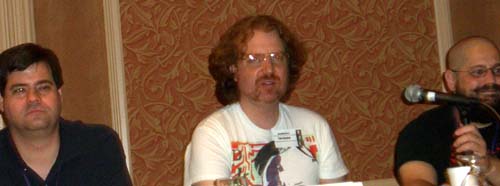
Charles Stross in the British SF panel at ArmadilloCon 2007
Charles Stross in the "Current Trends in British SF" panel at ArmadilloCon 2007

Some people thought that parts of Stross' futuristic vision were too sketchy. Especially Economics 2.0, which, many readers agreed, was explained in no more than a hand-waving fashion.

Everybody acknowledged that this book is not for mass audiences. Its extremely high "geek quotient" prompted comments such as these:

-- It definitely is rapture of the nerds.

-- You have to have a background in sciene fiction to understand it. Mainstream book clubs shouldn't read it. Stross is not pandering. Well, he's pandering to a geek audience. If you're not reading science fiction and you're not getting any of this, he doesn't care.

-- It's definitely written for a SF computer nerd. Specifically, computer science SF nerd. 90% of reference he makes are computer science references that's he's playing around.

Somebody also observed that despite being set in the future, Accelerando is very closely tied to today's technological and pop-culture landscape: "I'm not sure you can understand if you don't read Dilbert and Slashdot. I'm not sure if a bright person who's not from that community would understand it." Which may be seen as a drawback for this book, as it unnecessarily narrows down the audience that might be able to enjoy it otherwise. For the same reason the book may not age well, as in 20 years Dilbert references may be obsolete.

Thursday, August 31, 2006

The Atrocity Archives by Charles Stross: FACT reading group discussion and my personal opinion

On August 15, 2006 the FACT reading group discussed The Atrocity Archives by Charles Stross, which consists of novels The Atrocity Archive and The Concrete Jungle. Everybody but one person in the group finished the book, and the one person who had not was planning to finish it. Everybody has read Charles Stross before. Most people in the group loved The Atrocity Archives. Like "Family Trade", and unlike some of Charles Stross' Singularity-themed science fiction, this book is a crowd pleaser. People described it as clever, loads of fun, and (to borrow a word occasionally used to characterize good space opera), rollicking. (The Atrocity Archives is not space opera, but it's rollicking nonetheless.)

Somebody took an informal survey on which genre did people think this book belong to: satire? comedy? horror? spy novel? Most people thought this book belonged to one of those genres first, and science fiction second or third.

Many in the group had fun with the computer / mathematical jargon and geek jokes. (Person 1: "I kept waiting to see whether the middle initial of the main character's name (Bob Howard) is E." Person 2: "No, his middle initials are OF.") Even those who didn't have the background to understand the jokes, appreciated the writing style. One reader said she liked the texture of the writing, "the way it was densely filled with all the science and pseudoscience vocabulary, thrown in with bits of Lovecraftian and magical vocabulary. I couldn't tell whether the way he was throwing things around was right or not scientifically, but I didn't care. I loved that texture to the writing."

Half of the group got a good chuckle out of the "pi = 4" moment. One reader spent some time pondering a universe where pi is equal to 4, and how bizarrely stretched the space must be in that universe. Another reader argued it's not possible mathematicaly, because a lot of mathematical results depend on the value of pi being what it is. Many series converge to pi, or to some number divided by pi. If its value changed, not only geometry would be different, but most of the mathematics, e.g. calculus or number theory, wouldn't work at all. Still, the first reader really enjoyed an opportunity to think about it. He said Charles Stross probably didn't even realize how fun it was for a reader to ponder this problem. Stross most likely put it in as a throwaway remark.

Other readers gave Stross credit for a convincing description of how to defuse a hydrogen bomb so that it would not explode, or rather, explode in a "benign", not-too-destructive fashion. In this he demonstrates knowledge of bombs beyond a typical Hollywood movie.

Everybody appreciated the irony of the fact that a certain technology the government uses (quite pointlessly) in the "war on terror", turns against it in a very bad way. (This was in The Concrete Jungle.) Somebody jokes that it was like making every land mine remote-controlled by WiFi from a computer running a Windows operating system. (To say more would be a major spoiler.)

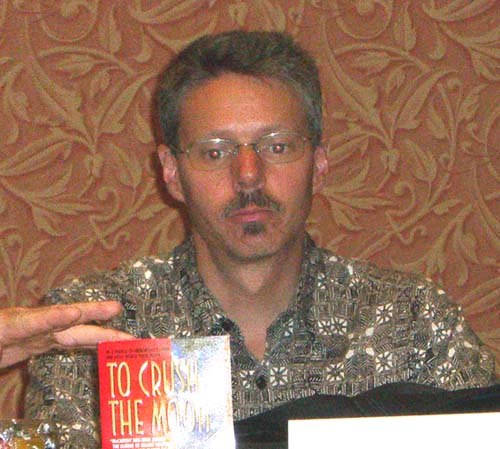
Charles Stross in the British SF panel at ArmadilloCon 2007
Charles Stross in the "Current Trends in British SF" panel at ArmadilloCon 2007

Overall, to quote one reader, Charles Stross "is a skillful writer and he gets a lot of details of computer technology and theroetical computer science right. This combination of a strong writer who knows technology, only Neal Stephenson comes close. Rudy Rucker knows what he's talking about, but can't write, and William Gibson, the other way around." Nonetheless, it was agreed that science in this book was used mostly as a joke, and maybe that's the reason why most readers would not classify this book primarily as science fiction. Stross uses a lot of SF tropes in what is essentially a modern fantasy horror story. While you can't not like a book that starts with a mention of Turing-Lovecraft equations, Stross kind of "fluffs over" that stuff, to quote another reader.

While enjoying the irreverent tone of the book, most readers were moved by the chapter that was entitled, as the novel itself, The Atrocity Archive. A reader said: "It was chilling and very good. At the end it made as much sense as any other explanation of the Nazi Germany I've ever heard."

One reader thought the exposition lasted too long. On one hand, sending your character to a training course that covers the material he already knows is a clever way to introduce that material to the reader; on the other hand, there were too many training courses. A character in an espionage novel should not spend half the book in a classroom. Some writers, for example, Roger Zelazny, are better at mixing action with exposition. At the time Stross was writing this book, he hadn't quite mastered it.

However, no one else in the reading group seemed to think the exposition slowed down the action. And another reader, who, according to herself, has recently rejoined the ranks of bureaucracy, appreciated the fact that the protagonist is forced to waste time in a training class while there are monsters to be fought. That's very typical for a bureaucratic organization.

This prompts a discussion, is the portrayal of bureaucratic absurdities in the Laundry an exaggeration, or are there really organizations like that? The part of the group that hasn't worked for the government thought it was obviously an exaggeration, but others who have worked for the government swore it was all true. There really are managers who say "You should have called in this morning to tell me you'll be sleeping late this morning". In the middle of sharing stories about real-life pointy-haired bosses, somebody asked the group, are there any actual managers in our midst? In the past, lambasting middle managers has caused bad feelings among some members of the group who happened to be middle managers themselves. So this time the person who asked the question wanted to make sure nobody was getting offended.

And of course, no discussion of a Charles Stross book could be complete without chuckling over memorable quotes. Such as "Fred's dead, so he works the night shift", or my favorite "[the hard drive array] scratches its read/write heads", or "The London Underground is famous for apparently believing that human beings go about this world owning neither a kidney nor colon." Or the line from a top secret report, where you have this long, dragged-on paragraph of bureaucratese ending with "when the Great Old Ones return from beyond the stars to eat our brains".

Wednesday, August 24, 2005

The New Weird Movement in SF Literature: an ArmadilloCon 2005 panel

Panelists: Tom Becker, Damien Broderick, Lawrence Person, Faye Ringel, Charles Stross

Charles Stross says everyone in science fiction make a mistake of pining for a new movement. The panelists latch onto the word "movement" and run for a few minutes with scatological jokes. Lawrence Person: "When a genre's bowels get backed up you have to have a movement to clean them out." Once they got that out of their system (heh heh heh), they became a bit more serious, but they still were no closer to defining The New Weird. It's a somewhat narrower category or subgenre than slipstream and, according to Lawrence, even less useful.

Is it possible to define this uncategorizable category?

But the fact that the New Weird, as well as slipstream, catches the "uncategorizable" books, has an upside, according to Tom Becker. "The beauty of the New Weird is that bookstore owners don't know where to file it, so they put it on the table up front", says Becker and adds: "We'll see how it works with Charlie's posthumanist literature."

Lawrence, always one for snappy definitions, proposes that The New Weird is something that uses the genre tropes but doesn't worry which genre it's pulling its tropes from. SF, fantasy and horror are all prodigiously mixed together.

Which authors fall into the New Weird category?

Which authors fall into the New Weird category? Why, of course, China Mieville. Any others? Probably M. John Harrison. And maybe Mary Gentle. But I don't remember the panelists coming up with more examples of the New Weird authors, or at least any that had not been mentioned in the last year's panel on slipstream. Some of the panelists credited the start of the New Weird to Michael Moorcock, and it has to do something with the leftist leaning of the genre. Moorcock once wrote an essay where he criticized science fiction's fetishization with starships, troopers and their boots.

The worldview exemplified by the New Weird also runs counter to the traditional, "high" fantasy with its right wing themes of traditional values, going back to the past, deference to authority, etc. Charles Stross says fantasy is a literature of consolation. It works on restoration of balance in the world. Lost son of the king takes the kingdom back, that kind of thing. High fantasy's worldview is inimical to science, and that's why Stross doesn't like it. (He does write fantasy himself, though, but I'm pretty sure it's not "high" fantasy. And while I don't typically like this genre, a Stross fantasy must be quite an unusual animal, and I intend to read it.)

To that extent, what China Mieville is doing with fantasy very emphatically contradicts that consolation literature.

Left to right: Lawrence Person, Tom Becker, Charles Stross. Here are more posts from ArmadilloCon 2005.

Tuesday, August 23, 2005

ArmadilloCon 2005: Current Trends in British science fiction

What this panel was supposed to be about, according to the ArmadilloCon program book: "Several British writers are currently producing some of the most exciting and best-written SF yet seen. We'll sort out the best stuff, try to discern trends, and overall try to spread our joy and enthusiasm."

Panelists: Jayme Lynn Blaschke, Jim Mann, Lawrence Person, Willie Siros, Charles Stross

Even though Charles Stross was on the panel, it was disappointing. The panel focused mostly on history of British science fiction, and the panelists examined the history in the dullest possible way, by enumerating various magazines and editors and how they influenced British SF. What new authors they discovered, etc. Not the most fascinating stuff for me. I'm not sure I care how British SF got to be what it is today. According to Charles Stross, it has something to do with the fact that the 20th century saw the sunset of British empire. Degeneration of the former empire into a country financially bankrupted by the World War II left British science fiction writers in a long-lasting depression. But Stross does not explain how the SF eventually got out of that depression and emerged so cool and interesting.

And trends? One panelist stated that "a lot of British writers don't fit into trends, but they are doing excellent work". The only trend mentioned on this panel was The New Weird, and only to say that an argument over who was writing The New Weird lead to such a huge flame war on a certain mailing list that it crashed the server. According to Jim Mann, when they got to the point of trying to include Aistair Reynolds into the New Weird, it became meaningless. This did not stop some panelists from continuing to make attempts to classify The New Weird. Charles Stross would include Liz Williams in that category, and Lawrence Person would include Mary Gentle as well.

Charles Stross informs us that Mary Gentle disputes that what she writes is not fantasy, it is science fiction set in a world where alchemy works. (In my humble opinion, "pearls" like that have a potential to redeem even the dullest panel.)

Another category of British SF that sells well is humor, observes Charles Stross. Examples: Terry Pratchett, Jasper Fforde. The list of bestselling SF authors in the UK is like this: J. K. Rowling, Terry Pratchett, then everyone else.

The only thing that made this panel worth going to was to hear Charles Stross' reading recommendations. Here are British authors he recommends: John Meaney (hard SF with interesting physics and some AI concepts, lots of adventure); Richard Morgan; Liz Williams -- according to Stross, she writes what used to be called "science fantasy" (why, is it not called that anymore?); Justina Robson, Tricia Sullivan. Willie Siros and Lawrence Person also recommend Neal Asher and Susanna Clarke.

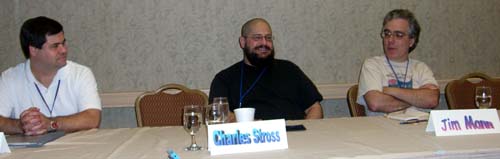
Left to right: Lawrence Person, Charles Stross, Jim Mann. Here are more posts from ArmadilloCon 2005

Where did all good hard science fiction go? An ArmadilloCon 2005 panel

Panelists: David Lee Anderson, Kurt Baty, Tom Becker, Alexis Latner, Wil McCarthy

At least one of the usual suspects' opinion on the topic of hard SF hasn't changed since last year. Actually, more like in decades. Kurt Baty still thinks the best hard SF books out there are Neal Stephenson's "The Diamond Age" and Daniel Keys Moran's "The Long Run". And he tried hard to find other hard SF books worthy of those! Which for him, it appears, means books mostly on nanotechnology. He's just not finding any.

He's not impressed with, for example, Karl Schroeder, after reading "Ventus". "It's a novel about labeling. Every particle has a label! How exciting!" exclaims Kurt sarcastically. Tom Becker, though, urges him to give Schroeder's second book, "Permanence", a chance. He says Schroeder combines Digital Rights Management and micropayments with virtual reality and nanotechnology and gets interesting social effects.

Plot and characterization in a hard SF story offends some readers

The most amusing comments in the panel were made by Wil McCarthy. He says readers expectations are not as clear as they used to be. People who read SF read it for ideas and for plot, but not necessarily for characters or for language. Some other readers, in the contrary, people are actually offended by good, credible science. They just want magic! They are shocked by really innovative science fiction. For example, Greg Egan with his quantum mechanical themes offends them. The hard SF that they want should be about rayguns and spaceships!

Then there are readers who are turned off by the weak characterizations and the no-nonsense, journalistic language of classical hard SF. But other readers think that characterization, artful language or even a presense of plot ruins a hard SF story! To them, anything with a plot is trashy.

So, did the panelists find out where all the good hard SF went?

I'm afraid they did not. Instead, some of them, especially Wil McCarthy, made some sobering observations about the state of hard science fiction today. "The first thing that occurs to me is, just looking at the audience," he said, "is that the size of audience for this panel is the same as for a filk session. Even though this is a good size convention. Fans understand that hard SF is a good thing and hard to pull off, but it's not the same as enjoying hard SF. The novelty of hard SF is begining to wear off and people are looking for something else."

David Lee Anderson says one of the reasons of why hard SF was more popular a few decades ago than it is now was that back then the space program did a lot to inspire people's interest in science fiction. The space race gave people something to look forward to, he says, but the things have long ago slowed down. "The space station didn't get up there until about 20 years later," says David Lee Anderson. "This was disappointing ot me. I wanted things in my own lifetime that we could go visit in space."

Wil McCarthy thinks the (perceived?) loss of interest in hard science fiction is part of a larger trend of declining respect for science in America. "[A life of an academic scientist] in America is a crummy life," he says. "Scientists used to be respected. But that's no longer true. With a bachelor's degree you can make as much money as an engineer as with a PhD, and you can make it immediately.

And in academia it got really ugly. Back in the 80s they started saying "publish or perish"." As much aggravation as it caused to scientists, they are now nostalgic about that. "Nowadays it's "bring in grant money or perish". So our brilliant scientists are sitting writing grant proposals, while their science is being done by their graduate students. [Well, science was always done by the graduate students, but] we are squeezing our professors so hard, and a lot of smart people say, I don't want that life. I'll take a bachelor's degree and go work for a corporation."

Wil McCarthy does not feel optimistic about the state of hard science fiction today. Here are more posts from ArmadilloCon 2005.

Saturday, August 20, 2005

ArmadilloCon 2005: opening ceremony and space opera panel

Opening ceremony is one of the most memorable parts of an ArmadilloCon. The toastmaster tries to embarrass the Guests of Honor by poking fun at them on stage. The toastmaster in 2005 was a Canadian urban fantasy writer Charles de Lint. In his speech he made a big deal of the fact that the writer Guest of Honor, Charles Stross, is a "computer wrangler" and that he is from Scotland. I don't know if perhaps Scotland is viewed by Americans as being primarily agricultural, but Charles de Lint drew a lot of parallels between computers and farming (and, by extension, wrangling). "Scotland doesn't have server farms, their computers are free-range".

Then he talked at length about Jim and Laurie Mann trapeze wedding. I missed most of it. I was too busy messing with my new recording gear, which is an MP3 player with a voice recording function, and a microphone that plugs into my laptop and allows me to record sound directly into the computer. It doesn't work very well. I don't know if it's a bug or a feature, but it stops every couple of minutes and then I have to press the Record button again. By then, some time has passed before I notice that it has stopped. So I'm sure my recording is missing large chunks of that speech.

Developments in Space Opera

Then I went to a panel "Developments in Space Opera". Charles Stross was on it. There were some interesting points made there, but I still don't know if my recording is of a good enough quality to capture everything that was said.

There was much wondering why so much space opera is coming out of UK nowadays, as opposed to America. Chris Roberson "accused" British authors of distrusting heroes. (I'm not sure if or how that was supposed to explain why British authors lead in space opera. :-)) Charles Stross said he doesn't so much mistrust heroes as doesn't think it's a realistic notion that one character in the right place could change the world, as in common in space opera and in science fiction in general. "In space opera, one shiny bright character always does the right thing, everybody revolves around him," he said. "In real world, we call people like that world criminals.

As may be expected for a panel with Stross, the discussion veered towards Singularity, although he didn't bring it up. (I'm actually surprised there are no Singularity-related panels in this year's ArmadilloCon, even though Stross is a guru on the subject. Two years ago, when Vernor Vinge, the writer who popularized the idea of Singularity, was the guest at the ArmadilloCon, several panels revolved around Singularity.)

Chris Roberson said we should ask Charles Stross to enumerate all singularities that the humankind has already been through. It turns out Stross thinks there had been a few. Apparently he does not define it as a very steep technological advance beyond which life becomes unpredictable: by that account we haven't had a singularity yet. I guess he has a broader definition: it's any kind of technological or social change beyond which life can't be predicted. If that's really his view, then it's almost like he is taking an easy way out. Because all these developments listed below, except the first one, are not the kind that would create an unbridgeable gap between the humans on one side and the humans on the other. You could take a person who lived before let's say, agriculture was practiced, and explain the concept to him or her; he/she would probably understand what it means to cultivate the crops, even though he/she may find that idea strange or silly. Even though it's true that the long-ranging consequences of agriculture could not have been predicted in advance, it still does not create an intellectual gap so deep that the "before" would have no means, no tools, no capabilities of understanding the "after".

In contrast, Vinge (I think) associates Singularity with an emergence of superhuman intelligences. In that scenario we have no chance of understanding what those intelligences are like, or what they are "about", or how they will begin to change the world, than a dog has a chance of understanding what human beings are about. That's probably why Vinge, in his novels, does not try to portray a post-Singularity society, but limits himself to the "left behind" societies, or scenarios where Singularity happened, but a particular society was somehow bypassed, or escaped it.

On the other hand, one guy in the audience commended Stross for not avoiding the post-Singularity scenarios, but "bear-hugging" them.

Anyway, this is Stross' list. It is probably incomplete (I might have missed something).

  1. Development of language. Obviously, there is an unbridgeable gap between the primates that don't have language and those who do.
  2. Agriculture. Once humans started farming, a given area of land could support many more people than it could when they were hunter-gatherers. Once the population density increased, it would have been impossible to go back to hunting-gathering. Or so his argument goes.
  3. Writing -- ability to transmit knowledge from generation to generation.
  4. Invention of finance and investing. He says, read Neal Stephenson's "Baroque Cycle" trilogy to get an idea how it changed society.
  5. In the picture: the Space Opera panelists. Left to right: Chris Robertson, Charles Stross, Jim Minz, Sean McMullen, Jayme Lynn Blaschke. Here are more posts from ArmadilloCon 2005.

Friday, August 19, 2005

ArmadilloCon pizza lunch with Charles Stross, or causal channel-enabled future space pirates

I finally got to meet Charles Stross in person at the pre-ArmadilloCon pizza lunch organized by Lawrence. The pizza place, Mangia, is crowded at lunchtime. Its acoustics are the kind that would be more appropriate for an opera theater. It was so noisy that people had to routinely lean forward and bent their ears in the direction of the speaker in order to hear a person sitting across the table from them. And, of course, Charles Stross speaks with a British accent, which I don't have much experience with. His accent isn't thick, but in general British accent is harder for me to process than any other kind. I have no problems with Indian or Chinese accent, but when I listen to British speak, I feel the cogs and gears in my brain grinding through the pattern-matching heuristics. Add this all up, and my attempt to relay the lunch conversation will be more like playing "a broken phone".

Bits and pieces of things Charles Stross talked about

A lot of the time Charlie (as he calls himself) and a small group of other people talked about the space program. Shuttle. Arianne. Soyuz. That's all I picked up. Stross writes about a 1000-1500 words a day. On very productive days he's been known to write 5000. He passed over the veggie pizza because it did not seem to have cheese. (Actually, it was a stuffed pizza with cheese inside.) He does not like the news tickers, or crawlers (I don't remember which word he used. I think he was referring to the text that crawls along the bottom of the screen, not related to the story that's being narrated in the main part of the screen). "Eek!" he exclaimed.

Charlie's adventures in tech industry

Before he went to write full time, he worked in the tech industry. He has his own dot-com crash story. After being a senior programmer, he was offered a position to head a software development department in a startup. He accepted. But, he admitted, he might have burned the bridges to his old workplace a bit prematurely. This was March 2000, he said and paused for a second, smiling, so we could see where this was going. All would have been good if his new company had had an IPO a few weeks earlier. The stock sale would have given it a big enough supply of cash. As it was, though, the stock market crashed and all of a sudden the company had just a few weeks to live.

Pirates and accounting

He does plan to write a sequel to "Iron Sunrise". It will be a book about space pirates. Or, more accurately, about something that sounded like "charter accounting" or "enchanted accounting". Probably the former... though of course, some accounting practices that gained notoriety in recent years could be rightfully called "enchanted" :-) I said I will be curious to find out what is the connection between space pirates and accounting. He proceeded to explain what he had in mind. In the days of old, pirates had to work out a system how to divide the loot. For example, one pirate might have reached into the cleavage of a baroness and pulled out a super-expensive necklace, while another one might have grabbed something much cheaper. So, if I understood correctly, they needed some kind of well-defined accounting system to decide how to divide their bounty.

So the idea is, the way I understood it, that the space pirates will use causal channels to speculate in the futures of... well, whatever goods the ships will transport. What is a causal channel? Why, it is a channel of communication by quantum entanglement. Two entangled particles, when separated by a distance, no matter how big, if the quantum state of one of the particles is changed, the state of the other particle will change too. That means a faster than light communication. If ships fly slower than light, and somebody could communicate via a causal channel with the second party at the destination about the contents of the ship's cargo, then the second party would know what commodities, and what amounts of them, will be sold in the market years from now, and could profit from that information.

The problem is, as I found out later, that quantum entanglement does not allow faster-than-light communication. So I may have misunderstood what he said. Like I said, the environment was noisy.

But why would you call those speculators pirates?

As Charlie explained this concept, he paused a few times and smiled briefly as if to check if we were following. (By the way, Stross has one of the most beatific smiles I've ever seen.) I did my best to compose my best generic understanding facial expression, even as I was struggling to grasp what was being said amidst the noise and British accent. I wondered if a guy sitting next to me understood what this had to do with pirates. I'm not so sure. The guy made a not-entirely-relevant observation that pirates still exist even in our times, and that Texas has a particular brand of "inner tube pirates". When people go tubing down Texas rivers, they bring beer with them, and often they lose six-packs of beer, and there are actually "pirates" who jump into the river and grab that beer. At least that's what I think he said. If this sounds weird -- and it does, to me, but then I've never gone inner-tube floating -- I shall attribute it to my less than perfect listening skills.

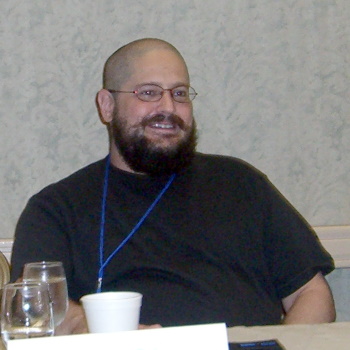
Charles Stross. Here are more posts from ArmadilloCon 2005.