Thursday, July 19, 2007

Mary Doria Russell "The Sparrow": a CFI Austin book group discussion

4 people attended the CFI Austin Science And Religion In Fiction book group discussion of Mary Doria Russell's book "The Sparrow". 3 out of 4 gave the book a thumbs-up, 1 thumbs-down.

The book presents a wide range of views from atheism to belief

One thing everybody liked about the book was that Mary Doria Russell presented the views of both believers and nonbelievers. The proportions, however, were disappointingly unequal. The only atheist on the mission, George, didn't get much air time. He was more like a token atheist. He was a very nice person, but he didn't say much throughout the book. Russell did better with other characters, who possessed various degrees of belief and nonbelief. Even the believers had complex views about religion; no one was dogmatic. For example, Emilio joined the Jesuit order for practical reasons, not because he was pious. But then he came to believe when the moment of faith washed over him. One reader said it was interesting to read about it, because he never experienced anything like that. Another reader said she wished more Christians read this book, because the author treated the material thoughtfully. Since Mary Doria Russell in her lifetime went from being Catholic to being atheist, and then to Jewish, we guessed she's obviously has thought about stuff a lot, and it shows in the book.
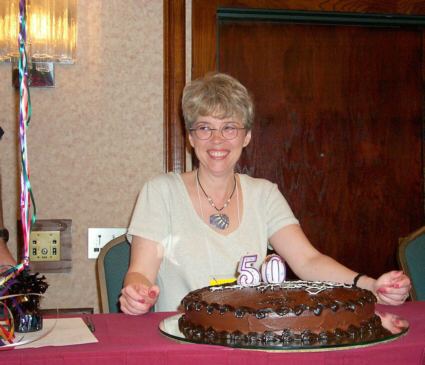
Mary Doria Russell at the ArmadilloCon 2000 Mary Doria Russell at the ArmadilloCon 2000, Austin science fiction convention. She celebrated her 50th birthday at the convention, and the organizers presented her with a cake.

Overall, the readers agreed, "The Sparrow" may be more interesting to believers who may be grappling with questions of faith, than to nonbelievers. For the latter, Emilio's endless questioning of what part God had or didn't have in the events can get tedious after a while. A non-theist would see those questions as based on a false premise.

Other things people liked about the story

  • Witty prose, lots of humor;
  • Remarkably vivid characters, each of them a full-fledged human being, which is rare in science fiction. Often, the characters in science fiction books are hardly more than stick figures who are there to spout author's ideas, or pawns to play out a conflict the author has set up. Not so in the "Sparrow", where each character is a multi-dimensional individual.
  • There were interesting insights in what it means to be a Jesuit;
  • There were lots of interesting tidbits and subthemes in the story, such as predator / prey races or the brain-picking AI "vultures".

I found "The Sparrow" an enjoyable read because it has several very likeable characters, easy to identify and empathize with. But that does not preclude the novel from addressing the dark sides of the human nature. I think the reason why this book spoke to me so strongly is because it asks a question "why do bad things happen to good people", and portrays a group of brilliant people who despite their best intentions make horrible, vast, destructive mistakes. It shows how even the best knowledge can lead to erroneous conclusions; it raises all the hard questions and interesting ethical dilemmas; if anything, it points to randomness and unpredictability of the world, not leaving a place in it for any intelligent supernatural force. At least those were my conclusions. However, our main character at the end of the sequel reaches a different conclusion.

This is not to say that there weren't serious criticisms of the book voiced by the members of the group.

It's not really science fiction

One reader was especially disappointed that the book, despite its science-fictional furnishings, turned out to be not really science fiction. "I'm a sucker for first contact stories," he said, "but it seems like a sham in this book. Instead, the story is all about Emilio's search for discovery. It's a background to ask, is there God, etc.? I was so tired by the end of the book of his inner dialogue about what part God played in the events and in Emilio's personal suffering. Yes, there were rocketships, but the book could have been set in 1700 and the mission could be going to Polynesian islands. So science fiction was just a framework on which to hang the morality flag."

Some plot twists are based on characters acting like idiots

Another flaw of the book is that some critical plot points stretch the reader's credibility a bit too much.

Attention! Spoilers!

Such as: Sophia "borrows" the lander (a rocket that they use to go back and forth between the planet and the ship in the orbit) and uses up most of the fuel, not leaving enough for the mission to get off the planet. A reader called this plot twist ludicrous. "When I drive, I pay attention to how much fuel there is," said a reader. "And when the lander is the only way to get off the planet, when the fuel is your lifeblood, it's just not credible that Sophia would have not checked the fuel levels in advance. It's not like 'ohmigosh, I forgot!'"

It was also hard to believe that the locals were not very impressed to meet the visitors from the stars. "They treat them so blase," said a reader. "We're gonna kill them all, and give one guy as a gift to head honcho. Huh? Maybe, but it seems so unrealistic. It's like, visitors from the stars arrive at the White House lawn, and we just capture them and give them away as presents."

It was also not very believable that the people back on Earth jumped to an easy conclusion that Emilio worked as a prostitute. Did it not occur to them that the most obvious explanation may not be correct when you are dealing with an alien society? Why didn't they interpret Emilio's actions with a more open mind?

End of spoilers

Sunday, July 15, 2007

Companies that don't Get It

While visiting his mom in New Jersey with Erika, Steve bought a Kodak disposable camera to take pictures of the child gallivanting about New Jersey beaches and such. Back in Austin he got the film developed at HEB and pictures put on a CD. I stuck the CD in my computer to get the pictures off. That's all I wanted: to get the pictures off the CD and onto my hard drive. It may come as a shock to Kodak that I did NOT want to sign up for Kodak's online photo gallery, and that I was perfectly capable of viewing and copying pictures using the good ole Windows Explorer -- I did NOT special software for that! Most emphatically, though, I did not want to install the said software.

Yet that's what I was forced to do if I wanted to see the pictures. Clicking on the CD gave me only one option, to install Kodak Easy Share software. It took half an hour to install. As is typical of Windows programs, the installation required to reboot the computer. All so that I could take a peek at 20-odd pictures. Because you know, as an average user, I'm so dumb that if you give me a CD with a folder of pictures in it, I won't know what to do with it. ;-) No, Kodak had to waste half an hour of my time installing software that lets me do nothing I can't already do by double-clicking or drag-and-dropping folders and files! Never mind that my hard drive is creaking at the seams with all the software I have on it, including several image manipulation programs. And wouldn't you know, Easy Share installed itself in the system tray, slowing down my already slow computer even more.

What I found the most presumptuous is that it also asked me to create an account for its online photo sharing site. Why did it assume I don't already use photo-sharing sites of my own choice, such as Flickr? This attitude is so patronizing. And the software did not really give me an option to NOT create an account. The most you can get away with is "Remind me later".

So I gritted my teeth, went through the install, copied the pictures onto my hard drive, and uninstalled the damn thing. Only then I realized I could have bypassed this by booting my computer into Linux, sticking the CD in, and getting the pictures off. Since the Easy Share program wouldn't run on Linux, it would not launch itself when I click on the CD, so I may be able to see directly into the image directory hidden somewhere in the Easy Share directory structure. So I did that, just for the heck of it. And of course, Linux was able to see the picture directory on the CD right away. Should have thought of it earlier. I'm glad to know -- attention, flame bait! -- that Linux is useful for something. :-) Kodak -- less so. I'll try to remember not to buy Kodak disposable cameras again. (Because I'm pretty sure it wasn't HEB's idea to stick the Easy Share software on the CD: it must be part of an agreement it has with Kodak about developing pictures from their disposable cameras.)

Friday, July 13, 2007

Photo software mumblings

Adding Statcounter to Gallery2 turned out to be easy. I don't know what about it confused me at first.

Continuing the gallery / photoblog saga, I got an unexpected response to a post on my other blog where I dissed Cheesecake Photoblog. One of its developers invited me to post my bad experiences on Cheesecake Photoblog forum. So I did. We'll see if it results in a productive dialog. Not that I'm really motivated to get Cheesecake Photoblog running on my web site, but I'm a bit curious how can it work out of the box for other people (as they claimed in the forum) and be such a disaster for me.

Wednesday, July 11, 2007

Can't Sew? Duc' it! Costuming with Duct Tape: an ApolloCon 2007 panel

Panelists: Chuck Coshow (moderator), Mary Miller, Shai Mohammed, Val Villareal

Description in the program book: It's light on one side and dark on the other and holds the universe together. Now you can use it to hold your costume together. Our team of guerilla costumers show tricks and techniques for non-sewn costumes using duct tape.

Who would have thought that duct tape is the unsung hero of costuming? The panelists could not praise its versatility high enough. It comes in a variety of surface colors and textures, and you can make all sorts of costume parts out of it. It is also infinitely repairable. To repair a tear, simply tape another piece over it. The panelists demonstrated some basic costume parts you can make with duct tape. For example, in the picture below is a boot, completely covered with shiny red duct tape. (The boot is reclaimable: the tape can be peeled off and the boot restored to its original condition.)

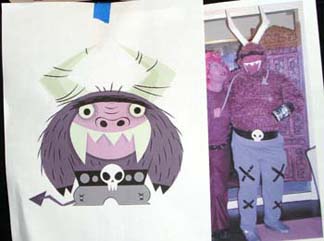
Shai with a boot covered in red tape Picture of a picture of Chuck and Val's costume
Shai with a boot covered in red tape Picture of a picture of Chuck and Val's costume, made with (among other things) tons of duct tape.

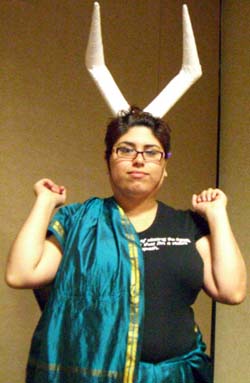
The horns Chuck is wearing in the costume above are shown up close below on Val. Yes, they are made mostly out of duct tape. The tape is wrapped around the frame that was made -- IIRC -- cardboard tubes from used-up paper towel rolls.

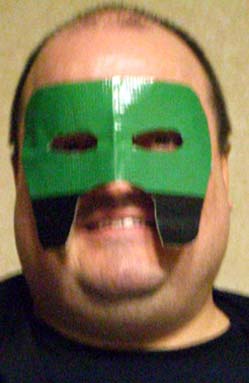
Valerie's horns Chuck's mask
Val with horns Chuck's duct tape mask.
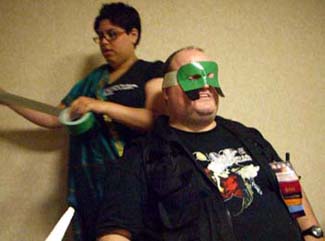
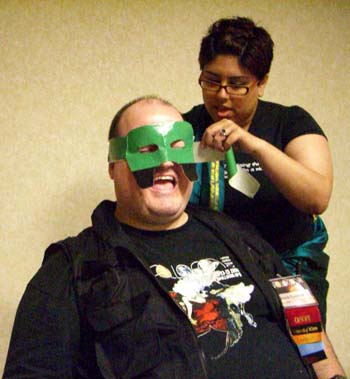
Val with a roll of tape, making Chuck's mask Mary Miller

In the course of the panel Chuck and Val made a simple mask. Chuck cut the mask out of a paper towel and covered one of its sides with strips of green and black tape (see above). Then Val made a two-sided headband (left) out of tape and attached it to the sides of Chuck's mask.

Val with a roll of tape, making Chuck's mask

The paper towel backing is a good thing not just because you don't want the tape to stick to your skin, but also because the towel provides an absorbent (albeit minimally) layer. And this brings us to the an oft-emphasized advice. The wearer should keep in mind that duct tape does not breathe. He or she will be sweating like hell under all that tape. It is imperative to wear absorbent garments underneath, unless, quoth Mary Miller, your character is a slug and is supposed to drip-drip-drip across the stage.

I must say, this panel nearly inspired me to get into costuming. Or get back into costuming, actually, after a brief foray I made into it 15 years ago. If only I didn't already suffer from hobby overload...

Here are more of my pictures and blog posts from ApolloCon 2007.

Monday, July 09, 2007

101 Uses for a Paper Clip (McGyver, eat your heart out) : an ApolloCon 2007 panel

Panelists: Kimber Chessmore, Dusty Rainbolt

Description in the program book: Ever wonder what McGyver might do with a paper clip? Our panelists, specially selected for their devious minds, consider McGyver-esque uses for the humble paper clip, and a variety of other small, household objects... as they toss back one bottle of beer after another.

No, actually the program book didn't say anything about beer. But it was a crucial ingredient in the panel. Some of the paperclip uses were not likely to be imagined without some brain chemistry alterations.

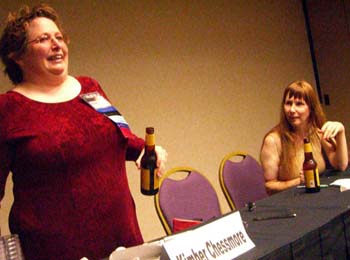
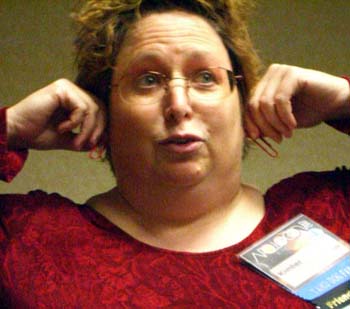
Kimber Chessmore and Dusty Rainbolt Kimber Chessmore and Dusty Rainbolt at ApolloCon 2007

People-poking, jewelry, cleaning; other household uses

Quite obviously, a straightened paperclip can serve as a tool for various kinds of poking, prodding or goading. That was a major set of its uses. For example, you could prod gamers with it to get them out of your way. (I didn't think gamers were a major nuisance at the convention, though.) It can be used for straightforward torture. A guy in the audience said, in Clockwork Orange you can use it to prop people's eyes open.

Kimber Chessmore with a straightened paperclip Kimber Chessmore with a straightened paperclip in her left hand (barely visible) for people-prodding

Paper clips can also double as jewelry, for example, earrings for unpierced ears, as Kimber Chessmore demonstrated; or an emergency wedding ring, if you suddenly have to pretend to be married (straighten it and wrap it around your finger).

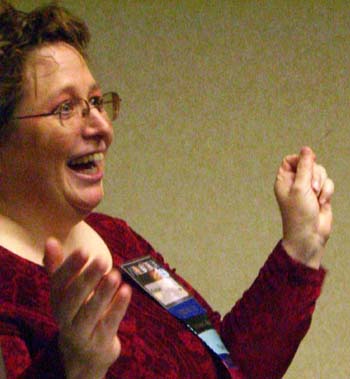
Kimber Chessmore with paperclips as earrings Kimber Chessmore with paperclips as earrings

Cleaning / hygiene: on a desert island, use a paperclip to clean teeth and various orifices. At home it's handy for digging the hair out of your sink trap (for those with long hair).

Art: if you are making clay pots, a paper clip is a sculpting tool (suggested by a woman in the audience). For cosplay or masquerade, you can fashion an instant antenna out of paperclip if you left the real one at home.

Mundane uses: In all its immeasurable flexibility, a paperclip can be any of these things: a dart tip. A thingy to hang a Christmas ornament from. Or a picture on the wall. For bra repair (if those plastic thingies at the ends of your bra straps break unexpectedly). To puncture an orange peel, so you could peel the orange more easily. A back scratcher. A bookmark. A package opener. Shoe laces. A swizzlestick. A cheap man's cigar punch. A cat toy (not necessarily a safe cat toy, says Dusty).

Farm uses (I've no idea if any of them are valid -- I wasn't raised on a farm): a tool for branding cattle. For horse tack repair. As a bailing wire substitution.

Offbeat uses

Some of the more "out there" uses suggested by people in the audience: on a desert island, paperclips (if you have at least two of them) can be dowsing rods for finding water. Also on a desert island, for lancing a hematoma. Another medical use: as an acupuncture tool. Oh, and speaking of which, Dusty suggested a paperclip could serve as a tattoo needle, though you may need a lot more than two drinks for that, she added.

Kimber said she once posed the paperclip usage question to a group of very polite girls, and the politest of them immediately went: nipple clamps!

Nara (a member of the audience) observed that a paperclip can be handy for stealthy kilt lifting.

Here are more of my pictures and blog posts from ApolloCon 2007.

Sunday, July 08, 2007

I fixed the Gallery! Really fixed it!

I think I have finally fixed the instance of Gallery2 on my web site for real. I am now able to add new images and do pretty much everything with it I did before. I wrote about how I broke Gallery2 here. Since then, I fixed it, but incompletely: it did not allow me to add new pictures. After some more work, I solved that last remaining glitch. What was wrong the first time? The short answer: I had overlooked a table that contains a column that is (I think but am not completely sure) auto-incremented each time a new item is added to Gallery2. That column generates unique IDs for Gallery2 items. Since I did not set its value to the value of the latest item inserted before the upgrade, it was generating ID values that were already "taken" by older items. The full, updated story of how the brokenness came to be and how I fixed it, is here, and yes, I realize that none of the handful of readers of this blog are interested in either the problem or its solution. :-) I'm posting the link here purely "for the sake of completeness", as they say in mathematics. :-)

I also need to find a way to put StatCounter code on my Gallery2 site. It's not obvious where in the Gallery2 bowels its HTML is generated.

However, I am not sure if I want to continue to use Gallery2 at all, or if I want to switch to a different software. My ideal software would have the features of both a photo gallery and a photo blog. (I wrote more about features I look for in photo gallery / blogging software in this blog post.) I tried out two systems that claimed to have such features, Cheesecake Photoblog and Sylverblog, and they both were pathetically unusable. They were so bad I'm not even motivated to write about all the ways they are bad. :-)

Friday, July 06, 2007

Size Matters! Knowing or Choosing the Correct Length to Tell Your Tale: An ApolloCon 2007 panel

Panelists: Katharine Eliska Kimbriel, Alexis Glynn Latner (moderator), Julia Mandala, Chris Roberson, Shanna Swendson

Description in the program book: How do writers know how long a story should be? Is it something they decide or something the story demands? Our panel discusses questions of size, from flash to series. (Don't worry guys, it's perfectly safe.)

It's as if this panel was created with me in mind, so closely it fit my writing predicament (inability to write short stories). But since this was yet another panel on writing and editing, there was bound to be some overlap with the previous two I went to. And so I was able to distill the noteworthy tips or observations into a few sentences.

Shanna Swendson Shanna Swendson

Apparently a lot of people, including accomplished writers, have trouble writing short stories. Shanna Swendson says she certainly does. All her stories turn into novels. (The same thing happens to me.) She wonders if she trained herself that way, to think in novels. The only time she managed to write short stories was when she wrote a series of connected fanfic stories, that all made up a big 100,000 word story.

Alexis Glynn Latner thinks that people who think in short stories are in the minority. She gave this advice: if you have trouble writing short, pick the most narrowly focused idea you can come up with. She also warned that worldbuilding adds to the word count. So it's much easier to make a story short if it's set in a consensus world -- for example, if it's alternative history. Or elves in the mall.

Alexis Glynn Latner Alexis Glynn Latner

A woman in the audience said that every time she writes a story, it comes out as series of dialogs, connected with two-sentence transitions. She asked how to make her stories more balanced between dialog and narrative. Alexis Glynn Latner recommended that she take another author's short story she really liked, highlight the dialog and see what the author does between the bits of dialog.

Here are more of my blog posts from ApolloCon 2007.

Tuesday, July 03, 2007

Pay No Attention to the Pro Behind the Curtain: Editors: An ApolloCon 2007 panel

Panelists: David G. Hartwell, Selina Rosen, Mel. White, Steve Wilson

Description in the program book: Learn about the secret world of the editor, the unsung hero of the literary world. Who are they, what do they do, and what is their impact on the fiction we read?

Mel. White at ApolloCon 2007 Mel. White

What was it really about: Unlike Editing 101: Self-editing panel, this one did not have specific advice to writers. (Nor was it supposed to.) Rather, it was one of those panels where pros hash out about little-known aspects of their jobs. Which can be fun!

The most memorable things in all such panels are funny stories "from the trenches", and industry tidbits you don't normally get to hear. Mel. White told this howler of a story. When science fictional elements started to percolate into paranormal romance, those novels were edited by editors who knew everything about romance, but very little about science. So you would get absurdities like a new star appearing between Earth and Jupiter. And nobody noticed it before, beause it appears only once in 200 years.

The Procrustean bed of book publishing economics

David Hartwell went back to the some of the same elements he covered at his kaffeeklatsch where he talked (among other topics) about the economics of book publishing and selling. Back then he gave some interesting examples of how a book word count translates into its price and how that impacts the book's distribution and sales. It turns out the word count economics is far more nuanced than he let us in on at first. Optimal word counts preferred by publishers are dictated not just by the cost of paper, but also by such factors as different printing processes required for books of different thickness -- some are costlier than others; the thickness of the book also determines how many books would fit into a box, thereby influencing shipping costs. The most bizarre factor (though it was completely logical -- it was only weird because I haven't thought about it that way) was pointed out by a guy in the audience. He said books need to be a certain number of inches thick to make it possible to print the author's name in large enough letters on the spines. After all, books in bookstores are stacked so that only their spines are visible (except those lucky tomes that are stored facing front). A customer of less than perfect vision (which is to say, most reading folks) should be able to see the author's name and book's title from 7-9 feet away. This requirement dictates the size of the font on book's back, hence a need for certain thickness.

David Hartwell at ApolloCon 2007 David Hartwell
So on one hand, less is more (a 120,000 word count sells better than a 140,000 word count), but on the other hand, more is more (a book should not be too thin). It doesn't surprise me (especially since I took several courses in mathematical optimization in grad school, which examined this type of problems -- optimizing against several conflicting criteria), it's only weird because we are talking here not about gadgets and widgets, but about a product that flows from an author's deep, innermost self. I always imagined only the author can decide how many words a story needs in order to be told. And yet, having heavily edited my own stuff, I know that number is much more flexible than I thought at first.

Apropos of which, David Hartwell said: "My favorite writers / editors relationship is the kind where both writer and editor agree that the text is just words on paper that could be rearranged any way they want. If the text is the writer's heart's blood, then I can't edit it."

Friday, June 29, 2007

Editing 101: Self-editing for the Spec Fic Writer: An ApolloCon 2007 panel

Panelists: Rosemary Clement-Moore, Melanie Miller Fletcher, Alexis Glynn Latner (moderator), Julia Mandala, Barbara Winter

Description in the program book: Panelists discuss the process of self-editing. And no, we don't mean just chucking it out the window and starting over. How can you honestly and dispassionately proof and edit your writing.

Start with the ending and write toward the beginning

... is a good advice if you are getting bogged down in the middle of your story and don't know how to progress your plot, or if you are not sure what's supposed to happen at a certain place in the book.

In one of the books she was writing, Rosemary Clement-Moore had beautiful first six chapters, but no ending. She had characters riding in cars. After she wrote the end of the book, she knew what they were going to talk about when they rode in cars.

Alexis Glynn Latner advises: outline ahead. Tolkien plotted LOTR all the way through and then wrote it backwards from the ending.

One panelist observes that a lot of people don't outline because they say they are "organic" writers who work better without an outline. Oh, come on! she says. You don't outline because you can't!

Editing out self-indulgent parts

The panelists addressed a problem that a lot of writers, especially beginners, apparently have: becoming so enamored with some of your characters that you want your readers to know everything about them, including the complete life history of those characters. But the reader usually doesn't need to know all about a certain character. The reader only needs to know enough to understand what's going on in the story right now. To make it easier to part with those extraneous bits, Julia Mandala suggests to think about it this way.

Julia Mandala. I like the editing part because I do that for the reader. I had my fun writing the first draft [where I got to play with the characters as much as I liked]. But [when you are editing, you need to] wonder, what will make the reader enjoy the story the most?

Alexis Glynn Latner agrees: the first draft is totally self indulgent. She also offers this bit of advice on how to assuage the pain of throwing out the passages that are dear to your heart but not necessary to the story.

Alexis Glynn Latner. When you write exciting, but unnecessary scenes about a secondary character who would like to have a book for himself or herself, you don't want to just dump them -- that's bad for you psychologically. Make a file of them so that you could reuse them for another book.
If your problem is like mine -- not that I get too attached to my characters (if anything, by the time I finish a story, I can't stand them anymore :-)), but that there's a lot going on in the story and you are uncertain in which order the events should be told, Barbara Winter offered a good piece of advice. Not that I asked her, but I was happy to hear something relevant to my own editing struggles.
Barbara Winter (left) and Melanie Miller Fletcher at ApolloCon 2007
Barbara Winter. One of the best tools anyone ever gave me was this. For every scene in your book, write on one page a sentence what the scene is about (e.g. Joe says "bla"), and on the other page, what's the purpose of this scene. If you do that for each scene, you will be able to say: oh, this scene obviously has to come before that one. Or: the purpose of these two scenes is exactly the same. In this case, do I need both of them, or can one of them be cut and go in that other file?

In any case cutting is probably necessary for any story. Apropos of which, Alexis Glynn Latner offered this poetic observation: a story that's alive would heal when you cut it.

No panel on editing is complete without funny tales from editors' trenches. The following story was probably supposed to illustrate mistakes novice writers make with insufficient / inadequate characterization of their characters.

One of the panelists was teaching at a writers' workshop, and one girl turned in a story that had a homosexual pedophiliac bondage relationship in it. The panelists told the girl: I can handle homosexuality and bondage, but an 8-year-old doing those things? That's a big no-no. The girl became really flustered: OMG, the protagonist was NOT a young boy, he was just a very slender, slim-built adult! The panelist did a hillarious impression of the girl becoming a blabbering mess as she tripped all over herself to explain there was no pedophilia in the story. She just wasn't skilled enough to describe her protagonist in a way that would let the reader see him accurately.

Choosing the correct tense and point of view

There was also a lot of talk about writing techniques such as choosing the correct tense and point of view for the story. The panelists were unanimously conservative on these two points. The past tense is almost always the right tense for a story, unless there is a compelling reason to choose present tense. A limited third person point of view is usually the right point of view, or the least problematic anyway.

Most readers, as well as most writers and editors, don't like stories told in present tense. The panelists said the present tense is very hard to do right. Rosemary Clement-Moore said even though present tense is supposed to immerse you in the story and make you feel as if you are experiencing it directly, for some reason it makes you more distant from the story.

The same with first person point of view, said Julia Mandala. It is good only when it's done right. You want to put the reader inside the character, to fully immerse the reader in the character's experiences. E.g. instead of "I was tired", you need to say, for example, "oh, my limbs were like noodles". ("Yes, I know it's a cliche," Julia added, "but you get the point".)

There had been stories done with multiple first-person points of view, but there had to be a very good reason for that. For example, if the hero and the villain are on separate parts of the country, and won't get together for many chapters, and don't know about each other, it is OK to use both first person viewpoints.

Alexis Glynn Latner offered an interesting observation regarding male versus female viewpoint. She likes to write from a male point of view, because, to quote her, "it snaps down productive filters: a guy wouldn't say that, a guy wouldn't notice that". She can become more easily bogged down in a female point of view -- perhaps because women notice more minute details.

How do you know when you're done editing?

A fitting question to end a panel with is how do you tell when you've done all the editing you could do? How do you know when the story is ready to be shown to the first reader (usually a friend or a fellow writer in a critique group)? The panelists say that point comes when you find yourself making minor word changes here and there rather than doing actual editing.

Melanie Miller Fletcher visualizes her stories as a board with nails in it that have loose colorful threads drawn between the nails. She says that she knows the story has been finished and is ready to be shown to the first reader when the strings are all tight.

Wednesday, June 27, 2007

Geeks in Love: Finding Love in Fandom: an ApolloCon 2007 panel

Description in the program book: Maybe it's flirting; maybe it's friendship; maybe it's a lifelong relationship. Finding romance in all its forms and guises in the ever-surprising world of fandom.

Panelists: Chuck Coshow, Jonathan Guthrie, Becca Leathers, Graham Leathers (moderator), Tim Miller, Val Villareal

What it was like: pretty much as advertised, only I was hoping it would be funnier and would have more quirky dating stories that are only likely to happen to geeks. In comparison, Eric and Cathy Raymonds' panel Dating 101: Remedial Flirting at Linucon 2004 was funnier.

Not surprisingly, common interests play a part in geek dating

All of the panelists met their significant others in the SF fandom, or, in the case of Tim, because of shared interests and sense of humor. Tim met his wife in high school and fell in love with her when she laughed at one of his jokes -- unlike the majority of the population, who doesn't get his sense of humor. She was also into Dr. Who. "Imagine that," he said, "a girl who had the same interests!" Val and Chuck... well, I don't remember how or where they met, but Chuck said his love for Val was clinched when he made a vaguest reference to a Disney kids show, and Val responded by singing a line from the theme song of the show. (Or something like that.) Becca and Graham Leathers met at DuckCon at Chicago 2 or 4 years ago. They were each an independent music guest, and they met in a music circle. They ended up hooking up again at a folk music festival at Winnipeg. Jonathan Guthrie met his his wife at a convention, but he had some experience with fannish women long before that: his first serious girlfriend, when he met her, was wearing a Don't Panic t-shirt.

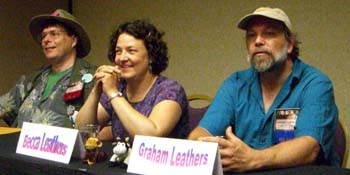
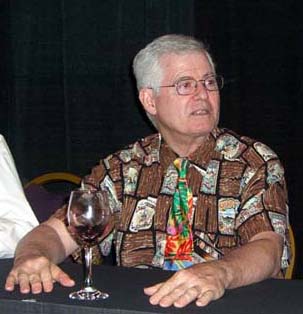
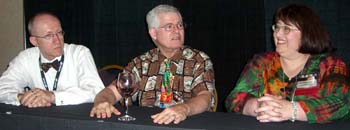
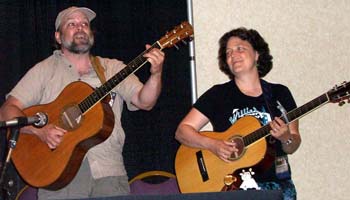
Jonathan Guthrie, Becca and Graham Leathers Jonathan Guthrie, filk Guests of Honor Graham and Becca Leathers

So, common interests fueled the attraction these people felt for their mates. As Becca said, it's hard to explain her interest in filk to somebody who's not a musician (or even to some fellow musicians?). The panelists valued the "he/she gets me" factor so highly that one of them even asked the audience, has anyone here ever had a successfulx relationship with a non-fan? Tim compared an interest in things fannish to an interest in politics. He knows couples where one is hard left and the other hard right, who work a lot better than couples where one is politically very involved and the other doesn't care at all. Because in the first case at least both understand each other's passion for politics. I, a sole contrarian voice, argued that a success of a relationship has little to do with whether the other person is in the fandom. But of course I have only one data point -- myself, and can't speak for the whole fandom.

But it wasn't just the geeky or fannish interests that brought those couples together. Graham said when he saw dogs listed as one of Becca's interests on her LiveJournal, it clinched his interest in her, since he had been a dog trainer himself.

How hard or easy is it to find romance at SF conventions?

Chuck. When I first started coming to conventions, in the mid-80s, there were a lot more women than men. And then you tried to meet these women, and everyone's shields were up. They were like, here is one of those assholes. Nowadays it feels OK to meet people. Does everyone feel it was like that? Women go to cons to have fun, and those geeky guys come to them and say, I roll hundreds on <some kind of RPG?>! Let's go have a coke!

A woman in the audience: it's the opposite for me. I work in theater and I don't go to bars, so my pool of available straight men is not very big. So I hope that a nice geeky guy will come talk to me [at a con]. But it doesn't happen often. They happen to be libertarians.

Tim. There is a reputation that fandom in general is a big open tent [?]. In the 70s and 80s everyone in the fandom was considered an outcast. So geeky guys thought that the girls in the fandom would automatically accept them, and then they discovered that the general rules of dating still applied even in the fandom.

So maybe there was a reason why this panel did not have much of a novelty factor: geek dating isn't very different from mundane dating.

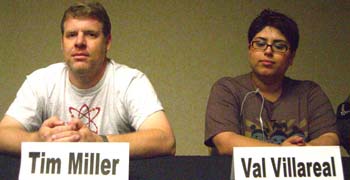
Tim Miller and Val Villareal Tim Miller and Val Villareal

Some said a difficulty of finding a romantic interest may also vary from con to con. One in-the-know fan in the audience dropped names of conventions that have reputations of being events where people go to get laid. Jonathan said that he had never experienced a hookup party at any convention. "Either I'm doing something wrong," he said, "or it really doesn't work this way."

Also, Becca reminded, a lot of people you meet at conventions are from out of town, so if you find romance, it's likely to be long-distance. That comes with its own challenges, and the odds for it surviving are not good (although a long distance relationship did work out for Becca and Graham). On the other hand, Graham added, if a relationship ends, the distance makes it less likely that you'll run into that person at future conventions.

Common sense advice, or conventions as churches

Overall, any advice given in this panel was only common sense. The panelists gave plenty of reminders for the guys to keep bathing and brushing their teeth if they ever want to get a date.

Chuck. It's a truism: a lot of guys come to a con and decide it's a 3-day excuse to abandon all hygiene. But [there are also] fans who go to cons try to socialize others, in the sense of teach them acceptable behaviors.

Tim. Remember the 5-3-1 rule: you have to have either 5 hours of sleep and 3 meals, or 3 hours of sleep and 5 meals, and 1 shower a day, and this will get you through the convention.

Chuck. The tub in your room doesn't just exist for icing down beer.

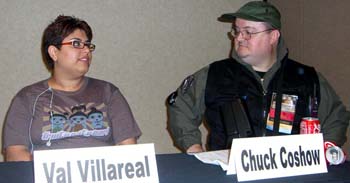
Val Villareal and Chuck Coshow Val Villareal and Chuck Coshow

Other advice:

Graham. One of the worst things you can do is come across as desperate. I was pretty much resigned to being single, and I was OK with that. I just had to bump into someone who I thought we can be friends with, but it progressed beyond that. I have no regrets about that. So, be yourself.

Tim. Don't look at cons a a singles bar: look at them more like a church, where you go for a some other purpose, but may meet people.

Jonathan added that some people treat church as a singles bar.

Here are more of my blog posts and pictures from ApolloCon 2007.

Monday, June 25, 2007

How Friendly Were Frodo and Sam? An ApolloCon 2007 panel

Description in the program book: Was there a homoerotic subtext to Lord of the Rings? Is subtext in the eye of the beholder, or is Spec Fic friendlier to GLBT characters and readings than the mainstream? Panelists discuss the perception of alternative sexualities in SF/F.

Panelists: Alexis Glynn Latner (moderator), Lee Martindale, Jess Nevins, Selina Rosen, Mel. White

Selina Rosen and Jess Nevins at ApolloCon 2007

What was it really about: The discussion didn't focus so much about a relationship between Frodo and Sam, or even gay / lesbian / bi / transsexual (GLBT) characters in SF. Mostly it revolved about fan fiction, especially slash fiction.

At first there was some speculation about Frodo and Sam. Were they or weren't they?

One panelist was vehemently opposed not just to slash fiction, but to most kinds of fan fiction. Others defended fan fiction, but acknowledged that slash fiction did nothing to address GLBT issues, and was overall not very relevant to the panel topic. Some panelists tried to get the panel back on track, but in the end they did not produce anything other than a few rather obvious observations.

My full article can be found on my web site.

Saturday, June 23, 2007

ApolloCon 2007, Friday: kaffeeklatsch with David Hartwell

Here are some interesting tidbits that were said at the kaffeeklatsch with the editor-legend David Hartwell.

A lot of people have very different opinions as to what hard science fiction means. Some count J. G. Ballard amont the writers working in this subgenre. In fact, J. G. Ballard had once stood up and said he was a hard science fiction writer: the hard science within which he was working were medicine and psychology. He may have had a point, because he was trained as a doctor, and he used those sciences rigorously in his fiction.

David Hartwell at the ApolloCon 2007 opening ceremony David Hartwell at the opening ceremony of ApolloCon 2007

About the economics of book sales. Apparently, mainstream books sell much worse than genre books. Of all 5 books nominated to the National Book award one year, none of them sold even a 1000 copies. Meanwhile it's a rare SF hardback that doesn't sell at least 2000 copies. Hartwell quotes Norman Spinrad, who said that publishing a SF novel that's a complete failure would be as unlikely as constipating yourself by active will.

Hartwell juggled some numbers, converting word count into dollars. For example, an extra 20,000 words translate into extra $2 added to the price of a hardcover. So if a 120,000 word hardcover would cost $24.95, a 140,000 hardcover would cost 26.95; and that means bookstores would order 25% fewer copies of it. (Or something like that. I'm not sure I am quoting those numbers right.) He shed light on the complex relationship between book distributors and publishing houses; a major portion of books are sold through supermarkets and other superstores, and if a superstore stops buying books from a publishing house, that publishing house may go bankrupt. Basically, he said, most books are now sold through superstores rather than small bookstores, which means that most of America lives 40 - 60 miles from a bookstore.

Hartwell says one of the best things one can do to promote the genre of science fiction, to keep it alive and thriving, is to write book reviews, an publish them somewhere. No matter how obscure is a web site where it's published, someone will find it and read it. It's especially true when you are reviewing an author's first novel. Even if the review is negative, if it is engaging and well thought-out, it will do a lot to promote the new author. 500 -- 1000 word review is better than a 300 word review. A 1500 word review is even better.

I feel so validated! My verbose book reviews are therefore worthwhile -- at least in Hartwell's opinion!

Here are more of my blog posts about Apollocon.

Friday, June 22, 2007

ApolloCon 2007: opening ceremony

The ApolloCon 2007 opening ceremony was short and simple. The convention chair, Mark Hall said they started ApolloCon because they wanted to have a con in Houston they wanted to go to. After 2 years of being the ApolloCon chair he will take the next two decades off, because this is a con he wants to go to. He added: "at least I think there's a con going on out there. Let me know if there isn't."
Mark B. Hall, David Hartwell, and C. S. Friedman at the opening ceremony Mark B. Hall, David Hartwell, and writer Guest of Honor C. S. Friedman at the opening ceremony of ApolloCon 2007. Here are more of my blog posts about Apollocon.
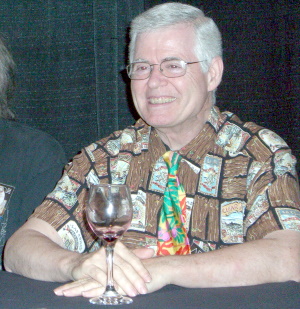
Introducing David Hartwell, Mark said: if David is wearing a tie, and you're an epileptic, you should truly try not to stare at it. I don't know if Hartwell's tie made anyone sick, but his voice must have soothed the audience's brain waves when he sang them a song "Teen Angel". Then the filk Guests of Honor Graham and Becca Leathers sang another song.
Graham and Becca Leathers at the opening ceremony Filk Guests of Honor Graham and Becca Leathers sing at the opening ceremony of ApolloCon 2007. Here are more of my blog posts about Apollocon.
The con has been reasonably fun so far. It started when an eminent Austin fan K and his wife M gave me a ride to Houston. We had some good conversation along the way. Then I hung out at some panels and room parties. All has been good so far, but not without a glitch. I found out I have forgotten my camera's cradle at home. A cradle is a thingy my camera must be docked into for transferring files into the computer, and for recharging. Forgetting it at home is a bummer. Fortunately, I have 2 spare batteries, so if I'm frugal, I may have enough juice to take pictures tomorrw and Sunday, but just barely. It's hard to break a habit of snapping away with abandon. As far as transferring the pictures, one guy offered to put my camera's memory card into a slot in his computer, and to plug in my external USB hard drive into his computer too, and that way transfer the pictures from one to the other. So that worked. Then again, that guy may not be here tomorrow, and I may not have another opportunity to transfer the pictures. Here are more of my blog posts about Apollocon.

Thursday, June 21, 2007

I finished my story for the ArmadilloCon writing workshop

Yesterday I finished a story for the ArmadilloCon writing workshop and mailed it. What a relief to be able to actually finish a story after 2 weeks worth of intense late night work! (And that wasn't writing -- it was just the editing.) What an excitement to know that a little less than 2 months from now it will be ripped into shreds... err, constructively criticized. :-)

Yes, I would be very excited to look forward to the workshop, except for this little bummer. My story is more than twice the 5000 word count limit. It's over 11,000 words. So I did what the Writers' Workshop instructions suggest to do in such cases: I cut it off at roughly 5000 words and put "the story continues" at the end. Even though that's clearly an undesirable option, because, to quote the workshop guidelines, "We recommend that you do not go over the word limit if writing a short story as it will not be representative of the work as a whole." Of course it won't. But what can I do if I am incapable of writing short fiction? I tried. Every time I start out to write a story, I think I can sum up its idea in 3 sentences; it's like, what will I fill those pages with? Then I start to write an outline, and lo and behold -- the outline itself takes 3 pages! :-) Then when I start writing the actual prose, I end up wondering if this wouldn't work better as a novel. :-)

And so it was with this story. I wasn't kidding when I said I spent the last 2 weeks just editing. The story itself was written half a year ago, but back then I was unable to finish it. Which is to say, I had written all the text that was supposed to go into it (and much, much more :-)), but I stopped short of reshuffling blocks of text to give it a linear structure. It had a beginning and an end, but I wasn't sure what the right sequence of events was, if that makes any sense. Back then I lost my focus and took a break from it. During the last 2 weeks I reorganized the text from an undirected graph of events into a narrative. :-)

In the process of editing / reshuffling, I cut, cut and cut. Oh, how I cut! It turned out it wasn't worthwhile to try to rewrite chapters of Wikipedia as dialogues between characters. :-) I cut them all out. 3/4 of "cool" science and technology that I thought was crucial to the story at first, turned out to be non-essential, so it all ended up in the trash. After all this butchering, the story still was over 11,000 words! This was insane. Realizing I'll have to cut it off at 5000 words, I was at least hoping those 5000 will come right around the cliffhanger (whatever passes for a cliffhanger in a story that reads like a troubleshooting script. :-)) But no, even that wasn't possible. After another pass of ruthless slicing, I had to cut it off at a point before things get really interesting (OK, so "really interesting" in my story is a relative term :-))

It's pathetic. I can't expect to get a meaningful critique of this story. Without having read the ending, the only meaningful input the critiquers can give me is on my writing style (dry), and characters (bland). But what can I do if I'm just not cut out to write short fiction? It would be a very good skill to develop, but I don't know if I can. What's worse, even as there are very few markets for short stories, there are fewer-to-none markets for novellette-length stories, such as mine! I really need to transition to a more marketable format. Don't know how to do it short of a complete brain rewiring. :-)

Anyway, I'm still proud of myself for finishing this story.

The funny thing is, before I could even mail the story, I almost acquired a reader. :-) An employee at Kinko's who helped me find the right envelope for mailing the story, picked it up and started reading it while I was writing the address on the envelope. A youngish Hispanic woman, she did not seem like a stereotypical reader of hard SF. I almost panicked: OMG, she'll think I'm weird! Most of my stories contain words that are not in the dictionary. ;-) Resisting an impulse to mutter "don't read this, it's for weird people only!" I politely pulled the sheaf of papers out of her hands. :-)

Monday, June 18, 2007

Paul Park "A Princess of Roumania": FACT reading group discussion and my review

On April 17th, 2007 the FACT reading group discussed "A Princess of Roumania" by Paul Park. 11 people attended the discussion. Everybody had started the book. Only 5 or so finished the book, but the rest were going to finish it. Only 2 people read Paul Park before. One of them had also read two sequels of "Princess Of Roumania", and his comments gave an impression that "Princess Of Roumania" is a lot more enjoyable in retrospective, once you know what happened next, as the events in the sequels explain a lot of things in the first book. Eventually others had to restrain him from revealing plot snippets from the sequels, although he was doing it only to be helpful.

Everybody liked it for different reasons

... most of which I couldn't relate to.

Majority of the group liked this book. Some of the group members derive a lot of their enjoyment of a book from its literary and political references. One of those people found a treasure trove of such references in "Princess of Roumania". He thought the magic (which was based, he said, on Gypsy tradition), was interesting, and the political situation in the alternative Europe, where Roumania is a major power, fascinating. He was also intrigued by the gnostic undercurrents in Paul Park's writing and an unusual version of Christianity that exists in the parallel world of the novel -- it's not the Christianity we know.

In contrast, another reader thought the alternative Roumania was not so fascinating as to intrigue somebody who knew very little about the actual Romania. "I don't know much about Romania," said a reader. "An alternate history of a country I don't know much about doesn't do much for me. [The author] didn't pull it off for me. He didn't make me interested in Romania."

People gave Paul Park credit for attempting an ambitious story ("He's trying to marry a children's adventure story that kind of reminds me of Philip Pulman, with alternate history stuff, and I think it's an interesting idea," said a reader) and breaking fantasy stereotypes. "This is not Tolkien," said another reader who praised "Princess of Roumania" as one of the best fantasy works he has ever read. "Tolkien created the stereotypes we follow, and I wish more people broke out of sterotypes like Paul Park has. The thing that fascinates me about this story is that it is talking about what happens to real life people when they do their best given the information they have. And the world is out there with a response that's based on a different set of information." Indeed, the plans of some of the main characters are continuously stymied, since they act on incomplete information.

The Baroness was the most interesting character

One thing most people could agree on is that they "liked" the Baroness. Not that they found her a likeable character in a conventional sense (she certainly is not), but most people found her interesting to read about. On one hand she is a sociopath who kills casually, almost spontaneously, when her plans are thwarted, and considers herself to be above the rest of the humanity; on the other hand, she is miserable and full of self-hatred. Readers thought her conflicted psyche made her human.

Criticisms

There were some criticisms voiced by one or more members of the group:

The pacing is pedestrian, most characters not very engaging

  • Readers felt distanced from the characters. Several people mentioned they did not find a character to root for or to become attached to.
  • The sudden shifts of viewpoint were confusing. Sometimes it wasn't immediately obvious which character is the viewpoint character in a particular chapter.
  • One person did not think the characters' behavior was credible. "One of my issues with either fantasy or SF where someone is taken from our world, and maybe I'm just way too egocentric, but it would take me pages and pages of my own mental dialogues to say, why me? I didn't feel they were incredulous enough in that situation." he said.
  • One person thought the beginning of the story, where we meet Miranda's parents, held false promise, as it was shaping up to be a story about kids who live in a college town and whose parents work at the university. He was disappointed to find out it wasn't the case. "I thought their parents were very interesting characters, only they don't appear further in the book."
  • Several readers remarked that the story was rather slow. "His pacing is very pedestrian," said one reader. "Very slow. He just doesn't get on with it, even three quarters into the book. His writing style is not bad, and his prose is fairly good, but his storytelling is, for me, pedestrian. It's very hard to keep going because he doesn't progress anything."

I agree with the last criticism. I found this book incredibly sloooow and tedious.

The Miranda storyline wasn't going anywhere

Paul Park at the World Fantasy Convention 2006

There is hardly any fantastic element in Miranda's storyline, apart from her initial disappearance from our world into the parallel universe. Park spends hundreds of pages recounting Miranda's and her friends' journey through the woods, and their encounters with various interested parties: first good guys, then bad guys, then good-but-not-so-good guys, then bad-but-maybe-not-so-bad guys, etc. Miranda's wanderings seem pointless and tedious.

It is understandable that Miranda doesn't know who to trust in this situation, and I've read many stories where the protagonist doesn't know who the good guys or the bad guys are, and in some stories a major part of intrigue is figuring it out; but in this book it is not so. The mystery of who is on her side and who is against her does not move the plot forward; on the contrary, it causes the plot to stall.

Readers puzzled by glowing blurbs

It doesn't help that the blurbs in the book compare Paul Park to famous contributors to the alternate history genre, such as Roger Zelazny. The comparison was found unwarranted by some people. "As far as alternate history I will admit that there were some really good books I read, [Charles Stross'] "Family Trade" and [Roger Zelazny's] "Nine Princes of Amber", and the first chapter of "Nine Princes of Amber" had more cool things than this book. Certainly more action than this whole book. Paul Park is a good writer, but he's not at Zelazny's level yet. He's being compared to Zelazny, but maybe it's because if you write a robot novel, you would be compared to Asimov," said another reader.

Other people, while agreeing the pace was kind of slow, thought it may have been adequate for the kind of story Paul Park is telling. "Nothing he writes is action adventure. It's intellectual puzzles," said a reader. Despite the slowness, most people found the story good enough to enjoy, and many were planning to read the sequels.

Still, some people felt the novel did not quite live up to the expectations raised by the glowing blurbs. For the second time in the recent history of the reading group, the discussion of a book ended up with a meta-discussion of why that book was so highly praised by famous writers (in this case, Ursula Le Guin or John Crowley). Some people also didn't think "Princess of Roumania" was outstanding enough to be nominated for the World Fantasy Award in 2006. A reader suggested this book may have been nominated for the following reasons: "It's trying to be literary, it has downtrodden people in Eastern Europe, and it was written by a college professor."

Wednesday, June 13, 2007

"Logical" may be in the eye of the beholder

There is this interesting article in this month's Scientific American.

The Traveler's Dilemma by Kaushik Basu

"When playing this simple game, people consistently reject the rational choice. In fact, by acting illogically, they end up reaping a larger reward -- an outcome that demands a new kind of formal reasoning"

Here is a long quote from the article, describing the game and the "paradox". (I put "paradox" in quotes because I don't think the behavior the author characterizes as illogical is at all illogical.) The quote is long, and the article itself is 5 times as long, but I found it rather interesting, myself, and the mathematics involved in it is very simple; it does not contain a single equation. :-)

The rules of the Traveller's Dilemma game


Lucy and Pete, returning from a remote Pacific island, find that the airline has damaged the identical antiques that each had purchased. An airline manager says that he is happy to compensate them but is handicapped by being clueless about the value of these strange objects. Simply asking the travelers for the price is hopeless, he figures, for they will inflate it.

Instead he devises a more complicated scheme. He asks each of them to write down the price of the antique as any dollar integer between 2 and 100 without conferring together. If both write the same number, he will take that to be the true price, and he will pay each of them that amount. But if they write different numbers, he will assume that the lower one is the actual price and that the person writing the higher number is cheating. In that case, he will pay both of them the lower number along with a bonus and a penalty--the person who wrote the lower number will get $2 more as a reward for honesty and the one who wrote the higher number will get $2 less as a punishment. For instance, if Lucy writes 46 and Pete writes 100, Lucy will get $48 and Pete will get $44.

What numbers will Lucy and Pete write? What number would you write?

Scenarios of this kind, in which one or more individuals have choices to make and will be rewarded according to those choices, are known as games by the people who study them (game theorists). I crafted this game, "Traveler's Dilemma", in 1994 with several objectives in mind: to contest the narrow view of rational behavior and cognitive processes taken by economists and many political scientists, to challenge the libertarian presumptions of traditional economics and to highlight a logical paradox of rationality.

Traveler's Dilemma (TD) achieves those goals because the game's logic dictates that 2 is the best option, yet most people pick 100 or a number close to 100--both those who have not thought through the logic and those who fully understand that they are deviating markedly from the "rational" choice. Furthermore, players reap a greater reward by not adhering to reason in this way. Thus, there is something rational about choosing not to be rational when playing Traveler's Dilemma.


I was stunned that the author would consider the number 2 to be the rational choice.

This is how the authors explains it


To see why 2 is the logical choice, consider a plausible line of thought that Lucy might pursue: her first idea is that she should write the largest possible number, 100, which will earn her $100 if Pete is similarly greedy. (If the antique actually cost her much less than $100, she would now be happily thinking about the foolishness of the airline manager's scheme.)

Soon, however, it strikes her that if she wrote 99 instead, she would make a little more money, because in that case she would get $101. But surely this insight will also occur to Pete, and if both wrote 99, Lucy would get $99. If Pete wrote 99, then she could do better by writing 98, in which case she would get $100. Yet the same logic would lead Pete to choose 98 as well. In that case, she could deviate to 97 and earn $99. And so on. Continuing with this line of reasoning would take the travelers spiraling down to the smallest permissible number, namely, 2. It may seem highly implausible that Lucy would really go all the way down to 2 in this fashion. That does not matter (and is, in fact, the whole point)--this is where the logic leads us.


But logic doesn't really lead us where the author says it does


Logic would lead us there only if Lucy's goal wasn't simply to get a big sum of money for her antique, but to get more, or at least no less, than Pete, at any cost, even at the cost of impoverishing herself.

The rest of this long article attempts to explain why most people, when play this game, behave "illogically", and -- gasp -- reap bigger rewards than if they were behaving "logically" and named 2 as their number. To me, the reason seems both obvious and easy to summarizein a couple of sentences. Most people's goal when playing this game isn't to beat the other guy, but to maximize the amount of money they get. I suppose they are perfectly fine with naming 100 and getting 98, while the other guy names 99 and gets 101. It's still a much better outcome for them than naming 2 and getting 2.

"Maximize" is probably the wrong word here. As long as they can get "close enough" to the maximum possible sum any one player could get (101), they don't care about attaining the absolute maximum. Of course, "close enough" is not easy to quantify mathematically, even though it can be interesting to try. My master's thesis was about heuristic algorithms in mathematical optimization, and heuristics are all about finding a "good enough" solution without worrying about the best.

Anyway, just because the actual human behavior can't be easily (or at all) explained by game theory, it simply means game theory is not perfect at modeling human behaviors (even in very simple scenarios such as this), not that humans behave irrationally.

Sunday, June 10, 2007

I fixed Gallery -- sort of

Fixed, fixed, fixed! Yay!... was my first thought. (It was tempered by a dose of reality later.) The fix was actually rather simple, and of a different nature than what I thought it would be. That is, it did not come by figuring out what to change in the Gallery2 code. I tried that first, but in the process of debugging the code I hosed it even more than it was already hosed. :-) Basically, I dug myself into a hole, and then dug myself out of it by taking a different route. I won't post the details of the fix here, since they are too tedious for my this blog. I have posted them on my web site instead, so that perhaps someone someday could benefit from my experience.

I was about to celebrate the fix by adding a new, funny image to Gallery. However... trying to upload an image I got an error. So much for joy. Well, at least it is possible to view the images that are already there. That's better than nothing, but still... if it turns out that my fix broke Gallery in a way that makes it impossible to add new pictures, it won't be much of a fix.

Wednesday, June 06, 2007

Science fiction writers versus NYTimes science writers

It's time, again, to grumble, marvel, or snicker at the New York Times Science section. Today's essay by Dennis Overbye, The Universe, Expanding Beyond All Understanding, says that our successors (make that very, very distant successors. Like 100 billion years from now) may have no way of finding out about the Big Bang and the expanding universe.

Because...


Because the universe is expanding at an ever-increasing rate,

[Physicists Lawrence Krauss and Robert J. Scherrer] calculate [that] in 100 billion years the only galaxies left visible in the sky will be the half-dozen or so bound together gravitationally into what is known as the Local Group, which is not expanding and in fact will probably merge into one starry ball.

Unable to see any galaxies flying away, those astronomers will not know the universe is expanding and will think instead that they are back in the static island universe of Einstein. [...] Observers in our "island universe" will be fundamentally incapable of determining the true nature of the universe.


From there the author jumps to a conclusion which made me think that science fact writers are a bit lacking in imagination compared to science fiction writers. :-)

Such as...


It is hard to count all the ways in which this is sad. Forget the implied mortality of our species and everything it has or has not accomplished. If you are of a certain science fiction age, like me, you might have grown up with a vague notion of the evolution of the universe as a form of growing self-awareness: the universe coming to know itself, getting smarter and smarter, culminating in some grand understanding, commanding the power to engineer galaxies and redesign local spacetime.


If not for the line "all the ways in which this is sad", this paragraph would seem to indicate Dennis Overbye has read enough science fiction to be optimistic about the fate of the humankind and the universe. But then in the next paragraph he says:

Instead, we have the prospect of a million separate Sisyphean efforts with one species after another pushing the rock up the hill only to have it roll back down and be forgotten.


Wait, hasn't he read, for example, Charles Stross? Does he not know that long before 100 billion years are over, the humanity is destined to experience a technological singularity and transition to a post-human state, where (if they so wish) they will live in the forms of digital consciousnesses and travel through wormholes, thereby overcoming the light speed barrier? :-) But... since Dennis Overbye claims to be "of a certain science fiction age", maybe Charles Stross falls beyond his personal horizon. Perhaps the writers who came after the golden age of science fiction are as invisible to him as those distant galaxies that are flying away at the speed of light will be invisble to our successors. :-)

Otherwise, I would agree, the picture would be sad, if it's true that

As this universe expands and there is more space, there is more force pushing the galaxies outward faster and faster. As they approach the speed of light, the galaxies will approach a sort of horizon and simply vanish from view, as if they were falling into a black hole, their light shifted to infinitely long wavelengths and dimmed by their great speed. The most distant galaxies disappear first as the horizon slowly shrinks around us like a noose.


But really, I think that in a 100 billion years the humanity (though not in its present form, of course) will have both seeded the distant galaxies and mastered FTL communication.

Besides, why assume that our successors will have access to none of the knowledge the humanity has accumulated so far? Given how plentifully scientific knowledge is documented, there is a good chance it will survive for posterity.

And overall, how can you meaningfully speculate about what will happen a 100 billion years from now? For comparison, the current age of the universe is only 14 billion years. Most science fiction writers I know think you can't meaningfully speculate about the future beyond, let's say, 50 years from now. I don't know what is this "certain science fiction" age of which Dennis Overbye claims to be, but time seems to flow many orders of magnitude slower for him. :-)

Overall, though, he makes an interesting point. If you assume that the current astrophysical knowledge won't survive into distant future, then it's possible that, in the words of Dr. Krauss, quoted in this article, future cosmologists "will puzzle about why the visible universe seems to consist of six galaxies. [...] What is the significance of six? Hundreds of papers will be written on that." Moreover, the same thing may be happening today. Our physics and astrophysics research may be leading us down wrong paths because the evidence that would lead to right conclusions simply doesn't exist. Maybe we are already living too late to find critical evidence that would explain why the universe is the way it is. This aspect of the article is interesting. But the hand-wringing over the sad fate of future humans... gimme a break.

Friday, May 25, 2007

Do I need Gallery at all?

Before throwing myself head first into attempt to fix Gallery, I think I should ask myself a question: do I need Gallery at all? Can I do without it? What's the point of having it on my website if I also post all the same pictures on Flickr? Why duplicate the effort? Wouldn't I be better off with just Flickr?

I've thought about it, and compared Flickr and Gallery according to several different criteria. What follows is a long and tedious list that smacks more of accounting than of geekery, and is of interest only to those who are wrestling with similar dilemmas.

1. Data presentation


1.1. Ability to organize images hierarchically


At first, Gallery had an advantage of having hierarchical albums with as many levels of subalbums as you want, whereas in Flickr you could have only one level of "sets". But Flickr recently introduced so-called "collections", which can be made up of sub-collections and sets. Thus it now provides a hierarchical way to organize your images. So Gallery and Flickr are pretty much equal at that point.

The score so far: 1:1

1.2. Ability to present newest images first


Flickr has a significant advantage: it presents your pictures as a (photo)stream -- newest pictures first. (That does not keep you from grouping them into sets and collections.) On the other hand, the only way to access newest pictures first in Gallery (I suppose) is through an RSS feed. And I'm not even sure if Gallery supports RSS feeds! (Though I've read somewhere that it does.) But try to explain to my mother-in-law (who regularly checks my albums for new pictures of Erika) what an RSS feed is, or how to access it! (My own mother, OTOH, took to RSS feeds with gusto after I explained to her what they were.)

The score so far: Flickr 2, Gallery 1

2. Hosting: on my website vs third-party website


One can say that an advantage of Gallery is that it is hosted on my own website, where I have "full control" over my images and data, whereas Flickr is hosted by Yahoo, a big, impersonal, corporation -- and we all know that big corporations are just one step shy of becoming Satan incarnate, and are constantly thinking of ways to harness their customers' data for world domination. :-) Well, the reason I put "full control" in quotes is because I'm afraid the control I have over my data on my website is illusory. First, even though it's "my" website, it is hosted not by me but by a corporation (Dreamhost), and they are the ones who have the actual control over it. Second, performing an upgrade that hosed my software actually caused me to lose control over my data. Loss of control over data comes not just in the form of having your data turned over to FBI, but also in losing ability to manipulate it due to software glitches. Whereas if Flickr hosed its own software, I'm sure they would be working day and night to fix it.

The score so far: Flickr 3, Gallery 1

3. Community aspect


On Flickr I am a part of a big community that occasionally shows it's paying attention to my pictures by way of commenting on them or marking them as favorites. It's nice. The Gallery on my website is not a part of any community. Sure, Gallery has community features: it lets you create user groups, and it lets users add comments to pictures. But not surprisingly, no one has ever created a user account in my Gallery just so as to comment on my pictures. Every time a viewer needs to create an account to participate in something, the probability of their participating falls by about an order or two of magnitude. On Flicr, though, all the Flickr'ites already have accounts, and with those accounts they can participate in all the numerous communities.

The score so far: Flickr 4, Gallery 1

If the score is so much in favor of Flickr, why do I even bother thinking of fixing Gallery on my website?

Here we come to the critical feature that makes it very hard for me to give up Gallery. It's not a feature of Gallery per se as much as a corollary of the fact that I'm hosting Gallery on my web site vs third-party website.

4. Access logs


My web hosting provider allows me to see statistics of who accessed Gallery and when, what images they viewed and where they came from. I am a sucker for access logs. I want to know which IP addresses are viewing my images, and how the viewers found it (referrer pages and search terms). That's 50% of the fun of posting images. I want to know much more than just the view count on a particular image. Because of that, I am not ready to give up Gallery.

You may say, get Statcounter or something like that, and put it on Flickr? Well, Flickr doesn't let you add HTML / Javascript to your photos page, so it's not an option. So, this is the one huge advantage of hosting software on my own website vs Flickr, and that's why I can't give up on Gallery yet.

Wednesday, May 23, 2007

Free software is worth what you pay for it

That's a statement worthy of a troll. So perhaps I should rephrase it more diplomatically. Free software support is worth what you pay for it. Or, to word it even more precisely, free software support by a cheap-ass web hosting company is worth what you pay for it. The company that hosts my web site, Dreamhost, offers a seductive feature: one-click software install for assorted popular free software packages, such as Joomla, phpBB, or Gallery. By clicking a button in your control panel you can initiate an installation process, and after asking a few simple questions, Dreamhost (or rather, its scripts) will do all installation process for you. Neat, huh? I used it to install several software packages on my site, and it worked as advertised.

It lulled me into a false sense of comfort...


For one-click-installable software Dreamhost also offers one-click upgrades. Basically, there is this button in your control panel "upgrade to the latest version", next to each one-click-installable package that you have installed. If a button is there, it's tempting you to click it. After all, why not install the latest version? You want to be "with it", don't you? :-) And Dreamhost provides reasonable precautions against upgrades gone bad: it urges you to back up your database, and it does not destroy the old version, but moves the old directory to .old, assuring you that should you not like the new version, you can revert back to the old one simply by renaming the directory. So really, why not upgrade? Is it any wonder that my finger itched to click that button?

...and then it sprung the trap


So I clicked to upgrade my Gallery installation. And... I don't have Gallery anymore. Or rather, I have a Gallery that throws itself into an infinite loop of URL redirection whenever anybody attempts to view it. It does that because it claims it "can't" "find" the default theme plugin, called Matrix. I put the words "can't" and "find" in quotes, because it's not clear in what sense Gallery is unable to find this plugin. Matrix theme is right there where it's always been, and Gallery debug messages indicate it is indeed able to instantiate the Matrix plugin class. But after that it arrives to a conclusion that the Gallery theme is missing, inactive or incompatible.

Googling this error message and various permutations of its terms didn't yield anything useful or applicable to my situation.

Can't go back to the old version, either


What about the assurance on behalf of Dreamhost that I should be able to go back to the old version of Gallery? (They say it's as simple as renaming the .old directory back to its proper name.) Well, that didn't help -- I'm getting a different error message. Blowing away both the old and the new directories and installing from scratch is not an option either, because I have literally thousands of pictures in Gallery, painstakingly added over the course of two years. I really, really want to fix this install. Dreamhost won't be of help, because they state clearly that they don't support third-party software, and all the installations or upgrades you perform, even the one-click ones, you do at your own risk.

But I think I should still fire off a nastygram to Dreamhost. It's one thing to not support software, but it's quite another to give your users rope to hang themselves with. At the very least they could have tried out the one-click upgrade themselves, observed that it leads to a disaster, and issued a warning to users. But I've been too demoralized to fire off nastygrams.

Of course, since this is an open source program, its source code is available to me, so in theory I should be able to debug it. In theory. Given plenty of spare time. If I go that route (since I don't have many other options at this point), at least I'll be able to get a lot of blogging mileage out of it, in the spirit of Eric Raymond's CUPS rant :-) (I won't put tedious details in this blog, though.)

Monday, May 21, 2007

Ken MacLeod "Learning The World": book review

I read this book because it was on the FACT reading list, but ended up not going to the reading group meeting, because my car broke down. So, instead of a discussion report, this is just my opinion of the book.

I liked "Learning The World".

An unusual take on a First Contact story


It was an unusual take on a First Contact story, at least to me. It was unusual that a highly technically advanced civilization (so advanced their spaceship is powered by an engine that creates universes in its wake) would be afraid of a much more primitive society (bat-people) that does not even have spaceflight. Despite the apparent power imbalance, the high-tech society has reasons to fear the low-tech society. This kept me interested in the story. The bat-people storyline was more interesting to me than the ship-people storyline. The Darvin and Orro characters were more vivid than any of the humans. I guess I didn't find any of the humans very convincing. For example, I did not understand how Atomic, the teenage protagonist, became a highly influential figure of her generation, so much so that the majority of her generation went along with a certain radical idea she promoted simply because she was the one pushing that idea. I understand that her blog, or "biolog", was widely read on the ship, but nothing she said there was so brilliant as to make her a very influential personality.

I could much better relate to the bat-people, who were more sympathetic characters than any of the ship-people. Yet their biology, mainly the fact that they were capable of flight, made their culture unusual to just the right degree to be intriguing. Their daily life was portrayed with enough convincing details that the reader could see they were alien, yet they remained understandable. What I didn't find too convincing was that their state of technology was almost identical to ours in the beginning of the 20th century. (Except they had television and we didn't at that time; but we had heavier-than-air flight and they did not.) I was almost waiting for this coincidence to be explained at the end: for example, was the bat-people society visited in the past by human space explorers who brought their technologies with them? If not, perhaps this coincidence reflected the central message of the book? The thesis of the book seemed to be that intelligent life is incredibly common in the universe, so maybe the author was trying to say that among billions of intelligent worlds there are likely to be some whose history mirrors one another very closely?

Not so credible science


Still... regarding this thesis, I don't think the author made a compelling case for it. Some characters in this book contemplate Fermi paradox, but they don't explain it very well. At the end where Atomic mentions the theory of universe creation by an evolutionary process, it does not explain the Fermi paradox either. I've read about the evolutionary theory of universe creation before, but the version that Atomic presents seems to have a fallacy in it. It's too bad that MacLeod did not elaborate this part further. If the fundamental questions about universe creation were addressed in more depth, this book could have been very good instead of merely not bad.

Cool character names, idioms


There's something to be said about the writing style. I got a kick out of the characters' names, such as Atomic Discourse Gale or Synchronic Narrative Storm. Since I always struggle to come up with names for my characters, I was envious that Ken McLeod found a method to generate an unlimited number of cool character names. :-) And the metaphors, idioms and turns of phrase used by both cultures are carefully constructed to reflect the alien realities of the two civilizations. The bat people's idioms revolve around wings and flight. The alienness of the ship-people's perspective was captured by little observations made by various ship-humans when they first see the bat-people's planet: how weird it is to live in a place where the horizon curves downward, not upward (as in the ship), and don't they feel unsafe living in a place that does not have a "ceiling", that's wide open and "exposed" to space? But the observation that topped it all was something a ship-human said when she saw trees for the first time and compared them to an array of parabolic antennas. Or something like that. Don't quote me on that as I may be misremembering. I wish I could find that place in the book, but I can't.

Friday, May 18, 2007

Tony Ballantyne's "Recursion": FACT group discussion and my opinion

11 members of the FACT reading group attended the discussion of Tony Ballantyne's "Recursion" on March 20, 2007. Nobody has read anything by Ballantyne before, because this is his first novel. Everybody in the group has started the book. About half the people finished it. Some of the rest were planning to finish, but a couple of people were so disappointed by the beginning that they put the book aside.

Three storylines: some dull, some exciting


"Recursion" consists of three storylines, set at different times in the future. In the storyline set in the most distant future, a human and a robot fight Van Neumann Machines (VNMs), self-reproducing assemblers that threaten to overtake the whole universe by converting all matter to VNMs. This storyline is introduced first, and unfortunately most readers found it rather boring, which demotivated some of them to continue reading. The protagonist, Herb, is a self-centered young man from a privileged background, with more money than common sense. It would seem such a person would have enough foibles to make him a vivid character, but most readers found him dull. It may have to do with the fact that instead of actively seeking solutions, he kind of just goes along for a ride. Not that he wanted anything more to begin with: the only reason he went on a mission to save the universe was because he was blackmailed into doing that by the robot Robert. Robert is immensely smarter than Herb, and has all sorts of information Herb does not. As a result, Herb ends up being hardly more than a puppet for Robert, who drags him off, kicking and screaming, on a series of nauseatingly scary adventures. Robert keeps him clueless about his plans until the very end, where Herb is supposed to play a critical part. Since Herb was, albeit unwillingly, hardly more than a passive observer throughout his adventures, the readers did not find him interesting. To quote one reader, "Herb's any real emotion was wetting his pants."

The second character, Constantine, was found to be on the average more interesting. His most intriguing aspect was his four personalities, voices in his head, that bickered among themselves and gave him advice. However, the storyline and characters most people found most interesting was a woman named Eva and her friends, fellow inmates of a psychiatric hospital. Readers thought Eva was the most credible of the three protagonists, and admired the way the author got into Eva's head. Some thought Ballantyne's skill in creating Eva showed he could have done a better job with the other two protagonists. The portrayal of the society Eva lived in -- one reader described it as "nanny-socialist state run amock, making sure that all needs are met, whether you want them to be met or not", was found compelling as well.

Some premises of 'Recursion' people found hard to accept


The premise of the book -- the fight against self-replicating machines that are taking over the universe -- was judged by various readers to be


  1. a bit of a stretch;


  2. a cliche, made worse because Ballantyne


    • didn't add much new to it,


    • spent too much time explaining what Van Neumann machines are, given that a fairly high percentage of the readership was familiar with this concept from other science fiction works.


Regarding point (1), two readers could not take seriously the premise that there can be a society with no safeguards against someone accidentally launching a plague of self-assembling machines, or "grey goo". At the very least a runaway grey goo problem would have happened much sooner and on a much bigger scale, they thought.

That wasn't the only concept in "Recursion" people found hard to accept. The idea that an AI tests its behavior against the "crazy" people, and it bases its decisions regarding the future of humanity on reactions of the inmates of a mental asylum -- that idea was not found credible by some people. A reader said "The whole concept of testing against the extremes and basing your decision on the extreme... it's not why you do testing. [...] You use extremes to determine the middle to where you should stay, you don't use extremes to base your decision on."

Reasons to like "Recursion"


But not everybody was disappointed in "Recursion". One person said he liked it because "it was different. When I was reading it, I really couldn't tell what was going to happen 50 pages from now. This book constantly kept me guessing." The people who liked it, although they were in the minority, enjoyed the puzzle aspect of "Recursion". By showing parts of the puzzle from different times and places, Ballantyne provided just enough clues for the reader to speculate what's going on, but not so many as to be predictable. Another aspect that appealed to some was the paranoia that pervaded the lives of the characters. Somebody said the paranoia reminded him of some of Philip K. Dick's work. "This was a stronger novel than Dick's A Scanner Darkly. This was on part with Dick's better novels like Ubik," he said. Paranoia in "Recursion" is fueled by the fact that the human protagonists are dealing with AIs of superior intellect, the motivations of which they can't possibly fathom. They can only acknowledge, as they do eventually, that they'll never know if they are on the "good" or "bad" side, or whether the "good" and "bad" sides even exist. I thought that was a realistic view of the situation on behalf of the author. It was also one of the reasons I liked this book.

I thought Ballantyne's storytelling was much better than some authors we've read recently (Karl Schroeder and Cordwainer Smith). I did not find Herb boring. I thought the writing style was witty, even though some people in the group found it bland. I guess the puzzle aspect of the book is what really drew me in. It is present in most books I've recently read that I liked.

Here are a few more of my observations. The method of destroying the Enemy seemed clever, but at the same time too simple to be entirely credible. It would seem that something so obvious should have been foreseen by the super-powerful AI that was the Enemy. Another aspect of the book I was a little disappointed with was that the two subplots -- Eva's and Constantine's -- that chronologically precede Herb's storyline, in the end turn out to be dead ends... to an extent. Though it's true that they have some consequences in Herb's story, they are not integrated organically. While they reveal how the main players in this world, EA/Watcher and the Enemy, came into being, they don't actually play a part in, or provide clues for, conquering the Enemy. So while those storylines were interesting, I wish they had been integrated tighter. (But then I don't know if I had read the book carefully enough; maybe it provided critical clues and I just missed them; it's possible for that to happen since I read mostly while exercising on a stairmaster. :-))

Also, there is a small scientific innacuracy in the book: quantum entanglement does not enable faster-than-light communication. But it wasn't critical to the plot.