Thursday, August 31, 2006

The Atrocity Archives by Charles Stross: FACT reading group discussion and my personal opinion

On August 15, 2006 the FACT reading group discussed The Atrocity Archives by Charles Stross, which consists of novels The Atrocity Archive and The Concrete Jungle. Everybody but one person in the group finished the book, and the one person who had not was planning to finish it. Everybody has read Charles Stross before. Most people in the group loved The Atrocity Archives. Like "Family Trade", and unlike some of Charles Stross' Singularity-themed science fiction, this book is a crowd pleaser. People described it as clever, loads of fun, and (to borrow a word occasionally used to characterize good space opera), rollicking. (The Atrocity Archives is not space opera, but it's rollicking nonetheless.)

Somebody took an informal survey on which genre did people think this book belong to: satire? comedy? horror? spy novel? Most people thought this book belonged to one of those genres first, and science fiction second or third.

Many in the group had fun with the computer / mathematical jargon and geek jokes. (Person 1: "I kept waiting to see whether the middle initial of the main character's name (Bob Howard) is E." Person 2: "No, his middle initials are OF.") Even those who didn't have the background to understand the jokes, appreciated the writing style. One reader said she liked the texture of the writing, "the way it was densely filled with all the science and pseudoscience vocabulary, thrown in with bits of Lovecraftian and magical vocabulary. I couldn't tell whether the way he was throwing things around was right or not scientifically, but I didn't care. I loved that texture to the writing."

Half of the group got a good chuckle out of the "pi = 4" moment. One reader spent some time pondering a universe where pi is equal to 4, and how bizarrely stretched the space must be in that universe. Another reader argued it's not possible mathematicaly, because a lot of mathematical results depend on the value of pi being what it is. Many series converge to pi, or to some number divided by pi. If its value changed, not only geometry would be different, but most of the mathematics, e.g. calculus or number theory, wouldn't work at all. Still, the first reader really enjoyed an opportunity to think about it. He said Charles Stross probably didn't even realize how fun it was for a reader to ponder this problem. Stross most likely put it in as a throwaway remark.

Other readers gave Stross credit for a convincing description of how to defuse a hydrogen bomb so that it would not explode, or rather, explode in a "benign", not-too-destructive fashion. In this he demonstrates knowledge of bombs beyond a typical Hollywood movie.

Everybody appreciated the irony of the fact that a certain technology the government uses (quite pointlessly) in the "war on terror", turns against it in a very bad way. (This was in The Concrete Jungle.) Somebody jokes that it was like making every land mine remote-controlled by WiFi from a computer running a Windows operating system. (To say more would be a major spoiler.)
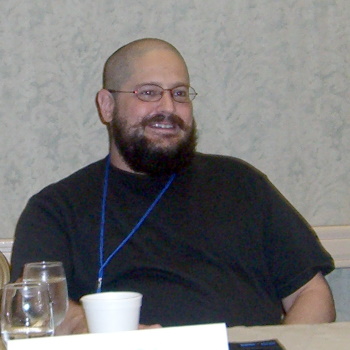
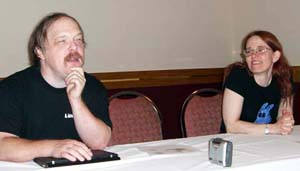
Charles Stross in the British SF panel at ArmadilloCon 2007
Charles Stross in the "Current Trends in British SF" panel at ArmadilloCon 2007

Overall, to quote one reader, Charles Stross "is a skillful writer and he gets a lot of details of computer technology and theroetical computer science right. This combination of a strong writer who knows technology, only Neal Stephenson comes close. Rudy Rucker knows what he's talking about, but can't write, and William Gibson, the other way around." Nonetheless, it was agreed that science in this book was used mostly as a joke, and maybe that's the reason why most readers would not classify this book primarily as science fiction. Stross uses a lot of SF tropes in what is essentially a modern fantasy horror story. While you can't not like a book that starts with a mention of Turing-Lovecraft equations, Stross kind of "fluffs over" that stuff, to quote another reader.

While enjoying the irreverent tone of the book, most readers were moved by the chapter that was entitled, as the novel itself, The Atrocity Archive. A reader said: "It was chilling and very good. At the end it made as much sense as any other explanation of the Nazi Germany I've ever heard."

One reader thought the exposition lasted too long. On one hand, sending your character to a training course that covers the material he already knows is a clever way to introduce that material to the reader; on the other hand, there were too many training courses. A character in an espionage novel should not spend half the book in a classroom. Some writers, for example, Roger Zelazny, are better at mixing action with exposition. At the time Stross was writing this book, he hadn't quite mastered it.

However, no one else in the reading group seemed to think the exposition slowed down the action. And another reader, who, according to herself, has recently rejoined the ranks of bureaucracy, appreciated the fact that the protagonist is forced to waste time in a training class while there are monsters to be fought. That's very typical for a bureaucratic organization.

This prompts a discussion, is the portrayal of bureaucratic absurdities in the Laundry an exaggeration, or are there really organizations like that? The part of the group that hasn't worked for the government thought it was obviously an exaggeration, but others who have worked for the government swore it was all true. There really are managers who say "You should have called in this morning to tell me you'll be sleeping late this morning". In the middle of sharing stories about real-life pointy-haired bosses, somebody asked the group, are there any actual managers in our midst? In the past, lambasting middle managers has caused bad feelings among some members of the group who happened to be middle managers themselves. So this time the person who asked the question wanted to make sure nobody was getting offended.

And of course, no discussion of a Charles Stross book could be complete without chuckling over memorable quotes. Such as "Fred's dead, so he works the night shift", or my favorite "[the hard drive array] scratches its read/write heads", or "The London Underground is famous for apparently believing that human beings go about this world owning neither a kidney nor colon." Or the line from a top secret report, where you have this long, dragged-on paragraph of bureaucratese ending with "when the Great Old Ones return from beyond the stars to eat our brains".

Saturday, July 15, 2006

Readercon 2006: kaffeeklatsch with Patrick and Theresa Nielsen Hayden

In between all that deconstructionist talk (see my previous post) I attended a very refreshing, and much more interesting event, a kaffeeklatsch with editors Patrick and Theresa Nielsen Hayden. They gave interesting insights in what makes a SF/F novel or story good, at least if we define good as interesting or readable. (Kaffeeklatsches were small gatherings, where a pro (a writer or an editor) met with fans (up to 10 people) around a round table, to chat and answer whatever questions fans wanted to ask them. Coffee and tea were served, hence the name.)

Just-in-time exposition

The conversation veered towards JK Rowling and the secrets of her success among mainstream readership (outside of science fiction fandom). Somebody (perhaps one of the Haydens) had this theory. In many SF/F books the reader needs to notice details whose significance he or she can't understand immediately, and store them for later use, to be remembered and interpreted later in the reading process as more information reveals itself. But Rowling does not make the reader do it. At any point in the book she reveals only as much information as is needed to understand what goes immediately after. One guy in the audience aptly called it Just-In-Time exposition. I wonder if anyone else in the room noticed that all this talk about JK Rowling seemed to have conjured Harry Potter himself. He was in the audience!

Another editor said her many years of work as an editor affected the ways she looks at real life. She can't help but look for a hidden plot in any real life story, for example, news stories. Let's say she saw a news story about a terrorist plot to flood Manhattan. But Manhattan is above the sea level, so it doesn't seem feasible for her. So she wonders "what's really going on", the same way she looks for hidden subplots in the books she's reading.

How fast is your train moving?

And here's a snappy piece of advice given by Theresa Nielsen Hayden: if the passengers are critiquing the scenery, the train isn't going fast enough. Writers often think they have to give more exposition to the readers, whereas in fact they need to give less. If the plot moves fast enough, readers are less likely to notice inconsistencies or incompleteness or logical gaps in the exposition.

Patrick and Teresa Nielsen Hayden at a kaffeeklatsch at Readercon. Here are more of my blog posts and pictures from Readercon 2006.

Friday, July 14, 2006

Readercon 2006: fantasy writers -- unwitting agents of capitalism?

I got an overall impression that Readercon is a more highbrow convention than ArmadilloCon. Or maybe it's just that I didn't go to those kind of panels at the ArmadilloCon. Or it could be that China Mieville's presence makes everything highbrow. I mean, suddenly the panelists, instead of just chatting about cool things in science fiction and fantasy, are "deconstructing" books and talking about "alternate readings of texts". Probably because socialist politics and literary theory go hand in hand.Not only you start hearing how most of the "traditional" fantasy (as opposed to "new weird" fantasy Mieville writes) upholds conservative beliefs and reinforces the status quo of class disparity (e.g. by promoting such archetypes as The Good King). No: in addition to that, you hear about how the very notion of a novel having a protagonist is somewhat bourgeois and reactionary. I don't know about you, Dear Reader, but my first thought was "Whaaaat?" Well, yes: the presence of a protagonist implies that one person, a hero, can single-handedly change the world (as they often do in SF and fantasy), and therefore reinforces the notion that our happiness or unhappiness is solely the consequence of our own actions, and never of the society, hereby removing a need for social change.

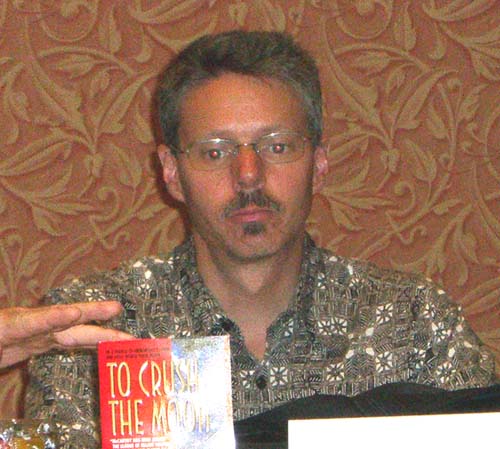
China Mieville at Readercon 2006
China Mieville at Readercon 2006, a science fiction convention in Boston

In SF and fantasy, therefore, a cigar is never just a cigar. Willingly or unwillingly, the genre has become an agent in the class struggle.

I'm semi-joking, of course. While I indeed heard China Mieville say things I recounted above, I also heard him say the opposite: namely, that he does NOT like reading SF and fantasy as an alegory, and that in order to get the most out of the genre, you must read it as if it was literal truth. (Suspension of disbelief and all that, I guess.)

I may have to think how to reconcile those views. Or, most likely I'll just forget it as the demands of daily life take over.

Friday, March 03, 2006

Where I'm going to hide from Google

I finally gave in to temptation to give my life over to this newly sinister entity that may one day succeed Microsoft on the throne of evil. Like Aragorn, if he hadn't been wise enough to turn down The Ring, it may give in to the corruptive seduction of power. I'm talking, of course, about Google. I signed over the contents of my hard drive, and by extension, my soul, to Google, when I installed Google Desktop on my computer.

I was inspired to do that by this article in Washington Post:

Google's Latest Bundle of Goodies Is Worth Opening.

"Last month, it introduced a free bundle of Windows XP software called Google Pack. [...] The Pack ( http://pack.google.com/ ) consists of five Google programs (Google Earth, Google Desktop, the Picasa photo organizer, the Google Toolbar for Internet Explorer and the new Google Pack Screensaver)," [and some other software I am not interested in].

I had almost forgotten about the once-viewed-as-controversial Google Desktop. The program that applies Google search algorithms to the files on your desktop, allowing you to search them as easily as the web. It was controversial when it was first announced, because there was some concern that Google may get hold of the contents of your desktop.

It so happens that lately I've been in need for a program that would let me search inside the PHP files on my machine. I was looking into modifying some of the Joomla source code to customize the Joomla installation on my web site. Joomla is an open source content management system. It's written in PHP. I have Joomla source code on my machine, and I want to be able to search it.

Normally I would use Windows built-in search mechanism for that. It does a pretty good job at letting you search files -- or so I thought until I tried searching within Joomla source code. Windows can't find files that are right under its nose! Or, rather, it can't find text strings in those files. I don't understand why that is. My only guess is because those files have a .php extension. Maybe Windows views them as different from text files, even though they really aren't. The text in them is "different" in that it's written in a programming language, but it does not contain any special characters. It's no different from documents written in English! Why should it be hard to search inside it?

Yes, Windows. I'm running Windows. For those who say I should use Linux, the answer is in this digression below.

<digression>

I do have Linux on my laptop. It usually refuses to work with the wireless connection at home (RoadRunner), although it sometimes works with wireless in public places, such as coffeeshops. With RoadRunner, most often it is unable to obtain an IP address. Occassionally, though, it does obtain an IP address, even though I am not doing anything different. A lot of times even when it obtains an IP address, it can't see anything on the internet. And, in the rarest of cases, it gets an IP address and sees the internet. It happens so rarely that I can practically count on not having an internet connection when booted into Linux. (My laptop is dual boot Windows XP and Linux.)

Because of that, it seldom makes sense for me to boot into Linux, because there's little I can accomplish without Internet access. For example, if I want to experiment with changes to my Joomla website, I need to be able to login into my hosting service to make those changes.

But, yes, Linux has the incredibly handly find command, which I so sorely miss on Windows.

My lappy is weird. Other Linux computers at our home don't have a wireless connection problem. RoadRunner or not, they work just fine. My lappy, though, experiences wireless glitches in Windows, too. It sometimes loses the wireledss connection for no reason at all, even though all the other machines at home are not experiencing any interruptions. Usually, after losing it, it regains it automatically in a few minutes. Other times it doesn't.

Steve thinks it's the Centrino chip in the laptop that's causing the weirdness. Maybe. Whatever it is, I know I'm not likely to figure out on my own how to get it to work with Linux. Not without getting a degree in Electrical Engineering, or something. There are machines out there that play with wireless better, but I like this lappy and won't give it up. It is very small, lightweight and neat. An ultimate portable machine. It fits my needs better than any other computer I've had.

</digression>

So I thought, well, it's some Microsoft idiocy. Surely Google Desktop will not suffer from the same. Surely I can use it to search inside the PHP files.

So I downloaded the Google Desktop as part of the Google Pack. (Other components of the Pack, such as a photo application Picasa, and a photo screensaver, looked appealing, too.) I let it run overnight indexing my files. Next day I let it loose to hunt in my PHP files.

And... nothing. After some playing around I determined that Google Desktop does not index the PHP files. As far as it's concerned, they don't exist.

How stupid. Of course, I am in the minority with my need for this. But still... why would it exclude perfectly good, perfectly searchable source code files?

After some looking, I found links to Google Desktop plug-ins written by third-party developers; some plug-ins let you index certain source code files. For example, Java. So apparently some people had the same problem as me, if they wrote their own software to index "special" types of files. (That are not really special at all.) There are no plug-ins to index PHP files, though.

Grumble. Grumble grumble grumble. How useless.

But, come the day when Google takes over the world, I will know where to hide my seditious thoughts. I'll just put them in .php files. :-)

Tuesday, October 11, 2005

Linucon 2005: quips and robots

A woman to Rob Landley: you've been preparing food every time I come here.

Rob says something like "it's my job".

The woman: and it disappears even faster than you make it.

Rob Landley: My objective here is not be able to keep up.


Austin Robot Group had a display of their robots at Linucon.


The Babbling Robot Head was singing Scottish traditional songs in a voice that, according to the project description in the Austin Robot Group's website, is synthesized. The voice is kind of nasal and drone'y, but oddly pleasant. Well, maybe not all of its songs were Scottish, but the one I remember best, "Flower of Scotland", was. It is captured in this video (9 sec).
This robot has lightning flashing across its "face" and it moves its arms up and down and those pincers at the end of its arms rotate. A video can be found here (13 sec). I could not find its name or description in the Austin Robot Group's page.


This "grim reaper" robot (another one whose name or description I could not find) turns its head from side to side and waves its hands, as seen in this video (8 sec).
Here are more images of Linucon 2005 robots.

Linucon 2005: Chupaqueso

This is what chupaqueso is described as in the Linucon program book: "The experts prepare cheese in a fried cheese shell, with extra cheese. The audience gets to eat the results. A favorite of Schlock Mercenary fans."

The story of chupaqueso invention

Chupaqueso was invented by Howard Tayler, the author of the Schlock Mercenary web comic. I'm not sure if I correctly remember the convoluted story of Chupaqueso's birth, but... At first there was a word. Howard Tayler was looking for a made-up word to describe quintessential cheap, greasy, Mexican fast food, probably for his comic strip, and chupaqueso suggested itself. It's composed of Spanish words for "suck" and "cheese".

Then, while he was on a low carb diet, and cheese must have been a major staple in his kitchen, he was flipping through a cookbook and saw a cheese crisp. That was the prototype of the chupaqueso. If I remember correctly, Howard improved on it by adding cheese filling to it.

How to make it

You cook it by spreading shredded cheese in a circle on a griddle (a pan would do too, I suppose). It melts and forms a pancake which will become the chupaqueso shell. You flip it over. Then you put more shredded cheese -- the same or different kind -- in the middle of the shell. Then you fold the sides of the pancake over one another, and the result is a chupaqueso.

Howard and Jay Maynard (a.k.a The Tron Guy) gave a chupaqueso cooking demonstration in the Con Suite. I ate a piece, and, well, it tastes just as cheesy and greasy as one would expect. That's not to say it's bad!

Click on the picture for YouTube video of the cooking demonstration.

Here are more pictures of making chupaqueso

Here are more posts and images from Linucon 2005.

Towards the end they even cooked a chupaqueso with a chocolate filling. I had to try that too, and even made a video of that, but must have accidentally deleted it. Or maybe my unconscious mind could not tolerate this level of disgust and made me hit the button. :-) It suffices to say chocolate didn't do much to improve the classic version.

Monday, October 10, 2005

Linucon 2005: Guilty Pleasures

Synopsis from Linucon program book: "Science Fiction authors we like, even though we think we shouldn't."

The panelists were Cathy and Eric Raymond. The audience enthusiastically joined into sharing their own guilty pleasures. Although I have read only one author out of the ones mentioned on the panel, I found this panel to be fun. Just to hear the plot summaries, funny details and even the titles of other people's favorite trashy books was hilarious.

Examples of hilarious titles and plot snippets

Titles: "Snow White and the Seven Samurai", or "Who's Afraid of Beowulf" (both by Tom Holt).

Plot snippets:

Cathy Raymond, recounting the plot of I don't remember what book. There's this wizard that goes on this quest and he has only one advantage...

Eric Raymond. An elderly mentor whose entire vocabulary consists of the word "indeed".

Cathy. He has a curse or attribute that he can never truly be alone for more than a second at a time. Which means that death can't nab him, because death has to go after him when he's alone, and he never is.

And:

Rob Landley. I dug up some old books "The Girl With The Silver Eyes" and such, where very little actually happens, but it's a really good book. It's a book about a telekinetic finding three other telekinetics due to something their mothers have taken as a headache medicine. They find out they WEREN'T actually being tracked by the government. It's one of those books where if they had been adults, it would have taken them 45 minutes and a car to find out.

I checked the names and titles of most authors and books mentioned in this post, but if some are misspelled, it is solely my fault.

So, here are our panelists' and audience's guilty pleasures.

Panelists' and audience's guilty pleasures

Eric Raymond. Honor Harrington series.

Cathy Raymond. Conan the Barbarian.

Eric Raymond. For me, military SF in general is a guilty pleasure cause most of it is crap. There are some fine ones, like Lois Bujold and Robert Heinlein. But those are exceptions. The rest of military SF is crap. But I read them anyway. I cut my teeth on Doc Smith [with his gigantic space battlefields blowing up] and I enjoy them.

Eric Raymond further mentions having enjoyed the Star Kings novel by Edmond Hamilton, and its sequel. That's actually the only two novels of the ones mentioned in this discussion, that I (Elze) have read. And they were delicious!

Eric and Cathy Raymond at Linucon 2005 Eric and Cathy Raymond. Here are more posts from Linucon 2005.
.

Cathy Raymond. Laurel K. Hamilton. She writes some wonderful fantasy wedging fantasy creatures rather convincingly into real world settings. She writes really well but that's not why I read her. I read her because of sex.

A woman in the audience. Soft porn.

Cathy. I wouldn't say soft porn. Some of it is really graphic.

Another woman in the audience brings up Anne Rice.

Cathy. I should have thought of her for the other panel (Authors We Gave Up On), because I've given up on her. She was even more in the soft porn direction, although not as good at is as the other authors.

Rob Landley. I like reading children's books, science fiction books that are aimed at young adult market. They have them in a section with big bright colors with baloons. I just grab books and take them home. Well, I pay for them first.

(Everyone laughs, and someone shouts: Now that would be a REAL guilty pleasure!)

Jay Maynard. I've got one. A Star Trek novel "How much for just the planet"?

Eric Raymond. It had a virulent anticapitalist political ranting in it, and [despite that] Jay and I both liked it. That's how good it was!

Jay Maynard. It's been described as Hitchiker's Guide to the Federation. If you put the book down ater the first 20 pages, you have no sense of humor at all.

Rob Landley says when he was 10, his parents visited Andre Norton in Florida. His father was this huge fan of hers. So he met this fat lady with veins in her legs and couldn't stand up very well, and had cats. She had books all over the place. She gave Rob a book based on D&D. She described it as "over most major plot turns you can hear the dice roll".

Then again, one person's guilty pleasure can be another person's brilliant satire. This leads the panelists to a debate on...

How does one define a guilty pleasure?

A guy in the audience lists a book "First Contract" (aliens make a contact with us and it turns out they're capitalists). Eric thinks it's a satire, not a guity pleasure. So are, in his opinion, Stainless Steel Rat stories, which another audience member counts as his guilty pleasure. So what differentiates a GP from a book you're willing to admit you like? asks Cathy.

Eric Raymond. I can put my finger on one difference. Most guilty pleasure have in common that the author is barefacedly trying to manipulate the reader in ways that are rewarding but have nothing to do with actual story or idea, or anything that rises to the forebrain level. First Contract makes an interesting case. There's a level of wit and cleverness in that book. There's a level of author sharing with you a sardonic commentary on that book that actual guilty pleasures don't have.

That's what GP have in common with pornography.

Eric Raymond. Terry Pratchet for me, when he was just doing lightweight satirical comedy, there was a touch of guilty pleasure about him too, but then he got all wise and I don't feel guilty reading him anymore.

A guy in the audience takes a different tack on the topic. My guilty pleasure is anything by De Sade. I did a monologue from him in my acting class. More than anything else he convinced me to leave the church. His ideas on welfare were also very extreme. That's a guy who makes Ayn Rand look tame, and that's hard to do.

Cathy acknowledges that that's a different topic: ideas so radical that even in this society they are not acknowledged.

How do the panelists have time to read so much?

Noticing that Eric Raymond has read pretty much every book that anyone in the audience has mentioned, someone asks: "How do you have time to read all this stuff?"

Eric Raymond says he reads faster than anyone he knows. He and Jay Maynard compare their reading speeds.

Cathy Raymond says she read the latest Harry Potter book on a Saturday afternoon when she had nothing else to do and it took her about 5 hours.

Eric Raymond. I thought I read faster than anyone else I know. But occasionally I think she reads faster than me.

Cathy. No, I ignore more shit.

Cathy offers a partial explanation to how Eric managed to read so many books in his lifetime. He has been a hacker for more than 20 years, and back then when you compiled, you had oodles of downtime, so he would read.

He has read so much that he issues a challenge to the audience: "if you can remember anything enough about a guilty pleasure that you don't know the title of, I can probably identify it." And then it turns out that he can't actually name any of the three books that the audience members ask him to identify.

Linucon 2005: Authors We Gave Up On

Synopsis. To quote from Linucon program book: "What does it take for an author you used to really like to honk you off so badly that you won't read him or her any more? Our panelists discuss cases." The panelists were Eric and Cathy Raymond, Lawrence Person and Jay Maynard, the guy in the Tron costume. (Actually he wore a different costume on that panel.)

To be accurate, "authors" in this case meant "science fiction authors".

The worst offender: Orson Scott Card

The worst offender, or the one panelists feel most strongly about: Orson Scott Card. Lawrence is disappointed by the Alvin Maker series, while ESR is put off by Ender books. Maybe not "Ender's Game", but some of the subsequent books in the series. ESR thinks that Orson Scott Card is incapable of moral reasoning, or something like that. I will have to listen to the tape to find out for sure. IIRC, he thinks Orson Scott Card characters (most notably, Ender) reach wrong moral conclusions from their experiences.

Other offenders:

Frank Herbert. Frank Herbert also has turned a lot of people off. Jay Maynard says the "Dune" trilogy was at least 2-3 books too long. And he says that being aware that the "Dune" series went to 6 books. That's not counting the posthumous collaborations.

Posthumous "collaborations" of living writers with the dead authors, or rather their greedy offspring, are subject to much disdain by the panelists. Lawrence has an entire arsenal of barbs for this particular phenomenon: industrial necrophilia, a frat boy in the closet with Asimov's naked corpse, and such.

Harry Turtledove. Jay Maynard likes to badmouth Harry Turtledove. Eric Raymond, while he likes a lot of Harry Turtledove's stuff, agrees with Jay on this author's alternative history Civil War series. Turtledove, he says, doesn't bother to write a nice story, because he is paid by the word.

I can explain Turtledove, says Eric Raymond. He is supporting 4 daughters. Even in the best of times his prose is quite pedestrian, plows like a truckhorse [?]. The economic cistumstances under which he labors are not favorable to good taste.

Cathy Raymond had given up on George R. R. Martin, because she got tired of unredeeming horror he visited on protagonists she has come to like.

Eric Raymond also gave up on Catherine Asaro who started out writing excellent space operas with good hard science in the background, and ended up writing goopy romance novels under the pretense of science fiction.

A discussion Philip K. Dick's place in science fiction, and Eric Raymond's opinion of what REAL science fiction is

A discussion ensues about Philip K. Dick's place in science fiction. ESR thinks that Philip K. Dick is most popular among people who don't understand science fiction. Lawrence objects that if everything in SF had descended from Heinlein and there was nothing from Dick, the genre would be immensely smaller. It needs the darkness that it got from Philip K. Dick.

Left to right: Eric Raymond, Cathy Raymond, Lawrence Person, Jay Maynard. Here are more posts from Linucon 2005.

As an example of dark work that makes everything brighter, ESR thinks Tim Powers is a much better example of that, instead of Philip K. Dick. Not only that, but in his opinion Powers is more of an example of a science fiction writer than Dick. Because the fundamental characteristic of SF is that it promulgates that universe is ordered and is ultimately knowable. That's Gregory's Benford's definition, to which ESR apparently subscribes. But Philip K. Dick was perpetually struggling against the idea that the universe had any order at all.

Lawrence says that Benford's definition would exclude a lot of work that's included in the science fiction canon.

A guy in the audience says Philip K. Dick is probably the only author who benefits from someone coming in, picking up a few pieces of his work and turning it into a nice, simple space opera, instead of paranoid madness.

How William Gibson's sense of humor is like the microwave background radiation of the universe

Another audience member says he gave up on William Gibson after "Pattern Recognition". Lawrence agrees. As he said in this article that discusses the recent works of the cyberpunk classics, Cyberpunk after 9/11, in "Pattern Recognition" Gibson wrote an exquisitively beautiful novel of excruciating tedium.

Lawrence's friend Dwight, who was sitting in the audience, suggested that "Pattern Recognition" is Gibson's attempt at slapstick. Lawrence doubts it, because, as he says, William Gibson's sense of humor is like the microwave background radiation of the universe: it takes a very finely calibrated instrument to read it. And to be able to tell it from pidgeon dung on your telescope, adds a guy named Andrew from the audience.

Thursday, October 06, 2005

Linucon 2005: Customers Do The Craziest Things

The title suggests this panel should have been stories from tech support front lines. It was a bit more general than that. The panelists and the audience shared particularly memorable stories they've experienced while working in computer or technology industry that did not necessarily involve customers. And no, none of the old chestnuts about retractable cup-holders or little white food pedals.

The panelists were supposed to be Rusty Allen and Stu Green, but Stu didn't show up. Too bad, because as I remember from Austin Linux Group meetings 5 years ago, Stu is quite an entertaining speaker. So Rusty Allen alone held down the fort. And the audience stepped in with funny stories of their own.

Impossible to press two buttons simultaneously?

At that time Rusty Allen was working as a system administrator or perhaps providing tech support to the employees of the company where he worked. One day he got a call from an executive who had some computer trouble. Rusty first tried to tell him to press Alt+Clear in order to clear the screen so that he could then tell the guy what to type in order to fix the problem. (Actually, I don't think there is a "Clear" key on modern keyboards, but from what I understand this was before PCs.) The executive asked: "so I have to hold down the Alt button and press the Clear button simultaneously?" Rusty said yes. The guy asked: "is there any other way to do it?" Rusty was puzzled. He said, "if you have a problem that's keeping you from doing that, tell me and maybe I can help". The executive said: "I have one arm".

Rusty was taken aback, and didn't know what else to say except to suggest politely that the guy do it the way he finds best. He figured that someone who climbed up to a high position in the company probably had ways to get around his handicap.

A chipmunk operator

There was this company that never had enough backup tapes. They kept buying and buying tapes and still kept running out of them. Then one day they were doing something to the computer room, perhaps re-laying a cable that was in the way, IIRC. In the process, they, quoting Rusty, "popped open the floor"... and there were paper grocery bags full of tapes underneath. They popped open the floor in several other places, and everywhere they found bags and bags of unused tapes. They found 4 or 5 caches like that. Eventually one of the third shift operators confessed he put them there. He explained: "I had my own stash of tapes, but people kept taking them!" In reality, he was using some "recreational stuff" and kept forgetting where he put the tapes. They started calling him Chipmunk after that.

But he didn't lose his job, since it was hard enough to find third shift operators as it was.

An operator stripped to the waist

A programmer walked into a computer room (mainframes). There was about 120 degrees in the room. The operator was there, stripped to the waist, and something was burning. The programmer ran to the emergency shutdown and hit the big red button, so that nothing would continue to burn. It was a button meant for absolute emergencies, when you don't care whether your machines will come back up afterwards, you just want to shut them down NOW! Then he asked the operator what happened. "Well, we've lost some cooling!" the guy explained. "And I decided to only run one job at the time, so that it won't heat up as fast!"

Back then with those machines the heat generated by them didn't really depend on whether you ran 1 task at a time or 20 tasks at a time. But the operator thought it was like burning gasoline: the less you use, the less heat would come out.

Metal particles mysteriously sucked into a hole

At a gas company in Houston a computer room was next to a secretary's desk. An electrician came over and said he needed to install a new socket over there (in the secretary's office). He attacked the wall with a circular saw, and noticed that the metal particles were being sucked into the hole he made. He didn't know or ask what was on the other side, only thought it was neat that the particles went into the other side of the wall: it meant he would not have to clean up.

Turns out he was drilling into a system that provided air circulation for the company's mainframes. All the metal shavings were sprayed into circuit boards of the machines. I don't remember if there was any mention of the whole company screeching to a halt, but that wouldn't be impossible, because, like Rusty said, back then one careless action by an operator could knock thousands of computers off line.

Disaster planning, said Rusty, is not so much planning for a hurricane as for operator spilling coke on a machine. That's much more likely to happen.

A human setting off radiation detectors

Rusty's sister, a biologist with a Ph.D., was taking medication for a thyroid problem. She started noticing at work that there was a problem with data collection that would happen whenever she walked into the room. Finally they figured it out. The researchers were using radioactive tags to collect their data, and her medicine contained something (I guess iodine?) that emitted beta particles.

Better obey those laws of physics

Apropos recent events (hurricanes Katrina and Rita), an audience member named Paul had a typhoon emergency preparation story. This happened in Asia, where typhoons are common. Before one hit, employees were loading valuables into a bank vault. Then they watertight-sealed the bank vault door and ran off into typhoon shelter. Afterwards they came back, tried the lock combination to open the door, and even though it was correct, the door wouldn't open. Then they realized that the atmospheric pressure was a little bit low when they closed the vault, and the current higher atmospheric pressure outside the vault was keeping it shut very effectively.

So they drilled a very small hole in the door and it whistled for about a week until the pressure equalized, giving a new meaning to "whistle while you work".


Rusty Allen. Here are more posts from Linucon 2005.

Wednesday, October 05, 2005

Other observations about Linucon

On geek flirting

Yesterday I went to a FACT (Fandom Association of Central Texas) reading group book meeting. This group consists of some of the same people who put together ArmadilloCon, the annual Austin science fiction convention. They were at Linucon, too. We chatted about it a little after we finished discussing the book. Willie wondered if two major subsets of people that this convention attracted -- Linux geeks and anime babes (since Linucon had a heavy emphasis on anime) would have anything in common. But maybe they had, because he observed a Linux guy approaching an anime babe with this classic line: "Wanna go check out Fry's"? It cracked him up. However, Fry's actually has a sizeable anime section (so they say, I haven't checked it out myself), and it may just be the point where those two worlds intersect. And Fry's is a near-perfect place for a first date. There is as much food for conversation there as in a museum, and, unlike in a museum, you can talk loudly. I'm even surprised why Eric and Cathy Raymond didn't mention it in their last year's panel on geek dating.

A positive effect of anime programming on Linucon -- in my experience, at least

Before going to Linucon I prepared to be put off by its heavy anime track (which was caused by the fact that this year Linucon was run by people who run anime conventions), because I have no interest in it. My familiarity with this genre begins and ends at "Ghost in the Shell" of which my mind retained only two things. One, that it was essentially the same story as William Gibson's "Neuromancer". Not a plagiarism, just a rehash, in the same way that unimaginative fantasy novels are rehashes of "Lord of the Rings". Raymond Feist's "Magician" is a prime example of this phenomenon. So I felt I didn't gain anything new by watching "Ghost in the Shell". Plus, to quote Chuck from the reading group, books give you better visuals. The other thing I remember about this movie was its awesome music. The only thing worth seeing it for.

However, I found the anime track at Linucon completely unobtrusive. An unintended advantage of devoting a lot of programming to anime is that it reduced the number of panels I may have been interested in, and that was a good thing! Fewer scheduling conflicts, fewer regrets for not being able to see everything I wanted.

The other welcome side effect was I got to see and take pictures of some very cute costumes. Anne from Pink Chocolate Cosplay (shown below) is one example. Here are image of more hall costumes (anime and not) from Linucon 2005.

Tuesday, October 04, 2005

Linucon 2005: World building panel

(Linucon was a joint Linux and science fiction convention that took place September 30 - October 2, 2005 in Austin, TX.)

I was about 20 minutes late to this discussion panel. In my pre-baby days an early panel was at 10 or 11 am (mostly because room parties at conventions go on late into the night), but now that I had to feed the baby and get her ready in order to take her along, even 12 pm seemed early. So I missed the beginning of the conversation.

"Building" a world means coming up with a description of a hypothetical planet's geography and how it would have conditioned or determined the biology and sociology of the alien civilization that lives here. And, of course, the ultimate goal would be to describe the civilization itself. Well, actually, the ultimate goal of such exercise is to write a story or a book. Writing a book or to a lesser extent a short story, that takes place on an alien world, requires giving a lot of thought to what this world would be like, and how to make it interestingly alien while remaining consistent with the principles of science. Because of that world building exercises are perennially popular at science fiction conventions. At least the ones I go to.

The brainstorming in this case was lead by an Austin-based science fiction writer Rie Sheridan, and the audience actively participated.

From what I gathered after missing the first 20 minutes is that Rie Sheridan and her audience had decided to "build" an sea world. This planet will be mostly covered with oceans and will have little dry land.

The intelligent life forms live in the sea

The intelligent life forms live in the sea. Unfortunately, the discussion on what those intelligent life forms would be like must have taken place before I arrived, since there wasn't much talk about it afterwards. Even so, they probably didn't devote much time to it because at the end of the panel a woman in the audience asked: "I came in late. Did you talk about how they communicate underwater? Do they have speech?" Rie replied: "that's a good point". It turned out they haven't covered that part.

But later Rie Sheridan brought up an interesting example of how the geology, etc., the nature, the surroundings these creatures live in would affect their language and mentality. If they live in the sea, the idioms in their language should be water-based. So, for example, they should not say "I have the weight of the world on my shoulders and it feels lika a rock is pressing on my heart" since those are earth-based metaphors. It reminds me of Ursula LeGuin's story "The Word for World is Forest" of which, unfortunately, I remember only the title. The story didn't seem memorable except for the forest-based figures of speech that the alien civilization in it used.

I guess if Rie and the audience did not even get around to discussing how the inhabitants of this world communicate, I might not have missed much. Because to me that's more interesting than geography and geology.

What would colonists have to deal with if they come to this world?

They approached this world mostly from a colonists' perspective. What would they have to deal with when they come to this world? What natural resources would they use, and how would they use them, to make stuff they need? What, you mean they won't have nanoassemblers that would convert any available molecules of matter into anything the colonists need? The latter was my thought, actually, not voiced in the discussion. Well, having process natural resources the old-fashioned way can be hard, I suppose. There was a suggestion to make things out of kelp which is reported to be very waterproof (maybe only in this fantasy world?) Or make boats out of glass, because this planet has volcanoes and they are somehow supposed to provide colonists with glass, though I'm not sure by what exact process. The volcanoes would also provide them with geo-thermal energy. Or they could harness wave and tidal action to generate electricity.

Writer Rie Sheridan at Linucon 2005 Writer Rie Sheridan. More posts from Linucon 2005 can be found in my blog

But their ability to do so would depend on their level of preparedness to deal with a hostile environment and that in itself is determined by the tools, materials and knowledge they have. Which can drastically vary depending on their circumstances. If they had set out to explore and put roots on a new planet, they would probably be well prepared. But what if it's just three guys from a freight ship that crash-landed on the planet? They don't have much supplies. How would they survive? And if there's no hope that a rescue mission would come and find them, would it even make sense to try to survive? Knowing that here on this planet you are the last representative of your kind and your race will die out with you might be too demotivating.

Somebody in the audience suggests that in the latter case the accidental colonists could try to assimilate themselves into the local population, even try to breed with them. The idea that two species so vastly different as terrestrial and aquatic could interbreed is so unlikely as to be largely unscientific. And as such, it doesn't appeal to me.

Even if it's a fantasy story, magic must have rules

Unless, of course, this is a fantasy story and this world has magic. That would change the rules of the game immensely. So one of the things Rie Sheridan advices the writers to decide on early in the exercise is whether this world is technology- or magic-based. Building a magic-based world was done at the last year's ArmadilloCon and is described in this article. It was very amusing! Rie Sheridan was there too, though she wasn't the driving force for that panel.

Magic, too, is not a ticket for you to do whatever you want with your world. If the inhabitants are able to do all the magic they want, it doesn't take any energy, it doesn't take any materials, and any situation you get into you can get out of with magic, that may be quite boring. So it's better if you have only a limited pool of energy to do magic. Maybe, as in Dungeons and Dragons, there are only so many spells you can cast in one day.

Common sense stuff, really. So... I don't know if it's even worth writing about.

Monday, October 03, 2005

My overall impression of Linucon 2005

Knowing the troubles the organizational committee has been through this year, I expected a very chaotic, disorganized convention. And looking at their schedule and seeing how the panelists were a small subset of last year's panelists (and not many new people) reiterating some of the same topics as last year, I expected it might get just a taaaad bit repetitive. And attending a convention with a baby in tow isn't easy even when it's well organized, but a disorganized convention may be a lot more stressful that way. So I went to Linucon with appropriately low expectations.

And they were exceeded beyond any expectation! It was even more fun than last year. Even though the speakers were the same people and talked on some of the same or related subjects, their personalities made it captivating. In particular, I'm talking about Eric and Cathy Raymond, Howard Tayler, and to some extent Jay Maynard "The Tron Guy", Steve Jackson (he of Steve Jackson games), Rie Sheridan and John Quarterman.

Chase Hoffman, the convention chair, was asked how the number of attendees this year compared to last year. He said, the universal gas law says that as the gas volume is compressed, its temperature increases. "So let me just say we are twice as hot this year."

Hotter despite (or because of) being smaller

And I agree -- it was hotter despite (or because) being smaller. For one thing, a small number of simultaneously occurring panels didn't put me in a conflict over which panel to choose, like it usually happens at ArmadillCon. ArmadilloCon organizers have a knack of scheduling two of the most interesting (to me) panels at the same time and that time is 10 am in the morning. Or 11 pm in the evening. :-) Maybe it means that the subjects I am interested in appeal only to a very small part of the general con-going population? Anyway, Linucon didn't have many scheduling conflicts. S and I were able to easily agree how to distribute baby-caring responsibility so that neither of us would have to miss too many interesting panels.

Of non-panel events there was Cosplay, which, I gather, is just a new-fangled name for Masquerade, a good old con tradition (which ArmadilloCon doesn't have -- too literary for that, huh?) and it had Chupaquesos. More on those two subjects later. I will post highlights from various events I went to in my upcoming posts.

More liquid nitrogen stories

At the closing ceremony Chase Hoffman retold his liquid nitrogen story that he first told at the opening ceremony, which I told in this post. Of course, this wasn't the only time he had to explain liquid nitrogen to puzzled onlookers. Another time, at the end of probably the same convention in Dallas, he had to decide what to do with the unused liquid nitrogen. He didn't want to drive it back to Austin in the front seat of his car (apparently no other arrangement was possible) just in case it splashes. He said he was already an ugly man (though I disagree), and he didn't want to make himself even uglier by having his skin slough off. And the parking lot at the convention hotel was conveniently empty. So he thought he would dump the remaining liquid nitrogen right there. He started to do that. This, however, is not an inconspicuous action, as it generates lots of impressive vapor. Suddenly the hotel guard (or something) comes out running, yelling, "what the hell is that?" "Really cold water." The guard didn't believe that at first, but as he saw the stuff evaporating on the scorching hot pavement, he mumbled, "hmm. Cold water." and went back inside.

In the picture (click for a bigger image): The rightmost guy in a black T-Shirt, Rob Landley -- the chair of last year's Linucon and one of the key organizers this year -- is making ice cream with liquid nitrogen.

Saturday, October 01, 2005

Linucon 2005: This topic is intentionally left blank

Linucon: This topic is intentionally left blank

I thought the name of this panel hinted at the lack of preparedness on the part of organizers, and given the trouble they've been through this year it would have been entirely understandable. But I was wrong: the title was deliberate. The purpose of this panel was to get Eric Raymond, Howard Tayler and Steve Jackson (THE Steve Jackson of Steve Jackson's Games) to just talk about anything. This turned out one of the most entertaining panels I've been to at any convention. That's a testimonial to the personalities of the above-mentioned three panelists. They have enough improvisational power to turn a topicless discussion into a blast.

It turns out Eric Raymond has come up with something like a language for generating games, where you plug the parameters in and it generates a game for you. It could possibly come up with 20 million games. (They have gotten on the game topic because Howard Taylor said to Steve Jackson that he came up with an idea of a game based on his web-based comic Schlock Mercenary, but he doesn't know how to pitch game ideas.)

They talk about science fiction's influence on the open source movement and geek culture in general, but they don't go anywhere with it beyond a few amusing tidbits / factoids.

Around 1991 -- 1992 Howard Tayler wrote a "prophetic" science fiction story where someone accesses a network through a device the size of a cordless phone (not wireless, he points out, cordless! Oh, those were the days...) that one can carry in their hand. The network can be accessed from public points "all over the place". So it seems this might have been the one and only documented case of science fiction actually predicting the future.

The unintended consequence of the proliferation of communications to the literary world is that one can no longer write plots where a character disappears and is cut off from all communication or is unable to call for help.

Another of the ideas Howard recently came up with is a card for the Illuminati game, which was inspired or counterinspired by the Microstuff card, which represents an evil company. Howard's card, named Open GNUnix, would represent open source, and it would have an opposite alignment than Microstuff. The first is conservative, straight, criminal. Open GNUNix is liberal, weird, fanatic. He took a Gnu head and put it on a penguin body, so that there's something in it card to offend everybody, starting from Stallman...

But one of the most interesting things ESR said was that in his opinion, in the future everyone's job will be performance art. That will be a natural consequence of rising levels of living, of rising wealth in the society. In what sense? Well, someone in the audience immediately mentions that his work -- tech support -- already is performance art. 80% of it is spent soothing the customer. Everybody laughs, but Eric actually meant something else. Basicaly, you will make money by being interesting, by being a personality. That's how Eric Raymond makes a living right now, and to some extent so does Howard Tayler, who lives off of ad revenue from his web comic. As an example to illustrate his statement, Eric Raymond points out that people click on the ads on Howard's page because they are implicitly "endorsed" by Howard. The cachet of his personality makes whatever is being advertised attractive to the viewers. Or so Eric thought.

Then they veer towards lighter subjects of Chupa Queso -- Howard's invention (more about it tomorrow) and capsaicin, one of Eric's favorite things. Eric remembers an experiment in which volunteer pepperheads were injected with a drug that blocks endorphins, and they didn't like their hot food anymore! It demonstrated that people's liking of hot food is due to the capsaicin release.

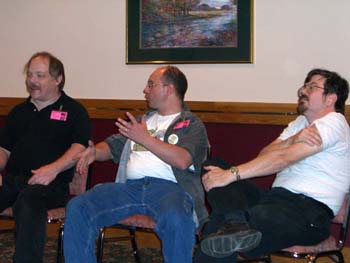
In the picture (click for a bigger image): Left to right: Eric Raymond, Howard Tayler, Steve Jackson.

Here are more posts from Linucon 2005.

Friday, September 30, 2005

Linucon: Adventures in Costuming

The last discussion panel on Friday I went to was "Adventures in Costuming", where the panelists were Cathy Raymond (Eric Raymond's wife) and Jay Maynard, a.k.a The Tron Guy. More of him and his costume can be seen in these posts. I had to leave this panel halfway because it was late and my 5-month-old was getting tired. Anyway, it was mostly Jay Maynard talking about all the fame (or infamy) that the Tron costume brought him. After a press story about him was posted on Slashdot, he braced for negative comments to come rolling in. He expected comments such as "a fat guy shouldn't be wearing spandex" and... by golly, he got them. Several hundreds. But there were also a lot of people who said his costume was cool. He appeared some television talk shows. Even Howard Stern contemplated inviting him to his radio show, but decided that the story won't make enough impact without the visuals.

Here is a much more detailed article about a similar panel at Linucon 2004: Costuming 101. It featured The Tron Guy, Cathy Raymond, and Kim Kofmel. That discussion was enlivened with all kinds of titillating details from the costume history.

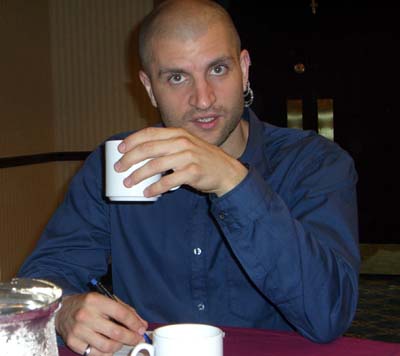
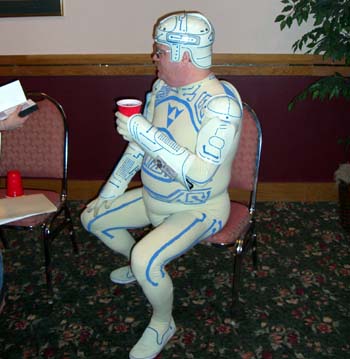
In the picture (click for a bigger image): The Tron Guy drinks mundane beverages like the rest of us.

Here are more images of Linucon 2005.

Linucon 2005 opening ceremony

It's that time of the year! Linucon 2 -- a joint Linux and science fiction convention -- is upon us! After spending a frustrated half an hour trying to find the Austin Ambassador hotel, I make it to the opening ceremony. No Linucon opening ceremony would be complete without the liquid nitrogen ice cream stories. Chase Hoffman, the convention chair, says that when he ran some convention in Dallas not long ago, the convention shared the hotel with FEMA workers. When Chase brought a can of liquid nitrogen into the hotel, the hotel employees thought it was a giant keg, so they didn't mind. Then the FEMA saw them and yelled: "Why are you carrying dangerous chemicals around?" Chase replied: "To make ice cream." "To make WHAAAT?" Chase then infromed them about making of ice cream with liquid nitrogen. The FEMA guys said, but you realize that the nitrogen vapor will push all the oxygen out of the room and you'll die? I didn't catch Chase's reply, but anyway... I think he reassured them that they knew what they were doing. In the picture (click for a bigger image): liquid nitrogen in the Con Suite.

Here are more images of Linucon 2005.

Thursday, August 25, 2005

ArmadilloCon 2005: What's Happening in Outer Space

Panelists: David Lee Anderson, Ctein (moderator), John Gibbons, Wil McCarthy

What this panel was supposed to be about, according to the ArmadilloCon program book: "Our panel of space scientists and afficionados will talk about recent and upcoming developments outside the earth's atmosphere."

Moderator Ctein challenged each panelist to tell us about a really really cool thing that happened in the outer space in the last year. To sum up panelists answers, it was the Genesis mission, Cassini mission to Saturn, Huygens probe, also the fact that the Mars Rovers were (at the time of this discussion) a year and a half old and still ticking. Commercial space flight was also mentioned, though Wil McCarthy said he found it worthwhile to acknowledge not because it was technologically revolutionary, but because it was done cheaply. "Spaceship One broke an important emotionally barrier", said McCarthy. "People used to think space tourism was unattainable, financially and [otherwise], but now that thinking flipped. Now people think space tourism is worth investing."

In keeping with the spirit of the times (open source movement, mash-ups, etc.) the panelists expressed their amazement at how much astronomy work is done collaboratively, and moreover, how much of it is done by amateurs. Wil McCarthy mentioned virtual observatories, where amateurs can analyze data that's already been gathered by telescopes, space probes and such, and even make their own discoveries. Some discoveries have been made that way. Virtual observatories give amateurs access to very high resolution images of some spectra. Ctein remarked that astronomy is currently the most egalitarian of the sciences. It is possible to do serious astronomical work with little credentials.

Speaking about astronomers collaborating over the data obtained by the Huygens probe, Wil McCarthy said: "It was like fan fiction. People looked at pictures through different filters and painted them different colors."

"Planetary science folk art?" added Ctein.

So even this alpha-geeky, low-quirkiness-factor panel had some quotable moments.

Left to right: David Lee Anderson, Wil McCarthy, Ctein, John Gibbons. Here are more posts from ArmadilloCon 2005.

--------

* Ctein is pronounced kuh-TINE. It's his official name now, even though he wasn't born with it. Yes, he uses a single name. I was surprised he hasn't run into any serious bureaucratic hassles because of that. I thought most government systems expect people to have a minimum of two names, and you can't very well argue with a computer that demands you enter both a first and a last name. I'm speaking from personal experience. Name-wise I am unusually poor, compared to a typical American. I don't have a middle name. When I changed my last name after marriage and tried to get a new driver's license, I was told by a woman at the Bureau of Motor Vehicles that their computer system required me to have a middle name. So she told me she was going to put my maiden name as the middle name. I would have preferred not to, but, as I said, you can't argue with a computer -- that's pretty much what she told me. :-) I guess I was fortunate that Texas BMV computers weren't that draconian 5 years earlier, when I first got a driver's license in Texas. I was single then and could not have legitimately come up with anything that could pass for a middle name.)

Wednesday, August 24, 2005

The New Weird Movement in SF Literature: an ArmadilloCon 2005 panel

Panelists: Tom Becker, Damien Broderick, Lawrence Person, Faye Ringel, Charles Stross

Charles Stross says everyone in science fiction make a mistake of pining for a new movement. The panelists latch onto the word "movement" and run for a few minutes with scatological jokes. Lawrence Person: "When a genre's bowels get backed up you have to have a movement to clean them out." Once they got that out of their system (heh heh heh), they became a bit more serious, but they still were no closer to defining The New Weird. It's a somewhat narrower category or subgenre than slipstream and, according to Lawrence, even less useful.

Is it possible to define this uncategorizable category?

But the fact that the New Weird, as well as slipstream, catches the "uncategorizable" books, has an upside, according to Tom Becker. "The beauty of the New Weird is that bookstore owners don't know where to file it, so they put it on the table up front", says Becker and adds: "We'll see how it works with Charlie's posthumanist literature."

Lawrence, always one for snappy definitions, proposes that The New Weird is something that uses the genre tropes but doesn't worry which genre it's pulling its tropes from. SF, fantasy and horror are all prodigiously mixed together.

Which authors fall into the New Weird category?

Which authors fall into the New Weird category? Why, of course, China Mieville. Any others? Probably M. John Harrison. And maybe Mary Gentle. But I don't remember the panelists coming up with more examples of the New Weird authors, or at least any that had not been mentioned in the last year's panel on slipstream. Some of the panelists credited the start of the New Weird to Michael Moorcock, and it has to do something with the leftist leaning of the genre. Moorcock once wrote an essay where he criticized science fiction's fetishization with starships, troopers and their boots.

The worldview exemplified by the New Weird also runs counter to the traditional, "high" fantasy with its right wing themes of traditional values, going back to the past, deference to authority, etc. Charles Stross says fantasy is a literature of consolation. It works on restoration of balance in the world. Lost son of the king takes the kingdom back, that kind of thing. High fantasy's worldview is inimical to science, and that's why Stross doesn't like it. (He does write fantasy himself, though, but I'm pretty sure it's not "high" fantasy. And while I don't typically like this genre, a Stross fantasy must be quite an unusual animal, and I intend to read it.)

To that extent, what China Mieville is doing with fantasy very emphatically contradicts that consolation literature.

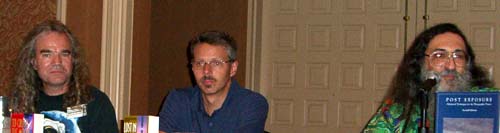
Left to right: Lawrence Person, Tom Becker, Charles Stross. Here are more posts from ArmadilloCon 2005.

Tuesday, August 23, 2005

ArmadilloCon 2005: Current Trends in British science fiction

What this panel was supposed to be about, according to the ArmadilloCon program book: "Several British writers are currently producing some of the most exciting and best-written SF yet seen. We'll sort out the best stuff, try to discern trends, and overall try to spread our joy and enthusiasm."

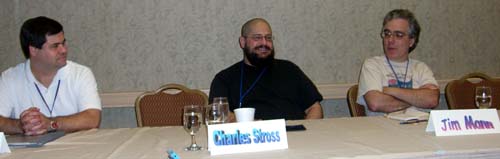
Panelists: Jayme Lynn Blaschke, Jim Mann, Lawrence Person, Willie Siros, Charles Stross

Even though Charles Stross was on the panel, it was disappointing. The panel focused mostly on history of British science fiction, and the panelists examined the history in the dullest possible way, by enumerating various magazines and editors and how they influenced British SF. What new authors they discovered, etc. Not the most fascinating stuff for me. I'm not sure I care how British SF got to be what it is today. According to Charles Stross, it has something to do with the fact that the 20th century saw the sunset of British empire. Degeneration of the former empire into a country financially bankrupted by the World War II left British science fiction writers in a long-lasting depression. But Stross does not explain how the SF eventually got out of that depression and emerged so cool and interesting.

And trends? One panelist stated that "a lot of British writers don't fit into trends, but they are doing excellent work". The only trend mentioned on this panel was The New Weird, and only to say that an argument over who was writing The New Weird lead to such a huge flame war on a certain mailing list that it crashed the server. According to Jim Mann, when they got to the point of trying to include Aistair Reynolds into the New Weird, it became meaningless. This did not stop some panelists from continuing to make attempts to classify The New Weird. Charles Stross would include Liz Williams in that category, and Lawrence Person would include Mary Gentle as well.

Charles Stross informs us that Mary Gentle disputes that what she writes is not fantasy, it is science fiction set in a world where alchemy works. (In my humble opinion, "pearls" like that have a potential to redeem even the dullest panel.)

Another category of British SF that sells well is humor, observes Charles Stross. Examples: Terry Pratchett, Jasper Fforde. The list of bestselling SF authors in the UK is like this: J. K. Rowling, Terry Pratchett, then everyone else.

The only thing that made this panel worth going to was to hear Charles Stross' reading recommendations. Here are British authors he recommends: John Meaney (hard SF with interesting physics and some AI concepts, lots of adventure); Richard Morgan; Liz Williams -- according to Stross, she writes what used to be called "science fantasy" (why, is it not called that anymore?); Justina Robson, Tricia Sullivan. Willie Siros and Lawrence Person also recommend Neal Asher and Susanna Clarke.

Left to right: Lawrence Person, Charles Stross, Jim Mann. Here are more posts from ArmadilloCon 2005

Where did all good hard science fiction go? An ArmadilloCon 2005 panel

Panelists: David Lee Anderson, Kurt Baty, Tom Becker, Alexis Latner, Wil McCarthy

At least one of the usual suspects' opinion on the topic of hard SF hasn't changed since last year. Actually, more like in decades. Kurt Baty still thinks the best hard SF books out there are Neal Stephenson's "The Diamond Age" and Daniel Keys Moran's "The Long Run". And he tried hard to find other hard SF books worthy of those! Which for him, it appears, means books mostly on nanotechnology. He's just not finding any.

He's not impressed with, for example, Karl Schroeder, after reading "Ventus". "It's a novel about labeling. Every particle has a label! How exciting!" exclaims Kurt sarcastically. Tom Becker, though, urges him to give Schroeder's second book, "Permanence", a chance. He says Schroeder combines Digital Rights Management and micropayments with virtual reality and nanotechnology and gets interesting social effects.

Plot and characterization in a hard SF story offends some readers

The most amusing comments in the panel were made by Wil McCarthy. He says readers expectations are not as clear as they used to be. People who read SF read it for ideas and for plot, but not necessarily for characters or for language. Some other readers, in the contrary, people are actually offended by good, credible science. They just want magic! They are shocked by really innovative science fiction. For example, Greg Egan with his quantum mechanical themes offends them. The hard SF that they want should be about rayguns and spaceships!

Then there are readers who are turned off by the weak characterizations and the no-nonsense, journalistic language of classical hard SF. But other readers think that characterization, artful language or even a presense of plot ruins a hard SF story! To them, anything with a plot is trashy.

So, did the panelists find out where all the good hard SF went?

I'm afraid they did not. Instead, some of them, especially Wil McCarthy, made some sobering observations about the state of hard science fiction today. "The first thing that occurs to me is, just looking at the audience," he said, "is that the size of audience for this panel is the same as for a filk session. Even though this is a good size convention. Fans understand that hard SF is a good thing and hard to pull off, but it's not the same as enjoying hard SF. The novelty of hard SF is begining to wear off and people are looking for something else."

David Lee Anderson says one of the reasons of why hard SF was more popular a few decades ago than it is now was that back then the space program did a lot to inspire people's interest in science fiction. The space race gave people something to look forward to, he says, but the things have long ago slowed down. "The space station didn't get up there until about 20 years later," says David Lee Anderson. "This was disappointing ot me. I wanted things in my own lifetime that we could go visit in space."

Wil McCarthy thinks the (perceived?) loss of interest in hard science fiction is part of a larger trend of declining respect for science in America. "[A life of an academic scientist] in America is a crummy life," he says. "Scientists used to be respected. But that's no longer true. With a bachelor's degree you can make as much money as an engineer as with a PhD, and you can make it immediately.

And in academia it got really ugly. Back in the 80s they started saying "publish or perish"." As much aggravation as it caused to scientists, they are now nostalgic about that. "Nowadays it's "bring in grant money or perish". So our brilliant scientists are sitting writing grant proposals, while their science is being done by their graduate students. [Well, science was always done by the graduate students, but] we are squeezing our professors so hard, and a lot of smart people say, I don't want that life. I'll take a bachelor's degree and go work for a corporation."

Wil McCarthy does not feel optimistic about the state of hard science fiction today. Here are more posts from ArmadilloCon 2005.

Monday, August 22, 2005

Why we write fantasy? An ArmadilloCon 2005 panel

Panelists: Charles de Lint, Dennis L. McKiernan, John Moore, Nancy Jane Moore, Sharon Shinn, Martha Wells

This panel was at 10 am, so of course, I was late. By the time I arrived 20 minutes late, the panelists seemed to have finished discussing why they write fantasy and filled in the remaining time chatting about how they do research of medieval weapons, technologies, clothes, customs, etc. for their books. Too bad. I was curious why they write it: what inspires them to rehash the same cliched stories over and over again? :-) Just kidding, I did not go into the panel with a snarky attitude. But I didn't hear many original thoughts regarding why they write fantasy, probably because I caught only the trail end of that particular discussion thread.

Sharon Shinn writes it because it's fun. People in fantasy stories get to have adventure. That reminds me of an opinion expressed by, I think, John Cramer through one of the characters of his book "Einstein's Bridge": mainstream literature is about losers in the process of losing. Mainstream literature talks mostly about how awful life is. On the other hand, in science fiction and fantasy people get to solve problems and come out a winner. Actually, Sharon Shinn said something like that in her Guest of Honor interview at the last year's ArmadilloCon.

Nancy Jane Moore said something about how fantasy gives you more choices that "hard science" fiction. This reminds me of the saying that science fiction differs from fantasy in that in fantasy, dragons can fly, while in science fiction they can't. While I appreciate the irony, I don't subscribe to this opinion. But anyway, this panel wasn't about my opinions.

Some of the more interesting comments in the panel were about literary style. Nancy Jane Moore says in a lot of high fantasy literature the language feels last week. So it is even more impressive to find an author -- and she gave an example of one, but I didn't hear the name -- whose language and style in general feels like the 18th century in which his novel is set; except it moves a lot faster than 18th century novels, which take forever to get the plot going.

Martha Wells says a writer needs to get into the mentality prevalent in the certain historical and geographical setting where the story is set. For example, her friend wrote a story where a medieval crime investigator works with forensics. They didn't do that in the Middle Ages. Rather, they would just go and arrest all the gypsies, or some group which was thought to be criminal.

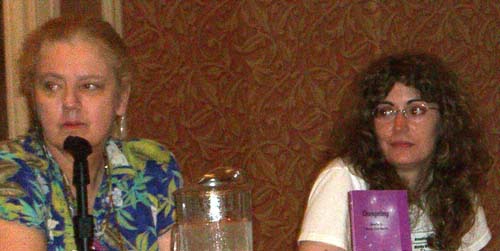
Nancy Jane Moore (left) and Martha Wells. Here are more posts from ArmadilloCon 2005.