Showing posts with label editors. Show all posts

Wednesday, August 01, 2012

ArmadilloCon 2012: What You Should Have Read in 2011 - 2012

A bunch of authors, editors, critics and booksellers discuss their science fiction, fantasy and horror picks of the year.

It's worth noting which of the books or authors got a nod from more than one panelist. This year those were N. K. Jemisin The Kingdom Of Gods, Kameron Hurley God's War and Infidel, Will Macintosh Soft Apocalypse, and anthology Welcome to Bordertown.

Below are each panelist's recommended books, and his or her comments about why they are worth reading.

Willie Siros's recommended books

Margaret Atwood In Other Worlds: SF and the Human Imagination

N. K. Jemisin The Kingdom Of Gods and The Killing Moon. -- N. K. Jemisin is one of the most amazing new writers. She has strong ties to Africa, and writes in non-Western ways. The structure of her novels are so amazingly different than what you find in American fantasy.

Ian McDonald Planesrunner -- When someone decides, after a lifetime of writing hard SF, to write a teen novel, it's interesting to see how he's trying not to talk down to the reader. We, adult readers, have seen many science fiction and fantasy tropes, such as alternate realities, but teens might have not seen them yet, and require a different approach.

Neal Stephenson REAMDE".

Bruce Sterling Gothic High-Tech -- short story collection.

Francis Spufford Red Plenty -- Willie called it "my epic fail of the year", though it wasn't clear to me why, because his comments about this book were quite flattering. It's a novel about Soviet space race, and it's not clear whether it's science fiction -- maybe not, says Willie. It could be secret history. In any case, having lived through American space era, it's very interesting to read the same events from the other side. We in the US thought American space program got it wrong, but Russians also thought THEY got it wrong, and had to go back to the roots of Marxism to start over.

Terry Bison Any Day Now is another big secret history novel. It starts out with the usual version of the 1960s, but then you discover that Kennedy doesn't die, and the story drifts just further and further from our history. Willie says that he was amazed by Terry Bison's sense of inertia in history. It's hist best novel since Talking Man.

Laird Barron The Croning -- a horror novel.

James S. A. Corey space series Caliban's War -- American writers trying to retake space opera from Alastair Reynolds and Peter F. Hamilton and other Brits.

Kim Stanley Robinson 2312. You can see it as a sequel to Mars trilogy, or not, as you wish. But, according to Willie, it is Robinson best novel since Mars.

Charles Stross Apocalypse Codex is the 4th Laundry novel, and it's as strong as the 1st one. Much stronger than the 2nd and 3rd.

Jeremy Lassen's recommended books

Lauren Beukes Zoo City -- She is an amazing writer from South Africa. She got a handle on the non-western-European future science fiction.

Mark Lawrence, Prince of Thorns -- Really weird fantasy series. The setting makes it unique.

N. K. Jemisin The Kingdom Of Gods, and the rest of her The Inheritance trilogy.

Jo Walton Among Others.

Michael Swanwick Dancing With Bears

Greg Egan Clockwork Rocket, a start of a new trilogy, and no, it's not steampunk.

Kameron Hurley God's War -- another real science-fiction book. Incredibly unique setting, a cast of characters that features strong women taking control of their hyperviolent world. The wold is ruled by a Queen, all men are sent off to war. So it's just old men, and women, and children running this world.

Will Macintosh Soft Apocalypse -- very depressing, a gut punch of a book. It looks at Apocalypse as something that happens not with explosions, but with lowered expectations, something that happens when unemployment reches 40% and Walmart runs out of stuff. The protagonist's life just gets grimmer and grimmer. It's a hard book to read.

Rob Ziegler Seed. It's similar to Paolo Bacigalupi's "Windup Girl", but with faster pacing, and with more likeable protagonist. Rob and Paolo live in the same small town, so it's an interesting bit of serendipity.

As an aside, someone from the audience recommends Paolo Bacigalupi's Shipbreaker as being much better and with nicer characters than Windup Girl.

Rudy Rucker Jim and the Flims, in which Rudy Rucker comes to terms with his own mortality.

Geoff Ryman Paradise Tales, short story collection from Small Beer Press.

Holly Black and Ellen Kushner, ed. Welcome to Bordertown, an anthology. They rebooted the Bordertown anthologies, which were urban fantasy before urban fantasy was created, and got a whole new cast of writers.

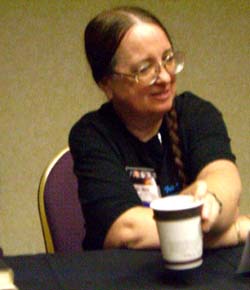
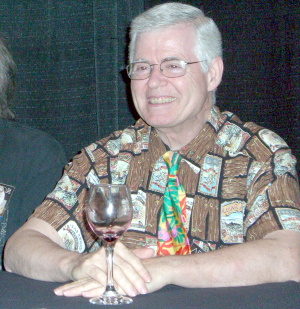
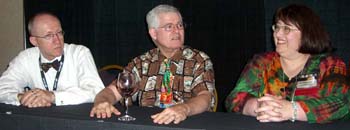
Jeremy Lassen, Bill Parker, Willie Siros, Michelle Muenzler, and Bev Hale on What You Should Have Read in 2011 - 2012 panel.
Jeremy Lassen, Bill Parker, Willie Siros, Michelle Muenzler, and Bev Hale on What You Should Have Read in 2011 - 2012 panel. More pictures from ArmadilloCon 2012 are in my photo gallery.

Bill Parker's recommended books

Ernest Cline Ready, Player One. Ernest Cline is native to Austin. This science fiction novel is set in 2044, and society has changed quite a lot. One character is a game designer from the 80s, and there are lots of references to 80s music, movies, and culture. It takes you through the game industry in little bits and pieces that are plugged into the story. By 2044 a game company has shut down, and opened up with a new product they called Oasis -- a virtual reality world. Kids don't go to school anymore -- they study in the Oasis. People don't go to the office, they work in the Oasis. One character lives in a trailer park, where trailers are stacked 30-high. The gist of the story is that the creator of Oasis has died, and left 3 Easter eggs for people. Who finds them, becomes rich. The story is about people who are looking for eggs, while an evil corporation wants to find them and make everyone pay for Oasis (which is currently free).

Some readers from the audience mentioned that there are also 3 Easter eggs in the book, and whoever finds them can win a prize.

Michelle Muenzler's recommended books

Haruki Murakami 1Q84 -- a very long and intricate story, that's very Murakami in the sense that every detail in it is very important. You can't just skip over chunks of text, because every detail is needed in order to understand what happens.

Johnathan L. Howard Johannes Cabal The Detective.

Ayize Jama-Everett The Liminal People -- a novel about underworld people who have powers, but you wouldn't consider it a superhero novel. It's a bit more gritty, realistic than most superhero novels Michelle has read. The protagonist's daughter disappears, he tries to track her down, and gets entangled with people with horrible powers.

J. M. McDermott When We Were Executioners

Martha Wells The Serpent Sea and The Cloud Roads -- very creative, vast world-building. Exploration of crazy-ass alien cultures clashing and interacting.

Jason Heller Taft 2012 -- hilarious, brilliant book. President Taft disappears, and 100 years later he wakes up on the White House lawn. The book is extremely fast-paced. It has Twitter conversations discussing his political views.

Kameron Hurley Infidel

Will Macintosh Soft Apocalypse

John Love Faith -- a massive battle, a dance between two spaceships, really fun.

Stina Leicht And Blue Skies from Pain

Rose Lemberg, ed. The Moment of Change -- a speculative poetry anthology. Very story-oriented poetry, resembles Year's Best SF anthologies.

Bev Hale's recommended books

Kage Baker Best of Kage Baker.

Holly Black and Ellen Kushner, ed. Welcome to Bordertown.

Pip Ballantine and Tee Morris Phoenix Rising -- steampunk.

Jim Butcher Ghost Story.

Rachel Caine Bite Club and Last Breath -- the last of her two Morganville Vampires books.

Gail Carriger Heartless

Kendare Blake Anna Dressed in Blood

Laura Anne Gilman Pack of Lies

Laurie R. King The Pirate King

Seanan Mcguire Discount Armageddon

Kim Newman, Professor Moriarty: The Hound Of the D'Urbervilles -- a spin-off of "Further Adventures of Sherlock Holmes" series, where Sherlock Holmes got retired, got married, and still doing stuff. This book has Professor Moriarty as protagonist.

Tim Powers Hide Me Among The Graves

Cherie Priest Hellbent

Ransom Riggs Miss Peregrine's Home for Peculiar Children

John Scalzi Fuzzy Nation and Redshirts -- Bev Hale liked Fuzzy Nationbetter than she liked Redshirts, though both were fun.

F. Paul Wilson Nightworld

George R. R. Martin and Gardner Dozois, ed. Down these Strange Streets -- an anthology.

Willie's recommendations of books that are very new, or are yet to come out

Neal Stephenson, Greg Bear, and a couple of other authors The Mongoliad -- because Neal Stephenson has an obsession with swords.

Mark Teppo Sinner: A Prequel to the Mongoliad, and Earth First

Terry Pratchett and Stephen Baxter The Long Earth. Someone said it would be funny if Terry Pratchett wrote the science in that book, and Stephen Baxter the characters.

Iain Banks Stonemouth and Hydrogen Sonata. The latter revels bits and pieces from the beginning of the Culture.

Robin Maxwell Jane: The Woman Who Loved Tarzan -- a Tarzan novel written from Jane's point of view. Burroughs estate gave Robin Maxwell, an award winning historical writer, access to Burroughs notes about Tarzan's backstory.

Tuesday, August 30, 2011

ArmadilloCon 2011: What is Texas Weird, and other gems of wisdom from the writers' workshop

ArmadilloCon writers' workshop followed the familiar agenda from the years before. The unexpected, as always, happened at the time of games and critiques.

The writing game was dreamt up by Scott Lynch at 3 a.m. the night before. Surprisingly (or not), it was one of the more meaningful games compared to previous workshops. (I just can't get into "let's collectively write a story" exercises. If I'm not in a complete control of my story, I stall. This was different.) You had to come up with a 4-sentence a story, or a synopsis thereof. Then an "evil" editor would tell you to make changes to make the story more sellable. You had to make them in 10 minutes. Finally everyone was supposed to read their original story, editor's comments, and the final story out loud. Luckily for me, due to time pressure only 4 or 5 people had to share their works.

Jayme Lynn Blaschke, Allyson and Jason

Jayme Lynn Blaschke, the "editor" (left), gives sly suggestions how to improve Allyson's and Jason's stories at the writing game. More pictures from ArmadilloCon 2011 are in my photo gallery.

The editors were supposed to be intentionally evil: their feedback required the author to throw away his or her precious idea. Let's say you wrote a story where humans, having landed on an alien planet, drilled into its core and found intelligent life there. The editor would praise your hard SF concept, and tell you that the drill actually bore into hell, and it's not aliens there, but demons. Or if your plot is influenced by the physics of a rotating black hole, the editor would say that rotating black holes are so last decade, and you should make it a diamond star (which was on the news recently).

Such an exercise may seem absurd, but its point was to teach us how to write "on demand". An editor can and will ask to make changes, and you have to cooperate even if your muse doesn't. Don't wait for the muse to inspire you, but crank out a product when you're asked to, and don't treat your ideas as sacred.

Paolo Bacigalupi, Lou Anders, and Mark Finn

Paolo Bacigalupi, Lou Anders, and Mark Finn at the critique group. More pictures from ArmadilloCon 2011 are in my photo gallery.

Later it was time for critiques. I was lucky to be in a group that not only was taught by great critiquers -- Guest of Honor Paolo Bacigalupi, and Mark Finn (who, by the way, has an uncanny ability to come up with plot twists to improve students' stories), but a third pro spontaneously joined our group. It was Pyr editor Lou Anders. I don't know what prompted him to join us, but he speed-read students' stories while the other group members were speaking, and gave critiques on the spot. Speed-reading (which, I presume, is all he does as an editor) made the stories look different to him than they did to other members who gave them more consideration. This was good, because it made the flaws really stand out. He didn't pick up on what other people (including the pros) identified as good parts of my story, but immediately pointed out a major flaw. It is invaluable to know how an editor sees a story.

All three pros not only pointed out what was wrong with the students' works, but gave suggestions how to improve them. That doesn't always happen. It gives me more confidence that maybe this will be the year I will revise my story based on the feedback. (No, I didn't do it the previous years. Bad writer. Bad!)

So what is Texas Weird?

A comment by Mark Finn clarified for me what "Texas Weird" genre is. Brainstorming ways to make one student's story better, he said: "Your opening sentence should be 'The President was holding a closed door meeting with severed heads.'" This would put the story in the Texas Weird genre. It pulls the curtain off the key historical moments and shows us how certain world-changing decisions were made, Mark explained. Yes, a president consulting severed heads might not even be the most unreasonable explanation for some US foreign or domestic policy decisions of recent decades.

Pictures from Armadillocon 2011 are in my photo gallery.

Thursday, September 02, 2010

ArmadilloCon 2010: What You Should Have Read This Year

In this traditional ArmadilloCon session, panelists recommend recently published science fiction and fantasy titles to the audience. The people entrusted with this honor are usually ones whose work or hobbies cause them to read lots of new genre fiction. This year, the team of "pundits" is Anne Sowards (ArmadilloCon 32 editor guest), Lawrence Person (a once-and-future editor of fanzine "Nova Express"), Willie Siros (an Austin bookseller), and Thomas Martin Wagner (a SF/F reviewer).

Anne Sowards describes herself as an editor who, in her own words, only edits "fun books", such as Jim Butcher and Ilona Andrews. She doesn't do award-winning books, and she likes it that way. Here is what she recommends:

Patricia Briggs "Wolfsbane", a sequel to "Masques";

Jim Butcher "Changes";

Caitlin Kiernan "Red Tree", a very dark fantasy nominated for World Fantasy award this year;

K. A. Stewart "The Devil Is In The Details", a Jim Butcher-like urban fantasy.

Martin Wagner's recommendations

Kay Kenyon "The Entire and the Rose", a 4-volume series about a pocket universe that uses our own universe for fuel. Martin says Kenyon writes humanist science fiction.

Kit Reed "Enclave", a book about a bunch of spoiled rich kids, whose parents were hoodwinked into sending kids to a school on a remote island. It's a "Lord of the Flies" type of situation, says Martin. He adds that Kit Reed is a New Wave author that has been off of everyone's radar until now.

Willie Siros recommendations Novels

Kage Baker, The Bird of the River (Tor)

Iain M. Banks, Surface Detail (Orbit US)

Greg Bear, Hull Zero Three (Orbit US)

Steven Brust, Iorich (Tor)

Lois McMaster Bujold, Cryoburn (Baen)

C. J. Cherryh, Deceiver (DAW)

Suzanne Colins, Mockingjay (Scolastic Press)

Greg Egan, Zendegi (Gollanz; Night Shade Books)

Jasper Fforde, Shades of Gray (Hodder & Stoughton; Viking)

Michael Flynn, Up Jim River (Tor)

William Gibson, Zero History (Putnam)

Joe Haldeman, Starbound (Ace)

Peter F. Hamilton, The Evolutionary Void (Ballantine Del Rey)

Joe Hill, Horns (Gollancz; Morrow)

Robin Hobb, Dragon Haven (HarperVoyager)

Robin Hobb, Dragon Keeper (Eos)

Alexander Jablokov, Brain Thief (Tor)

N. K. Jemisin, The Broken Kingdoms (Orbit US)

Diana Wynne Jones, Enchanted Glass (HarperCollins UK, HarperCollins / Greenwillow)

Guy Gavriel Kay, Under Heaven (Penguin Canada; Roc)

Ken MacLeod, The Restoration Game (Orbit)

Jack McDevitt, Echo (Ace)

Ian McDonald, The Dervish House (Pyr)

Robin McKinley, Pegasus (Putnam)

China Mieville, Kraken (Macmillan UK)

Elizabeth Moon, Oath of Fealty (Orbit; Ballantine Del Rey)

Christopher Moore, Bite Me (Morrow)

Nnedi Okorafor, Who Fears Death (DAW)

Daniel Pinkwater, Adventuers of a Cat-Whiskered Girl (Houghton Mifflin)

Terry Pratchett, I Shall Wear Midnight (Doubleday UK; HarperCollins US)

Cherie Priest, Dreadnought (Tor)

Alastair Reynolds, Terminal World (Gollancz)

Kim Stanley Robinson, Gallileo's Dream (Ballantine Spectra)

Michael Shea, The Extra (Tor)

Lucius Shepard, The Taborin Scale (Subterranean Press)

Sharon Shinn, Troubled Waters (Ace)

Dan Simmons, Black Hills (Little Brown / Reagan Arthur Books)

Peter Straub, A Dark Matter (Doubleday)

Charles Stross, The Fuller Memorandum (Ace)

Charles Stross, The Trade Of Queens (Tor)

Scott Westerfeld, Behemoth (Simon Pulse)

Connie Willis, Blackout (Ballantine Spectra)

Connie Willis, All Clear (Ballantine Spectra)

David Wingrove, Son of Heaven (Atlantic Books UK / Corvus)

Gene Wolfe, The Sorcerer's House (Tor)

Jane Yolen & Midori Snyder, Except the Queen (Roc)

Collections and Anthologies

Poul Anderson, Young Flandry (Baen, collection)

Poul Anderson, Captain Flandry: Defender of the Terran Empire (Baen, collection)

Poul Anderson, Sir Dominic Flandry: The Last Knight of Terra (Baen, collection)

Peter S. Beagle, Mirror Kingdoms: The Best of Peter Beagle (Subterranean Press, collection)

Kevin Brockmeier, ed., Real Unreal: Best American Fantasy, Vol 3 (Underland Press, anthology)

Terry Dowling, Amberjack: Tales of Fear and Wonder (Subterranean Press, collection)

Karen Joy Fowler, What I Didn't See And Other Stories (Small Beer Press, collection)

Neil Gaiman & Al Sarrantonio, eds., Stories (Headline Review; William Morrow, anthology)

Nick Gevers, ed., The Book of Dreams (Subterranean Press, anthology)

Joe R. Lansdale, Flaming Zeppelins: The Adventures of Ned the Seal (Tachyon Publications, collection)

Fritz Leiber, Selected Stories (Night Shade Books, collection)

George R. R. Martin and Gardner Dozois, eds., Songs of Love and death (Simon & Shuster / Gallery, anthology)

Kim Stanley Robinson, The Best Of Kim Stanley Robinson (Night Shade Books, collection)

Theodore Sturgeon, Case and the Dreamer: The Complete Sturgeon: V XIII (North Atlantic, collection)

Ann Vandermeer & Jeff Vandermeer, eds., Steampunk Reloaded (Tachyon Publications, anthology)

Walter John Williams, The Green Leopard Plague and Other Stories (Night Shade Books, collection)

Thomas Martin Wagner, Willie Siros, Lawrence Person, and Anne Sowards on the What You Should Have Read This Year panel

Thomas Martin Wagner, Willie Siros, Lawrence Person, and Anne Sowards on the What You Should Have Read This Year panel.

Books recommended by more than one person

China Mieville "Kraken". Recommended by Martin Wagner and Willie Siros. Martin says it's the most accessible of China Mieville's books, pure pop-corn entertainment. The end of the world takes place in London, and there are squid worshippers. Mieville's earlier books, like "City in the City" (that was on last year's recommended list) is a literary novel, but "Kraken" has explosions. Willie Siros adds that "Kraken" is not as angry as Mieville's first novels. In this book he has settled down and matured.

Guy Gavriel Kay "Under Heaven". Recommended by Martin Wagner and Willie Siros.

Connie Willis "Blackout" and its sequel "All Clear" -- a time-travel story set during the blitz in London. Historicians travel to London during World War II to see how London coped with bombings, but then they get stuck in there, and also worry if they changed direction of history. Recommended by Martin Wagner and Willie Siros.

Gene Wolfe "The sorcerer's house" -- a Gene Wolfe Cthulhu mythos book. Recommended by Lawrence Person and Willie Siros.

Several panelists also discussed "Ariel" by Steve Boyett, a postapocalyptic fantasy, in which magic happens. Electricity stops working, and a dragon rises into the sky. "There is a unicorn in it, but it's gritty and edgy. It won't emasculate you if you read it," promised Lawrence. Last year, two decades since "Ariel", its sequel came out, titled "Elegy Beach". In it a boy uses magic in a programmatic way. "Also has totally bad-ass swordplay," Lawrence added.

Pictures from Armadillocon 2010 are in my photo gallery.

Monday, August 17, 2009

ArmadilloCon: first draft in Icelandic, and other advice for writers

All the advice that could be given to beginning authors has already been mentioned in my posts from writing workshops of the past (you can find more of them by clicking the "writers' workshop" tag under this post). Overall, I'm afraid all that could be said about speculative fiction has already been said in my earlier posts from ArmadilloCon and other conventions. There's no point in repeating it, so what's left? Jokes. Thankfully, jokes at ArmadilloCon are fresh every year, which is amazing, because the people are the same.

The writers who taught the ArmadilloCon writing workshop were trying to one-up one another on how badly they sucked when they were just starting out. Sharon Shinn: I'm a poster child for perseverance. I wrote 10 books before I sold one. Chris Roberson: I wrote 11 books before one sold. Sharon: But I wrote three or four after I sold the first one, that never sold. Scott Lynch, this year's Guest of Honor, can top that: he wrote 12 unpublished novels, many of them in high school. He never finished any of them before he wrote a novel that actually sold (I assume he's talking about "The Lies of Locke Lamora"). Thus, the skeletons in his closet are malformed embryo skeletons.

On revising your work: Most pros recommend completing the first draft of the book before revising, rewriting, or editing it. The alternative -- revising after you finish each chapter or page -- is not so good. Jim Frenkel, a Tor editor, says George R. R. Martin is an exception in that respect, and the worst role model to a beginner writer. "He doesn't go to on to write an new page until the previous page is perfect. And you wonder why his next book is taking so long?"

Sharon Shinn recalls what someone else has said on this topic. "Revising while you write is like drinking decaf coffee in the morning. Great idea, wrong time. Your first draft should read like it was hastily translated from Icelandic by a non-native speaker."

Ah, so I must be doing something right!

In other encouraging news (see, I said it was going to be all jokes, but there is some useful advice in there): yes, you can find time for writing. Julie Kenner wrote her first 15 books while working full-time as a lawyer, and the last seven of those with babies and small children (she has two). Martha Wells wrote some of her first books while being constantly distracted. At that time she worked in tech support, where she wrote programs in KOBOL. She worked on her novels while the programs compiled and ran. Her desk was in a very small space, surrounded by mainframe computers whose hard drives constantly made clicking noises. And since she was in tech support, people would drop in and ask questions all the time. So now she needs distractions in order to write, such as a television in the background.

I wonder which of my bad habits will one day turn out to be an unexpected blessing.

Pictures from ArmadilloCon 2009 are in my photo gallery. There are only a few of them there, but I'm adding new pictures every day.

Saturday, August 30, 2008

ArmadilloCon 2008: What You Should Have Read

"The Year is Half Over: What I Should Have Read" is a traditional panel at ArmadilloCon, where a bunch of avid and discriminating readers recommend recent must-read books in the science fiction / fantasy genre. The panelists are an assortment of writers, editors and booksellers. Without further ado --

Rick Klaw recommends "Somnambulist" by Jonathan Barnes. It's a late Victorian era / Edwardian novel about a magician. It's the oddest novel you'll read this year, or perhaps any other year, says Rick. The ending is a little weak, but by that time you don't care. He also recommends Ann and Jeff Vandermeers' anthologies "Best American Fantasy" and "The New Weird" -- a collection of really odd stories. They also have a collection named "Steampunk". When you finish reading it, you'll have an idea exactly what steampunk is.

Rusty Hevelin recommends reprints of Robert Heinlein, and Jack Williamson, who's still as good as when he started selling in the 20s.

Sheila Williams didn't recommend any specific novel or story collection, but mentioned a few new authors she likes very much, such as Ted Kosmatka (especially his story "Divining Light" which came out in a recent issue of Asimov's, and got many fan letters from engineers and scientists, who all wanted to perform the double slit experiment described in the story), also Felicity Shoulders, who has a story "Burgerdroid" in Asimov's. She also mentioned recent stories by Elizabeth Bear (March), Stephen Baxter (September) and Nancy Kress, but I didn't catch the titles of those stories.

Willie Siros' list of this year's must-read books


Science fiction:

Charles Stross: Saturn's Children -- his take on the later Heinlein. If Heinlein hadn't gone crazy and was still writing well.

Iain Banks: Matter -- a new Culture novel. Incredibly fascinating far future.

Greg Egan: Incandescence -- Greg Egan is probably the most out there hard SF writer there is; keeps up with the cutting edge of matehmatics.

Greg Bear: City At The End Of Time

Melissa Snodgrass: Edge of Reason

Joe Scalzi -- Zoe's Tale

Joe Haldeman: Marsbound

Chris Roberson: The Dragon's Nine Sons

Cory Doctorow: Little Brother

Peter Hamilton: Temporal Void -- finishes current duology

Richard Morgan: Steel Remains -- a very bizarre far future world

Alistair Reynolds: House of Suns -- new space opera

Neal Stephenson: Anathem

Fantasy:

Thomas Disch: Word of God -- in this novel Thomas Disch reveals that he's God, and that his opponent is Phillip K. Dick, which he's been fighting for all eternity.

Ursula Le Guin: Lavinia

Terry Pratchett: Nation

Diana Wynne Jones: House of Many Ways -- a sequel to Howl's Moving Castle. Willie thinks D.W. Jones is the one who God should have tapped on the shoulder, saying, hey, I'm gonna give you millions -- instead of JK Rowling.

Naomi Novik: Victory of Eagles

Adam. Roberts: Swiftly -- Jonathan Swift's Gulliver's Travels turn out to be real.

Jeffrey Ford: Shadow Year

James Morrow: Philosopher's Apprentice

Gene Wolfe: Evil Guest

Joe Abercrombie: Last Argument of Kings

J. M. McDermott: Last Dragon

Matt Hughes: Hespira

Tim Scott: Love In The Time Of Fridges -- surreal. Too absurd to try to explain in 2 sentences.

Sean McMullen: Time Engine

Steve Erickson: Toll The Hounds


In addition to all this, Willie mentioned "Go-Go Girls of the Apocalypse" by Victor Gischler. I'm not sure which category it falls into.

UPDATE:

Another person emailed me other recommendations that were mentioned on the panel, that I didn't catch.

Eric Marin recommends: ShadowUnit.org -- crime fiction with a supernatural twist, from TV concepts

Sheila Williams:

-- a Gulliver' Travels redux thingie by Gord Seller

-- "Lester Young and the Jupiter's Moons Blues" in the July Asimov's

-- David ????, "Flowers of Nikosia" in December Asimov's, about a Nirvana cover band

Madeleine Dimond: Michael Chabon, The Yiddish Policemen's Union

Some other people recommended:

-- Scott Lynch, The Lies of Locke Lamora

-- Michael Swanwick, The Dog Said Bow-Wow

Here are lists of books recommended on other "What You Should Have Read" panels: at ArmadilloCon 2005, ArmadilloCon 2006, ArmadilloCon 2007, ArmadilloCon 2009, ArmadilloCon 2010.

Saturday, August 16, 2008

ArmadilloCon writers' workshop: pros' advice and a story construction game

The writers' workshop started with advice panels on writing. Some of the advice the pros gave was debunking common writing myths, so in a way it was metaadvice. Sheila Williams, the editor guest of honor, shared some good, compelling pieces of wisdom. It's all the more valuable coming from the mouth of the Asimov's editor. She identified mistakes made by beginning authors with accuracy that made me hang my head down in embarrassment a s I recognized myself making them in my own writing.

Then Don Webb conducts an audience participation game. He and the audience collaboratively construct outlines for two genre stories: an immuno-defficient woman in a bubble encounters a giant germ (horror) and a little slave boy in the 19th century American south meets aliens (science fiction). For this, the audience needs to decide: the story's genre (SF, F or H), who is the protagonist, where or when the story is taking place, and, most importantly, what is the driving force for the story. If it's horror, what is the protagonist afraid of? If they are aliens, what do they want?

After the critique sessions, ArmadilloCon guest of honor John Scalzi gave a closing speech for the workshop students on the power of suck -- why a beginning writer should suck as hard as he/she can. :-)

The whole article can be found in my web site.

The pictures from the writing workshop and the rest of ArmadilloCon 2008 can be found on my web site.

Tuesday, July 03, 2007

Pay No Attention to the Pro Behind the Curtain: Editors: An ApolloCon 2007 panel

Panelists: David G. Hartwell, Selina Rosen, Mel. White, Steve Wilson

Description in the program book: Learn about the secret world of the editor, the unsung hero of the literary world. Who are they, what do they do, and what is their impact on the fiction we read?

Mel. White at ApolloCon 2007 Mel. White

What was it really about: Unlike Editing 101: Self-editing panel, this one did not have specific advice to writers. (Nor was it supposed to.) Rather, it was one of those panels where pros hash out about little-known aspects of their jobs. Which can be fun!

The most memorable things in all such panels are funny stories "from the trenches", and industry tidbits you don't normally get to hear. Mel. White told this howler of a story. When science fictional elements started to percolate into paranormal romance, those novels were edited by editors who knew everything about romance, but very little about science. So you would get absurdities like a new star appearing between Earth and Jupiter. And nobody noticed it before, beause it appears only once in 200 years.

The Procrustean bed of book publishing economics

David Hartwell went back to the some of the same elements he covered at his kaffeeklatsch where he talked (among other topics) about the economics of book publishing and selling. Back then he gave some interesting examples of how a book word count translates into its price and how that impacts the book's distribution and sales. It turns out the word count economics is far more nuanced than he let us in on at first. Optimal word counts preferred by publishers are dictated not just by the cost of paper, but also by such factors as different printing processes required for books of different thickness -- some are costlier than others; the thickness of the book also determines how many books would fit into a box, thereby influencing shipping costs. The most bizarre factor (though it was completely logical -- it was only weird because I haven't thought about it that way) was pointed out by a guy in the audience. He said books need to be a certain number of inches thick to make it possible to print the author's name in large enough letters on the spines. After all, books in bookstores are stacked so that only their spines are visible (except those lucky tomes that are stored facing front). A customer of less than perfect vision (which is to say, most reading folks) should be able to see the author's name and book's title from 7-9 feet away. This requirement dictates the size of the font on book's back, hence a need for certain thickness.

David Hartwell at ApolloCon 2007 David Hartwell
So on one hand, less is more (a 120,000 word count sells better than a 140,000 word count), but on the other hand, more is more (a book should not be too thin). It doesn't surprise me (especially since I took several courses in mathematical optimization in grad school, which examined this type of problems -- optimizing against several conflicting criteria), it's only weird because we are talking here not about gadgets and widgets, but about a product that flows from an author's deep, innermost self. I always imagined only the author can decide how many words a story needs in order to be told. And yet, having heavily edited my own stuff, I know that number is much more flexible than I thought at first.

Apropos of which, David Hartwell said: "My favorite writers / editors relationship is the kind where both writer and editor agree that the text is just words on paper that could be rearranged any way they want. If the text is the writer's heart's blood, then I can't edit it."

Friday, June 22, 2007

ApolloCon 2007: opening ceremony

The ApolloCon 2007 opening ceremony was short and simple. The convention chair, Mark Hall said they started ApolloCon because they wanted to have a con in Houston they wanted to go to. After 2 years of being the ApolloCon chair he will take the next two decades off, because this is a con he wants to go to. He added: "at least I think there's a con going on out there. Let me know if there isn't."
Mark B. Hall, David Hartwell, and C. S. Friedman at the opening ceremony Mark B. Hall, David Hartwell, and writer Guest of Honor C. S. Friedman at the opening ceremony of ApolloCon 2007. Here are more of my blog posts about Apollocon.
Introducing David Hartwell, Mark said: if David is wearing a tie, and you're an epileptic, you should truly try not to stare at it. I don't know if Hartwell's tie made anyone sick, but his voice must have soothed the audience's brain waves when he sang them a song "Teen Angel". Then the filk Guests of Honor Graham and Becca Leathers sang another song.
Graham and Becca Leathers at the opening ceremony Filk Guests of Honor Graham and Becca Leathers sing at the opening ceremony of ApolloCon 2007. Here are more of my blog posts about Apollocon.
The con has been reasonably fun so far. It started when an eminent Austin fan K and his wife M gave me a ride to Houston. We had some good conversation along the way. Then I hung out at some panels and room parties. All has been good so far, but not without a glitch. I found out I have forgotten my camera's cradle at home. A cradle is a thingy my camera must be docked into for transferring files into the computer, and for recharging. Forgetting it at home is a bummer. Fortunately, I have 2 spare batteries, so if I'm frugal, I may have enough juice to take pictures tomorrw and Sunday, but just barely. It's hard to break a habit of snapping away with abandon. As far as transferring the pictures, one guy offered to put my camera's memory card into a slot in his computer, and to plug in my external USB hard drive into his computer too, and that way transfer the pictures from one to the other. So that worked. Then again, that guy may not be here tomorrow, and I may not have another opportunity to transfer the pictures. Here are more of my blog posts about Apollocon.