Showing posts with label David Hartwell. Show all posts

Tuesday, July 03, 2007

Pay No Attention to the Pro Behind the Curtain: Editors: An ApolloCon 2007 panel

Panelists: David G. Hartwell, Selina Rosen, Mel. White, Steve Wilson

Description in the program book: Learn about the secret world of the editor, the unsung hero of the literary world. Who are they, what do they do, and what is their impact on the fiction we read?
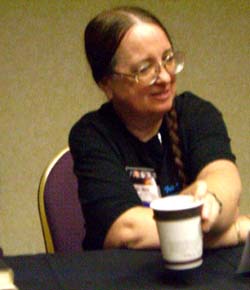
Mel. White at ApolloCon 2007 Mel. White

What was it really about: Unlike Editing 101: Self-editing panel, this one did not have specific advice to writers. (Nor was it supposed to.) Rather, it was one of those panels where pros hash out about little-known aspects of their jobs. Which can be fun!

The most memorable things in all such panels are funny stories "from the trenches", and industry tidbits you don't normally get to hear. Mel. White told this howler of a story. When science fictional elements started to percolate into paranormal romance, those novels were edited by editors who knew everything about romance, but very little about science. So you would get absurdities like a new star appearing between Earth and Jupiter. And nobody noticed it before, beause it appears only once in 200 years.

The Procrustean bed of book publishing economics

David Hartwell went back to the some of the same elements he covered at his kaffeeklatsch where he talked (among other topics) about the economics of book publishing and selling. Back then he gave some interesting examples of how a book word count translates into its price and how that impacts the book's distribution and sales. It turns out the word count economics is far more nuanced than he let us in on at first. Optimal word counts preferred by publishers are dictated not just by the cost of paper, but also by such factors as different printing processes required for books of different thickness -- some are costlier than others; the thickness of the book also determines how many books would fit into a box, thereby influencing shipping costs. The most bizarre factor (though it was completely logical -- it was only weird because I haven't thought about it that way) was pointed out by a guy in the audience. He said books need to be a certain number of inches thick to make it possible to print the author's name in large enough letters on the spines. After all, books in bookstores are stacked so that only their spines are visible (except those lucky tomes that are stored facing front). A customer of less than perfect vision (which is to say, most reading folks) should be able to see the author's name and book's title from 7-9 feet away. This requirement dictates the size of the font on book's back, hence a need for certain thickness.
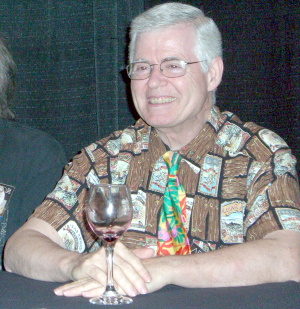
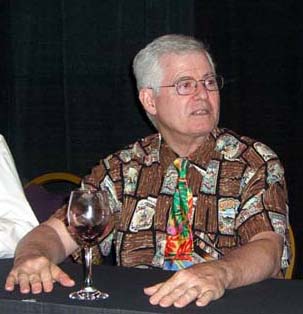
David Hartwell at ApolloCon 2007 David Hartwell
So on one hand, less is more (a 120,000 word count sells better than a 140,000 word count), but on the other hand, more is more (a book should not be too thin). It doesn't surprise me (especially since I took several courses in mathematical optimization in grad school, which examined this type of problems -- optimizing against several conflicting criteria), it's only weird because we are talking here not about gadgets and widgets, but about a product that flows from an author's deep, innermost self. I always imagined only the author can decide how many words a story needs in order to be told. And yet, having heavily edited my own stuff, I know that number is much more flexible than I thought at first.

Apropos of which, David Hartwell said: "My favorite writers / editors relationship is the kind where both writer and editor agree that the text is just words on paper that could be rearranged any way they want. If the text is the writer's heart's blood, then I can't edit it."

Saturday, June 23, 2007

ApolloCon 2007, Friday: kaffeeklatsch with David Hartwell

Here are some interesting tidbits that were said at the kaffeeklatsch with the editor-legend David Hartwell.

A lot of people have very different opinions as to what hard science fiction means. Some count J. G. Ballard amont the writers working in this subgenre. In fact, J. G. Ballard had once stood up and said he was a hard science fiction writer: the hard science within which he was working were medicine and psychology. He may have had a point, because he was trained as a doctor, and he used those sciences rigorously in his fiction.

David Hartwell at the ApolloCon 2007 opening ceremony David Hartwell at the opening ceremony of ApolloCon 2007

About the economics of book sales. Apparently, mainstream books sell much worse than genre books. Of all 5 books nominated to the National Book award one year, none of them sold even a 1000 copies. Meanwhile it's a rare SF hardback that doesn't sell at least 2000 copies. Hartwell quotes Norman Spinrad, who said that publishing a SF novel that's a complete failure would be as unlikely as constipating yourself by active will.

Hartwell juggled some numbers, converting word count into dollars. For example, an extra 20,000 words translate into extra $2 added to the price of a hardcover. So if a 120,000 word hardcover would cost $24.95, a 140,000 hardcover would cost 26.95; and that means bookstores would order 25% fewer copies of it. (Or something like that. I'm not sure I am quoting those numbers right.) He shed light on the complex relationship between book distributors and publishing houses; a major portion of books are sold through supermarkets and other superstores, and if a superstore stops buying books from a publishing house, that publishing house may go bankrupt. Basically, he said, most books are now sold through superstores rather than small bookstores, which means that most of America lives 40 - 60 miles from a bookstore.

Hartwell says one of the best things one can do to promote the genre of science fiction, to keep it alive and thriving, is to write book reviews, an publish them somewhere. No matter how obscure is a web site where it's published, someone will find it and read it. It's especially true when you are reviewing an author's first novel. Even if the review is negative, if it is engaging and well thought-out, it will do a lot to promote the new author. 500 -- 1000 word review is better than a 300 word review. A 1500 word review is even better.

I feel so validated! My verbose book reviews are therefore worthwhile -- at least in Hartwell's opinion!

Here are more of my blog posts about Apollocon.

Friday, June 22, 2007

ApolloCon 2007: opening ceremony

The ApolloCon 2007 opening ceremony was short and simple. The convention chair, Mark Hall said they started ApolloCon because they wanted to have a con in Houston they wanted to go to. After 2 years of being the ApolloCon chair he will take the next two decades off, because this is a con he wants to go to. He added: "at least I think there's a con going on out there. Let me know if there isn't."
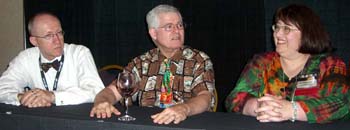
Mark B. Hall, David Hartwell, and C. S. Friedman at the opening ceremony Mark B. Hall, David Hartwell, and writer Guest of Honor C. S. Friedman at the opening ceremony of ApolloCon 2007. Here are more of my blog posts about Apollocon.
Introducing David Hartwell, Mark said: if David is wearing a tie, and you're an epileptic, you should truly try not to stare at it. I don't know if Hartwell's tie made anyone sick, but his voice must have soothed the audience's brain waves when he sang them a song "Teen Angel". Then the filk Guests of Honor Graham and Becca Leathers sang another song.
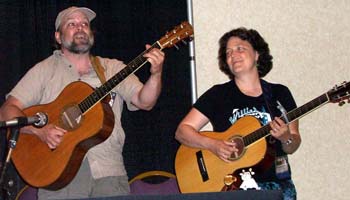
Graham and Becca Leathers at the opening ceremony Filk Guests of Honor Graham and Becca Leathers sing at the opening ceremony of ApolloCon 2007. Here are more of my blog posts about Apollocon.
The con has been reasonably fun so far. It started when an eminent Austin fan K and his wife M gave me a ride to Houston. We had some good conversation along the way. Then I hung out at some panels and room parties. All has been good so far, but not without a glitch. I found out I have forgotten my camera's cradle at home. A cradle is a thingy my camera must be docked into for transferring files into the computer, and for recharging. Forgetting it at home is a bummer. Fortunately, I have 2 spare batteries, so if I'm frugal, I may have enough juice to take pictures tomorrw and Sunday, but just barely. It's hard to break a habit of snapping away with abandon. As far as transferring the pictures, one guy offered to put my camera's memory card into a slot in his computer, and to plug in my external USB hard drive into his computer too, and that way transfer the pictures from one to the other. So that worked. Then again, that guy may not be here tomorrow, and I may not have another opportunity to transfer the pictures. Here are more of my blog posts about Apollocon.