Showing posts with label Mel. White. Show all posts

Wednesday, July 14, 2010

ApolloCon 2010: Scientific Advancement vs. Social Stigma

"For as long as there has been science, there has been the bleeding edge -- progress at odds with social norms. Centuries ago, no one believed the earth rotated around the sun. For years, the concept of 'zero' was a religious heresy. Today society balks at the thought of cloning and artificial intelligence. How do we balance our cultural identity and values with our ingrained curiosity and desire for progress?"

Those are rich questions, but most of this panel was spent lamenting that "nobody" is thinking through the ethics of scientific advancement. As an example of ethically dubious bioengineering, Teddy Harvia brought up the cactus people from China Mieville's "Perdido Street Station". Then again, he admits that "authors often write not to be realistic, but to make a statement". He was also shocked by a relationship between the human protagonist and a bug-like creature in "Perdido Street Station".

"I'm not racial," Teddy Harvia said, "but..."

"But you are prejudiced against cockroaches", said Kimberly Frost.

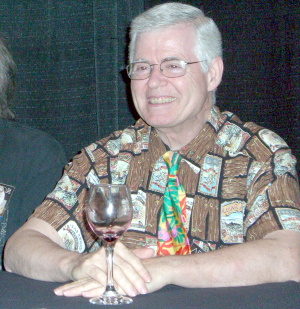
Kimberly Frost, Teddy Harvia, and Alexis Glynn Latner

Kimberly Frost, Teddy Harvia, and Alexis Glynn Latner in the "Scientific Advancement vs. Social Stigma" panel. Find more pictures from ApolloCon 2010 in my photo gallery.

Moderator Kimberly Frost asked: does literature has a role in creating acceptance of the world that science is creating? Unfortunately, this question did not get much traction with the panelists.

It is often not literature but religion that most people expect to help them make sense of scientific and societal changes. In my experience, even in the SF and fantasy fandom many people still don't question the cliche that religion, or, more generally, "spirituality" should provide ethical safeguards for scientific research. So it was encouraging to see that some of the panelists were skeptical of religion's role. Only one panelist, Lou Antonelli, defended Christianity. His observation is that more and more religious people think we shouldn't mess with the planet, because "God gave it to us". That's hopeful news, but I wasn't sure how much I could trust his objectivity, since he said in the same breath that Christians and religious people in general are being mocked in today's "atheistic" environment. Since the purpose of this blog is not politics, I'll just say my view of this is very different.

Some other panelists also disagreed with the notion that Christianity is persecuted in the West. Teddy Harvia pointed out that Christians' claims that "Harry Potter" books attacked religion were wrong, since the books take a completely neutral stance towards religion.

On a marginally related topic, one panelist gave an insightful answer on why many non-Christians don't like when people offer to pray for them. She was in the hospital with her daughter who, like her, was a pagan, and a very nice Catholic chaplain came in and wanted to pray for them. The two of them agreed, but felt the way a Christian would feel if a voodoo priest came in and started waving chicken bones.

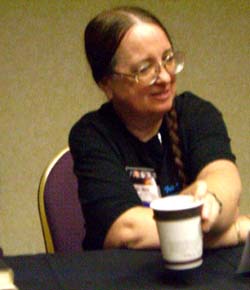
Mel. White and Lou Antonelli

Mel. White and Lou Antonelli in the "Scientific Advancement vs. Social Stigma" panel. Find more pictures from ApolloCon 2010 in my photo gallery.

Tuesday, July 03, 2007

Pay No Attention to the Pro Behind the Curtain: Editors: An ApolloCon 2007 panel

Panelists: David G. Hartwell, Selina Rosen, Mel. White, Steve Wilson

Description in the program book: Learn about the secret world of the editor, the unsung hero of the literary world. Who are they, what do they do, and what is their impact on the fiction we read?

Mel. White at ApolloCon 2007 Mel. White

What was it really about: Unlike Editing 101: Self-editing panel, this one did not have specific advice to writers. (Nor was it supposed to.) Rather, it was one of those panels where pros hash out about little-known aspects of their jobs. Which can be fun!

The most memorable things in all such panels are funny stories "from the trenches", and industry tidbits you don't normally get to hear. Mel. White told this howler of a story. When science fictional elements started to percolate into paranormal romance, those novels were edited by editors who knew everything about romance, but very little about science. So you would get absurdities like a new star appearing between Earth and Jupiter. And nobody noticed it before, beause it appears only once in 200 years.

The Procrustean bed of book publishing economics

David Hartwell went back to the some of the same elements he covered at his kaffeeklatsch where he talked (among other topics) about the economics of book publishing and selling. Back then he gave some interesting examples of how a book word count translates into its price and how that impacts the book's distribution and sales. It turns out the word count economics is far more nuanced than he let us in on at first. Optimal word counts preferred by publishers are dictated not just by the cost of paper, but also by such factors as different printing processes required for books of different thickness -- some are costlier than others; the thickness of the book also determines how many books would fit into a box, thereby influencing shipping costs. The most bizarre factor (though it was completely logical -- it was only weird because I haven't thought about it that way) was pointed out by a guy in the audience. He said books need to be a certain number of inches thick to make it possible to print the author's name in large enough letters on the spines. After all, books in bookstores are stacked so that only their spines are visible (except those lucky tomes that are stored facing front). A customer of less than perfect vision (which is to say, most reading folks) should be able to see the author's name and book's title from 7-9 feet away. This requirement dictates the size of the font on book's back, hence a need for certain thickness.

David Hartwell at ApolloCon 2007 David Hartwell
So on one hand, less is more (a 120,000 word count sells better than a 140,000 word count), but on the other hand, more is more (a book should not be too thin). It doesn't surprise me (especially since I took several courses in mathematical optimization in grad school, which examined this type of problems -- optimizing against several conflicting criteria), it's only weird because we are talking here not about gadgets and widgets, but about a product that flows from an author's deep, innermost self. I always imagined only the author can decide how many words a story needs in order to be told. And yet, having heavily edited my own stuff, I know that number is much more flexible than I thought at first.

Apropos of which, David Hartwell said: "My favorite writers / editors relationship is the kind where both writer and editor agree that the text is just words on paper that could be rearranged any way they want. If the text is the writer's heart's blood, then I can't edit it."