Showing posts with label Alexis Glynn Latner. Show all posts

Friday, November 11, 2011

ArmadilloCon 2011: The Singularity panel

Singularity is commonly associated with emergence of strong artificial intelligence, and the panelists don't think strong AI is any closer now than it was at the time this topic was discussed on ArmadilloCon panels of the past. Or 30 years ago. Or ever. Singularity is certainly no closer than when Vernor Vinge debated it at ArmadilloCon 2003, or Charles Stross at ArmadilloCon 2006. Moreover, some panelists disagreed whether moderator John Gibbons' question "What do you see as a fundamental block towards strong Artificial Intelligence?" is even the right question to ask. They disagreed whether it is possible to bring an AI into being by programming it.

This was a well-reasoned analysis of common Singularity tropes.

Trope 1: Singularity will come from the emergence of strong AI

Bruce Sterling admits that he used to find the idea of strong AI seductive, but doesn't see any evidence of it emerging any time. More, he doubts whether the products of intelligent mind, such as new ideas or inventions, can be attained computationally. "I know many very intelligent people, and they don't reason stuff out of the first principles," said Bruce Sterling. It certainly doesn't "feel like" creative insights come to us algorithmically. And if flashes of insight can't be simulated by a Turing machine, then they are not achievable by a computer. "Computation is not like human intelligence," says Sterling. "It's like mathematics. You could say, mathematics will one day overtake the human brain! But that would be a category error."

Left to right: authors Alexis Glynn Latner, Adrian Simmons, John Gibbons Left to right: authors Alexis Glynn Latner, Adrian Simmons, John Gibbons at the Singularity panel. More pictures from ArmadilloCon 2011 are in my photo gallery.

Bruce Sterling thinks collective intelligence is more interesting than artificial intelligence. When you are starting a company, would you hire HAL 9000, an intelligent machine who never sleeps, or a bunch of engineers who use Google, he asks. Google would immediately defeat HAL. He didn't answer another panelist Adrian Simmons' question if it wouldn't be even better to hire a HAL who uses Google.

Then Bruce Sterling left the panel to go help his daughter who was at the other end of town, adding "Real futurists have children!"

Trope 2: Moore's law will inevitably lead to strong AI

Both the panelists and the audience doubted whether the advance of AI has hardly anything to do with Moore's law. We already have extremely powerful computers for extremely complex weather and economic simulations, but you can't speak about their IQ.

Trope 3: Sentient computers care about the existence of humankind one way or another

Would we even want a sentient machine? John Gibbons reminds us that Charles Stross, author of Singularity-themed novels, asked this question in a recent blog post. What do we need a sentient machine for? While we conceivably might want an intelligent computer to run a spaceship on a long mission, like HAL 9000, in general there's not much advantage to sentience in a software program, argued John Gibbons. And it raises a huge batch of ethical questions. Using a genetic algorithm to derive sentient software? You're committing genocide along the way, because you're killing off versions that don't meet your goals.

Left to right: authors Katy Stauber, Marshall Ryan Maresca, and Bruce Sterling Left to right: authors Katy Stauber, Marshall Ryan Maresca, and Bruce Sterling at the Singularity panel. More pictures from ArmadilloCon 2011 are in my photo gallery.

Even if a sentient AI is benevolent to the humankind, it can't be expected to do what humans would like it to do, Adrian Simmons pointed out. You may ask it how to make better gadgets, but it will instead turn around and ask you personal questions, because it might feel it's human now, and wants to experience a human perspective of the world. (Even that, I should say, is a bit human-centric, if not to say myopic. An AI might not be interested in learning from humans, since by necessity it would develop its own way of learning about the world: else it would not be an AI. It is a common trope in science fiction that a robot or AI yearns to know what it is like to be human, but I think we as humans overestimate our interestingness to the machines. We absolutely can't expect them to take an interest in our problems, let alone serve us. -- E.)

Trope 4: Singularity will come from augmentation of human brain

But machine intelligence is not the only way for Singularity to come about. Bruce Sterling said: increase of a metabolic efficiency of certain regions of the brain (that are dedicated to higher functions), and it will feel like Singularity. Our brain is very inefficient -- the biggest parts of it are dedicated to such functions as walking. So an increase in efficiency of higher reasoning parts of the brain could bring about enormous changes for the humankind. Science fiction has already addressed something similar, such as repurpose visual cortex to do other computations, an audience member pointed out.

Trope 5: Singularity will come from uploading a human personality to a machine

The panelists doubt whether that will ever be possible, because it seems like such a stretch between the chemistry of "wetware" and computational substrate. Here, too, science fiction has shown how horrific unintended consequences of this can be -- case in point is Greg Egan's story "Learning To Be Me".

Trope 6: Singularity will come from the web "waking up"

A person in the audience asked: if we organize semantic connections on the web, will the web "wake up"? John Gibbons reply was what I would have said too: becoming conscious requires a model of self. And it's hard to see how that model of self would emerge simply by organizing semantic connections on the web.

Wednesday, July 14, 2010

ApolloCon 2010: Scientific Advancement vs. Social Stigma

"For as long as there has been science, there has been the bleeding edge -- progress at odds with social norms. Centuries ago, no one believed the earth rotated around the sun. For years, the concept of 'zero' was a religious heresy. Today society balks at the thought of cloning and artificial intelligence. How do we balance our cultural identity and values with our ingrained curiosity and desire for progress?"

Those are rich questions, but most of this panel was spent lamenting that "nobody" is thinking through the ethics of scientific advancement. As an example of ethically dubious bioengineering, Teddy Harvia brought up the cactus people from China Mieville's "Perdido Street Station". Then again, he admits that "authors often write not to be realistic, but to make a statement". He was also shocked by a relationship between the human protagonist and a bug-like creature in "Perdido Street Station".

"I'm not racial," Teddy Harvia said, "but..."

"But you are prejudiced against cockroaches", said Kimberly Frost.

Kimberly Frost, Teddy Harvia, and Alexis Glynn Latner

Kimberly Frost, Teddy Harvia, and Alexis Glynn Latner in the "Scientific Advancement vs. Social Stigma" panel. Find more pictures from ApolloCon 2010 in my photo gallery.

Moderator Kimberly Frost asked: does literature has a role in creating acceptance of the world that science is creating? Unfortunately, this question did not get much traction with the panelists.

It is often not literature but religion that most people expect to help them make sense of scientific and societal changes. In my experience, even in the SF and fantasy fandom many people still don't question the cliche that religion, or, more generally, "spirituality" should provide ethical safeguards for scientific research. So it was encouraging to see that some of the panelists were skeptical of religion's role. Only one panelist, Lou Antonelli, defended Christianity. His observation is that more and more religious people think we shouldn't mess with the planet, because "God gave it to us". That's hopeful news, but I wasn't sure how much I could trust his objectivity, since he said in the same breath that Christians and religious people in general are being mocked in today's "atheistic" environment. Since the purpose of this blog is not politics, I'll just say my view of this is very different.

Some other panelists also disagreed with the notion that Christianity is persecuted in the West. Teddy Harvia pointed out that Christians' claims that "Harry Potter" books attacked religion were wrong, since the books take a completely neutral stance towards religion.

On a marginally related topic, one panelist gave an insightful answer on why many non-Christians don't like when people offer to pray for them. She was in the hospital with her daughter who, like her, was a pagan, and a very nice Catholic chaplain came in and wanted to pray for them. The two of them agreed, but felt the way a Christian would feel if a voodoo priest came in and started waving chicken bones.

Mel. White and Lou Antonelli

Mel. White and Lou Antonelli in the "Scientific Advancement vs. Social Stigma" panel. Find more pictures from ApolloCon 2010 in my photo gallery.

Thursday, November 15, 2007

Alexis Glynn Latner "Hurricane Moon": FACT reading group discussion

Alexis Glynn Latner "Hurricane Moon": FACT reading group discussion

10 people attended the discussion of Alexis Glynn Latner's debut novel "Hurricane Moon". 4 people have read Latner's short stories before. 7 people started the book, 4 of them finished. Some others didn't finish it because they got it too late. This book had not been in stores for long at the time of the discussion. Some of these people were planning to finish it, if for no other reason then because they know Alexis personally (she has been coming to ArmadilloCons for many years).

"Hurricane Moon" is a story of an interstellar mission to find a habitable planet for humans to colonize. Finding the right planet takes longer than expected, and having spent a thousand years in a stasis, the colonists wake up with significant gene damage. Unless the damage is somehow fixed, they'll be unable to procreate; hence, the mission will have failed. The only person capable of coming up with a way to fix the damage is Joe, a brilliant geneticist who is somewhat of a difficult character. The other protagonist is a ship doctor named Katharin. Joe and Katharin feel attracted to one another despite disagreeing on just about everything.

Readers quibbled with science and with romance

People's opinions on the romance thread varied. Two people commented that the book lost their interest when the courtship of the two main characters took the central stage. Some others said the romance wasn't done very well: it wasn't as sophisticated as, for example, the kind of romance you find in Lois Bujold novels. "Those two people seemed to forget they were scientists, they didn't behave like scientists," said a reader. Other readers argued that the love story didn't dominate the novel; this was still hard SF, not a romance novel with a spaceship thrown in. The love story was merely part of the character development.

Some people found quibbles with the science in the book. One reader said it's strange for an Analog writer like Alexis to have pools of anaerobic bacteria on the surface of the planet (where they are presumably exposed to oxygen). Then he thought the explanation why the plants on the planet were blue was scientifically infeasible. These two perceived errors ruined his enjoyment of the book so much he put it down. Regarding the blue color of the plants, another reader tried to convince him he misunderstood the explanation. Somebody also thought Alexis Glynn Latner played fast and loose with deceleration. The numbers didn't add up -- the engine didn't have enough power to slow the ship down over a short period of time.

The plot lost its focus in the second half

Others, including readers well-versed in science, did not see serious problems in that respect. They found the science plausible, and they liked how the book started out as a classical hard SF story. The decision making that went into selecting the right planet, the weighing of the risks -- to stay at the originally selected planet, even though it turned out to be much worse than expected, or to travel further in search for a more suitable planet and risk greater gene damage -- all of this caught their interest. However, some of those who were initially impressed, thought the story lost focus in the second half. When the crew settled on the planet, it seemed the author didn't always know what to do with them. A reader said: "I could tell it was the first really long thing Alexis has written, because the plot was in some places, OK, I don't know what I should do next, so let's let Joe (one of the two main characters, the brilliant geneticist) wonder around and get lost. It happened 2-3 times. One time I could have handled, but 2-3 times? And he's the only guy who can figure out how to fix the genome so that the people could reproduce? And they let him get lost? And the plot depends on him getting lost?"

It can make you ponder logistics of running an interstellar mission

There were other indications that the plot wasn't well thought out. One reader said: "I would have wished that they would have done more exploration of Green, Blue and the other planet, sending drones or something, before settling down. Particularly because Blue is in the title of the book. They never go there, and yet it's in the title." Another reader reminded him that the mission had only enough drones for one planet. This led to an observation that the expedition seemed rather poorly equipped. They only had 1 doctor and one person with training in first aid, which is rather strange for an expedition that has landed on an unknown planet. (Not counting, of course, hundreds of doctors and people of all specialties that were in the stasis, waiting for their turn to wake up -- perhaps decades after the first colonists have landed. Those people were "passengers", not the crew.) This led to an interesting discussion of what is an optimal crew composition for an expedition exploring an alien planet. One reader, after thinking about it for a while, concluded it was a rational idea to have just the absolute minimum of people awake until they determine who else they actualy need. Because the more people you wake up, the more demands you have on resources, and then it becomes a challenge to find out what combination of human resources you need to wake up in order to support all those additional people that have woken up.

So it seems there are readers in this group who have given more than a passing thought to the logistics of running an interstellar mission. They've also read enough books in this particular subgenre where you have a spaceship with colonists in a stasis. Despite the debatable flaws of logic, "Hurricane Moon" came out ahead of many books in this subgenre. It may sound like this discussion report focuses mostly on the negative, but actually a lot of people in the group liked it. I guess they just didn't make it very clear to me what exactly they liked it for.

Alexis Glynn Latner Alexis Glynn Latner at ArmadilloCon 2007

Or maybe they did, to some extent. They liked the culture, for example. The new culture the colonists are trying to build in this new world, the rituals they create, was seen as some of the more interesting things of the novel. One reader, though, was thrown off by the characters changing their last names, as it made it difficult for him to keep track of them. He also found the motivations of the colonists not very credible. Not just the motivations for taking on the names of their home cities ("if they are forever cut off from Earth, why are they holding on the geographical areas that have divided us for a long time?"), but also the fundamental reason for leaving the Earth. Several main characters seemed to be driven by the notion that the Earth society was too screwed up, so they had to go somewhere else to establish a better society. But the colonists are only human, and human society is not going to be all that much better elsewhere, the reader pointed out.

Overall, most readers thought all of these flaws could be attributed to this being Alexis Glynn Latner's first novel. They thought Latner had potential, and her subsequent books are bound to be better.

I wanted to like this book, because I have a weakness for hard SF, and because Alexis Glynn Latner is such a nice person, but I found it less than satisfactory for several reasons. The pacing is, to borrow a word from another FACT reading group member, a bit "pedestrian". From the time the mission lands on planet Green, nothing much science-fictional happens. There are no interesting scientific discoveries until the very end. Instead, the pages are filled with interpersonal drama.Even though the colonists in the end make two significant discoveries that challenge their assumptions about this planet, those discoveries play no part in solving the main problem they are facing -- healing the damage to their genes.

SPOILERS!

It is especially strange that the colonists conclude that the aliens made Blue what it is and put it there in orbit for religious purposes. It's hard to believe that a very advanced technological civilization would attach so much significance to religious symbols as to make an artifact of planetary proportions and put it in orbit. As an explanation of Blue's origin and purpose, it seems rather like a cop-out. It's almost as if scientists can't be bothered to seriously study Blue, so they conveniently label it a religious artifact, because then you don't have to explain anything -- who can begin to guess what the alien religion was like; whereas if you assumed there were good scientific, technological or political reasons for the Blue to be made what it is and placed where it is, you would have to continue to look for them.

END OF SPOILERS

When I pointed out that those discoveries play very little role in the story, one reader suggested that maybe their implications are left to be explored in a sequel.

Another way the resolution of the book was unsatisfactory is that the ending depends on a protagonist's psychological transformation rather than scientific / technical ingenuity. That's not what I would expect from a classic hard SF tale.

Friday, July 06, 2007

Size Matters! Knowing or Choosing the Correct Length to Tell Your Tale: An ApolloCon 2007 panel

Panelists: Katharine Eliska Kimbriel, Alexis Glynn Latner (moderator), Julia Mandala, Chris Roberson, Shanna Swendson

Description in the program book: How do writers know how long a story should be? Is it something they decide or something the story demands? Our panel discusses questions of size, from flash to series. (Don't worry guys, it's perfectly safe.)

It's as if this panel was created with me in mind, so closely it fit my writing predicament (inability to write short stories). But since this was yet another panel on writing and editing, there was bound to be some overlap with the previous two I went to. And so I was able to distill the noteworthy tips or observations into a few sentences.

Shanna Swendson Shanna Swendson

Apparently a lot of people, including accomplished writers, have trouble writing short stories. Shanna Swendson says she certainly does. All her stories turn into novels. (The same thing happens to me.) She wonders if she trained herself that way, to think in novels. The only time she managed to write short stories was when she wrote a series of connected fanfic stories, that all made up a big 100,000 word story.

Alexis Glynn Latner thinks that people who think in short stories are in the minority. She gave this advice: if you have trouble writing short, pick the most narrowly focused idea you can come up with. She also warned that worldbuilding adds to the word count. So it's much easier to make a story short if it's set in a consensus world -- for example, if it's alternative history. Or elves in the mall.

Alexis Glynn Latner Alexis Glynn Latner

A woman in the audience said that every time she writes a story, it comes out as series of dialogs, connected with two-sentence transitions. She asked how to make her stories more balanced between dialog and narrative. Alexis Glynn Latner recommended that she take another author's short story she really liked, highlight the dialog and see what the author does between the bits of dialog.

Here are more of my blog posts from ApolloCon 2007.

Friday, June 29, 2007

Editing 101: Self-editing for the Spec Fic Writer: An ApolloCon 2007 panel

Panelists: Rosemary Clement-Moore, Melanie Miller Fletcher, Alexis Glynn Latner (moderator), Julia Mandala, Barbara Winter

Description in the program book: Panelists discuss the process of self-editing. And no, we don't mean just chucking it out the window and starting over. How can you honestly and dispassionately proof and edit your writing.

Start with the ending and write toward the beginning

... is a good advice if you are getting bogged down in the middle of your story and don't know how to progress your plot, or if you are not sure what's supposed to happen at a certain place in the book.

In one of the books she was writing, Rosemary Clement-Moore had beautiful first six chapters, but no ending. She had characters riding in cars. After she wrote the end of the book, she knew what they were going to talk about when they rode in cars.

Alexis Glynn Latner advises: outline ahead. Tolkien plotted LOTR all the way through and then wrote it backwards from the ending.

One panelist observes that a lot of people don't outline because they say they are "organic" writers who work better without an outline. Oh, come on! she says. You don't outline because you can't!

Editing out self-indulgent parts

The panelists addressed a problem that a lot of writers, especially beginners, apparently have: becoming so enamored with some of your characters that you want your readers to know everything about them, including the complete life history of those characters. But the reader usually doesn't need to know all about a certain character. The reader only needs to know enough to understand what's going on in the story right now. To make it easier to part with those extraneous bits, Julia Mandala suggests to think about it this way.

Julia Mandala. I like the editing part because I do that for the reader. I had my fun writing the first draft [where I got to play with the characters as much as I liked]. But [when you are editing, you need to] wonder, what will make the reader enjoy the story the most?

Alexis Glynn Latner agrees: the first draft is totally self indulgent. She also offers this bit of advice on how to assuage the pain of throwing out the passages that are dear to your heart but not necessary to the story.

Alexis Glynn Latner. When you write exciting, but unnecessary scenes about a secondary character who would like to have a book for himself or herself, you don't want to just dump them -- that's bad for you psychologically. Make a file of them so that you could reuse them for another book.
If your problem is like mine -- not that I get too attached to my characters (if anything, by the time I finish a story, I can't stand them anymore :-)), but that there's a lot going on in the story and you are uncertain in which order the events should be told, Barbara Winter offered a good piece of advice. Not that I asked her, but I was happy to hear something relevant to my own editing struggles.
Barbara Winter (left) and Melanie Miller Fletcher at ApolloCon 2007
Barbara Winter. One of the best tools anyone ever gave me was this. For every scene in your book, write on one page a sentence what the scene is about (e.g. Joe says "bla"), and on the other page, what's the purpose of this scene. If you do that for each scene, you will be able to say: oh, this scene obviously has to come before that one. Or: the purpose of these two scenes is exactly the same. In this case, do I need both of them, or can one of them be cut and go in that other file?

In any case cutting is probably necessary for any story. Apropos of which, Alexis Glynn Latner offered this poetic observation: a story that's alive would heal when you cut it.

No panel on editing is complete without funny tales from editors' trenches. The following story was probably supposed to illustrate mistakes novice writers make with insufficient / inadequate characterization of their characters.

One of the panelists was teaching at a writers' workshop, and one girl turned in a story that had a homosexual pedophiliac bondage relationship in it. The panelists told the girl: I can handle homosexuality and bondage, but an 8-year-old doing those things? That's a big no-no. The girl became really flustered: OMG, the protagonist was NOT a young boy, he was just a very slender, slim-built adult! The panelist did a hillarious impression of the girl becoming a blabbering mess as she tripped all over herself to explain there was no pedophilia in the story. She just wasn't skilled enough to describe her protagonist in a way that would let the reader see him accurately.

Choosing the correct tense and point of view

There was also a lot of talk about writing techniques such as choosing the correct tense and point of view for the story. The panelists were unanimously conservative on these two points. The past tense is almost always the right tense for a story, unless there is a compelling reason to choose present tense. A limited third person point of view is usually the right point of view, or the least problematic anyway.

Most readers, as well as most writers and editors, don't like stories told in present tense. The panelists said the present tense is very hard to do right. Rosemary Clement-Moore said even though present tense is supposed to immerse you in the story and make you feel as if you are experiencing it directly, for some reason it makes you more distant from the story.

The same with first person point of view, said Julia Mandala. It is good only when it's done right. You want to put the reader inside the character, to fully immerse the reader in the character's experiences. E.g. instead of "I was tired", you need to say, for example, "oh, my limbs were like noodles". ("Yes, I know it's a cliche," Julia added, "but you get the point".)

There had been stories done with multiple first-person points of view, but there had to be a very good reason for that. For example, if the hero and the villain are on separate parts of the country, and won't get together for many chapters, and don't know about each other, it is OK to use both first person viewpoints.

Alexis Glynn Latner offered an interesting observation regarding male versus female viewpoint. She likes to write from a male point of view, because, to quote her, "it snaps down productive filters: a guy wouldn't say that, a guy wouldn't notice that". She can become more easily bogged down in a female point of view -- perhaps because women notice more minute details.

How do you know when you're done editing?

A fitting question to end a panel with is how do you tell when you've done all the editing you could do? How do you know when the story is ready to be shown to the first reader (usually a friend or a fellow writer in a critique group)? The panelists say that point comes when you find yourself making minor word changes here and there rather than doing actual editing.

Melanie Miller Fletcher visualizes her stories as a board with nails in it that have loose colorful threads drawn between the nails. She says that she knows the story has been finished and is ready to be shown to the first reader when the strings are all tight.

Sunday, August 21, 2005

ArmadilloCon 2005: When and How Will the 21st Century Get More Interesting?

What this panel was supposed to be about, according to the ArmadilloCon program book: "The 20th Century saw great advancements in technology and many cultural changes, but the new one's been pretty dull. It may even be going backward. Seen any moonwalks lately? Is there interesting stuff we just haven't noticed, is good stuff about to happen, or is the highlight of the century going to be a multiple-button mouse from Apple?" Panelists: Alexis Glynn Latner, Sean McMullen, John Moore, Chris Nakashima-Brown, Mark L. Williams Chris Nakashima-Brown rejected the premise that 21st century so far hasn't been interesting. On one hand, he admitted that cyberpunk becoming the reality turned out to be pretty dull: nobody gets excited about online billpay. But the geopolitical scene, he says, is quite a bit more interesting. We live in a Lord of the Rings world, where there is Mordor and medieval stateless necromancers. (He tossed the phrase "stateless necromancers" around in the last year's ArmadilloCon, too, and I actually expected him to bring it into this discussion. I anticipated that Chris Nakashima-Brown will focus on the geopolitical aspects of the 21st century, and how can you do it without medieval necromancers? And I wasn't disappointed!) Sean McMullen. We've been concentrating on minutia. But I don't want a jet car, I don't want stupid [people] flying over my real estate. They are damaging enough in 2 dimensions, I don't want them in 3 dimensions. Nutrition pills? Bad idea: I like eating, I like drinking. Just because something is possible doesn't mean people will pay for it. We could have been on Mars in 1980. Being viable and having a good reason to do it in the first place is not the same thing.

Peak oil or sex robots?

John Moore asks the audience which of the two likely realities of the 21st century they would like to talk about: peak oil or sex robots? The audience goes for the less disturbing topic, sex robots, and the positive aspect of it: the demand for them will drive robotics and a lot of other scientific disciplines. After all, sex has long been driving technological change: in the last century porn created enough demand for photographic chemicals so they started to be produced in factories. Before that, you had to mix them yourself. And blue movies provided a critical mass for VCRs. And, of course, porn drove the rise of the internet. Sean McMullen is convinced robots and virtual reality will never replace live interaction with other human beings because they won't provide the same richness of experience. "Look at what's on a video game. It's nothing like reality. People who put those games together, they are totally out of sync with reality. Real environment, if you're over here, plug into the virtual reality thing; on the other hand, there is a party next door, and there are nice people; You're not guaranteed to score, but those nice people may change your life. So I would take the real life adventure every time."

Relationship of real and virtual words is not as cut-and-dried

People from the audience argue that the relationship of real and virtual words is not as cut-and-dried. One audience member says that the virtual community of his MMPG is having a real life barbeque tomorrow. The novel form of interaction is mixing the two worlds. He plays a female character, even though the players know he's a guy, and it has been a wonderful experience. He bonded over it with his daughter. It's been a liberating concept. He's now one of the girls. They invite him to those things and just have the girl chatter. John Moore. When you're watching Motorcross on television versus real life, virtual reality improves upon reality. Things that are tedious and not interesting in real life can be made more interesting in virtual reality. Like motorcycle jumps when shown with a camera. A discussion ensues whether we will see radical, drastic technological changes, or will technical advances be more of an incremental kind, like "progressing" from Word 2000 to Word 2003. Some of the stranger ideas, tossed about by Alexis Glynn Latner, was that maybe 9/11 scenario was inspired by the violent special effects in movies and video games. "Could 9/11 have hapepend in a world where there were no special effects in the movies?" she asks. She thinks the terrorist used this particular scenario, crashing planes into buildings, because it provided very violent visuals, the kind they must have seen in the movies and video games.

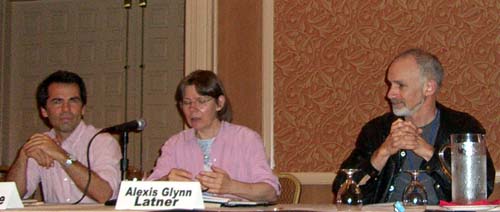
Left to right: John Moore, Alexis Glynn Latner and Sean McMullen. Here are more posts from ArmadilloCon 2005.