People in the FACT reading group had said "Old Man's War" is like Heinlein with serial numbers filed off. I have read some Heinlein, but perhaps the wrong novels, because I found no similarity between Scalzi and Heinlein. If anything, I like Scalzi better because he writes characters that feel real, not walking puppets playing roles pre-assigned to them by the author. I guess the similarities must lie in the military theme? I haven't read "Starship Troopers", but I bet it's not as funny as "Old Man's War". And the latter does not have a political agenda, unlike anything I would expect from Heinlein. Scalzi's dry wit shines from the very opening scene in the military recruiter's office, and it immediately inspired me to get to know the protagonist better. John Perry is a 70-something man who enrolled in the military to fight a war in the Colonies. He knows very well that once he leaves Earth, he'll never be able to come back, nor to send a message to his loved ones. For all purposes, military recruits are considered dead by the Earth society. More than that, nobody on Earth has any idea what the Colony worlds are like. At best, they suspect there are alien races and unimaginably advanced technologies. The only reason huge numbers of 70-somethings venture into the complete unknown is because they are convinced the technology of the Colonies will give them new bodies and significantly extend their life span. They figure it has to be true because an ordinary 70-year-old is not too fit to be a warrior.
The beginning of the novel does a good job of drawing you in. I was hooked at the point where the John and his friends reasoned out, from hints and glimpses and inconsistencies, that the world in the Colonies must be stranger than they imagine. At that realization I was rearing to go along for a ride with the protagonist.
The world out there turns out be strange, but unfortunately not in very interesting or profound ways. Sure, the rejuvenating treatment the new recruits undergo is quite shocking, but perhaps it would have been less so if they had read more science fiction ;-) It's not entirely original. Other than that, the strangeness of the Colonies comes mostly from all sorts of bizarre alien species living out there. The middle third of the book describes John's romp through all those alien worlds and species. Obviously he goes there not as a tourist but a soldier, and his exposure to alien cultures consists mostly of blowing them up. By his nature he's not very happy to do that, or to see his friends getting killed. But this inner dissonance does not do very much to advance the story. It still feels like some kind of Gulliver's travels-kind of tour of the bizarre, only without the satire. At that point the story stagnated and I wasn't very sure if it will take off again.
Towards the end the story regains its momentum when John meets Jane Sagan and forms an unusual, tension-fraught relationship with her. An interesting aspect to Jane's character is that despite being physically an adult, she, like other Special Forces members, is technically only 6 years old (she was born in an adult body). Thus, some of her emotional responses are like a 6-year-old's. I have to say I found it a bit illogical that individuals with emotional maturity of children would be trained to have the lethal superpowers, such as Special Forces members. Still, it's an interesting point to ponder. Another thing about the warriors of the Ghost Brigades that rang fake to me was that they secrectly longed for birth families they never had and fantasized about what their childhoods might have been like. They felt inferior for not having grown up the ordinary way. I did not find that believable. To be curious about what it's like to grow up in a family -- sure; but to feel inadequate for having missed that -- hardly. It reminded me of many classic SF stories where robots, despite being smarter and more capable than humans, wanted nothing more than to actually be human. Because you know, being human is by default superior to any mode of existence. Jane's predicament seemed similarly disingenuous.
Regardless, "Old Man's War" is a fun read, if you don't expect much depth from it.
Bookmark This on Delicious
Showing posts with label john scalzi. Show all posts
Showing posts with label john scalzi. Show all posts
Monday, September 29, 2008


Sunday, August 24, 2008
ArmadilloCon 2008: John Scalzi's Guest of Honor interview
John Scalzi's interview took a different format than the usual Guest of Honor interview. There was no interviewer; Scalzi paced back and forth, shooting the breeze with the audience. He probably didn't say anything one wouldn't find on his blog. It's how he said those things that made him so entertaining. He acted out various stories from his life as little skits. For example, he said, after you win a Hugo, you get only a week to be flaunt it -- and he did a skit of a person who mentions his Hugo award in every other sentence. After a week is over, he said, you're supposed to be blase about it -- yeah, I won a Hugo, it's no big deal.
Then there was a rich vein of humor in his attempts to find out what it's like to be a 16-year-old girl. He had to do that in order to get the "Zoe's Tale" protagonist's voice right. "Hard as it may be to believe, I've never been a 16-year-old girl," Scalzi said. He also never understood girls in high school. "You can ask people I went to high school with. They'll say, "no, John. Noooo."" So what were his options? Hang out with teenage girls at the mall? He illustrated this dilemma with another skit, that began with his sidling up to a girl in the mall, and ended with a restraining order.
And so the interview continued in this spirit. As far as creating Zoe's character, his wife turned out to be his greatest resource. After all, she was a 16-year-old girl once. It took a lot of tries to get Zoe right, but eventually he succeeded, and became proud of Zoe as one of the finest characters he ever created. He also told this story at the writers' workshop to illustrate his point that writers should venture out into unfamiliar territory and not be afraid to fail. In Scalzi-speak that's called "the power of suck".
Later on in the interview he commented on Neal Stephenson, openly admitted to stealing from other authors, and talked about why he could not afford to be as polemical in "Old Man's War" as Heinlein was in "Starship Troopers". Finally, he revealed an unexpected fact about himself.
The whole article is available on my website.
Then there was a rich vein of humor in his attempts to find out what it's like to be a 16-year-old girl. He had to do that in order to get the "Zoe's Tale" protagonist's voice right. "Hard as it may be to believe, I've never been a 16-year-old girl," Scalzi said. He also never understood girls in high school. "You can ask people I went to high school with. They'll say, "no, John. Noooo."" So what were his options? Hang out with teenage girls at the mall? He illustrated this dilemma with another skit, that began with his sidling up to a girl in the mall, and ended with a restraining order.
And so the interview continued in this spirit. As far as creating Zoe's character, his wife turned out to be his greatest resource. After all, she was a 16-year-old girl once. It took a lot of tries to get Zoe right, but eventually he succeeded, and became proud of Zoe as one of the finest characters he ever created. He also told this story at the writers' workshop to illustrate his point that writers should venture out into unfamiliar territory and not be afraid to fail. In Scalzi-speak that's called "the power of suck".
Later on in the interview he commented on Neal Stephenson, openly admitted to stealing from other authors, and talked about why he could not afford to be as polemical in "Old Man's War" as Heinlein was in "Starship Troopers". Finally, he revealed an unexpected fact about himself.
The whole article is available on my website.
Saturday, August 16, 2008
ArmadilloCon writers' workshop: pros' advice and a story construction game
The writers' workshop started with advice panels on writing. Some of the advice the pros gave was debunking common writing myths, so in a way it was metaadvice. Sheila Williams, the editor guest of honor, shared some good, compelling pieces of wisdom. It's all the more valuable coming from the mouth of the Asimov's editor. She identified mistakes made by beginning authors with accuracy that made me hang my head down in embarrassment a s I recognized myself making them in my own writing.
Then Don Webb conducts an audience participation game. He and the audience collaboratively construct outlines for two genre stories: an immuno-defficient woman in a bubble encounters a giant germ (horror) and a little slave boy in the 19th century American south meets aliens (science fiction). For this, the audience needs to decide: the story's genre (SF, F or H), who is the protagonist, where or when the story is taking place, and, most importantly, what is the driving force for the story. If it's horror, what is the protagonist afraid of? If they are aliens, what do they want?
After the critique sessions, ArmadilloCon guest of honor John Scalzi gave a closing speech for the workshop students on the power of suck -- why a beginning writer should suck as hard as he/she can. :-)
The whole article can be found in my web site.
The pictures from the writing workshop and the rest of ArmadilloCon 2008 can be found on my web site.
Then Don Webb conducts an audience participation game. He and the audience collaboratively construct outlines for two genre stories: an immuno-defficient woman in a bubble encounters a giant germ (horror) and a little slave boy in the 19th century American south meets aliens (science fiction). For this, the audience needs to decide: the story's genre (SF, F or H), who is the protagonist, where or when the story is taking place, and, most importantly, what is the driving force for the story. If it's horror, what is the protagonist afraid of? If they are aliens, what do they want?
After the critique sessions, ArmadilloCon guest of honor John Scalzi gave a closing speech for the workshop students on the power of suck -- why a beginning writer should suck as hard as he/she can. :-)
The whole article can be found in my web site.
The pictures from the writing workshop and the rest of ArmadilloCon 2008 can be found on my web site.
Friday, February 08, 2008
Book review of John Scalzi "Android's Dream"
Many people post book reviews on their blogs, but I usually post reports on reading group discussions. In my general opinion, a survey of what a bunch of people said about a book is more informative than my opinion alone. While it is often true, sometimes we have discussions that are not very informative. This usually happens when instead of analyzing a book in depth, people chat about various cute, trivial bits of it that they liked. (Usually it happens with books that are not very deep in and of themselves.) As a result I sometimes look at the discussion report and realize it contains no clue whether a particular novel is worth reading. So once in a while I'll haughtily assume that my own opinion may be more informative than a survey of others' opinions. Today is one of such days, and John Scalzi's "Android's Dream" is one of those books.
I got started on this book in a skeptical frame of mind. The cover blurb clearly showed this lighthearted space romp did not exemplify "literature of ideas", the kind of SF I like best. Indeed, if you check out its summary on Amazon --
"An interstellar scandal explodes when a human diplomat assassinates an alien diplomat by farting at him, albeit using a scent-emitting communicator. To forestall interspecies war, the government enlists former war hero and current uberhacker Harry Creek. His mission: to placate the aliens by finding a unique form of sheep used in the aliens' upcoming coronation ritual."
it becomes obvious that the value of this novel lies mostly in the humor. The fact that it opens with a very elaborate fart joke also didn't encourage me to read further. The only reason I read it was because John Scalzi is the Guest of Honor at the upcoming ArmadilloCon.
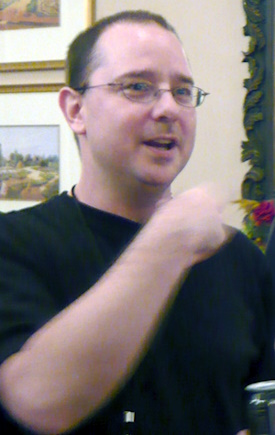
John Scalzi at the ArmadilloCon, an Austin, Texas speculative fiction convention, in 2008.But I liked it! It's a really fun book. There is humor, there are unexpected plot twists, there is irony, there is neat technological trivia. Scalzi very humorously merges the familiar with the alien, the mundane with the high-tech. Harry Creek and his damsel-in-distress Robin escape the Earth on a cruise liner; later, its endless buffets, slow elevators, plush lounges and obnoxious picture-snapping tourists provide a comical backdrop for our protagonists' fight against lizard-like alien marines.
Then there is the way kosher laws provide inspiration for the legal argument that established Robin's citizenship status. That was a brilliant, or at least a very funny, twist. Using something so quaint and irrational as kosher laws to make an argument about legal implications of genetic engineering, is an example of what makes this book more than a source of cheap chuckles.
Neither the humor, nor suspense abates until the very few last pages. This thriller did a very good job in keeping me guessing how Creek and Robin are going to get out of all the tight spots they found themselves in.
By the way, it's not for nothing that I called Robin a damsel in distress. That's one real issue I take with this book. While Robin is tough, spunky, witty and unflappable, she does not have an independent role in the book. She just goes along for a ride with Harry, who calls all the shots. Her only purpose of existence is to be rescued by him. It's a bit of a throwback to how women used to be portrayed in SF of a less enlightened era.
Other than that, it's a really fun read.
Subscribe to:
Posts (Atom)

 Posts
Posts


