Friday, June 29, 2007

Editing 101: Self-editing for the Spec Fic Writer: An ApolloCon 2007 panel

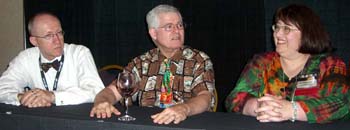
Panelists: Rosemary Clement-Moore, Melanie Miller Fletcher, Alexis Glynn Latner (moderator), Julia Mandala, Barbara Winter

Description in the program book: Panelists discuss the process of self-editing. And no, we don't mean just chucking it out the window and starting over. How can you honestly and dispassionately proof and edit your writing.

Start with the ending and write toward the beginning

... is a good advice if you are getting bogged down in the middle of your story and don't know how to progress your plot, or if you are not sure what's supposed to happen at a certain place in the book.

In one of the books she was writing, Rosemary Clement-Moore had beautiful first six chapters, but no ending. She had characters riding in cars. After she wrote the end of the book, she knew what they were going to talk about when they rode in cars.

Alexis Glynn Latner advises: outline ahead. Tolkien plotted LOTR all the way through and then wrote it backwards from the ending.

One panelist observes that a lot of people don't outline because they say they are "organic" writers who work better without an outline. Oh, come on! she says. You don't outline because you can't!

Editing out self-indulgent parts

The panelists addressed a problem that a lot of writers, especially beginners, apparently have: becoming so enamored with some of your characters that you want your readers to know everything about them, including the complete life history of those characters. But the reader usually doesn't need to know all about a certain character. The reader only needs to know enough to understand what's going on in the story right now. To make it easier to part with those extraneous bits, Julia Mandala suggests to think about it this way.

Julia Mandala. I like the editing part because I do that for the reader. I had my fun writing the first draft [where I got to play with the characters as much as I liked]. But [when you are editing, you need to] wonder, what will make the reader enjoy the story the most?

Alexis Glynn Latner agrees: the first draft is totally self indulgent. She also offers this bit of advice on how to assuage the pain of throwing out the passages that are dear to your heart but not necessary to the story.

Alexis Glynn Latner. When you write exciting, but unnecessary scenes about a secondary character who would like to have a book for himself or herself, you don't want to just dump them -- that's bad for you psychologically. Make a file of them so that you could reuse them for another book.
If your problem is like mine -- not that I get too attached to my characters (if anything, by the time I finish a story, I can't stand them anymore :-)), but that there's a lot going on in the story and you are uncertain in which order the events should be told, Barbara Winter offered a good piece of advice. Not that I asked her, but I was happy to hear something relevant to my own editing struggles.
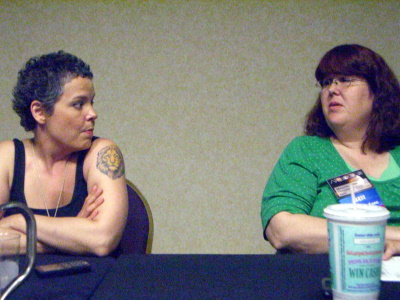
Barbara Winter (left) and Melanie Miller Fletcher at ApolloCon 2007
Barbara Winter. One of the best tools anyone ever gave me was this. For every scene in your book, write on one page a sentence what the scene is about (e.g. Joe says "bla"), and on the other page, what's the purpose of this scene. If you do that for each scene, you will be able to say: oh, this scene obviously has to come before that one. Or: the purpose of these two scenes is exactly the same. In this case, do I need both of them, or can one of them be cut and go in that other file?

In any case cutting is probably necessary for any story. Apropos of which, Alexis Glynn Latner offered this poetic observation: a story that's alive would heal when you cut it.

No panel on editing is complete without funny tales from editors' trenches. The following story was probably supposed to illustrate mistakes novice writers make with insufficient / inadequate characterization of their characters.

One of the panelists was teaching at a writers' workshop, and one girl turned in a story that had a homosexual pedophiliac bondage relationship in it. The panelists told the girl: I can handle homosexuality and bondage, but an 8-year-old doing those things? That's a big no-no. The girl became really flustered: OMG, the protagonist was NOT a young boy, he was just a very slender, slim-built adult! The panelist did a hillarious impression of the girl becoming a blabbering mess as she tripped all over herself to explain there was no pedophilia in the story. She just wasn't skilled enough to describe her protagonist in a way that would let the reader see him accurately.

Choosing the correct tense and point of view

There was also a lot of talk about writing techniques such as choosing the correct tense and point of view for the story. The panelists were unanimously conservative on these two points. The past tense is almost always the right tense for a story, unless there is a compelling reason to choose present tense. A limited third person point of view is usually the right point of view, or the least problematic anyway.

Most readers, as well as most writers and editors, don't like stories told in present tense. The panelists said the present tense is very hard to do right. Rosemary Clement-Moore said even though present tense is supposed to immerse you in the story and make you feel as if you are experiencing it directly, for some reason it makes you more distant from the story.

The same with first person point of view, said Julia Mandala. It is good only when it's done right. You want to put the reader inside the character, to fully immerse the reader in the character's experiences. E.g. instead of "I was tired", you need to say, for example, "oh, my limbs were like noodles". ("Yes, I know it's a cliche," Julia added, "but you get the point".)

There had been stories done with multiple first-person points of view, but there had to be a very good reason for that. For example, if the hero and the villain are on separate parts of the country, and won't get together for many chapters, and don't know about each other, it is OK to use both first person viewpoints.

Alexis Glynn Latner offered an interesting observation regarding male versus female viewpoint. She likes to write from a male point of view, because, to quote her, "it snaps down productive filters: a guy wouldn't say that, a guy wouldn't notice that". She can become more easily bogged down in a female point of view -- perhaps because women notice more minute details.

How do you know when you're done editing?

A fitting question to end a panel with is how do you tell when you've done all the editing you could do? How do you know when the story is ready to be shown to the first reader (usually a friend or a fellow writer in a critique group)? The panelists say that point comes when you find yourself making minor word changes here and there rather than doing actual editing.

Melanie Miller Fletcher visualizes her stories as a board with nails in it that have loose colorful threads drawn between the nails. She says that she knows the story has been finished and is ready to be shown to the first reader when the strings are all tight.

Wednesday, June 27, 2007

Geeks in Love: Finding Love in Fandom: an ApolloCon 2007 panel

Description in the program book: Maybe it's flirting; maybe it's friendship; maybe it's a lifelong relationship. Finding romance in all its forms and guises in the ever-surprising world of fandom.

Panelists: Chuck Coshow, Jonathan Guthrie, Becca Leathers, Graham Leathers (moderator), Tim Miller, Val Villareal

What it was like: pretty much as advertised, only I was hoping it would be funnier and would have more quirky dating stories that are only likely to happen to geeks. In comparison, Eric and Cathy Raymonds' panel Dating 101: Remedial Flirting at Linucon 2004 was funnier.

Not surprisingly, common interests play a part in geek dating

All of the panelists met their significant others in the SF fandom, or, in the case of Tim, because of shared interests and sense of humor. Tim met his wife in high school and fell in love with her when she laughed at one of his jokes -- unlike the majority of the population, who doesn't get his sense of humor. She was also into Dr. Who. "Imagine that," he said, "a girl who had the same interests!" Val and Chuck... well, I don't remember how or where they met, but Chuck said his love for Val was clinched when he made a vaguest reference to a Disney kids show, and Val responded by singing a line from the theme song of the show. (Or something like that.) Becca and Graham Leathers met at DuckCon at Chicago 2 or 4 years ago. They were each an independent music guest, and they met in a music circle. They ended up hooking up again at a folk music festival at Winnipeg. Jonathan Guthrie met his his wife at a convention, but he had some experience with fannish women long before that: his first serious girlfriend, when he met her, was wearing a Don't Panic t-shirt.

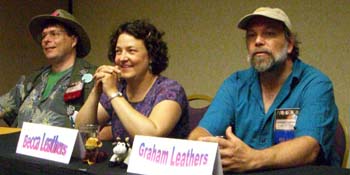
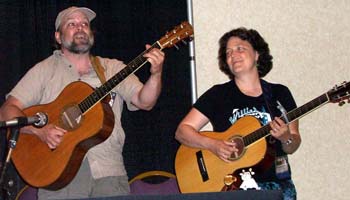
Jonathan Guthrie, Becca and Graham Leathers Jonathan Guthrie, filk Guests of Honor Graham and Becca Leathers

So, common interests fueled the attraction these people felt for their mates. As Becca said, it's hard to explain her interest in filk to somebody who's not a musician (or even to some fellow musicians?). The panelists valued the "he/she gets me" factor so highly that one of them even asked the audience, has anyone here ever had a successfulx relationship with a non-fan? Tim compared an interest in things fannish to an interest in politics. He knows couples where one is hard left and the other hard right, who work a lot better than couples where one is politically very involved and the other doesn't care at all. Because in the first case at least both understand each other's passion for politics. I, a sole contrarian voice, argued that a success of a relationship has little to do with whether the other person is in the fandom. But of course I have only one data point -- myself, and can't speak for the whole fandom.

But it wasn't just the geeky or fannish interests that brought those couples together. Graham said when he saw dogs listed as one of Becca's interests on her LiveJournal, it clinched his interest in her, since he had been a dog trainer himself.

How hard or easy is it to find romance at SF conventions?

Chuck. When I first started coming to conventions, in the mid-80s, there were a lot more women than men. And then you tried to meet these women, and everyone's shields were up. They were like, here is one of those assholes. Nowadays it feels OK to meet people. Does everyone feel it was like that? Women go to cons to have fun, and those geeky guys come to them and say, I roll hundreds on <some kind of RPG?>! Let's go have a coke!

A woman in the audience: it's the opposite for me. I work in theater and I don't go to bars, so my pool of available straight men is not very big. So I hope that a nice geeky guy will come talk to me [at a con]. But it doesn't happen often. They happen to be libertarians.

Tim. There is a reputation that fandom in general is a big open tent [?]. In the 70s and 80s everyone in the fandom was considered an outcast. So geeky guys thought that the girls in the fandom would automatically accept them, and then they discovered that the general rules of dating still applied even in the fandom.

So maybe there was a reason why this panel did not have much of a novelty factor: geek dating isn't very different from mundane dating.

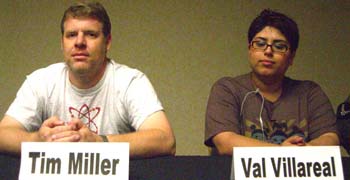
Tim Miller and Val Villareal Tim Miller and Val Villareal

Some said a difficulty of finding a romantic interest may also vary from con to con. One in-the-know fan in the audience dropped names of conventions that have reputations of being events where people go to get laid. Jonathan said that he had never experienced a hookup party at any convention. "Either I'm doing something wrong," he said, "or it really doesn't work this way."

Also, Becca reminded, a lot of people you meet at conventions are from out of town, so if you find romance, it's likely to be long-distance. That comes with its own challenges, and the odds for it surviving are not good (although a long distance relationship did work out for Becca and Graham). On the other hand, Graham added, if a relationship ends, the distance makes it less likely that you'll run into that person at future conventions.

Common sense advice, or conventions as churches

Overall, any advice given in this panel was only common sense. The panelists gave plenty of reminders for the guys to keep bathing and brushing their teeth if they ever want to get a date.

Chuck. It's a truism: a lot of guys come to a con and decide it's a 3-day excuse to abandon all hygiene. But [there are also] fans who go to cons try to socialize others, in the sense of teach them acceptable behaviors.

Tim. Remember the 5-3-1 rule: you have to have either 5 hours of sleep and 3 meals, or 3 hours of sleep and 5 meals, and 1 shower a day, and this will get you through the convention.

Chuck. The tub in your room doesn't just exist for icing down beer.

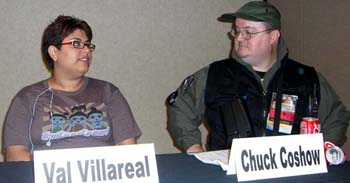
Val Villareal and Chuck Coshow Val Villareal and Chuck Coshow

Other advice:

Graham. One of the worst things you can do is come across as desperate. I was pretty much resigned to being single, and I was OK with that. I just had to bump into someone who I thought we can be friends with, but it progressed beyond that. I have no regrets about that. So, be yourself.

Tim. Don't look at cons a a singles bar: look at them more like a church, where you go for a some other purpose, but may meet people.

Jonathan added that some people treat church as a singles bar.

Here are more of my blog posts and pictures from ApolloCon 2007.

Monday, June 25, 2007

How Friendly Were Frodo and Sam? An ApolloCon 2007 panel

Description in the program book: Was there a homoerotic subtext to Lord of the Rings? Is subtext in the eye of the beholder, or is Spec Fic friendlier to GLBT characters and readings than the mainstream? Panelists discuss the perception of alternative sexualities in SF/F.

Panelists: Alexis Glynn Latner (moderator), Lee Martindale, Jess Nevins, Selina Rosen, Mel. White

Selina Rosen and Jess Nevins at ApolloCon 2007

What was it really about: The discussion didn't focus so much about a relationship between Frodo and Sam, or even gay / lesbian / bi / transsexual (GLBT) characters in SF. Mostly it revolved about fan fiction, especially slash fiction.

At first there was some speculation about Frodo and Sam. Were they or weren't they?

One panelist was vehemently opposed not just to slash fiction, but to most kinds of fan fiction. Others defended fan fiction, but acknowledged that slash fiction did nothing to address GLBT issues, and was overall not very relevant to the panel topic. Some panelists tried to get the panel back on track, but in the end they did not produce anything other than a few rather obvious observations.

My full article can be found on my web site.

Saturday, June 23, 2007

ApolloCon 2007, Friday: kaffeeklatsch with David Hartwell

Here are some interesting tidbits that were said at the kaffeeklatsch with the editor-legend David Hartwell.

A lot of people have very different opinions as to what hard science fiction means. Some count J. G. Ballard amont the writers working in this subgenre. In fact, J. G. Ballard had once stood up and said he was a hard science fiction writer: the hard science within which he was working were medicine and psychology. He may have had a point, because he was trained as a doctor, and he used those sciences rigorously in his fiction.

David Hartwell at the ApolloCon 2007 opening ceremony David Hartwell at the opening ceremony of ApolloCon 2007

About the economics of book sales. Apparently, mainstream books sell much worse than genre books. Of all 5 books nominated to the National Book award one year, none of them sold even a 1000 copies. Meanwhile it's a rare SF hardback that doesn't sell at least 2000 copies. Hartwell quotes Norman Spinrad, who said that publishing a SF novel that's a complete failure would be as unlikely as constipating yourself by active will.

Hartwell juggled some numbers, converting word count into dollars. For example, an extra 20,000 words translate into extra $2 added to the price of a hardcover. So if a 120,000 word hardcover would cost $24.95, a 140,000 hardcover would cost 26.95; and that means bookstores would order 25% fewer copies of it. (Or something like that. I'm not sure I am quoting those numbers right.) He shed light on the complex relationship between book distributors and publishing houses; a major portion of books are sold through supermarkets and other superstores, and if a superstore stops buying books from a publishing house, that publishing house may go bankrupt. Basically, he said, most books are now sold through superstores rather than small bookstores, which means that most of America lives 40 - 60 miles from a bookstore.

Hartwell says one of the best things one can do to promote the genre of science fiction, to keep it alive and thriving, is to write book reviews, an publish them somewhere. No matter how obscure is a web site where it's published, someone will find it and read it. It's especially true when you are reviewing an author's first novel. Even if the review is negative, if it is engaging and well thought-out, it will do a lot to promote the new author. 500 -- 1000 word review is better than a 300 word review. A 1500 word review is even better.

I feel so validated! My verbose book reviews are therefore worthwhile -- at least in Hartwell's opinion!

Here are more of my blog posts about Apollocon.

Friday, June 22, 2007

ApolloCon 2007: opening ceremony

The ApolloCon 2007 opening ceremony was short and simple. The convention chair, Mark Hall said they started ApolloCon because they wanted to have a con in Houston they wanted to go to. After 2 years of being the ApolloCon chair he will take the next two decades off, because this is a con he wants to go to. He added: "at least I think there's a con going on out there. Let me know if there isn't."
Mark B. Hall, David Hartwell, and C. S. Friedman at the opening ceremony Mark B. Hall, David Hartwell, and writer Guest of Honor C. S. Friedman at the opening ceremony of ApolloCon 2007. Here are more of my blog posts about Apollocon.
Introducing David Hartwell, Mark said: if David is wearing a tie, and you're an epileptic, you should truly try not to stare at it. I don't know if Hartwell's tie made anyone sick, but his voice must have soothed the audience's brain waves when he sang them a song "Teen Angel". Then the filk Guests of Honor Graham and Becca Leathers sang another song.
Graham and Becca Leathers at the opening ceremony Filk Guests of Honor Graham and Becca Leathers sing at the opening ceremony of ApolloCon 2007. Here are more of my blog posts about Apollocon.
The con has been reasonably fun so far. It started when an eminent Austin fan K and his wife M gave me a ride to Houston. We had some good conversation along the way. Then I hung out at some panels and room parties. All has been good so far, but not without a glitch. I found out I have forgotten my camera's cradle at home. A cradle is a thingy my camera must be docked into for transferring files into the computer, and for recharging. Forgetting it at home is a bummer. Fortunately, I have 2 spare batteries, so if I'm frugal, I may have enough juice to take pictures tomorrw and Sunday, but just barely. It's hard to break a habit of snapping away with abandon. As far as transferring the pictures, one guy offered to put my camera's memory card into a slot in his computer, and to plug in my external USB hard drive into his computer too, and that way transfer the pictures from one to the other. So that worked. Then again, that guy may not be here tomorrow, and I may not have another opportunity to transfer the pictures. Here are more of my blog posts about Apollocon.

Thursday, June 21, 2007

I finished my story for the ArmadilloCon writing workshop

Yesterday I finished a story for the ArmadilloCon writing workshop and mailed it. What a relief to be able to actually finish a story after 2 weeks worth of intense late night work! (And that wasn't writing -- it was just the editing.) What an excitement to know that a little less than 2 months from now it will be ripped into shreds... err, constructively criticized. :-)

Yes, I would be very excited to look forward to the workshop, except for this little bummer. My story is more than twice the 5000 word count limit. It's over 11,000 words. So I did what the Writers' Workshop instructions suggest to do in such cases: I cut it off at roughly 5000 words and put "the story continues" at the end. Even though that's clearly an undesirable option, because, to quote the workshop guidelines, "We recommend that you do not go over the word limit if writing a short story as it will not be representative of the work as a whole." Of course it won't. But what can I do if I am incapable of writing short fiction? I tried. Every time I start out to write a story, I think I can sum up its idea in 3 sentences; it's like, what will I fill those pages with? Then I start to write an outline, and lo and behold -- the outline itself takes 3 pages! :-) Then when I start writing the actual prose, I end up wondering if this wouldn't work better as a novel. :-)

And so it was with this story. I wasn't kidding when I said I spent the last 2 weeks just editing. The story itself was written half a year ago, but back then I was unable to finish it. Which is to say, I had written all the text that was supposed to go into it (and much, much more :-)), but I stopped short of reshuffling blocks of text to give it a linear structure. It had a beginning and an end, but I wasn't sure what the right sequence of events was, if that makes any sense. Back then I lost my focus and took a break from it. During the last 2 weeks I reorganized the text from an undirected graph of events into a narrative. :-)

In the process of editing / reshuffling, I cut, cut and cut. Oh, how I cut! It turned out it wasn't worthwhile to try to rewrite chapters of Wikipedia as dialogues between characters. :-) I cut them all out. 3/4 of "cool" science and technology that I thought was crucial to the story at first, turned out to be non-essential, so it all ended up in the trash. After all this butchering, the story still was over 11,000 words! This was insane. Realizing I'll have to cut it off at 5000 words, I was at least hoping those 5000 will come right around the cliffhanger (whatever passes for a cliffhanger in a story that reads like a troubleshooting script. :-)) But no, even that wasn't possible. After another pass of ruthless slicing, I had to cut it off at a point before things get really interesting (OK, so "really interesting" in my story is a relative term :-))

It's pathetic. I can't expect to get a meaningful critique of this story. Without having read the ending, the only meaningful input the critiquers can give me is on my writing style (dry), and characters (bland). But what can I do if I'm just not cut out to write short fiction? It would be a very good skill to develop, but I don't know if I can. What's worse, even as there are very few markets for short stories, there are fewer-to-none markets for novellette-length stories, such as mine! I really need to transition to a more marketable format. Don't know how to do it short of a complete brain rewiring. :-)

Anyway, I'm still proud of myself for finishing this story.

The funny thing is, before I could even mail the story, I almost acquired a reader. :-) An employee at Kinko's who helped me find the right envelope for mailing the story, picked it up and started reading it while I was writing the address on the envelope. A youngish Hispanic woman, she did not seem like a stereotypical reader of hard SF. I almost panicked: OMG, she'll think I'm weird! Most of my stories contain words that are not in the dictionary. ;-) Resisting an impulse to mutter "don't read this, it's for weird people only!" I politely pulled the sheaf of papers out of her hands. :-)

Monday, June 18, 2007

Paul Park "A Princess of Roumania": FACT reading group discussion and my review

On April 17th, 2007 the FACT reading group discussed "A Princess of Roumania" by Paul Park. 11 people attended the discussion. Everybody had started the book. Only 5 or so finished the book, but the rest were going to finish it. Only 2 people read Paul Park before. One of them had also read two sequels of "Princess Of Roumania", and his comments gave an impression that "Princess Of Roumania" is a lot more enjoyable in retrospective, once you know what happened next, as the events in the sequels explain a lot of things in the first book. Eventually others had to restrain him from revealing plot snippets from the sequels, although he was doing it only to be helpful.

Everybody liked it for different reasons

... most of which I couldn't relate to.

Majority of the group liked this book. Some of the group members derive a lot of their enjoyment of a book from its literary and political references. One of those people found a treasure trove of such references in "Princess of Roumania". He thought the magic (which was based, he said, on Gypsy tradition), was interesting, and the political situation in the alternative Europe, where Roumania is a major power, fascinating. He was also intrigued by the gnostic undercurrents in Paul Park's writing and an unusual version of Christianity that exists in the parallel world of the novel -- it's not the Christianity we know.

In contrast, another reader thought the alternative Roumania was not so fascinating as to intrigue somebody who knew very little about the actual Romania. "I don't know much about Romania," said a reader. "An alternate history of a country I don't know much about doesn't do much for me. [The author] didn't pull it off for me. He didn't make me interested in Romania."

People gave Paul Park credit for attempting an ambitious story ("He's trying to marry a children's adventure story that kind of reminds me of Philip Pulman, with alternate history stuff, and I think it's an interesting idea," said a reader) and breaking fantasy stereotypes. "This is not Tolkien," said another reader who praised "Princess of Roumania" as one of the best fantasy works he has ever read. "Tolkien created the stereotypes we follow, and I wish more people broke out of sterotypes like Paul Park has. The thing that fascinates me about this story is that it is talking about what happens to real life people when they do their best given the information they have. And the world is out there with a response that's based on a different set of information." Indeed, the plans of some of the main characters are continuously stymied, since they act on incomplete information.

The Baroness was the most interesting character

One thing most people could agree on is that they "liked" the Baroness. Not that they found her a likeable character in a conventional sense (she certainly is not), but most people found her interesting to read about. On one hand she is a sociopath who kills casually, almost spontaneously, when her plans are thwarted, and considers herself to be above the rest of the humanity; on the other hand, she is miserable and full of self-hatred. Readers thought her conflicted psyche made her human.

Criticisms

There were some criticisms voiced by one or more members of the group:

The pacing is pedestrian, most characters not very engaging

  • Readers felt distanced from the characters. Several people mentioned they did not find a character to root for or to become attached to.
  • The sudden shifts of viewpoint were confusing. Sometimes it wasn't immediately obvious which character is the viewpoint character in a particular chapter.
  • One person did not think the characters' behavior was credible. "One of my issues with either fantasy or SF where someone is taken from our world, and maybe I'm just way too egocentric, but it would take me pages and pages of my own mental dialogues to say, why me? I didn't feel they were incredulous enough in that situation." he said.
  • One person thought the beginning of the story, where we meet Miranda's parents, held false promise, as it was shaping up to be a story about kids who live in a college town and whose parents work at the university. He was disappointed to find out it wasn't the case. "I thought their parents were very interesting characters, only they don't appear further in the book."
  • Several readers remarked that the story was rather slow. "His pacing is very pedestrian," said one reader. "Very slow. He just doesn't get on with it, even three quarters into the book. His writing style is not bad, and his prose is fairly good, but his storytelling is, for me, pedestrian. It's very hard to keep going because he doesn't progress anything."

I agree with the last criticism. I found this book incredibly sloooow and tedious.

The Miranda storyline wasn't going anywhere

Paul Park at the World Fantasy Convention 2006

There is hardly any fantastic element in Miranda's storyline, apart from her initial disappearance from our world into the parallel universe. Park spends hundreds of pages recounting Miranda's and her friends' journey through the woods, and their encounters with various interested parties: first good guys, then bad guys, then good-but-not-so-good guys, then bad-but-maybe-not-so-bad guys, etc. Miranda's wanderings seem pointless and tedious.

It is understandable that Miranda doesn't know who to trust in this situation, and I've read many stories where the protagonist doesn't know who the good guys or the bad guys are, and in some stories a major part of intrigue is figuring it out; but in this book it is not so. The mystery of who is on her side and who is against her does not move the plot forward; on the contrary, it causes the plot to stall.

Readers puzzled by glowing blurbs

It doesn't help that the blurbs in the book compare Paul Park to famous contributors to the alternate history genre, such as Roger Zelazny. The comparison was found unwarranted by some people. "As far as alternate history I will admit that there were some really good books I read, [Charles Stross'] "Family Trade" and [Roger Zelazny's] "Nine Princes of Amber", and the first chapter of "Nine Princes of Amber" had more cool things than this book. Certainly more action than this whole book. Paul Park is a good writer, but he's not at Zelazny's level yet. He's being compared to Zelazny, but maybe it's because if you write a robot novel, you would be compared to Asimov," said another reader.

Other people, while agreeing the pace was kind of slow, thought it may have been adequate for the kind of story Paul Park is telling. "Nothing he writes is action adventure. It's intellectual puzzles," said a reader. Despite the slowness, most people found the story good enough to enjoy, and many were planning to read the sequels.

Still, some people felt the novel did not quite live up to the expectations raised by the glowing blurbs. For the second time in the recent history of the reading group, the discussion of a book ended up with a meta-discussion of why that book was so highly praised by famous writers (in this case, Ursula Le Guin or John Crowley). Some people also didn't think "Princess of Roumania" was outstanding enough to be nominated for the World Fantasy Award in 2006. A reader suggested this book may have been nominated for the following reasons: "It's trying to be literary, it has downtrodden people in Eastern Europe, and it was written by a college professor."

Wednesday, June 13, 2007

"Logical" may be in the eye of the beholder

There is this interesting article in this month's Scientific American.

The Traveler's Dilemma by Kaushik Basu

"When playing this simple game, people consistently reject the rational choice. In fact, by acting illogically, they end up reaping a larger reward -- an outcome that demands a new kind of formal reasoning"

Here is a long quote from the article, describing the game and the "paradox". (I put "paradox" in quotes because I don't think the behavior the author characterizes as illogical is at all illogical.) The quote is long, and the article itself is 5 times as long, but I found it rather interesting, myself, and the mathematics involved in it is very simple; it does not contain a single equation. :-)

The rules of the Traveller's Dilemma game


Lucy and Pete, returning from a remote Pacific island, find that the airline has damaged the identical antiques that each had purchased. An airline manager says that he is happy to compensate them but is handicapped by being clueless about the value of these strange objects. Simply asking the travelers for the price is hopeless, he figures, for they will inflate it.

Instead he devises a more complicated scheme. He asks each of them to write down the price of the antique as any dollar integer between 2 and 100 without conferring together. If both write the same number, he will take that to be the true price, and he will pay each of them that amount. But if they write different numbers, he will assume that the lower one is the actual price and that the person writing the higher number is cheating. In that case, he will pay both of them the lower number along with a bonus and a penalty--the person who wrote the lower number will get $2 more as a reward for honesty and the one who wrote the higher number will get $2 less as a punishment. For instance, if Lucy writes 46 and Pete writes 100, Lucy will get $48 and Pete will get $44.

What numbers will Lucy and Pete write? What number would you write?

Scenarios of this kind, in which one or more individuals have choices to make and will be rewarded according to those choices, are known as games by the people who study them (game theorists). I crafted this game, "Traveler's Dilemma", in 1994 with several objectives in mind: to contest the narrow view of rational behavior and cognitive processes taken by economists and many political scientists, to challenge the libertarian presumptions of traditional economics and to highlight a logical paradox of rationality.

Traveler's Dilemma (TD) achieves those goals because the game's logic dictates that 2 is the best option, yet most people pick 100 or a number close to 100--both those who have not thought through the logic and those who fully understand that they are deviating markedly from the "rational" choice. Furthermore, players reap a greater reward by not adhering to reason in this way. Thus, there is something rational about choosing not to be rational when playing Traveler's Dilemma.


I was stunned that the author would consider the number 2 to be the rational choice.

This is how the authors explains it


To see why 2 is the logical choice, consider a plausible line of thought that Lucy might pursue: her first idea is that she should write the largest possible number, 100, which will earn her $100 if Pete is similarly greedy. (If the antique actually cost her much less than $100, she would now be happily thinking about the foolishness of the airline manager's scheme.)

Soon, however, it strikes her that if she wrote 99 instead, she would make a little more money, because in that case she would get $101. But surely this insight will also occur to Pete, and if both wrote 99, Lucy would get $99. If Pete wrote 99, then she could do better by writing 98, in which case she would get $100. Yet the same logic would lead Pete to choose 98 as well. In that case, she could deviate to 97 and earn $99. And so on. Continuing with this line of reasoning would take the travelers spiraling down to the smallest permissible number, namely, 2. It may seem highly implausible that Lucy would really go all the way down to 2 in this fashion. That does not matter (and is, in fact, the whole point)--this is where the logic leads us.


But logic doesn't really lead us where the author says it does


Logic would lead us there only if Lucy's goal wasn't simply to get a big sum of money for her antique, but to get more, or at least no less, than Pete, at any cost, even at the cost of impoverishing herself.

The rest of this long article attempts to explain why most people, when play this game, behave "illogically", and -- gasp -- reap bigger rewards than if they were behaving "logically" and named 2 as their number. To me, the reason seems both obvious and easy to summarizein a couple of sentences. Most people's goal when playing this game isn't to beat the other guy, but to maximize the amount of money they get. I suppose they are perfectly fine with naming 100 and getting 98, while the other guy names 99 and gets 101. It's still a much better outcome for them than naming 2 and getting 2.

"Maximize" is probably the wrong word here. As long as they can get "close enough" to the maximum possible sum any one player could get (101), they don't care about attaining the absolute maximum. Of course, "close enough" is not easy to quantify mathematically, even though it can be interesting to try. My master's thesis was about heuristic algorithms in mathematical optimization, and heuristics are all about finding a "good enough" solution without worrying about the best.

Anyway, just because the actual human behavior can't be easily (or at all) explained by game theory, it simply means game theory is not perfect at modeling human behaviors (even in very simple scenarios such as this), not that humans behave irrationally.

Sunday, June 10, 2007

I fixed Gallery -- sort of

Fixed, fixed, fixed! Yay!... was my first thought. (It was tempered by a dose of reality later.) The fix was actually rather simple, and of a different nature than what I thought it would be. That is, it did not come by figuring out what to change in the Gallery2 code. I tried that first, but in the process of debugging the code I hosed it even more than it was already hosed. :-) Basically, I dug myself into a hole, and then dug myself out of it by taking a different route. I won't post the details of the fix here, since they are too tedious for my this blog. I have posted them on my web site instead, so that perhaps someone someday could benefit from my experience.

I was about to celebrate the fix by adding a new, funny image to Gallery. However... trying to upload an image I got an error. So much for joy. Well, at least it is possible to view the images that are already there. That's better than nothing, but still... if it turns out that my fix broke Gallery in a way that makes it impossible to add new pictures, it won't be much of a fix.

Wednesday, June 06, 2007

Science fiction writers versus NYTimes science writers

It's time, again, to grumble, marvel, or snicker at the New York Times Science section. Today's essay by Dennis Overbye, The Universe, Expanding Beyond All Understanding, says that our successors (make that very, very distant successors. Like 100 billion years from now) may have no way of finding out about the Big Bang and the expanding universe.

Because...


Because the universe is expanding at an ever-increasing rate,

[Physicists Lawrence Krauss and Robert J. Scherrer] calculate [that] in 100 billion years the only galaxies left visible in the sky will be the half-dozen or so bound together gravitationally into what is known as the Local Group, which is not expanding and in fact will probably merge into one starry ball.

Unable to see any galaxies flying away, those astronomers will not know the universe is expanding and will think instead that they are back in the static island universe of Einstein. [...] Observers in our "island universe" will be fundamentally incapable of determining the true nature of the universe.


From there the author jumps to a conclusion which made me think that science fact writers are a bit lacking in imagination compared to science fiction writers. :-)

Such as...


It is hard to count all the ways in which this is sad. Forget the implied mortality of our species and everything it has or has not accomplished. If you are of a certain science fiction age, like me, you might have grown up with a vague notion of the evolution of the universe as a form of growing self-awareness: the universe coming to know itself, getting smarter and smarter, culminating in some grand understanding, commanding the power to engineer galaxies and redesign local spacetime.


If not for the line "all the ways in which this is sad", this paragraph would seem to indicate Dennis Overbye has read enough science fiction to be optimistic about the fate of the humankind and the universe. But then in the next paragraph he says:

Instead, we have the prospect of a million separate Sisyphean efforts with one species after another pushing the rock up the hill only to have it roll back down and be forgotten.


Wait, hasn't he read, for example, Charles Stross? Does he not know that long before 100 billion years are over, the humanity is destined to experience a technological singularity and transition to a post-human state, where (if they so wish) they will live in the forms of digital consciousnesses and travel through wormholes, thereby overcoming the light speed barrier? :-) But... since Dennis Overbye claims to be "of a certain science fiction age", maybe Charles Stross falls beyond his personal horizon. Perhaps the writers who came after the golden age of science fiction are as invisible to him as those distant galaxies that are flying away at the speed of light will be invisble to our successors. :-)

Otherwise, I would agree, the picture would be sad, if it's true that

As this universe expands and there is more space, there is more force pushing the galaxies outward faster and faster. As they approach the speed of light, the galaxies will approach a sort of horizon and simply vanish from view, as if they were falling into a black hole, their light shifted to infinitely long wavelengths and dimmed by their great speed. The most distant galaxies disappear first as the horizon slowly shrinks around us like a noose.


But really, I think that in a 100 billion years the humanity (though not in its present form, of course) will have both seeded the distant galaxies and mastered FTL communication.

Besides, why assume that our successors will have access to none of the knowledge the humanity has accumulated so far? Given how plentifully scientific knowledge is documented, there is a good chance it will survive for posterity.

And overall, how can you meaningfully speculate about what will happen a 100 billion years from now? For comparison, the current age of the universe is only 14 billion years. Most science fiction writers I know think you can't meaningfully speculate about the future beyond, let's say, 50 years from now. I don't know what is this "certain science fiction" age of which Dennis Overbye claims to be, but time seems to flow many orders of magnitude slower for him. :-)

Overall, though, he makes an interesting point. If you assume that the current astrophysical knowledge won't survive into distant future, then it's possible that, in the words of Dr. Krauss, quoted in this article, future cosmologists "will puzzle about why the visible universe seems to consist of six galaxies. [...] What is the significance of six? Hundreds of papers will be written on that." Moreover, the same thing may be happening today. Our physics and astrophysics research may be leading us down wrong paths because the evidence that would lead to right conclusions simply doesn't exist. Maybe we are already living too late to find critical evidence that would explain why the universe is the way it is. This aspect of the article is interesting. But the hand-wringing over the sad fate of future humans... gimme a break.

Friday, May 25, 2007

Do I need Gallery at all?

Before throwing myself head first into attempt to fix Gallery, I think I should ask myself a question: do I need Gallery at all? Can I do without it? What's the point of having it on my website if I also post all the same pictures on Flickr? Why duplicate the effort? Wouldn't I be better off with just Flickr?

I've thought about it, and compared Flickr and Gallery according to several different criteria. What follows is a long and tedious list that smacks more of accounting than of geekery, and is of interest only to those who are wrestling with similar dilemmas.

1. Data presentation


1.1. Ability to organize images hierarchically


At first, Gallery had an advantage of having hierarchical albums with as many levels of subalbums as you want, whereas in Flickr you could have only one level of "sets". But Flickr recently introduced so-called "collections", which can be made up of sub-collections and sets. Thus it now provides a hierarchical way to organize your images. So Gallery and Flickr are pretty much equal at that point.

The score so far: 1:1

1.2. Ability to present newest images first


Flickr has a significant advantage: it presents your pictures as a (photo)stream -- newest pictures first. (That does not keep you from grouping them into sets and collections.) On the other hand, the only way to access newest pictures first in Gallery (I suppose) is through an RSS feed. And I'm not even sure if Gallery supports RSS feeds! (Though I've read somewhere that it does.) But try to explain to my mother-in-law (who regularly checks my albums for new pictures of Erika) what an RSS feed is, or how to access it! (My own mother, OTOH, took to RSS feeds with gusto after I explained to her what they were.)

The score so far: Flickr 2, Gallery 1

2. Hosting: on my website vs third-party website


One can say that an advantage of Gallery is that it is hosted on my own website, where I have "full control" over my images and data, whereas Flickr is hosted by Yahoo, a big, impersonal, corporation -- and we all know that big corporations are just one step shy of becoming Satan incarnate, and are constantly thinking of ways to harness their customers' data for world domination. :-) Well, the reason I put "full control" in quotes is because I'm afraid the control I have over my data on my website is illusory. First, even though it's "my" website, it is hosted not by me but by a corporation (Dreamhost), and they are the ones who have the actual control over it. Second, performing an upgrade that hosed my software actually caused me to lose control over my data. Loss of control over data comes not just in the form of having your data turned over to FBI, but also in losing ability to manipulate it due to software glitches. Whereas if Flickr hosed its own software, I'm sure they would be working day and night to fix it.

The score so far: Flickr 3, Gallery 1

3. Community aspect


On Flickr I am a part of a big community that occasionally shows it's paying attention to my pictures by way of commenting on them or marking them as favorites. It's nice. The Gallery on my website is not a part of any community. Sure, Gallery has community features: it lets you create user groups, and it lets users add comments to pictures. But not surprisingly, no one has ever created a user account in my Gallery just so as to comment on my pictures. Every time a viewer needs to create an account to participate in something, the probability of their participating falls by about an order or two of magnitude. On Flicr, though, all the Flickr'ites already have accounts, and with those accounts they can participate in all the numerous communities.

The score so far: Flickr 4, Gallery 1

If the score is so much in favor of Flickr, why do I even bother thinking of fixing Gallery on my website?

Here we come to the critical feature that makes it very hard for me to give up Gallery. It's not a feature of Gallery per se as much as a corollary of the fact that I'm hosting Gallery on my web site vs third-party website.

4. Access logs


My web hosting provider allows me to see statistics of who accessed Gallery and when, what images they viewed and where they came from. I am a sucker for access logs. I want to know which IP addresses are viewing my images, and how the viewers found it (referrer pages and search terms). That's 50% of the fun of posting images. I want to know much more than just the view count on a particular image. Because of that, I am not ready to give up Gallery.

You may say, get Statcounter or something like that, and put it on Flickr? Well, Flickr doesn't let you add HTML / Javascript to your photos page, so it's not an option. So, this is the one huge advantage of hosting software on my own website vs Flickr, and that's why I can't give up on Gallery yet.

Wednesday, May 23, 2007

Free software is worth what you pay for it

That's a statement worthy of a troll. So perhaps I should rephrase it more diplomatically. Free software support is worth what you pay for it. Or, to word it even more precisely, free software support by a cheap-ass web hosting company is worth what you pay for it. The company that hosts my web site, Dreamhost, offers a seductive feature: one-click software install for assorted popular free software packages, such as Joomla, phpBB, or Gallery. By clicking a button in your control panel you can initiate an installation process, and after asking a few simple questions, Dreamhost (or rather, its scripts) will do all installation process for you. Neat, huh? I used it to install several software packages on my site, and it worked as advertised.

It lulled me into a false sense of comfort...


For one-click-installable software Dreamhost also offers one-click upgrades. Basically, there is this button in your control panel "upgrade to the latest version", next to each one-click-installable package that you have installed. If a button is there, it's tempting you to click it. After all, why not install the latest version? You want to be "with it", don't you? :-) And Dreamhost provides reasonable precautions against upgrades gone bad: it urges you to back up your database, and it does not destroy the old version, but moves the old directory to .old, assuring you that should you not like the new version, you can revert back to the old one simply by renaming the directory. So really, why not upgrade? Is it any wonder that my finger itched to click that button?

...and then it sprung the trap


So I clicked to upgrade my Gallery installation. And... I don't have Gallery anymore. Or rather, I have a Gallery that throws itself into an infinite loop of URL redirection whenever anybody attempts to view it. It does that because it claims it "can't" "find" the default theme plugin, called Matrix. I put the words "can't" and "find" in quotes, because it's not clear in what sense Gallery is unable to find this plugin. Matrix theme is right there where it's always been, and Gallery debug messages indicate it is indeed able to instantiate the Matrix plugin class. But after that it arrives to a conclusion that the Gallery theme is missing, inactive or incompatible.

Googling this error message and various permutations of its terms didn't yield anything useful or applicable to my situation.

Can't go back to the old version, either


What about the assurance on behalf of Dreamhost that I should be able to go back to the old version of Gallery? (They say it's as simple as renaming the .old directory back to its proper name.) Well, that didn't help -- I'm getting a different error message. Blowing away both the old and the new directories and installing from scratch is not an option either, because I have literally thousands of pictures in Gallery, painstakingly added over the course of two years. I really, really want to fix this install. Dreamhost won't be of help, because they state clearly that they don't support third-party software, and all the installations or upgrades you perform, even the one-click ones, you do at your own risk.

But I think I should still fire off a nastygram to Dreamhost. It's one thing to not support software, but it's quite another to give your users rope to hang themselves with. At the very least they could have tried out the one-click upgrade themselves, observed that it leads to a disaster, and issued a warning to users. But I've been too demoralized to fire off nastygrams.

Of course, since this is an open source program, its source code is available to me, so in theory I should be able to debug it. In theory. Given plenty of spare time. If I go that route (since I don't have many other options at this point), at least I'll be able to get a lot of blogging mileage out of it, in the spirit of Eric Raymond's CUPS rant :-) (I won't put tedious details in this blog, though.)

Monday, May 21, 2007

Ken MacLeod "Learning The World": book review

I read this book because it was on the FACT reading list, but ended up not going to the reading group meeting, because my car broke down. So, instead of a discussion report, this is just my opinion of the book.

I liked "Learning The World".

An unusual take on a First Contact story


It was an unusual take on a First Contact story, at least to me. It was unusual that a highly technically advanced civilization (so advanced their spaceship is powered by an engine that creates universes in its wake) would be afraid of a much more primitive society (bat-people) that does not even have spaceflight. Despite the apparent power imbalance, the high-tech society has reasons to fear the low-tech society. This kept me interested in the story. The bat-people storyline was more interesting to me than the ship-people storyline. The Darvin and Orro characters were more vivid than any of the humans. I guess I didn't find any of the humans very convincing. For example, I did not understand how Atomic, the teenage protagonist, became a highly influential figure of her generation, so much so that the majority of her generation went along with a certain radical idea she promoted simply because she was the one pushing that idea. I understand that her blog, or "biolog", was widely read on the ship, but nothing she said there was so brilliant as to make her a very influential personality.

I could much better relate to the bat-people, who were more sympathetic characters than any of the ship-people. Yet their biology, mainly the fact that they were capable of flight, made their culture unusual to just the right degree to be intriguing. Their daily life was portrayed with enough convincing details that the reader could see they were alien, yet they remained understandable. What I didn't find too convincing was that their state of technology was almost identical to ours in the beginning of the 20th century. (Except they had television and we didn't at that time; but we had heavier-than-air flight and they did not.) I was almost waiting for this coincidence to be explained at the end: for example, was the bat-people society visited in the past by human space explorers who brought their technologies with them? If not, perhaps this coincidence reflected the central message of the book? The thesis of the book seemed to be that intelligent life is incredibly common in the universe, so maybe the author was trying to say that among billions of intelligent worlds there are likely to be some whose history mirrors one another very closely?

Not so credible science


Still... regarding this thesis, I don't think the author made a compelling case for it. Some characters in this book contemplate Fermi paradox, but they don't explain it very well. At the end where Atomic mentions the theory of universe creation by an evolutionary process, it does not explain the Fermi paradox either. I've read about the evolutionary theory of universe creation before, but the version that Atomic presents seems to have a fallacy in it. It's too bad that MacLeod did not elaborate this part further. If the fundamental questions about universe creation were addressed in more depth, this book could have been very good instead of merely not bad.

Cool character names, idioms


There's something to be said about the writing style. I got a kick out of the characters' names, such as Atomic Discourse Gale or Synchronic Narrative Storm. Since I always struggle to come up with names for my characters, I was envious that Ken McLeod found a method to generate an unlimited number of cool character names. :-) And the metaphors, idioms and turns of phrase used by both cultures are carefully constructed to reflect the alien realities of the two civilizations. The bat people's idioms revolve around wings and flight. The alienness of the ship-people's perspective was captured by little observations made by various ship-humans when they first see the bat-people's planet: how weird it is to live in a place where the horizon curves downward, not upward (as in the ship), and don't they feel unsafe living in a place that does not have a "ceiling", that's wide open and "exposed" to space? But the observation that topped it all was something a ship-human said when she saw trees for the first time and compared them to an array of parabolic antennas. Or something like that. Don't quote me on that as I may be misremembering. I wish I could find that place in the book, but I can't.

Friday, May 18, 2007

Tony Ballantyne's "Recursion": FACT group discussion and my opinion

11 members of the FACT reading group attended the discussion of Tony Ballantyne's "Recursion" on March 20, 2007. Nobody has read anything by Ballantyne before, because this is his first novel. Everybody in the group has started the book. About half the people finished it. Some of the rest were planning to finish, but a couple of people were so disappointed by the beginning that they put the book aside.

Three storylines: some dull, some exciting


"Recursion" consists of three storylines, set at different times in the future. In the storyline set in the most distant future, a human and a robot fight Van Neumann Machines (VNMs), self-reproducing assemblers that threaten to overtake the whole universe by converting all matter to VNMs. This storyline is introduced first, and unfortunately most readers found it rather boring, which demotivated some of them to continue reading. The protagonist, Herb, is a self-centered young man from a privileged background, with more money than common sense. It would seem such a person would have enough foibles to make him a vivid character, but most readers found him dull. It may have to do with the fact that instead of actively seeking solutions, he kind of just goes along for a ride. Not that he wanted anything more to begin with: the only reason he went on a mission to save the universe was because he was blackmailed into doing that by the robot Robert. Robert is immensely smarter than Herb, and has all sorts of information Herb does not. As a result, Herb ends up being hardly more than a puppet for Robert, who drags him off, kicking and screaming, on a series of nauseatingly scary adventures. Robert keeps him clueless about his plans until the very end, where Herb is supposed to play a critical part. Since Herb was, albeit unwillingly, hardly more than a passive observer throughout his adventures, the readers did not find him interesting. To quote one reader, "Herb's any real emotion was wetting his pants."

The second character, Constantine, was found to be on the average more interesting. His most intriguing aspect was his four personalities, voices in his head, that bickered among themselves and gave him advice. However, the storyline and characters most people found most interesting was a woman named Eva and her friends, fellow inmates of a psychiatric hospital. Readers thought Eva was the most credible of the three protagonists, and admired the way the author got into Eva's head. Some thought Ballantyne's skill in creating Eva showed he could have done a better job with the other two protagonists. The portrayal of the society Eva lived in -- one reader described it as "nanny-socialist state run amock, making sure that all needs are met, whether you want them to be met or not", was found compelling as well.

Some premises of 'Recursion' people found hard to accept


The premise of the book -- the fight against self-replicating machines that are taking over the universe -- was judged by various readers to be


  1. a bit of a stretch;


  2. a cliche, made worse because Ballantyne


    • didn't add much new to it,


    • spent too much time explaining what Van Neumann machines are, given that a fairly high percentage of the readership was familiar with this concept from other science fiction works.


Regarding point (1), two readers could not take seriously the premise that there can be a society with no safeguards against someone accidentally launching a plague of self-assembling machines, or "grey goo". At the very least a runaway grey goo problem would have happened much sooner and on a much bigger scale, they thought.

That wasn't the only concept in "Recursion" people found hard to accept. The idea that an AI tests its behavior against the "crazy" people, and it bases its decisions regarding the future of humanity on reactions of the inmates of a mental asylum -- that idea was not found credible by some people. A reader said "The whole concept of testing against the extremes and basing your decision on the extreme... it's not why you do testing. [...] You use extremes to determine the middle to where you should stay, you don't use extremes to base your decision on."

Reasons to like "Recursion"


But not everybody was disappointed in "Recursion". One person said he liked it because "it was different. When I was reading it, I really couldn't tell what was going to happen 50 pages from now. This book constantly kept me guessing." The people who liked it, although they were in the minority, enjoyed the puzzle aspect of "Recursion". By showing parts of the puzzle from different times and places, Ballantyne provided just enough clues for the reader to speculate what's going on, but not so many as to be predictable. Another aspect that appealed to some was the paranoia that pervaded the lives of the characters. Somebody said the paranoia reminded him of some of Philip K. Dick's work. "This was a stronger novel than Dick's A Scanner Darkly. This was on part with Dick's better novels like Ubik," he said. Paranoia in "Recursion" is fueled by the fact that the human protagonists are dealing with AIs of superior intellect, the motivations of which they can't possibly fathom. They can only acknowledge, as they do eventually, that they'll never know if they are on the "good" or "bad" side, or whether the "good" and "bad" sides even exist. I thought that was a realistic view of the situation on behalf of the author. It was also one of the reasons I liked this book.

I thought Ballantyne's storytelling was much better than some authors we've read recently (Karl Schroeder and Cordwainer Smith). I did not find Herb boring. I thought the writing style was witty, even though some people in the group found it bland. I guess the puzzle aspect of the book is what really drew me in. It is present in most books I've recently read that I liked.

Here are a few more of my observations. The method of destroying the Enemy seemed clever, but at the same time too simple to be entirely credible. It would seem that something so obvious should have been foreseen by the super-powerful AI that was the Enemy. Another aspect of the book I was a little disappointed with was that the two subplots -- Eva's and Constantine's -- that chronologically precede Herb's storyline, in the end turn out to be dead ends... to an extent. Though it's true that they have some consequences in Herb's story, they are not integrated organically. While they reveal how the main players in this world, EA/Watcher and the Enemy, came into being, they don't actually play a part in, or provide clues for, conquering the Enemy. So while those storylines were interesting, I wish they had been integrated tighter. (But then I don't know if I had read the book carefully enough; maybe it provided critical clues and I just missed them; it's possible for that to happen since I read mostly while exercising on a stairmaster. :-))

Also, there is a small scientific innacuracy in the book: quantum entanglement does not enable faster-than-light communication. But it wasn't critical to the plot.

Friday, April 27, 2007

The CFI book club meeting

I did not get to work peacefully on my laptop throughout the first meeting of the CFI fiction book club: I was kept from it by the other 4 people who attended! So much for my hope that no one would show up! :-) (Just kidding. Though I was prepared for a possibility that no one would show up.) The experience was a bit unexpected. Not just because I don't often find myself in a position of leadership (or coordinator, which isn't quite the same, of course :-)) but because people's expectations were quite different from mine. Before the meeting, I sent out a notice that pretty much repeated what the director of the CFI Austin told me in the past: his idea was that this should be primarily a science fiction book club, though it does not have to be limited to this genre. Since the theme of the club is "Science and religion in fiction", SF would fit well, but mainstream fiction that ponders questions of science and religion would qualify too. I also asked people to bring their suggestions of books they would like to read and discuss at the club.

Well, one guy brought a list of books that left me a bit stunned. Two of the three books he suggested were "The Lovely Bones" by Alice Sebold and "The Five People You Meet in Heaven" by Mitch Albom. I didn't know what to think. After all he was a member of (or affiliated with) Center for Inquiry, which, according to their mission statement, "encourages evidence-based inquiry into science, pseudoscience, medicine and health, religion, ethics, secularism, and society". Based on that, I thought that exploring the theme of religion in fiction would mean reading books that critically examine religion, not books that affirm / promote religious feelings! :-) Recovering from momentary speechlessness, I stammered: "uh, actually, the <director> thought this should be primarily a science fiction club." The guy said, "oh, never mind then!" Apparently he had not read the announcement I sent out.

But I had more luck with other people's recommendations. There were some books that the majority of the attendees found appealing. We gradually worked out a list that represents a little from genres of hard SF, light SF, fantasy, and satire. (Not that we deliberately tried to cover all subgenres, it just so happened that the favorite books of the attendees covered the whole spectrum.)

To make a long story short, the book slated for discussion at the next meeting is "Sparrow" by Mary Doria Russell, and the one after that is "Towing Jehovah" by James Morrow. I've read "Sparrow" before, and liked it very much. It's a great read, a very moving story (even though I disagree with some of its philosophy). The next meeting is Thursday, May 24, at the Barnes & Noble at the Arboretum.

Tuesday, April 24, 2007

Book club crack

I have a confession to make. I volunteered to be a coordinator of a new book club that's forming in Austin. Because the FACT reading group just isn't cool enough for me anymore! :-) Heh heh, just kidding. No, I got so addicted to the FACT reading group experience that I need more book club crack! If seriously, I'm not sure why I'm doing this -- mostly to expand my social horizons, I guess. This book club will be under the auspices of Center For Inquiry. The theme of the club is "science and religion in fiction". We haven't yet decided which books to discuss. The guy who raised the idea of starting this club, and recruited me into coordinating it, thought it should be primarily a science fiction club, dedicated to that rather small part of the genre that actually has science in it. :-)

Though if I was really a pragmatic person, I would find good reasons why I shouldn't be taking this on. Do I not have enough to read as it is? Of course I do. Is it a good idea, then, to commit to reading any more books, some of which won't be in my taste (just like a lot of FACT group books are not in my taste)? Probably not. Will it meet my socializing goals? I have some nebulous and misguided hopes that maybe it will.

In any case, I plan to be sitting in the cafe area of the Barnes & Noble at the Arboretum, with a CFI sign on my table (if I can find a table, that is :-)) this Thursday the 26th, 7 -- 9 pm. All the people of good will are welcome to join. Actually, if no one shows up, that's OK -- I'll just work on my laptop for those two hours. :-) But I think at least one person has already promised to show up. So I may have no choice but to conduct a meeting. The first meeting will be spent choosing the books we might want to read.

Thursday, April 19, 2007

"Lady of the Mazes" by Karl Schroeder: FACT group discussion and my opinion

On March 5, 2007 the FACT reading group discussed "Lady of the Mazes" by Karl Schroeder. Everybody who was present at the discussion has read Karl Schroeder before. All but one person had read at least some part of this book. Only 4 people (out of 8) finished it. Most of others were planning to finish. The person who did not even attempt to read this book justified her decision with one word: "Ventus". :-) Despite agreement that "Lady of the Mazes" was better than "Ventus" (Karl Schroeder's first novel), the group's opinions on "Lady of the Mazes" ranged from lukewarm approval to outright disappointment.

Overall, this evaluation can be summed up like this: the concepts may be intriguing, but the storytelling is poor.

Would virtual reality work the way the author thinks it would?

While some people thought Schroeder's world building seemed interesting at first while the story centered on Teven Coronal, later in the book both the world building and the plot faltered. A few people gave the author credit for developing something rarely seen in SF, countless overlapping virtual realities with no "baseline reality", but others thought his descriptive powers were not up to par to this undoubtedly difficult task. One reader found the portrayal of virtual reality unconvincing: "The fundamental idea of multiple overlapping realities was such a cool idea, and yet he didn't entirely convince me that in his version of it it makes sense. There were so many questions about, what if there are physical obstacles from one reality imposing on another reality? And he kind of danced it around it a little bit about having software impose a compatible obstacle, or even suppress your awareness of the motions you made to walk around something, to make you feel that you're walking in a straight line, but he didn't quite convince me that it would work." At the same time he acknowledged that Karl Schroeder's attempt at depicting virtual reality was more ambitious than what most writers had done before.

Can too much reality-editing technology ruin a science fiction story?

Another reader was even less impressed. "I see mundaneness everywhere, and I don't think that's what he intends to describe," he said. He thought Schroeder could have built a much more impressive world given the technology available in this world. He quotes examples of technological blunders in the book that one does not expect from a writer of hard science fiction. Case in point: "[In the scene where they are travelling in space], they spin up to get half the g, and they are looking out with the telescope. What's wrong with that scene?" he asks. "They are spinning like hell! You need to spin really fast to create an artificial gravity of half g." If they tried to look out the window while spinning this fast, they would see nothing but a blur. Another group member countered that the telescope output was edited by the virtual reality software (called inscape in the book) to eliminate the blur, making it look as if there was no spinning.

So there's an interesting dilemma. Too much reality-editing technology can, at best, make the world described in a science fiction book look mundane, and at worst, mistakenly imply that the author doesn't understand science. There's a fine line between giving your characters full control over the reality they experience, and shielding them from experiencing anything unusual, which would defeat the point of writing science fiction in the first place. The group for the large part seemed to think that Schroeder does not walk this line very well. This was the main source of dissatisfaction for some of the readers. When the virtual reality started to fall apart, it promised some interesting developments as the characters are forced to deal with the raw, unedited world. But it didn't happen. A reader said: "It starts out, we are in the virtual reality world and something weird starts happening. From the title "Lady of Mazes" I expected a series of puzzles to unravel. As the virtual reality world kind of fell apart, I thought, this was going to get interesting. And when they say, we're going to reinvent science, I thought, cool! And reinventing science is, you are in a house and put a sign on the house of your destination, and throw yourself of the cliff, that's reinvention of science?"

Karl Schroeder reads from his upcoming work at Readercon 2006, a speculative fiction convention in Boston

He was talking about a scene that exemplifies the low-tech feel of the book, unexpected for a hard science fiction novel. The three main characters launch themselves into space by getting into a house and throwing that house off of a cliff -- or, to be exact, off the edge of their world. The destination sign is the way to communicate their destination to the forces / mechanisms that run the set of artificial habitats floating in space, known as coronals. The forces read the sign and deliver the house to the right habitat. The same reader goes on to say: "They go around the ringworld, and they find nothing? OK, so let's go to Jupiter. And there's more virtual reality people! I wanted not the virtual reality people, I wanted the real world stuff! I was hoping I'll find people dealing with real science, real world stuff, but no."

Personally I have to admit I liked the scene with the house falling off the edge of the world. Given that the three main characters had zero familiarity with spaceflight, I thought it was both a brilliant and quirky way to escape the confines of their world. At that point this novel got me hooked. It was temporary, though. The book went downhill from there.

The group was also unanimous in the opinion that the middle third of the book was poorly plotted; the narrative meandered and snarled. A reader said: "When [the characters] got to the Archipelago, it's like [the author] didn't know what to do. It kind of really slowed down, bogged down the whole thing".

Somebody was also disappointed that the psychological suspense in the book does not get satisfactorily resolved. A reader said: "there was this psychological suspense about why [Livia] reacted in certain ways, and what really happened back at the time of the accident. That scene should have been extremely intense, it should have been the point of the book, and it just didn't have the payoff it should have had."

I found characters motivations and their personal philosophies unconvincing

I wasn't convinced by the characters' personal motivations, or even by the philosophical conclusions they arrive at in the course of the novel. First, there is this intriguing notion of "tech locks", which was one of the concepts that made me want to like this book, even though I was eventually unable to. The idea is that when we are choosing technologies we use, we are choosing our values. "Tech locks" are technological limitations, restrictions that prevent the society from using certain technologies. Those restrictions are self-imposed by the society. One of the main characters thinks society should not censor itself by dismissing entire classes of technologies; he thinks humans can't live authentic lives without complete technological freedom. Then the world they live in comes under attack from a superhuman power that wants to destroy the tech locks. The book does not make it clear why it wanted that -- maybe just for the sake of an experiment? Then it turns out there are not just one, but two superhuman / transcendent entities warring against one another, even though both of them want to destroy the tech locks. The main characters, who started out on a mission together to find help for their homeworld, split up and align themselves with one power or the other for no good reasons. Their choices don't seem to flow from deep inside their personalities. Once they started making arbitrary choices, I stopped caring about what was happening to them.

The book delivers a conservative message

The central message of the book -- the one behind which I think I recognized the author speaking through a minor character's lips -- was even less convincing. If there are no tech locks, the message says -- if you are not restricted by a system of technologies / values -- then your life becomes meaningless, because you become "walpaper". You lose your uniqueness. Your life becomes identical to billions of other lifes. You are bound to do the same things, speak the same words as billions of other people. I did not see how the author arrived at this conclusion. If anything, freedom to choose any technologies one wants should enable each of us to build richer lives. I guess I don't agree with the equation "tech locks = values". Lack of a society-wide veto on certain technologies is not equal to preservation of values. A person's values can, and should, dictate technologies they use on a case-by-case basis. I don't see how it can be useful to exclude entire classes of technologies a priori. So I guess I found the message of the book to be unexpectedly conservative for an author who has a reputation of being on a cutting edge of science fiction.

What did the group like about "Lady of the Mazes"?..

... if anything? The readers gave Karl Schroeder points for trying. Few writers try to create a virtual reality world as complex as this one, or an interesting mix of human and posthuman societies. It was also acknowledged that Schroeder's writing has improved since "Ventus". This was followed by a meta-discussion of why "Lady of the Mazes" got all the rave reviews from a bunch of science fiction luminaries such as Charles Stross and Vernor Vinge. Those reviews were what made some hard SF fans in the group want to read this book in the first place, only to be disappointed. It was suggested that since these authors explore similar topics, such as singularity and post-humanism, and they all write works that are heavy on ideas but a bit weak on characterization, it is conceivable that they overlooked mediocre storytelling in favor of the ideas.

Friday, April 06, 2007

Cordwainer Smith "We The Underpeople": FACT reading group discussion

There were 9 people present at the FACT reading group discussion of We The Underpeople by Cordwainer Smith. Everybody read some portion of the book. A lot of people have read some of the stories that make up "We The Underpeople", and other Cordwainer Smith's stories before, sometimes decades ago. So the discussion revolved not so much around We The Underpeople, as around Cordwainer Smith's writing in general.

Storytelling influenced by Eastern myths


Most people in the group loved it. What they liked about Smith's stories was their political subtext and his manner of storytelling. The latter, everybody agreed, is unusual. It seems as if Smith wasn't so much writing novels and stories in the traditional Western sense, as creating a set of myths. People familiar with Paul Linebarger's (Cordwainer Smith's real name) biography inferred that his storytelling style was inspired by Chinese culture, with which he became very familiar during his stay in China. Several readers remarked that Smith's stories were structured as Chinese parables. They are set in mythical time. Everything in them has happened a long, long time ago, and the heroic feats of the characters have been exaggerated to mythical proportions. And the ostensible purpose of Smith's stories is to enlighten the readers about what really happened. "I'm sure you know the story of C'mell. Everybody knows the story of C'mell. Well, you think you know it, but this is what really happened." (That's not a real quote from the book -- that's how one reader paraphrased Cordwainer Smith's approach.)

Some people compared Cordwainer Smith's storytelling style with that of Stanislav Lem's in Cyberiad. Like Lem, Smith creates fables, myths and legends rather than conventional stories. And like Cyberiad, this story collection does not feel dated despite having been written several decades ago, as it does not have specific technology in it that would date it. "The computers are disembodied voices," said a reader. "There's nothing wrong with that. There's no concept of how big it is. Contemporary authors would throw in tubes and knobs and dials, and it would date it."

Passivity of the characters: a bug or a feature?


Cordwainer Smith's storytelling style did not appeal to everybody in the group. As one person pointed out, "Norstrilia didn't have much of a plot. A stupid boy wanders around and people and animals tell him what to do. He is completely passive. He doesn't have an original thought in his head. He only does what others tells him to do." This lead to a debate whether that was intentional and supposed to be enjoyed, or if it was a critical flaw of Cordwainer Smith's writing.

Reader 1. [The protagonist's passivity] was part of the point. What he was trying to portray, is how easily people fall into doing what they are told, and not questioning.

Reader 2. I can see that, but most people like to read about take-charge individuals.

Reader 3. But he wanted something -- he wanted the stamp! And then the Cat guy tells him what to do, and the next thing he doesn't even want the stamp! The only time he had a definite desire, it got brainwashed out.

Reader 2. The protagonists are really not active or interesting.

Reader 3. Even in one of my favorite stories, Mother Hitton's Littul Kittons, the girl who activates the defense mechanism only sits and does what she's told. She might as well be replaced with a machine.

Reader 4 pointed out that Chinese mythos and Native American mythos are structured the same way. The characters wander here and there until the event happens. That way the characters, and the listener learn about the world they live in. And the world where Cordwainer Smith's stories take place is, by everyone's admission, quite rich and interesting to learn about.

I side myself with those who did not find "Norstrilia" interesting. In fact, I found most stories in "We The Underpeople" to be both unconvincing and dull. There is a lot I could say about each of them, but I'll focus on the novel "Norstrilia". I found it unconvincing because:

The premise of 'Norstrilia' seems bogus to me


The premise of 'Norstrilia' seems bogus to me. I don't believe there can be a society that possesses untold riches, but its inhabitants have voluntarily agreed to give up those riches and instead live an austere, puritanical lifestyle. Suspension of disbelief doesn't work when it's directed against human nature. Overall, I am very skeptical of utopias / dystopias (and I'm not even sure which of these categories the "Underpeople" series falls into -- utopia for the humans and dystopia for the underpeople? :-)) because I think human nature would prevent a society from developing into a utopia or dystopia. Such books usually contain no explanation or even a hint as to how the society came to be this way.

<Somebody>, in anoher blog, has said that "Norstrilia" never gets around to having a plot. That's very true. Not only Norstrilian society itself is based on an unrealistic premise, but the plot-driving mechanism in "Norstrilia" didn't make sense. The protagonist finds out that an old enemy is pursuing him, probably wanting his death. So what does he do? He does not even think of turning to police, or some equivalent thereof, for protection. He fully assumes that he is left to his own devices. This is strange, because Norstrilia appears to be an authoritarian state, and as usual in authoritarian states, police should be a very visible force. "Norstrilia" appears to be an example of what Marion Zimmer Bradley calls a plot that only works because everyone acts like an idiot. Well, not everybody in this case, but the main character's apparent idiocy is what sets the book in motion.

The protagonist psychological transformation, if such occurs, seems baseless


The protagonist's further adventures on Earth in an underperson's / catman's body are interesting in some places, but not consistently. When he meets the Catmaster, his psychological transformation is not convincing. The Catmaster hypnotizes him and shows him something -- I already forgot what it was; the vision Rod saw was somehow supposed to make him super-wise, bring him inner peace, and make him realize that he's happy with his situation in life -- that Norstrilia is where he wants to be. Ostensibly it is some kind of archetypal transformation that is common in myths and fairy tales. A spiritual guide (the Catmaster in this case) is supposed to guide the character to a realization that he already has everything he needs in life, that he is a complete person, etc. However, in Rod's case this seems superfluous, because he wasn't really dissatisfied with his position in the first place! He was forced out of Norstrilia not by his need to rebel against the society, not by a longing for adventure or anything, but against his own will. And he never really had a big ego or lofty aspirations that would need to be tempered. The only thing he was unhappy with in his life was lack of consistent ability to speak and hear telepathically. But even that didn't bother him a whole lot. So it seems like there was no internal driving force to his adventures. Hence, his adventure does not seem to have a point. Not to me, at least.

Regardless, Cordwainer Smith has many fans in this group


Passivity of the characters notwithstanding, at least half of the people who were present at the discussion count Cordwainer Smith among their favorite writers. It is my impression that those were the people who were well educated in political science, and who were familiar with Paul Linebarger's biography and his work in China. Perhaps a good understanding of and interest in political science can really enhance one's enjoyment of Smith's writing, although I personally thought the politics in Smith's novels and stories were quite transparent and did not require a great sophistication to understand. Political figures in all those stories were more like symbols than real people with complex agendas.

It was also acknowledged that he influenced several generations of science fiction writers, such as Ballard and Delaney, all the New Wave people, as well as Charles Stross. One person in the group, who read Charles Stross' Glasshouse clearly felt Cordwainer Smith's influence on "the deep stuff about psychological warfare" in Glasshouse.

Some people got a chuckle out of the humor in Norstrilia. The whole setup with stroon (an immortality drug) being produced by sick sheep was a bit farcical. Especially the part where if you steal a sheep and smuggle it out of Norstrilia, it gets better and stops making stroon. This lead to speculation if Frank Herbert's spice in Dune is re-cast stroon. Norstrilia was written a lot earlier than Dune, so some readers thought it was conceivable that Herbert borrowed the idea of how the spice is made, from Cordwainer's stroon.

Tuesday, March 20, 2007

The Steampunk party

Last Monday S and I went to the Steampunk party "Futures Past", thrown by EFF and some other organizations as part of the South By Southwest conference. S had to be dragged down there kicking and screaming, although I thought he would enjoy the robot exhibit by the Robot Group, who demoed several new cool robots (new being those I haven't seen at their earlier exhibits). But S wasn't impressed with robots-as-art. He thinks robots are only cool if they do something functional. Oh well. I myself went there primarily for the costumes galore. Steampunk costumes! Victoriana with a techy twist! Yum. Mile after a square mile of lace-up boots and fishnet stockings, and much more.

An upright robot - bubble on wheels

An upright robot - a bubble on wheels, made by The Robot Group of Austin, Texas

I'm reporting on this event only now, because it took me this long to sift through the 200 pictures I took and post them on my photo gallery.

I got a glimpse of Bruce Sterling and his wife Jasmina. And somebody played a theremin, of which I dutifully made a video, but my buggy camera often causes the audio be out of synch with the movie; and while that's tolerable in baby videos, it makes a theremin video completely pointless, since you can't see the correspondence between hand movements and sounds. Too bad the sounds he made weren't very melodious; it was, I'm afraid to say, a rather tuneless improvisation. I've heard some theremin performances where it played actual music.

But the biggest attraction was a duo of two young women acrobats, Popsy Purvy. The name very well describes what they do. Since a picture is better than a thousand words, I'll say no more. The pictures are at the bottom of my blog post at this link. I also took a couple of videos of their acts, embedded below.

Monday, March 12, 2007

"Accelerando" by Charles Stross: FACT reading group discussion

On January 23, 2007 the FACT reading group discussed "Accelerando" by Charles Stross. Here are the main observations made at the discussion. These links lead to the full write-up of the discussion on my SFragments website.

"Accelerando" is too discontinuous to be called a novel. The stories that make up "Accelerando" revolve around the same set of characters, but there is no plot arch to unify them. That can be a good thing, too. The characterization was mediocre. But it was offset by innovative ideas, which "Accelerando" is chockfull of. The readers were most impressed by: Charles Stross' portrayal of the technological Singularity; his answer to the Fermi paradox; his humorous treatment of lawyers, spam, pyramid schemes and other life's small annoyances.

Charles Stross in the British SF panel at ArmadilloCon 2007
Charles Stross in the "Current Trends in British SF" panel at ArmadilloCon 2007

Some people thought that parts of Stross' futuristic vision were too sketchy. Especially Economics 2.0, which, many readers agreed, was explained in no more than a hand-waving fashion.

Everybody acknowledged that this book is not for mass audiences. Its extremely high "geek quotient" prompted comments such as these:

-- It definitely is rapture of the nerds.

-- You have to have a background in sciene fiction to understand it. Mainstream book clubs shouldn't read it. Stross is not pandering. Well, he's pandering to a geek audience. If you're not reading science fiction and you're not getting any of this, he doesn't care.

-- It's definitely written for a SF computer nerd. Specifically, computer science SF nerd. 90% of reference he makes are computer science references that's he's playing around.

Somebody also observed that despite being set in the future, Accelerando is very closely tied to today's technological and pop-culture landscape: "I'm not sure you can understand if you don't read Dilbert and Slashdot. I'm not sure if a bright person who's not from that community would understand it." Which may be seen as a drawback for this book, as it unnecessarily narrows down the audience that might be able to enjoy it otherwise. For the same reason the book may not age well, as in 20 years Dilbert references may be obsolete.