Friday, November 23, 2007

The cruise: ruins of Tulum

The cruise: ruins of Tulum

Steve and I recently went on a Caribbean cruise that stopped at two places in Mexico. So, technically I can say I've been to Mexico, even though I spent at most 16 hours there, a good 10 of them on buses and ships. As little as I've seen of that country, it shall not prevent me from filling up these pages with my detailed impressions. As always, I'll do it in installments.

First, the Mayan ruins of Tulum.

Our ship stopped off at Cozumel and Progresso; a variety of tours was offered at each port of call. One of the options at Cozumel was to tour the Mayan ruins of of Tulum. They are not actually in Cozumel, which is an island; Tulum is in inland Mexico, ~ 1.5 hours bus ride from the coast. So, first you have get to the coast from Cozumel. It means taking a boat. A small boat. (Small, at least, in comparison with the gigantic cruise ship.) The waves are, of course, the same size whether you are on a big or a small boat, but the amplitude of motion felt by passengers is very different. What feels like a gentle rocking on a big ship, feels like a rollercoaster on a small ship. The ride was only 40 minutes, but man, did I get sick! Sea-sickness is a bitch. I felt residual nausea the rest of the day. And then I had to return to Cozumel on the same boat, across the same choppy sea! Fortunately, it wasn't as bad. Perhaps the sea was really calmer, or because I sat in the bottom deck (the amplitude of motion must be smaller at the bottom, at least in theory), or because I kept my eyes closed for the entire ride back (when you don't see the horizon heaving up and down, your brain has fewer clues that the ship is rocking), but I tolerated the ride back fairly well.

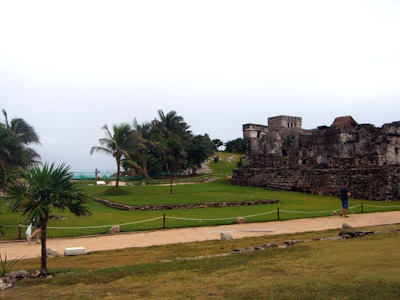
Nausea or not, the trip was worth it, even more so since I haven't seen ancient Mayan cities before. From the ruins of Tulum a beautiful view opens up to the sea

.
View of the sea from the ruins of Tulum, November 2007 View of the sea from the ruins of Tulum

It was there, according to our tour guide, that the Mayans of Tulum first saw the masts of Spanish ships over the horizon. (Or maybe our tour guide was dramatizing, as the ruins themselves weren't very dramatic, at least not in rainy weather.) And we all know what happened next. This adds a twinge of sadness to the beautiful view. Tulum survived only a few years after that. Actually, the tour guide said the Spaniards left Tulum alone, because there was no gold in it. The Spaniards had made their outpost in what is now Cuba, and raided various places along the Mexican coast, mostly looking for gold. But after the Spaniards conquered the Aztec emperor Montezuma, Tulum's days were numbered.

Then again I'm not sure if (a) I heard the guide correctly, and (b) he wasn't making things up. I later noticed some things our guide said were of dubious truthiness. (Like for example, that a certain restaurant at Tulum, run by his friend, had best margaritas in the world. I tried a margarita there, and it was decent, but I've had better in some places in Austin. Ditto for the food. Still, it wouldn't be right to go to Mexico and not have "authentic" Mexican food and drink, now would it?)

Here are more of my pictures from Tulum.

Thursday, November 15, 2007

Alexis Glynn Latner "Hurricane Moon": FACT reading group discussion

Alexis Glynn Latner "Hurricane Moon": FACT reading group discussion

10 people attended the discussion of Alexis Glynn Latner's debut novel "Hurricane Moon". 4 people have read Latner's short stories before. 7 people started the book, 4 of them finished. Some others didn't finish it because they got it too late. This book had not been in stores for long at the time of the discussion. Some of these people were planning to finish it, if for no other reason then because they know Alexis personally (she has been coming to ArmadilloCons for many years).

"Hurricane Moon" is a story of an interstellar mission to find a habitable planet for humans to colonize. Finding the right planet takes longer than expected, and having spent a thousand years in a stasis, the colonists wake up with significant gene damage. Unless the damage is somehow fixed, they'll be unable to procreate; hence, the mission will have failed. The only person capable of coming up with a way to fix the damage is Joe, a brilliant geneticist who is somewhat of a difficult character. The other protagonist is a ship doctor named Katharin. Joe and Katharin feel attracted to one another despite disagreeing on just about everything.

Readers quibbled with science and with romance

People's opinions on the romance thread varied. Two people commented that the book lost their interest when the courtship of the two main characters took the central stage. Some others said the romance wasn't done very well: it wasn't as sophisticated as, for example, the kind of romance you find in Lois Bujold novels. "Those two people seemed to forget they were scientists, they didn't behave like scientists," said a reader. Other readers argued that the love story didn't dominate the novel; this was still hard SF, not a romance novel with a spaceship thrown in. The love story was merely part of the character development.

Some people found quibbles with the science in the book. One reader said it's strange for an Analog writer like Alexis to have pools of anaerobic bacteria on the surface of the planet (where they are presumably exposed to oxygen). Then he thought the explanation why the plants on the planet were blue was scientifically infeasible. These two perceived errors ruined his enjoyment of the book so much he put it down. Regarding the blue color of the plants, another reader tried to convince him he misunderstood the explanation. Somebody also thought Alexis Glynn Latner played fast and loose with deceleration. The numbers didn't add up -- the engine didn't have enough power to slow the ship down over a short period of time.

The plot lost its focus in the second half

Others, including readers well-versed in science, did not see serious problems in that respect. They found the science plausible, and they liked how the book started out as a classical hard SF story. The decision making that went into selecting the right planet, the weighing of the risks -- to stay at the originally selected planet, even though it turned out to be much worse than expected, or to travel further in search for a more suitable planet and risk greater gene damage -- all of this caught their interest. However, some of those who were initially impressed, thought the story lost focus in the second half. When the crew settled on the planet, it seemed the author didn't always know what to do with them. A reader said: "I could tell it was the first really long thing Alexis has written, because the plot was in some places, OK, I don't know what I should do next, so let's let Joe (one of the two main characters, the brilliant geneticist) wonder around and get lost. It happened 2-3 times. One time I could have handled, but 2-3 times? And he's the only guy who can figure out how to fix the genome so that the people could reproduce? And they let him get lost? And the plot depends on him getting lost?"

It can make you ponder logistics of running an interstellar mission

There were other indications that the plot wasn't well thought out. One reader said: "I would have wished that they would have done more exploration of Green, Blue and the other planet, sending drones or something, before settling down. Particularly because Blue is in the title of the book. They never go there, and yet it's in the title." Another reader reminded him that the mission had only enough drones for one planet. This led to an observation that the expedition seemed rather poorly equipped. They only had 1 doctor and one person with training in first aid, which is rather strange for an expedition that has landed on an unknown planet. (Not counting, of course, hundreds of doctors and people of all specialties that were in the stasis, waiting for their turn to wake up -- perhaps decades after the first colonists have landed. Those people were "passengers", not the crew.) This led to an interesting discussion of what is an optimal crew composition for an expedition exploring an alien planet. One reader, after thinking about it for a while, concluded it was a rational idea to have just the absolute minimum of people awake until they determine who else they actualy need. Because the more people you wake up, the more demands you have on resources, and then it becomes a challenge to find out what combination of human resources you need to wake up in order to support all those additional people that have woken up.

So it seems there are readers in this group who have given more than a passing thought to the logistics of running an interstellar mission. They've also read enough books in this particular subgenre where you have a spaceship with colonists in a stasis. Despite the debatable flaws of logic, "Hurricane Moon" came out ahead of many books in this subgenre. It may sound like this discussion report focuses mostly on the negative, but actually a lot of people in the group liked it. I guess they just didn't make it very clear to me what exactly they liked it for.

Alexis Glynn Latner Alexis Glynn Latner at ArmadilloCon 2007

Or maybe they did, to some extent. They liked the culture, for example. The new culture the colonists are trying to build in this new world, the rituals they create, was seen as some of the more interesting things of the novel. One reader, though, was thrown off by the characters changing their last names, as it made it difficult for him to keep track of them. He also found the motivations of the colonists not very credible. Not just the motivations for taking on the names of their home cities ("if they are forever cut off from Earth, why are they holding on the geographical areas that have divided us for a long time?"), but also the fundamental reason for leaving the Earth. Several main characters seemed to be driven by the notion that the Earth society was too screwed up, so they had to go somewhere else to establish a better society. But the colonists are only human, and human society is not going to be all that much better elsewhere, the reader pointed out.

Overall, most readers thought all of these flaws could be attributed to this being Alexis Glynn Latner's first novel. They thought Latner had potential, and her subsequent books are bound to be better.

I wanted to like this book, because I have a weakness for hard SF, and because Alexis Glynn Latner is such a nice person, but I found it less than satisfactory for several reasons. The pacing is, to borrow a word from another FACT reading group member, a bit "pedestrian". From the time the mission lands on planet Green, nothing much science-fictional happens. There are no interesting scientific discoveries until the very end. Instead, the pages are filled with interpersonal drama.Even though the colonists in the end make two significant discoveries that challenge their assumptions about this planet, those discoveries play no part in solving the main problem they are facing -- healing the damage to their genes.

SPOILERS!

It is especially strange that the colonists conclude that the aliens made Blue what it is and put it there in orbit for religious purposes. It's hard to believe that a very advanced technological civilization would attach so much significance to religious symbols as to make an artifact of planetary proportions and put it in orbit. As an explanation of Blue's origin and purpose, it seems rather like a cop-out. It's almost as if scientists can't be bothered to seriously study Blue, so they conveniently label it a religious artifact, because then you don't have to explain anything -- who can begin to guess what the alien religion was like; whereas if you assumed there were good scientific, technological or political reasons for the Blue to be made what it is and placed where it is, you would have to continue to look for them.

END OF SPOILERS

When I pointed out that those discoveries play very little role in the story, one reader suggested that maybe their implications are left to be explored in a sequel.

Another way the resolution of the book was unsatisfactory is that the ending depends on a protagonist's psychological transformation rather than scientific / technical ingenuity. That's not what I would expect from a classic hard SF tale.

Sunday, November 11, 2007

Book review: Richard Matheson "I Am Legend"

I read this book as "homework" for the FACT reading group, but ended up not going to the discussion because I've been steamrolled by work. Regardless, here is my review.

To sum up my opinion, it's a good character study, but a bit lacking in originality, and certainly lacking in scientific credibility.

The story follows a guy who (believes he) is the last surviving human after the Earth has been overrun by vampires. A cover blurb says Matheson was a big influence to Stephen King, and I wonder if that was the reason this book gave me a continuous deja vu. Stephen King has dealt with apocalyptic scenarios in some of his books, as well as with supernatural horror, though I think he did a better job of these two genres.

I was intrigued not so much by a premise that the humankind has been wiped out by / transformed into vampires, as with the notion that you can make an entire novel out of the last survivor's experiences (a short novel, but still). If the protagonist is the only person left alive in the world, what is the book going to be about? Him living out his days and dying? That would hardly make an interesting story. Thus, to fill up those 171 pages, something unexpected has to happen. Was the protagonist wrong in his assumption that he was the last person on Earth? The story is in no rush to reveal it. As the story goes on, you start to wonder if you were wrong and this is really a book about a lonely guy living out his sad, meaningless existence in a world without a future. He starts out desperate and pathetic. He is devastated by the loss of his wife and daughter to the vampire plague, and even more so by the realization that he is doomed to be alone until the end of his life. Even so, he's focused on survival. Each day he swings between alcohol-fueled rage and a tenacious, clear-headed effort to do what he needs to do to make it through one more day. Matheson portrays the character's emotional state so vividly and movingly that not only I sympathized with the protagonist, but I also started to think, grudgingly, that even if nothing more happens to him, the book will still be interesting enough as a character study of the last survivor.

Then the story gets better still, as the guy overcomes his alcoholism and becomes determined to find a scientific explanation of the vampire plague. That was the part I could really identify with. His frustrations reminded me a lot of my days in graduate school, when I used to bang my head against particularly ornery projects, or even of my current bouts with writer's block, as I struggle to think my way out of plot dead ends.

Yet when he found an explanation, it was very disappointing -- to me, at least -- because it was so implausible. Even more implausible was that nobody found this answer before him. And he wasn't even a scientist by training! He was merely a smart guy who taught himself biology from textbooks. Even though the plague was fast and the humanity, including all "real" scientists, was gone in a matter of weeks, it's still not likely that the CDC and other experts did not have time to make the same discovery that this self-taught scientist eventually did. Science is not this book's strong suit. Also, the ending did not seem well thought out. Certain things happened for no good reason.

The rest of the stories in the book were even more Stephen King'ish in their spirit. Their dominant genre is supernatural horror. There isn't much science fiction in them. But the characters are vivid, and their situations resonated with me in ways that held my interest despite the fact that this isn't my genre.

Friday, November 02, 2007

Maker Faire, part 5: of techno-optimism and reconstructed fashion

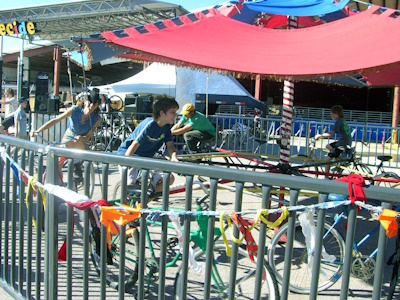
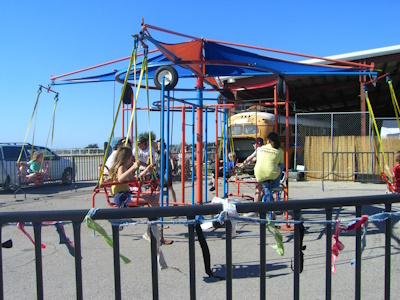
As one would expect at a faire, there were faire rides and merry-go-rounds. Supposedly they were all homemade? The amazing thing about them was that (I may be wrong on this) none of them ran on electric power. The ones I saw were all pedal-powered.

A bicycle merry-go-round at the Maker Faire 2007 A bicycle merry-go-round at the Maker Faire 2007
A pedal-powered fair ride at the Maker Faire 2007 A pedal-powered fair ride

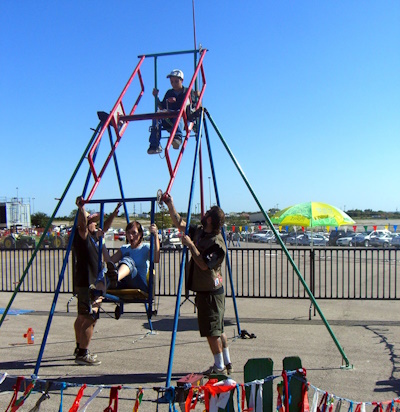
Sure, these merry-go-rounds were nothing like roller-coasters in industrial entertainment parks, but they also required more active participation on the rider's part than simply giving in to the centrifugal force. And some of them, like this circular see-saw, managed to frighten some riders. Apparently, pedaling was less trivial than they thought. It got me wondering, by the way -- do the riders all need to pedal synchronously, in phase and at the same speed? What happens if one of them slacks off or falls out of phase?

A pedal-powered circular see-saw in motion A pedal-powered circular see-saw in motion at the Maker Faire 2007

(I didn't go on any of the rides, I must say. I'm way too uncoordinated for that. One look at them makes me lose my balance.)

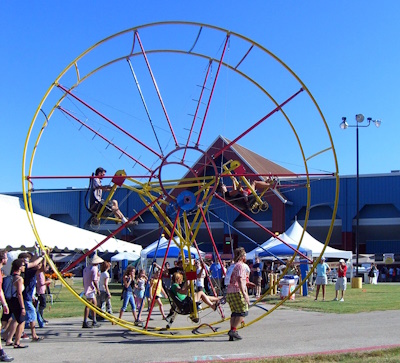
And this rolling wheel was just stunning, but I wasn't sure if it could move on its own, or if it needed to be pushed. In this picture, a bunch of people are pushing it, but maybe just because they need to help it up the hill?

A pedal-powered mini Ferris wheel A pedal-powered mini Ferris wheel at the Maker Faire 2007

More than anything else in this Faire, the merry-go-rounds and the modified cars left me optimistic in general about the ability of western civilization to survive the looming energy crisis. Oil may run out one day, but human ingenuity is under no such threat, it seems.

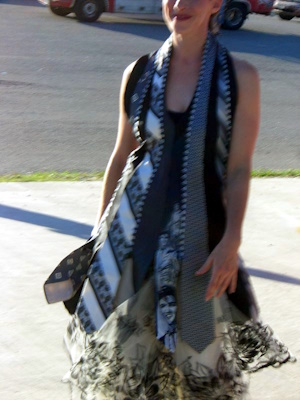
And then there was Swap-o-Rama-Rama, a two day event where you were supposed to be able to drop off your used clothing and be taught, or inspired, create new, reconstructed clothes out of stuff people dropped off. I didn't even stop by to check it out, because I knew it would ignite in me a temptation to start making clothes again. Sewing and knitting were my major hobbies in high school and college, but I abandoned them in favor of hobbies that hold a more profound appeal to me, such as writing. But I checked out their fashion show at the end of the day. They demonstrated clothes that were, IIRC, created during the day out of stuff people dropped off. Most of them were quite original. As I understand it, the creators of those clothes were actual fashion designers who specialize in "reconstructed" fashion. An ordinary person off the street, such as myself, would not likely have created something as good in just one day. But it was still interesting to see. Men's ties seemed to be a prominent sub-theme.

A dress made of ties and other recycled fabrics A dress made of ties and other recycled fabrics

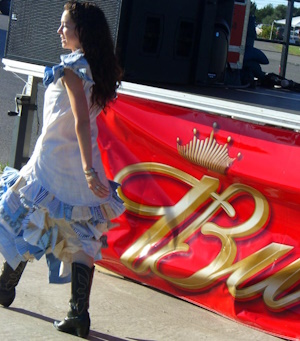
Several of the dresses shown at the fashion show were made out of ties. Well, it was good to see ties can be put to good use: I don't remember the last time I saw anyone wearing a tie according to its purpose.

A dress with a ruffle made of ties and other recycled fabrics A dress with a ruffle made of ties and other recycled fabrics

Tuesday, October 30, 2007

Maker Faire, part 4: art cars

Many cars and bicycles exhibited at the Maker Faire made you pause and rethink your definition of a car or a bicycle.

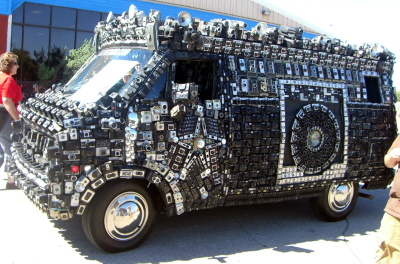
There was a morbid, but fascinating roach mobile; a van covered with cameras (http://www.cameravan.com); an assortment of electric cars.

Camera Van at the Maker Faire 2007 Camera Van at the Maker Faire 2007

Some of them were made by companies that plan to make money off of them, others by hobbyists as tongue-in-cheek projects. Some were converted from cars that run on gas. Some allowed you to look under the hood, others (most) had no hood at all.

Then there was a panoply of wonderful bicycles in shapes of butterflies, grasshoppers, and who-knows-what. I felt like I stepped off into a fairy tale world.

Saturday, October 27, 2007

Maker Faire, part 3

There was also some art where the point wasn't so easily found.

Tree of Secrets, dream recorder

An example of such a contraption was the Tree of Secrets, which was a cardboard tree with microphones hanging off of it. You could speak your secrets into those microphones, and they would get recorded. Then you could play them back. I think you could also listen to other people's secrets (thus making it a tree of no secrets, said S.) When the tree accumulates enough soundtracks, it starts mixing them up. I guess that was supposed to somehow make it more interesting.

Another example was a dream recorder (?) that looked like an old, rusty voltmeter from a high school physics lab. You put it near your bed, and record your dreams in the morning. "Record" is too ambitious a word, though, because the only thing you can do with it is press one of the two buttons: "good" or "bad". Also, if I remember correctly, it's connected to the internet, and the needle on its face shows you the proportion of people who are having good dreams versus bad dreams. (Or maybe my subconscious made up this part as it tried really hard to find some meaning in this project.) Even so, this kind of dream evaluation could be shared only by people who have identical dream recorders near their beds. But... how many of them are there? Isn't the dream recorder a one-of-a-kind thing, given that it was created by a graduate student as a course project?

Yes, both of these exhibits were created as course projects by students of a graduate program with some kind of... umm... trendy name, like Interactive Communications, or Interactive Media, or some such. S told me I wasn't supposed to see a point in these projects: they were Art. Period. I said it wasn't obvious to me that this program was primarily artistic rather than technical, as the name sounded slightly geeky. Well, S shamed me for looking for utility value in this art. Oh well. Yet I kinda felt sorry for those students. While I do remember having to do graduate course projects that seemed about as useful as shoveling sand from one pile to another (i.e. they did not involve original research, only reshuffling the existing data), I still think they were more meaningful than, say, making a tree of secrets. As I said, I'm not cut out to be an artist.

If you were curious what true randomness sounded like...

Along the same lines, I felt, was Kosmophone by Jerry Chamkis, a "musical" instrument that synthesizes sounds from gamma rays. This device measures frequency, wavelength, or energy (he said those things were interchangeable) of gamma rays that are hitting the Earth at all times, and a synthesizer "translates" those measurements into sounds. By the sound of it, gamma rays hit it at varying intervals averaging about once in a couple of seconds, so the device produces a steady ping-pong-pung of random notes at random intervals. This was the gist of the half-an-hour long talk by Jerry Chamkis. I actually figured out what it was doing after hearing the first 5-10 of these "musical" sounds. The rest were the details about how this instrument was made. I more or less slept through the details, but S was interested: his graduate studies in physics were all about chasing elementary particles, so he found some common ground with Chamkis. He had a chat with the creator of the Kosmophone about stuff like what materials you use to make a light-tight casing for your sensitive components.

The obvious -- and perhaps the only -- point of Kosmophone, as Chamkis readily admitted, was to give the listener an experience of true randomness. Try as they may, humans can't create truly random processes. But truly random processes do exist in nature, and spectral characteristics of gamma rays hitting the Earth are one of them. So, before I could open my mouth and say to S "this could make a really good random number generator on a computer", he turned to me and said the same thing. Then one guy in the audience said it out loud. Apparently all the computer geeks in the audience had the same thought. Chamkis replied that while that's true, it wouldn't be practical, because the rays hit the Earth way too infrequently. In computer applications -- mostly cryptography -- random numbers need to be generated much faster than a sequence of gamma rays would allow.

Screaming Babyhead, a robot band at the Maker Faire 2007 Screaming Babyhead, a robot band at the Maker Faire 2007

So, the projects demonstrated at the Maker Faire were a mixed bag. Which of course means there was a lot of good in it too. There were tons of robots, as I said before, but most of them had artistic rather than utilitarian value. For example: a robobabe/angel, or Marvin Niebuhr's Screaming Babyhead band of robots -- a very steampunky bunch of musicians. If they played any music, it must have been lost in the general din of the exhibit hall, as I couldn't hear anything.

Wednesday, October 24, 2007

Maker Faire, part 2

Maker Faire in bullet points:

Cute and practical: floating speakers, hidden in Mylar balloons.

Artsy and practical: Stop-Motion Armatures, poseable figures that can be photographed serially to create animation.

Pleo, a robot dinosaur pet Pleo, a robot dinosaur pet at the Maker Faire 2007

Artsy and geeky: thereping.

Geeky and cuddly: robotic dinosaur pets, named Pleo, that have a range of sentient-looking behaviors.

Geeky with a hard science edge: Stirling engines.

Quirky technology that has its uses: wood iPods.

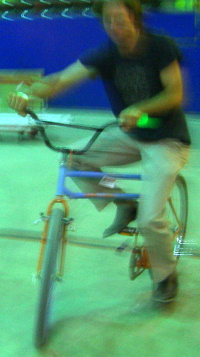
A person trying to ride a bicycle with a hinge in the middle A person trying to ride a bicycle with a hinge in the middle at the Maker Faire 2007

Quirky technology that's not useful for anything except to build your character through extreme frustration: bicycle with a hinge in the middle. "You really have to steer it two ways!" said a perplexed guy after making a few wobbly laps on this bicycle. Many people fell trying to ride it.

This peculiar item is in a category that's worth a separate article: quirky / art cars. And it will have a separate post! But first, some snarkiness. Coming up tomorrow.

And here are even more pictures from the Maker Faire 2007

Sunday, October 21, 2007

Maker Faire, part 1

Maker Faire is upon us! According to its website, it is a "two-day, family-friendly event that celebrates arts, crafts, engineering, science projects and the Do-It-Yourself (DIY) mindset". In my own words, I'll say only this: who needs Flipside when you have Maker Faire? It has a much higher concentration of quirky technology and art, it's in an air-conditioned building (part of it, anyway), and -- best of all -- there is no techno music!

The Do-It-Yourself stuff exhibited here ranges from technology to art to food (cooking is the DIY of food, right?), and the exhibits cover every category: from practical, to art-that's-actually-beautiful, to art-that's-kinda-pointless, to practical technology, to technology that has no value except quirk, to technology that has no point at all. Most of the technology demonstrated here only had value as an art piece, however. Or as a proof of concept. There were exceptions, of course. I will cover a bit of all of those categories in a few upcoming posts.

For starters, here is an example of DIY art that struck the sweet spot between beauty and utility like only a few projects at the Faire did: lampshades made of interlocking plastic pieces, here and here.

The overlapping area between art and technology was densely populated by robots created by our own local Robot Group. A robot that unexpectedly appealed to my girly side was Mechanical Flower, created by Denise Scioli and Ms. Puiyee "PY" Hung from the Robot Group. The flower's inner petals are made of a steamer insert, identical to the one I have at home. Mechanical Flower's steamer insert dances, opening and closing to the music, slow or fast.

Here is a video:

The tiny holes in the steamer insert create hypnotizing moving patterns when its "petals" open and close. What an exaltation of a mundane steamer! (To be sure, I don't see mine as mundane. For me it is one of the most beautiful household items I own. Its petalness (petality?) can easily inspire one to think of its potential uses for art. To non-artistic people, like me, this call is barely a passing whisper, but artistic people take things like this and incorporate them into their art projects.

Here are more of my blog posts and pictures about the Maker Faire.

Oh, one more important thing. Steve enjoyed this event as much as I did! It is very rare for him to like the same things I do. Hmm, what else is going on in Austin on a regular basis that resembles Maker Faire?

Sunday, October 14, 2007

An authentication scheme cooked up by a pointy-haired boss

There was this article in Washington Post that reminded me of a conversation I had with a friend via his blog about authentication questions, the kind you have to answer in order to login to online banking systems and such. In this post he pointed out that security questions based on users' wishes, preferences and hobbies were useless. (My, has it been almost a year? It feels like we had this conversation just yesterday.) Well, things have only gone downhill in the security world since then, if this article is any indication.

This Is Your Life*... *As Determined by Confounding Identity-Protection Safeguards

Old authentication systems, as imperfect as their questions were, at least allowed you to select a question and an answer that suited you best (or that was less useless to you than others). But how would you like an authentication system that does not even let you choose the questions? Instead, it asks you your biographical facts that you are "supposed" to know. For example, your great-grandmother's birthday. I wish it was a joke, but it isn't.

How does the authentication system know your great-grandmother's birthday in the first place? To quote the article, "unlike traditional shared knowledge authentications, in which the user picks the test and the answer and regurgitates it with each sign-on, Verid [the company that makes this uniquely egregious kind of authentication software -- E.] vacuums public records for factoids, then tosses them at the user at random."

The birthdays of long-gone relatives are not even the most obnoxious example of authentication questions. Others are, for example, "what was your high school mascot" or "the name of your homecoming queen". So what do you do if you come from a country like mine, where not only high schools don't have mascots or homecoming traditions, but the very concept of high school does not exist (all grades from from first to twelfth are taught under the same roof. You don't have to change schools when you transition from primary to secondary education.) Well, OK, a non-existent homecoming queen of a non-existent high school would not appear in public records, and would not serve as a basis for an authentication question. But if you dared to forget her majesty's name, you are screwed. :-)

The article does address the issue that some people's lives don't follow a typical middle class American route, thus some people don't have, or don't remember, the biographical facts enabling them to answer security questions. What the article does not address, is the invasion of privacy committed by a company that "vacuums up the public records" and collects all the knowledge about you, up to your great-grandparents' names and birthdays.

Only a pointy-haired boss could have come up with this kind of authentication scheme. I just hope that the company I work for -- which happens to write software for online banking -- never comes up with something like this.


The best quote from the article:

"Computers are like very dumb people, but they're very fast at being dumb," says Jason Hong, a professor at Carnegie Mellon's Human-Computer Interaction Institute (HCII).

Monday, October 08, 2007

Book review: Tales from the Secret City

I suppose I can't really call this post a book review, otherwise I would have to review each story in this anthology. And I'm not going to do that. So, call it what you will.

"Tales from the Secret City" is a collection of stories of various Austin science fiction and fantasy writers, many of who I've met personally. Many of them don't have a lot of publishing credentials; they are still trying to make their first sale (though some of them have already sold stories, even novels). So I had two good personal reasons for reading this book. I'm always curious to read the work of people I know, and I identify with aspiring writers.

The anthology turned out to be not bad, though I can't say any of the stories struck me as stunningly good. The overall quality i comparable to another anthology of stories by local SF writers -- "Cross Plains Universe" -- and the latter has been nominated for the World Fantasy Award!

It would be too tedious to comment on each story, so I'll mention just the one that was the most memorable to me. (Which is not to say it's the best -- this is just a reflection of my taste, nothing else.) It was "Nothing Personal" by Odessa Cole. Haven't most of us felt that our gadgets have conspired against us? Well, in this story they actually do. Normally, I'm not too fond of technological dystopias, but this tale of a guy trapped in a hell of "smart technology" appealed to me for unusual reasons. Suspecting that his "smart card" deliberately lies to him about his finances, he spends the rest of the story troubleshooting it. This story devotes an amount of loving detail to the troubleshooting process you can't expect from any real-life tech support person.

There is a term "gadget fetish", but I don't think I've ever heard a term "debugging fetish". But if you have the latter, you'll find this story really sexy.

Well, I can't say I always get my kicks out of debugging things. There are lots of technologies out there I wouldn't approach with a ten-foot pole, as their complexity simultaneously scares and bores me. And yet, once I get deeply into something, I do get a thrill out of troubleshooting it. And that's the part of me this story indulged.

Wednesday, October 03, 2007

James Morrow "The Last Witchfinder": FACT reading group discussion

James Morrow "The Last Witchfinder": FACT reading group discussion

Another review of a book by James Morrow!

Everybody started "The Last Witchfinder" by James Morrow. Half of the people finished it. Everybody but one person read James Morrow before. The novel chronicles the life of Jennet Sterne, a fictional 17th century woman. After her beloved aunt and mentor is accused of witchcraft and executed, the 12-year-old Jennet decides to make it her life mission to put an end to witch trials. For that she needs to come up with an incontrovertible argument that would convince everybody that the notion of witchcraft is absurd and impossible. She devotes her life to this grand task, and it takes her on many interesting, even improbable adventures.

Everybody said the book was beautifully written. The prose was full of archaic turns of phrase, yet it didn't seem stilted or artificial. I personally was amazed that the characters' speech consistently sounded like it really could have been spoken three centuries ago. It must have taken some effort for a writer to maintain this prose style throughout a 500+-page-long novel!

The book too realistic for some people

Nonetheless, a few people commented that the book was very easy to put down. It is written in a picaresque form, which is uncommon nowadays, and it may distance a reader from the characters, so that it's difficult to get engrossed in a page-turning way in a book. Some readers admitted having wanted something a bit more escapist at the moment, so they did not continue. One reader said he could not enjoy the story, as good as it was, because it was too realistic. While appreciating the beautiful prose and the philosophical depth of the novel, he "could not forgive" James Morrow for torturing the reader. "I cared about the characters and I really feared for what was going to happen to them. I really figured he was going to kill [the protagonist]. [...] I know a little bit about witchhunting, and just the knowledge of pennyroyal for birth control was sufficient to be tried as a witch. Just herbal practices. There is an estimate that "Malleus Maleficarum" (the witchhunters' handbook) cost the lives from 600,000 to 9 million people. In Europe there were at least 40,000 documented witch trial cases in 5 years. It was unpleasant reality. This book was unpleasant for that reason. It was so hideous. I read SF to escape. If I wanted to find [about real-life horrors], I would turn on the news. [...] It's not that it wasn't well written, I just didn't want to be there, I didn't want to experience this." (Despite that, he read through the end.)

On the other hand, another reader found the witch trial scenes funny at the beginning; a scene where a accused witch is being "floated" even reminded him of Monty Python. However, as he realized the witchhunting specifics described in this book were historically accurate, he started to find them a little disturbing.

I myself admit I found this book very disturbing and emotionally harrowing. It was hard to read about a brave, admirable heroine who risks everything, including her life, for an improbable cause. I was pretty sure that the forces she was up against were going to kill her. I even had to look to the end of the book to see how it turns out, something I almost never do. However, the fast pace of the book kept me engaged. There were a few of us who found the story riveting and did not want to put the book down.

A discussion of the book's philosophical themes

It wasn't just the adventures that kept people absorbed in the book, but first and foremost its philosophical themes. One reader has a special interest in the time period the book is set in, the era when Newton made his great discoveries. He has read biographies of many members of the Royal Society, the salient points of which he generously shared with us. I myself was intrigued by the Newton era when I read Neal Stephenson's "Quicksilver", but in my humble opinion, James Morrow did a better job portraying this historical period than Neal Stephenson. At the very least, I think James Morrow shows us very convincingly how the principles of scientific inquiry came into being -- something "Quicksilver" doesn't do as well.

What is the significance of the book-writing-a-book device?

The narrative in "The Last Witchfinder" is contained in an unusual framing device. The story is presented as if written by another book, Newton's "Principia Mathematica". Interspersed with the main story are Principia's personal reflections. We learn from them that Newton's masterpiece is engaged in a centuries-long war with "Malleus Maleficarum", in which each book tries to destroy the existing copies of the other, sometimes resorting to comical measures, such as sending troops of insects to eat the enemy's volumes. "Principia Mathematica" also admits it's been in love with Jennet ever since it laid eyes on her. One reader said she found those confessions of love very tender, but very weird; and another reader countered: "Hey, people love books -- why shouldn't a book love a person!" The notion of a book as a sentient being and an author of another book is probably the only science-fictional element in "The Last Witchfinder". But even then, it is only a framing device. Other than that, readers noted, the only way "The Last Witchfinder" could fit within the SF/F genre is it if were put it in a "secret history" niche subgenre.

But the book-writing-a-book device isn't merely for grins; in fact, it inspired some of the more interesting discussions in the reading group. One reader wondered, why was this framing device was needed at all? Perhaps because Morrow was trying to make a point that books have lives independent of what their authors intended? He said: "When an author releases the work into a literary world, the author can't say what it means anymore. It means what it means to the reader. Newton's "Principia Mathematica" feels very strongly about the demon hypothesis, even if Newton didn't. And I think Morrow is quite correct that the character's conclusion that Newton's Principia is the death knell of demon's hypothesis is quite true, even though Newton didn't see it that way."

Indeed, Jennet got out of "Principia Mathematica" more than Newton intended: it prompted her to establish the principle of "sufficiency of the world" -- the idea that phenomena of the world can be sufficiently explained by the natural world itself, without resorting to demons and the supernatural.
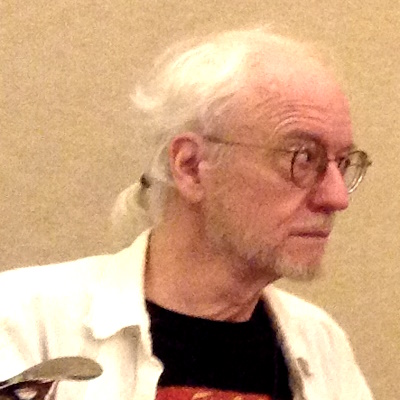
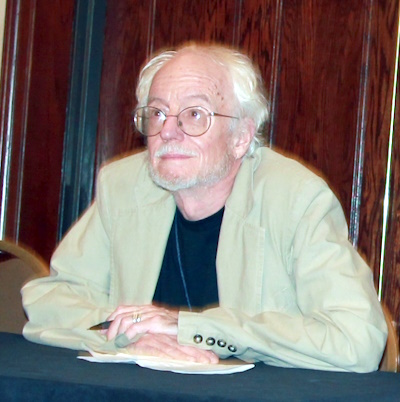
James Morrow being interviewed at ArmadilloCon 2015 James Morrow being interviewed at ArmadilloCon 2015, a speculative fiction convention in Austin, Texas

As for me, I thought the concept of a book as a conscious entity was simply meant to underscore the importance of wars of ideas that have been going on for... well, for as long as there have been ideas. One reader speculated that the war between rationalism and superstition did not die off in the age of Enlightenment; quite the opposite, it intensified. "Witchhunts began to happen in Renaissance, at a time in human history when we got a greater command of the physical world," he said. "I've long been convinced that religious fundamentalism is a product of Enlightenment, not a reaction to the Enlightenment. Because it was then that we started to take the world literally enough, not as a collection of metaphors. Then we started taking those commands about not suffering a witch to live literally. At the same time, Newton's view of the world really did destroy that."

Regardless of the reasons why James Morrow chose to make "Principia Mathematica" a sentient being, many people in this group are no strangers to a feeling that books have lives of their own. One reader said she had this point made very clear to her at one time during her college days. She was taking a tour of the restricted rooms of her university library. One of those rooms contained one of the early editions of "Principia Mathematica". Suddenly she realized that book was worth more than her life, because in case of fire, the room where the book was would be filled with flame retardant gas, which would kill her.

The protagonist too modern to be realistic... or is she?

A couple of us thought Jennet, while a very admirable and brave character, was a bit too unrealistic for a 17th century woman. She was very independent, treated men as equal and expected to be treated as equal by them. Her notions about women's place in the society were those of a 21st century woman. We found it unlikely that she, as well as her mentor, aunt Isobel, could have been brought up with such modern attitudes, and that they were completely unaffected by expectations of submissiveness and passivity that were beaten into many of their contemporary women. However, one reader, who is better familiar with that time period, said there were a lot of very educated women in the 1600s and 1700s, who wrote books, even very technical books. So while such women were unusual, it's not like they didn't exist.

Personally I have to say I liked "The Last Witchfinder" very much, both because of its beautiful prose and because of its themes: heroism, going against the dominant system of beliefs, trying to single-handedly right monstrous wrongs while pursuing scientific understanding. I think I would have liked this novel just for that, even if it wasn't so well written, even if storytelling wasn't so engaging. But since it has those other qualities too, this book is a real gem. I have only read two books by James Morrow so far, but I think he's going to be my Favorite Writer Of The Year. (Last year's title went to Robert Charles Wilson.)
Friday, September 21, 2007

James Morrow "Towing Jehovah": CFI book club discussion

4 people attended a Center For Inquiry book group discussion of James Morrow "Towing Jehovah". 3 of them liked it, one not so much.

Unexpectedly to myself, I liked this novel very much. This book was first recommended to me by a guy in the Atheist Community of Austin. When he told me about the book's premise -- God dies, falls to Earth, and his 2-mile-long body needs to be towed -- I thought it was absurd. He said, yes, but it's very good and very funny.

I am cautious of stories based on absurd premises. Too often they are simply incoherent, as if the author thought that absurdity alone makes a story funny, or that it is a good substitution for satire. This wasn't the case with "Towing Jehovah". Even though the premise patently doesn't make sense to either atheists or believers (only a vanishingly small minority of the latter believe that God has a physical body), the plot develops completely logically, and all of the major characters behave rationally in the bizarre circumstances. When I picked it up, little did I know how much I will enjoy it.

Lots of funny ideas

But not everybody in the CFI book club thought this book was great. One reader felt that while "Towing Jehovah" had a few funny ideas, it "didn't jell". There were plenty of comical moments, like the Pope watching big screen videos of Bing Crosby; or the whole subplot with World War II re-enactors. Or the scenes that give us an appreciation of how humongous God's body was. The mechanics of attaching chains to the eardrums in order to tow the body. Or driving the Jeep into God's bellybutton. Or individual hairs thick enough to tie things to. Or being underwater and swimming into a divine ear with scuba gear. (I would say those scenes were extremely gross, and just as fascinating. Overall, this book does not shy from the gross. It examines it in loving detail, even. If you think an up-close scrutiny of pores the size of moon craters is repulsive, just wait to see what happens when the ship gets stuck on the shallows near the coast of an uninhabited island.)

Some characters' motivations were hard to understand

So overall, one reader thought "Towing Jehovah" had lots of interesting little ideas, but overall didn't quite jell. "In the end," he said, "I was wondering, what was it all about"? He also did not quite buy Cassie and Oliver's reasons for wanting to destroy God's body. Cassie supposedly wanted to get rid of it because, as an arch-feminist, she was afraid that a discovery of God's body by the general public would plunge the world into the new Dark Ages. This reasoning sounded somewhat flimsy to this reader. If God was dead, wouldn't it be logical to show it to the world, so that they would know they were wrong in their belief? The ironic thing is, a discovery of a dead god did not serve either Christians or atheists. The former would find out they were right before, because God really did exist, but they are wrong now; the latter would be right, but not for reasons they thought.

James Morrow at ArmadilloCon 2015 James Morrow at ArmadilloCon 2015, a speculative fiction convention in Austin, Texas

A reader also noted that the lighthearted farcical tone of the book was inconsistent with certain tragic moments scattered throughout the book, where people die or getting seriously injured in ways that are not funny at all.

Satire equally directed towards believers and non-believers

Other people enjoyed the satire in the book. They appreciated that it was directed not just towards religion, but towards atheism in equal measure. Readers recognized some aspects of groups like CFI in the fictional Enlightenment League, and admitted that the barbs pointed at it were pretty accurate. "Despite having a lot of money, the Enlightenment League is pretty ineffective, and what they mostly do is pranks, silly stuff", a reader said.

An interesting dialogue between those groups

While this book is written from an atheist perspective, it is notable that the author does not side with militant atheists. Rather, he lets the three main characters -- the Jesuit priest, the religion-neutral captain, and the atheist Cassie -- have a conversation about God and related matters. One reader said their discussions were one of the enjoyable points of the book. "I thought the priest was interesting, reasonable, the professor. And the captain was interesting too. To me he represented the moderate middle. He wasn't willing to say the didn't believe in God, but he wasn't religious by any means. And then the atheist coming in... I liked the interplay between these 3 individuals, and the way they discussed their beliefs, and that it didn't degrade into awful fighting," she said.

Sympathetic characters and a humanist message

The protagonist, captain Van Horn, who was commissioned to tow the God's body, is probably the most sympathetic character of the book. He has his own deeply felt reasons for wanting to deliver the God's body to its final resting place in the Arctic. They originate in his unfulfilling relationship with his father, a relationship he is still trying and failing to heal. Too many works of satire have left me feeling empty, because there weren't any characters to root for, but this clearly isn't the case here: there are several characters one can easily identify with.

This novel does an excellent job of delivering a humanist message. I really like how it demonstrates the point that whether God existed or not, the civilization would be no different. In the absence of a basis for religion, society is held together by human social and moral norms, which remain the same. The ship crew's brief experiment with giving up those norms ends as a disaster to all of them, and the social order is restored by people's need to cooperate for the sake of their own survival.

Monday, September 17, 2007

eBay as a giant museum

Many words have been spilled on Web 2.0 and how it's supposed to change the world -- from Pulitzer prize-winning pundits to rank-and-file bloggers, everybody seems to have weighed in. Still I haven't read many observations as sharp or fresh as this one from William Gibson. This quote is from William Gibson's interview in Washington Post. Yes, this article is a couple of weeks old, but, as I mentioned before, I'm a leisurely blogger, not a professional one. :-)

"Google is the piece de resistance of weird [stuff] finding," he says. "One of the things I've been doing in the eBay era -- I've become a really keen observer of the rationalization of the world's attic. Every class of human artifact is being sorted and rationalized by this economically driven machine that constantly turns it over and brings it to a higher level of searchability. . . . The tentacles of that operation extend into every flea market and thrift shop and basement and attic in the world. . . .

"Every hair is being numbered -- eBay has every grain of sand. EBay is serving this very, very powerful function which nobody ever intended for it. EBay in the hands of humanity is sorting every last Dick Tracy wrist radio cereal premium sticker that ever existed. It's like some sort of vast unconscious curatorial movement. (emphasis mine -- E.)

"Every toy I had as a child that haunted me, I've been able to see on eBay. [...]

"This is new. People in really small towns can become world-class connoisseurs of something via eBay and Google. This didn't used to be possible. If you are sufficiently obsessive and diligent, you can be a little kid in some town in the backwoods of Tennessee and the world's premier info-monster about some tiny obscure area of stuff. That used to require a city. It no longer does."


The whole article can be found here.

I think I may lobby the FACT reading group coordinator to put Gibson's new book, "Spook Country" on the FACT group candidate list. Even though FACT group on the average didn't like Gibson's earlier novel, "Pattern Recognition", I am quite intrigued by Gibson's perspective.

Tuesday, September 11, 2007

LoneStaRG 9

On Labor Day weekend, envious of all those cool people who were either at the WorldCon or at the Burning Man, I had to console myself by going to LoneStaRG, a Mensa regional gathering. I spent half a day there (out of 4 possible total). That was about the right amount of time. There were very few costumes at this year's LoneStaRG, and overall it just wasn't as lively as last year. But our air conditioning at home had gone out that weekend, and LoneStaRG seemed as good a place as any to go to recover from the heat.

When Mensans get together, their collective IQ sometimes takes a hit

I overheard a few funny stories at the LoneStaRG. Somebody said he received an offer for a credit card, co-branded by Mensa, with an 24.99% APR. "Whoever Mensa sold members' addresses to, clearly didn't have a good idea who they were dealing with", said the "lucky" recipient of the offer. Because you know, Mensans are way too ridiculously smart to fall for something like that.

Or are they? I got contradictory impressions of the people at the gathering. Many of them are individually as smart as advertised, and quirky enough to make you scratch your head (in a good way). But... when they get together, it sometimes looks like their collective IQ takes a hit.

You get discussions where 30 people sit around and re-hash the obvious. For example, they may devote 15 minutes to stating and re-stating the idea that symbols in general, and brands specifically, serve as shortcuts for people to make decisions about the world. A symbol stands for something; hence, seeing a symbol, a person makes a rapid decision without having to analyze the phenomenon. So what else is new? Everyone is in violent agreement, and no one offers a different perspective. I don't know about all the group discussions at LoneStaRG, but this one discussion I'm thinking about was very much like this.

So, the quality of group discussions seemed less than the sum of the quality of their contributing minds. But the individual people were often funny.

Stories too good to be true

Somebody told the story of a guy who figured out a unique way to bring his shoes into a foreign country. You see, he found it impossible to buy shoes in his size (13) in that country. No stores had them. He brought some footwear from the US, but when it wore out, he was left in a quandary. He could ask his friends in the US to send him shoes, but then he would have to pay exorbitant tarifs imposed on foreign goods. So he asked friends to mail him two separate packages containing a single shoe each. His host country's customs officers didn't know what to make of a package containing a single shoe, so they let him have it without imposing a tariff. Whether that's believable or not, I can't tell. It sounds a bit too much like one of those apocryphal tales of out-of-the-box thinking, that management books are rife with.

Don Baker's talk on Universal Darwinism

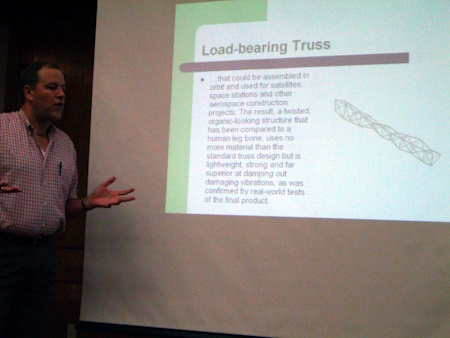
One of the more interesting things at the LoneStaRG was ACA's own Don Baker's presentation "Universal Darwinism: How Computer Science has Validated the Theory of Evolution". It can be summed up in a few sentences thus. Computer simulations can help to study evolution, which is hard to study otherwise, because it occurs very slowly in nature. The benefit flows both ways: the principles of evolution applied to computer science have lead to creation of a class of algorithms called genetic algorithms. I have to admit, I've already heard or read most of the points mentioned in his talk (as is more and more often the case with public science lectures I go to. Is that a downside of ed-joo-ma-cating myself, or what? But it was neat to see them summed up all in one place. The most interesting part of the talk were examples of designs that genetic algorithms have come up with, such as the hemispherical coverage antenna, and the load-bearing truss.

Hemispherical coverage antenna - Don Baker lecture on Universal Darwinism, September 2007 Hemispherical coverage antenna - Don Baker lecture on Universal Darwinism
Load-bearing truss - Don Baker lecture on Universal Darwinism, September 2007 Load-bearing truss - Don Baker lecture on Universal Darwinism
As Don noted, some of those designs seem really non-intuitive; they don't look like anything a human designer could have come up with, but their superiority was confirmed in real-world tests.

Monday, September 10, 2007

Odds are stacked against myth debunkers

Here is an interesting article I've read recently. It has depressing implications for Center Of Inquiry and I guess everyone who would like to see the world thinking more rationally.

Persistence of Myths Could Alter Public Policy Approach

Some highlights from the article:

The conventional response to myths and urban legends is to counter bad information with accurate information. But the new psychological studies show that denials and clarifications, for all their intuitive appeal, can paradoxically contribute to the resiliency of popular myths.

[...]

The research also highlights the disturbing reality that once an idea has been implanted in people's minds, it can be difficult to dislodge. Denials inherently require repeating the bad information, which may be one reason they can paradoxically reinforce it.

Indeed, repetition seems to be a key culprit. Things that are repeated often become more accessible in memory, and one of the brain's subconscious rules of thumb is that easily recalled things are true.


But silently ignoring the lies isn't any better, the article says:

So is silence the best way to deal with myths? Unfortunately, the answer to that question also seems to be no.

Another recent study found that when accusations or assertions are met with silence, they are more likely to feel true, said Peter Kim, an organizational psychologist at the University of Southern California. He published his study in the Journal of Applied Psychology.


The article ends with this pessimistic conclusion:

Myth-busters, in other words, have the odds against them.


It really makes you wonder if humanity is doomed to live in perpetual ignorance (and I know a lot of people would answer with a resounding "yes"! ;-() How did people ever stop believing, for example, that whispering incantations or casting an evil glance on someone can cause a person to fall ill? Actually, it may be too optimistic to say people stopped believing it. :-) There are plenty of people who still do, even these days. But at least the majority doesn't... I would hope. Or, OK, at least the majority doesn't think it's a valid reason to accuse someone of casting spells and burn them at a stake. So how did the humankind ever moved beyond these superstitions? Well, this question runs central to a James Morrow novel "The Last Witchfinder". The novel is about one woman's lifelong quest to banish not just the trials and executions of witches, but the very notion of witchery. We discussed this book in the FACT book club, and it lead to some interesting philosophical debates. I will post the report of the discussion in the next few weeks.

Sunday, September 02, 2007

Authors and the fans who love them: maybe a little too much: an ArmadilloCon 2007 panel

This is my last post from this year's ArmadilloCon. The topic is a problem many of us wish we had. :-)

Authors and the fans who love them: maybe a little too much

Description in the program book: Ever wonder why your favorite author looks a little scared when they see you? The panelists will talk about the tale-tell signs of a stalker and tell amusing stories about what has happened to them in the past. (For instance, did they call you at home during a baseball game?)

Since the stories told on this panel were a bit personal in nature, the panelists' names were omitted. The stories weren't so much about real stalking anyway, as about weird encounters between writers and their fans.

Tips on how to properly stalk a writer


Unconventional gestures of admiration


A writer who lied to a priest


Guests Of Honor with unusual demands


The whole article can be found on my web site.

By the way, one of these authors said the most persistent stalkers are writing students. "The first line of a panel on writing in conventions is populated by intense looking young men with laptops, and after the panel they'll follow you around wherever you go." I would fit that profile very well, except for not being a man (or, ahem, young :-)) because I do often sit in a front row with a laptop and type away furiously. But I swear I had not followed anyone around at any convention. :-)

Friday, August 24, 2007

ArmadilloCon: my first experience as a moderator

... on the "That's a FACT" panel.

It wasn't bad. It was just as I expected. It was made easier by the fact that there were only about 6 people in the audience. Which was also as I expected. :-) Two of those people were not even from Austin, but from places like Minneapolis, so I'm not sure what they were hoping to get out of this panel. I could fantasize that they came to hear advice about running a science fiction reading group, so that they could start one in the place where they live, but I think it's more likely that they were just killing time on Sunday afternoon before their flight home. :-)

According to the program, the panelists were supposed to "...go over the books they have read over the past year letting you know which ones got a thumbs up and which ones were stinkers. They will also talk about how you can join the bi-weekly reading group." We followed these instructions to the letter. :-) As a moderator, I made a list of books that received the best reception with the FACT reading group, and wrote it on a whiteboard. We briefly talked about each of those books, as well as the "stinkers".

The FACT reading group holds power over authors' careers :-)


AT, the reading group coordinator (who wasn't supposed to be on the panel, but joined us halfway into the panel -- the game of Pictionary ended prematurely :-)) told an amusing anecdote about a time when a certain author received an especially bad reception with the reading group. She called AT during the meeting so that the readers could ask her questions about her book, in case they needed her to clarify something. However, people were so unimpressed by her novel that they couldn't think of questions to ask. They unanimously decided that this author didn't know anything about the three main elements of her book: private investigators, Catholic church, or the internet. According to AT, a highly negative review of her book on the FACT reading group website kept her from selling her subsequent novels, and she had to start writing under a pseudonym.

The thumbs-up list


And here is the list of the thumbs-up books. (I won't post the list of the stinkers, because I've already critiqued them in separate posts on my blog, and I don't want to dwell on the negative. :-))

John Moore "Bad Prince Charlie" -- a light, humorous urban fantasy everybody liked

Terry Pratchett "Going Postal"

Jasper Fforde "The Big Over Easy"

Charles Stross "Family Trade", "Atrocity Archives"

Naomi Novik "Her Majesty's Dragon"

John Scalzi "Old Man's War"

Cordwainer Smith "We The Underpeople"

Stanislaw Lem "Cyberiad"

Vernor Vinge "Rainbows End"

Tuesday, August 21, 2007

Center For Inquiry presence at ArmadilloCon

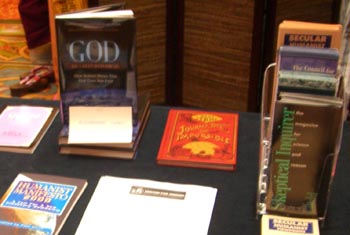
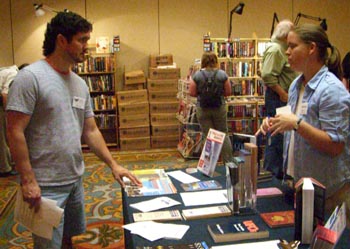
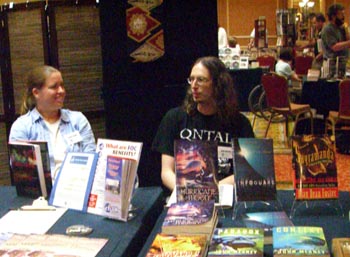
At this ArmadilloCon I spent a substantial amount of time in the dealer room -- on the dealers' side of the table! I was volunteering at the Center For Inquiry table. We would grab the passers-by by their sleeves and proselytize to them our doctrine of freethought and rationalist mindset. No, I'm kidding. We did not try to engage anyone in the conversation against their own will. And the nature of materials on the CFI table -- books and booklets on freethought, skepticism and humanism -- indeed had an ability to make some people uncomfortable. Jenni (the person who coordinated the CFI activities at the ArmadilloCon, and who spent quite a few hours at the table) observed more than one person scurrying away after taking one look at the titles of books on our table.

CFI booth at ArmadilloCon 2007 CFI booth at ArmadilloCon 2007

Still, some other people struck up conversations with us. Long ones, sometimes. I guess that compensated somewhat for their scarcity. One guy argued that religious fundamentalism is losing its strength and is on the way to extinction, at least in the US if not worldwide. We pointed out there were a lot of signs to the contrary, such as (to take the most obvious example) encroachment on abortion rights.Then he started a long discussion on why the recently passed laws to curtail abortion rights in several states aren't really important. Since I stay away from politics in this blog, I'll say no more, but it suffices to say it was an interesting discussion. It could have gone on even longer, but at some point we were joined by a woman who brought a different perspective to the discussion. She teaches at a university, and in the last few years she has had hard time with some students who demand that she bring a religious perspective into the classroom. I don't remember the exact way she phrased it, but I think she was saying some students want her to address the subjects she teaches from a biblical perspective. They are a minority, but a vocal one, and they have gotten increasingly louder over the years.

By joining our discussion, she drew the guy's argumentative zeal towards herself, and soon they drifted off into the crowd where they continued their agitated debate.

Jenni talks with Matt Cardin Jenni talks with Matt Cardin

We also had a handful of people sign up for the CFI email list. Another thing we did -- with less than stellar results -- was sell books. All the books were from Pyr, a publishing house that has a close relationship to CFI. They sent us a shipment of science fiction and popular science books at a discount, so we could, in theory, make a profit selling them... but we sold only about 7 books throughout the entire weekend. The dealers' room was teeming with booksellers, and the competition was stiff.

Center For Inquiry volunteers at ArmadilloCon 2007 Center For Inquiry volunteers at ArmadilloCon 2007

I can't say if participation in ArmadilloCon was really beneficial to CFI in terms of attracting new members, but I personally had a nice time sitting at the table and chatting with some people (mostly with fellow volunteers, and sometimes with other congoers who wandered by).

Here are more of my pictures and blog posts from ArmadilloCon 2007.

Sunday, August 19, 2007

Create a World: an ArmadilloCon 2007 panel

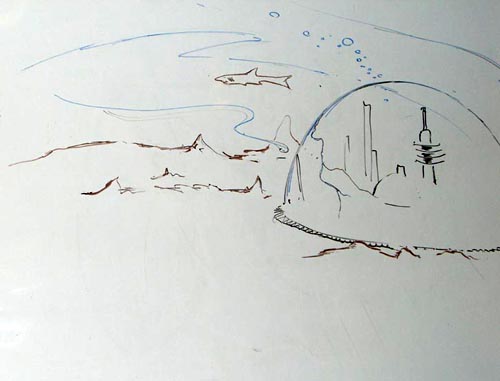
Every ArmadilloCon has a world-building panel, where the panelists and the audience "create" a science-fictional or fantasy world by collective brainstorming. Artist R. Cat Conrad often participates by drawing scenes from this world on a whiteboard.

For starters, the panelists and the audience decide by voting: are they building a science fiction or a fantasy world? The audience is almost equally split between the two, but, but science fiction prevails by a small margin.

The submerged city under a dome of a force field

To keep the scope of the task manageable, we'll focus on one city in this world we are building. The city is half-submerged in water. Or it maybe be fully submerged and exist under a dome of a force field. What kind of inhabitants will it have? What kind of conflicts will arise in this society? They may arise from the different species' fight for dominance, or natural cataclysms. What kind of religion will they have, and what part will it play in the conflict? What myths will this society tell itself? And finally, some silly touches.

The whole article can be found on my web site.

Here are more of my pictures and blog posts from ArmadilloCon 2007.

Tuesday, August 14, 2007

What I Should Have Read This Year: an ArmadilloCon 2007 panel

I've noticed over the years that some of the "What I Should Have Read" panelists have tastes so unlike mine, it's as if we are from different planets. (It's different people each year, by the way.) For example, some people's idea of good science fiction is a Sherlock Holmes-type detective story with time travel, as you'll see further in the text. I'm sure a time-travelling Sherlock Holmes can be done very well, but... I've already read the original Sherlock Holmes, so why would I want to read the same story again? I read science fiction for something new, although it becomes increasingly harder to find. But the moment I truly realized I landed on a wrong planet came when I listed to Rick Klaw praising a comic book "I shall destroy all the civilized planets" by Flether Hanks. (More about it behind the cut). I sat there thinking, well, I'm not against weird, but I would never read SF just for that. Even the weird needs to have logic.

I found it a bit comical that while the panelists praised obscure, bizarre books like the one mentioned above, they had hardly anything to say on this year's Hugo nominees. A person in the audience asked which of this year's Hugo nominees they would recommend most highly, and Willie admitted he drew a blank on who the nominees were. Jessica Reisman corrected the situation somewhat by recommending "Blindsight" by Peter Watts.

Without further ado, here is the list of the recommended books.

Some of this year's must-read books garnered nominations from more than one panelist, and we shall start with them.

Books recommended by 2 people:

Two-handed Engine, a Henry Kuttner story collection. Joe Lansdale says: "Kuttner is one of the best SF writers, although he's a better short story writer than a novelist. The reason Kuttner still survives is because he's a damn good writer. Ideas, charcters, writing -- he's got all that."

"Thirteen" by Richard Morgan

Books recommended by 1 person:

Rick Klaw and Jessica Reisman at ArmadilloCon 2007 Rick Klaw and Jessica Reisman.

Here is the list of Willie's recommended science fiction books (each title is followed by Willie's short comment):

Brasyl by Ian McDonald -- In McDonald's "River Of Gods" it was India taking over the Universe, now he's doing Brazil taking over the universe.

The Prefect by Alastair Reynolds -- a quintessential space opera.

Execution Channel by Ken MacLeod -- an almost mainstream thriller that has pretty amazing stuff in it.

Mainspring by Jay Lake -- trying to imagine a world where Newtonian clockwork idea is in fact true, and where the world is composed of springs.

The Yiddish Policemen's Union by Michael Chabon -- alternate history.

Hurricane Moon by Alexis Glynn Latner

Here is the list of Willie's recommended fantasy books (each title is followed by Willie's short comment):

Un Lun Dun by China Mieville -- the villain is amazing.

Renegade's Magic by Robin Hobb -- a conclusion to her current series.

Heart Shaped Box by Joe Hill -- Stephen King's son who writes under a pseudonym.

Interworld by Neil Gaiman and Michael Reaves

Reaper's Gale by Steven Erikson

Ysabel -- Guy Gavriel Kay

Legacy -- Lois Bujold

Here are books recommended by CJ Mills. (All of these books were more than a year old.)

The Prodigal Troll by Charles Coleman Finlay

The Terrorists of Irustan and The Maquisarde by Louise Marley

Anansi Boys by Neil Gaiman

Books recommended by Joe Lansdale

Pearls from Peoria and The Best of Philip Jose Farmer: story collections by Phil Jose Farmer.

Books recommended by Jessica Reisman:

Territoryby Emma Bull -- alternative history.

Precious Dragon by Liz Williams

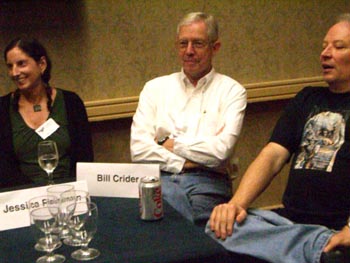
Jessica Reisman, Bill Crider and Joe Lansdale at ArmadilloCon 2007 Jessica Reisman, Bill Crider and Joe Lansdale.

Books recommended by Rick Klaw:

Fast Forward 1, edited by Lou Anders -- a pretty incredible anthology. It's got an incredible Robert Charles Wilson story. There's also a story by Tony Balantyne about a world operating system, infected by a virus.

Acacia by David Durham. It's a violent fantasy with no magic. It's closer to George R. R. Martin, not to Lord of the Rings.

Michael Moorcock's detective stories -- they essentially Sherlock Holmes stories. They go to plaes you would never expect.

I Shall Destroy All the Civilized Planets: the Comics of Fletcher Hanks. Rick Klaw says: "You have these cosmic power shadow charaters who would punish people for doing the wrong things. They would freeze people's heads, they would dissect them. There is a guy there with flaming hands who goes around killing people."

Or -- and I'm not sure I got this right -- there are people who want to kill everyone on Earth except themselves, so they tie themselves to Earth and spin up the Earth so that everyone would fly off of it. The last idea sounded so absurd that I really don't know if I got it right. At that point I just sat there thinking, well... this panel is going to be less helpful to me than I hoped.

Books recommended by Bill Crider:

The Dead Fathers Club by Matt Haig -- a riff on Hamlet. A dark, but hilarious book. And if you've read Hamlet several times, you'll get a lot of in-jokes about Hamlet.

There was also a book that, in my calculation, collected 0 nominations, despite being mentioned by two people. One of the mentions was positive, the other negative, so I guess they canceled out. That was Un Lun Dun by China Mieville.

Here are more of my pictures and blog posts from ArmadilloCon 2007.

Sunday, August 12, 2007

A few quotes from ArmadilloCon 2007

John Moore

John Moore

From the panel "The story unwritten" (A discussion on what stories are left to be told and why they haven't been written yet): "Fortunately, writers today are no longer shackled to the idea that writing is original creative process," said John Moore. If you can think of a spinoff, go with it. "For example, who's to say Dudley Dursley shouldn't have his own fantasy series? In each book he could team up with another 10-year-old wizard," he said.

From "Mythology/Schmythology" panel
Laura Anne Gilman

Laura Anne Gilman

Laura Anne Gilman: "Is a hero someone who knows he has a destiny, or someone who fights against the odds to do something heroic? Somebody like Harry Potter, who knew he had a destiny, who was told by everybody he was special, and people trained him for that and protected him? I don't think that's a hero, that's cannon fodder."

Here are more of my pictures and blog posts from ArmadilloCon 2007.

Saturday, August 11, 2007

Con disaster stories: an ArmadilloCon 2007 panel

Some of the panelists started accumulating material for this panel since the very beginning of their involvement with fandom. One panelist was drafted into working an art show at a convention because she packed a short, low-cut dress. Another was told that her background as a medical professional working in a psychiatric ward made her eminently qualified. That's not to say she did not get creeped out by things she saw at cons. A certain con in the Pacific Northwest has mock slave auctions, where (if I understood correctly) teenage girls are "auctioned off". The panelist did not go into details, except to say "sometimes they're kissing auctions, sometimes they are creepy. Lingerie is usually involved."

The program book said: "Want to hear about the best disasters in the fandom world?" Indeed, some of the fiascos, or merely weird stories, mentioned in this panel, were real pearls.

They swooned over Brad, even though he wasn't Pitt

To stir things up, put a dyslexic in charge of printing the program

Sprinklers are not a sex toy

Pictures from ArmadilloCon 2007 can be found in my photo gallery.

Friday, August 10, 2007

Losing my writers' workshop virginity

Ah, the ArmadilloCon writers' workshop.

This is the first writers' workshop I've ever been to -- actually, the first time I've had my writing critiqued. It's like crack. I'm hooked. I want more, more of this experience!

Not because the critiquers praised my work. Of course they didn't, nor did I expect them to. I'm very aware of the flaws in my writing. But it was so interesting to have other people read -- really read -- my work and analyze it in detail, and tell me what they did and didn't like. This was so much better than reader comments I received on some of my stories that were published in fanzines and on the internet. Those were limited to "it sucked" or "I didn't get it". This was the whole new dimension of critique.

Louise Marley, Sarah Arnold and Chuck Emerson at ArmadilloCon 2007 writers' workshop Author Louise Marley (the teacher of our group), and students Sarah Arnold and Chuck Emerson. More pictures from ArmadilloCon 2007 are in my photo gallery

As I said in one of my earlier posts, due to size restrictions I could only submit half a story. Because of that, I did not expect to get helpful critique, but what I got exceeded my expectations. To summarize the readers' comments: my ideas were interesting and BIIG. But the story wasn't so much a story as an outline. For a novel. Some comments were of a nature "this sentence needs to be a chapter", or "I really want to know how this or that happened". I guess that's not too different from the ole "show, not tell". There were infodumps in some places. Several reviewers commented that the story was completely devoid of setting and the action was totally internal -- and that's very true. All the reviewers asked me to put in more images, some sensory stuff, to help them see the characters. That's an entirely valid comment. My characters are devoid of external descriptions. Not just because descriptions are desperately difficult for me to come up with. I don't see my characters as 3-dimensional people... or even 1-dimensional ones. They are just moving points in space that draw trajectories connecting my ideas.

Steve Wilson, Patrice Sarath and Matthew Bey at ArmadilloCon 2007 writers' workshop Patrice Sarath, the coordinator of the writers' workshop (center), Steve Wilson, and Matthew Bey (instructors). More pictures from ArmadilloCon 2007 are in my photo gallery

The most fascinating thing for me was to see how people saw different things in my story than what I've put in there. A topic I thought was secondary, they perceived as primary. And they had very few comments on the topic I myself perceived as primary -- perhaps because the primary topic does not reveal itself in earnest until the second half of the story, which they didn't have a chance to read.

A curious fact: based on the text alone, only 2 of 6 critiquers figured out English isn't my first language. That's not to say they didn't find flaws in my writing style; they did. The most common criticism was repetitiveness.

In any case, the workshop experience was rich beyond my expectations. I still haven't had a chance to absorb all the comments. What I said here is just scratching the surface. What saddens me is that the aspects of the story that require fixing are probably beyond my skills right now... and may be for a long time.

Here are more of my pictures and blog posts from ArmadilloCon 2007.

Thursday, August 09, 2007

Louise Marley "Glass Harmonica": a book review

Louise Marley will be a Guest of Honor at this year's ArmadilloCon, so I made an effort to read one of her books. I like to have an idea what the Guest of Honor is "about". "Glass Harmonica" was a fun book to read.

The most straightforward plot I've seen in years

It's set in the near future about a decade from now. The protagonist is a young woman named Erin, a world-renowned musician who plays glass harmonica, the title instrument of the book. It's a device that's played by running one's fingers over the rims of spinning glasses. Her twin brother, Charlie, is a composer who suffers from a neurodegenerative illness that made him incapable of walking. He undergoes an experimental treatment that supposedly has a chance to help him walk again.

Then there is a parallel story line set in the late 1700s in England, where the protagonist is a teenage girl Eilish, a street musician who, too, plays a glass harmonica. She's been lifted out of poverty by Benjamin Franklin when Franklin constructed a glass harmonica, and needed a talented musician to play it and help him improve its design. He was impressed by Eilish's talent and employed her in that capacity.

And that's about it. This pretty much describes the plot of the book. It is very straightforward. There are no twists or surprises. Not any major ones, anyway. It's so devoid of mystery or suspense, that you start to wonder, will anything notable, shocking, or simply unexpected, ever happen in the book? Even as things get worse for some characters, they do so in a very gradual, predictable manner.

Science and pseudoscience

I'm actually not sure I would call this book science fiction. Maybe science fantasy. Actually, Louise Marley once said her favorite genre is science fantasy. There are two kinds of science-fictional elements in this novel:

(1) the two girls occasionally see one another as a ghost-like presence;

(2) Charlie's experimental treatment consists of stimulating his brain by certain sounds, to help route neural impulses to his legs around the damaged neuron pathways.

(1) The ghosts are "explained" by "quantum weirdness". As soon the word "quantum" is uttered, the characters throw up their hands and admit they don't know first thing about it, yet they believe they found a good explanation. Because hey, everybody knows quantum physics is "weird", so who's to say it can't explain ghosts? As well as a whole slew of paranormal phenomena, such as remote viewing? Maybe I'm being unjustly sarcastic here, as well as oversimplifying a little, but pseudoscience irks me. Anyone who actually understands quantum physics (not that I do) will tell you that quantum physics can't explain paranormal phenomena... if they really exist. And I don't believe they do. I wouldn't be involved in the Center For Inquiry otherwise.

Louise Marley at ArmadilloCon 2007 Author Louise Marley at the ArmadilloCon 2007

I find (2) a lot more credible than (1). Some research into rerouting neural impulses in the brain is already taking place. There's been some fascinating research that suggested it may be possible for blind people to "see" with their tongues (video signals from a camera are routed to a sensor placed on a person's tongue, which translates them into electrical impulses that "tingle" the tongue in certain patterns. The patterns the tongue senses are interpreted by the brain as images). Similarly, people suffering from chronic vertigo can use a tongue sensor to teach the brain to compensate for confusing signals from inner ear (that are causing the vertigo). In light of this, reprogramming your brain with sound doesn't seem too infeasible, but I still have strong doubts. Since it's a relatively low-tech concept, it would seem somebody would have tried it already. Perhaps someone had. But we haven't heard of any discoveries in that area.

A perfect escapist book

However, if you don't ask too many questions, this book can be quite enjoyable. It's a fast, lighthearted read. So fast it practically read itself! Such a contrast to several "high concept" SF books I've read lately that were loaded with plot speed bumps. The story in this book flows smoothly like a melody from a musician's fingertips (not that I ever heard glass harmonica music, so perhaps my metaphor isn't appropriate.

The main characters are all likeable, and it's fun to get glimpses into a rarefied world of classical musicians, their jet-setting lifestyle of concerts, press interviews, and spur-of-the-moment jaunts to London. And romance is handled very well in this book! It's not something I see often in SF. In most books I read (perhaps because they are written by male writers) the romance storyline consists of two scenes: first, the heroine and the hero find each other attractive, second, they fall into bed. That's it. How boring. Where's the suspense, the mystery, the pining, the uncertainty? Not so in "Glass Harmonica". There's plenty of suspense here: will the two would-be lovers get together or not? There's plenty of pining, and shyness, and teasing, and pulling back at the last minute. Very well done! It is, in a word, a perfect escapist book.

Wednesday, August 08, 2007

Me -- a moderator!

I will be on one of ArmadilloCon panels! Not only that, I'll get to play a moderator! :-) Fortunately, the panel is on a subject I have some experience with.

That's a FACT: The FACT Reading group will go over the books they have read over the past year letting you know which ones got a thumbs up and which ones were stinkers. They will also talk about how you can join the bi-weekly reading group.


It's at 2 pm on Sunday.

Since the initially assigned moderator bowed out, I volunteered to moderate and was allowed to! So now I have to think of smart questions to ask panelists (referred to below as W, M and K). I need to come up with some open-ended questions that will let them talk a lot. On the other hand, the potential questions are already listed in the panel descriptions. So I guess it may go like this:

Me (addresses the panelists): "so, which books got a thumbs-up? What do you think, W? M? K? "

Then I'll go:

"And which ones were the stinkers? W? M? K?"

I hope this will be enough to fill the panel time. :-) But maybe I shouldn't worry about that. I was told that two of the panelists are rather talkative and that it may be hard to keep them in check. Actually, I know them both and I haven't really noticed them monopolizing the conversation, at least not in the book group. So we'll see.