Defining the peak oil is not simple
As we may have already reached peak oil, the point in time when the maximum rate of global petroleum extraction is reached, it is timely to have a panel like "Imagining a future without fossil fuels". But before we can ask science fiction writers what will happen once oil production enters inevitable decline, we have to take into account that the definition of peak oil in itself, err, slippery. The question of whether there is a peak oil should be, "peak oil at what price", says Paolo Bacigalupi, whose novel "The Windup Girl" is set in post-fossil-fuel future. At $90/barrel, it becomes profitable to convert shale into oil. So when cheap oil becomes unavailable, people start extracting oil from reserves that were harder to reach. Since petroleum is used for much more than fuel, but also for plastic, fertilizers, and many other things, at some point oil will become too valuable to burn as fuel. We'll have to prioritize what we'll use fossil fuels for -- driving versus plastics, food, or fertilizers.

Matt Cardin, Paolo Bacigalupi, Jayme Lynn Blaschke, and David Chang. More pictures from ArmadilloCon 2011 are in my photo gallery.
With the tendrils of fossil fuels going into so many things, we should not imagine that a world with a different energy mix will look just like this one, says Matt Cardin. Our supply chains won't look the same. For example, industrial farming will change, because Dow Chemical produceds a lot of fertilizers from petrochemicals, and it will be too expensive to do that.
The question is, does the future have to go apocalyptic?
Will it look like the Little House of the Prairie?
The panelists sure hope the technological society won't go away completely, and we won't have to return to a lifestyle of 19th century farmers. Katy Stauber's mixed visions of the future do include farmhouses, albeit still connected to the internet. That way we could still play World of Warcraft while riding our bikes to power our computers. It seems she doesn't mind returning to pre-technological civilization, as long as enough technology is preserved for us to have some fun.

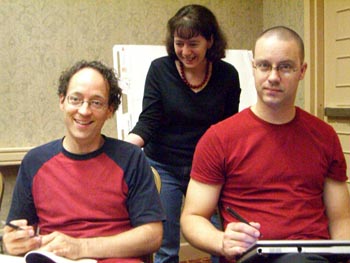
David Chang, Katy Stauber, and Matthew Bey. More pictures from ArmadilloCon 2011 are in my photo gallery.
David Chang and Paolo Bacigalupi hope that the tools and technology we have these days will make it possible for ordinary people to innovate solutions for post-fossil-fuel future. Bacigalupi has faith in people like a guy down the street from him, who is working on a biogas composter in his garage.
We could save lots of energy just by wasting it less, the audience points out. House builders used to (or still do) put the air conditioning unit in the attic, where it gets 150 degrees in summer. With energy costs rising, they might soon become smarter about that.
What is the next promising power source?
It is solar? Though it's commonly viewed as being cost-ineffective compared to coal, solar power costs about the same as coal, says Jayme Lynn Blaschke. The reason for discrepancy is that when those comparisons are made, commercial solar panels are lumped in with retail, and that drives their cost up. But there isn't such a thing as "retail" coal power.
Is it wind? Jayme was driving on Texas coast and saw four times as many wind turbines as last year. Matthew Bey said he knows a wind power entrepreneur -- a wind wildcatter, as it were -- who invests in this form of energy, and he's not doing it to make the planet green. This investor had a Whataburger franchise before he decided to make money off wind power. So anecdotal evidence shows that the good old free market is starting to see alternative energy as viable.
What are the promising modes of post-fossil-fuel transportation?
Could it be Shweeb, which David Chang describes as a human powered transportation system resembling a bicycle on tracks. You can go long distances on it, because there is little friction.
Could it be buses on stilts, or straddling buses, the kind that have been developed in China? (Here's a New York Times article on that.) While the buses don't do away with fossil-fuel (they are only partially solar-powered), their capacity to carry 40 times as many people as a regular bus should present significant energy savings.




 Posts
Posts


