Showing posts with label tom becker. Show all posts

Wednesday, August 24, 2005

The New Weird Movement in SF Literature: an ArmadilloCon 2005 panel

Panelists: Tom Becker, Damien Broderick, Lawrence Person, Faye Ringel, Charles Stross

Charles Stross says everyone in science fiction make a mistake of pining for a new movement. The panelists latch onto the word "movement" and run for a few minutes with scatological jokes. Lawrence Person: "When a genre's bowels get backed up you have to have a movement to clean them out." Once they got that out of their system (heh heh heh), they became a bit more serious, but they still were no closer to defining The New Weird. It's a somewhat narrower category or subgenre than slipstream and, according to Lawrence, even less useful.

Is it possible to define this uncategorizable category?

But the fact that the New Weird, as well as slipstream, catches the "uncategorizable" books, has an upside, according to Tom Becker. "The beauty of the New Weird is that bookstore owners don't know where to file it, so they put it on the table up front", says Becker and adds: "We'll see how it works with Charlie's posthumanist literature."

Lawrence, always one for snappy definitions, proposes that The New Weird is something that uses the genre tropes but doesn't worry which genre it's pulling its tropes from. SF, fantasy and horror are all prodigiously mixed together.

Which authors fall into the New Weird category?

Which authors fall into the New Weird category? Why, of course, China Mieville. Any others? Probably M. John Harrison. And maybe Mary Gentle. But I don't remember the panelists coming up with more examples of the New Weird authors, or at least any that had not been mentioned in the last year's panel on slipstream. Some of the panelists credited the start of the New Weird to Michael Moorcock, and it has to do something with the leftist leaning of the genre. Moorcock once wrote an essay where he criticized science fiction's fetishization with starships, troopers and their boots.

The worldview exemplified by the New Weird also runs counter to the traditional, "high" fantasy with its right wing themes of traditional values, going back to the past, deference to authority, etc. Charles Stross says fantasy is a literature of consolation. It works on restoration of balance in the world. Lost son of the king takes the kingdom back, that kind of thing. High fantasy's worldview is inimical to science, and that's why Stross doesn't like it. (He does write fantasy himself, though, but I'm pretty sure it's not "high" fantasy. And while I don't typically like this genre, a Stross fantasy must be quite an unusual animal, and I intend to read it.)

To that extent, what China Mieville is doing with fantasy very emphatically contradicts that consolation literature.
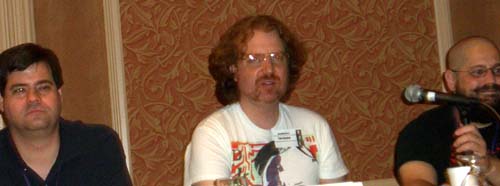
Left to right: Lawrence Person, Tom Becker, Charles Stross. Here are more posts from ArmadilloCon 2005.

Tuesday, August 23, 2005

Where did all good hard science fiction go? An ArmadilloCon 2005 panel

Panelists: David Lee Anderson, Kurt Baty, Tom Becker, Alexis Latner, Wil McCarthy

At least one of the usual suspects' opinion on the topic of hard SF hasn't changed since last year. Actually, more like in decades. Kurt Baty still thinks the best hard SF books out there are Neal Stephenson's "The Diamond Age" and Daniel Keys Moran's "The Long Run". And he tried hard to find other hard SF books worthy of those! Which for him, it appears, means books mostly on nanotechnology. He's just not finding any.

He's not impressed with, for example, Karl Schroeder, after reading "Ventus". "It's a novel about labeling. Every particle has a label! How exciting!" exclaims Kurt sarcastically. Tom Becker, though, urges him to give Schroeder's second book, "Permanence", a chance. He says Schroeder combines Digital Rights Management and micropayments with virtual reality and nanotechnology and gets interesting social effects.

Plot and characterization in a hard SF story offends some readers

The most amusing comments in the panel were made by Wil McCarthy. He says readers expectations are not as clear as they used to be. People who read SF read it for ideas and for plot, but not necessarily for characters or for language. Some other readers, in the contrary, people are actually offended by good, credible science. They just want magic! They are shocked by really innovative science fiction. For example, Greg Egan with his quantum mechanical themes offends them. The hard SF that they want should be about rayguns and spaceships!

Then there are readers who are turned off by the weak characterizations and the no-nonsense, journalistic language of classical hard SF. But other readers think that characterization, artful language or even a presense of plot ruins a hard SF story! To them, anything with a plot is trashy.

So, did the panelists find out where all the good hard SF went?

I'm afraid they did not. Instead, some of them, especially Wil McCarthy, made some sobering observations about the state of hard science fiction today. "The first thing that occurs to me is, just looking at the audience," he said, "is that the size of audience for this panel is the same as for a filk session. Even though this is a good size convention. Fans understand that hard SF is a good thing and hard to pull off, but it's not the same as enjoying hard SF. The novelty of hard SF is begining to wear off and people are looking for something else."

David Lee Anderson says one of the reasons of why hard SF was more popular a few decades ago than it is now was that back then the space program did a lot to inspire people's interest in science fiction. The space race gave people something to look forward to, he says, but the things have long ago slowed down. "The space station didn't get up there until about 20 years later," says David Lee Anderson. "This was disappointing ot me. I wanted things in my own lifetime that we could go visit in space."

Wil McCarthy thinks the (perceived?) loss of interest in hard science fiction is part of a larger trend of declining respect for science in America. "[A life of an academic scientist] in America is a crummy life," he says. "Scientists used to be respected. But that's no longer true. With a bachelor's degree you can make as much money as an engineer as with a PhD, and you can make it immediately.

And in academia it got really ugly. Back in the 80s they started saying "publish or perish"." As much aggravation as it caused to scientists, they are now nostalgic about that. "Nowadays it's "bring in grant money or perish". So our brilliant scientists are sitting writing grant proposals, while their science is being done by their graduate students. [Well, science was always done by the graduate students, but] we are squeezing our professors so hard, and a lot of smart people say, I don't want that life. I'll take a bachelor's degree and go work for a corporation."

Wil McCarthy does not feel optimistic about the state of hard science fiction today. Here are more posts from ArmadilloCon 2005.